How Much Matcha Per Cup? The Gram Guide for Every Drink


A level spoon and a heaped spoon are not the same dose.
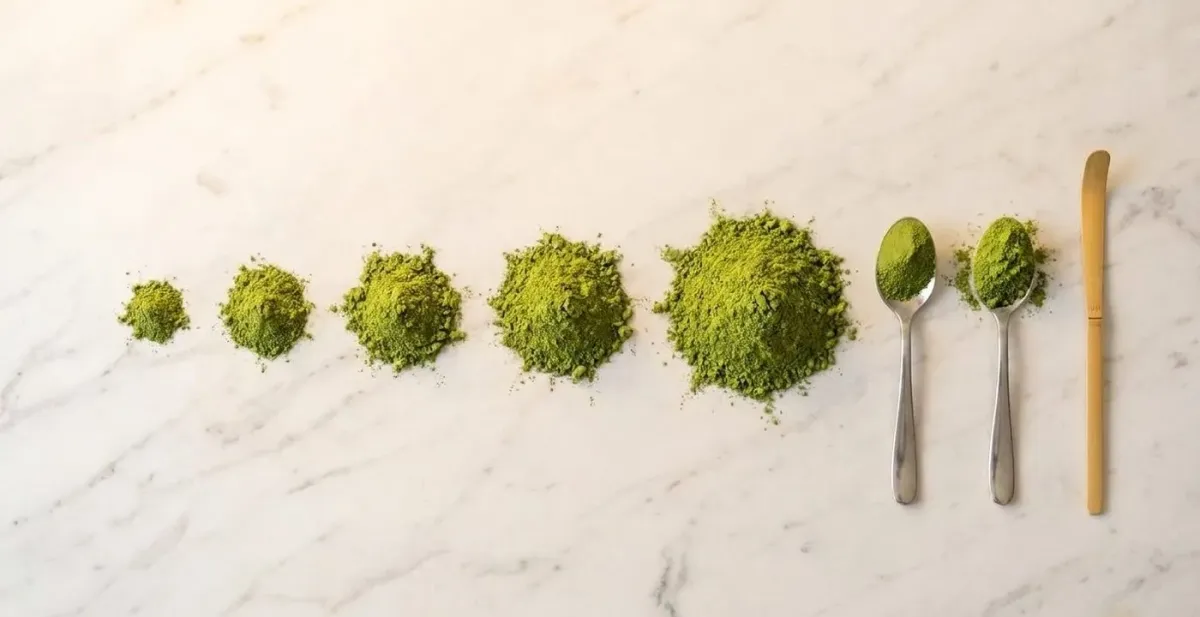
Table of Contents
Some of the links in this article are affiliate links, which help fund our independent review work at no extra cost to you. How we assessed these products is explained in this article and our Editor Lab methodology. No brand pays to appear, and no placement is guaranteed.
Use 2 g of matcha, about 1 level teaspoon, for a standard cup of thin matcha (usucha), whisked into 60 ml of water at 80°C. Use about 3 g for a latte, whisked into 100 ml of hot water before you add 100 ml of milk, and 4 g in 30 ml of water for thick matcha (koicha). Weigh your powder if you can, because a heaped teaspoon holds noticeably more than a level one.
Most home cups go wrong in one of two ways when you work out how much matcha per cup: a heaped spoon, or a mug where the recipe meant a small bowl.
Every dose here comes from the preparation specs that Japanese producers and UK tea companies publish, compared side by side and converted to grams and millilitres. The caffeine figures multiply a published per-gram range by each dose.
Editor's Note
I am a registered Nutritional Therapist and BANT member, trained at the College of Naturopathic Medicine in King's Cross. I have not tested these doses myself: each one comes from a producer's published preparation spec, and the caffeine figures are arithmetic on a published range. No powder is recommended on this page, so you can read the numbers without a sales pitch attached.
How Much Matcha Per Cup: The Short Answer
Pick your drink first, because the dose follows the drink. The table gives you the four doses that the Japanese tea producer Ippodo prints for its own recipes, in grams and millilitres.
| Drink | Matcha | Level teaspoons | Water | Milk | Source |
|---|---|---|---|---|---|
| Thin matcha (usucha) | 2 g | 1 | 60 ml at 80°C | None | Ippodo |
| Matcha latte | 3 g | 1.5 | 100 ml at 80°C | 100 ml | Ippodo |
| Thick matcha (koicha) | 4 g | 2 | 30 ml at 80°C | None | Ippodo |
| Iced matcha | 2 g | 1 | 60 ml at 80°C, then ice | None | Ippodo |
Notice how small a 'cup' is in this table. In matcha recipes a cup is a bowl of 60 to 80 ml, not a 240 ml mug, so a mug filled from a bowl recipe tastes thin and watery to you.
If your own number ends up a gram away from the table, you have not failed. Treat 2 g as a starting point, taste it, and move by half a gram until the cup suits you.
If you only remember one rule, remember the order: bowl 2 g, latte 3 g, koicha 4 g. The water changes with the drink as well, so follow the water column and not only the grams.
Keep your kettle at 80°C for every row. The full method, including sifting and whisking, sits in our guide on how to make matcha.
Matcha Per Cup by Drink Style
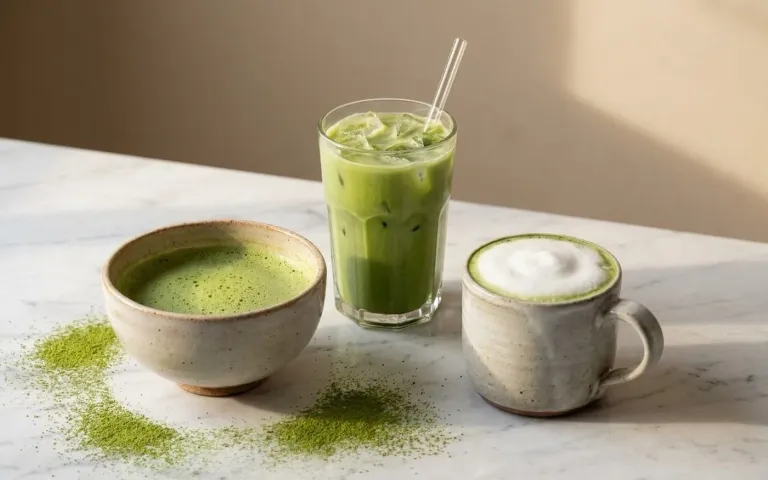
Every drink below follows the same order: dissolve the powder in a small amount of hot water first, then build the drink around that shot. You get the same dose each time, and the powder dissolves instead of floating in cold milk.
Usucha: Thin Matcha
Usucha is the everyday cup, and it is the answer most people want when they ask how much matcha per cup. Sift 2 g into a bowl, add 60 ml of water at 80°C, and whisk for 15 seconds, as Ippodo prints it. Nio Teas stretches the same 2 g to 80 ml of water, which gives you a weaker bowl.
Matcha Latte
Milk dilutes matcha, so your latte needs more powder than your bowl. Ippodo whisks 3 g into 100 ml of water at 80°C for 15 seconds and then adds 100 ml of milk. That is about 50% more powder than a cup of thin matcha, 3 g against 2 g.
Matcha Direct, a Kyoto producer, offers a lighter version: 2 g with 60 ml of hot water and about 140 ml of warmed milk. If you want it stronger, the same page says to raise the powder to around 4 g and keep the water-to-milk ratio unchanged. Our guide to the matcha latte covers the recipes around these doses.
Koicha: Thick Matcha
Koicha is matcha as a thick, small serving, and you use twice the powder of usucha in half the water. Ippodo sifts 4 g, which it describes as 3 heaping tea ladles or 2 level teaspoons, and adds 30 ml of water at 80°C. Matcha Direct gives the same 4 g with around 35 ml.
If you want to try it, our roundup of the best ceremonial grade matcha is the place to choose a powder.
Iced Matcha
Iced matcha keeps the usucha dose. Ippodo whisks 2 g into 60 ml of water at 80°C, then cools it rapidly with plenty of ice. You make the shot hot first, so the powder still dissolves properly.
Iced Matcha Latte
You do not need a separate gram figure for an iced latte, because the shot is the same as the hot latte: 3 g in 100 ml of hot water. Pour it over ice and milk instead of warm milk. Only the glass changes.
What the Producers Say: Specs Side by Side
If every guide you open gives a different number, you are reading the numbers correctly. They differ because the guides measure different things. The table prints each dose as the producer wrote it, then converts it to grams and millilitres where the source allows.
| Source | Drink | Dose as printed | Grams | Water | Milk | Fetched |
|---|---|---|---|---|---|---|
| Ippodo | Usucha | 2g (1.5 heaped tea ladles or 1 level teaspoon) | 2 g | 60 ml at 80°C | None | Nov 2026 |
| Ippodo | Latte | 3g (2 heaping tea ladles or 1.5 level teaspoons) | 3 g | 100 ml at 80°C | 100 ml | Nov 2026 |
| Ippodo | Koicha | 4g (3 heaping tea ladles or 2 level teaspoons) | 4 g | 30 ml at 80°C | None | Nov 2026 |
| Ippodo | Iced | 2g (1.5 heaping tea ladles or 1 level teaspoon) | 2 g | 60 ml at 80°C | Ice | Nov 2026 |
| Matcha Direct (Kyoto) | Usucha | approximately 0.07 ounces (2g) per cup | 2 g | 60 ml | None | Nov 2026 |
| Matcha Direct (Kyoto) | Koicha | 0.14 ounces or 4g | 4 g | Around 35 ml | None | Nov 2026 |
| Matcha Direct (Kyoto) | Latte | 2g of matcha | 2 g | 60 ml | About 140 ml | Nov 2026 |
| Nio Teas | Standard cup | 2 grams of matcha powder for 80ml of water | 2 g | 80 ml | None | Nov 2026 |
| Bird & Blend | Bowl or mug | 1 Perfect Matcha Spoon (half a teaspoon) | Not stated | Not stated, 80°C | None | Nov 2026 |
| Thistle & Sprig | Small 6 oz cup | 1/2 teaspoon (1 gram) | 1 g | 6 oz cup | None | Nov 2026 |
| Thistle & Sprig | 10 to 12 oz cup or latte | 1 teaspoon (2 grams) | 2 g | 10 to 12 oz cup | Latte | Nov 2026 |
| Three Leaf Tea | One serving | 1 tsp. per 8 oz of water, milk or milk substitute | Not stated | 8 oz | Optional | Nov 2026 |
| Soar Organics | Standard 8-ounce latte | 1 to 2 grams (approximately 1/2 to 1 teaspoon) | 1 to 2 g | Not stated | Latte | Nov 2026 |
Three things explain the spread you see. The cups are different sizes, from a 60 ml bowl to a 12 oz mug, and some producers print grams while others print teaspoons or ounces.
Several UK and US retailer guides also give one dose for every drink, whether you are making a bowl, a latte or a smoothie.
That last habit is where the weak latte comes from. Soar Organics gives 1 to 2 g for a standard 8-ounce latte, the same figure it gives for a bowl of usucha, while Ippodo uses 3 g for a latte with 200 ml of liquid. If you follow the lower figure, you get the thin, forgettable latte that home drinkers complain about.
Grams, Teaspoons and Scoops: Measuring 2 g Without Guessing
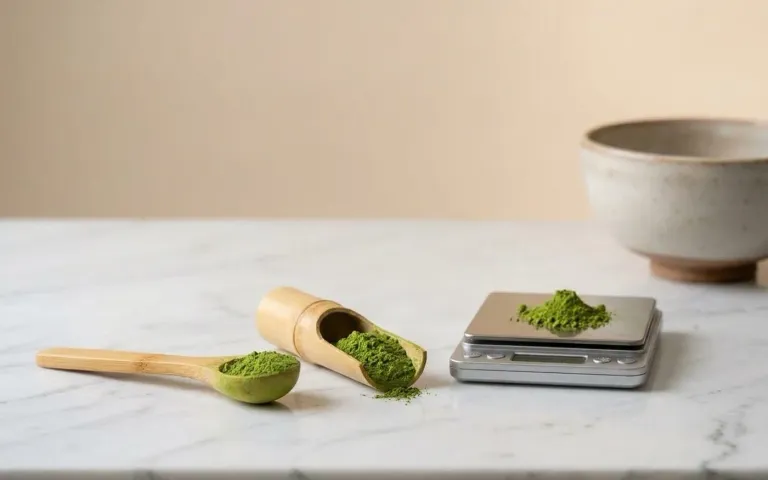
A kitchen scale that reads to 0.1 g is the most reliable way to measure matcha, because spoons vary. If you only have spoons, use a level one and run the back of a knife across the top.
Two records on the USDA FoodData Central database show how much your spoon holds. Branded record 2408471, an organic matcha powder, lists a 1 teaspoon serving as 2.0 g, and branded record 2398187, another organic matcha powder, lists a 1 tablespoon serving as 6.0 g. Two products are a small sample, so read the figures as a guide rather than a law.
Ippodo gives the same equivalents from the other direction, so you can check your spoon both ways. Its 2 g is 1.5 heaped tea ladles or 1 level teaspoon, and its 4 g is 3 heaping tea ladles or 2 level teaspoons. Thistle & Sprig puts half a teaspoon at about 1 g.
Here is the trap. Producers print level-teaspoon equivalents, so if you scoop a heaped teaspoon you are putting in more than the recipe intended. You will not taste a clean 2 g.
Try this once. Put a small bowl on the scale, tare it, and spoon powder in until the display reads 2.0 g, then note how full your spoon looks. You can repeat that level at the kettle without the scale.
You need very little to get this right:
- A kitchen scale reading to 0.1 g, or a level teaspoon
- A fine sieve, so the powder does not clump
- A bowl wide enough to whisk in
- A whisk or milk frother
Caffeine Per Cup at Each Dose
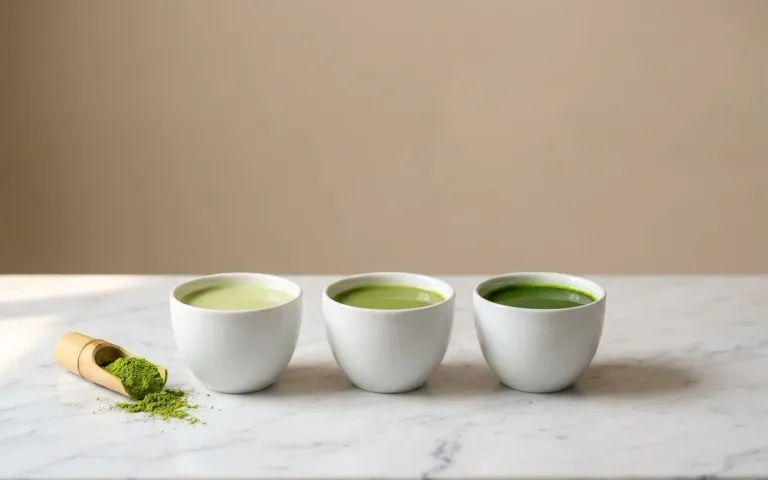
Every extra gram of matcha is also extra caffeine, so your dose is a caffeine decision as well as a taste one. A 2021 review in the journal Molecules put caffeine in matcha at between 18.9 and 44.4 mg per gram (Kochman et al. 2021). Multiplying that range by each dose gives you this table.
| Matcha dose | Caffeine range (calculation) | Typical use |
|---|---|---|
| 1 g | 19 to 44 mg | Small cup (Thistle & Sprig) |
| 2 g | 38 to 89 mg | Usucha, iced matcha |
| 3 g | 57 to 133 mg | Latte |
| 4 g | 76 to 178 mg | Koicha, stronger latte |
| 6 g | 113 to 266 mg | One level tablespoon |
Figures are grams multiplied by 18.9 to 44.4 mg per gram, rounded to whole milligrams. The range is wide because matcha varies, so our guide to caffeine in matcha goes deeper into why.
Here is a worked example. Two 4 g lattes at the top of the range carry 356 mg between them (a calculation, 2 x 178 mg), which uses most of a 400 mg day before you count a single coffee. At the bottom of the range the same two lattes carry 152 mg, so your daily total matters more than any one cup.
Now set those numbers against the guidance. The European Food Safety Authority says single doses of caffeine up to 200 mg, from all sources, do not raise safety concerns for healthy adults, and intakes up to 400 mg a day do not either, except in pregnancy (EFSA). For pregnancy, the NHS says you should not have more than 200 mg of caffeine a day.
The useful habit from nutritional therapy is to count caffeine as a running daily total. Add your matcha to your morning coffee, because a mug of coffee varies as widely as matcha does, as our guide to how much caffeine in coffee shows. For the daily total, read how much matcha per day, and if you are pregnant, ask your GP or midwife.
Why Your Cup Tastes Weak or Bitter: Fix the Dose First
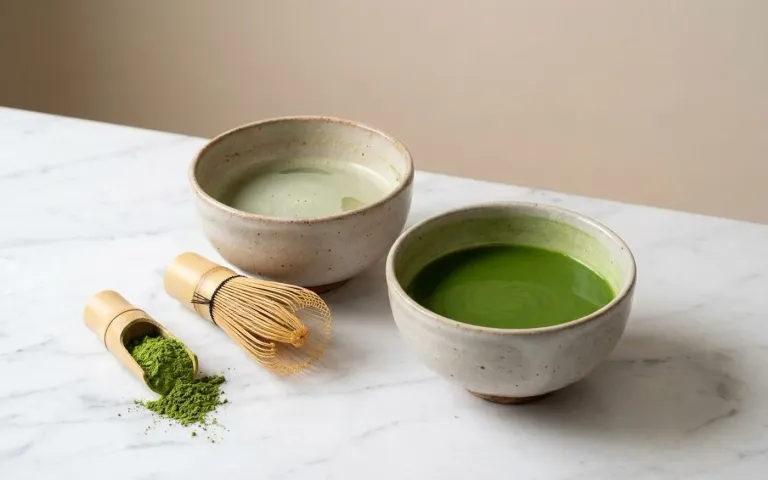
If your cup tastes weak, the powder is rarely the problem. A 2 g dose in a mug-sized cup is spread too thin, so you fix the water volume first and add powder second.
Cut the water back toward 60 ml, or make a 2 to 3 g shot in 60 ml and top it up with hot water or milk until your cup tastes right. If it is still weak, add 0.5 to 1 g and taste again. That is more reliable than jumping to a tablespoon, which puts roughly three standard cups of powder in one drink.
If your cup tastes bitter, look at the temperature and the dose together. Both Ippodo and Bird & Blend specify 80°C, not boiling water, so let the kettle settle before you pour. Too much powder for the water can also push a cup toward bitter, so check your spoon is level.
| What you notice | Likely cause | Your first fix |
|---|---|---|
| Weak, thin flavour | Too much water for the dose, or a mug-sized cup | Cut the water toward 60 ml, or make a shot and top up |
| Still weak after that | Dose too low for the drink | Add 0.5 to 1 g |
| Weak latte | A bowl-sized dose in a milky drink | Use 3 g in 100 ml of water, then add 100 ml of milk |
| Bitter | Water hotter than 80°C, or too much powder for the water | Let the kettle settle and level your spoon |
You do not need a perfect bowl every morning. Change one thing at a time, taste, and keep the version you like.
How Far a Tin Goes
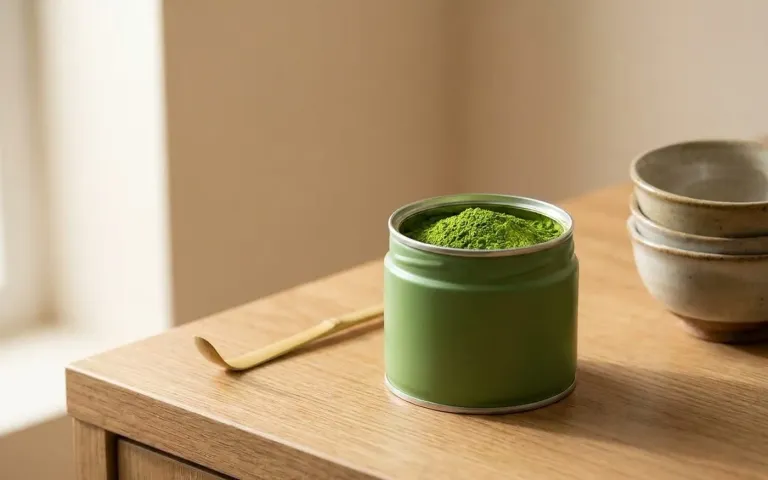
Bigger doses empty your tin faster, and it helps to see the arithmetic. Take a 30 g tin as a worked example, and divide it by the dose.
| Dose | Drink | Cups from a 30 g tin (calculation) |
|---|---|---|
| 2 g | Usucha or iced matcha | 15 |
| 3 g | Latte | 10 |
| 4 g | Koicha or stronger latte | 7 |
| 6 g | One level tablespoon | 5 |
The 4 g row is 7.5 cups, rounded down to 7 whole drinks. If you drink a tablespoon a day, your tin lasts five days.
A heaped spoon drains your tin the same way. If you scoop 3 g when you meant 2 g, a 30 g tin gives you 10 cups instead of 15, so you lose five.
None of this means you should under-dose. It means that once you know your number, you can work out your tin, and see whether a stronger cup is worth the extra powder. When it is time to choose the next tin, our guide to the best matcha brands is the place to start.
Scaling to a UK Mug: How Much Matcha for a Bigger Cup
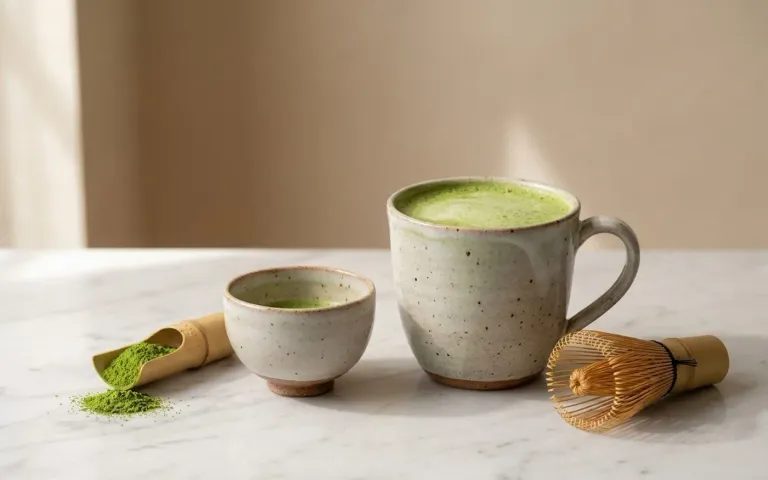
Take a 240 ml mug as the example, and the recipes you have seen so far were written for bowls of 60 to 80 ml. To scale up, start from Nio Teas' strength baseline of 2 g per 80 ml and multiply.
| Water | Matcha at that strength (calculation) | Caffeine range (calculation) |
|---|---|---|
| 80 ml | 2 g | 38 to 89 mg |
| 160 ml | 4 g | 76 to 178 mg |
| 240 ml | 6 g | 113 to 266 mg |
This is the catch for your mug. A 240 ml mug at bowl strength takes 6 g, which is a tablespoon, and it can carry up to about 266 mg of caffeine, above EFSA's 200 mg single-dose figure at the top of the range.
You have a better route. Make a 2 to 3 g shot in 60 ml of water at 80°C, then top it up with hot water or milk to fill your mug. You get a mug-sized drink, a milder flavour, and a dose you can count.
Whatever route you choose, protect the ratio. The baseline is 2 g to 80 ml, and every extra gram of powder in your cup should come with extra water, not instead of it. If a full mug feels like too much, the 160 ml row is a middle step at 4 g.
Does Matcha Grade Change How Much You Use?
The producers' doses in this guide are for their drinking matcha, the powder they sell to be whisked into water. Latte-grade powders are made to be used with milk, so a pack's own instructions are worth reading before you apply a table from another producer.
Do not assume your pricier tin needs a different number of grams. This guide gives no grade-specific dose or caffeine figure, because the sources checked do not support one. Our comparison of ceremonial vs culinary matcha explains how the labels differ, and our explainer on matcha grades goes further.
Start with the producer's dose for your drink, taste it, and adjust by half a gram. That is a better test than the label.
If your pack prints its own dose, follow it for that tin and compare it with the specs table. A gap of a gram is normal, given the spread above, while a gap of four grams is a prompt to check the units.
Matcha Dose Reference Tables
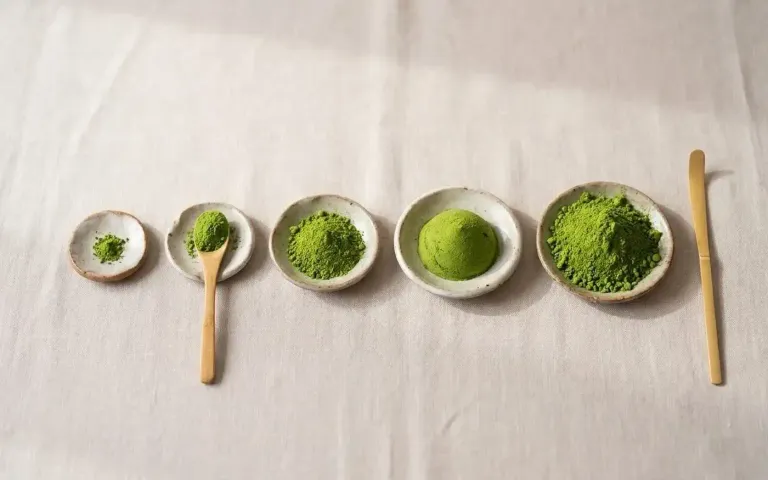
Keep this section for your kettle. The first table converts between grams, spoons and ounces, and the second repeats the producer specs compactly.
| Grams | Level teaspoons | Ounces | Typical use |
|---|---|---|---|
| 1 g | Half a teaspoon | Not stated | Small 6 oz cup (Thistle & Sprig) |
| 2 g | 1 | 0.07 oz | Usucha, iced matcha |
| 3 g | 1.5 | 0.11 oz | Latte |
| 4 g | 2 | 0.14 oz | Koicha, stronger latte |
| 6 g | 3 (1 level tablespoon) | Not stated | Mug at bowl strength |
| Producer | Usucha | Latte | Koicha | Fetched |
|---|---|---|---|---|
| Ippodo | 2 g in 60 ml | 3 g in 100 ml, 100 ml milk | 4 g in 30 ml | 4 Nov 2026 |
| Matcha Direct (Kyoto) | 2 g in 60 ml | 2 g in 60 ml, about 140 ml milk | 4 g in around 35 ml | 4 Nov 2026 |
| Nio Teas | 2 g in 80 ml | Not stated | Not stated | 4 Nov 2026 |
Producer specs checked November 2026.
Frequently Asked Questions
How much matcha powder for 1 cup?
Use 2 g, about one level teaspoon, whisked into 60 ml of water at 80°C for a standard cup of thin matcha, per Ippodo. Use about 3 g for a latte and 4 g for thick koicha. Weigh the powder if you can, because a heaped spoon holds more than a level one.
How much is 2 grams of matcha powder?
About one level teaspoon. USDA FoodData Central lists a 1-teaspoon serving of matcha powder as 2 g, and Ippodo describes 2 g as 1.5 heaped tea ladles or 1 level teaspoon. A heaped spoon holds more, so weigh it if you can.
Is 1 tablespoon of matcha too much?
For one drink it is a lot. A tablespoon is about 6 g, three times a standard cup, and carries roughly 113 to 266 mg of caffeine. The top of that range is above EFSA's 200 mg single-dose figure for healthy adults, so you are better off with 2 to 4 g.
What equipment do I need for matcha?
You need a level teaspoon or a kitchen scale, a fine sieve, a bowl and a whisk or milk frother. A bamboo matcha whisk and a wide matcha bowl make the best foam but are optional. A matcha starter kit bundles the basics if you want them in one box.
How does matcha compare to coffee?
Per cup, 2 g of matcha has about 38 to 89 mg of caffeine, and a stronger 4 g latte about 76 to 178 mg. Both sit in the range of a typical mug of coffee, so the dose in your cup matters more than the drink's name. Our guide to matcha vs coffee compares them in full.
What is the 30/20/10 rule for matcha?
None of the producer or retailer preparation guides checked for this article publishes a '30/20/10 rule'. Use the producer specs instead: 2 g in 60 ml for a standard cup, about 3 g for a latte, and 4 g in 30 ml for koicha, at about 80°C, then adjust to your taste.
How many grams of matcha for a latte?
About 3 g, whisked into 100 ml of 80°C water and topped with 100 ml of milk, per Ippodo. For a milder latte, Matcha Direct uses 2 g with 60 ml of water and about 140 ml of milk. If you want it stronger, go up half a gram at a time.
How many teaspoons of matcha per cup?
One level teaspoon, about 2 g, makes your standard cup of thin matcha, and two level teaspoons, about 4 g, make koicha. Ippodo's latte uses 1.5 level teaspoons, which is 3 g. Level the spoon each time, because a heaped teaspoon puts you above the recipe.
How much matcha per cup of milk?
Ippodo pairs 3 g with 100 ml of milk after a 100 ml hot-water shot, and Matcha Direct pairs 2 g with about 140 ml of milk. Make the shot in water first so the powder dissolves, then add your milk. Scale the shot if you use a bigger cup.
How many cups does a 30 g tin of matcha make?
About 15 standard cups at 2 g, 10 lattes at 3 g, or 7 drinks at 4 g. At a tablespoon, about 6 g, a 30 g tin makes 5 drinks. These are calculations, so your count shifts if your spoon is heaped or your dose changes.

A registered Nutritional Therapist and member of BANT, Clemmie blends science with a holistic approach to wellbeing.