Matcha vs Coffee: Caffeine, Energy and Focus Fully Compared
Matcha and coffee deliver caffeine differently - one is calmer, one is faster. Here is how to choose.
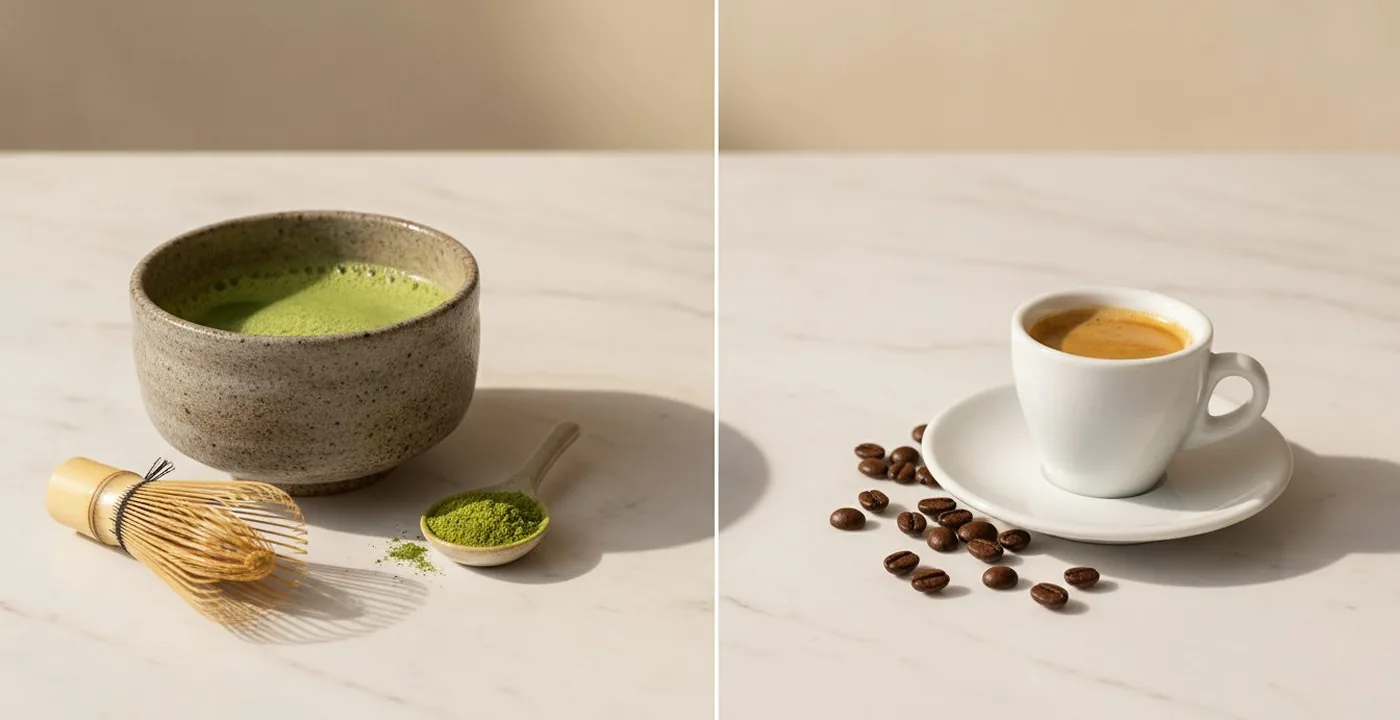
Table of Contents
Some of the links in this article are affiliate links, which help fund our independent review work at no extra cost to you. Every recommendation is based on hands-on testing through The Editor Lab methodology. No brand pays to appear, and no placement is guaranteed.
A standard cup of matcha contains roughly 30 to 70mg of caffeine. A standard cup of coffee contains roughly 80 to 140mg. That gap is the starting point for everything that follows in the matcha vs coffee debate - but the numbers alone do not tell the full story.
The reason matcha feels different from coffee is not simply that it contains less caffeine. Matcha delivers that caffeine alongside L-theanine, an amino acid that modulates how the caffeine is absorbed and experienced. The result is a different quality of energy, not just a different quantity.
Snita Pandoria is a food writer whose work spans over a decade of London dining and thirty-plus countries. She is Head of Editorial at Balance Journal and has spent the past year personally testing matcha brands across ceremonial and culinary grades, including Ritual & Flow Matcha, Bird & Blend Matcha, and Jade Leaf Matcha.
The Short Answer
Matcha and coffee are both caffeinated beverages worth drinking - they deliver their caffeine differently.
Matcha gives you roughly half the caffeine of a standard coffee, but pairs it with L-theanine. That combination tends to produce what researchers call a calm-alert state: focused and clear without the jitteriness or sharp drop that some people associate with coffee. The energy onset is slower and the duration is longer.
Coffee gives you a stronger, faster caffeine hit. For many people that is exactly what the morning requires. The downside for those who are caffeine-sensitive is a higher likelihood of jitters, a faster cortisol spike, and a more pronounced crash as the caffeine clears.
Neither is better in an absolute sense. The right choice depends on what you are trying to achieve, how you respond to caffeine, and - honestly - what you enjoy drinking.
At a Glance: Matcha vs Coffee Compared
| Attribute | Matcha (per standard serving) | Coffee (per standard serving) |
|---|---|---|
| Caffeine content | 30-70mg | 80-140mg |
| L-theanine | Yes (natural, significant) | No |
| Energy onset | 30-45 minutes | 15-30 minutes |
| Energy duration | 4-6 hours | 3-5 hours |
| Jitters risk | Low (for most people) | Moderate to high (caffeine-sensitive individuals) |
| Antioxidants | High (EGCG, catechins) | Present (chlorogenic acids, polyphenols) |
| Taste profile | Grassy, slightly sweet, umami | Bitter, roasted, variable by origin |
| Prep effort | Medium (whisk method, temperature matters) | Low to medium (machine or cafetiere) |
| Cost per serving | £0.40-£1.50 (ceremonial grade) | £0.20-£0.80 (quality ground coffee) |
Sources: Caffeine figures from the European Food Safety Authority (EFSA) caffeine safety opinion; NHS caffeine guidance; Journal of Nutritional Biochemistry (matcha caffeine and L-theanine content analysis).
Caffeine and Energy Compared
The caffeine figures above are averages, and it is worth understanding why the ranges are wide.
For matcha, the caffeine content varies significantly by grade and preparation. Ceremonial grade matcha, made from the youngest leaves of shaded tea plants, tends to sit at the higher end of the 30 to 70mg range. Culinary grade, used in lattes and baked goods, often delivers less per serving. How much powder you use matters: a standard Japanese serving uses 1 to 2g of matcha per cup; many UK cafe preparations use more.
For coffee, the variation is even wider. A double espresso typically delivers 60 to 120mg of caffeine. A large filter coffee from a chain can reach 200 to 300mg. The EFSA guidance on caffeine safety (400mg per day for healthy adults) applies to your total intake from all sources, including matcha, tea, soft drinks, and chocolate.
The practical difference most people notice is not in the number but in the experience. Coffee caffeine tends to arrive faster - you feel the lift within 15 to 30 minutes. Matcha's onset is slower, typically 30 to 45 minutes, partly because the L-theanine and other compounds in the whole-leaf powder affect absorption.
One thing worth flagging for anyone switching from coffee to matcha: the first week often feels flat. If you have been drinking two or three coffees per day and you replace all of them with matcha, you will likely feel under-caffeinated. That is not the matcha failing to work. It is your body adjusting from a higher baseline. Most people find the sensation normalises within five to seven days.
Focus and the L-Theanine Effect
L-theanine is the most cited reason to choose matcha over coffee, and the research behind it is more solid than most supplement-adjacent claims.
A 2008 study published in Nutritional Neuroscience found that the combination of L-theanine and caffeine improved both speed and accuracy on attention-switching tasks compared to caffeine alone. A 2021 review in Nutrients examining the synergistic effects of L-theanine and caffeine on cognition concluded that the pairing consistently outperformed caffeine alone on measures of sustained attention and working memory.
The mechanism is that L-theanine promotes alpha-wave activity in the brain - the same brainwave state associated with relaxed alertness - while caffeine simultaneously increases dopamine and norepinephrine activity. The result is that the stimulating effect of caffeine is present, but the anxiety and racing quality that some people experience from caffeine alone is attenuated.
In practice, this tends to mean a longer, smoother focus window with less of the sharp spike-and-crash pattern. It is a different kind of productive than coffee - better for sustained concentration work than for needing to be sharp in the next 20 minutes.
Having tested ceremonial matcha from over a dozen brands - including Ritual & Flow, Bird & Blend, and Jade Leaf - the calm focus is noticeably different from the post-coffee spike. The absence of the jittery edge is not a placebo; it is consistent across grades and preparation methods.
Which Is Better for Anxiety and Jitters?
For anyone who finds coffee triggers anxiety, restlessness, or a racing heartbeat, matcha is generally the more manageable option. But it is not entirely consequence-free.
Matcha still contains caffeine. If you are highly caffeine-sensitive - the kind of person who gets palpitations from a single espresso - matcha will reduce (not eliminate) that problem. Two or three servings of matcha can deliver the same total caffeine as one strong coffee. Quantity matters.
The cortisol question is worth addressing directly, because it appears frequently in matcha-adjacent wellness content. L-theanine has been linked to reduced acute stress response in several studies, including a 2019 randomised controlled trial in Nutrients that found L-theanine supplementation reduced self-reported stress and salivary cortisol in participants under experimental stress conditions. However, the leap from "L-theanine reduces stress response in a lab setting" to "matcha lowers your cortisol" is larger than many wellness articles acknowledge. The honest position is that matcha's L-theanine may help moderate the cortisol spike that caffeine can trigger - but matcha is not a cortisol-lowering supplement.
If you are dealing with clinical anxiety, neither matcha nor coffee is a treatment. Both affect the central nervous system and both warrant discussion with your GP if you are managing anxiety with medication or therapy.
For the majority of people who are simply getting jittery on three coffees a day and wondering whether to switch, matcha is a reasonable experiment. Start with one morning serving and see how your body responds before making a full switch.
Health and Antioxidants
Antioxidants are where the two beverages stop sharing a story. They deliver different types.
Matcha is notably high in EGCG (epigallocatechin gallate), a catechin found in green tea. Because matcha is a whole-leaf powder rather than a steeped infusion, you consume the entire leaf and get a higher concentration of EGCG per cup than from loose-leaf green tea. EGCG has been studied for its anti-inflammatory properties and potential role in metabolic health, with a body of research summarised in reviews published on PubMed.
The evidence on EGCG and fat oxidation is real but modest. Several studies, including a 2009 meta-analysis in the International Journal of Obesity, found that green tea catechins combined with caffeine produced a small but statistically significant effect on body weight and fat mass. This is where claims that matcha "burns belly fat" originate. The honest translation: EGCG may support fat metabolism when combined with exercise. Matcha is not a fat-burner as a standalone intervention.
Coffee's antioxidant profile is different. It is one of the largest single sources of polyphenols in the UK diet, primarily chlorogenic acids. Regular coffee consumption has been associated in large observational studies with reduced risk of type 2 diabetes, liver disease, and certain neurodegenerative conditions. The NHS acknowledges that moderate coffee consumption (around three to four cups per day) is not harmful for most adults and may have benefits.
Neither beverage needs to "win" on the antioxidant question. The better framing is: which do you drink consistently? The antioxidants in a drink you enjoy and consume daily will do more for you than those in a drink you force yourself through.
One genuine caution for matcha: both tea and coffee can inhibit non-heme iron absorption when consumed close to meals. If you follow a plant-based diet and rely on non-heme iron from food (lentils, spinach, tofu), it is worth keeping a gap of at least an hour between your matcha or coffee and your main meals.
Which Should You Choose?
What you want from a morning drink determines which of these wins for you.
Choose matcha if: you are getting anxious or jittery on your current coffee intake; you want a longer, smoother focus window for sustained desk work; you are interested in the EGCG antioxidant profile; or you simply want to reduce your caffeine intake without going caffeine-free.
Choose coffee if: you need a strong, fast energy hit - early mornings, pre-workout, long drives; you enjoy the taste and ritual of coffee and are not experiencing negative effects; or your caffeine tolerance is high and matcha simply does not deliver enough.
A rotation approach is worth considering. Many people who switch to matcha find the best outcome is not an either/or replacement but a natural rotation: coffee in the morning for the stronger hit when the day is starting, matcha in the early afternoon when they want sustained focus without the sleep disruption of a late coffee. This also keeps total daily caffeine within the EFSA's recommended 400mg ceiling without requiring either beverage to carry the whole load.
If you are interested in a third option for the caffeine-without-jitters brief - particularly if you are looking to reduce overall caffeine while keeping a functional morning drink - it is worth reading about lions mane coffee, which is increasingly used by people rotating off high-caffeine coffee for the morning slot.
Balance Journal is published alongside Balance Coffee, founded by James Bellis.
Frequently Asked Questions
Is matcha actually healthier than coffee?
Both have distinct, well-evidenced benefits. Matcha's edge is L-theanine (which modifies how caffeine is experienced) and a concentrated dose of EGCG catechins from the whole-leaf powder. Coffee's edge is a stronger polyphenol profile from chlorogenic acids and a more established body of large-cohort research on long-term health. Neither is categorically healthier - the one you consume consistently without negative side effects wins.
Is it good to drink matcha every day?
Yes, for most healthy adults. A single serving contributes 30 to 70mg of caffeine toward the EFSA's 400mg daily ceiling, leaving ample room. Matcha adds to your daily caffeine budget rather than replacing it - if you are also drinking tea or soft drinks, total caffeine adds up. Those managing iron deficiency should keep matcha away from mealtimes, as it can inhibit non-heme iron absorption.
Does matcha lower cortisol?
L-theanine has been linked to a reduced acute stress response in controlled studies, including a 2019 randomised trial in Nutrients measuring salivary cortisol under experimental stress. The evidence does not support the claim that matcha lowers baseline cortisol over time. The accurate framing is that L-theanine may moderate the cortisol spike that caffeine triggers - giving matcha a gentler stress profile than coffee, not a cortisol-lowering effect independently.
Is there a downside to drinking matcha?
Yes. Matcha still contains caffeine - it is not suitable for anyone who needs to avoid caffeine entirely. It inhibits non-heme iron absorption when consumed close to meals, which is relevant on a plant-based diet. Quality and price variance between ceremonial and culinary grades is significant, and low-quality matcha tastes noticeably worse. Preparation requires more effort than instant coffee, and the grassy flavour is an acquired taste.
Does matcha burn belly fat?
EGCG has been studied for modest fat-oxidation effects. A 2009 meta-analysis in the International Journal of Obesity found green tea catechins with caffeine produced a small but significant improvement in fat oxidation and body weight compared to caffeine alone. EGCG may support fat metabolism as part of an exercise routine. Matcha on its own, without changes to diet or activity, is unlikely to produce meaningful body composition changes.
Why is Gen Z obsessed with matcha?
Several factors converged. The vivid green colour made matcha native to social media aesthetics. The wellness framing around calm, jitter-free energy appealed to a generation more alert to mental health. Speciality coffee culture made quality-driven drinks mainstream, and matcha fitted that category. The latte format - matcha with oat milk and a little sweetener - made it accessible to people who find straight espresso too harsh.
Does matcha have more caffeine than coffee?
Per standard serving, no. Matcha delivers 30 to 70mg per cup versus 80 to 140mg for coffee. Gram for gram, matcha powder is more caffeine-dense (around 35mg per gram versus 10 to 12mg per gram of coffee grounds). But a standard matcha serving uses 1 to 2g of powder while coffee uses 7 to 20g of grounds, so the brewed cup delivers considerably more caffeine from coffee.
Is matcha or coffee better for focus?
They produce different kinds of focus. Matcha's L-theanine and caffeine pairing gives a smoother, longer sustained focus - better for extended concentration tasks like writing or analytical work. Coffee gives a stronger, faster focus spike useful for immediate alertness over a shorter window. Research in Nutritional Neuroscience (2008) found the L-theanine and caffeine combination improved sustained attention and accuracy compared to caffeine alone. The right choice depends on the task.
A seasoned food and lifestyle writer with over a decade in London's hospitality scene, Snita explores the culture of dining, drink, and connection.