Reishi benefits graded by a nutritional therapist: what human trials show for immunity, fatigue and sleep, which claims failed, and who should avoid it.
You have probably heard that reishi calms stress, helps sleep, and supports immunity. The honest list of reishi benefits is much shorter: the best human evidence covers fatigue and people having cancer treatment, the blood sugar and cholesterol trials failed, sleep and stress rest on tradition, and the UK authorises no reishi health claim.
Reishi (Ganoderma lucidum, also called lingzhi) has limited human evidence: small, low-quality trials in cancer patients found modest rises in immune cell counts and better quality of life, and one 132-person trial found less fatigue. Trials testing blood sugar, cholesterol and blood pressure found no benefit over placebo, and no reishi health claim is authorised in the UK.
I went into this review expecting a stronger case than I found. I reviewed every claim and graded it by study type and population, keeping human trials apart from animal and cell work, using Cochrane reviews and PubMed abstracts checked in October 2026. As a nutritional therapist with a dipNT from the College of Naturopathic Medicine, I would rather you know exactly how thin a claim is than buy a bottle on a hunch, and the best mushroom supplements in the UK guide covers the buying side once you have decided.
Editor's Note
I am a registered Nutritional Therapist and BANT member, and I received CNM's Nutrition Academic Excellence Award in 2019. Reishi is a YMYL topic, so each claim below is graded Limited, Not Supported, or Animal-Only, and I name the population studied every time. Reishi is not a treatment for any disease, and nothing here replaces the advice of your GP or your care team.
Reishi Benefits at a Glance: The Evidence Grade for Each Claim
Here is the whole picture in one table, before the detail. Read the Who Was Studied column first, because that is where most reishi claims quietly fall apart for you.
Claim
Best evidence
Who was studied
Result
Grade
Immune markers
Cochrane review, 2016 (five RCTs)
People with cancer
Small rises in CD3, CD4 and CD8 cell percentages
Limited
Quality of life alongside cancer treatment
Cochrane review, 2016
People with cancer
Four of five trials found better quality of life; methods low quality
Limited
Fatigue
Tang 2005 RCT; Zhao 2012 pilot
Neurasthenia; breast cancer on endocrine therapy
Less fatigue than placebo in the larger trial
Limited
Sleep
No human sleep trial located
None
No human result
Animal-Only
Stress and anxiety
Zhao 2012 (secondary outcome only)
Breast cancer patients
Less anxiety in a 48-person pilot
Limited
Blood sugar
Klupp 2015 and 2016
Type 2 diabetes
No effect on HbA1c or fasting glucose
Not Supported
Cholesterol and blood pressure
Klupp 2015 Cochrane review
Type 2 diabetes
No meaningful change
Not Supported
Antioxidant effect
Wachtel-Galor 2004
10 healthy adults
Small rise after one dose; 10-day changes not significant
Limited
You will notice no row says "Strong". That is the finding.
The Great Britain nutrition and health claims register lists no authorised health claim for reishi. That includes the ones printed on many UK product pages. A brand can describe what a study found, but it cannot tell you reishi "boosts immunity" or "promotes sleep" as fact, and neither will I.
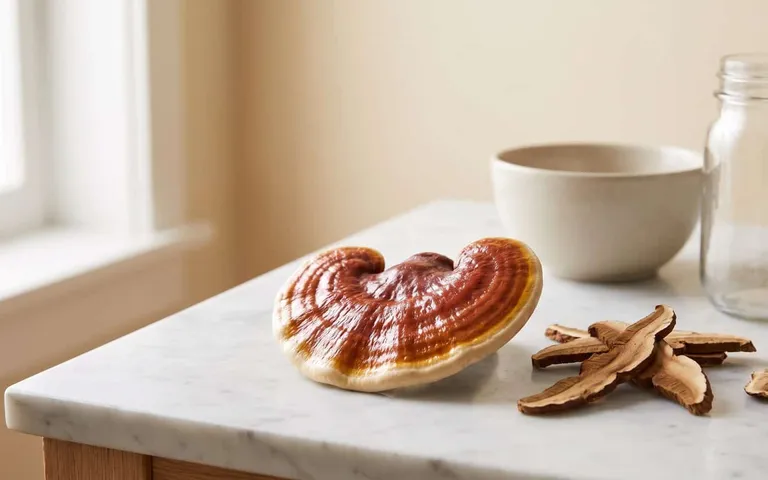
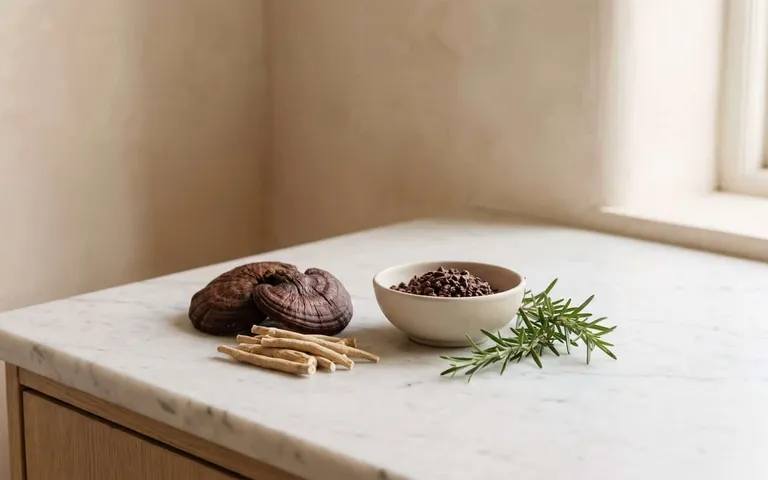
Reishi (Ganoderma lucidum) is used whole or as dried slices.
Immune Support: What the Cancer-Patient Trials Show
If you are hoping reishi will "boost" your immune system, this is the section the claim comes from, and it is more modest than the label. The strongest source is a 2016 Cochrane review of reishi in cancer treatment. It pooled five randomised trials, and the authors called the methodological quality "generally unsatisfying".
In those trials, people given reishi alongside chemotherapy or radiotherapy were more likely to respond positively than people given the conventional treatment alone (RR 1.50, 95% CI 0.90 to 2.51, P = 0.02). Immune markers rose: CD3, CD4 and CD8 cell percentages went up by 3.91%, 3.05% and 2.02%. Four of the five studies found relatively better quality of life, which matters if you are living with treatment side effects.
Here is what I want you to take from that. These are immune cell counts in people with cancer, not fewer colds in healthy adults. Nobody has shown that a small rise in a lab marker means you will fall ill less often.
The review's own conclusion is plain. It "did not find sufficient evidence to justify the use of G. lucidum as a first-line treatment for cancer".
Reishi is not a cancer treatment. If you are having treatment, speak to your oncology team before you take it, because some reishi products interact with chemotherapy and may affect tumour marker tests. Memorial Sloan Kettering Cancer Center notes raised CA72-4 readings in gastrointestinal cancer patients taking spore supplements.
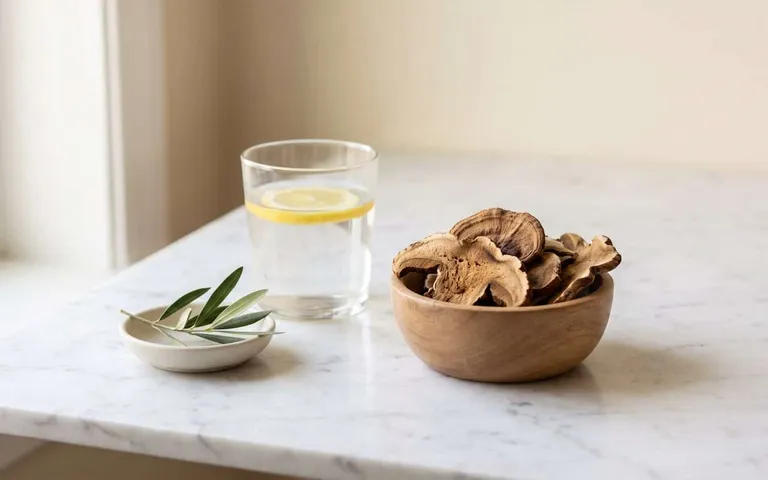
Dried reishi slices are typically simmered or extracted before use.
Fatigue and Wellbeing: The One Positive RCT
If tiredness is why you are reading, this is the most encouraging evidence on the page, with some real limits attached. A 2005 trial by Tang and colleagues in the Journal of Medicinal Food enrolled 132 people with neurasthenia, a condition marked by persistent exhaustion. They took 1,800 mg of a reishi polysaccharide extract three times daily for eight weeks.
Fatigue scores fell by 28.3% on reishi against 20.1% on placebo. More people on reishi counted as more than minimally improved: 51.6% (32 of 62) against 24.6% (15 of 61), P = .002. The extract was well tolerated.
If you wonder about people already in treatment, a smaller 2012 pilot of reishi spore powder in breast cancer patients by Zhao and colleagues gave reishi spore powder for four weeks to 48 breast cancer patients on endocrine therapy and struggling with cancer-related fatigue. Their physical wellbeing and fatigue scores improved, anxiety and depression were lower, and there were no serious adverse effects. It is a pilot, so you should treat it as a signal and not a result.
A 2024 survey of 1,374 Chinese cancer patients and survivors found that most commonly reported benefits were less fatigue, depression, nausea, and poor appetite. That cancer-patient survey is self-report, not a trial, so nobody can say reishi caused the improvement you might read about.
Every one of these studies used a specific group. If you are a healthy adult with a busy week and a flat afternoon, nobody has tested reishi on you, and that is fine to admit.
Sleep and Stress: What Is Actually Known
You may have picked up reishi hoping for calmer evenings, and that hope is exactly where the marketing is loudest. I searched PubMed and Cochrane this month and located no human trial with sleep as its main outcome. The calming reputation comes from traditional Chinese medicine and laboratory work, not from sleep studies in people.
The stress evidence is thinner still, so you should not expect much. The only human signal is anxiety as a secondary outcome in that 48-person breast cancer pilot, which is not a stress trial.
People do report back. Some say reishi gives them calmer evenings, and others say it left them with fatigue or brain fog. Both reports are anecdotes, and neither tells you what will happen to you.
Some readers ask whether reishi acts like a benzodiazepine, because of a claim about GABA that circulates online. I found no human evidence of that mechanism, and none showing dependence either, so you cannot lean on it either way. That absence is not proof of safety, and it is not proof of a sedative effect.
You are not failing if sleep is hard and a mushroom has not fixed it. Reishi has no proven sleep benefit to fall short of.
Reishi is often taken as part of an evening wind-down routine.
Blood Sugar, Cholesterol, and Heart Health: Tested and Not Supported
This is the section most pages skip, and if you manage blood sugar or cholesterol, it matters most. Reishi has been tested for both, and the results were negative.
If you manage blood sugar, start with the biggest source. A 2015 Cochrane review on reishi and cardiovascular risk factors pooled five trials with 398 participants. It found no clinically meaningful drop in HbA1c (a measure of average blood sugar over three months), total cholesterol, LDL cholesterol or BMI, and no significant difference for blood pressure or triglycerides. The authors concluded the evidence "does not support the use of G lucidum for treatment of cardiovascular risk factors in people with type 2 diabetes mellitus".
A larger trial then tested it directly. In 2016, Klupp and colleagues published a randomised trial in Scientific Reports of 84 people with type 2 diabetes and metabolic syndrome. They took 3 g a day for 16 weeks, and there was no effect on HbA1c (p = 0.60), fasting glucose (p = 0.95), or any secondary outcome.
You may also see fibromyalgia mentioned. A 2021 double-blind pilot in women with fibromyalgia by Pazzi and colleagues used 6 g a day of reishi fruiting body for six weeks against carob flour. It found no significant differences in glucose, cholesterol, triglycerides, body composition or blood pressure.
If you take medication for diabetes or blood pressure, please do not swap it for reishi. The trials above say it will not do that job.
The follow-up should temper your expectations. After 10 days at 0.72 g a day, antioxidant enzyme activity rose without reaching significance, and plasma lipids "tended to decrease, but changes were not statistically significant".
A short-lived blip in a blood test in 10 people is not the same as protecting your cells over years. Treat antioxidant as a lab observation, not a health benefit.
Reishi is often grouped with other adaptogens such as ashwagandha.
Reishi Side Effects, Liver Safety, and Drug Interactions
You deserve the safety picture stated plainly, because reishi is not harmless for everyone. In the trials, reishi was generally well tolerated, and the Cochrane cancer review reported minor events such as nausea and insomnia. Memorial Sloan Kettering's reishi monograph lists nausea, insomnia, dry mouth, constipation and dizziness.
The serious risk is rare, and it is real. Memorial Sloan Kettering notes liver injury, including fatal cases. A 2007 case report from Thailand described fatal fulminant hepatitis linked to reishi powder. Hepatotoxicity was first described in a Hong Kong patient in 2004, and both patients had switched to powder for one to two months while taking other therapeutic agents.
A case report shows an event is possible. It does not tell you how often it happens or to whom. That is why I would not wave it away, and why I would not panic over it either.
Some people also report that reishi made fatigue or brain fog worse before it helped, if it helped at all. If that happens to you, stop and speak to your GP.
Who Should Not Take Reishi Without Medical Advice
You take anticoagulants or antiplatelet drugs, because reishi may raise bleeding risk.
You take immunosuppressants, because reishi may counteract them.
You are having chemotherapy, because reishi may interfere with it.
You have surgery planned.
You are pregnant or breastfeeding, because the data are lacking.
You have an autoimmune condition.
The list follows Memorial Sloan Kettering's guidance, and liver problems are a reason for caution too. If one of those applies to you, your GP or pharmacist is the right first call, not a supplement shelf. For the wider picture on safety across the category, my guide to mushroom supplement side effects covers what applies to most extracts.
How to Take Reishi: Daily Use, Timing, and Trial Doses
You do not need a perfect routine, and the research cannot give you one. I will not give you a recommended dose, because no trial has established one for healthy adults. What I can do is show you what the trials used.
If you want the numbers, doses ranged from 0.72 g a day in the antioxidant study to 6 g a day in the fibromyalgia pilot. Tang's fatigue trial used 5.4 g a day of a polysaccharide extract (three doses of 1,800 mg). Those are research doses of specific products, and a tincture bottle is a different thing. The label on your bottle will give a different number, in different units, for a different extract. Nobody can convert one to the other for you with confidence, which is one more reason to ask your pharmacist before you start.
Daily use is what every trial tested, for four to 16 weeks. Beyond that, human data on long-term use are thin, so if you take reishi daily, review it every few months with your GP or pharmacist.
Morning or night? No trial compared timing. Most people choose the evening because of reishi's calming reputation, but that is habit, not evidence. If you are unsure how a liquid extract fits into your day, our guide on how to take mushroom tinctures walks through the practical side.
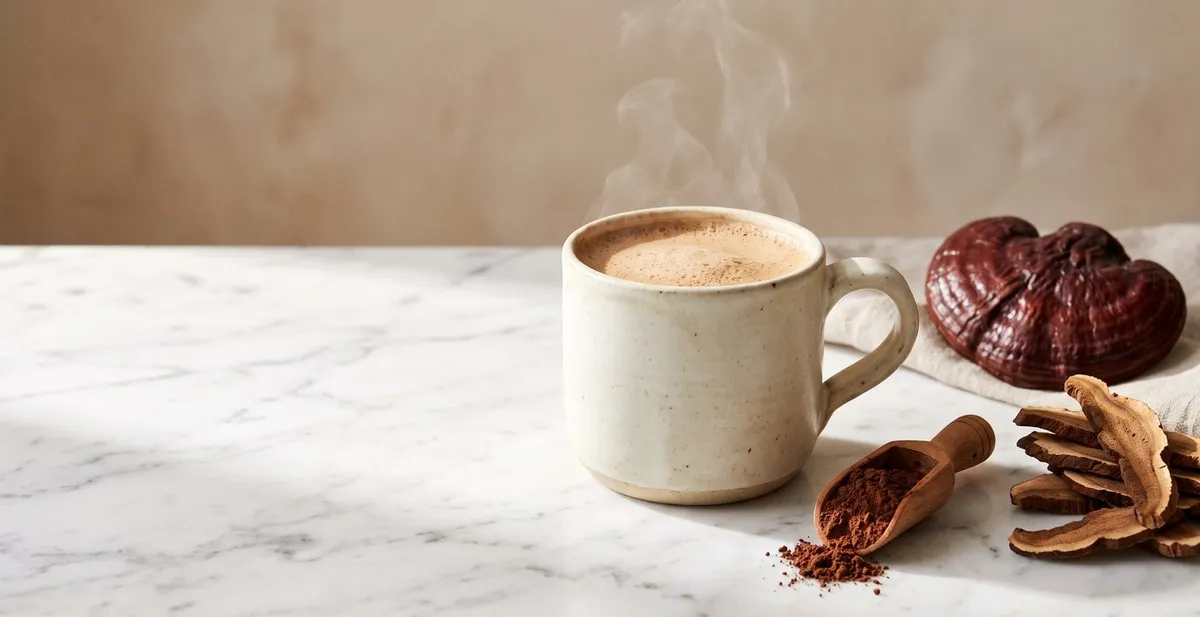
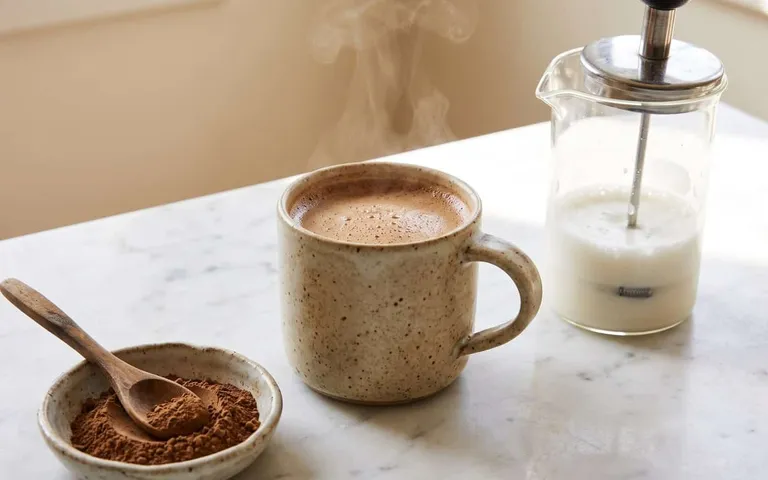
A reishi elixir made with powder and frothed milk.
Choosing a Reishi Product: Fruiting Body, Extraction, and Quality
If you have read this far and still want to try it, that is a reasonable choice, and the aim is to avoid wasting money. You are not the first person to open a bottle that smelled wrong or a tub that listed no content, and quality varies widely.
Start with the part of the mushroom. Fruiting body is the part you would recognise as the mushroom. Mycelium grown on grain is the root-like network, and spore powder is a separate material again. Ask what share of any powder is mushroom and what share is the grain it grew on.
Then look at extraction, which you can check on the label. Reishi's triterpenes dissolve in alcohol and its beta-glucans dissolve in water, so a single-method extract captures only one group. A dual extraction uses both, which is why I would make it the default; our explainer on dual extraction goes further. A tincture is one dual-extract format, and a mushroom powder is another.
Finally, look for a stated beta-glucan and triterpene content and independent third-party testing. A label that lists neither is asking for your trust without showing its working. Balance Journal's founder, James Bellis, also founded Balance Coffee, which sells a reishi elixir; one example of that dual-extract format is the Reishi Elixir, a 50 ml glass bottle from £39.99.
If you want a ranked comparison later, we are working on a best reishi supplement guide, and the best mushroom tincture roundup already covers the format. If you are weighing the format more broadly, a dedicated guide to mushroom tincture benefits is planned.
Last, a note on lion's mane versus reishi, since readers ask. Reishi is studied mainly for immune markers and fatigue, and lion's mane is studied mainly for cognition; lion's mane benefits sets out that evidence in the same graded way. If cordyceps is on your list too, cordyceps benefits is a separate evidence question, and you should expect the same grading approach there.
Reishi works best as one small part of an overall wellness routine.
Studies Cited
Every study named above, so you can check my reading against the source.
Jin X, Ruiz Beguerie J, Sze DM, Chan GC. Ganoderma lucidum (Reishi mushroom) for cancer treatment. Cochrane Database Syst Rev 2016;4:CD007731. Five RCTs, low methodological quality. https://pubmed.ncbi.nlm.nih.gov/27045603/
Klupp NL et al. Ganoderma lucidum mushroom for the treatment of cardiovascular risk factors. Cochrane Database Syst Rev 2015;2:CD007259. Five trials, 398 participants. https://pubmed.ncbi.nlm.nih.gov/25686270/
This article is for information and is not medical advice. Speak to your GP or pharmacist before taking reishi, especially if you take medication.
Frequently Asked Questions
What are the main benefits of reishi?
The best human evidence is for immune markers and quality of life in people with cancer (a 2016 Cochrane review) and for less fatigue in one trial in neurasthenia. Claims for blood sugar and cholesterol were not supported in trials. No reishi health claim is authorised in the UK, so treat every benefit as research, not a promise.
What happens if you take reishi every day?
Trials gave reishi daily for four to 16 weeks and found it generally well tolerated. Longer-term human data are thin, so nobody can say what years of daily use does. Rare liver injury has been reported with reishi powder. If you take it daily, review it with your GP or pharmacist every few months.
What are the downsides of reishi?
The commonest downsides are mild: nausea, insomnia, dry mouth, constipation and dizziness. Rare liver injury, including fatal cases, has been reported, and reishi may raise bleeding risk if you take blood thinners. Some people also report more fatigue or brain fog. If you notice any of these, stop taking it and speak to your GP.
What not to mix reishi with?
Check with your GP or pharmacist before combining reishi with anticoagulants or antiplatelets, immunosuppressants, chemotherapy, or blood pressure and diabetes medication. Memorial Sloan Kettering advises that reishi may raise bleeding risk, counteract immunosuppressants, and interfere with chemotherapy. If you have surgery planned, mention reishi to your surgical team first.
Should you take reishi in the morning or night?
Nobody knows, because no trial compared timing. Most people choose the evening because of reishi's calming reputation, but that is habit, not evidence. If you try it, pick a time you will remember, and watch how you feel. If it leaves you tired or foggy, stop and speak to your GP.
Which is better, lion's mane or reishi?
They have different evidence bases, so neither is better overall. Lion's mane is studied mainly for cognition, and reishi is studied mainly for immune markers and fatigue, mostly in specific patient groups. Read our lion's mane benefits guide, then choose based on the question you want answered.
Are there reishi benefits for women?
No women-specific benefit has been shown. Two studies enrolled only women: a 2012 pilot in breast cancer patients found less fatigue, and a 2021 pilot in women with fibromyalgia found no significant effect on any outcome. Neither tells you what reishi does for healthy women, and reishi is not advised in pregnancy or breastfeeding.
Is reishi good for your skin?
There is no human trial on reishi and skin, so any skin claim is unproven. Product pages that promise glowing skin are describing hope, not data. If your skin concerns you, a GP or dermatologist can help you far more than a supplement, and good sleep and a balanced diet remain the sensible foundations.