Dual Extraction Mushroom Tincture: What It Means and Why It Matters
A nutritionist's evidence-based guide to dual extraction mushroom tincture.
Table of Contents
Some of the links in this article are affiliate links, which help fund our independent review work at no extra cost to you. Every recommendation is based on hands-on testing through The Editor Lab methodology. No brand pays to appear, and no placement is guaranteed.
Not all mushroom tinctures are made the same way - and for certain species, the difference in process changes what ends up in the bottle. A dual extraction mushroom tincture uses both hot water and alcohol on the same mushroom material to capture two groups of bioactive compounds that neither solvent reaches alone.
Spending a year testing more than 30 mushroom tincture brands teaches you something that no amount of marketing copy can: the term 'dual extraction' appears on both the best and the worst products in the category. As someone who has blind-tasted her way through the UK's mushroom coffee market and spent much of the past year comparing tincture formulations across brands including Bristol Fungarium, DIRTEA, and No Ordinary Moments, I started treating it as a checkpoint rather than a selling point. What I found is that the label claim matters far less than the evidence behind it.
The difference between a dual-extraction tincture that delivers genuine bioactive compounds and one that uses the phrase as decoration comes down to three numbers and two words. This article explains the science behind the best mushroom tincture uk formulations I have tested, shows you exactly what to look for on a label, and gives you a buying criterion you can apply in under a minute.
“After testing 30+ mushroom tincture brands across the UK market, the single most consistent marker of a quality product was not the species blend or the price. It was the transparency of the extraction method - specifically, whether the brand stated both solvents, named a beta-glucan percentage, and confirmed fruiting-body sourcing.”Snita Pandoria, Head of Editorial, Balance Journal
I oversee Balance Journal's wellness coverage, and I have been writing about food, drink, and functional nutrition for more than fifteen years across London's hospitality scene and thirty-plus countries. The mushroom tincture category is one of the most confusing markets I have covered - partly because the ingredients are genuinely interesting, and partly because the labelling norms are still catching up with the science.
What Dual Extraction Means (in One Paragraph)
Dual extraction is a production process in which the same mushroom material is subjected to two separate extraction phases: first, a hot water phase to release water-soluble compounds, and then an alcohol phase to release compounds that water alone cannot pull. The two resulting extracts are combined into the final tincture. A single-solvent extract - whether water or alcohol alone - will only ever capture one group of actives from the same starting material. Dual extraction captures both.
That is the definition. The question worth asking is what those two groups of compounds actually are, and whether the species you are taking even contains meaningful quantities of the second group.
Water vs Alcohol: What Each Extraction Pulls Out
The chemistry here is straightforward, and it matters for every label-reading decision you will make.
Hot water extraction pulls beta-glucans: long-chain polysaccharides that form part of the mushroom's cell wall structure. Beta-glucans are the most studied class of compounds in medicinal mushroom research. A 2020 review published in the Journal of Fungi (Murphy et al.) documented immunomodulatory properties associated with mushroom beta-glucans and noted their investigation as adjuvant agents across multiple clinical contexts. They are water-soluble, which means a basic hot water decoction will capture a portion of them. What a water extract cannot do is access compounds locked inside the cell wall itself, or compounds that are alcohol-soluble by their chemical nature.
What does alcohol add that water cannot? Triterpenes: a class of secondary metabolite that includes the ganoderic acids found in reishi and the betulinic acids found in chaga. Food-grade ethanol at 25-70% concentration is the standard solvent used for this phase. Triterpenes are the compounds most associated with the adaptogenic properties often cited for these species, and they are not meaningfully soluble in water - which is why a water-only tincture of reishi or chaga will have a very different active-compound profile from a dual-extracted version.
Neither phase alone is enough. By combining both - beta-glucans captured via hot water and triterpenes via alcohol - a dual-extraction tincture reaches compound classes that a single-solvent product will always leave behind. The two extracts are blended before bottling, which is why you will sometimes see the alcohol content of a tincture listed in single digits despite alcohol being one of the solvents - the water extract dilutes the final concentration.
| Extraction Phase | Solvent Used | Compounds Captured | Species Most Relevant |
|---|---|---|---|
| Hot water | Filtered water, heat | Beta-glucans, polysaccharides | All species |
| Alcohol | Food-grade ethanol | Triterpenes (ganoderic acids, betulinic acids) | Reishi, chaga primarily |
| Dual (combined) | Both phases | Beta-glucans + triterpenes | Reishi, chaga; partial benefit for lion's mane |
Why Single Extraction Can Fall Short
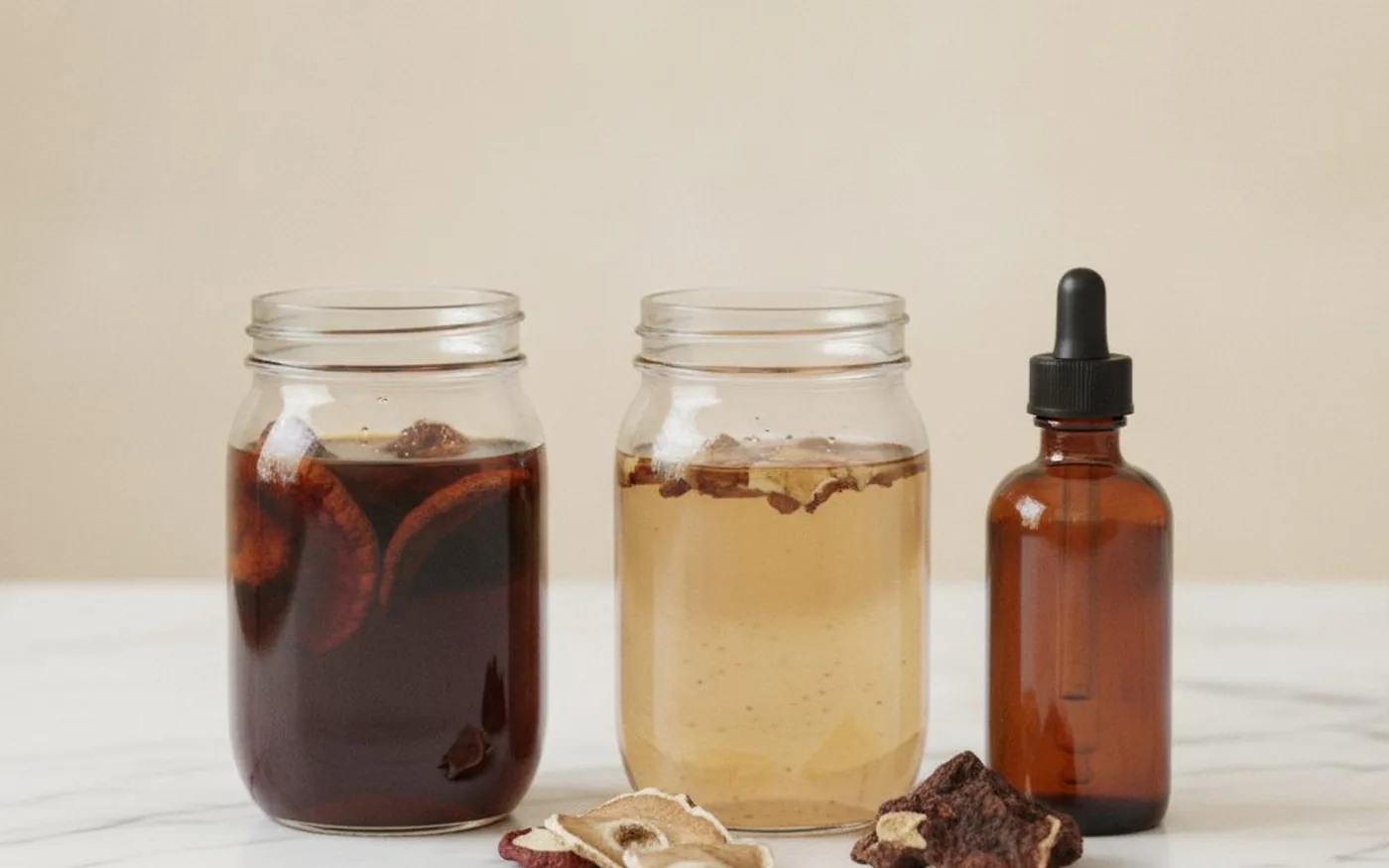
The assumption many people bring to tincture shopping is that any liquid mushroom extract is essentially the same product. That assumption is understandable. The label says 'mushroom extract' and lists the same species whether the process behind it is a hot water decoction or a dual extraction.
For certain species - particularly reishi and chaga - a single-solvent extract will miss a significant portion of the compounds most associated with those mushrooms' therapeutic profiles. Reishi's ganoderic acids, which are the triterpenes most associated with adaptogenic and immune-supportive research on this species, are not extracted by water. A water-only reishi tincture will contain beta-glucans and some polysaccharides, but a dual-extracted version will contain the same plus the alcohol-soluble compounds that water cannot access.
This is not a flaw in water extraction as a method. It is a chemical reality of what different solvents can dissolve. A water-only extract is a legitimate product; it is simply a different product from a dual-extracted one. The problem arises when brands list 'reishi extract' without specifying the extraction method, and buyers assume they are getting the full-spectrum profile.
The friction point I noticed repeatedly when comparing labels across the best mushroom coffee uk brands and tincture lines: many products list 'polysaccharides' as the key bioactive, without specifying whether that figure represents beta-glucans specifically. Polysaccharides is a broader category that can include compounds with significantly less research behind them. A label that states a beta-glucan percentage - rather than a total polysaccharide percentage - is giving you a more specific and more useful number.
Which Mushrooms Actually Need Dual Extraction
Not every mushroom species benefits equally from dual extraction, and the briefing materials I reviewed from several UK brands sometimes conflate the process across species where the case for it is actually quite different.
Reishi is the species where dual extraction is most clearly justified by the chemistry. Reishi's most researched compounds - the ganoderic acid group - are triterpenes. They are not present in meaningful quantities in a water-only extract. If you are buying a reishi tincture specifically for its adaptogenic or immune-support profile, dual extraction is a genuine quality differentiator for this species.
Chaga presents a similar case. Chaga contains betulinic acid and a range of triterpene-class compounds that are more accessible via alcohol extraction. Its beta-glucan content is also significant, which means both extraction phases contribute meaningfully to the final profile.
Lion's mane is the species where the argument is more nuanced. Lion's mane's most researched actives - hericenones and erinacines, compounds associated with nerve growth factor stimulation in preclinical research - have different solubility profiles from the triterpenes in reishi. The research on lion's mane extraction chemistry is less settled than for reishi or chaga. This does not mean dual extraction is irrelevant for lion's mane; it means the species-specific benefit is less clear-cut, and a brand claiming dramatic superiority for a dual-extracted lion's mane product over a water-extracted one should be able to point to more than the extraction label to support that.
Cordyceps is another species where dual extraction adds value, as its cordycepin content - an adenosine analogue studied for performance and energy support - benefits from both extraction phases depending on the specific sub-species and growing conditions.
| Species | Key Research Compounds | Water-Soluble? | Alcohol-Soluble? | Dual Extraction Benefit |
|---|---|---|---|---|
| Reishi | Ganoderic acids (triterpenes), beta-glucans | Beta-glucans only | Ganoderic acids | High - triterpenes missed by water alone |
| Chaga | Betulinic acid, triterpenes, beta-glucans | Beta-glucans | Triterpenes | High - significant compounds missed by water alone |
| Lion's mane | Hericenones, erinacines, beta-glucans | Partial | Partial | Moderate - chemistry less settled |
| Cordyceps | Cordycepin, beta-glucans | Partial | Partial | Moderate - depends on sub-species |
How to Spot Genuine Dual Extraction on a Label
This is where the practical buying criterion sits, and it is the section I most wished I had when I started comparing brands twelve months ago.
A label that genuinely backs up a dual-extraction claim will typically give you three things. First, it will name both solvents used. "Extracted using hot water and alcohol" or "aqueous and ethanolic extraction" are the phrases to look for. If a label says 'extract' or 'dual extract' without naming both solvents, the claim is unverified by the label itself.
Second, it will state a beta-glucan percentage. This is important because beta-glucan content is the most commonly standardised figure in quality mushroom extracts, and it gives you a direct comparison point between products. Labels that state only 'polysaccharides' rather than 'beta-glucans' are using a broader, less specific category. A brand confident in its formulation will name the specific compound.
Third, it will confirm fruiting body sourcing rather than mycelium. This distinction matters because mycelium - the root-like structure of a fungus, often grown on grain substrates in commercial cultivation - contains significantly less beta-glucan and triterpene content than the fruiting body. A 2022 study published in Foods (Brazkova et al.) measured beta-glucan content at 31.66% in oyster mushroom fruiting body versus 12.04% in mycelium biomass - a difference large enough to matter for dosing. Mycelium-based products are not without value, but they are a different product from a fruiting-body extract.
The three-point check in summary: both solvents named, beta-glucan percentage stated, fruiting body confirmed. If a product calling itself 'dual extraction' passes all three, you have a legitimate quality signal. If it fails any one of them, you are taking the brand's word for something you cannot verify from the label.
- Labels that use 'mushroom complex', 'full-spectrum extract', or 'proprietary blend' without any of the three data points above. These phrases describe a formulation philosophy rather than a verifiable process.
Does It Change the Dose or How You Take It?
Dual-extracted tinctures are generally more concentrated than single-extract versions made from the same starting quantity of mushroom material, because more of the bioactive compound classes have been extracted. This concentration does not usually change the serving format - most UK tinctures are taken by dropper, typically 1-2 ml per serving, either under the tongue or mixed into water, coffee, or another liquid - but it is worth checking the serving size stated on the label against the beta-glucan content figure to understand the dose you are actually receiving per serving.
The alcohol content is a separate consideration worth naming. A dual-extracted tincture will contain a small amount of residual ethanol from the alcohol extraction phase. Most UK tinctures are diluted with water after extraction, bringing the final alcohol content down to somewhere between 20-40%. For anyone avoiding alcohol - whether for pregnancy, medication interactions, or personal preference - check the label. Some brands offer alcohol-free alternatives using glycerine as a carrier, though these are typically water-based only and will not contain the triterpene fraction in the same quantities.
If you are already familiar with best lions mane coffee uk products and want to add a tincture alongside your existing routine, the two formats complement each other: a lion's mane coffee typically uses a water-extracted powder, while a dual-extracted tincture provides the additional alcohol-soluble fraction. For a full guide to daily tincture use and dosage, see our best mushroom tincture UK roundup.
Brands Worth Noting
This article focuses on the science of dual extraction rather than ranking specific products. The full ranking is in our guide to the best mushroom tincture UK brands. Three brands are worth mentioning here specifically in the context of extraction transparency.
Bristol Fungarium consistently labels its extraction method and publishes third-party lab testing on every batch. If you are new to tinctures and want a starting point with transparent labelling, their reishi tincture is the natural first choice.
DIRTEA operates at the premium end of the UK tincture market, and their labelling reflects that - extraction method, beta-glucan content, and fruiting body sourcing are all confirmed on their product pages.
No Ordinary Moments takes a craft approach to sourcing, and their transparency documentation is more detailed than most UK brands at a similar price point.
Balance Coffee also sells a mushroom tincture bundle combining lion's mane, cordyceps, and reishi - see the Balance Coffee Mushroom Elixir Bundle. Balance Journal is published alongside Balance Coffee, founded by James Bellis. The full best mushroom coffee uk guide covers the coffee-format options if you prefer that delivery method.
Frequently Asked Questions
What is a dual extraction mushroom tincture?
A dual extraction mushroom tincture uses both hot water and alcohol on the same mushroom material. The hot water phase extracts water-soluble beta-glucans; the alcohol phase extracts alcohol-soluble triterpenes. Single-solvent extracts capture only one group. Combining both extracts gives a wider range of bioactive compounds in the final product.
Is dual extraction actually better than single extraction?
For triterpene-rich mushrooms such as reishi and chaga, dual extraction captures compounds that water alone genuinely misses, so it is a meaningful quality signal for those species. For lion's mane, the benefit is less settled because its key actives have more varied solubility. It is not a blanket marker of superiority across every mushroom.
Which mushrooms need dual extraction?
Reishi and chaga benefit most clearly from dual extraction. Both contain significant quantities of triterpenes - the ganoderic and betulinic acid groups respectively - that water extraction does not access. Lion's mane and cordyceps show some benefit but the evidence is less definitive. If you are buying a reishi or chaga product specifically, dual extraction is the more meaningful specification.
How can I tell if a tincture is genuinely dual-extracted?
Check three things on the label: the product names both solvents (water and alcohol), states a beta-glucan percentage rather than a broader 'polysaccharides' figure, and confirms fruiting body sourcing rather than mycelium. A product passing all three gives you a verifiable extraction claim. One that states only 'dual extract' without any of these data points does not.
What are the side effects of a mushroom tincture?
Reported effects include nausea, gastrointestinal discomfort, dry mouth, and, in rare cases, allergic reactions - particularly in people with mould sensitivities. Dual-extracted tinctures carry a small residual alcohol content, which is relevant if you have dietary restrictions or are on medication. The NHS recommends checking with a pharmacist before combining herbal supplements with prescribed medicines.
Can you make a dual-extraction tincture without alcohol?
A true dual extraction requires alcohol to pull triterpenes from the mushroom material. Water-only extracts capture beta-glucans but miss the alcohol-soluble compounds. Some brands use glycerine as a substitute, but glycerine does not dissolve triterpenes comparably, so a glycerine-based product is not a genuine dual extract - it is a water-based extract in a different carrier.
What does a mushroom tincture do?
Functional mushroom tinctures are used for the bioactive compounds associated with each species - beta-glucans linked to immune modulation, and triterpenes associated with adaptogenic properties in species like reishi. UK and EFSA health claims for mushroom extracts are not currently authorised under food law, so clinical outcome claims cannot legally be made. Evidence varies by species, and research is ongoing.
Does dual extraction change the dose or how I take it?
Dual-extracted tinctures are generally more concentrated than single-extract versions. The format stays the same - typically 1-2 ml per serving by dropper - but the beta-glucan content per ml will usually be higher. Check the label's stated serving and beta-glucan figure together to understand the actual dose. If you are avoiding alcohol, note that dual-extracted tinctures contain residual ethanol.
A seasoned food and lifestyle writer with over a decade in London's hospitality scene, Snita explores the culture of dining, drink, and connection.