Our nutrition team ranked 8 UK collagen coffees by collagen dose, testing, fit, service and price per cup, and checked whether hot coffee destroys collagen.
“We scored eight UK collagen coffees on five weighted criteria against each label and its published testing, and checked if hot coffee ruins collagen.”
Collagen Coffee: The Short Answer
Collagen coffee is ordinary coffee with hydrolysed collagen peptides added, either as a ready-made instant blend or as an unflavoured collagen powder stirred into a cup you already make. Hot coffee does not destroy it: the collagen is already broken down into peptides during manufacture, and the temperature at which collagen begins to degrade in laboratory testing sits around 300C, far above brewing temperature. A 2025 clinical trial found the key collagen peptides were absorbed from coffee at the same rate as from plain water.
Ready-made blends on UK shelves carry 2g to 20g of collagen a serving and cost £0.90 to £2.00 a cup, so the product you land on changes what you are buying more than the category name suggests. The cheaper route, stirring unflavoured collagen powder into coffee you already drink, is covered further down. Our nutrition team scored eight UK collagen coffees on five weighted criteria using each brand's own label, published testing and price, and read the reviews on Amazon UK and the brands' own sites; nobody on the team has personally used these products, and the article says which findings are label evidence and which are customer consensus, per the same methodology as our Editor Lab. Bulk Collagen Coffee ranks first below.
I am a registered Nutritional Therapist and BANT member, trained at the College of Naturopathic Medicine in King's Cross, where I received the Nutrition Academic Excellence Award, and I have led nutrition clinics at The Kyros Project with Google DeepMind. Collagen coffee sits at an odd intersection: a genuine delivery-vehicle idea, sold with more confidence than the evidence supports.
My job is to separate what each label proves from what its marketing implies.
What Real Buyers Say About Collagen Coffee
Five of the eight verbatim reactions here turn on taste or smell rather than dose or evidence: getting a real dose into a cup is easy, finishing the cup is what buyers argue about.
“Tastes a bit like cow… don't have it first thing in the morning. But its a good way to get protein in.”
Soraya, Amazon UK review of Bulk Collagen Coffee (3 stars, 5 Apr 2025)
“...The taste of it as just plain black coffee is pretty bad… when you add milk and sweetener of your choice, it actually tastes more like a latte.”
BB I, Amazon UK review of Bulk Collagen Coffee (5 stars, 26 May 2024)
“It's not the best mixer, sometimes there's bits of undissolved coffee floating on the top if you just stir it. A whisk does a better job.”
Berther, Amazon UK review of Reformed Black Coffee with Collagen (5 stars, 4 Sep 2026)
“Nails are definitely growing better could be coincidence Has a strange taste as coffee.”
Mrs Sheena Evans, Amazon UK review of Reformed Black Coffee with Collagen (4 stars, 27 Jul 2026)
“Omg this coffee tastes so good. I got caramel flavour and its even good without any milk.”
Emilia, Amazon UK review of The Protein Works Collagen Protein Coffee (5 stars, 28 Jun 2026)
"Dissolves in hot water with no issues," she added.
“I couldn't stomach the smell of the powder although it did dissolve nicely in coffee and gave it a creamy taste.”
AnchorWHAT, Mumsnet, "Collagen - what can I put it in?" (12 Apr 2026)
“It's one (easy) way to get protein without loads of calories. I'm unconvinced by any skin/ joint benefits despite 6 months of daily use.”
AltitudeCheck, Mumsnet, "What is Collagen coffee and why is everyone drinking it?" (27 May 2026)
“I add a scoop of Hunter Gather bovine collagen to my coffee every morning.”
OnlyOneAdda, Mumsnet, same thread (27 May 2026)
How We Ranked Collagen Coffee
You are choosing on five weighted things, and no single one decides the order. Product quality, 25 per cent: collagen dose where published, ingredient count, added sugar or sweeteners, and whether the coffee is named by origin. Verified trust, 30 per cent, the highest weight on the page: published testing or a testing standard, named sourcing (organic, grass-fed), and a full nutrition panel rather than a headline claim. Fit for the job, 15 per cent: hot and iced use, decaf or dairy-free options, and vegan suitability. Service reality, 10 per cent: delivery speed, guarantees, and how easy a subscription is to skip or cancel. Value, 20 per cent: price per serving read against the collagen actually delivered, never price alone.
Trust carries the largest weight because dose transparency is the one thing most brands here get wrong by default: Bulk wins on quality and value with the biggest published dose, while Ancient + Brave, the strongest testing standard here, ranks last because its dose is a fifth of what most skin trials use. Price sits inside value and never decides a position alone. For the dose research behind these scores, see our guide to how much collagen per day you actually need.
Rating shown for Dose & Co is marked "not published" rather than invented - no product-level rating figure appears on the pages checked for this article, and the Planet Paleo figure above is a brand-wide average, not product-specific.
These three are not simply the cheapest. Bulk wins on the largest dose at the lowest price, on the current sale. Dose & Co wins its slot because it is a creamer, not a fixed coffee, so it works with whatever you already make, hot, iced, or decaf. Planet Paleo earns its place on the shortest, cleanest ingredient list here, even though its dose is smaller than Bulk's. If none of the eight below suit you, the cheaper add-your-own route is covered later on this page.
The Best Collagen Coffees in the UK, Ranked
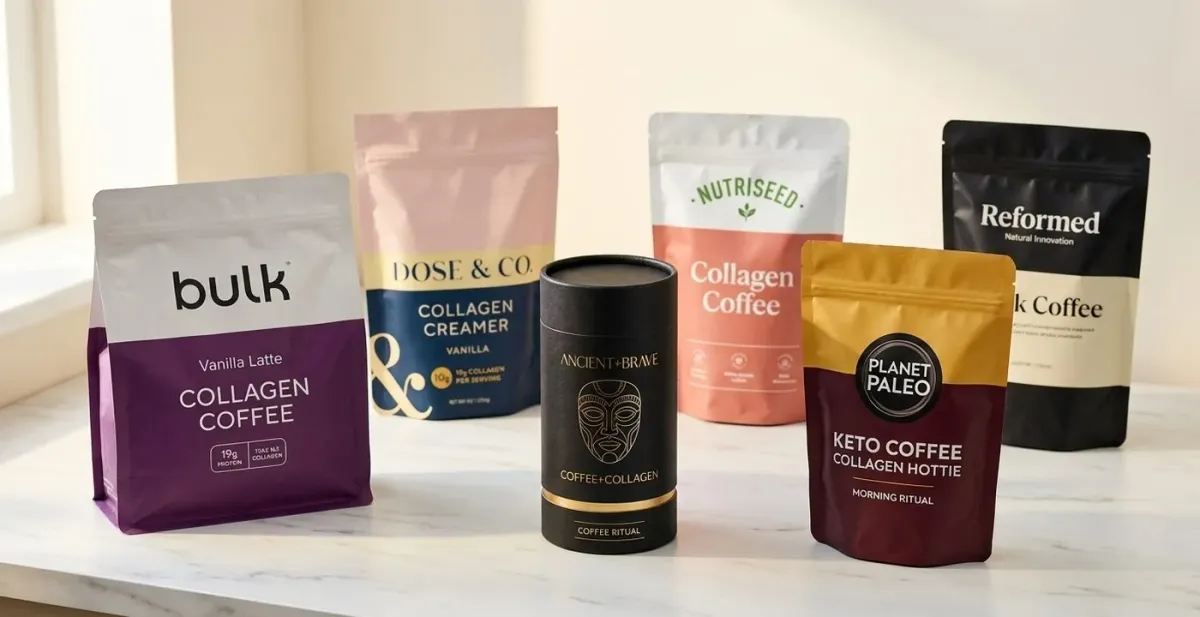
1. Bulk Collagen Coffee - Best Overall: Most Collagen for the Money
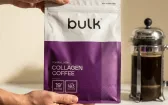
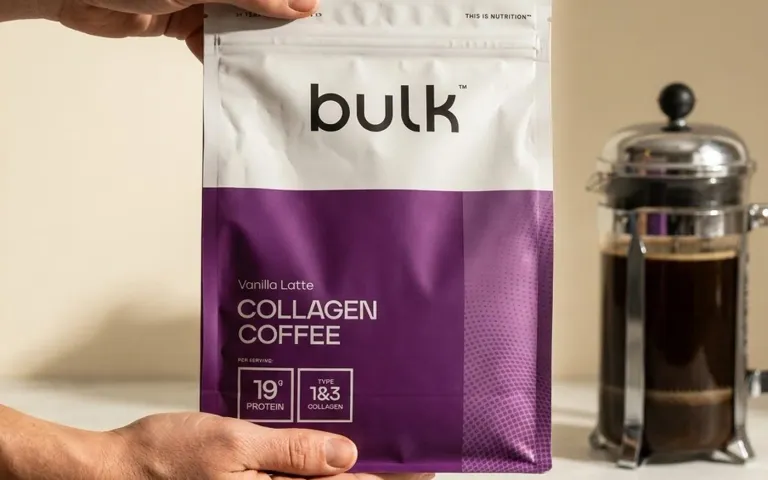
Bulk prints 20g of collagen and 18g of protein per 25g serving, with 168mg of caffeine and 94kcal, the biggest dose and most transparent label here. Ingredients: hydrolysed bovine collagen, instant coffee and MCT powder, no added sugar. It comes in six flavours, including Black Coffee and Caramel Latte, in 500g and 1kg bags. At the current sale price of £17.99 for 500g, that is £0.90 a cup across 20 servings, rising to £1.15 once the sale ends and the £22.99 regular price applies. Amazon UK rates it 4.0 from 399 ratings, and taste is the recurring complaint: several reviewers describe a distinct "cow" flavour in black coffee, softened once milk goes in.
You should skip this one if you are watching caffeine closely. Bulk's own label warns 180 to 336mg per two servings, close to a whole day's EFSA reference in one sitting.
“The label that tells you the most is also the label that costs the least.”
Evaluation Criteria
Our Findings
Full review
Full BJ brand review not yet published
Best for
Largest published collagen dose at the lowest price per cup
2. Dose & Co Collagen Creamer (Vanilla) - Best for Your Own Coffee
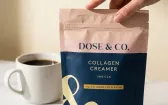
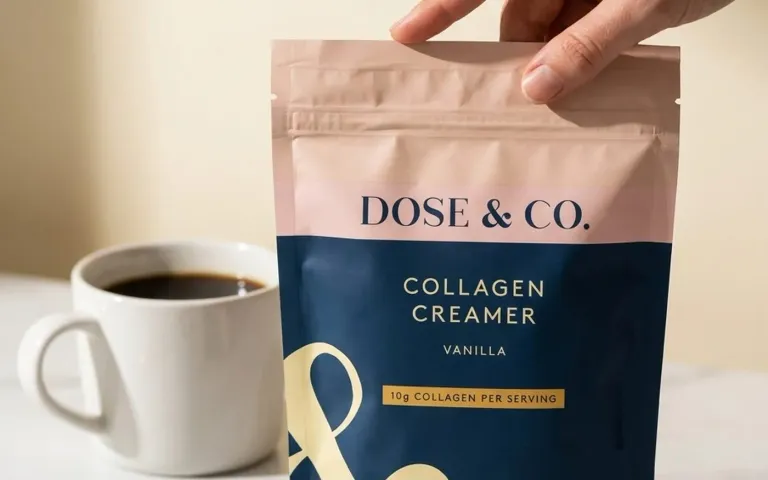
Where the other seven products come pre-mixed with instant coffee, Dose & Co's Collagen Creamer goes into a cup you already make, hot, iced or decaf. A 20g serving delivers 10g of collagen and 13g of protein, from Type I and Type III collagen peptides, whey powder, whole milk powder, vanilla flavour and steviol glycoside. A dairy-free version swaps in coconut milk powder for the same 10g collagen and 12g protein. Dose & Co's own marketing states "85% of consumers reported visible results", but that figure comes from a consumer-perception study of 466 respondents, not a clinical trial. The brand does not publish servings per tub, so no genuine price-per-cup figure is possible here.
You should skip the standard version if you are dairy-free or vegan, since it is built on whey and whole milk powder, and check the dairy-free price against a plain unflavoured powder if dose alone is your priority.
“A creamer does one job: it lets your usual coffee stay usual.”
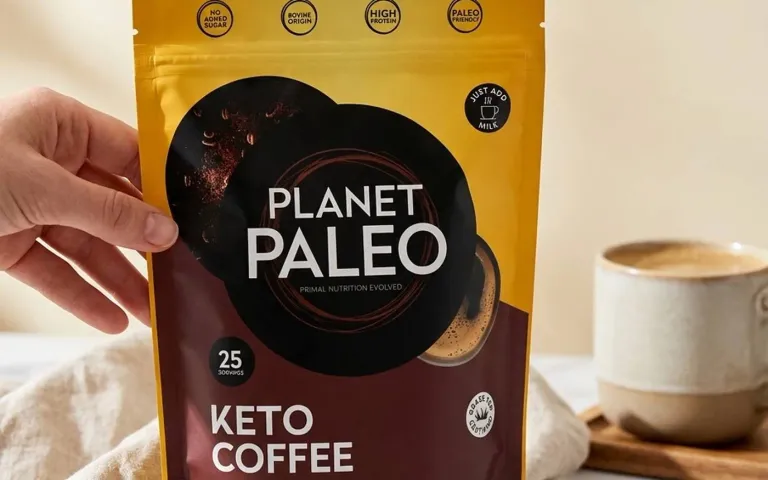
3. Planet Paleo Keto Coffee - Collagen Hottie - Best Sugar- and Sweetener-Free Blend
Planet Paleo's Keto Coffee has the cleanest ingredient list here: grass-fed bovine collagen hydrolysate, C8 MCT powder, and organic cardamom and vanilla pod powder, with organic roasted Sumatran coffee named on the front as a highlight rather than a percentage ingredient. No added sugar and no sweetener appear anywhere, a claim no other product here can make. An 8.5g serving, roughly four 5ml teaspoons, goes into 200ml of hot water, delivering the brand's stated 5g of collagen. At £29.99 for 25 servings, that is £1.20 a cup. It offers a skip-anytime subscription, a 14-day money-back guarantee, and a brand-wide rating of 4.51 across 9,000-plus customers, covering the whole range rather than this product alone.
You should skip this one if dose is your priority over ingredient cleanliness: 5g of collagen a cup is half the roughly 10g most published skin trials actually use.
“No added sugar and no sweetener is a short sentence. On this label, it is also true.”
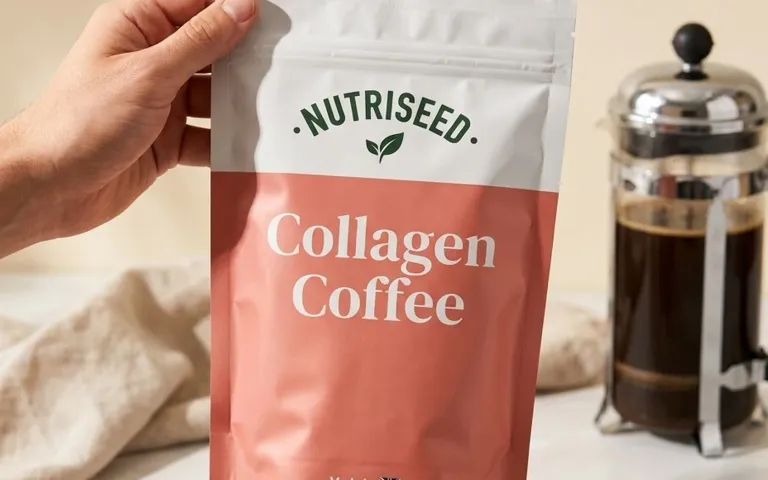
4. Nutriseed Collagen Coffee - Best Mid-Price Blend with a Full Nutrition Panel
Nutriseed prints 12,000mg, 12g, of collagen per serving alongside a full nutrition panel: 11g protein, 51kcal, 0.1g sugar and 0.2g salt for a 16g serving. Ingredients: high-altitude Colombian Arabica coffee, grass-fed hydrolysed bovine collagen peptides, maca root, ashwagandha, MCT powder, vitamin C, biotin and vitamin B6. Caffeine is not published, and no sweetener is named, so this article does not call it sweetener-free on an absence. A bag runs to 20 servings for £29.99, £1.50 a cup, with 3 and 6-bag options bringing that down. On-site reviews put it at 4.3 stars from 673 ratings, UK customers only.
You should skip this one if an unpublished caffeine figure is a dealbreaker, or if you would rather your coffee did not also carry maca and ashwagandha you did not ask for.
“Printing the panel is not the same as printing everything. This one is close.”
Evaluation Criteria
Our Findings
Full review
Full BJ brand review not yet published
Best for
A genuine full nutrition panel at a mid-field price
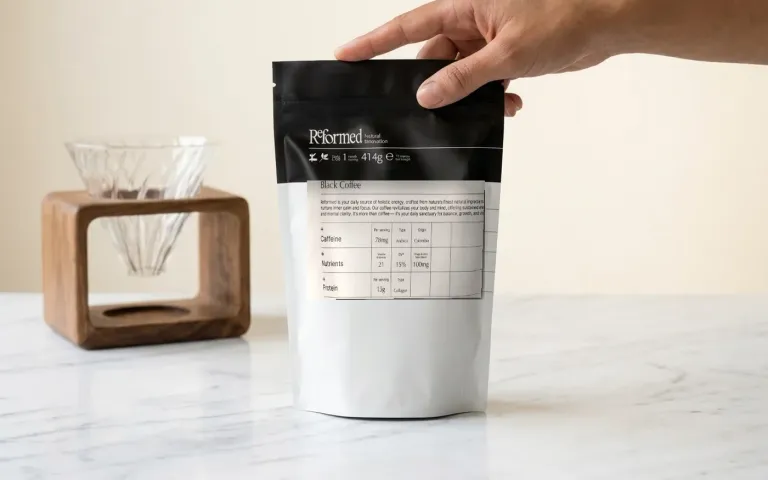
5. Reformed Black Coffee with Collagen - Best Range of Options
Reformed's strongest card is choice: Black Coffee, Vanilla Black, Decaf Black and Mocha, each with bovine or vegan collagen. A serving carries 15g of protein, 0.1g carbohydrate with no added sugar, 0.2g fat and 83kcal, and 78mg of caffeine in Black Coffee against 46mg in Mocha. Reformed does not print a collagen-gram figure separate from protein, so this article states "15g protein" rather than a number it cannot verify. Its own page names Mexican coffee; its Amazon listing names Colombian for the same product, reported here rather than smoothed over. The collagen is Halal and Kosher certified. At £49.99 for one 414g bag, 25 coffees, that is £2.00 a coffee, the priciest here. Reformed rates 4.7 by 118,000-plus users on-site, 4.1 from 116 on Amazon.
Pick this one for the format range, especially the vegan collagen and decaf options nothing else here offers, and skip it if price per cup decides it for you.
“Four flavours and a vegan option is real choice. It also carries the highest price tag here.”
Evaluation Criteria
Our Findings
Full review
Full BJ brand review not yet published
Best for
The widest flavour and collagen-source range of any brand here
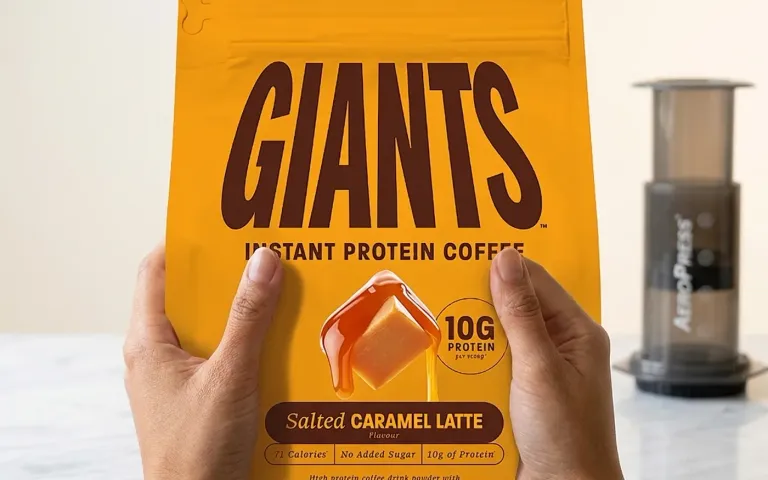
6. GIANTS Instant Collagen Protein Coffee - Best Latte-Style Blend with a Satisfaction Guarantee
GIANTS delivers 10g of hydrolysed, grass-fed collagen protein per scoop, 20g across a 2-scoop latte, with 80mg of natural caffeine and 71 calories. The Amazon UK ingredients for Salted Caramel run to fourteen items, including skimmed milk powder, medium-roast coffee, coconut MCT oil powder, prebiotic inulin fibre, Lion's Mane extract, pink Himalayan salt and sucralose, and GIANTS states on its own FAQ that the product contains lactose and a small amount of sucralose. Pricing runs £24.95 to £119.97 across bag sizes, but servings per bag are unpublished, so no per-cup price can be given. It offers a money-back guarantee on subscriptions, and rates 4.9 by 3,000-plus daily users on-site, 4.5 from 55 on Amazon.
You should skip this one if you are avoiding sucralose or dairy, since both are present, and check the servings figure directly with GIANTS before buying if cost per cup matters to your decision.
“A guarantee is a real signal of confidence. It does not tell you what a serving costs.”
Evaluation Criteria
Our Findings
Full review
Full BJ brand review not yet published
Best for
A money-back guarantee alongside a genuine 10g-per-scoop dose
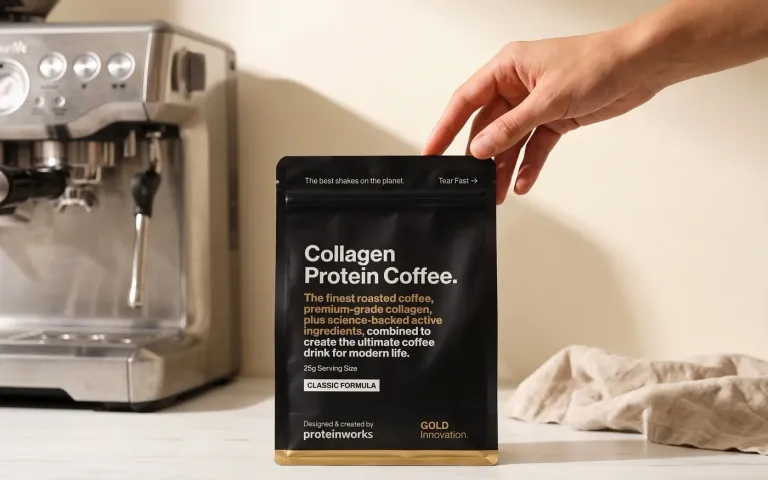
7. The Protein Works Collagen Protein Coffee GOLD - Best Budget Latte, with a Caffeine Choice
The Protein Works is the cheapest per cup here at £0.89 to £1.00 a coffee, and the only brand offering a genuine caffeine choice by flavour: 140mg in the Americano, 68mg in the Caramel Latte. The trade-off is transparency: neither the product page nor the Amazon listing prints a collagen-gram or protein-gram figure, unlike every product ranked above it. Ingredients include hydrolysed collagen peptides, coffee powder, skimmed milk powder, MCT with sodium caseinate and glucose syrup solids, an emulsifier, flavouring, vitamin C and sucralose. A scoop is 25g with 200ml boiling water. Amazon UK rates it 4.1 from 129 ratings.
You should buy this one on price and caffeine flexibility alone, and skip it if you need to know your actual collagen dose before spending money on it.
“The cheapest cup here is also the one that tells you the least about what is in it.”
Evaluation Criteria
Our Findings
Full review
Full BJ brand review not yet published
Best for
The lowest price per cup and a genuine caffeine choice
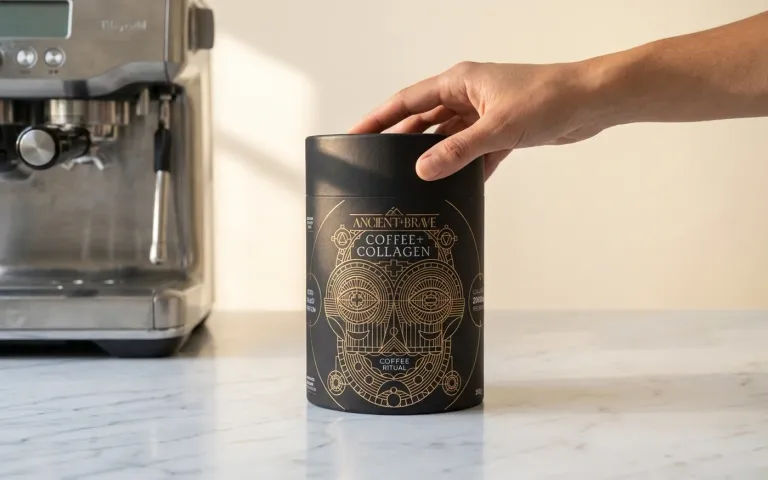
8. Ancient + Brave Coffee + Collagen - Best Organic Ground Coffee for a Cafetiere
Ancient + Brave is the only genuinely brewed product here, ground organic Brazilian coffee for a cafetiere rather than an instant sachet, and it carries the strongest testing standard: accredited laboratories check every batch for heavy metals, microbial and other environmental contamination, the brand states. A 10g serving delivers 3.5g protein, 4g fibre and 200mg of ashwagandha, alongside organic raw cacao, chicory root and baobab. Its own FAQ is explicit about the trade-off: the 2g collagen dose is "specifically designed at a lower dose so you can adjust your daily dose", a fifth of the roughly 10g used in most published skin trials. At £24.00 for a 250g tub, about 25 servings, that is £0.96 a serving, £19.20 on subscription. It rates 4.8 on its own page.
You should buy this one for the brewing ritual and the testing standard, and skip it if collagen dose per cup is what you are actually optimising for, because on that single measure it ranks last of the eight.
“The best-tested product on this list also carries the smallest dose. Both things are true at once.”
Does Hot Coffee Destroy Collagen? What the Evidence Says
You can put hydrolysed collagen straight into hot coffee without worrying the heat undoes it. Every product ranked above uses hydrolysed collagen, meaning the protein is already broken into short peptides during manufacture, before it reaches your cup. That structural change has already happened at the factory, not in your mug.
The laboratory work behind this comes from a 2011 study of native collagen fibrils and gelatin, not hydrolysed peptides, using microthermal analysis and atomic force microscopy. It found transitions around 150C and 220C linked to gelatinisation of the fibril, and a common initial degradation temperature around 300C. Coffee is brewed nowhere near either figure. One widely read UK explainer states collagen's "initial degradation occurred at around 150C", citing the same study, but that is the gelatinisation figure, not the 300C degradation figure the paper settles on. The conclusion, that hot coffee will not damage your collagen, holds either way, but the number is worth correcting once, since it is the one most likely to be repeated wrongly elsewhere.
Absorption is a separate question with better evidence than most of this category gets. A 2025 randomised cross-over trial gave volunteers collagen hydrolysate in coffee or water and measured the bioactive peptides Pro-Hyp, Hyp-Gly and Gly-Pro-Hyp afterwards. The key markers were similar between the two drinks, so coffee did not blunt absorption of those peptides, though free amino acids varied more in coffee. Five of the study's authors are employed by Rousselot, a collagen manufacturer, so this is not independent research.
Whether any of this delivers the results the marketing implies is the bigger question. A 2025 meta-analysis of 23 randomised controlled trials in 1,474 participants found a pooled benefit for skin outcomes, but studies not funded by a collagen-supplement company showed no effect, and the authors concluded there is currently no clinical evidence to support collagen for preventing or treating skin ageing. See our guide to whether collagen actually works.
How to Add Collagen to Your Own Coffee Without Clumps
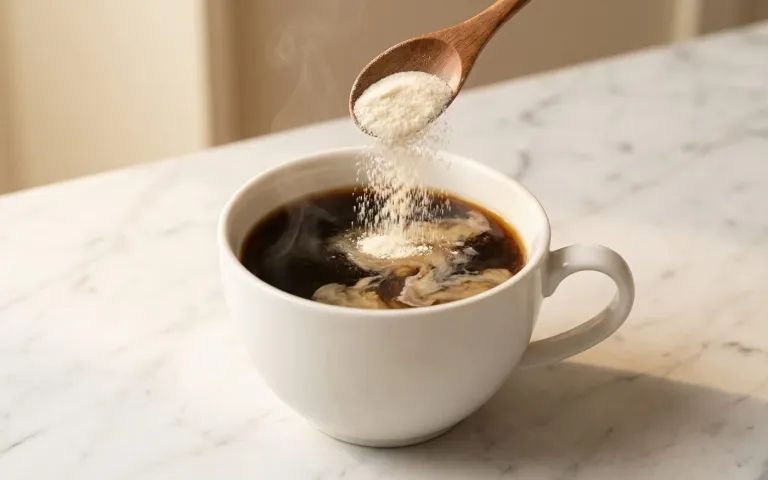
If none of the eight blends suit your taste or budget, the cheapest route is an unflavoured hydrolysed collagen powder stirred into a coffee you already drink. Our best collagen powder UK guide ranks the standalone powders, topped by Ancient + Brave's True Collagen, also covered in the Ancient + Brave review above. Dose & Co's Pure Collagen, from the brand behind the Collagen Creamer ranked second, suits a matching flavour, covered in the Dose & Co review. Vital Proteins is a third widely stocked option, in our Vital Proteins review. Choosing marine versus bovine, the two most common sources, is covered in our marine vs bovine collagen comparison. For readers who do not drink coffee at all, our best liquid collagen UK guide covers the non-coffee route.
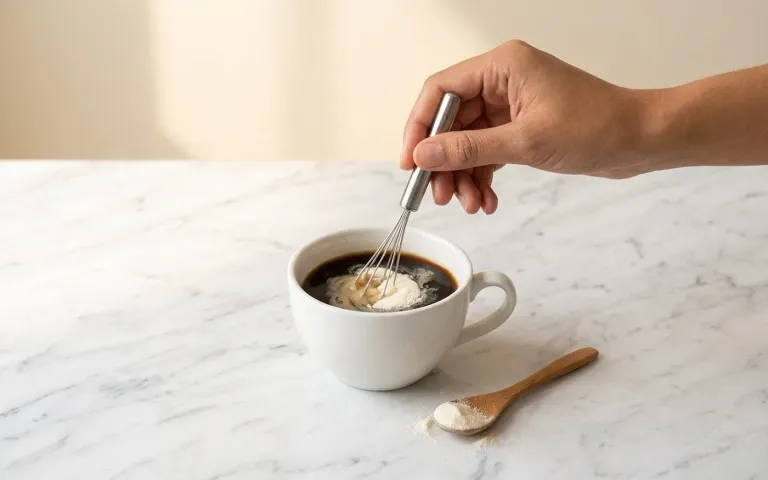
The clumping complaint that shows up repeatedly in buyer reviews has a straightforward fix. Whisk your powder into a small amount of hot coffee first, then top up the rest of the cup, rather than tipping it into a full mug and stirring once. Forum buyers who whisk report no problem; the ones who stir a full cup describe "bits of undissolved coffee floating on the top". A milk frother does the same job faster if you own one.
Heat is not the worry, boiling water is 100C at sea level, well below the 300C figure above, and the 2025 coffee-versus-water absorption trial applies to a home cup the same way. Start with a coffee you would actually drink anyway rather than the cheapest instant jar. Our guide to healthy coffee beans covers what to look for.
Caffeine, Sweeteners and Who Should Skip It
Product
Caffeine per Serving
Sweetener
Bulk (Black)
168mg
None listed
The Protein Works (Americano / Caramel Latte)
140mg / 68mg
Sucralose
GIANTS
80mg
Sucralose
Reformed (Black / Mocha)
78mg / 46mg
None listed
Nutriseed
Not published
Not named
Planet Paleo
Not published
None listed
Ancient + Brave
Not published
None listed
Dose & Co Creamer
Adds none, your coffee sets the level
Steviol glycosides
EFSA's reference point for healthy adults is up to 400mg of caffeine a day, and up to 200mg in a single dose. Two servings of Bulk gets you to 336mg on the brand's own warning label, most of a day's reference in one product. The NHS pregnancy limit is lower still, 200mg a day, roughly one cup of instant coffee, so a pregnant reader on one Bulk serving is already close to that limit before anything else counts.
Be cautious if you are pregnant, especially with Bulk, or if you take prescription medication and have not checked with a pharmacist. For citalopram, the NHS position is to tell your doctor about any supplement you are taking. Vegans should note every product except Reformed's vegan option uses bovine collagen, and anyone avoiding dairy should check GIANTS, The Protein Works and Dose & Co's standard creamer, all of which contain milk. None of this is medical advice beyond what is stated on the NHS pages linked here.
Also Considered, and Why They Did Not Make the List
Freja's Coffee Collagen Protein Blend delivers a genuine 14g of collagen per 25g serving, but it is a bone-broth protein shake with coffee at only 8 per cent of the blend and 6.4g of sugar from coconut sugar, a different product to the coffee-forward blends above. Nature's Finest by Nutrisslim mixes collagen powder with instant coffee and maltodextrin at roughly 2.5g of collagen per 5g serving, with no GBP price shown on the Amazon UK listing checked. Free Soul's Protein Iced Coffee contains no collagen at all, a plant-and-dairy protein blend instead, excluded on product type rather than quality.
Full Comparison Table
Every figure below is taken from each brand's own product page or Amazon UK listing, pulled 16 September 2026. An unpublished figure is marked as such, never estimated.
Brand
Collagen
Protein
Caffeine
Sweetener
Price
Price per Serving
Pulled
Bulk Collagen Coffee
20g
18g
168mg
None listed
£17.99 (sale, 500g)
£0.90
16 Sep 2026
Dose & Co Collagen Creamer
10g
13g
Set by your coffee
Steviol glycosides
£29.99
Not published (servings/pack not stated)
16 Sep 2026
Planet Paleo Keto Coffee
5g
Not published
Not published
None listed
£29.99 (213g)
£1.20
16 Sep 2026
Nutriseed Collagen Coffee
12g
11g
Not published
Not named
£29.99 (1 bag)
£1.50
16 Sep 2026
Reformed Black Coffee with Collagen
Not published (15g protein)
15g
78mg / 46mg
None listed
£49.99 (1 bag)
£2.00
16 Sep 2026
GIANTS Instant Collagen Protein Coffee
10g per scoop
10g per scoop
80mg
Sucralose
£24.95 (1 bag)
Not published (servings/bag not stated)
16 Sep 2026
The Protein Works Collagen Protein Coffee GOLD
Not published
Not published
140mg / 68mg
Sucralose
£18.99
£0.89-£1.00
16 Sep 2026
Ancient + Brave Coffee + Collagen
2g
3.5g
Not published
None listed
£24.00 (250g tub)
£0.96
16 Sep 2026
Frequently Asked Questions
Is coffee with collagen good for you?
Hot coffee does not damage hydrolysed collagen, since the peptides are already broken down before you drink them. Whether collagen itself delivers the benefits marketed is a separate question, and the evidence is mixed: see our full breakdown of whether collagen actually works for the detail behind that distinction.
Does the NHS recommend collagen?
No NHS page recommends collagen supplements of any kind. A search of nhs.uk for "collagen" returns a single result, about keloid scars, nothing about supplementation. That is not the NHS advising against it, simply an absence of official guidance either way.
Does collagen coffee shrink belly fat?
No. Collagen coffee is a protein-and-calorie product, not a fat-loss product, roughly 94 calories a serving for Bulk. None of the evidence in this article shows a fat-loss effect from collagen, and no brand ranked here makes that claim on its label.
Can I take a collagen supplement with citalopram?
The NHS position is to tell your doctor or pharmacist about any supplement, including collagen, before you start taking it alongside citalopram, and to flag any other medicines or herbal remedies too. See the NHS citalopram page for the full wording. No interaction claim either way is made here.
What is the downside of taking collagen in coffee?
The main trade-offs are caffeine stacking across more than one serving a day, added sweeteners in several blends, cost per cup up to £2.00, and doses on some products too low to match published research. Our collagen side effects guide covers the wider picture.
What are the five signs that collagen is working?
There are no validated signs to watch for. Trials run for weeks before measuring anything, and the highest-quality, independently funded trials found no measurable skin effect at all. See our guide to how much collagen per day studies actually use before expecting a fast result.
What should you avoid while taking collagen coffee?
Watch for stacking caffeine across two servings in one day, blends carrying added sugar you did not expect, and paying a premium for a product that will not say how much collagen it actually contains. Our collagen side effects page goes into each of these in more depth.
Why must collagen be taken at night?
It need not be. Morning coffee is a perfectly reasonable time to drink it, and nothing in the published evidence ties collagen's effectiveness to a specific time of day. What matters more than timing is consistency, taking a dose daily over the weeks a trial would run, rather than which hour you drink it. See our guide on when to take collagen for the full reasoning.
What food is very high in collagen?
Bone broth, gelatin, and skin-on poultry or fish skin are the food sources most commonly cited, though none of them are precisely quantified in the way a supplement label is. Freja's bone-broth-based coffee blend, covered above, is one product built directly on that idea. Our collagen supplements guide covers dietary sources in more depth.
Does hot coffee destroy collagen?
No. The degradation temperature measured in laboratory testing sits around 300C, far above brewing temperature, and a 2025 clinical trial found the key collagen peptides were absorbed from coffee at a similar rate to plain water. The heat you pour is not the risk this category is actually built on.


Soraya, Amazon UK review of Bulk Collagen Coffee (3 stars, 5 Apr 2025)