Marine vs Bovine Collagen: Which Is Better?
Your goal and diet decide this one. Ignore whichever type markets itself harder.

Table of Contents
Some of the links in this article are affiliate links, which help fund our independent review work at no extra cost to you. Every recommendation is based on hands-on testing through The Editor Lab methodology. No brand pays to appear, and no placement is guaranteed.
The difference between marine and bovine collagen comes down to what you are actually trying to support. Marine collagen is fish-derived, predominantly Type I, and the form most often associated with skin, hair, and nail benefits. Bovine collagen, sourced from cattle, contains both Type I and Type III, which means it covers a broader range of applications including joints and the gut lining.
Clemmie Rose, a BANT-registered Nutritional Therapist who has run nutrition clinics at The Wellness Clinic at Harrods, has assessed both types across her clinical practice. Her view: the choice is not about which is superior in absolute terms, but which collagen type matches the reader's primary health goal.
“Clemmie Rose holds a Diploma in Nutritional Therapy from the College of Naturopathic Medicine and is a registered member of BANT. She currently leads the nutrition clinic at The Kyros Project with Google DeepMind, where she uses advanced biomedical testing to inform personalised supplement protocols.”Clemmie Rose, Nutritional Therapist
What Is Marine Collagen?
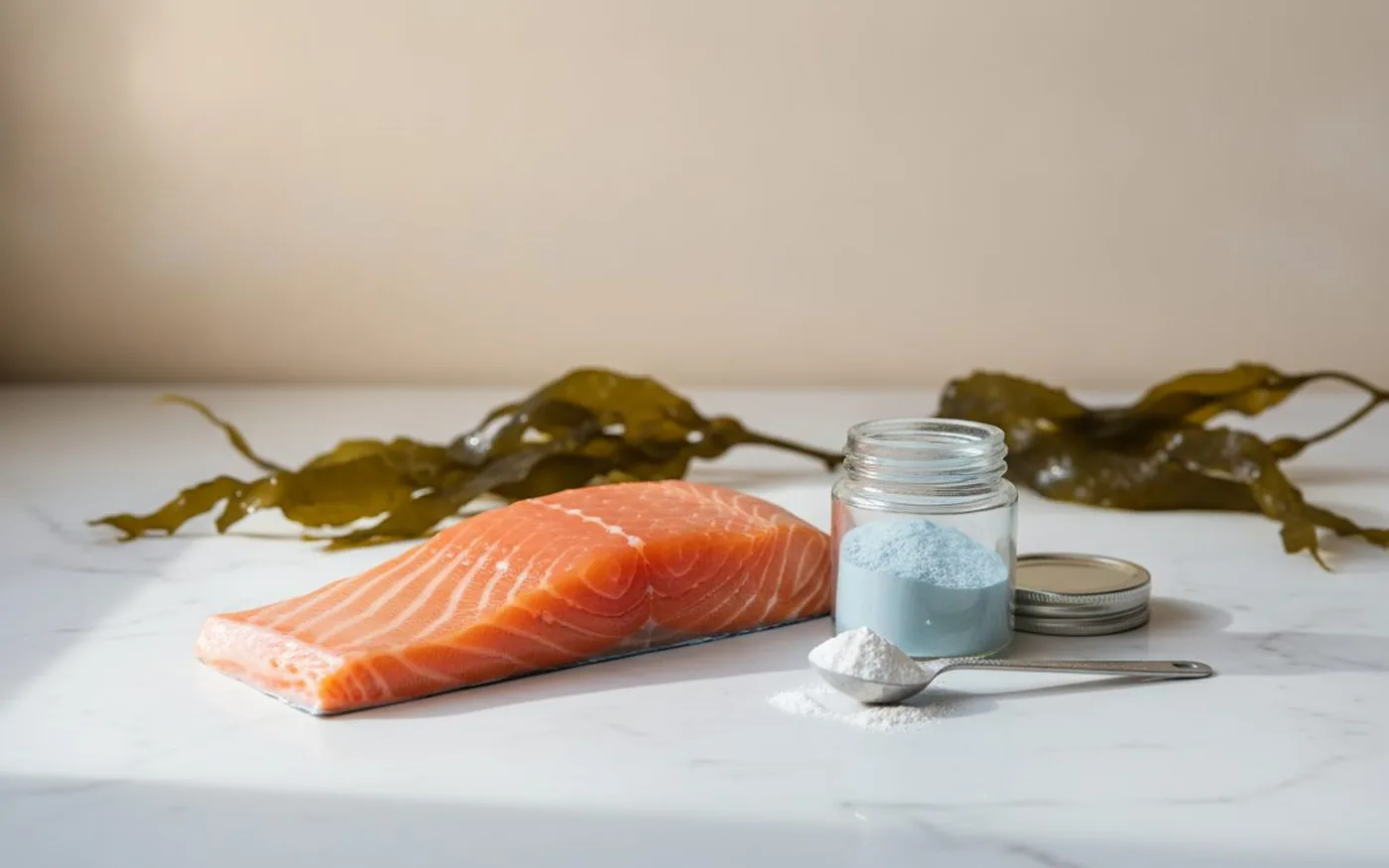
Marine collagen is extracted from fish - typically the skin, scales, and bones - and is predominantly Type I collagen. Type I is the most abundant collagen in the human body and the primary structural protein in skin, hair, and nails.
The term 'bioavailability' comes up frequently in marine collagen marketing, and there is some basis for it. Marine collagen peptides are generally produced at a lower molecular weight than bovine alternatives, which may allow faster absorption through the gut wall. A 2019 study published in the journal Nutrients found that low-molecular-weight marine collagen peptides showed good intestinal permeability in cell models, though large-scale human trials directly comparing marine and bovine absorption rates remain limited.
Pescatarians have only one option here: marine collagen is the only supplemental collagen available to people who avoid red meat or pork but still consume fish. It is not vegan.
On price, marine collagen typically costs more per gram of protein than bovine. The marine sourcing process, combined with higher-grade food-safety requirements around fish processing, drives the premium.
What Is Bovine Collagen?
Bovine collagen is derived from the hides, bones, and connective tissue of cattle. Unlike marine, it contains both Type I and Type III collagen.
Type III collagen is structurally important for organs, blood vessels, and the gut lining. It also works alongside Type I in skin - the combination of both types is one reason some nutritionists favour bovine collagen for anyone with gut-health or joint concerns in addition to skin goals.
The BSE (bovine spongiform encephalopathy) question comes up with clients. Reputable bovine collagen supplements are sourced from grass-fed, pasture-raised cattle and carry full traceability documentation. The NHS advises that modern BSE controls mean the risk from UK and EU-sourced beef products is extremely low. If sourcing ethics matter to you, look for brands that publish their full supply-chain documentation.
Bovine collagen is generally the lower-cost option per serving. For people with no dietary restriction around red meat, it delivers a broader collagen type profile at a more accessible price point.
Marine vs Bovine: Head-to-Head
| Evaluation Criteria | Our Findings |
|---|---|
| Best for | Skin-first goals and pescatarians |
| Source | Hydrolysed marine peptides, almost entirely type I |
| Format | Liquid sachets, 8,000mg per sachet |
| Shop | Shop marine collagen → |
| Evaluation Criteria | Our Findings |
|---|---|
| Best for | Value, clean taste and daily use |
| Source | Hydrolysed bovine peptides, types I and III |
| Format | 587g powder tub |
| Shop | Shop bovine collagen → |
| Factor | Marine Collagen | Bovine Collagen |
|---|---|---|
| Source | Fish skin, scales, bones | Cattle hides, bones, connective tissue |
| Collagen types | Primarily Type I | Types I and III |
| Absorption | Lower molecular weight - potentially faster absorption | Larger peptides - absorption rate lower |
| Taste and smell | Can have a mild fishy odour if poorly processed | Largely neutral when hydrolysed |
| Diet compatibility | Pescatarian-friendly; not vegan | Not suitable for vegetarians or pescatarians |
| Sustainability | Concerns around fish sourcing; by-product brands available | Concerns around cattle farming; grass-fed options available |
| Price per serving | Higher - typically £0.80-£1.50 per serving | Lower - typically £0.40-£0.90 per serving |
| Best for | Skin, hair, nails; pescatarian diets | Joints, gut lining, skin plus gut combined goals |

Which Is Better for Skin, Joints, and Gut?
This is where the "marine is automatically better" assumption tends to break down.
For skin: Both marine and bovine collagen provide Type I collagen, the structural protein most closely linked to skin elasticity and hydration. A 2021 systematic review and meta-analysis in the International Journal of Dermatology (Miranda et al.), which assessed 19 randomised, double-blind, controlled trials of oral collagen supplementation, found evidence for improvement in skin hydration and elasticity across multiple collagen sources. Neither marine nor bovine consistently outperformed the other in skin-specific outcomes when matched for dose and hydrolysis grade. Marine collagen's lower molecular weight may give it a slight bioavailability edge, but this has not translated into consistently larger skin benefits in head-to-head human trials.
For joints: Type III collagen, present in bovine but absent in marine, plays a structural role in joint cartilage and connective tissue. For anyone with joint concerns as a primary goal, bovine collagen is the more rational choice on the basis of collagen type coverage.
The gut lining argument mirrors the joints case. Bovine collagen again provides broader coverage here. Clients who present with both gut and skin concerns are typically better served by bovine than by a Type I-only marine supplement.
The clearest use case for marine collagen is a person with an exclusively skin, hair, and nail goal who follows a pescatarian diet. For everyone else, bovine collagen offers a wider type profile at a lower price.
If you are weighing up the evidence on whether collagen supplementation works before choosing a type, see our guide to does collagen work for a breakdown of the clinical evidence.
Taste, Smell, and Mixability
The 'fishy' concern around marine collagen is the most common reason clients avoid it - and it is worth addressing honestly.
High-quality, well-hydrolysed marine collagen peptides should be close to tasteless and odourless in a well-formulated product. The fishy smell associated with some marine collagen products is a sign of lower-grade processing or inadequate deodourisation during manufacture. It is not an inherent property of marine collagen itself.
In practice: unflavoured marine collagen from a reputable brand dissolves cleanly in cold or warm water, coffee, or smoothies with minimal taste. Lower-cost products may carry a detectable fish odour. If taste is a concern, choosing a marine collagen from a brand with transparent processing standards eliminates this in most cases.
Bovine collagen is largely flavour-neutral when hydrolysed, which is why it tends to be the default choice for mixing into coffee or hot drinks without affecting taste.
Both types dissolve well in hot drinks. If you are adding collagen peptides to your morning coffee - a popular routine - both marine collagen and bovine collagen peptides dissolve without clumping or affecting extraction quality. For anyone who takes their coffee seriously, our guide to mould-free coffee uk is worth reading alongside your collagen routine. Balance Journal is published alongside Balance Coffee, founded by James Bellis.
For a full ranked guide to marine-specific options, see our best marine collagen UK roundup. For bovine options, our best collagen powder UK guide covers the full field.

Price and Sustainability
Price per serving: Marine collagen typically runs from around £0.80 to £1.50 per serving for a 10g dose. Bovine typically runs from around £0.40 to £0.90 per serving for the same dose. Over a 90-day supplementation period, the gap is meaningful - roughly £30-£50 more for marine at typical pricing.
Sustainability: Neither marine nor bovine collagen is without environmental trade-offs. Marine collagen sourced from fish processing by-products - skin and scales that would otherwise be discarded - represents a waste-reduction argument. But not all marine collagen brands source from by-products, and fishing pressure varies considerably by supply chain. Bovine collagen tied to intensive cattle farming carries a higher carbon footprint, though grass-fed sourcing reduces some of the environmental burden.
If sustainability is a priority, look for brands that publish sourcing documentation and, for marine collagen specifically, confirm that fish skin and scales come from food-processing by-products rather than dedicated fish harvest.
Verdict: How to Choose
Three questions determine the right choice:
Choose marine collagen if: your primary goal is skin, hair, or nail support; you follow a pescatarian diet; or you have a specific sensitivity to bovine products.
Choose bovine collagen if: your goals include joints, gut health, or skin plus gut combined; you have no dietary restriction around red meat; or price per serving is a significant factor.
Take both if: you want to cover Types I and III across different goals simultaneously, and cost is not a limiting factor. There is no clinical contraindication to taking both. Some people use a marine collagen in the morning (skin focus) and a bovine collagen at a different time (joint and gut focus), though the evidence for timing benefits is weak.
Neither source is objectively superior. The correct choice is the one that matches your goal, your diet, and a dose you will maintain consistently. Consistency of supplementation matters more than source in most clinical contexts.
For goal-specific roundups, see our best collagen for skin and best collagen for joints guides. For a full overview of collagen supplementation, visit the collagen pillar guide.
Frequently Asked Questions
Which is better, marine or bovine collagen?
It depends on your goal. Marine collagen is predominantly Type I and suits skin, hair, and nails - it is also the only option for pescatarians. Bovine collagen contains Types I and III, making it the stronger choice for joint support and gut health. Neither is universally superior. The correct type is determined by your primary health objective and any dietary restrictions you follow.
Is it better to take both marine and bovine collagen?
Taking both is not contraindicated, and some people use marine collagen for skin goals alongside bovine for joint and gut support. The argument is covering a broader collagen type profile - Types I and III from bovine, plus the potentially higher-bioavailability Type I from marine. Whether the added cost justifies the marginal benefit over a well-dosed bovine-only protocol is debatable for most people.
Is there a downside to taking marine collagen?
The main downsides are cost and the risk of a fishy taste in lower-quality products. Marine collagen is also unsuitable for anyone with a fish or shellfish allergy - a hard contraindication. Lower-grade products may carry a detectable fish smell due to inadequate processing. A reputable, well-hydrolysed marine collagen should be close to tasteless and odourless. Cost per serving is higher than bovine across most UK brands.
What is the best form of collagen to take?
Hydrolysed collagen peptides - whether marine or bovine - are the most studied and best-absorbed form. Hydrolysation breaks collagen into smaller amino acid chains that are more readily absorbed through the gut wall than intact collagen protein. Collagen in powder form is equally effective as capsules provided the peptide grade is comparable. Gelatin (unhydrolysed collagen) is absorbed more slowly and is a less efficient supplement vehicle.
What collagen did Jennifer Aniston use?
Jennifer Aniston has publicly stated she adds Vital Proteins collagen peptides to her coffee each morning. Vital Proteins primarily uses bovine hide collagen peptides. Whether any specific celebrity's collagen choice is right for your goals depends on your own health objectives and collagen type requirements, not on brand endorsement.
Which collagen does Davina McCall use?
Davina McCall has spoken publicly about using Totally Derma, a bovine collagen drink formulated with hydrolysed collagen peptides, hyaluronic acid, and Vitamin C. As with any celebrity endorsement, the relevant question is whether the collagen type and dose match your own goals rather than another person's specific protocol.
Is marine or bovine collagen better for hair growth?
Both types contain Type I collagen, which is the primary structural protein in hair follicles. Marine collagen is often marketed more specifically for hair and nail benefits given its Type I concentration. The clinical evidence for collagen supplementation and hair growth across both types is still limited - most studies have focused on skin outcomes. Consistency of dose matters more than source for this goal.
Can you take bovine and marine collagen together?
Yes. There is no clinical contraindication to taking both simultaneously. The rationale for combining them is achieving broader collagen type coverage - Type III (bovine only) alongside the potentially faster-absorbing Type I from marine. If budget is a factor, a well-dosed bovine supplement covering Types I and III achieves most of the combined benefit at lower cost than running both supplements in parallel.
A registered Nutritional Therapist and member of BANT, Clemmie blends science with a holistic approach to wellbeing.