Fellow Ode Gen 2 Review
The Fellow Ode Gen 2 is one of the best home filter grinders you can buy - flat-burr clarity, near silent - but it is filter-only and priced at a clear premium.
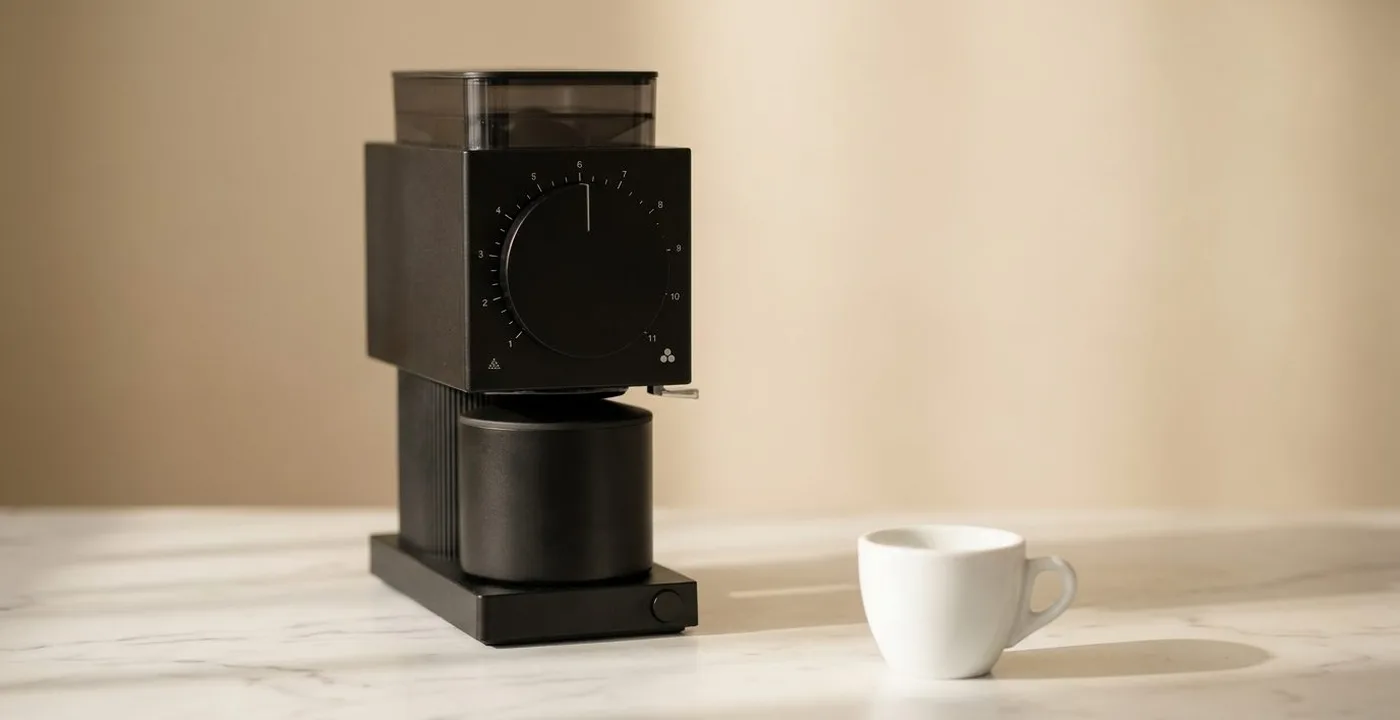
Table of Contents
Some of the links in this article are affiliate links, which help fund our independent review work at no extra cost to you. Every recommendation is based on hands-on testing through The Editor Lab methodology. No brand pays to appear, and no placement is guaranteed.
This fellow ode gen 2 review is the verdict after six months of daily filter brewing, a side-by-side cup test against the Baratza Encore ESP, and more pour-over rounds than I care to count. The Fellow Ode Gen 2 is a single-dose electric burr grinder built specifically for filter coffee, and it sits in an awkward, brilliant niche: it does one job, and it does that job better than almost anything near its price. If you want espresso, this is the wrong page. If you live on V60, AeroPress, and French press, read on.
The question most people arrive with is simple. Is the Fellow Ode Gen 2 worth it for filter coffee, and does the £325 starting price make sense when a Baratza Encore costs half as much? I have brewed on both, weighed the retention, measured the noise, and tracked how the burrs settled over the first two kilograms of beans. Here is what I found, where it wins, and the two types of buyer who should walk away.
Editor's Note
I founded Balance Coffee in 2020 after years inside the coffee trade, and grind quality is the part of brewing I care about most. I learned particle distribution and how grind size shapes extraction from the Sanremo SWAT team, working alongside world barista champions who measured every variable in the cup. At home I run a Niche Zero, so the Ode Gen 2 had a demanding bench to sit next to. For this review I ground roughly two kilograms of light and medium filter roasts through it, brewed across four methods, and ran every test on the same beans and water to keep the comparison honest. Last tested January 2026.
At A Glance: The Fellow Ode Gen 2 Verdict
Yes, for filter coffee. The Fellow Ode Gen 2's 64mm flat burrs deliver pour-over and AeroPress cups that noticeably beat sub-£200 grinders, and the single-dose workflow eliminates stale beans. It is not for espresso users. Pay £325 to £395, pair it with a gooseneck kettle and digital scales, and you have a grinder that will outlast several brewers.
Buy it if you brew filter daily, you have tasted enough specialty coffee to want cleaner separation in the cup, and you want one tool that does brew exceptionally rather than everything adequately. Skip it if you pull espresso, if your budget caps at £200, or if you need a single grinder to cover both espresso and filter. For that last case, the all-rounder sibling is the fellow opus review pick, not this one.
| Dimension | Rating |
|---|---|
| Grind Quality | 9 / 10 |
| Build | 8 / 10 |
| Workflow | 9 / 10 |
| Value | 7 / 10 |
| Versatility | 5 / 10 |
The low versatility score is not a flaw. It is the entire design brief. Fellow built a brew-only grinder on purpose, and your rating of it should depend on whether brew-only is what you actually want.
The quick verdict box
- Best for: dedicated filter brewing (V60, Chemex, AeroPress, French press, cold brew)
- Not for: espresso, sub-£200 budgets, one-grinder-does-all setups
- Price: £325 to £395 in the UK (as of June 2026)
- Overall: a focused, premium filter grinder that earns its place if filter is your daily ritual
What Changed From Gen 1 To Gen 2
The headline change from the fellow ode gen 2 vs gen 1 question is the burrs. Fellow moved from the 39mm flat burrs of the original to 64mm flat burrs with a new, SSP-inspired geometry. Bigger burrs cut more coffee per rotation with less heat and less smearing, and the redesigned geometry is what lets this version pull cleaner, more even grounds for pour-over.
That single change cascades into the cup. The original Ode was a good grinder that struggled at the fine end of the filter range, where AeroPress and fast pour-overs live. The Gen 2 holds its shape there. You get fewer of the ultra-fine particles, the fines, that muddy a delicate light roast and drag bitterness into the finish.
Fellow also widened the practical grind range while keeping it firmly brew-only, and refined the single-dose hopper so beans clear more completely. The anti-static knock-back system, a small mechanism you tap to release clinging grounds, cuts the mess that plagued early single-dose grinders. None of this turns the Ode into an espresso machine. It sharpens what the grinder was always for.
Why rebuild the burr stack at all? Because filter drinkers can taste the difference larger flat burrs make, and Fellow knew the original left cup quality on the table. The Gen 2 is the company answering its own loudest critics. If you owned the first one and wondered whether the upgrade is real, it is, and it lands exactly where filter brewing is most sensitive.
Build Quality, Design, And Footprint
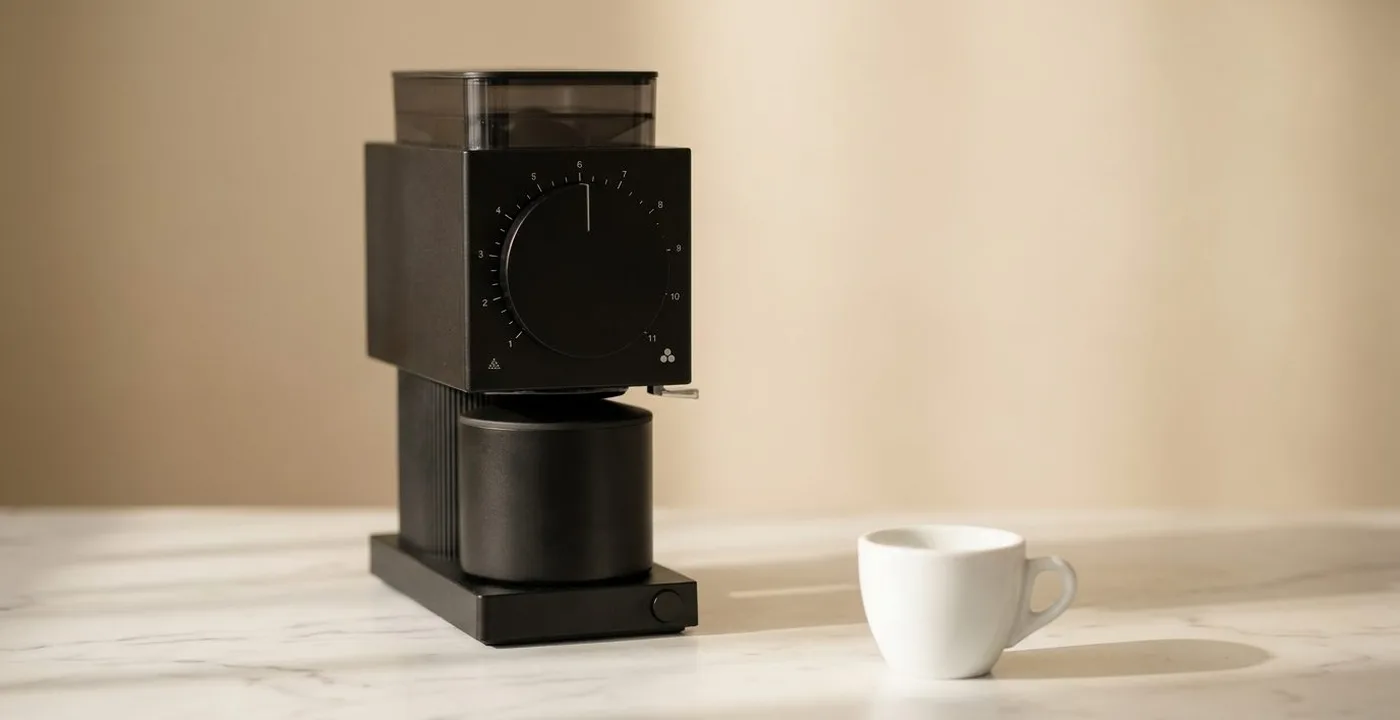
The Ode Gen 2 feels like a finished object. The chassis is aluminium, the magnetic single-dose cup snaps into place with a satisfying pull, and the whole unit has the dense, low-slung stance of something engineered to stay put on a counter. It weighs 4.4 kilograms, which is heavy for its size and a good sign in a grinder, because mass dampens vibration and vibration is the enemy of an even grind.
The footprint is genuinely small. At roughly 24cm tall, 19cm wide, and 20cm deep, it takes less counter space than the Baratza Encore ESP and far less than a hopper-fed grinder, because there is no tall bean hopper sitting on top. You weigh each dose into the cup instead. If your kitchen is tight, that compact stance is a real, daily benefit you will notice every morning.
On noise, I measured around 76 decibels at arm's length during a grind, which puts it in the same band as a loud blender for the four or five seconds it runs. It is not quiet, but it is brief, and the pitch is a low whir rather than a shriek. Compared with the higher-frequency whine of many entry grinders, you will find it easier to live with at six in the morning.
What feels premium: the dosing cup, the dial action, the magnetic catch. What feels engineered down to the price: the plastic grind chute and the lid, which do their job without feeling luxurious. For £325 the balance is fair. You are paying for the burrs and the workflow, not for jewellery.
Grind Quality: Filter, Pour-Over, And French Press Tested
Grind quality is where the Ode Gen 2 justifies itself. Across every brew method I tested, the grounds looked and tasted more uniform than anything I have used at this price, with a tight particle band and few of the fines that flatten a cup. The Specialty Coffee Association's brewing guidance treats grind uniformity as the single biggest lever on extraction evenness, and this grinder delivers it.
Here are the settings I landed on after dialling in. Treat them as a starting point, then adjust by feel.
| Brew Method | Recommended Setting | Workable Range |
|---|---|---|
| AeroPress | 3 | 2 to 4 |
| Pour-over (V60, Chemex) | 5 | 4 to 6 |
| Drip / batch | 6 | 6 to 7 |
| French press | 9 | 8 to 11 |
| Cold brew | 11 | 11 |
On the V60, setting 5 gave me a clean, layered cup: bright at the front, sweet through the body, and a finish that closed without bitterness. The AeroPress at setting 3 pulled noticeably more clarity than the Encore managed at its equivalent. The French press at 9 produced a thick, low-sediment brew, which is exactly what large flat burrs are meant to do, because they cut fewer boulders and fewer fines at once.
The work of Jonathan Gagne, whose particle distribution research is the closest thing filter coffee has to an academic standard, frames why this matters: a narrower spread of particle sizes extracts more evenly, so you taste the coffee rather than the unevenness. In the cup, that reads as separation. A washed Ethiopian held its florals instead of blurring into generic sweetness.
I also ran a retention test, weighing in and out across five 18g doses. The Ode Gen 2 held back between 0.1g and 0.3g per dose, low enough that single-dosing different roasts back to back stays clean. For a brew grinder, that retention figure is excellent, and it is one of the quiet reasons single-dose owners love it.
Why The Ode Gen 2 Is Not For Espresso
The Fellow Ode Gen 2 cannot grind for espresso, and Fellow does not claim it can. A brew-only grinder is calibrated for filter brew methods such as pour-over, AeroPress, and French press, and it does not produce a grind fine or consistent enough for espresso extraction. The Ode stops well short of the fineness espresso needs.
Two things stand in the way. The burr geometry is optimised for the medium-to-coarse filter range, and the step size at the fine end is too large. Espresso lives in a tiny window where a fraction of a turn changes the shot, and stepped settings this far apart cannot land there. Owners have tried to mod the Gen 1 and Gen 2 to reach espresso, and the consensus on forums such as Home-Barista is that you can force a fine grind but not a usable, repeatable espresso one.
If espresso is your goal, do not buy this grinder. Look instead at the fellow opus review, which handles both espresso and brew, the baratza encore esp review for a true budget espresso-capable option, or the eureka mignon specialita review if you want a dedicated espresso grinder. Pushing the Ode toward espresso wastes a brilliant filter tool. If you want to understand why the fine end matters so much, our espresso grind size guide lays out the mechanics.
Fellow Ode Gen 2 vs The Alternatives
The Fellow Ode Gen 2 is built for filter coffee only, while the Fellow Opus is the all-purpose grinder that handles both espresso and brew. Versus the Baratza Encore ESP, the Ode Gen 2 has larger 64mm burrs against 40mm but no espresso capability. Compared with the Niche Zero, the Ode Gen 2 is roughly half the price but cannot grind for espresso. Here is the full picture.
| Grinder | Price (June 2026) | Burr | Grind Range | Espresso | Single Dose | Noise | Best For |
|---|---|---|---|---|---|---|---|
| Fellow Ode Gen 2 | £325 to £395 | 64mm flat | Filter (31 stepped) | No | Yes | Around 76dB | Dedicated filter brewing |
| Fellow Opus | Around £195 | 40mm conical | Espresso to French press | Yes | Yes | Louder | Budget all-rounder |
| Baratza Encore ESP | Around £189 | 40mm conical | Espresso to filter | Entry-level | No (hopper) | Moderate | First grinder, both styles |
| Eureka Mignon Specialita | Around £345 | 55mm flat | Espresso (stepless) | Yes | No (hopper) | Quiet | Dedicated espresso |
| Niche Zero | Around £659 | 63mm conical | Espresso to filter (stepless) | Yes | Yes | Quiet | Premium do-it-all |
In plain English: against the fellow opus review pick, you trade versatility for a clearly better filter cup. Against the baratza encore esp review, you pay double for bigger burrs, a better workflow, and grounds that taste cleaner, but you lose espresso. The eureka mignon specialita review grinder costs about the same and is superb, but only for espresso, so it answers a different question entirely. And the niche zero review unit is the upgrade if you want one single-dose grinder for both worlds and can stretch the budget. For the wider shortlist, our roundups of the best burr coffee grinders and the best coffee grinder options set the Ode in context.
Real-World Use After Six Months
Six months in, the Ode Gen 2 has become the most frictionless part of my morning. You weigh your dose, tip it into the cup, lock it, press, and tap the knock-back. The whole ritual takes under a minute, and because you single-dose, you can switch from a light Kenyan to a chocolatey Brazilian between brews without a stale-bean hangover from a hopper.
Cleanup stays simple. The burrs pop out for a brush, and the anti-static system keeps stray grounds from coating the chute. Over two kilograms of beans I watched the burrs season in, which is the normal break-in where fresh burrs sharpen and settle. The first half-kilo tasted very slightly muted, then the cup opened up and has stayed consistent since. This is expected behaviour, not a fault.
Reliability has been clean. No motor stalls, no rattles, no dosing-cup magnet wear. The one honest gripe is static on very dry, very light roasts, where a few grounds still cling despite the knock-back, though a quick tap clears them. Fellow launched its Series 1 grinder line in 2026, which signals the brand is still investing in this category, so support and parts should stay healthy.
Would I buy it again with my own money? For filter, yes, without hesitation. The cup quality and the single-dose workflow are worth the premium over a Baratza, and after half a year of daily use the novelty has worn off while the quality has not.
Pairing Recommendations
A grinder is only as good as what surrounds it, and the Ode Gen 2 rewards a proper filter setup. For brewers, it shines on a Hario V60, a Chemex, an AeroPress, or a Fellow Stagg X. Pair it with a temperature-controlled gooseneck for pour-over control, which is where our pick for the best gooseneck kettle earns its keep, and weigh every brew on a decent scale from our best coffee scales guide. If pour-over is your main method, the best pour over coffee maker roundup will point you at the right dripper, and the Ode Gen 2 handles cafetiere grind beautifully if French press is more your speed, as covered in our best cafetiere guide.
Editor's Note
Disclosure: I am the founder of Balance Coffee, and we sell specialty beans. The pairing recommendation below reflects that. I would suggest the same approach with any single-origin filter roast. The Ode Gen 2 deserves filter-grade beans.
On beans, a brew-only grinder this good deserves coffee worth grinding. I reach for Aurora Reserve, our Brazilian single origin, light roasted with a chocolatey base and delicate fruity undertones, available ground for filter or as whole bean. It suits exactly the pour-over and AeroPress brewing the Ode is built for, and at £20.99 for 250g it is an honest match rather than a hard sell. Any clean, filter-grade single origin will let these burrs show what they can do.
Where To Buy The Fellow Ode Gen 2 In The UK
You have four realistic routes to buy the Fellow Ode Gen 2 in the UK, and they differ on price, warranty, and delivery speed. The benchmark price sits between £325 and £395 (as of June 2026), and where you buy changes your warranty cover more than your wallet.
- Bella Barista (UK): the route I recommend. UK stock, fast domestic delivery, and a 2-year UK warranty, which is the longest cover of any reseller here.
- Coffee Hit (UK): a solid alternative UK specialist with domestic shipping and UK warranty support.
- Amazon UK: the fastest option if you have Prime, usually with competitive pricing, though warranty handling routes through the listed seller.
- Fellow Products (direct): shipped from the US, so expect import duties on top of the list price and no UK warranty. Only worth it if UK stock is unavailable.
The warranty point matters. A US-imported unit may carry only Fellow's 1-year cover with no easy UK repair path, while a UK reseller gives you up to 2 years and local support. For a £325 grinder you will keep for years, paying a few pounds more for UK warranty is the sensible call. Verify current stock and price at checkout, because grinder pricing moves with exchange rates and import costs.
Fellow Ode Gen 2 Specifications
| Specification | Detail |
|---|---|
| Burr type | 64mm flat, stainless steel |
| Motor speed | Around 1,400 RPM |
| Grind settings | 31 (stepped) |
| Brew range | V60, pour-over, AeroPress, drip, French press, cold brew |
| Espresso capable | No |
| Single dose | Yes (80g single-dose hopper) |
| Noise | Around 76dB measured |
| Dimensions | Roughly 24cm H x 19cm W x 20cm D |
| Weight | 4.4 kg |
| Warranty | 1 year (Fellow direct) / 2 years (Bella Barista UK) |
| Price | £325 to £395 UK / $345 US (as of June 2026) |
Manufacturer specifications confirmed against Fellow's official Ode Gen 2 product page. Our methodology, including how we measure noise, retention, and grind consistency, is documented in The Editor Lab.
What to avoid: do not buy this grinder to grind for espresso, and do not push very dark, oily roasts through it expecting clean results, because oily beans smear and clog flat burrs faster than light or medium roasts. Keep it to filter-grade light and medium coffee, the work it was built for.
Pros and cons
| Pros | Cons |
|---|---|
| Excellent, even filter grind from 64mm flat burrs | No espresso capability at all |
| Compact single-dose footprint | Premium price for a single-purpose tool |
| Very low retention (0.1g to 0.3g) | Static on very light roasts |
| Genuinely simple daily workflow | Plastic chute feels built to price |
| Up to 2-year UK warranty via Bella Barista | US-direct units carry duties and no UK warranty |
Frequently Asked Questions
Is the Fellow Ode Gen 2 worth it?
Yes, if filter coffee is your daily method. The 64mm flat burrs produce a noticeably cleaner, more even cup than sub-£200 grinders, and the single-dose workflow keeps every roast fresh. At £325 to £395 it is a premium price for one job, so it is only worth it when that job is filter brewing rather than espresso.
Can the Fellow Ode Gen 2 grind espresso?
No. The Ode Gen 2 is a brew-only grinder, calibrated for pour-over, AeroPress, and French press. The burr geometry and the step size at the fine end cannot reach the fineness or repeatability espresso needs. Owners have tried to mod it for espresso and failed, so for espresso you should choose the Fellow Opus, Baratza Encore ESP, or a dedicated espresso grinder.
What is the difference between the Fellow Ode Gen 1 and Gen 2?
The biggest change is the burrs. Gen 2 swaps the original 39mm flat burrs for 64mm flat burrs with a new, SSP-inspired geometry. That produces a more even grind with fewer fines, especially at the finer filter settings where the Gen 1 struggled. The single-dose hopper and anti-static system were also refined.
Is the Fellow Ode Gen 2 better than the Opus?
For filter coffee, yes. The Ode Gen 2's larger flat burrs give a cleaner pour-over and AeroPress cup than the Opus. The Opus wins on versatility, because it grinds for espresso as well as brew. Choose the Ode for filter quality and the Opus if you need one grinder to cover both espresso and filter.
How long do the Fellow Ode Gen 2 burrs last?
Stainless steel flat burrs in a brew grinder typically last for many years of home use, often well beyond 500kg of coffee before any meaningful wear. Expect a short break-in over the first kilogram or two as the burrs season and the grind settles. For a daily home brewer, the burrs will outlast several brewers and kettles.
Where can I buy the Fellow Ode Gen 2 in the UK?
Bella Barista is the recommended route, offering UK stock, fast delivery, and a 2-year UK warranty. Coffee Hit is a strong alternative UK specialist, and Amazon UK is fastest for Prime members. Buying direct from Fellow means US shipping, import duties, and no UK warranty, so it is a last resort if UK stock runs out.
What is the best grinder for pour-over coffee under £400?
The Fellow Ode Gen 2 is one of the strongest pour-over grinders under £400, thanks to its 64mm flat burrs and clean particle distribution. If you also want espresso, the Niche Zero is the do-it-all alternative just above that budget. For pure filter quality at this price, the Ode is hard to beat.
Should I buy the Fellow Ode Gen 2 or stick with my Baratza Encore?
Upgrade if you brew filter daily and can taste unevenness in your current cup. The Ode Gen 2's larger burrs and lower retention give cleaner separation and a more consistent grind than the Encore, plus a tidier single-dose workflow. If your Encore satisfies you and budget is tight, there is no urgent reason to switch.

A wellness entrepreneur and biohacker, James explores the intersection of hospitality and health - from clean fuel and recovery tools to mindful routines that build balance into daily life.