Sage Oracle vs Oracle Touch: What Buyers Need to Know in 2026

Coffee & Wellness Writer
Both Sage Oracle machines are discontinued. An honest secondhand buying guide - which to buy used, and what replaced them.
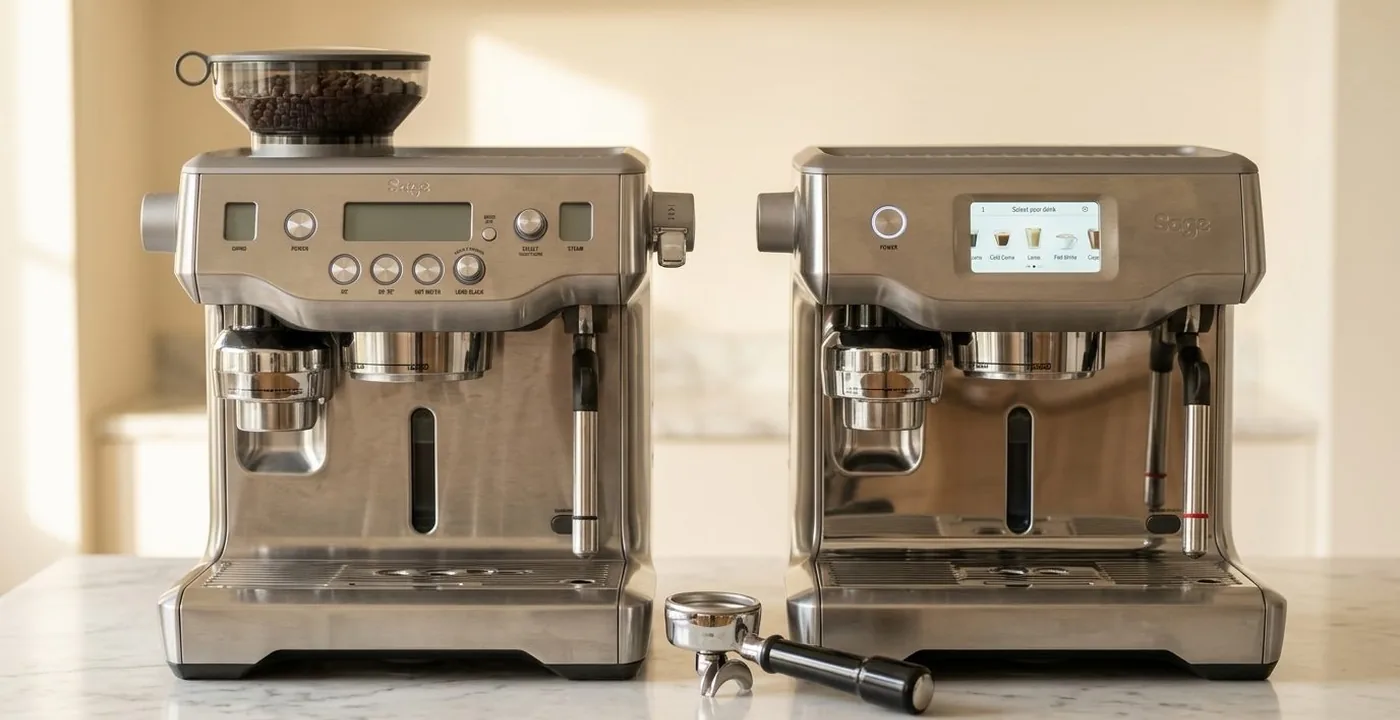
Table of Contents
Some of the links in this article are affiliate links, which help fund our independent review work at no extra cost to you. Every recommendation is based on hands-on testing through The Editor Lab methodology. No brand pays to appear, and no placement is guaranteed.
Having reviewed the Oracle Touch for Balance Journal, and more recently the Oracle Jet that replaced it, the machine I expected to write a comparison article for was still actively available to buy new. That is no longer the case.
Both the Sage Oracle and Oracle Touch are discontinued. If you are researching these machines in 2026, you are almost certainly looking at the secondhand market, or trying to understand Sage's Oracle range history before deciding what to buy now. A standard new-machine comparison would not serve you. This guide covers what the difference between these machines actually was, who should still consider buying each model used, and what the current alternatives look like.
Both the Oracle Touch and the Oracle Jet - Sage's current Oracle-range machine - have been reviewed independently on Balance Journal. For buyers who want a new Sage machine at this price tier, the sage oracle jet review is where to start. For the secondhand question, read on.
Editor's Note
The comparison below draws on five-and-a-half years at Sanremo UK, where I matched commercial dual-boiler espresso systems to 60 of Britain's leading roasters, and on hands-on assessment of both the Oracle Touch and Oracle Jet through The Editor Lab, Balance Journal's evaluation methodology.
Quick Verdict
Three use cases, three clear answers.
Buy the Oracle (BES980) used if you want genuine dual-boiler espresso hardware at the lowest entry price, are comfortable with a manual steam wand, and have found a well-maintained example with a functioning puck preparation system.
Buy the Oracle Touch (SES990) used if you want the same dual-boiler espresso quality with automatic milk texturing and guided drink programming, and the secondhand premium over the standard Oracle fits your budget.
Consider a current Sage machine if you want warranty coverage, faster heat-up, and connected features: the Oracle Jet (£1,699.95, ThermoJet) or Oracle Dual Boiler (£2,499.95, true dual boiler) are the current options.
What Happened to the Sage Oracle Range?
Sage discontinued both the Oracle and Oracle Touch as part of a broader update to the Oracle line. The Oracle launched as Sage's flagship semi-automatic machine - a genuine dual boiler with automatic grinding, dosing, and puck preparation built in. It removed the most technically demanding variables from home espresso without asking buyers to sacrifice the commercial standard 58mm portafilter or manual milk control.
The Oracle Touch followed, adding a TFT colour touchscreen, five pre-programmed drink modes, and Auto MilQ automatic milk texturing to the same dual-boiler platform. Both machines were retired in 2024 when the Oracle Jet launched.
The Sage Oracle and Oracle Touch are both discontinued and no longer available new in the UK. The Oracle Jet (£1,699.95) is Sage's current Oracle-range machine, and the Oracle Dual Boiler (£2,499.95, launched September 2025) is the current true dual-boiler successor. Buyers researching the Oracle or Oracle Touch are looking at secondhand and refurbished stock only.
Key Differences at a Glance
Both machines share the same espresso platform: dual boilers, the same automatic puck preparation system, and the same 58mm portafilter. What the Oracle Touch added was the interface layer above that hardware - a touchscreen, guided programming, and automatic milk texturing.
The core difference is straightforward: the Sage Oracle Touch added a TFT colour touchscreen, five pre-programmed drink modes, and Auto MilQ automatic milk texturing to the standard Oracle's platform, at a retail premium of approximately £300 and a similar premium on the secondhand market today.
| Feature | Sage Oracle (BES980) | Sage Oracle Touch (SES990) |
|---|---|---|
| Status | Discontinued | Discontinued |
| Last UK RRP | £1,799.95 | £2,099.95 |
| Typical secondhand range (May 2026) | £700-1,200 | £900-1,600 |
| Display | Digital readout | 5.7" TFT colour touchscreen |
| Drink modes | Manual only | Five pre-programmed + manual |
| Milk system | Manual steam wand | Auto MilQ + manual option |
| Puck preparation | Auto (grind, dose, tamp) | Auto (grind, dose, tamp) |
| Boiler type | True dual boiler | True dual boiler |
| Portafilter | 58mm | 58mm |
The Oracle: What It Was
At £1,799.95 new, the Oracle sat at the apex of Sage's consumer range. Dual-boiler architecture is the central specification: a separate 0.3L brew boiler and a 0.95L steam boiler running on independent circuits. Brewing and steaming simultaneously does not require either boiler to share capacity or adjust temperature for the other. On commercial machines - the category I spent five years in at Sanremo UK - separate boilers are standard because they provide genuinely independent thermal management. Bringing that architecture to a domestic machine at this price was a meaningful engineering decision.
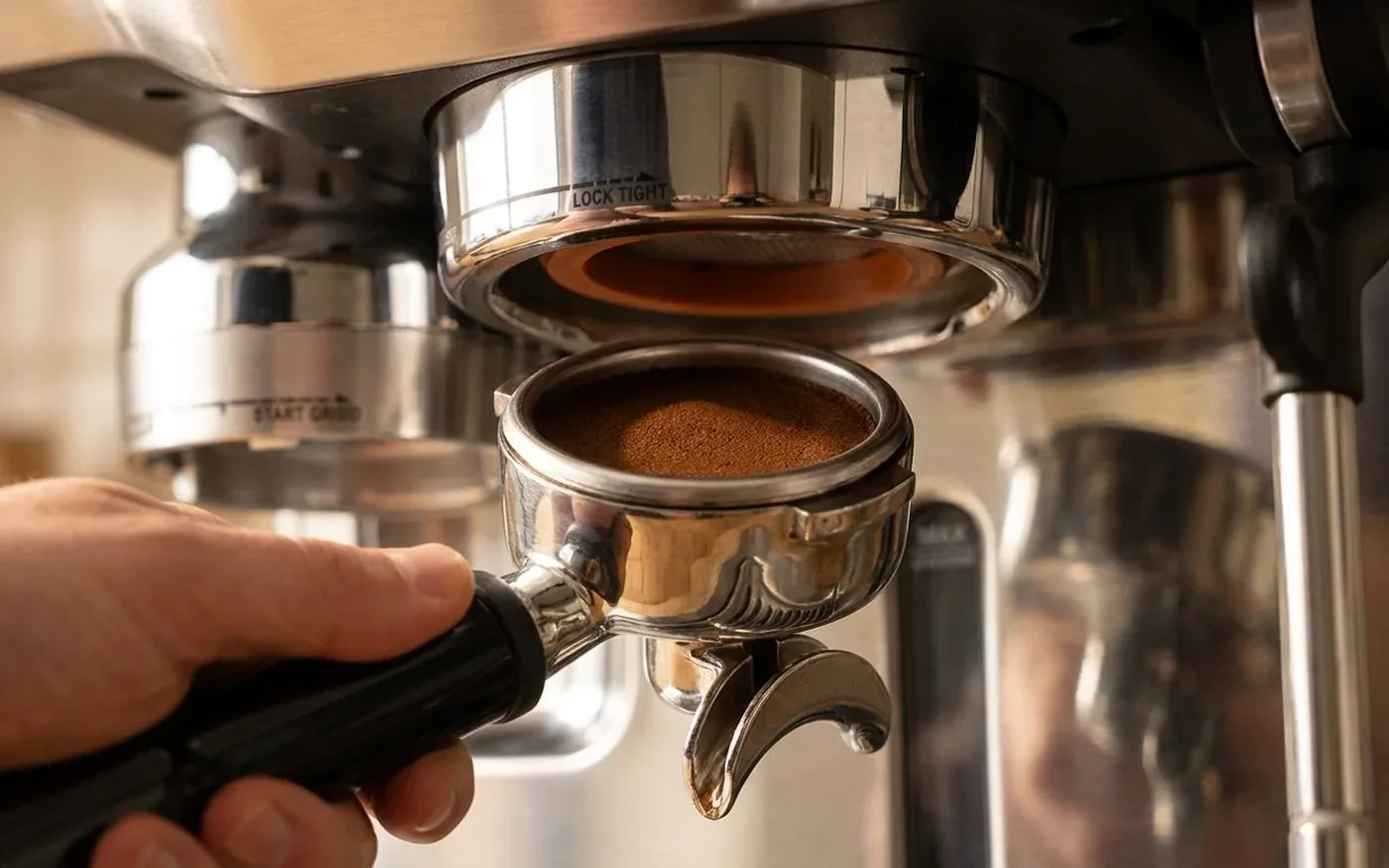
Automatic puck preparation made the Oracle the first Sage machine at this tier to remove grind, dose, and tamp variables from the user's hands. You load beans, set the grind once, and the machine handles the rest of the preparation into a 58mm portafilter. For buyers who had not spent time developing manual puck technique, this removed the three steps most likely to produce inconsistent shots.
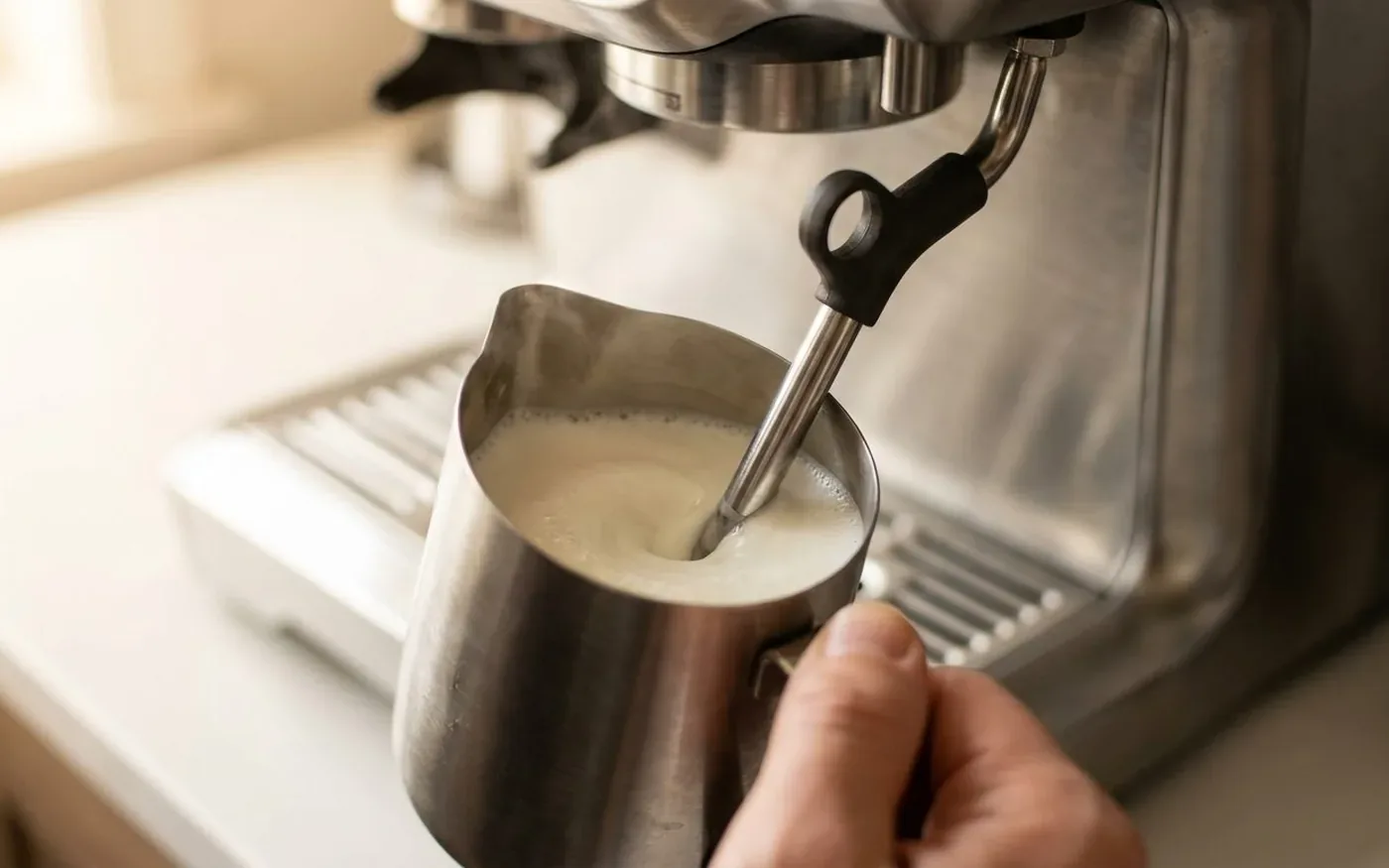
Manual steaming is where the Oracle required skill. Steam pressure on this machine is serious - measurably more than the Barista or Bambino range - and the technique needed to produce properly stretched microfoam is real. For households where someone already knew how to steam milk, this was not a limitation. For buyers who wanted to learn, best barista lessons uk or regular practice were both realistic paths. For buyers who simply wanted consistent results without developing that skill, the Oracle Touch addressed that limitation directly.
Bean quality is genuinely audible in the cup at this machine level. If you are buying an Oracle or Oracle Touch for the secondhand market, it is worth pairing it with quality-focused sourcing. The dual-boiler temperature stability makes what is in the hopper more visible, not less. The best coffee beans for espresso uk article covers what performs well at this extraction level.
Secondhand availability: No longer available new. Search eBay UK and Gumtree for used examples. Typical secondhand range as of May 2026: £700-1,200 depending on condition and age. See the Should You Buy Used section below before purchasing.
The Oracle Touch: What It Added
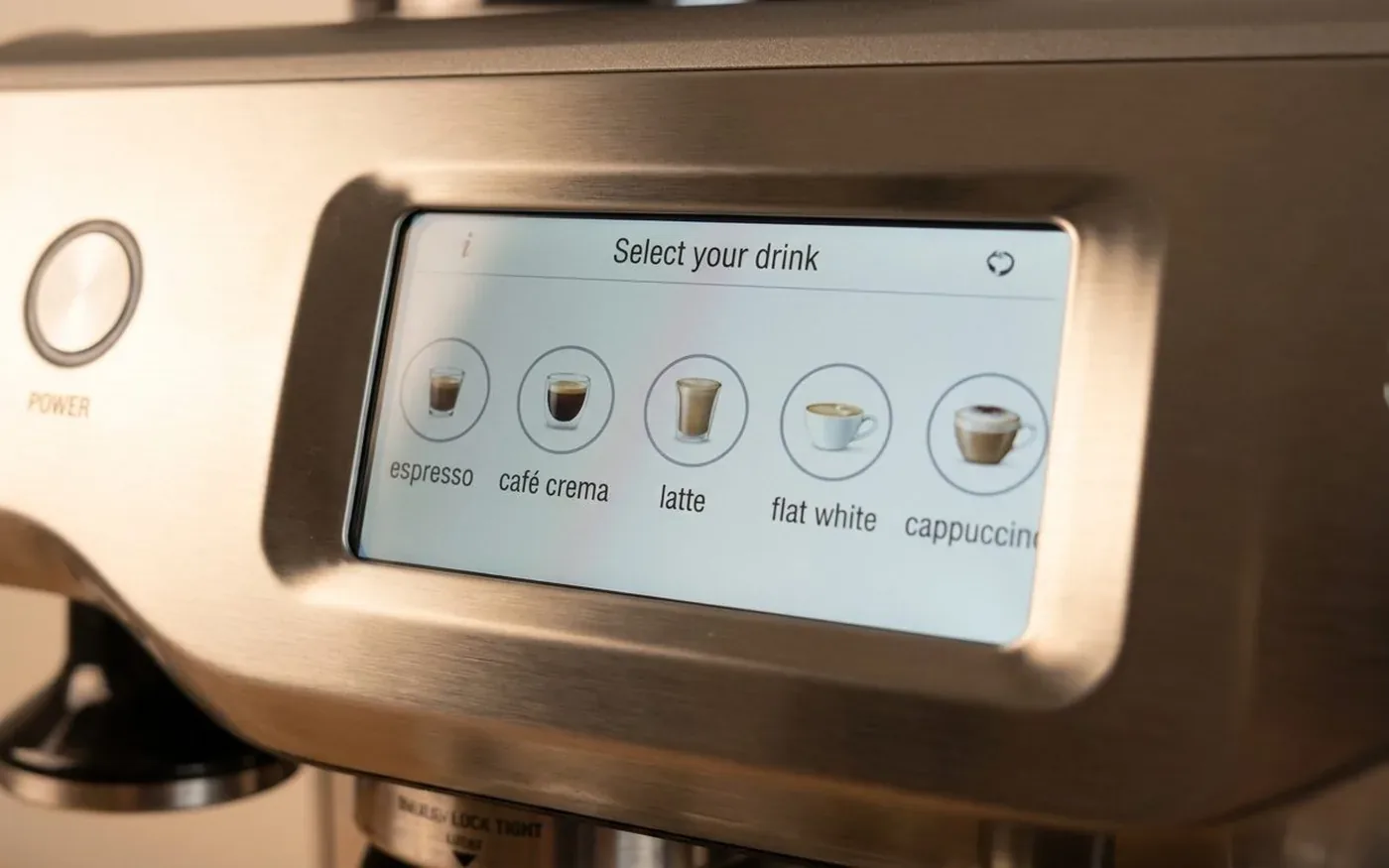
At £2,099.95 new, the Oracle Touch premium was entirely in the interface layer. The espresso hardware - dual boilers, automatic puck preparation, 58mm portafilter, PID temperature control - was identical to the standard Oracle. Buyers paid approximately £300 extra for three additions: a 5.7" TFT colour touchscreen, five pre-programmed drink modes (espresso, americano, flat white, latte, cappuccino), and Auto MilQ automatic milk texturing.
Auto MilQ removes manual steaming from the workflow. You select a drink, press start, and the machine extracts the shot and textures the milk automatically. Eight personalised settings let you save your preferred grind, dose, temperature, and milk parameters. Once dialled in, the Oracle Touch functions as a push-button machine for daily use.
Having assessed the Oracle Touch through The Editor Lab: automatic milk texturing produces consistent results on whole dairy milk. Oat milk and other alternative milks behave less predictably with Auto MilQ, as with any automatic texturing system. If plant-based milk is your primary choice, this is worth factoring into your secondhand buying decision - and worth testing if a seller will permit it. The full oracle touch review covers Auto MilQ performance and the dual-boiler workflow in full detail.
The touchscreen is not faster than the Oracle's digital controls for users who already know what settings they want. What it offers is guided workflow for users who are new to the machine or who share it across a household with different preferences. The step-up from the Oracle to the Oracle Touch follows exactly the same logic as the sage barista touch review comparison to the Barista Pro: same espresso hardware, touchscreen and auto-milk on top, price premium for the interface.
Secondhand availability: No longer available new. Typical secondhand range as of May 2026: £900-1,600 depending on condition. The touchscreen and Auto MilQ hardware remain present and functional in good used examples.
What Replaced the Oracle: Two Different Successors
Sage replaced the Oracle and Oracle Touch with two machines that serve different buyer needs.
Launched October 2024, Sage's current Oracle-range machine is the Oracle Jet (£1,699.95). It uses a ThermoJet heating system rather than true dual boilers - fast three-second heat-up, WiFi connectivity, over-the-air firmware updates, and Auto MilQ included. The architecture is different to the machines it replaced: a ThermoJet heating system that cycles between brew and steam temperatures is not the same as two independent boilers, though the practical difference varies by how you use the machine. Balance Journal's sage oracle jet review covers this distinction and the Oracle Jet's full performance in detail.
The Oracle Dual Boiler (£2,499.95, launched September 2025) is the true dual-boiler successor. Two independent boilers, the same 45-setting Baratza-partnership grinder from the Oracle Jet, and the full simultaneous brew-and-steam workflow that the Oracle and Oracle Touch delivered. For buyers who specifically want dual-boiler architecture, this is the more direct current equivalent.
Current retail for both: Sage UK (Oracle Jet, Oracle Dual Boiler), John Lewis, Amazon UK, Currys.
Should You Buy the Oracle or Oracle Touch Used?
For the right buyer, with the right example, a secondhand Oracle is a strong value proposition. Genuine dual-boiler extraction capability at £700-1,000 secondhand is not available from any new machine. The caveat is that 'the right example' is carrying significant weight in that sentence.
The puck preparation system is the first thing to inspect. The Oracle's automatic grinding, dosing, and tamping mechanism is the most mechanically complex part of the machine - and the most common failure point in secondhand examples. On commercial dual-boiler equipment, puck preparation systems require regular calibration and maintenance. On a secondhand Oracle, this mechanism has years of use behind it. Ask for a live demonstration of a complete puck preparation cycle before agreeing to any price. If the seller declines or the demonstration is inconclusive, treat it as a warning. Repair costs for a worn puck preparation system can exceed the machine's secondhand value.
Boiler condition is the second check. Ask when the machine was last descaled and whether the boilers have been professionally serviced. A dual-boiler machine that has sat unused for an extended period without maintenance may have scale on the boiler elements that affects temperature stability. This is repairable, but adds to the cost of ownership.
Spare parts availability. Sage maintains support inventories for discontinued models, and UK consumer law requires spare parts availability for several years post-discontinuation. Before purchasing any secondhand Oracle, verify the current status at Sage spare parts portal or contact Sage UK directly to confirm parts are available for the BES980 or SES990. Do not rely on estimates - the actual answer takes one email.
When a secondhand Oracle makes clear sense: the machine is under five years old, the seller demonstrates puck preparation running correctly, the asking price for the Oracle is £800 or below and for the Oracle Touch £1,000 or below, and you are prepared for a machine that requires more maintenance attention than a current-production single-boiler machine.
When to pass: the seller cannot demonstrate puck preparation, machine age is unknown, the asking price is within £400 of an Oracle Jet new, or the boiler has never been professionally serviced.
Was the Oracle Touch Worth the Extra Cost?
On the secondhand market, the Oracle Touch typically commands a £200-400 premium over a comparable Oracle. The same question that applied when both were new applies today: are auto-milk and the touchscreen worth the gap?
If your household primarily makes milk-based espresso drinks - flat whites, lattes, cappuccinos - and consistent results without developing manual steaming technique are what you need, the Touch premium is rational. Auto MilQ and the guided drink modes are genuine daily-use improvements, not theoretical ones. Those improvements exist in the secondhand machine just as they did when new.
If your priority is developing manual milk skills or maximising control over the espresso extraction process, the standard Oracle delivers the same dual-boiler hardware at a lower entry price. Saving £200-400 on the used price and investing in a decent milk practice routine reaches the same outcome with more skill gained. The verdict logic here mirrors what we found in sage barista pro vs barista touch: same espresso platform, meaningful daily-use improvement on the Touch, rational premium if you will actually use the automation.
Full Technical Spec Comparison
| Specification | Sage Oracle (BES980) | Sage Oracle Touch (SES990) |
|---|---|---|
| Model number | BES980 / SES980 | SES990 / BES990 |
| Status | Discontinued | Discontinued |
| Last UK RRP | £1,799.95 | £2,099.95 |
| Boiler type | True dual boiler | True dual boiler |
| Brew boiler capacity | 0.3L | 0.3L |
| Steam boiler capacity | 0.95L | 0.95L |
| Puck preparation | Auto grind, dose, tamp | Auto grind, dose, tamp |
| Portafilter size | 58mm | 58mm |
| Display | Digital readout | 5.7" TFT colour touchscreen |
| Milk system | Manual steam wand | Auto MilQ + manual |
| Saved profiles | N/A | 8 personalised settings |
| Water tank | 2.5L | 2.5L |
| Bean hopper | 280g | 280g |
| Wattage | 2400W | 2400W |
| Pump pressure | 15 bar (9 bar extraction) | 15 bar (9 bar extraction) |
| Temperature control | PID | PID |
Source: uk.sageappliances.com (archived product pages BES980/SES990). Specifications verified via Sage UK product data at time of writing.
Verdict
Both machines are discontinued, and both are worth buying secondhand under the right conditions.
The Oracle is the stronger secondhand buy for buyers who want the lowest entry price to genuine dual-boiler espresso hardware and have the steaming skill to use the manual wand effectively. Find a well-maintained example under five years old, test the puck preparation system, and the dual-boiler platform delivers something no new machine offers at the same price.
The Oracle Touch is the better buy for households where automatic milk texturing and touchscreen workflow are genuinely useful day-to-day. If the secondhand premium over a comparable Oracle is within £300-400, the same espresso hardware comes with meaningfully better usability for milk drinks.
For buyers who want a new machine, the Oracle Jet review covers the current Oracle-range machine in full. For buyers who specifically want dual-boiler architecture new, the Oracle Dual Boiler at £2,499.95 is the true current successor to both discontinued machines.
Frequently Asked Questions
Is the Sage Oracle discontinued?
Yes. Both the Sage Oracle (BES980) and Sage Oracle Touch (SES990) have been discontinued by Sage and are no longer available new in the UK. Neither machine appears in Sage's current product range as of 2026. The Oracle Jet and Oracle Dual Boiler are the current replacements at £1,699.95 and £2,499.95 respectively.
What replaced the Sage Oracle?
Sage replaced the Oracle range with two machines: the Oracle Jet (£1,699.95, launched October 2024), which uses a ThermoJet heating system rather than true dual boilers, and the Oracle Dual Boiler (£2,499.95, launched September 2025), which is the true dual-boiler successor with an updated 45-setting grinder. For Oracle Jet details, see Balance Journal's full review.
What is the difference between the Sage Oracle and Oracle Touch?
The Oracle Touch added a TFT colour touchscreen, five pre-programmed drink modes, and Auto MilQ automatic milk texturing to the standard Oracle's platform. The espresso hardware - dual boilers, automatic puck preparation, 58mm portafilter, PID temperature control - was identical on both machines. The Touch commanded approximately £300 more at retail, and a similar premium on the secondhand market today.
Can I still buy a Sage Oracle new?
No. Both the Oracle and Oracle Touch are discontinued and no longer available new from Sage, John Lewis, Currys, Amazon UK, or other UK retailers. Used and refurbished examples are available on eBay UK and similar platforms. The Oracle Jet (£1,699.95) and Oracle Dual Boiler (£2,499.95) are the current new options in the Sage Oracle range.
Is it worth buying a used Sage Oracle in 2026?
Yes, under the right conditions. A well-maintained Oracle under five years old, with a demonstrably functioning puck preparation system, offers genuine dual-boiler espresso capability at a secondhand price no new machine matches. Inspect the puck preparation mechanism carefully - it is the most common failure point on secondhand examples. Verify spare parts availability with Sage UK before committing. For buyers who want the same hardware with automatic milk texturing, the Oracle Touch secondhand trades at a £200-400 premium over a comparable Oracle and delivers the same dual-boiler espresso foundation. See the Speciality Coffee Association's brewing standards at Speciality Coffee Association for the extraction temperature benchmarks these machines were designed to meet.
How much does a used Sage Oracle Touch cost in the UK?
Used Oracle Touch machines (SES990) sell on eBay UK and Back Market for roughly £600 to £900, depending on condition and included accessories. The original retail price was around £1,499. Well-maintained examples under five years old with the original steam wand and manual in the box typically sit toward the top of that range. Factor in the age of the machine - older stock may need a service.
Which should I buy secondhand - the Oracle or the Oracle Touch?
Buy the Oracle if you want the lowest entry price into dual-boiler espresso and plan to steam milk manually. Buy the Oracle Touch if automatic milk texturing matters to you or you want the touchscreen drink presets. Both use identical espresso hardware. The Touch commands a £150 to £300 premium on the secondhand market, which is a smaller gap than the original £300-plus retail difference.
Does the Oracle Touch have automatic milk frothing?
Yes. The Oracle Touch includes Auto MilQ, an integrated automatic milk frother that heats and textures milk to a set temperature and consistency without manual steaming. The standard Oracle does not have this feature - it has a manual steam wand only. On the Oracle Touch you can still use the steam wand manually if you prefer to texture milk by hand.
A wellness entrepreneur and biohacker, James explores the intersection of hospitality and health - from clean fuel and recovery tools to mindful routines that build balance into daily life.