Sage Barista Express vs Barista Pro: Which Should You Buy?

Coffee & Wellness Writer
Most buyers should start with the Express. We explain exactly when the Pro's £230 premium is worth paying.
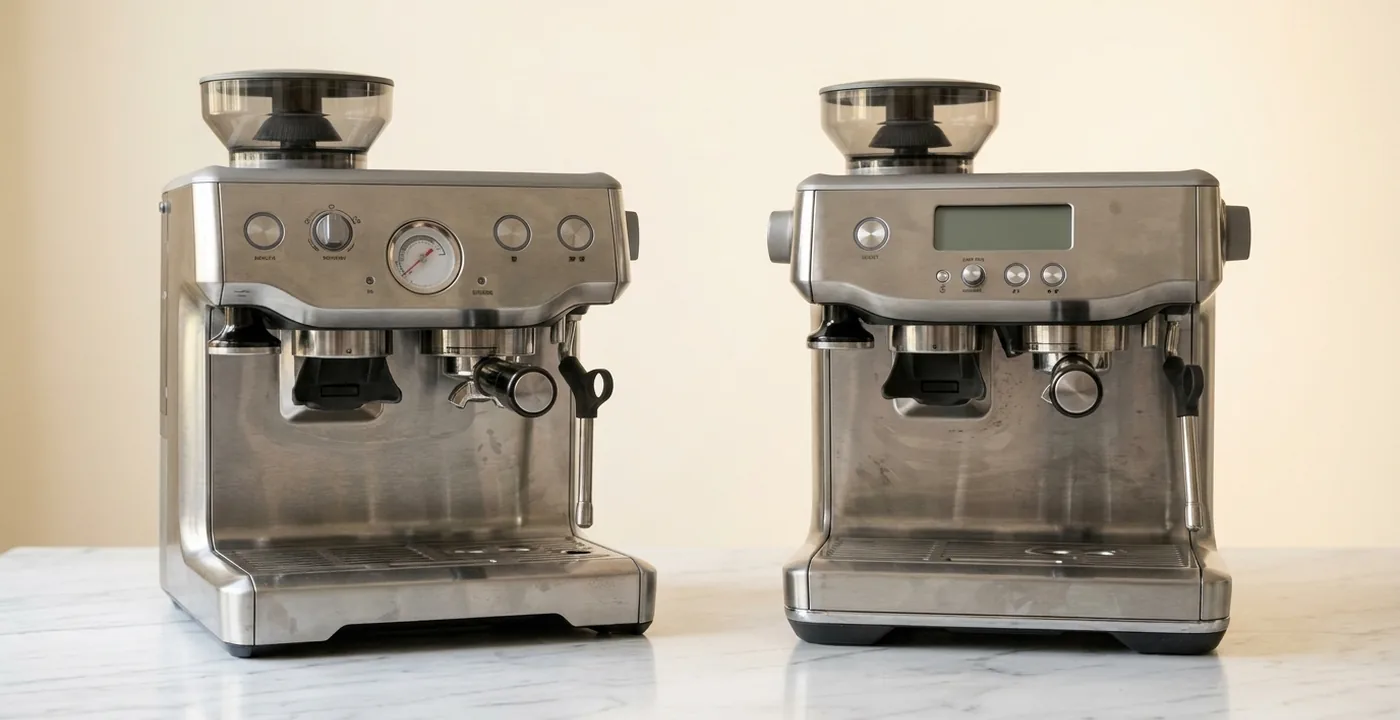
Table of Contents
Some of the links in this article are affiliate links, which help fund our independent review work at no extra cost to you. Every recommendation is based on hands-on testing through The Editor Lab methodology. No brand pays to appear, and no placement is guaranteed.
When my parents asked which home espresso machine to buy at the start of the first COVID lockdown, I did not hesitate. I bought them the Barista Pro. Six years on, it is still in their kitchen, and the question they asked in 2020 is the same one you are asking now: is the Barista Pro worth the extra £200 over the Barista Express?
Both machines have been tested and reviewed independently on Balance Journal — the full Sage Barista Express review and Sage Barista Pro review cover each machine in full detail. The findings below draw directly on those hands-on sessions alongside five and a half years matching espresso equipment to some of the UK's best independent roasters at Sanremo UK.
Both machines share the same core architecture: an integrated conical burr grinder, a manual steam wand, and Sage build quality at a price point that most UK coffee shops cannot reach in equipment terms. The price difference between them is approximately £230 at current UK retail. The differences are real, specific, and matter considerably for certain types of buyer.
Editor's Note
Quick Verdict
Buy the Barista Express if this is your first proper espresso machine, your budget sits below £600, and you drink medium to dark roast whole bean coffee. The analogue pressure gauge makes dialling in more intuitive for beginners than any digital display, and the integrated grinder is capable enough for daily use on mainstream roast profiles. At £499.95 from Sage direct in May 2026, it is the rational starting point.
Buy the Barista Pro if you are already pulling shots regularly, want tighter control over extraction temperature, and plan to explore light roast specialty coffee. The ThermoJet three-second heat-up, 30-setting grinder, and LCD temperature control in two-degree increments make a practical difference when you are using the machine deliberately. At £729.95, you are paying for precision tools that require intentional use to justify the cost.
The honest answer on the price gap: for most buyers, the Express is the better starting point. For buyers who already know they will push beyond the basics from day one, the Pro's upgrades earn their cost.
Quick Buy
| Sage Barista Express | Sage Barista Pro | |
|---|---|---|
| UK RRP (May 2026) | £499.95 | £729.95 |
| Best for | First espresso machine, medium roast, analogue simplicity | Experienced home baristas, light roast, more control |
| Buy | Sage direct | Sage direct |
Key Differences at a Glance
Three seconds versus thirty seconds. That gap between ThermoJet and ThermoCoil heat-up times is the most practically relevant difference between these two machines. The Express uses ThermoCoil technology - Sage's thermocoil-based system - which delivers stable brew temperature but requires a longer warm-up. The Pro uses ThermoJet, a faster heating variant that reaches brew temperature in approximately three seconds. That difference changes the morning routine for anyone making multiple drinks.
Where does the Express fall short first? The grinder. The Express has 16 settings with micro-adjust positions between steps. The Pro has 30. More settings mean more resolution for dialling in light roast specialty coffee, where fine grind adjustments produce measurable extraction differences.
The comparison table below is verified against uk.sageappliances.com in May 2026.
| Sage Barista Express | Sage Barista Pro | |
|---|---|---|
| Price (May 2026) | £499.95 | £729.95 |
| Heating system | ThermoCoil | ThermoJet (3-second heat-up) |
| Grinder settings | 16 + micro-adjust | 30 |
| Interface | Analogue dials + pressure gauge | LCD display + shot timer |
| Steam wand tip | 1-hole | 4-hole |
| Pre-infusion | Automatic (fixed) | Manual control via LCD |
| Brew temp control | Limited | 2°C increments via LCD |
| Portafilter | 54mm | 54mm |
| Pump pressure | 15 bar (9-bar extraction) | 15 bar (9-bar extraction) |
| Weight | 9.8 kg | 8.8 kg |
What the table means in daily use: the most important rows are heating system, grinder settings, and interface. The portafilter and pump pressure are identical - your espresso extraction starts from the same mechanical foundation on both machines. The price difference buys control tools, not different underlying hardware.
Sage Barista Express: What You Get
The Barista Express (SES875) is the entry point of Sage's integrated grinder range. ThermoCoil heating - Sage's thermocoil-based system - delivers stable brew temperature once the machine is up to temperature. The 54mm portafilter and 15-bar pump (running at nine bars of extraction pressure) produce consistent espresso across medium roast beans.
During dialling in, the analogue pressure gauge gives you real-time extraction pressure feedback - something the Pro's LCD does not replicate. That feedback shortens the calibration process considerably in the first weeks of ownership. The Barista Pro does not have a pressure gauge - that is a genuine trade-off, not a marketing oversight.
Sixteen grind settings cover medium and dark roast whole beans adequately for daily use. The manual steam wand produces workable microfoam once you have developed your technique. Both are capable within their limits, and both limits are covered in the head-to-head sections below.
Before ordering, verify your counter depth - the grinder mechanism adds height, and a tight cabinet-to-counter gap makes loading beans awkward.
Read the full Sage Barista Express review for complete test findings.
Retailers (May 2026): Sage (£499.95, buy direct) | Amazon UK (£499-549, buy on Amazon) | John Lewis (check John Lewis) | Currys (check Currys)
Sage Barista Pro: What You Get
The Barista Pro (SES878) is the next step in Sage's integrated range. At £729.95 direct in May 2026, it markets itself on three upgrades over the Express: faster heat-up, more grinder settings, and digital controls.
ThermoJet heating is the headline claim. Three seconds from off to brew temperature is accurate - not an approximation. For anyone who has waited five to eight minutes for a machine to stabilise, that time saving is a real change in morning routine. Pre-infusion on the Pro is manually controlled via the LCD, which means you can saturate the coffee puck with low-pressure water before full extraction begins - producing better extraction evenness, particularly on lighter roasts. Pre-infusion is the process where water enters the puck at low pressure before full extraction begins, allowing grounds to bloom and even out before the full 9-bar pressure is applied.
The LCD display shows shot time in real time. You dial in by time and taste rather than pressure, which is how most experienced home baristas work. The 30-setting grinder and four-hole steam wand are both meaningful upgrades over the Express, covered in detail in the head-to-head sections.
What the Pro does not have: a pressure gauge. If that specific feedback matters for your learning process, the Express deserves reconsideration regardless of budget.
Read the full Sage Barista Pro review for complete test findings.
Retailers (May 2026): Sage (£729.95, buy direct). Also available at Amazon UK, John Lewis, and Currys - check current prices direct from those retailers.
Head-to-Head: Grinder Performance
The integrated grinder is where the practical gap between these two machines is most relevant in day-to-day use.
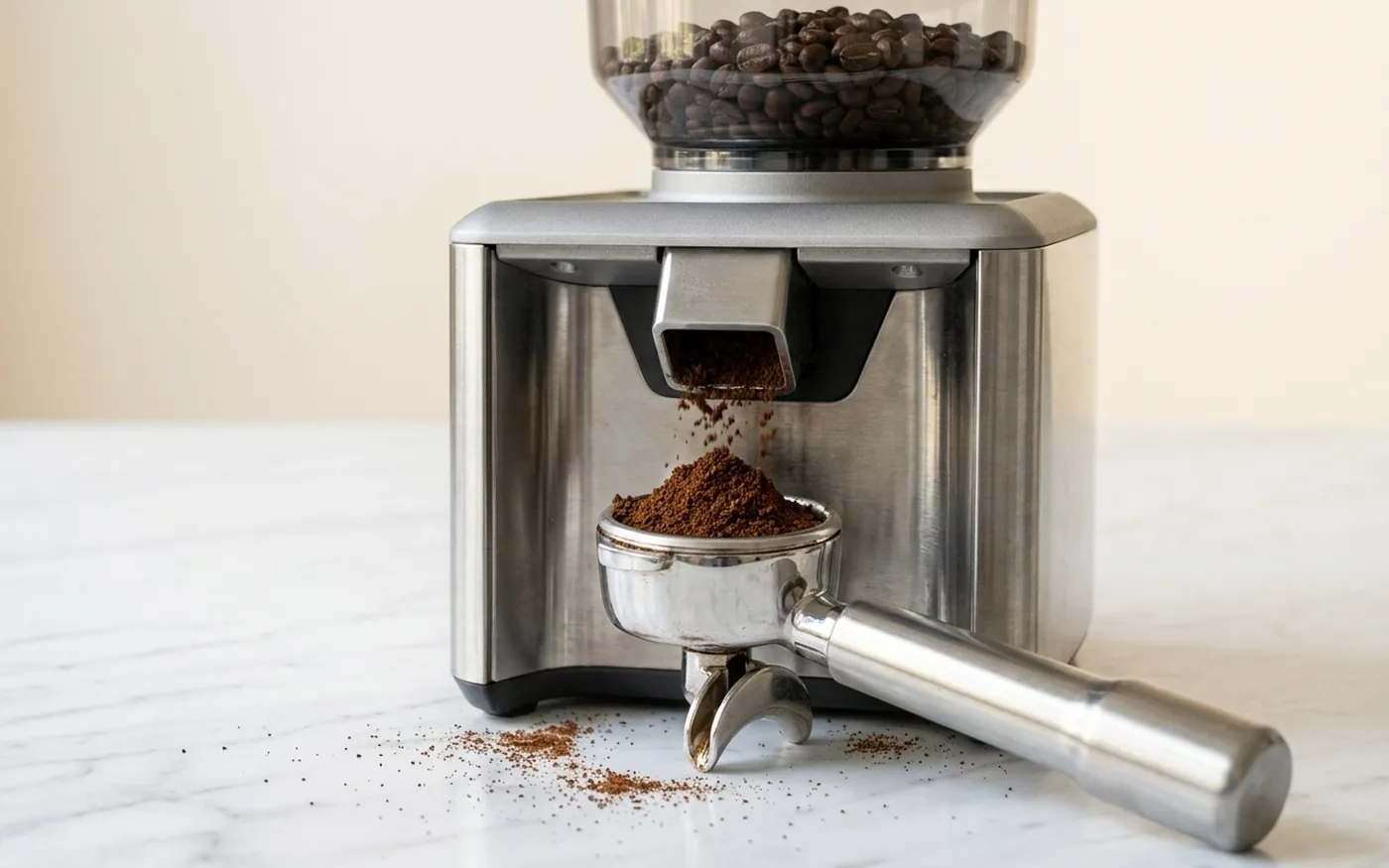
The Express's grinder, with 16 main settings and micro-adjust positions between each step, is capable for medium and dark roast whole beans. The friction emerges when you switch beans or change roast profiles. The single-dose chute on the Express requires recalibration on finer settings, and grind output can vary by half a gram to a full gram between shots until the machine settles after a bean change. That is not a manufacturing defect - it is the expected behaviour of an integrated grinder at this price. Sage's marketing does not feature it prominently.
The Pro's 30 settings and integrated shot timer give you more resolution and marginally more consistent dose output on finer settings. Switching beans still requires recalibration - that is true of any conical burr at this price - but the additional increments mean you are more likely to find the correct setting without extended micro-adjusting.
The honest benchmark: neither machine competes with a dedicated standalone grinder at a similar spend. The Specialty Coffee Association espresso brewing standards specify dose, time, and pressure parameters that both machines can meet on medium roast beans with correct technique. For specialty-grade light roasts, a dedicated grinder produces better particle distribution than either integrated option. If that is how you intend to brew, a Sage Bambino vs Bambino Plus setup paired with a standalone grinder delivers more precision at a similar combined cost.
The practical verdict: for medium and dark roast everyday espresso, both grinders perform adequately. For light roast specialty coffee, the Pro's 30 settings give you meaningfully more to work with.
Head-to-Head: Espresso Quality and Temperature Control
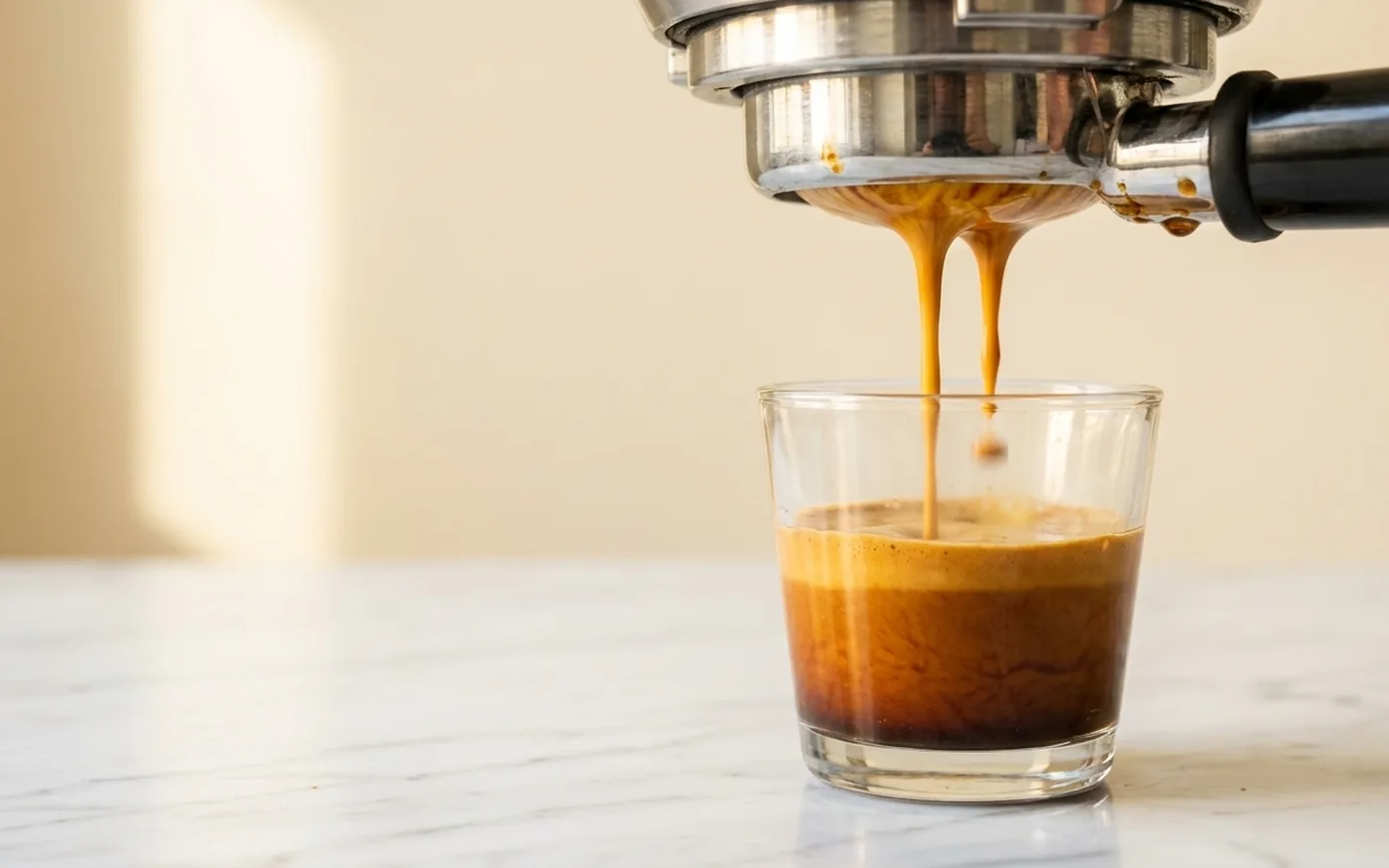
On medium roast beans with correct technique, both machines produce espresso that exceeds most UK coffee shop output. That is not promotional framing - it is the straightforward assessment from back-to-back testing. The espresso hardware shares the same 54mm portafilter, the same 15-bar pump at nine bars of extraction, and the same core extraction process.
The difference is temperature control. ThermoCoil heating on the Express operates at a fixed brew temperature with limited manual adjustment. ThermoJet heating on the Pro reaches brew temperature in three seconds and allows adjustment in two-degree increments via the LCD, across a range spanning the full recommended espresso extraction window. The SCA recommends 90-96°C for espresso extraction. Light roasts extract best towards the higher end of that range - a distinction the Express cannot address with precision.
A conical burr grinder is one where two cone-shaped burrs rotate against each other to grind coffee, as opposed to flat burr geometry found in most high-end dedicated grinders. Both machines use the same basic burr geometry. The extraction quality difference comes from temperature control and grinder resolution, not from different burr designs.
Does the Pro make better espresso? In experienced hands, with active temperature adjustment and light roast beans: yes, marginally. For buyers making medium roast drinks daily and focused on developing technique before experimenting with settings, the quality difference is less meaningful than learning to use whichever machine you buy.
Head-to-Head: Usability and Learning Curve
The Barista Pro's LCD menu system frustrates buyers expecting a simpler experience than the Express. Setting a custom extraction time, adjusting brew temperature, and navigating the shot settings menu requires reading the manual. Sage's marketing describes the Pro as an 'intuitive upgrade' over the Express. In the first two weeks of ownership, the analogue Express is more immediately navigable for most buyers.
That framing shifts. Once you have worked through the LCD settings once - an afternoon, not a week - the controls become second nature. The real-time shot timer gives you extraction feedback the analogue dials cannot replicate. At that point, the Pro's control architecture starts to earn its cost.
The Express's analogue dials and pressure gauge give you two pieces of simultaneous information during every shot: grind output and extraction pressure, both visible without pressing a button. For buyers who want to understand what the machine is doing from the first morning, that transparency has genuine value. It is the reason you might choose the Express even if your budget can stretch to the Pro.
Is the Barista Pro Worth the Extra Cost?
The price difference between these machines at UK retail in May 2026 is approximately £230. That is not a trivial sum, and it deserves a direct answer.
The Pro is worth the extra cost if you meet three conditions: you make two or more espresso-based drinks daily, you intend to dial in actively rather than find a setting and leave it, and you plan to brew light roast specialty coffee at some point during the machine's life. The grinder resolution, temperature control, and faster heat-up all pay off when you use the machine intentionally and regularly.
The Pro is not worth the extra cost if your primary interest is reliable morning coffee without regular adjustment, you drink medium to dark roast exclusively, or the price stretch creates genuine financial pressure. At £499.95, the Express gives you enough machine to produce genuinely good espresso for years.
One forward-looking note: if automatic milk texturing matters to you, the Sage Barista Pro vs Barista Touch is the relevant next comparison. The Touch adds a touchscreen and automated steam system at approximately £799. The espresso hardware is identical on both the Pro and the Touch - you are paying the Touch premium for the milk side, not for better shots.
For buyers questioning whether either machine suits them at all: the Sage Bambino vs Bambino Plus is the right comparison if counter space or budget is tighter. A Bambino Plus paired with a standalone grinder produces more espresso precision at a similar or lower combined cost than either integrated machine here.
Who Should Buy the Barista Express
Buy the Barista Express if you fit this profile:
- This is your first proper espresso machine
- Your budget sits below £600
- You drink medium to dark roast whole bean coffee
- You make milk-based drinks daily and want to develop steaming technique over time
- You want one machine on the counter without a grinder alongside it
- Real-time pressure gauge feedback during extraction sounds useful, not irrelevant
Consider alternatives if you plan to drink exclusively light roast specialty coffee from day one, or if you already own a quality standalone grinder (the integrated design loses its value proposition if a dedicated grinder is already on your counter).
The lower-budget alternative: the Sage Bambino vs Bambino Plus comparison is relevant for buyers who want a smaller footprint and are comfortable sourcing a separate grinder. See also the sage barista express vs barista express impress comparison (coming to Balance Journal) if auto-dosing and an updated grinder are priorities.
Who Should Buy the Barista Pro
Buy the Barista Pro if you fit this profile:
- You have used a basic espresso machine before and want more control
- You drink black espresso or single-origin shots and plan to experiment with different roast profiles
- Your budget allows £730 and you intend to use the machine's controls deliberately
- You want a four-hole steam wand for faster milk texturing
- Three-second heat-up makes a practical difference to your morning routine
- Light roast specialty coffee is either a current interest or a planned one
Consider the next tier up if automatic milk texturing matters: the sage barista pro vs barista touch comparison is the relevant decision at that point. The Touch adds touchscreen control and automated milk texturing at approximately £799. The espresso on both is identical.
For buyers who want a fully automatic bean-to-cup alternative with no portafilter involvement, the De'Longhi Magnifica Evo review covers a different category worth understanding before committing to a semi-automatic machine.
Full Specification Comparison
| Specification | Sage Barista Express (SES875) | Sage Barista Pro (SES878) |
|---|---|---|
| UK RRP (May 2026) | £499.95 | £729.95 |
| Heating system | ThermoCoil | ThermoJet |
| Heat-up time | ~30 seconds to stability | ~3 seconds |
| Grinder type | Conical burr | Conical burr |
| Grinder settings | 16 + micro-adjust | 30 |
| Portafilter size | 54mm | 54mm |
| Pump pressure | 15 bar (9-bar extraction) | 15 bar (9-bar extraction) |
| Steam wand tip | 1-hole | 4-hole |
| Brew temp control | Fixed (limited adjust) | 2°C increments via LCD |
| Pre-infusion | Automatic (fixed) | Manual control |
| Interface | Analogue dials + pressure gauge | LCD display + shot timer |
| Water tank | 2L | 2L |
| Weight | 9.8 kg | 8.8 kg |
Sources: uk.sageappliances.com, verified May 2026.
Verdict
For most buyers choosing between these two machines, the Express is the better starting point. The pressure gauge, analogue simplicity, and £230 lower price point make it the rational entry into this category. The grinder handles medium and dark roast whole beans capably. The espresso hardware is strong. You can produce consistently good shots without technical background.
The Pro makes its case when you are already pulling shots regularly and want tools to develop further - temperature control for light roast work, more grinder resolution, and faster heat-up for back-to-back drinks. If that describes where you are now rather than where you intend to be in six months, the Pro is the correct machine. If you are still finding your feet on espresso, the Express is.
Both machines benefit significantly from using quality whole beans. Pairing either with the best coffee beans for espresso uk from a specialty roaster produces noticeably better results than supermarket pre-ground, regardless of which machine you buy.
For buyers comparing across the full Sage espresso range, the best sage coffee machine guide covers every model from the Bambino Plus to the Oracle Jet.
For complete per-machine findings: the Sage Barista Express review and Sage Barista Pro review are both live on Balance Journal.
Frequently Asked Questions
Is the Sage Barista Express Being Discontinued?
No. As of May 2026, the Barista Express is in active production and widely available through Sage direct, Amazon UK, John Lewis, and Currys. No discontinuation has been announced. The machine has been in continuous production since 2013. Buyers sometimes confuse this with updates to the Oracle and Oracle Jet range, which is a separate product line at a higher price point.
Does the Barista Pro Have a Built-In Grinder?
Yes. The Barista Pro (SES878) includes an integrated 30-setting conical burr grinder that doses directly into the portafilter. Both the Barista Express and the Barista Pro include an integrated grinder. The distinction matters versus the Bambino range - the Bambino and Bambino Plus do not include grinders and require a separate purchase. If a single machine covering both grinding and extraction is your goal, both the Express and the Pro satisfy it.
What Grind Size Should I Use on the Barista Express?
Start at setting five or six for medium roast whole beans and adjust from there. A correctly extracted double espresso should run between 25 and 35 seconds. If the shot runs faster than 25 seconds, the grind is too coarse - move finer. If the machine struggles to push water through or the shot runs beyond 40 seconds, move coarser. The pressure gauge on the Express gives you real-time feedback during the shot, making this calibration process more intuitive than on machines without one.
Can I Use Pre-Ground Coffee in the Barista Pro?
Yes. Both the Express and the Pro include a bypass doser for pre-ground coffee. Load it directly into the portafilter using the included dosing funnel and bypass the integrated grinder. Pre-ground is a workable option for occasional use. Freshly ground beans produce noticeably better extraction quality on both machines, because ground coffee loses its volatile compounds and CO2 within days of opening.
How Long Does the Barista Pro Take to Heat Up?
The Pro reaches brew temperature in approximately three seconds using ThermoJet heating. Pre-infusion begins immediately from cold. The Barista Express takes longer to reach stable brew temperature via its ThermoCoil system - allow 30 to 60 seconds before pulling your first shot. In a household making several drinks each morning, the Pro's faster heat-up is a practical time difference that compounds over a week of use.
Is the Barista Pro Worth the Extra Cost Over the Barista Express?
At UK prices of £629.95 for the Express and £729.95 for the Pro, the £100 gap buys three upgrades: a 3-second ThermoJet heat-up versus 30 to 60 seconds, a 4-hole steam wand that produces microfoam more consistently, and an LCD display with a shot timer. The espresso itself is not meaningfully different. The Pro earns its premium for daily milk drinkers. The Express is better value for mostly black coffee.
What is the Difference Between the Barista Express and the Barista Express Impress?
The Barista Express Impress (SES876) is a newer variant of the original Express (SES875). The Impress adds Intelligent Dosing, which measures grounds automatically once you have found your correct grind setting, and Assisted Tamping via a side lever, which eliminates inconsistent hand tamping. It also offers 25 grind settings versus 18 on the original Express. The core extraction hardware - boiler, pump, and portafilter - is the same across both.
Does the Barista Express Have a Steam Wand?
Yes. Both machines include a manual steam wand. The difference is the tip: the Express uses a single-hole tip that produces steam more slowly, giving more time during the stretch phase. The Pro uses a 4-hole tip similar to the Bambino Plus wand, which generates more volume and textures milk faster. Neither is automatic - both require you to hold and angle the pitcher manually throughout the steaming process.
Is the Pressure Gauge on the Barista Express Actually Useful?
Yes, particularly when learning to dial in. The gauge shows extraction pressure in real time. A reading in the espresso range confirms your grind and dose are correctly set. Once your recipe is dialled in, you will reference it less often. The Barista Pro removes the gauge in favour of an LCD timer. Beginners find the Express gauge a practical calibration aid that experienced baristas tend to outgrow.
Which is Noisier, the Barista Express or the Barista Pro?
The Barista Express is louder in daily use. Its Thermocoil system cycles actively between shots to hold temperature, producing audible pump and heating noise. The Pro is quieter - ThermoJet heats on demand in 3 seconds and stays silent between shots. Both machines produce similar grinder noise. If you make coffee early in a shared household, the Pro is the more considerate machine from a noise perspective.
A wellness entrepreneur and biohacker, James explores the intersection of hospitality and health - from clean fuel and recovery tools to mindful routines that build balance into daily life.