How to Grind Coffee Beans: Grind Sizes for Every Brewer

Coffee Writer & Biohacker
An SCA-certified, ex-Sanremo trainer on how to grind coffee beans for every brewer: a grind size chart, burr and blade steps, and a taste-based dial-in loop.
Table of Contents
Some of the links in this article are affiliate links, which help fund our independent review work at no extra cost to you. How we assessed these products is explained in this article and our Editor Lab methodology. No brand pays to appear, and no placement is guaranteed.
How to grind coffee beans well starts with one decision: picking the right size for your brew method, not the fanciest grinder you can afford. The right grind still cannot rescue a bad bag, so start with one of the best coffee beans in the UK and build your grind setting from there.
Weigh your beans, pick the grind for your brewer, grind only what you need, then taste and adjust:
- Weigh your beans. About 15g of coffee per 250ml of water is a sensible starting point for most brew methods.
- Pick the grind for your brewer. Coarse, like sea salt, for a cafetiere or cold brew. Medium, like table salt, for pour-over and filter machines. Fine for a moka pot or espresso.
- Grind only what you need, just before you brew.
- Taste and adjust. Sour or thin means grind finer. Bitter or harsh means grind coarser.
A burr grinder gives you the most even result across all four steps. A blade grinder or a kitchen tool from further down this page works for you too, with more effort, for anything coarser than a filter grind.
I learned to read a grind the way the Sanremo SWAT team taught me: by what it does in your cup, not by the number on a dial. Whichever brewer you use, and whatever grinder you own, burr, blade, hand-crank or nothing at all, the method below gets you there.
This guide draws on my training in grind distribution at Sanremo and the grinding research cited below, alongside the published guides of UK roasters. I have not personally tested the kitchen workarounds further down this page; they are described from those cited sources, not from testing of my own.
“I founded Balance Coffee in 2020. I learned grind distribution from the Sanremo SWAT team, and I grind on a Niche Zero every morning.”
Coffee Grind Size Chart for Every Brew Method
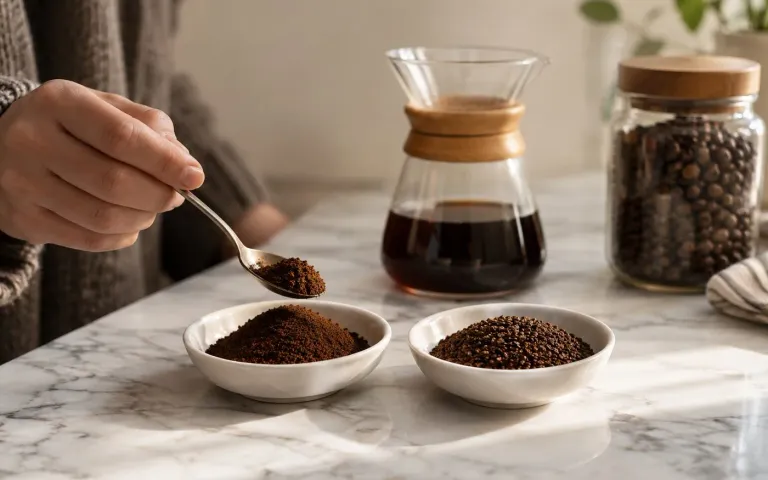
Every grind size question comes back to one variable: how long your brew keeps water in contact with the coffee. The longer the contact, the coarser your grind needs to be, which is why cold brew and a cafetiere sit at one end of the chart and espresso sits at the other.
| Brew Method | Grind Size | Feels Like |
|---|---|---|
| Turkish coffee | Extra fine | Flour or icing sugar |
| Espresso | Fine | Fine table salt, powdery (full numbers in our espresso grind size guide) |
| Moka pot | Fine to medium-fine | Slightly coarser than espresso (see our best coffee for moka pot guide) |
| AeroPress | Fine to medium | Caster sugar to breadcrumbs, depending on your recipe |
| Pour-over, V60, filter machine | Medium | Table salt |
| Chemex | Medium-coarse | Between table salt and sea salt |
| Cafetiere, French press | Coarse | Sea salt or rock salt |
| Cold brew | Extra coarse | Rock salt, coarser again |
Your rule for reading this chart in a hurry: the longer the water touches your coffee, the coarser the grind needs to be.
How to Grind Coffee Beans With a Burr Grinder
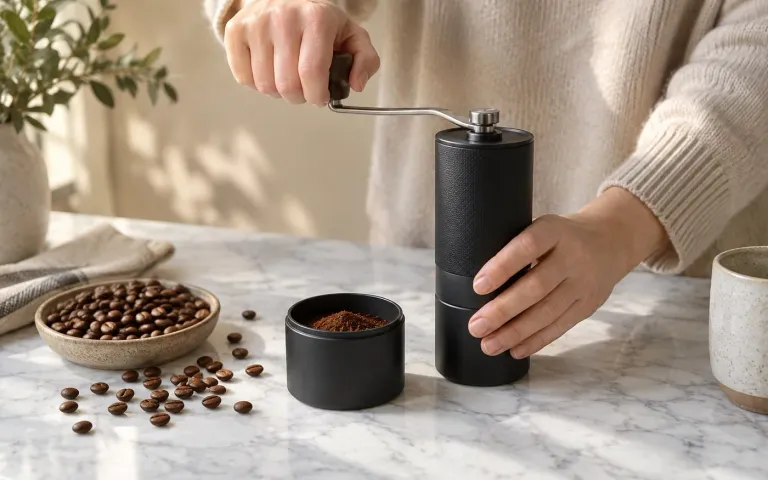
Electric or hand-powered, a burr grinder gets you there in five steps.
- Weigh your beans on a scale rather than a scoop. Grind size changes how densely beans pack, so a scoop measure never stays accurate for long.
- Set your grinder to the size your brewer needs, from the chart above.
- Grind into a dry container, never a damp mug or jug.
- Tap the hopper or chute to release any grounds clinging to the burrs. Retained grounds build up over a week of brewing and eventually drop into a later cup at the wrong dose.
- Brew straight away.
Burr grinders carry numbered settings, but the numbers are not standard between brands, or even between two grinders from the same brand. Start from your manufacturer's suggested range for your brew method, then move one notch at a time until your cup tastes right, using the dial-in loop further down this page.
A hand burr grinder, such as the entry-level Hario Mini Mill+, uses the same mechanism as an electric one, just powered by your arm. Hold the body firmly against your palm or your counter, and turn the handle in steady, even rotations rather than fast bursts, which keeps the particle size consistent through the whole grind.
Hand grinding a single cup of filter coffee takes a couple of minutes rather than a couple of seconds, and that is the honest trade-off against an electric burr grinder, which is also considerably louder on your counter. Neither is the wrong choice for you; they simply ask for different amounts of your time and your patience.
I learned grind distribution and particle size on the Sanremo SWAT team, and I grind on a Niche Zero at home every morning. If you are weighing up a hand grinder against an electric one, our best manual coffee grinder guide tests exactly that trade-off across several models.
How to Get a More Even Grind From a Blade Grinder
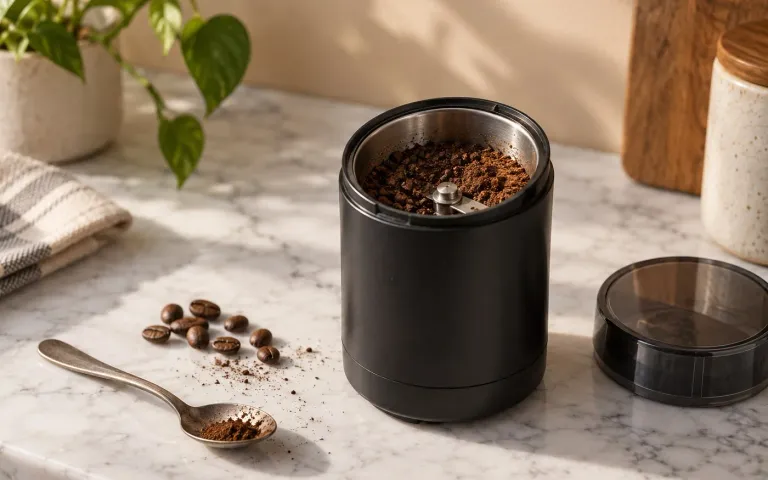
A blade grinder chops your beans with a spinning blade rather than crushing them to a set size, and the technique that gets you the most even result is short, repeated bursts rather than one long grind.
- Grind in pulses of two to three seconds each.
- Shake the grinder between pulses to move larger pieces down toward the blade.
- Grind in small batches. A grinder loaded past half full grinds unevenly no matter how carefully you pulse it.
- Judge fineness by time: shorter pulses for a coarser grind, more total time for a finer one.
A blade grinder cannot make an even coarse grind for you. It leaves boulders and powder side by side in the same batch, the biggest pieces barely touched while the smallest turn to dust, and that uneven mix is why cafetiere coffee from a blade grinder so often turns muddy and bitter at the bottom of your cup.
If that is happening in your kitchen, the practical fix is a fine sieve: sift your grounds after pulsing, then regrind whatever stays in the sieve for a few more seconds.
A blade grinder works best for you on filter and pour-over grinds, where a wide range of particle sizes matters less than it does for espresso or a cafetiere. If you are finding its limits, our best coffee grinder guide covers the step up to a burr grinder and what you actually gain from it.
Burr vs Blade Grinder: What Changes in the Cup
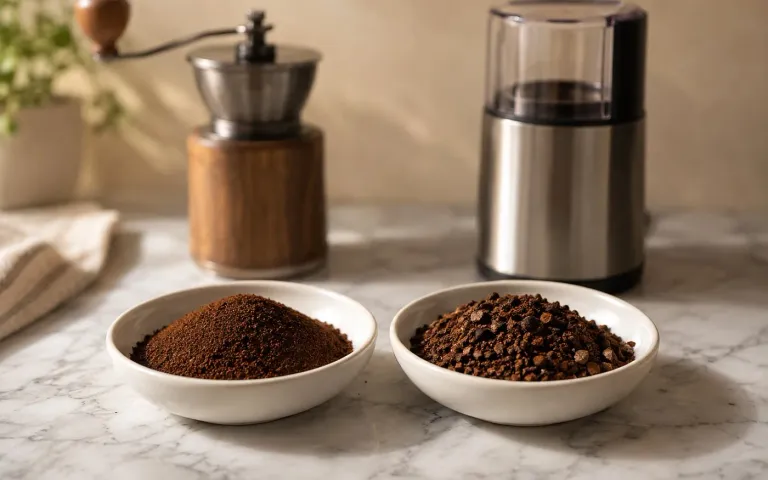
A burr grinder crushes your beans between two burrs set a fixed distance apart, producing particles of a consistent size. A blade grinder chops beans with a spinning blade, producing a mix of large and small pieces in the same batch.
That difference matters to you because particle size controls extraction. Water pulls flavour out of small particles, fines, faster than it pulls flavour out of large ones, boulders, so in a blade grind the fines over-extract and turn bitter while the boulders are still under-extracted and taste sour or thin, often in the same cup. An even burr grind extracts all its particles at close to the same rate, which is the main reason burr-ground coffee tastes cleaner across every brew method on the chart above.
Research published in Scientific Reports found that the resulting particle size distribution from grinding roasted coffee does not depend on where your beans came from or how they were processed, but it does depend on the grinding conditions themselves, including temperature: grinding cold beans produces a narrower spread of particle sizes and a smaller average size than grinding warm ones.
None of this settles whether you should own a burr grinder. That is a cost and commitment question covered properly in our best burr coffee grinder guide, not a verdict this page needs to make for you.
How to Grind Coffee Beans Without a Grinder
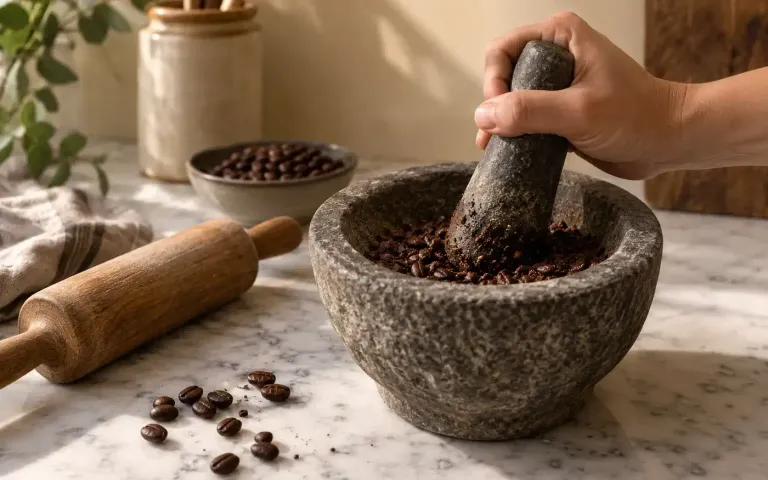
Five kitchen tools can grind your coffee beans without a dedicated grinder, each suited to a different brew and a different amount of effort from you.
| Method | Best Grind | Brewers It Suits | Effort |
|---|---|---|---|
| Blender | Coarse to medium | Cafetiere, cold brew | Low, a few short pulses |
| Food processor | Coarse | Cafetiere, cold brew, larger batches | Low |
| Mortar and pestle | Medium to fine | Pour-over, moka pot, single cups | High, slow by hand |
| Rolling pin in a freezer bag | Coarse | Cafetiere, cold brew | Medium, some arm work |
| Flat of a heavy knife or pan | Coarse | Cafetiere, small amounts | Medium |
Blender or food processor. Grind in pulses of around three seconds each, shaking the jug between pulses to move the larger pieces back down toward the blade, the same principle as pulsing a blade coffee grinder. A food processor handles a bigger batch for you at once but gives the same coarse, uneven result.
Mortar and pestle. Fill the mortar no more than a quarter full, then crush your beans with firm, controlled strokes before grinding them against the sides in a circular motion. This gets you closer to a fine, even grind than any other kitchen tool here, but it is slow and genuinely tiring for you across more than one cup, so treat it as a single-serving method rather than your everyday routine.
Rolling pin in a freezer bag. Seal your beans in a sturdy freezer bag, lay it flat, and crush them with the rolling pin before rolling over them repeatedly to break the pieces down further. This gives you a coarse, uneven result suited to a cafetiere or cold brew, nothing finer.
Flat of a heavy knife or the base of a pan. Press down hard and rock the blade or the pan across your beans on a chopping board. It works in small amounts for you and takes real effort for a coarse grind only.
Whichever method you choose, keep the blade edge away from your hand and the lid on firmly before you start. None of these five methods gets you a grind fine and even enough for an unpressurised espresso basket, and it is worth saying that plainly rather than pretending otherwise: if espresso is what you are after and you own no grinder, buy coffee pre-ground for espresso or use a pressurised basket instead.
How Much Coffee to Grind: Weigh, Don't Scoop
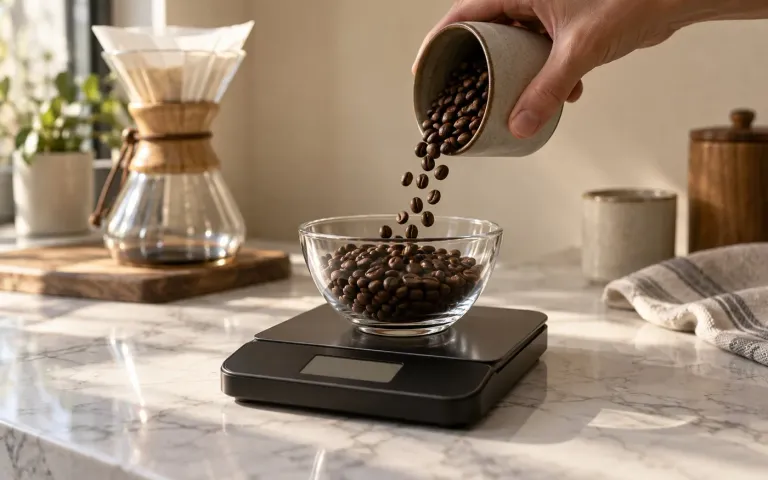
A scoop measure calibrated for pre-ground coffee stops being accurate for you the moment you switch to whole beans, because whole beans and ground coffee pack into a scoop at different densities.
One home brewer described exactly this problem on Coffee Stack Exchange: switching to the same volume of whole beans, measured by the same tablespoon used for pre-ground coffee, produced a noticeably weaker cup.
That is why you weigh your beans on a scale rather than measure by scoop or tablespoon. A widely used starting ratio is about 15g of coffee to every 250ml of water, close to 1:17, for filter-style brews such as pour-over or a drip machine.
Weigh your beans before you grind them, not after. Ground coffee is harder for you to level accurately in a scoop, and weighing pre-grind also means you are measuring the one thing a scoop measure never could.
Dial It In: Adjusting Your Grind by Taste
Every grind size on the chart above is a starting point for you, not a fixed answer, because your beans, your water and your brewer all shift the ideal setting slightly.
Taste your cup and read it this way. Sour, thin or weak means the water moved through your coffee too fast relative to its size: grind finer. Bitter, harsh or dry on the finish means the opposite: grind coarser. Move one notch at a time and brew again before you judge the change, since two variables moving together tell you nothing useful.
Timing gives you the same answer without tasting. A pour-over that drains for you in under two minutes is running fast: grind finer. A cafetiere that is hard to plunge, or that leaves your coffee tasting over-extracted and bitter, is running slow: grind coarser.
Roast level shifts your dial too. Lighter roasts are denser and often taste better for you ground a touch finer than the chart suggests, while darker roasts are more brittle during grinding and throw off more fines at the same setting, pushing your cup toward bitterness faster. Our light roast vs dark roast guide covers why that brittleness happens.
If espresso is your brew, the same dial-in loop applies, but the stakes are higher and the numbers matter more. Our espresso grind size guide walks you through shot time and dose in full.
When to Grind: Freshness and the 15-15-15 Rule
Whole beans and ground coffee lose their freshness at noticeably different speeds, and that gap is the entire argument for grinding just before you brew rather than the night before.
According to the Specialty Coffee Association, whole bean coffee can reasonably be considered fresh for about three weeks after roasting, while ground coffee loses carbon dioxide, and the aroma that goes with it, so much faster that it might only be considered fresh for about an hour after grinding.
Our sibling guide calls this the 15-15-15 rule: open and start a bag within 15 days of its roast date, grind no more than 15 minutes before you brew, and drink your cup within 15 minutes of pouring it. It is a rough memory aid rather than a stopwatch, but each number marks a real point where your flavour leaks away, as our guide to storing coffee beans explains in full.
The practical takeaway for you is simple: grind one brew's worth at a time, every time, rather than a batch to save yourself five minutes each morning.
If buying a grinder is not where you are right now, that gap does not have to mean drinking stale coffee. A growing number of speciality roasters, including Balance Coffee, sell the same beans ground for your specific brewer rather than only as whole beans. I founded Balance Coffee in 2020, and selling identical speciality coffee as wholebean, ground for filter or ground for espresso, at the same price, was a direct answer to exactly this gap.
Five Grinding Mistakes to Avoid
Five habits turn your otherwise correct grind size into a disappointing cup.
Grinding a week's worth at once. It saves you a faster morning, but ground coffee loses its aroma within about an hour of grinding, so a batch ground on Sunday is flat in your cup well before Friday.
Regrinding pre-ground coffee in a burr grinder. Pre-ground coffee is already fine and dense enough to jam a burr grinder's mechanism, and the repair rarely costs you less than the time you saved. If you need it finer, start from whole beans instead.
Letting a blade grinder run in one long burst. Long, continuous grinding heats your blade and your beans, pushes more of the batch into fine dust, and gives you less control than short pulses with a shake in between.
Measuring with a scoop instead of a scale. Your beans and your ground coffee pack to different densities, and a scoop calibrated for one will under- or over-dose the other every time.
Letting static turn your grounds into a clumped, clinging mess. Grinding dry, low-moisture beans builds up a static charge that throws fine grounds around your counter and clumps them against the grinder's sides. Research published in the journal Matter found that moisture on the beans reduces this static charging during grinding, which is why a single drop of water on your beans before grinding cuts down on mess without changing the grind itself.
Grind Size Reference Table
A compact version of the chart above, for you to check at the grinder without scrolling back up.
| Brew Method | Grind Size |
|---|---|
| Turkish coffee | Extra fine |
| Espresso | Fine |
| Moka pot | Fine to medium-fine |
| AeroPress | Fine to medium |
| Pour-over, filter | Medium |
| Chemex | Medium-coarse |
| Cafetiere, French press | Coarse |
| Cold brew | Extra coarse |
Frequently Asked Questions
How do you grind your own coffee beans?
Weigh your beans on a scale, set your grinder to the size your brewer needs, from extra coarse for cold brew to fine for espresso, then grind only what you are about to brew. Taste the cup and adjust one notch at a time. A burr grinder gives the most even result, while a blade grinder or a kitchen tool works too, with more effort and less consistency.
What is the 15-15-15 coffee rule?
It is a rough memory aid for coffee freshness: open and start a bag within 15 days of its roast date, grind no more than 15 minutes before you brew, and drink your cup within 15 minutes of pouring it. It is not a strict law, but each number marks a real point where flavour leaks away, as our guide to storing coffee beans explains in full.
Is it cheaper to grind your own coffee?
Often not by much on the bag itself. Many speciality roasters, including Balance Coffee, charge the same price whether a bag is wholebean or ground, for example £14.99 for 250g of Stability Blend in any grind, checked 12 October 2026. The real extra cost to you is the grinder: an entry-level hand burr grinder such as the Hario Mini Mill+ costs £29.00 at Horsham Coffee Roaster, checked the same day.
What can I use to grind coffee if I don't have a coffee grinder?
A blender, a food processor, a mortar and pestle, a rolling pin in a freezer bag, or the flat of a heavy knife all work for you. A blender or food processor gives a coarse grind in short pulses, best for a cafetiere or cold brew, while a mortar and pestle gets you closest to a fine grind but takes real effort for more than one cup.
How to grind up coffee beans by hand?
A hand burr grinder, such as the Hario Mini Mill+, is your most consistent option: turn the handle in steady rotations rather than fast bursts. Without one, a mortar and pestle filled about a quarter full, crushed then ground against the sides, gets you closer to an even grind than a rolling pin or a knife, though it takes you longer.
What can I do with whole coffee beans without a grinder?
Crush them with a kitchen tool, a blender, food processor, mortar and pestle, rolling pin or heavy knife, for a coarse grind suited to a cafetiere or cold brew. Or buy your next bag already ground for your specific brewer, since many speciality roasters sell the same coffee wholebean or ground for filter or espresso at the same price.
What grind size should I use for a cafetiere?
Coarse, about the texture of sea salt or rock salt, for you. Too fine and the mesh plunger lets grounds through, leaving sludge at the bottom of your cup and making the plunger genuinely hard to push down. Too coarse and your coffee tastes thin and under-extracted.
Can I grind coffee beans the night before?
You can, but ground coffee loses its aroma within about an hour of grinding, according to the Specialty Coffee Association, so a cup made from beans you ground the night before will taste noticeably flatter than one ground fresh. Grind in the morning if you can, and if you must grind ahead, seal your grounds in an airtight container.

A wellness entrepreneur and biohacker, James explores the intersection of hospitality and health - from clean fuel and recovery tools to mindful routines that build balance into daily life.