How to Store Coffee Beans: What a Roaster Does

Coffee Writer & Biohacker
Ten pages say airtight, opaque, cool, dark. Not one says how many days that actually buys you, which is the only thing the reader wants to know.
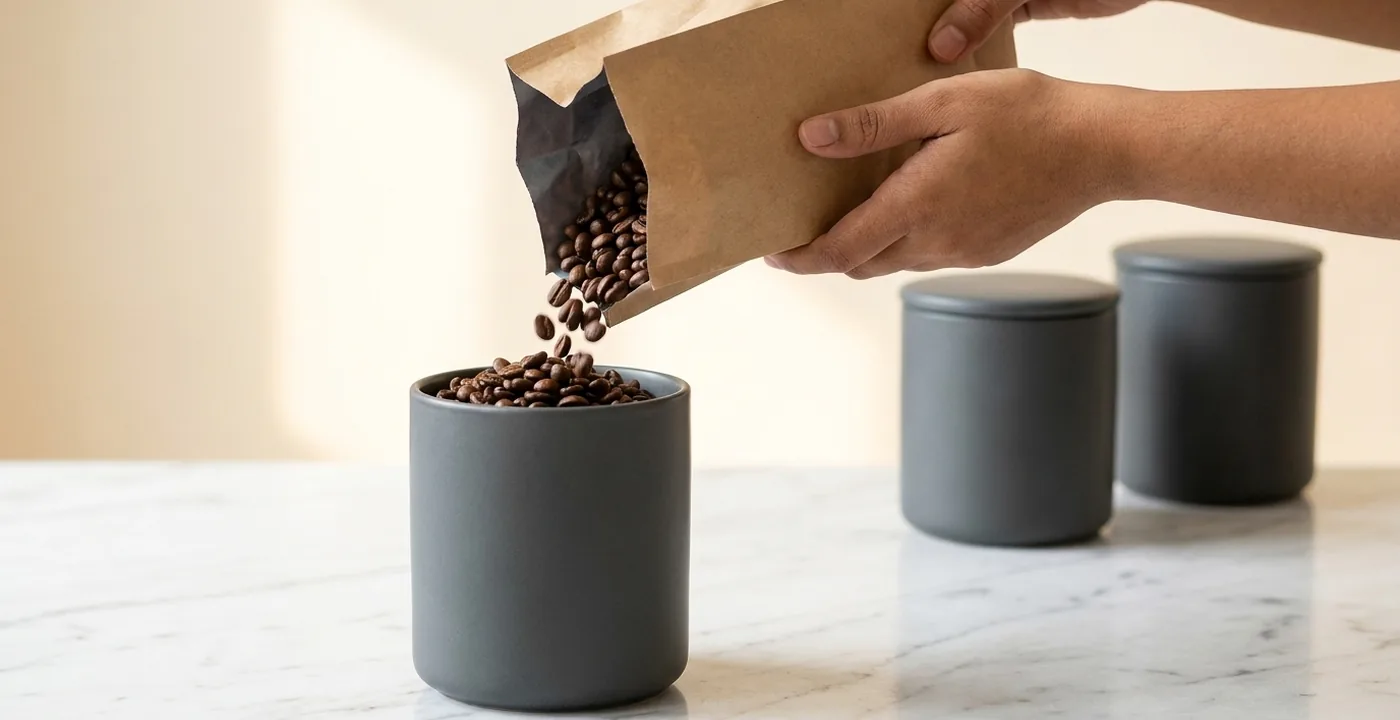
Table of Contents
Some of the links in this article are affiliate links, which help fund our independent review work at no extra cost to you. Every recommendation is based on hands-on testing through The Editor Lab methodology. No brand pays to appear, and no placement is guaranteed.
Airtight, opaque, room temperature, away from light, never in the fridge: every guide to storing coffee beans repeats the same five rules. None of them tells you how many days that buys you, or what a stale bean tastes like on the way out.
The timings here come from how we rotate roasted stock at Balance Coffee and from published research on coffee staling, not from repeating the standard advice, and where the evidence is genuinely contested, as it is on freezing, you get a defended position rather than a quiet hedge.
“I founded Balance Coffee in 2020, and the storage decisions in this guide are the ones we make with our own roasted stock every week, not only the advice we hand out.”
How to Store Coffee Beans, in One Box
Four rules cover almost every situation you will face with a bag of beans, whether it is a light roast or a dark roast, or a bag that meets the speciality coffee standard rather than a supermarket blend.
- Keep your beans airtight. Oxygen is what turns fresh coffee stale, so the seal matters more than what the container is made from.
- Keep them opaque, or in the dark. Light degrades the oils that carry flavour, and a clear jar on your counter is doing the damage in slow motion.
- Keep them at room temperature. Heat speeds up staling, and so does the swing of moving your beans in and out of a fridge.
- Buy less than you think you need. A smaller bag finished in two weeks beats a large bag stretched across two months, and this single habit does more for your cup than any storage upgrade you could buy.
The Four Enemies, Ranked by How Much Each Costs You
Every guide names the same four enemies: oxygen, light, heat and moisture. None ranks them, and if you can only fix one thing, you need to know which one to fix first.
Oxygen comes first. It never stops working, from the moment you open the bag, and no container fully solves it, only slows it. An open bag left unclipped on your counter is losing flavour within days.
Light comes second, and it moves faster than you probably expect. Ultraviolet and visible light both break down the oils that carry a coffee's aroma, which is why the National Coffee Association's storage and shelf life guidance names opaque containers specifically, not only airtight ones.
This is where the single worst common storage choice lives: a decorative glass jar on your kitchen counter. It looks better than the bag it came in, and it performs worse: it lets in light, and it rarely seals as well as the valve bag it replaced.
Heat is third, and for your kitchen it is likely the smallest lever of the four, because most UK homes do not run hot enough for heat alone to decide the outcome.
Moisture is fourth on flavour impact but first on safety, because it is the one enemy that can make you ill rather than simply make your coffee taste worse. Damp storage is the mechanism behind mould risk in coffee, a genuine food safety concern covered by the Food Standards Agency's guidance on mycotoxins, and by our own closer look at mycotoxins in coffee. In six years of rotating roasted stock at Balance Coffee, and after visiting close to 300 UK roasteries during my time in the industry, the beans I have seen spoil, rather than simply go flat, were always a moisture failure, never an oxygen one.
Fix your seal first, keep your beans out of the light second, and treat heat and moisture as conditions to avoid rather than manage.
How Long Your Beans Last
Degassing, the release of carbon dioxide trapped during roasting, is a well-documented and uncontroversial part of how coffee ages, and it is why freshness has a shape rather than a single cliff edge. A roast date tells you when your beans were roasted; a best-before date is a legal shelf-life marker that can run to a year or more and tells you nothing about freshness.
Whole beans, kept sealed in their original valve bag, peak in flavour for roughly the first two to three weeks after the roast date and stay genuinely good, not merely drinkable, for about a month before you notice the difference in the cup. After that they are still safe for you to drink, though flatter, for another month or two.
Swap the valve bag for a proper airtight, opaque canister and you can stretch the genuinely-good window out toward six weeks, because it removes most of the oxygen exchange a folded bag still allows. It will not rescue beans that were already stale when you sealed them in.
One competitor's claim doing the rounds says coffee stays fresh "for up to four weeks after opening when stored correctly." That matches the data for a well-sealed bag, and lines up with what we see rotating our own roasted stock at Balance Coffee, where the printed roast date is a promise about that window. If you are shopping for new beans, our best coffee beans UK guide weighs freshness heavily for exactly this reason.
Two years is the outer edge of the real question most people are asking: can I still use it? Yes, it will not harm you if it has been kept dry, but it will taste tired, flat and papery. If your bag is genuinely that old, cold brew will pull more sweetness out of it than a black pour-over will.
Should You Freeze Coffee Beans?
Freeze your beans if you have bought more than you will get through in a month. Portion them into the amount you use in a week, in small airtight bags with as little air in them as possible, and freeze immediately after opening, not after the bag has already sat on your counter losing flavour.
The advice you find online on freezing contradicts itself, and most guides hedge rather than pick a side. Here is a defended position instead: freezing works, portioning is what makes it work, and the method most people use, tipping the whole bag into the freezer and pulling it out repeatedly, is close to the worst version of it.
Repeated temperature cycling is what damages your beans in a freezer, not the cold itself. Every time you open the container, condensation forms on the beans as they warm, and that moisture is the same enemy from earlier in this guide, arriving by a different route.
Thaw a portion at room temperature, sealed, before you open it. Grinding or brewing straight from frozen reintroduces the same condensation problem you were trying to avoid.
What freezing costs you: a small amount of aromatic complexity does not fully return after thawing, which is why you are better off buying a bag you will finish in three weeks than freezing a kilo to save on shipping. Freezing is a tool for beans you already own, not a reason to buy more than you need.
Fridge vs Freezer
Your fridge is worse than your counter for coffee, not better, and the reason is not temperature. Every time you open the fridge door, warm kitchen air meets a cold bag, and that temperature swing pulls moisture onto your beans, which is exactly the enemy that costs you flavour fastest. Refrigerators also carry food odours, and roasted coffee absorbs smells readily.
The freezer avoids this because most households open it far less often, and because a well-portioned, well-sealed freezer bag limits the air exchange that causes the damage. A fridge gives you all of the moisture risk with almost none of the freezer's benefit.
If you are choosing between the two for everyday storage, choose neither. Reserve the freezer for genuine long-term storage, portioned as described above, and keep your everyday beans on the counter, sealed and out of the light.
The Best Container (and Why the Bag Is Nearly as Good)
Start with what you already have. Your original valve bag has a one-way valve stitched into it, a small vent that lets carbon dioxide escape as your beans degas without letting outside air back in. Folded over twice and closed with a clip, it blocks most of the light and most of the air, and it costs you nothing.
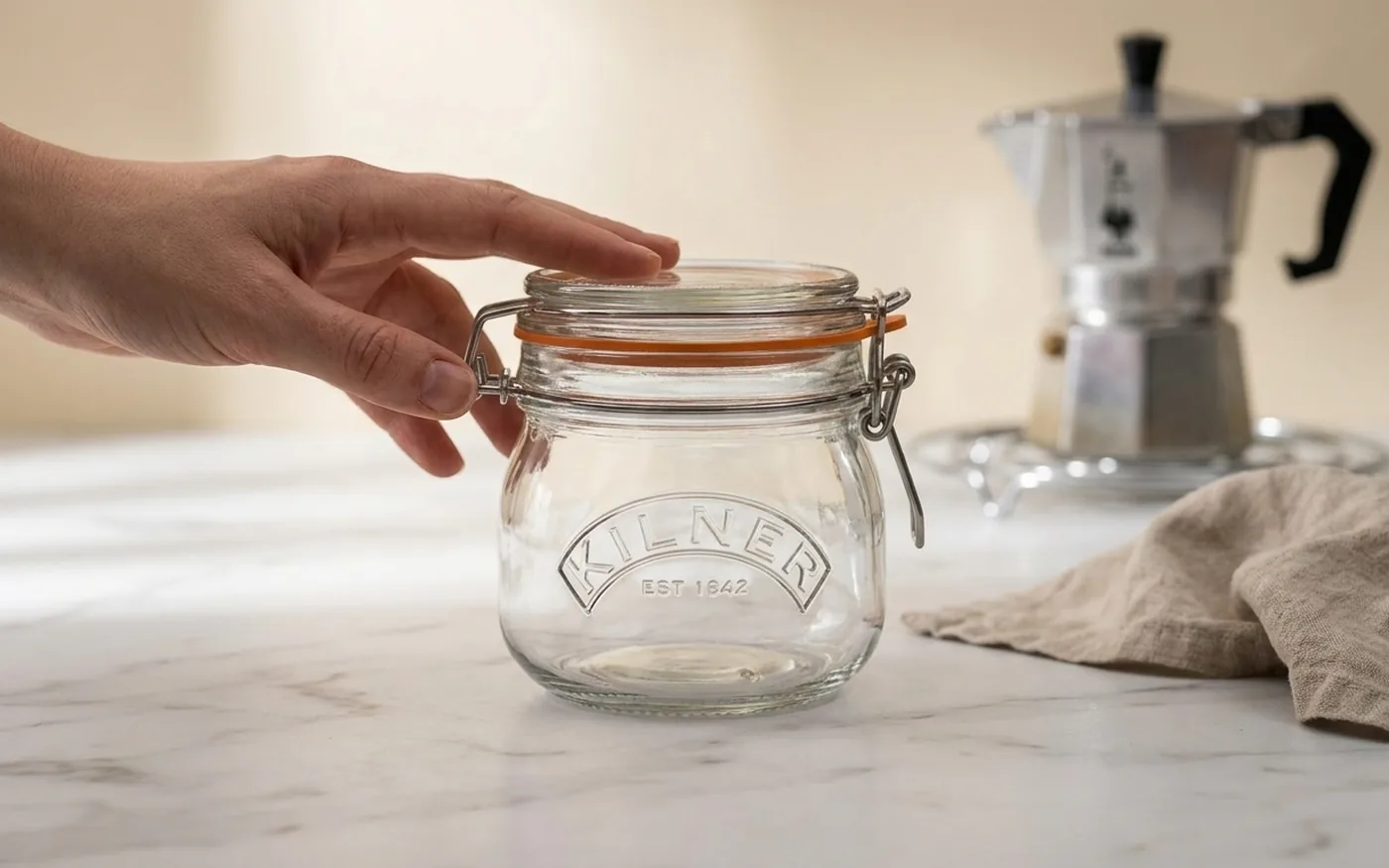
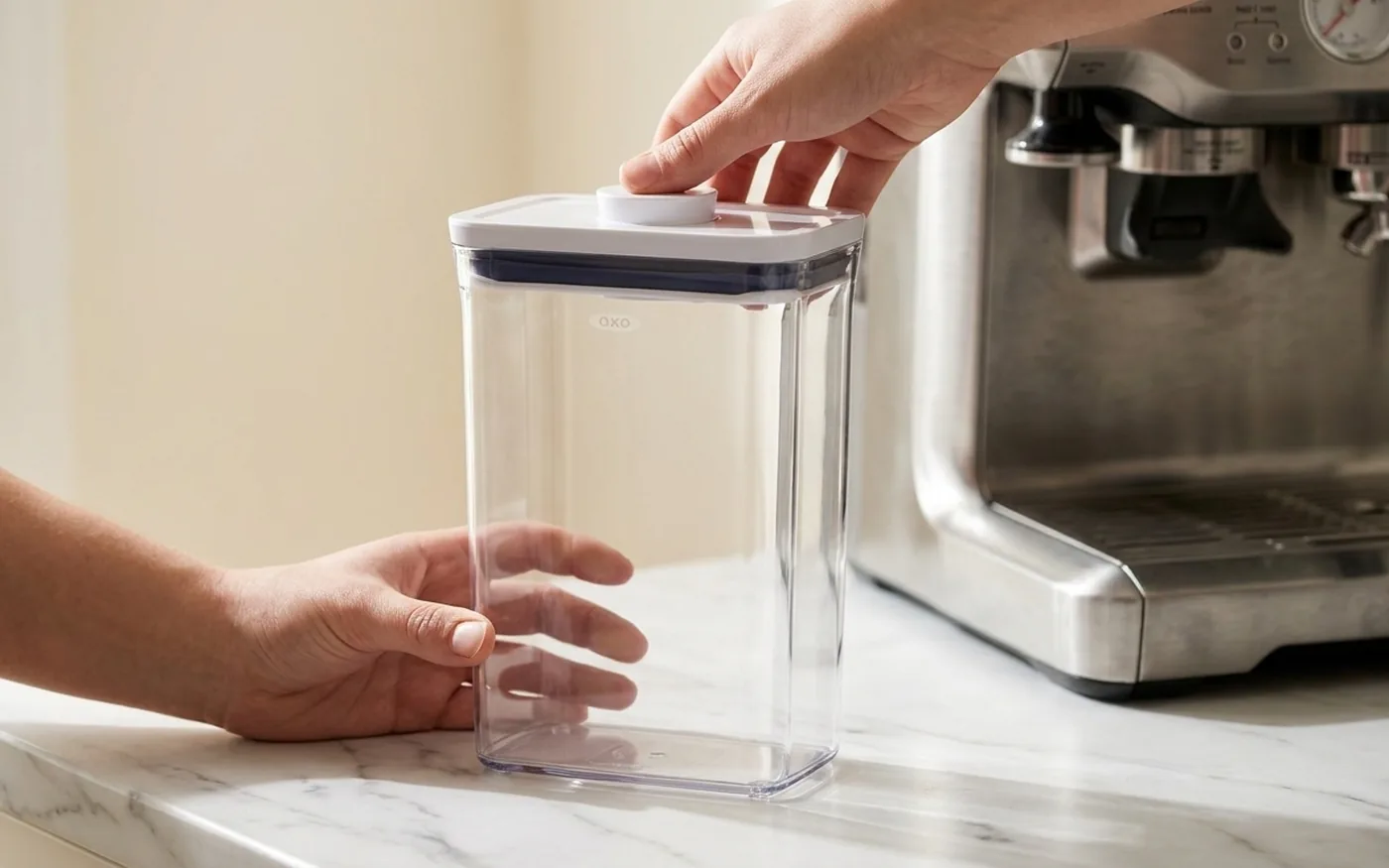
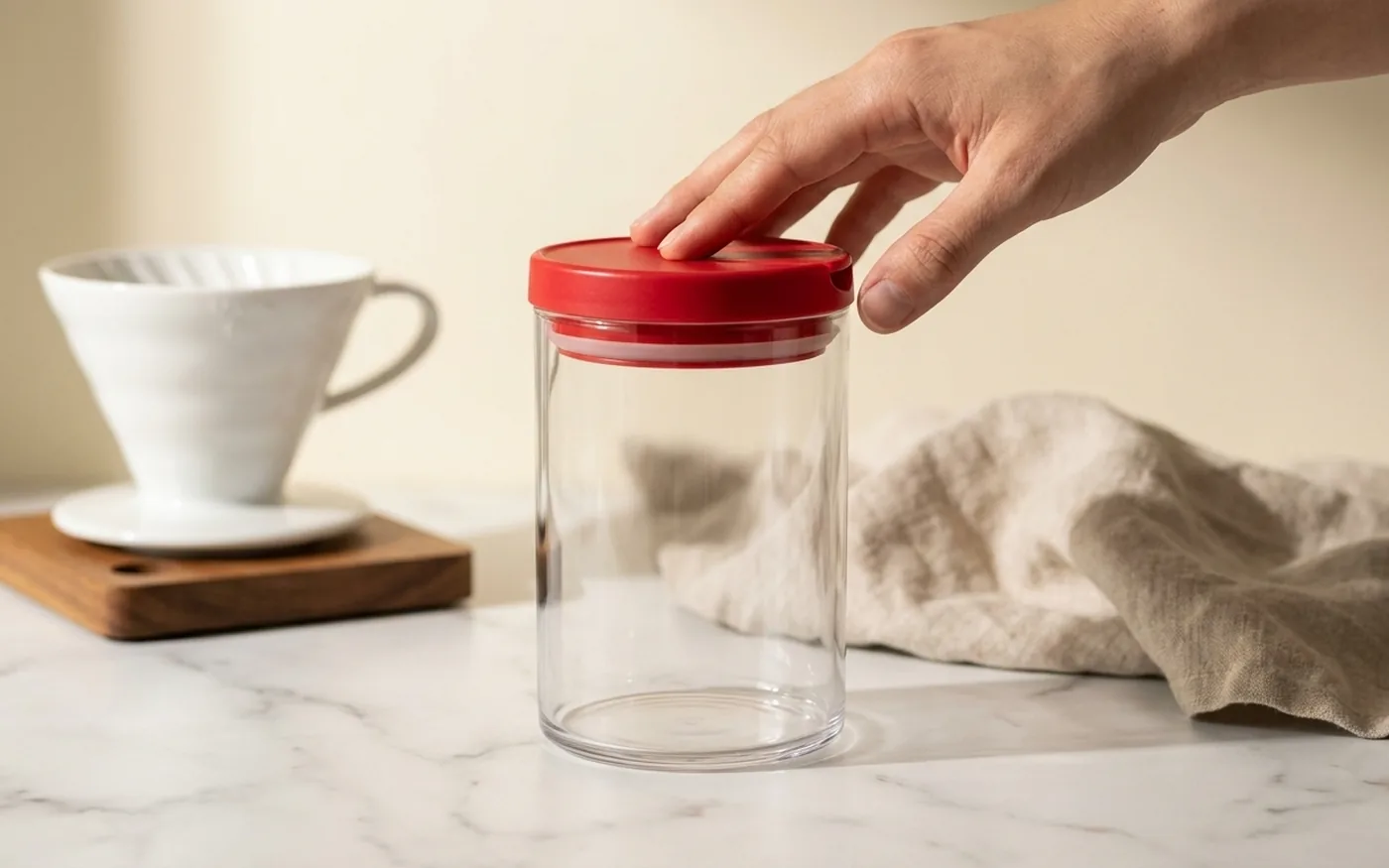
A cheap airtight jar, the kind sold by supermarkets and brands like Kilner or OXO, is the next step up, and it is genuinely close to as good as anything more expensive, provided you keep it in a cupboard rather than on a sunlit counter. This is where the decorative glass jar problem returns: a clear jar in the light is worse than the ugly opaque tin.
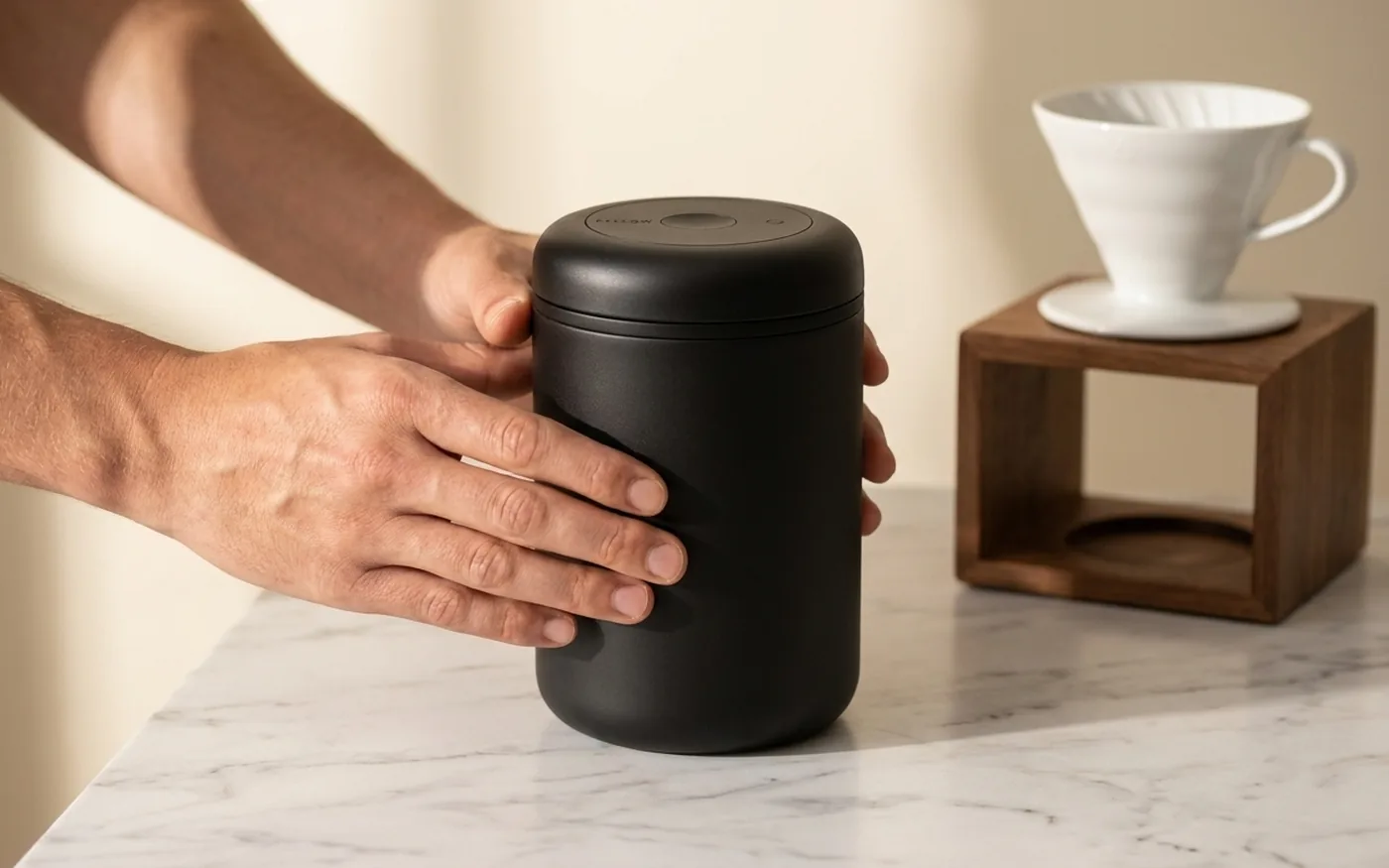
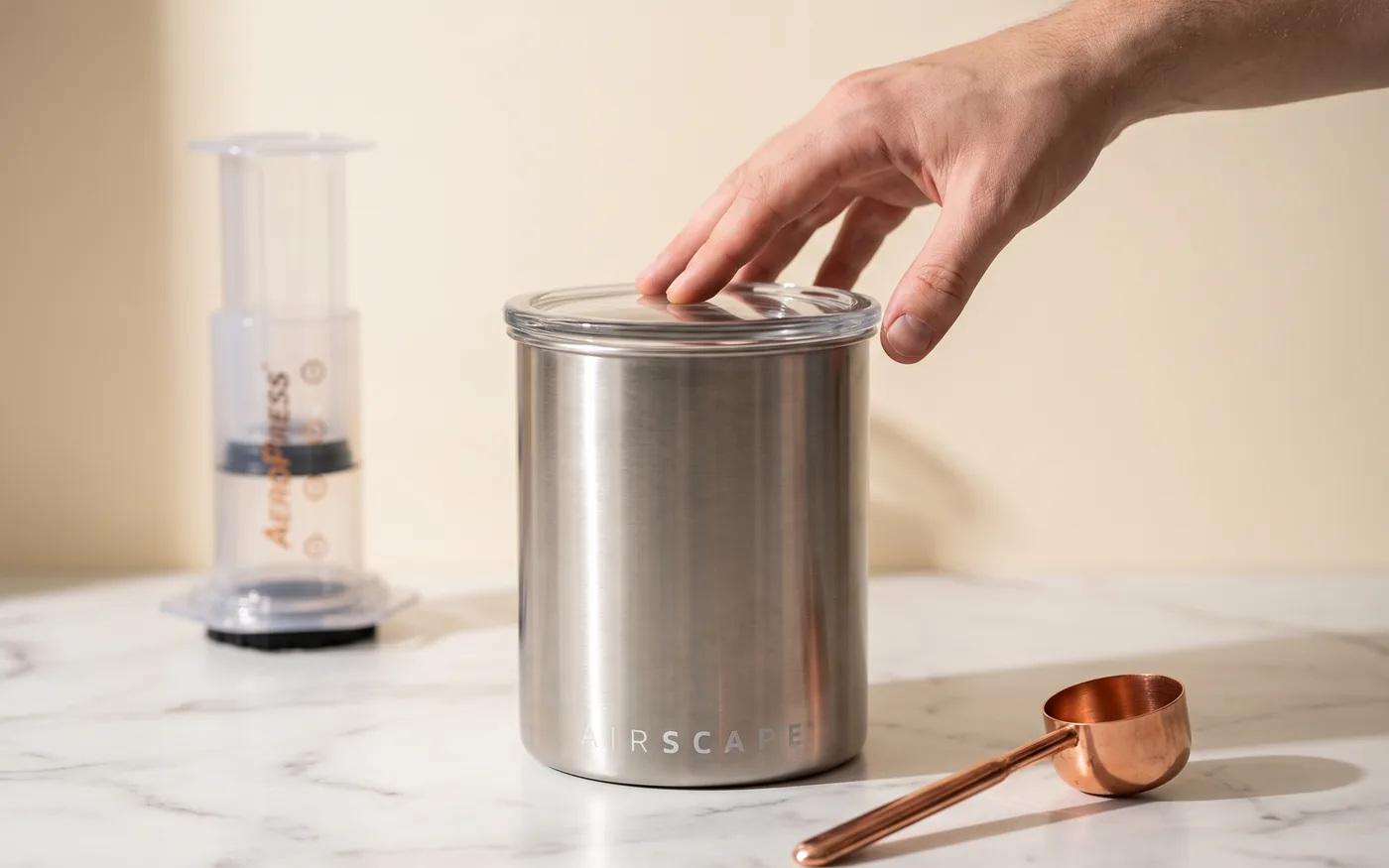
Above that sits the vacuum canister, a genuinely different product to weigh up, rather than a pricier airtight one. An airtight canister like an Airscape keeps new oxygen out. A vacuum canister like the Fellow Atmos removes the oxygen already inside, which is why it holds flavour for roughly twice as long, for roughly four times the price of a basic airtight tin. A Hario canister sits between the two on price, and does the airtight job well if that is the level you want.
Buy the upgrade if you drink through more than 250g every couple of weeks. Skip it if you already buy little and often, because your buying habit is already doing the canister's job for you.
Storing Ground Coffee
Ground coffee needs everything whole beans need, plus speed. The moment your beans become grounds, the surface area exposed to air multiplies roughly a hundredfold, so the same airtight, opaque, cool rules apply, but the clock now runs in days, not weeks.
Keep your ground coffee in an airtight, opaque container and use it within a week for anything close to peak flavour, ten days at the outside edge. A plastic container is fine as long as it seals properly and blocks light. Plastic is not the risk, a poor seal is.
If you own a machine with a built-in hopper, such as many bean-to-cup machines and some filter coffee machines, do not treat it as your primary storage. It is rarely airtight or opaque, so beans sitting in it daily get the worst of the light and oxygen exposure at once. Load a day or two in, and if you are shopping for a new best coffee grinder uk, check the hopper design first.
Buy ground coffee in smaller quantities than you would buy whole beans, because no upgrade path rescues stale grounds the way freezing can partly rescue whole beans. This is where our best ground coffee uk guide matters as much as storage advice: no storage method fixes a bag that was stale before it reached your kitchen.
The 15-15-15 Rule, Explained
The 15-15-15 rule is a rough guide for grinding fresh: use your beans within 15 days of the roast date, grind no more than 15 minutes before you brew, and drink within 15 minutes of grinding for the best possible cup. It is not a law of physics, but it names the three points where freshness leaks out of your routine: how old your beans are, how long ground coffee sits before brewing, and how long brewed coffee sits before you drink it.
The middle point matters most. Grinding your beans right before brewing, rather than the night before or in a weekly batch, protects more flavour than any container upgrade, because it removes the hundredfold surface area problem almost entirely.
How to Tell If Your Beans Have Gone Stale
Trust your nose before you trust the calendar. Fresh beans smell noticeably aromatic before you even open the bag properly, a mix of the roast's own character and a faint sharpness from the carbon dioxide still escaping. Stale beans smell muted, sometimes faintly like cardboard, and that flatness in the aroma is the first sign you will notice, well before the taste changes.
In the cup, staling shows up as flatness rather than bitterness. You lose the bright, specific notes first, the citrus or berry or floral character a roast might have carried, and what is left tastes generically "brown". That is why so many people quietly conclude they do not like good coffee, when what they are tasting is old coffee.
A visual check helps too. Fresh beans still bloom and bubble when hot water hits them, as the carbon dioxide trapped since roasting escapes. A flat, lifeless bloom on beans you know are not ancient is a reliable sign they were stored badly rather than simply old.
Freshness Timeline
The table below gives a working range for each storage method, based on roastery stock rotation and the published research cited throughout this guide. Treat the acceptable window as the point where your beans are still safe and drinkable, if past their best.
| Storage Method | Peak Window | Acceptable Window | Sensory Marker at the Edge |
|---|---|---|---|
| Whole bean, original valve bag (sealed) | 2-3 weeks | Up to 6-8 weeks | Muted aroma before you open the bag; flat, "brown" flavour in the cup |
| Whole bean, airtight opaque canister | 3-4 weeks | Up to 8 weeks | Same profile, delayed by roughly a week |
| Whole bean, vacuum canister (e.g. Fellow Atmos) | 5-6 weeks | Up to 10-12 weeks | Slower onset of the same flat, muted profile |
| Whole bean, frozen in weekly portions | Up to several months | Up to 6 months | Slightly reduced aromatic complexity even when otherwise fresh |
| Ground, airtight opaque container | 3-5 days | Up to 10 days | Cardboard note on the nose, flat "brown" cup |
Frequently Asked Questions
What is the best way to store coffee beans to keep them fresh?
Keep your beans airtight, opaque and at room temperature, away from light and heat. The original valve bag, folded and clipped shut, does most of this for free. A canister improves on it slightly. Buying less at a time matters more than any container you choose.
Can I still use 2 year old coffee beans?
Yes, two-year-old beans kept dry will not harm you, but they will taste flat and papery rather than showing the roast's original character. If your bag is this old, cold brew or a strong milk drink will hide the staleness better than a black pour-over.
What is the 15-15-15 rule for coffee?
The 15-15-15 rule says: use your beans within 15 days of the roast date, grind no more than 15 minutes before brewing, and drink within 15 minutes of grinding. It is a rough guide, not a strict law, but the middle step protects more flavour than any storage upgrade.
What is the best way to store ground coffee beans?
Store ground coffee the same way as whole beans, airtight, opaque and at room temperature, but treat the clock as days, not weeks. Grinding exposes roughly a hundred times more surface area to oxygen, so it is at its best for about a week and flatter by ten days.
Is it okay to store ground coffee in a plastic container?
Yes, plastic itself is not the problem, as long as the container seals tightly and blocks light. A poor seal or a clear tub left on a sunlit counter will let your coffee stale faster regardless of the material. An opaque, airtight plastic tub works fine.
What is the enemy of coffee beans?
Coffee has four enemies: oxygen, light, heat and moisture. Oxygen does the most consistent damage and is hardest to block. Light works faster than most people expect, which is why opaque storage matters as much as airtight storage. Moisture is the smallest flavour risk but the only one that is also a food safety concern.
How long do coffee beans last once the bag is opened?
Whole beans in their original valve bag, folded and sealed shut, stay genuinely good for around two to three weeks and remain drinkable, if flatter, for a month or so beyond that. A proper airtight, opaque canister stretches that window toward six weeks. Ground coffee lasts a fraction of that: about a week.
Should you keep coffee beans in the grinder hopper?
No, not for more than a day or two of beans at a time. A grinder hopper is rarely fully airtight or opaque, so beans sitting in it are exposed to light and air the whole time they wait to be ground. Load only what you will use next, and keep the rest sealed in your main container.
A wellness entrepreneur and biohacker, James explores the intersection of hospitality and health - from clean fuel and recovery tools to mindful routines that build balance into daily life.