Cold Brew Ratio: Grams, Dilution and the Real Strength

Coffee Writer & Biohacker
Your jar keeps back part of the water, so the glass is stronger than the label says.
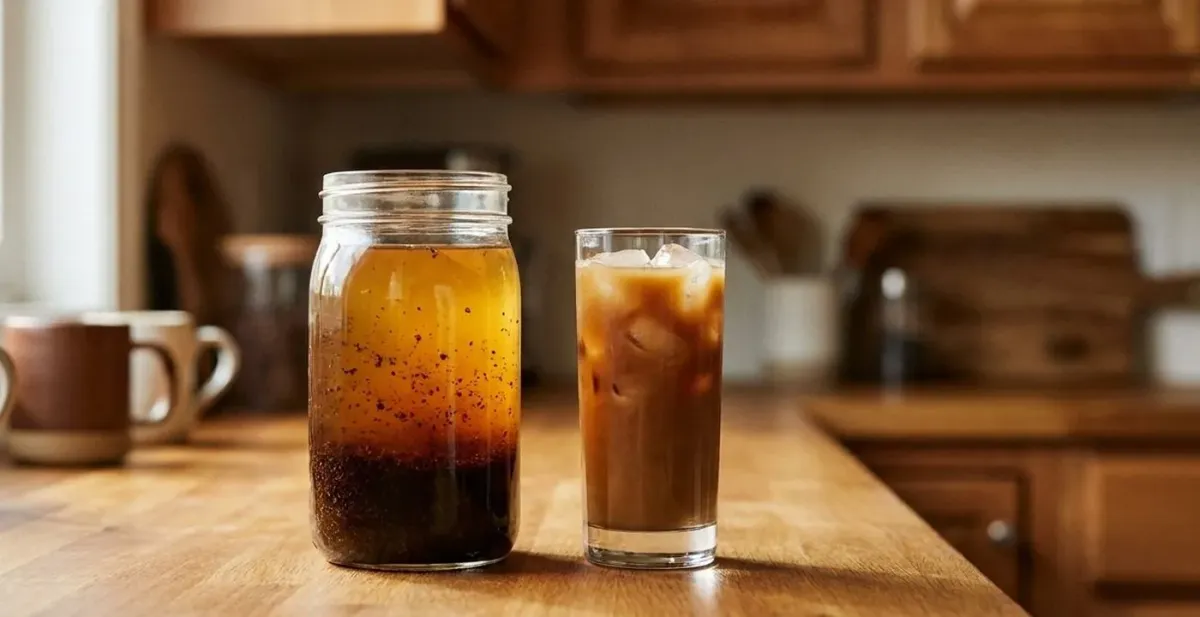
Table of Contents
Some of the links in this article are affiliate links, which help fund our independent review work at no extra cost to you. How we assessed these products is explained in this article and our Editor Lab methodology. No brand pays to appear, and no placement is guaranteed.
Five recipes give you five different cold brew ratios, and the batch you make from any of them comes out smaller and stronger than the numbers suggest. Use 1:8 by weight if you plan to dilute your cold brew, and 1:12 to 1:15 if you plan to drink it straight.
A good cold brew ratio is 1:8 by weight for a concentrate you dilute 1:1 with water or milk, which is 125 g of coarse coffee to 1 litre of water. For cold brew you drink straight, use about 1:12 to 1:15, which is 67 g to 83 g per litre. The grounds keep back roughly 1.7 g of water per gram of coffee, so a 1-litre batch at 1:8 yields closer to 790 ml.
You have probably followed a recipe to the gram, then found the jar gave back less than you poured in. Most ratio guides count the water you add and ignore the water your grounds keep. This guide gives you the grams for every common batch size, and the strength that ends up in your glass.
For this guide I compared the ratios published by seven roasters and brewer brands, checked each against the research on cold extraction, and did the dilution maths by weight. If you want the method itself, our guide to how to make cold brew covers the kit, the strain, and the storage, so your batch only needs the numbers from this page.
Editor's Note
Cold Brew Ratio: The Short Answer
You need two starting points, because cold brew is two different drinks. A concentrate is brewed tight, at 1:8 by weight, and you thin it with water or milk before you drink it. A ready-to-drink batch is brewed looser, at 1:12 to 1:15, and you pour it straight over ice.
The ratio is by weight, so 1 g of coffee to 8 g of water is 1:8. One millilitre of water weighs 1 g, which means grams and millilitres are interchangeable for the water in your jar. That is the only conversion you need, and it is why a 1-litre batch at 1:8 takes 125 g of coffee.
Most roasters land in this range. Counter Culture writes "We prefer a 1:8 ratio", and Seven Sisters calls "a milder 1:15 ratio" a fantastic place to start. You will see wider numbers on other pages, and the section on why published ratios disagree explains where they come from.
Here is what 1:8 means in your kitchen. Put 125 g of coffee in a jar, pour in 1,000 g of water, and you have a concentrate that tastes strong on its own and opens up once you add water or milk. Put 67 g in the same jar and you have a drink that is ready to pour.
Pick the style first, because the style decides the number. If you want one jar that gives you a week of iced coffees and room in the fridge, brew the 1:8 concentrate. If you want the simplest batch with the least chance of getting it wrong, brew 1:12 to 1:15 and pour.
Concentrate vs Ready-to-Drink: Two Ratios, Two Jobs
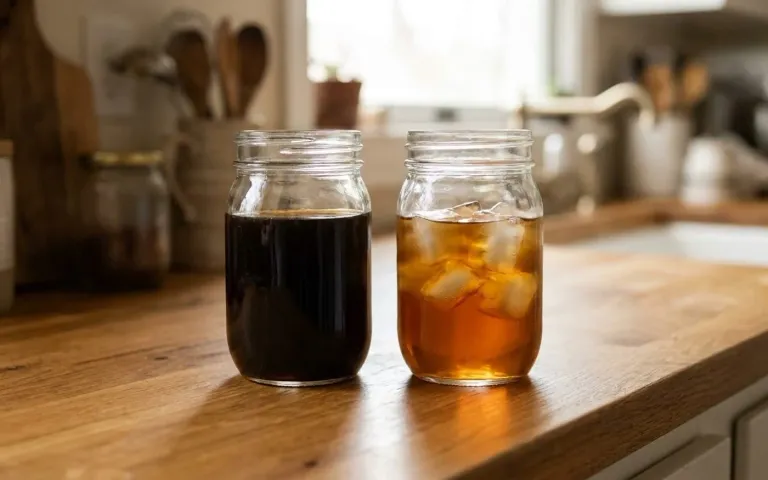
Concentrate and ready-to-drink are two jobs for your jar, and each job has its own range of ratios. Podium Coffee Club puts it plainly: concentrate runs 1:4 to 1:5 by weight and gets diluted 1:1 with water or milk before drinking. Ue Coffee Roasters gives a wider band, with concentrates "Strong, typically 1:4 to 1:8" and ready-to-drink "Milder, around 1:12 to 1:16".
Concentrate: 1:4 to 1:8
A concentrate is a tight brew that you dilute to taste. It saves fridge space, and it lets you make each glass stronger or weaker without brewing again. The cost is that you have to do the dilution sum, which the dilution section below walks through.
The "1/4 ratio" people search for means 1 g of coffee to 4 g of water. That is the strongest common concentrate, and at 1 litre of water it takes 250 g of coffee. The grounds keep a large share of the water, so you get back only about 575 ml.
Ready-to-Drink: 1:10 to 1:16
A ready-to-drink batch is brewed at the strength you want in your glass. Published recipes for it run from about 1:10 to 1:16, and the common middle is 1:12 to 1:15. You pour it, add ice if you like, and you are done.
The trade-off is volume. A ready-to-drink batch of 1 litre of water takes 67 g to 83 g of coffee and returns most of that water, but it fills the fridge faster than the same coffee brewed as a concentrate. If your fridge is small, the concentrate wins on space.
A tight concentrate looks like a bargain on the label, because it uses twice the coffee of a 1:8 batch for the same litre of water. It returns only about 575 ml against about 790 ml. Once you dilute both to the same strength you pay the same coffee per glass, so the saving is in fridge space and flexibility, not in coffee.
How Much Coffee for Your Batch
This table gives you the grams of coarse coffee for each batch size, at two concentrate ratios and two ready-to-drink ratios. Measure your water by weight or by millilitres, as 1 ml of water weighs 1 g.
| Water | 1:5 concentrate | 1:8 concentrate | 1:12 drink | 1:15 drink |
|---|---|---|---|---|
| 500 ml | 100 g | 62 g | 42 g | 33 g |
| 750 ml | 150 g | 94 g | 62 g | 50 g |
| 1 litre | 200 g | 125 g | 83 g | 67 g |
| 1.5 litres | 300 g | 188 g | 125 g | 100 g |
| 2 litres | 400 g | 250 g | 167 g | 133 g |
If you want a 1-litre batch, start with 125 g of coffee for a 1:8 concentrate, or 83 g for a drink you pour straight. For 1500 ml of water, use 188 g at 1:8, or 100 g at 1:15. Those grams assume coarse ground coffee, and the method for the jar itself sits in our guide to how to make cold brew.
Cafetiere and Jar Batches
Yes, you can make cold brew in a French press. A 6-cup cafetiere holds about a litre, so a full 1-litre batch will not fit once you add the grounds. For a 6-cup cafetiere, use the 750 ml row in the table: 94 g of coffee at 1:8. Our guide to the best cafetiere covers which sizes hold a full litre without overflowing when you add the grounds.
Weigh, Do Not Scoop
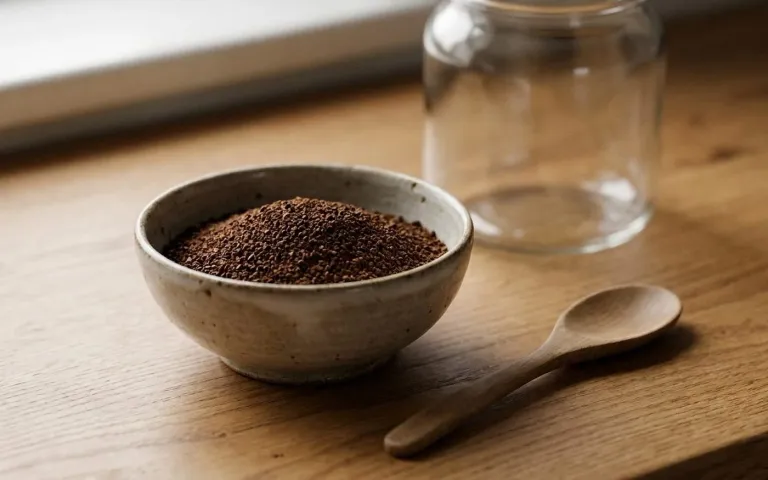
You will see this ratio written in cups and tablespoons, and I would not use either. Spoon weights change with the grind and the roast, so two scoops from two bags are two different doses. A set of coffee scales turns every number on this page into something you can repeat.
Weighing is the habit I took from the Sanremo years, where the culture was extraction precision and testing with scales. It costs you a minute per batch, and it is the cheapest fix for a jar that tastes different each week.
Scaling Up for a Household or an Office
The table stops at 2 litres, but the arithmetic scales in a straight line. For 10 litres of water you need 1,250 g of coffee at 1:8, or about 667 g at 1:15. The grounds keep about 2,125 g of water at 1:8, so you collect about 7,875 ml of concentrate, and about 8,870 ml of drink at 1:15.
If you brew for a team, work in the largest vessel you can fill and weigh the coffee in batches. You will get the same ratio every time, and you will know how many glasses to expect before you start.
Why the Grounds Keep Some of Your Water
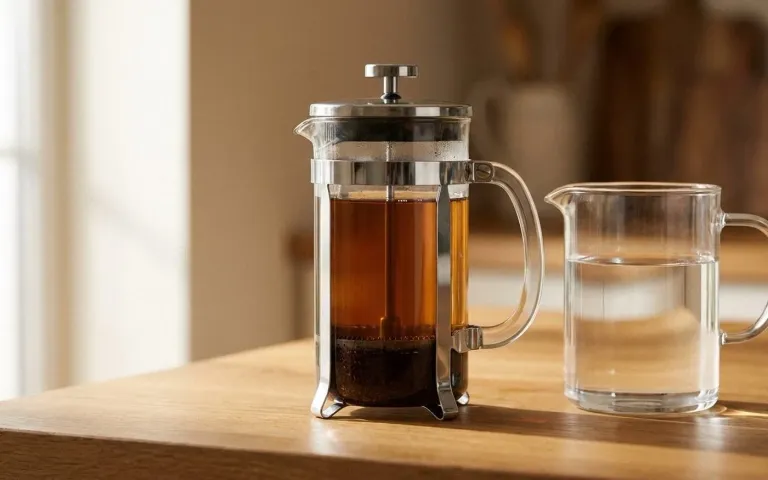
Wet grounds act like a sponge, and the water they hold never reaches your glass. The Gunga cold brew patent (US 11284740 B2) puts a number on it: "Residual water retained by the coffee grounds will vary somewhat, but is frequently around about 1.5 to 2 liters of water per kilogram of coffee grounds". The same patent says that "assuming a value of about 1.7 liters of water per kilogram of coffee grounds for residual water generally provides good results for estimating total yield".
In plain English, each gram of coffee keeps about 1.7 g of water, which is a figure you can check on your own scale by weighing the wet grounds after you strain. A 1:8 batch with 125 g of coffee keeps about 213 g, so you get back about 790 ml from 1 litre. A 1:4 batch with 250 g keeps about 425 g, so you get back about 575 ml.
That explains a complaint you will find from home brewers on Coffee Stack Exchange, who ask why their batch comes out far smaller than the water they poured in. Ue Coffee Roasters says to "expect a yield of around 70-80% of your initial water volume". That holds for a 1:8 batch, which returns 79%, but not for a 1:4 batch, which returns 58%.
You can see the pattern in the numbers: the stronger your concentrate, the bigger the share of water you lose. At 1:8 the grounds keep about a fifth of your water, and at 1:4 they keep over two fifths. Squeezing the grounds to win some back is a method question, and our guide to how to make cold brew covers it.
Dilution Maths: What Your Glass Holds
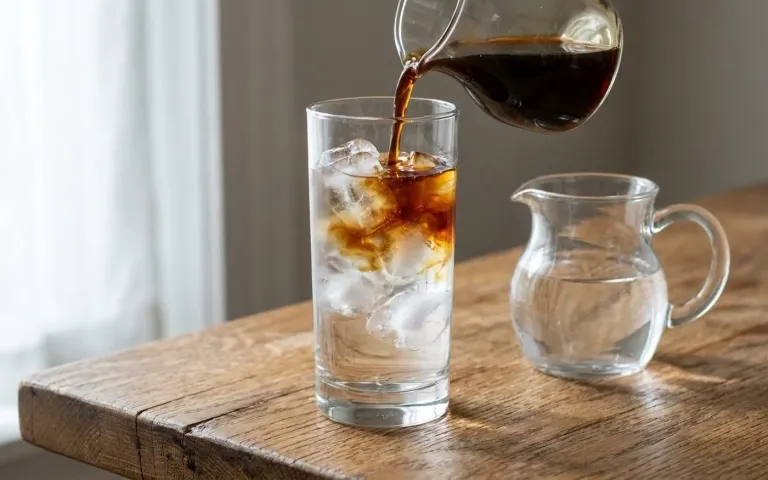
The usual dilution sum is wrong for your jar, and a Coffee Stack Exchange asker said so first. Omar Miranda wrote, "I don't think that is as simple as adding the n remaining parts". The accepted style of answer, from Shiri, treats a 1:4 concentrate as holding 4 parts water for every 1 part coffee, so 100 g of it needs 275 g of added water to reach 1:15.
That sum ignores absorption. A 1:4 batch gives back only 575 g of liquid from 250 g of coffee, so 100 g of that concentrate came from about 43 g of coffee, not 25 g. Add the same 275 g of water and you land near 1:8.6, not 1:15 (375 g of drink over 43 g of coffee).
The honest number for your glass is the effective ratio: grams of finished drink divided by grams of coffee. This table uses 1 litre of water and 1.7 g of water kept per gram of coffee. "Diluted 1:1" means 1 part concentrate to 1 part water, and "1:2" means 1 part concentrate to 2 parts water.
| Brew ratio | Concentrate back | Straight | Diluted 1:1 | Diluted 1:2 |
|---|---|---|---|---|
| 1:4 | 575 ml | 1:2.3 | 1:4.6 | 1:6.9 |
| 1:5 | 660 ml | 1:3.3 | 1:6.6 | 1:9.9 |
| 1:6 | 717 ml | 1:4.3 | 1:8.6 | 1:12.9 |
| 1:8 | 788 ml | 1:6.3 | 1:12.6 | 1:18.9 |
| 1:10 | 830 ml | 1:8.3 | 1:16.6 | 1:24.9 |
A Worked Example
Take 125 g of coffee brewed at 1:8, then diluted 1:1. You get about 1,575 ml of drink, which is an effective 1:12.6. That is the same strength as a ready-to-drink brew at about 1:12.6 straight, and it sits inside the 1:12 to 1:15 band from earlier.
Podium Coffee Club writes that a "1:4 concentrate, diluted 1:1 with water" has an "Effective serving ratio 1:9". Corrected for the water the grounds keep, the same drink is about 1:4.6, nearly twice as strong as the guide implies. If you followed that page, you were drinking a much stronger cup than you planned.
The Rule for Any Target Strength
Take the grams of coffee and multiply by the effective ratio you want, which gives you the total drink weight. Subtract the millilitres of concentrate you got back, and add that much water. For 125 g at 1:8 and a target of 1:15, that is 1,875 g in total, less 788 ml of concentrate, so you add about 1,087 ml of water.
This treats the concentrate as weighing about the same as water, which is close enough for a kitchen. Your scale does the rest.
Once you have the sum, you can run it backwards. If a glass tastes right to you, write down the grams of coffee and the grams of finished drink, and divide. That effective ratio is your number, and you can reproduce it from any concentrate you brew in future.
Cold Brew Ratio for Lattes, Milk and Ice
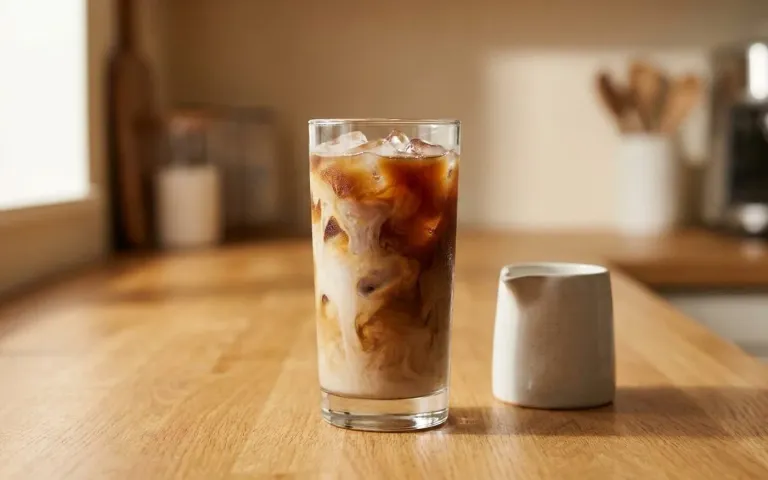
For a latte, brew a concentrate between 1:4 and 1:8 and let the milk do the diluting. Mix concentrate and milk at about 1:1 for a strong latte, and add more milk for a milder one. Milk takes the place of the dilution water, so you do not need both.
Milk carries fat and sugar, which soften coffee, so a stronger concentrate holds up better in your latte than in a glass of water. Start from the 1:8 concentrate if you are unsure. A 100 ml pour of it carries about 16 g of coffee, so 100 ml of concentrate with 100 ml of milk gives you a latte at an effective 1:12.6, the same strength as the worked example in the dilution section.
If you have a favourite bean for milk drinks, our guide to the best coffee for cold brew is where bean choice lives.
Ice melts, and melted ice is dilution you did not measure. Espro notes that some people prefer a stronger cold brew, around 1:10 to 1:14, because once you add ice and some of it melts, you end up at a balanced strength. If you pour over a full glass of ice, brew toward the tighter end of that band.
Ratio and Steep Time Work Together
Ratio is the strength lever you can trust, and steep time matters less than most recipes imply. Fuller and Rao's 2017 study in Scientific Reports found that "caffeine and 3-CGA concentrations reached equilibrium according to first order kinetics between 6 and 7 hours in all cold brew samples instead of 10 to 24 hours outlined in typical cold brew methods". Past the first several hours, a longer steep adds little of those two compounds, so if your batch is weak, add more coffee.
Having worked alongside Sasa Sestic, the 2015 World Barista Champion, on the Sanremo team, I read extraction papers with one question, and you should too: what did they measure? This paper measured caffeine and one chlorogenic acid (3-CGA), not flavour.
Most recipes still steep for 12 to 18 hours, and that is where the taste argument lives. So do not read the 6-to-7-hour result as proof that your short steep tastes as good.
Time can also hurt. A Coffee Stack Exchange answer from wearashirt says "The biggest factor is oversteeping (like, 48hours up brew), as it can make your cold brew sour." Podium's guidance for a short steep points the other way, since at 8 hours it says "Push ratio stronger (1:4 concentrate, 1:6 ready-to-drink)".
If you came to cold brew for a gentler cup, the acid story is smaller than you might expect. Rao and Fuller's 2018 paper found that the pH values of cold and hot brew samples were comparable, ranging from 4.85 to 5.13, while the hot brews had higher concentrations of total titratable acids. Our guide to low acid coffee covers what that means in your cup.
Grind, Roast and Ratio
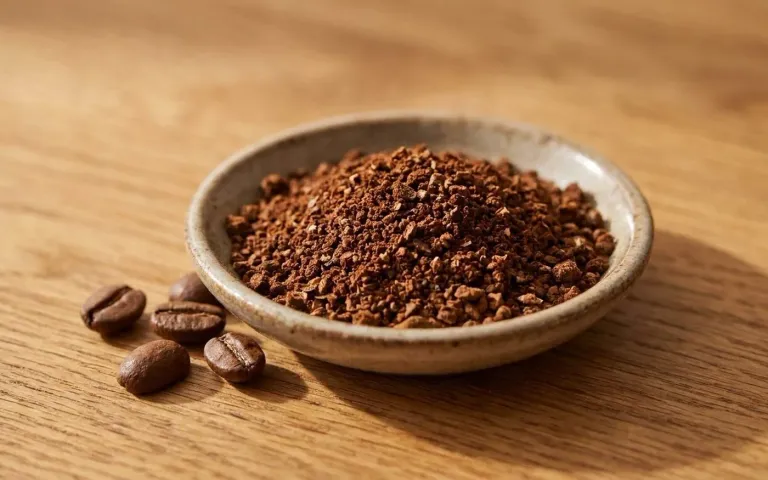
Grind coarse for cold brew, and keep it consistent. King Shots Coffee warns that a grind that is too fine leaves the cold brew cloudy and gritty. A good coffee grinder gives you a coarse setting that does not leave dust behind in the jar.
The 2017 study found that grind size did not significantly change the 3-CGA and caffeine concentrations of cold brew samples. So grind mostly changes clarity and how hard the straining is for you, not how strong the batch gets. Roast does change strength: the same study found higher 3-CGA and caffeine concentrations in cold brew made with medium roast than with dark roast.
At the same ratio, then, a medium roast gives your glass more of those two compounds than a dark one. Pick the roast for taste, and then set the ratio. If you switch roast between batches, change nothing else, and your jar will show you the difference.
Grind also decides how you strain. A coarse grind drains fast through a sieve or a paper filter, and a fine one clogs both, so you lose time and liquid. That is a practical reason to stay coarse, even though the paper found no strength penalty for going finer.
For bean ideas, see our guide to the best coffee beans, and keep an eye out for the best coffee for cold brew guide, which is written for exactly this use.
Why Published Cold Brew Ratios Disagree
Published ratios disagree because they describe different drinks, and you can see it in the sources. This table sets out what nine of them say. The wording in the last column is theirs, and "not stated" means the page does not say whether the batch is a concentrate.
| Source | Concentrate | Ready to drink | Note |
|---|---|---|---|
| Espro | 1:2 to 1:5 | 1:15 to 1:18 | 1:10 to 1:14 over ice |
| Counter Culture | 1:8 | Not stated | Down to 1:4.5 |
| Seven Sisters | 1:8 | 1:12 to 1:16 | "Milder 1:15" to start |
| Podium | 1:4 to 1:5 | 1:7 to 1:8 | Dilute concentrate 1:1 |
| Ue Coffee Roasters | 1:4 to 1:8 | 1:12 to 1:16 | 70-80% yield |
| The Coffee Ratio calculator | 1:5 | 1:8 | Calculator headings |
| Cafedirect | Not stated | Not stated | 100 g per litre (1:10) |
| King Shots | Not stated | Not stated | 1:8 or 1:10 |
| Starbucks at Home | 22 g per 180 ml | Not stated | Then 1:1 with water |
Starbucks at Home publishes 22 g of coarse coffee to 180 ml of water, which is about 1:8, and then says to "Pour one part concentrate with one part water". That is the home press recipe, not a cafe specification, so do not read it as what a Starbucks counter uses. It matches the 1:8 concentrate diluted 1:1 that this page starts you on.
Four things cause most of the gaps. Some pages describe a concentrate and some a drink, and some count the water you add while others count the liquid you get back. Some write for black coffee and some for milk, and each house has its own roast style.
Once you know which drink a recipe describes, the numbers stop fighting each other. Read the table by column, not by row, and you will see the concentrate column clusters around 1:4 to 1:8 and the drink column around 1:12 to 1:16. The outliers are pages that do not say which drink they mean, so treat those two rows with care.
Fixing a Batch by Ratio: Weak, Harsh, Sour
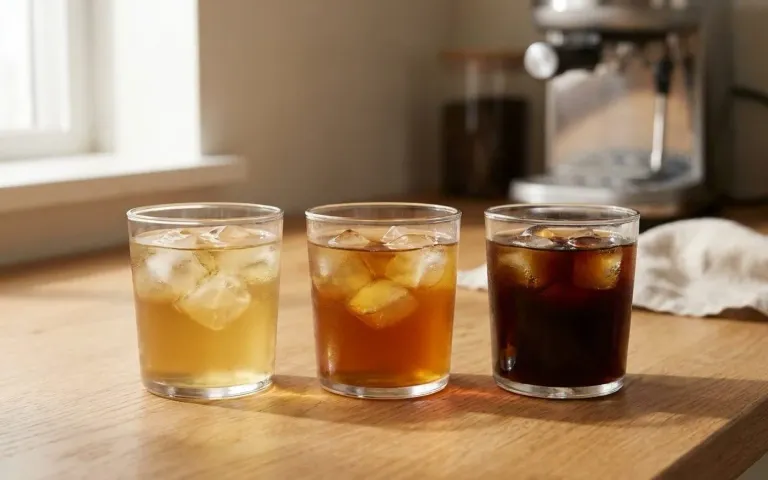
Change the ratio first, change it by one step, and change nothing else in the same batch. If you move the grind, the steep, and the ratio together, you will never learn which one fixed it. The table gives you the first move for each problem.
| Problem | Likely cause | First fix |
|---|---|---|
| Weak | Ratio too loose | Tighten one step, such as 1:10 to 1:8 |
| Too strong | Ratio too tight for your taste | Dilute more, brew the same next time |
| Harsh or bitter | Grind too fine, steep too long | Coarser grind, shorter steep |
| Sour after a long steep | Over-steeped | Shorten the steep |
| Cloudy and gritty | Grind too fine | Coarser grind, paper filter |
When your batch is too strong, dilute it rather than brewing weaker next time. You keep the batch, and you learn how much water it wanted. Seven Sisters gives the same direction for a weak batch with "Try a stronger ratio", which in their example means 1:7 instead of 1:8.
For a harsh or sour cup, resist the urge to loosen the ratio. A looser ratio gives you a thinner version of the same harshness, and the cause sits in the grind or the steep. Check those two first, then come back to the ratio.
Keep a note of each batch, with the grams, the water, the steep, and a one-line verdict. After three batches you will have your own number, and it will be better than any recipe on a page, including this one.
Cold Brew Ratio vs Hot Coffee Ratios
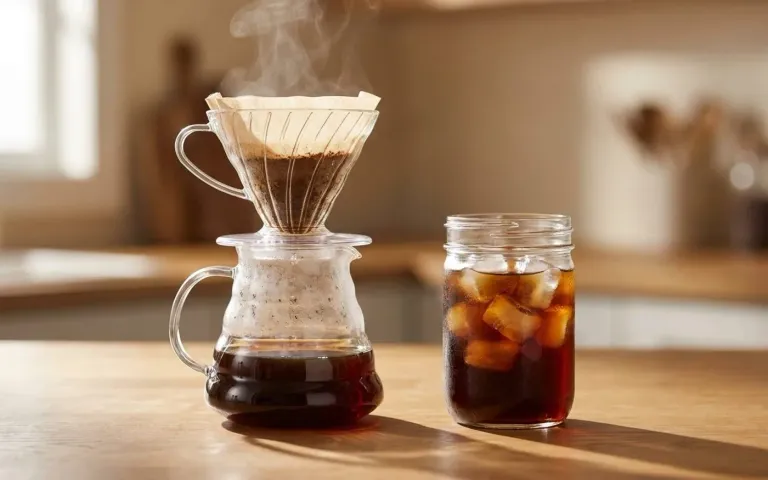
Cold brew starts tighter than hot coffee, and the reason is temperature. Cold water extracts less per gram, so a cold concentrate needs more coffee to reach a strength you would recognise. Espro suggests "aiming for a coffee ratio of 1 gram of coffee to 15-18 milliliters of water" for drinking strength, which is where the ready-to-drink end of the table sits.
Speciality coffee has a benchmark for hot brewing, and it does not transfer to your jar. Batali, Ristenpart and Guinard's 2020 paper describes a central region of the brewing control chart that spans TDS values of 1.15-1.35% and PE values of 18-22%, identified as the Specialty Coffee Association's "Golden Cup Standard". That is a hot-brew target, and our guide to speciality coffee explains where it comes from.
For the neighbouring brew methods, see our guides to French press ratio and espresso ratio. If you are working from cups instead of grams, our guide to how many coffee beans per cup converts the common measures.
Cold Brew Ratio Quick Reference
This is the whole page in one table, for 1 litre of water. Screenshot it, or keep it by your jar.
| Style | Ratio | Coffee per litre | Concentrate back | Serve |
|---|---|---|---|---|
| Strong concentrate | 1:4 | 250 g | About 575 ml | Dilute 1:2 |
| Concentrate | 1:5 | 200 g | About 660 ml | Dilute 1:1 to 1:2 |
| House concentrate | 1:8 | 125 g | About 790 ml | Dilute 1:1 |
| Ready-to-drink | 1:12 | 83 g | About 860 ml | Straight |
| Light ready-to-drink | 1:15 | 67 g | About 890 ml | Straight |
Frequently Asked Questions
What is the best ratio of coffee to water for cold brew?
Use 1:8 by weight for a concentrate that you dilute 1:1 with water or milk, and 1:12 to 1:15 for cold brew you drink straight. In grams per litre of water, that is 125 g, 83 g, or 67 g of coarse coffee. Weigh the coffee instead of scooping it.
What is the recommended ratio of coffee to water for making cold brew coffee?
Recommendations run from 1:4 to 1:16 because some describe a concentrate and some a finished drink. Pick the style first, then the number. Counter Culture writes "We prefer a 1:8 ratio", which is a sound concentrate to start from before you adjust it to your taste.
How to make cold brew 1 liter?
Use 125 g of coarse coffee to 1 litre of water for a 1:8 concentrate, which gives you about 790 ml back. Dilute it 1:1 with water or milk to drink. For the steep, strain, and storage, follow our guide to how to make cold brew.
How much coffee for 1500 ml of water for cold brew?
Use 188 g of coffee for a 1:8 concentrate, or 100 g at 1:15 for a drink you pour straight. Expect about 1.18 litres of concentrate back at 1:8, because the grounds keep roughly 1.7 g of water per gram of coffee (1,500 minus 320 ml).
What are the ideal ratios for making a cold brew latte?
Brew a concentrate between 1:4 and 1:8, then mix it with milk at about 1:1 instead of water. Milk takes the place of the dilution water, so add more milk if you want a milder latte. Start at 1:8 if you are unsure.
What is a 1/4 ratio for cold brew?
It means 1 g of coffee to 4 g of water, which is 250 g of coffee per litre. That is a strong concentrate. The grounds keep about 425 g of the water, so you get back only about 575 ml, and you need to dilute it before you drink it.
Can I use a French press for cold brew?
Yes. A 6-cup cafetiere holds about a litre, so make a 750 ml batch with 94 g of coarse coffee at 1:8 to leave room for the grounds. Steep it in the fridge, plunge slowly, then pour the batch through a paper filter for a cleaner cup. For a full litre of water, you need a cafetiere larger than 1 litre.
What ratio does Starbucks use for cold brew?
Starbucks at Home publishes 22 g of coarse coffee to 180 ml of water, about 1:8, then says to mix one part concentrate with one part water. That is the home press recipe, not a cafe specification. It gives you a useful 1:8 concentrate to copy.
How many grams of coffee do I need per litre for cold brew?
Use 67 g to 83 g per litre for ready-to-drink, 125 g for a 1:8 concentrate, and 200 g to 250 g for strong concentrates. Weigh the coffee, because spoons vary with the grind and the roast. Your scale makes every batch repeatable.

A wellness entrepreneur and biohacker, James explores the intersection of hospitality and health - from clean fuel and recovery tools to mindful routines that build balance into daily life.