Gaggia vs De'Longhi: Which Coffee Machine Brand Should You Buy?

Coffee & Wellness Writer
Gaggia vs De'Longhi is not about which brand is better - it is about which brand is built for what you actually want from a coffee machine.
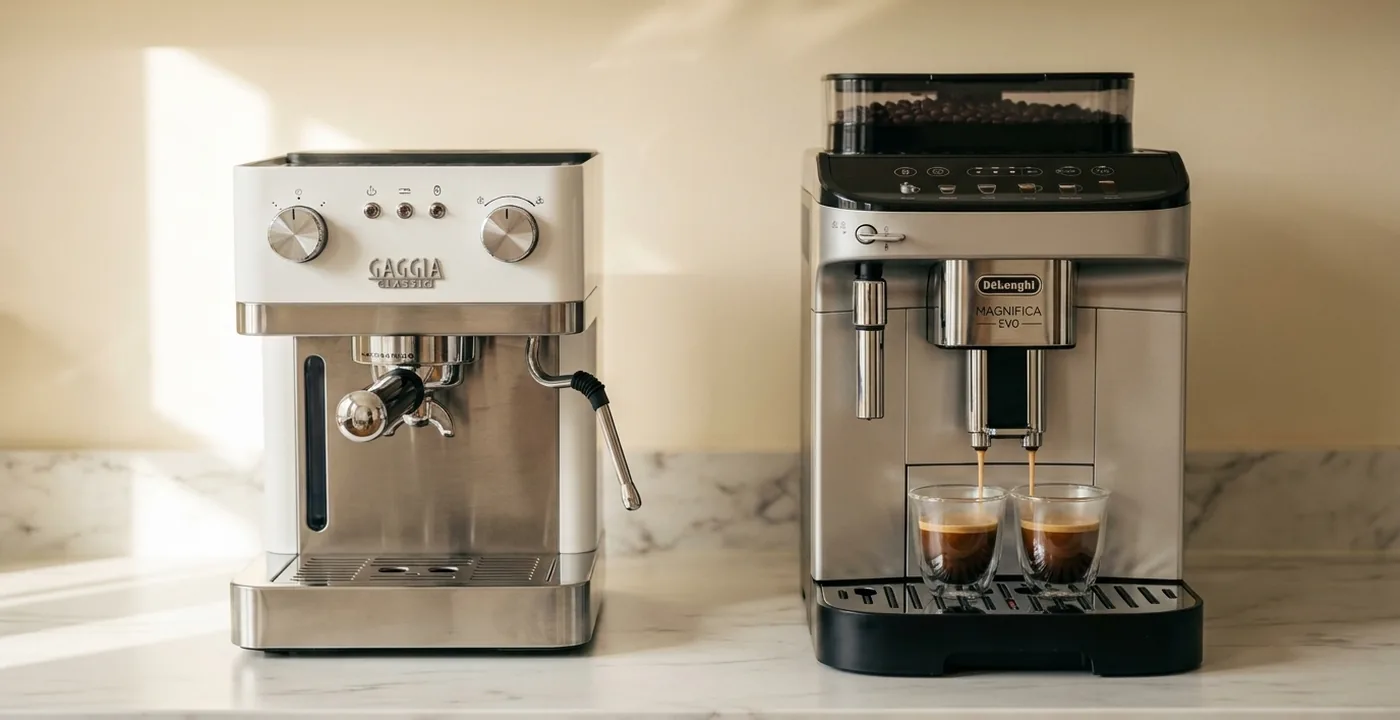
Table of Contents
Some of the links in this article are affiliate links, which help fund our independent review work at no extra cost to you. Every recommendation is based on hands-on testing through The Editor Lab methodology. No brand pays to appear, and no placement is guaranteed.
If you are weighing Gaggia vs De'Longhi, you are really weighing two different design philosophies, not two ranks on a single scale. Gaggia is the brand for buyers who put the cup first; De'Longhi is the brand for buyers who put convenience and choice first. Both are made in Italy, both have a long pedigree, and both have machines I would put in a real kitchen.
This comparison draws on work at both ends of the question. I spent more than five years as Sales and Marketing Manager for Sanremo UK, an Italian espresso machine manufacturer, where I was trained by authorised engineers on traditional espresso architecture; before that, I spent two years at UCC Coffee calibrating bean-to-cup machines in London law firms, McDonald's and Wetherspoons. All current ranges, warranty terms and indicative UK prices in this article were web-verified against the official Gaggia, De'Longhi UK, Amazon UK and John Lewis pages at the time of writing.
Editor's Note
Choose Gaggia for coffee quality, traditional Italian build and a machine you will keep for a decade. Choose De'Longhi for convenience, the widest model and feature choice, the lowest entry price or a longer warranty. The single biggest deciding factor is what you actually value in the cup versus what you value in the kitchen, and the second is your budget. Neither brand is categorically better; they are optimised for two different buyers.
Editor's Note
Editor's note. I founded Balance Coffee in 2020. We are a UK coffee roaster, and we do not sell coffee machines, so there is no brand of mine in this comparison. My fourteen years across both commercial bean-to-cup and traditional espresso are the only reason I think this matters: most "Gaggia vs De'Longhi" pages pick a winner. This one resolves your decision.
Gaggia vs De'Longhi: The Short Answer
Gaggia optimises for coffee quality and traditional craftsmanship; De'Longhi optimises for convenience, feature breadth and value. That sentence is the entire comparison in one line, and it is also why neither brand is categorically better than the other. They are not chasing the same buyer, and they never have been.
Gaggia's flagship line is still the Gaggia Classic Pro, a manual single-boiler espresso machine with a 58mm commercial portafilter, a chrome-plated brass group head and an architecture that has barely changed since the 1990s. Pull-and-tamp, dial in your grind, learn the dance. Its automatics, the Gaggia Brera and Anima, are built around flat ceramic burr grinders and compact footprints, with a much narrower feature set than the De'Longhi alternatives at the same price.
De'Longhi runs the other direction. Its Magnifica range of bean-to-cup machines is one of the most refined in Europe, with one-touch milk recipes, an “Over Ice” mode on newer models and adjustable bean settings that hide the technical work from you. Its entry espresso machine, the De'Longhi Stilosa, sits at around £90-150 (as of May 2026); the Dedica at the next tier up is a slim, forgiving steam-arm espresso machine that Gaggia simply does not contest at that price.
If you want a brand that asks more of you and pays you back in the cup, that is Gaggia. If you want a brand that meets you where you are and gives you a wide menu of options, that is De'Longhi.
Two Brands, Two Philosophies
The two brands answer different questions about what a home coffee machine is for. Gaggia, founded in Milan in 1938 by Achille Gaggia, was built around the lever espresso machine and the idea that a domestic machine should mimic a cafe's. De'Longhi, founded in Treviso in 1902, built its modern coffee business around making cafe quality automatic and accessible. You can hear those origin stories in their current ranges.
Gaggia keeps a narrow and intentionally traditional line. The Classic, in some form, has been the heart of the catalogue for thirty years; the Classic Pro, the Gaggia Classic Up and the Classic GT Dual Boiler are evolutions of the same idea rather than departures from it. The manual machines run a 58mm commercial portafilter, the same diameter you find on professional bar machines, which means basket and tamper accessories transfer cleanly between the two. On the automatic side, Brera and Anima keep flat ceramic burrs and a compact body, with no one-touch milk and no app. The choices are deliberate: more cup, less interface.
De'Longhi runs the opposite playbook. Its current De'Longhi UK coffee machine range covers entry espresso (Stilosa, Dedica), mid-range automatics (Magnifica family), the slim Rivelia with its dual-bean Bean Switch, and the PrimaDonna and Maestosa at the top of the bean-to-cup line. Across that range you get one-touch lattes and cappuccinos, programmable strength, hot water dispensers, the “Over Ice” recipe and, on the newer Magnifica and PrimaDonna machines, app pairing. Different buyers, different priorities. You can see the parallel narrowness on Gaggia's side at the Gaggia official site.
Manual Espresso: Gaggia Classic vs De'Longhi
On manual espresso, the Classic Pro sits at the top of an audience that the De'Longhi range does not directly contest. From the Sanremo side of my career I spent years inside the same Italian manufacturing tradition Gaggia comes from. The Classic Pro's 58mm commercial portafilter, three-way solenoid valve and chrome-plated brass group head are the same kind of architecture you find on a small bar machine, scaled down. It is a single-boiler machine, so it asks you to flush and pause between brewing and steaming, and the steam wand is short and stiff. That is the ceiling you are buying into: a machine you will be dialling in for years.
De'Longhi's manual line is built for a different reader. The De'Longhi Dedica (around £179-249, as of May 2026) is a 15-bar pump machine in a 15cm-wide body, with a single steam wand and pressurised baskets that forgive a sloppy grind. The Stilosa, at around £90-150, is the cheapest credible espresso machine from a major Italian brand in the UK, and there is no equivalent Gaggia product at that price. Both are pump-driven, both produce drinkable espresso, and both are designed to be used straight out of the box rather than dialled in over six weeks.
The honest framing: at the manual-espresso skill ceiling, the Gaggia Classic Pro review position is clear, the Classic Pro has no direct De'Longhi rival; at the entry price point, the De'Longhi Stilosa has no Gaggia rival at all. If you want to learn real espresso and keep one machine for a decade, you are buying Gaggia. If you want to buy your first espresso machine for under £150 and accept it for what it is, you are buying De'Longhi. Both calls are defensible and many readers will be looking at a best espresso machine under 500 roundup to bridge the gap.
Bean-to-Cup: Gaggia Brera and Anima vs De'Longhi Magnifica
On bean-to-cup, the comparison flips. De'Longhi has spent the last decade refining the Magnifica platform, and from the calibration work I did at UCC, the current Magnifica machines extract more consistently shot-to-shot than the equivalent Gaggia automatics at the same price. The Magnifica S, Magnifica Evo and Magnifica Plus share the same core brewing unit, with adjustments for milk system and recipe count rather than fundamental architecture. You can read the long-form take in our De'Longhi Magnifica review.
Gaggia's automatic line counters on grinder build and footprint, not feature breadth. The Gaggia Brera review spec is straightforward: a flat ceramic burr grinder, a steam wand for manual milk frothing and a compact 26.5cm-wide body. The Anima sits above it with a one-touch milk option but the same grinder family underneath. Ceramic burrs run cooler than the steel burrs in many entry De'Longhi machines, which can help preserve aromatic compounds in the cup; the trade-off is fewer programmable recipes and no app integration.
The honest split: if a one-touch latte at the press of a button matters more to you than the last 10% of cup quality, De'Longhi's Magnifica is the easier recommendation, and the De'Longhi Dedica review companion piece will tell you the same for the entry espresso slot. If you would rather steam your own milk, value a flat ceramic burr grinder and want a machine that takes up less counter space, Gaggia's Brera or Anima earns the look. Independent UK testing in the Which? coffee machine reviews and buying advice hub tends to mirror this split.
Price, Range and Warranty
The honest position on price is that De'Longhi competes at points Gaggia does not contest. The Stilosa at around £90-150 (as of May 2026) sits below the cheapest Gaggia machine; the Dedica at around £179-249 still sits below most Gaggia options. At mid-range bean-to-cup, the Magnifica S starts at around £399 (as of May 2026) and competes head-on with the Gaggia Brera at around £549. Above that, the PrimaDonna and Maestosa take De'Longhi into £1,500-plus territory that Gaggia largely leaves alone on the automatic side.
Range tells the same story. De'Longhi covers manual espresso, slim semi-automatics, full-size bean-to-cup, dual-bean machines and premium one-touch all under one roof. Gaggia keeps a narrower, more focused line: the Classic family on the manual side, Brera and Anima as the everyday automatics, and a handful of higher-tier machines around them. If you want choice, De'Longhi wins on volume. If you want fewer, more deliberate options, Gaggia is the simpler shop.
Warranty is the cleanest single difference. De'Longhi UK machines ship with a 2-year warranty as standard, and the brand publishes parts and service information on its main site. Gaggia UK machines ship with a 1-year warranty as standard, with extended terms available through some retailers. Both have well-established UK parts networks because the platforms have been around for decades, and the Classic in particular is one of the best-supported home espresso machines in the world for spares.
If budget is a hard constraint, the comparison is largely decided before it begins. Below £200, you are choosing between De'Longhi machines and nothing else. Above £400, you are choosing on philosophy and feature set rather than price.
Choose Gaggia If / Choose De'Longhi If
Two clean profiles, no hedging. If you do not see yourself clearly in one of them, read the other.
Choose Gaggia if you:
- Want to learn real espresso. The Classic Pro is the machine I would point a serious beginner toward if they accept the learning curve. You will need a separate grinder, fresh beans and a willingness to dial in over weeks.
- Value the cup over convenience. You would rather steam your own milk and pull your own shot than press a single button for a cappuccino.
- Plan to keep one machine for a decade. The Classic platform is endlessly serviceable and the spares ecosystem is unusually deep.
- Want a 58mm commercial portafilter. Basket sizes, tamper sizes and bottomless portafilters transfer cleanly from cafe accessories.
- Prefer fewer, more deliberate choices. Gaggia's range is narrow and focused.
Choose De'Longhi if you:
- Want the widest model and feature choice in one brand. Manual, slim, mid-range automatic, dual-bean, premium one-touch, all from one catalogue.
- Want one-touch lattes and cappuccinos without learning to steam milk. The Magnifica and PrimaDonna lines are built for exactly this buyer.
- Need the lowest entry price. The Stilosa at around £90-150 has no Gaggia rival.
- Value a longer warranty. The standard 2-year De'Longhi UK warranty buys you a real margin of cover compared with Gaggia's 1-year standard.
- Want the machine to do more of the work for you. The “Over Ice” recipe, programmable strength, adjustable milk and app pairing on newer models all point the same way.
Whichever brand you choose, the cup that comes out of it will lean on the beans you put in. Fresh, well-roasted espresso beans matter more than the brand badge, and our guide to the best coffee beans for espresso uk covers the side of the decision that this article does not.
Brand Comparison Table
| Dimension | Gaggia | De'Longhi |
|---|---|---|
| Brand philosophy | Coffee quality, traditional craft | Convenience, feature breadth, value |
| Manual espresso line | Classic Pro, Classic Up, Classic GT Dual Boiler | Stilosa, Dedica |
| Bean-to-cup line | Brera, Anima | Magnifica S/Evo/Plus, Rivelia, PrimaDonna, Maestosa |
| Typical UK price range (May 2026) | £400-£1,500+ | £90-£2,500+ |
| Automatic grinder type | Flat ceramic burrs | Steel burrs (most models) |
| One-touch milk recipes | No (Anima limited) | Yes (Magnifica, PrimaDonna) |
| Standard UK warranty | 1 year | 2 years |
| Best-known machine | Classic Pro | Magnifica |
Frequently Asked Questions
Is Gaggia better than De'Longhi?
Neither is categorically better. Gaggia is the better brand if you prioritise coffee quality, a traditional 58mm portafilter and a machine you will dial in for years. De'Longhi is the better brand if you prioritise convenience, one-touch milk recipes, the lowest entry price or a 2-year warranty. The right answer is the one that matches your priority, not a single ranking that ignores it.
What is the difference between Gaggia and De'Longhi?
The core difference is design philosophy. Gaggia builds traditional Italian machines around the Classic line and compact bean-to-cup automatics with flat ceramic burr grinders, optimising for what comes out of the cup. De'Longhi builds a much wider range that includes entry espresso machines from around £90-150, refined Magnifica bean-to-cup automatics and one-touch milk recipes, optimising for accessibility and feature breadth.
Which is better for espresso, Gaggia or De'Longhi?
For learning real espresso and building skill over time, Gaggia is the better brand. The Classic Pro has a 58mm commercial portafilter, a three-way solenoid valve and a chrome-plated brass group head, with no direct De'Longhi equivalent at its ceiling. For an inexpensive, forgiving first espresso machine, De'Longhi is the better brand; the Stilosa and Dedica sit below Gaggia's entry price and accept pre-ground coffee without complaint.
Is Gaggia or De'Longhi better for a beginner?
For a beginner who wants espresso to be easy on day one, De'Longhi is the better brand. The Stilosa and Dedica come with pressurised baskets that work with pre-ground coffee, and the Magnifica line removes the milk-steaming learning curve entirely. For a beginner who wants to learn real espresso and is happy to invest in a grinder and patience, Gaggia's Classic Pro is the better long-term home; the learning curve is the point.
A wellness entrepreneur and biohacker, James explores the intersection of hospitality and health - from clean fuel and recovery tools to mindful routines that build balance into daily life.