Best espresso machine for beginners UK
Ranked on one thing: how fast your first attempt becomes a good shot.
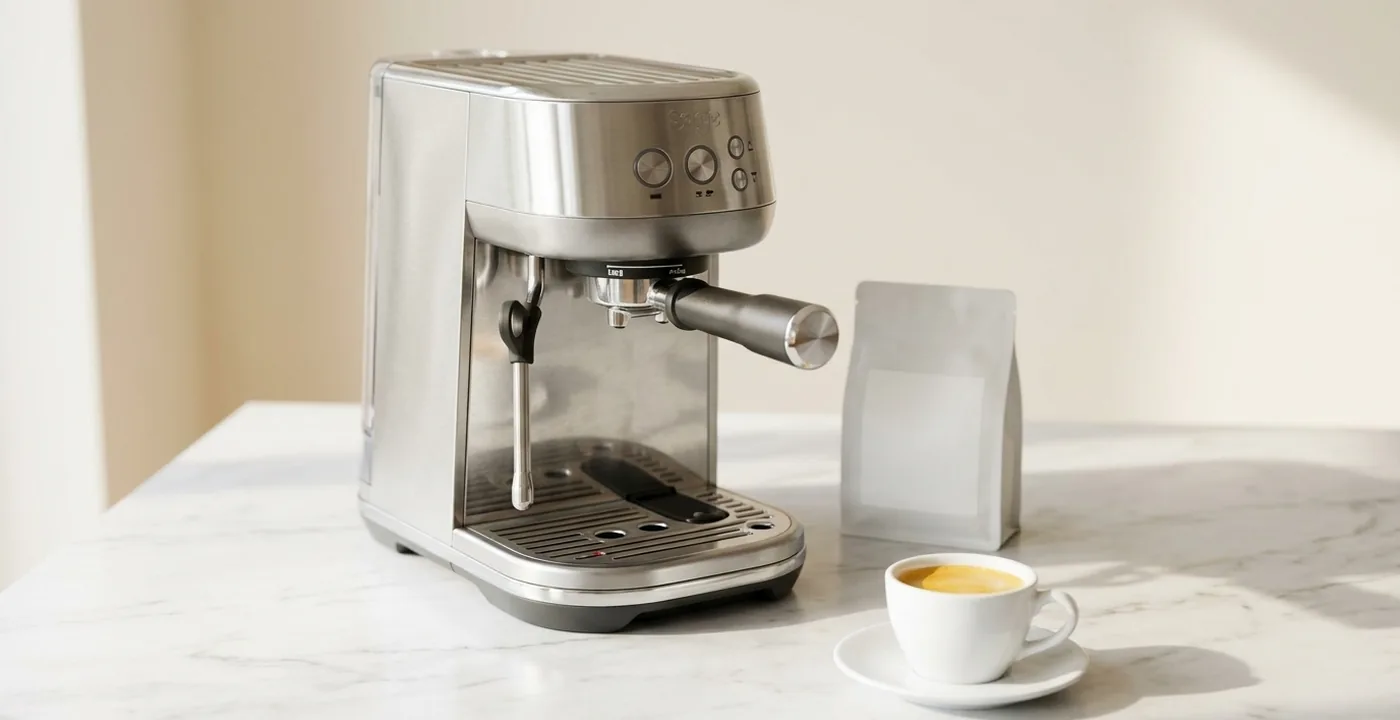
Table of Contents
Some of the links in this article are affiliate links, which help fund our independent review work at no extra cost to you. Every recommendation is based on hands-on testing through The Editor Lab methodology. No brand pays to appear, and no placement is guaranteed.
When I trained on commercial Sanremo machines, I saw how the steep learning curve cost cafes money in wasted coffee and time during barista onboarding. Beginners at home face the same problem.
The difference between a beginner-friendly machine and an unforgiving one is largely about three things: milk texturing feedback, extraction consistency at default settings, and how much technique variance the machine tolerates. A machine that compensates for minor tamping inconsistency will make a beginner feel capable within days. A machine that punishes every small error will make them feel like the problem is them. The problem is almost never them.
I bought a Sage Barista Pro for my parents and spent weeks dialling it in. I have also trained people on machines from the £250 Bambino Plus to commercial kit. This list is built on that range, not on spec sheets. Most beginner recommendations are written by reviewers who learned espresso on consumer machines. This one is built on understanding what separates a beginner-tolerant machine from an unforgiving one at the engineering level. Espresso machines are one of several formats, and our overview of the main types of coffee machine shows where they fit.
James Bellis is the Coffee Writer & Biohacker at Balance Journal and founder of Balance Coffee. He has fifteen years in the coffee industry, including five and a half years with Sanremo, one of the world's leading espresso machine manufacturers, and has visited almost 300 UK roasteries.
How we tested
We evaluated seven machines against three beginner-specific criteria: (1) extraction consistency at default settings -- does the machine produce a good shot without manual pressure calibration? (2) milk texturing forgiveness -- does the steam wand provide enough feedback and enough time in the steam phase that a beginner can learn from each attempt? (3) tolerance for tamping variance -- does a slightly uneven tamp still produce a drinkable espresso?
Machines were tested with fresh pre-ground espresso and with freshly ground beans. On each machine we judged how far a beginner's first shots would fall from a practised shot. That gap is what we call the 'beginner gap', and it is the primary measure used in this ranking.
Prices quoted are approximate UK retail at time of writing. Verify current pricing before purchase.
What makes an espresso machine beginner-friendly?
Three things. First, consistent pressure at default settings: a machine that extracts reliably at 9 bar without requiring manual calibration means the beginner's variables are limited to grind and tamp, not pressure. Second, a forgiving milk system: a steam wand with enough temperature feedback and enough time in the steam phase that the user can learn from each attempt rather than simply burning the milk. Third, dual-wall filter baskets, which compress the espresso bed and tolerate tamping inconsistency far better than single-wall baskets. All three of those criteria are measurable. Most 'beginner' recommendations on the web are based on brand familiarity rather than these criteria. This ranking is not.
Top 3 Espresso Machines for Beginners
| Brand | Best For | Price | Shop |
|---|---|---|---|
 1st Place 1st Place | £279 | Shop Sage | |
 2 2 | £149 | Shop De’Longhi | |
 3 3 | £79 | Shop De’Longhi |
Quick view: our top three beginner espresso machines
1. Sage Bambino Plus – best overall for beginners
The Bambino Plus was designed with a specific brief: produce cafe-quality espresso with minimal technique required. It achieves this more consistently than anything else at its price.
The ThermoJet heating system reaches extraction temperature in three seconds. That speed matters for beginners because it removes the guesswork around preheating. The 54mm portafilter uses dual-wall filter baskets by default, which compress the espresso bed and significantly reduce the effect of tamping inconsistency. A beginner who tamps slightly unevenly on a single-wall basket gets a channelled extraction. On a dual-wall basket, they get a decent espresso.
The milk system is where the Bambino Plus earns its beginner status most clearly. The steam wand uses an auto milk texturing feature that pauses steam at a set temperature. It is not as precise as manual texturing on a commercial machine, and experienced baristas find it limiting. For a beginner, that limitation is the point. The machine teaches the motion without punishing the error.
The honest note: the Bambino Plus does not include a grinder. You will need one, or fresh pre-ground espresso. The machine is forgiving enough that quality pre-ground works better here than it does on machines without dual-wall baskets, so it is a workable starting position while you decide on a grinder.
“The gap between a beginner's first shot and a good shot is shorter on this machine than on anything else we tested.”James Bellis, Balance Journal
| Spec | Detail |
|---|---|
| Price | £279 |
| Ease of use | 5/5 |
| Milk system | Auto-steam wand with temperature pause |
| Grinder included | No |
| Beginner score | 5/5 |
2. De’Longhi Stilosa EC230 – best budget
At around £79, the Stilosa is the lowest point of genuine entry into espresso. Not pod espresso, not filter coffee styled as espresso: a 15-bar machine with a portafilter and a steam wand, at a price where the alternative is usually a capsule machine.
The machine does not have the Bambino Plus's dual-wall basket assistance or its auto-temperature steam pause. What it has is a panarello steam wand, which injects air automatically and requires less technique than a professional steam wand. The result is not as silky as textured milk on a higher-end machine, but it is workable for a latte or a flat white once you have spent a week with it.
The honest trade-off: the Stilosa requires more attentiveness than the Bambino Plus. Pressure is less consistent across consecutive shots, and tamping variance matters more. A beginner who is willing to accept a longer learning period will eventually produce good espresso on this machine. A beginner who wants consistent results from week one should budget for the Bambino Plus or the Dedica.
The Stilosa's value is simple: it is a real machine at a price where most buyers are choosing between this and a pod machine. If you want to learn the skill and keep your early investment modest, it is the right entry point.
“A genuinely functional espresso machine for £79. That is not a trivial thing.”
| Spec | Detail |
|---|---|
| Price | £79 |
| Ease of use | 3.5/5 |
| Milk system | Panarello wand |
| Grinder included | No |
| Beginner score | 3.5/5 |
3. De’Longhi Dedica EC685 – best compact
The Dedica occupies an unusual position in the beginner market. At 15cm wide, it fits on worktops that would not accommodate the Bambino Plus, and it ships with dual-wall filter baskets as standard -- which puts it significantly ahead of the Stilosa on extraction consistency.
The pressure system is better calibrated than the Stilosa, and the machine responds more predictably to small changes in grind size. For a beginner learning to adjust variables, that feedback loop matters. On the Stilosa, it can be difficult to tell whether an underperforming shot is a machine problem or a technique problem. On the Dedica, the machine is reliable enough that the variable is clearly you -- which is, in a practical sense, the better teaching environment.
One limitation worth flagging: the portafilter handle sits close to the machine body, which makes the tamp-and-lock process awkward with larger hands. It is not a dealbreaker, and most users adapt within a week, but it is worth knowing before you buy.
For a beginner in a small kitchen, the Dedica is the most practical route into espresso without compromising on learning potential. The dual-wall baskets give you the same tamping tolerance as the Bambino Plus, at a lower price and a narrower footprint.
“Best beginner machine if counter space is your actual constraint.”
| Spec | Detail |
|---|---|
| Price | £149 |
| Ease of use | 4/5 |
| Milk system | Panarello wand |
| Grinder included | No |
| Beginner score | 4/5 |

4. Sage Barista Express – best step-up
The Barista Express has a built-in conical burr grinder, which removes one of the most significant decision points for beginners: the separate grinder. You load beans, adjust the grind dial, and pull a shot. The workflow is simpler than managing two separate machines, and the freshness of grinding directly before extraction produces a noticeably cleaner cup.
It is not, however, the easier starting point. The Barista Express has more settings to manage than the Bambino Plus: grind size, dose, extraction time, and milk texturing are all manual. None of them is difficult individually. Together, they ask more of a beginner who simply wants a coffee before work.
The Barista Express is a better long-term machine than the Bambino Plus. The integrated grinder produces fresher espresso, and the manual controls give you the range to improve as your technique develops. But when I have helped people start out on espresso, the Bambino Plus produces better results in week one. The Barista Express catches up by month two, once the user has developed enough baseline technique to use the additional control productively.
See the best espresso machine under £500 UK guide for how the Barista Express compares to other machines at the mid-range price point.
“Buy the Barista Express if you are ready to learn. Buy the Bambino Plus if you want good espresso while you learn.”
| Spec | Detail |
|---|---|
| Price | £649 |
| Ease of use | 3.5/5 |
| Milk system | Manual steam wand |
| Grinder included | Yes -- conical burr |
| Beginner score | 3.5/5 |

5. De’Longhi Magnifica S – best one-touch
The Magnifica S is a bean-to-cup machine. Beans go in, coffee comes out. The machine handles grinding, dosing, tamping, and extraction. You control strength and cup size via a dial.
This is the least instructive machine in this list. A beginner who uses the Magnifica S will learn how to use the Magnifica S. They will not learn how to make espresso. The distinction matters if you ever want to upgrade, use a different machine, or understand what you are tasting and why. If none of those things matter to you, the Magnifica S is excellent.
What it delivers is consistency. The same dial setting produces the same cup every morning, without any variation in technique. For someone who wants high-quality automatic coffee and has no interest in developing a manual skill, that is a completely legitimate position. The machine is also quiet enough that it does not announce itself at six in the morning, which is a genuine quality-of-life consideration most reviews do not mention.
The milk system uses a separate manual steam wand, which is an inconsistency in the design. The espresso function is fully automatic; the milk function is not. Beginners sometimes find this jarring. The espresso itself, however, is reliably good from the first use.
“If convenience is the priority, this is the best in class. If learning espresso is the goal, start with the Bambino Plus.”
| Spec | Detail |
|---|---|
| Price | £499 |
| Ease of use | 5/5 (espresso function) |
| Milk system | Manual steam wand (separate) |
| Grinder included | Yes -- automatic |
| Beginner score | 4/5 |

6. Fellow Series 1 – best premium (US only, May 2026)
The Fellow Series 1 is the most interesting machine in this category, and the most honest thing to say about it upfront is: you cannot buy it in the UK right now.
As of May 2026, the Series 1 is US-only and retails at $1,499. The reason it belongs in this list is its digital pressure display, which gives the user real-time feedback on extraction pressure as the shot pulls. No other machine at this price point does this. For a beginner, that feedback is genuinely instructive: you see, in real time, whether your tamp produced consistent pressure and whether the grind is extracting at the correct rate.
The pressure gauge teaches you what espresso feels like before you develop the palate to recognise it from taste alone. That is a meaningful educational advantage that no YouTube tutorial replicates. Most beginners spend their first three months pulling shots and wondering whether what they tasted was correct. The Series 1 answers that question while you are still in the process of making the shot.
For UK buyers: if it launches here at a comparable price, it moves to the top of this list for beginners who are serious about learning the craft from the start.
“Not available in the UK yet. Worth watching closely.”
| Spec | Detail |
|---|---|
| Price | $1,499 (US only -- May 2026) |
| Ease of use | 4/5 |
| Milk system | Manual steam wand |
| Grinder included | No |
| Beginner score | 4.5/5 (when available) |
If you do not want to learn the skill: Nespresso Vertuo
Nespresso Vertuo machines appear on most beginner espresso lists and the framing is almost always misleading. A Vertuo machine does not produce espresso in the technical sense.
The Vertuo system uses centrifusion technology and operates at up to 19 bar of pressure, higher than the 9-bar standard that defines espresso extraction. The resulting coffee is strong and crema-covered, but the extraction chemistry is different. This is not a quality criticism. It is a category distinction, and it matters because a beginner who learns to dial in a Nespresso will not have learned anything transferable to a portafilter machine.
What the Nespresso Vertuo Next does deliver is consistent, good-quality coffee at the push of a button, with no technique required and no margin for human error. If your goal is good coffee rather than learning espresso craft, it is a legitimate choice at around £89. The pods are more expensive per cup than freshly ground beans, but the machine costs less, the learning curve is flat, and the results are predictable.
Be honest with yourself about which you actually want before spending £279 on a portafilter machine and a grinder.
Do you need a grinder?
Yes, eventually. The question is whether to add one at the start or after you have confirmed espresso is something you want to pursue.
Pre-ground espresso degrades quickly once the bag is opened. For a beginner testing whether they enjoy the process, fresh pre-ground from a quality roaster -- used within two to three weeks of opening -- is an acceptable starting point, particularly on the Bambino Plus and Dedica where dual-wall baskets compensate for the slight inconsistency of pre-ground particle size. The best coffee beans UK guide covers which roasters produce espresso blends that hold up well as pre-ground and are appropriate for beginner machines.
The key requirement when you do add a grinder: burr only, not blade. A blade grinder produces particles of inconsistent size, which leads to uneven extraction regardless of how forgiving the machine is. The Sage Dose Control Pro is the standard recommendation at around £150 and pairs well with both the Bambino Plus and the Dedica.
For anyone buying the Barista Express, the built-in grinder removes this decision entirely.
One starting point worth flagging: Balance Coffee's Cerrado Brazil or Rotate Espresso are both calibrated for espresso extraction and work well on any machine in this list -- a low-risk way to establish a baseline before you develop your own preferences.
Full comparison table
| Machine | Price | Ease of use | Milk system | Grinder | Beginner score |
|---|---|---|---|---|---|
| Sage Bambino Plus | £279 | 5/5 | Auto steam wand | Not included | 5/5 |
| De’Longhi Dedica EC685 | £149 | 4/5 | Panarello wand | Not included | 4/5 |
| De’Longhi Stilosa EC230 | £79 | 3.5/5 | Panarello wand | Not included | 3.5/5 |
| Sage Barista Express | £649 | 3.5/5 | Manual steam wand | Built in (burr) | 3.5/5 |
| De’Longhi Magnifica S | £499 | 5/5 (auto) | Manual wand (separate) | Built in (auto) | 4/5 |
| Fellow Series 1 | $1,499 (US only) | 4/5 | Manual steam wand | Not included | 4.5/5 |
| Nespresso Vertuo Next | £89 | 5/5 | Separate frother | No (pod) | N/A |
What to avoid
Blade grinders paired with portafilter machines. Inconsistent grind particle size is the single most common reason a beginner's espresso underperforms. The machine is rarely the problem.
15-bar pump pressure as a quality indicator. Most entry-level machines claim 15-bar pump pressure. The measurement refers to peak pump output, not extraction pressure. A well-engineered machine extracts at a consistent 9 bar. A cheap machine claiming 15 bar produces 15 bars of inconsistency delivered unevenly. The number on the box is not the useful number.
Fully automatic machines if learning is the goal. Bean-to-cup machines produce consistent coffee, but they do not teach espresso. If you want to understand what you are tasting and improve over time, you need a machine where you control the variables.
Pod machines described as espresso machines. A Nespresso Vertuo is a well-engineered product. It is not an espresso machine in the technical sense. If you buy it expecting to develop espresso technique, you will be frustrated. If you buy it expecting consistent coffee at the push of a button, you will not be.
Final verdict
The Sage Bambino Plus is the correct answer for most beginners. It is not the cheapest machine in this list, and it is not the most capable machine in this list, but it is the machine that produces the shortest gap between a beginner's first attempt and a genuinely good espresso. That is the specific thing this ranking measures.
If budget is the primary constraint, the De’Longhi Dedica EC685 at around £149 gives you dual-wall baskets and consistent extraction in the smallest possible footprint. The De’Longhi Stilosa is available under £80 if you want to spend as little as possible while still learning on a portafilter machine, with the understanding that the learning curve is longer.
For the step-up buyer who wants one machine for the long term, the best espresso machine under £500 UK guide covers the mid-range in more detail. For the full Sage range from beginner to professional, the best Sage coffee machine UK guide is the right starting point. For the broader category, see our best espresso machine UK overview.
For the right coffee to pair with any of these machines, see the best coffee beans UK guide.
Updated May 2026. Prices are approximate UK retail at time of writing. Verify current pricing before purchase.
Frequently Asked Questions
Is the Sage Bambino Plus good for beginners?
It is the best espresso machine for beginners. It produces consistent espresso at default settings, and its auto milk texturing system is forgiving enough that beginners can produce workable lattes within a week. The dual-wall filter baskets compensate for tamping inconsistency, the most common beginner error. The machine does not include a grinder, but fresh pre-ground espresso works well as a starting point.
Do I need a grinder for the Bambino Plus?
The Bambino Plus does not include a grinder. You can start with fresh pre-ground espresso from a quality roaster -- the dual-wall baskets are tolerant enough that this works reasonably well. When you are ready to improve further, a burr grinder makes a significant difference. The Sage Dose Control Pro at around £150 is the standard pairing and works well with the Bambino Plus's 54mm portafilter.
What is the easiest espresso machine to use in the UK?
The Sage Bambino Plus is the easiest machine with genuine espresso extraction. The De’Longhi Magnifica S is technically simpler to operate (one-touch, bean-to-cup), but it does not teach you to make espresso. If ease of use is the only criterion, the Nespresso Vertuo Next is the simplest option at the lowest price, though it is a pod machine, not an espresso machine.
Bambino vs Bambino Plus: which for beginners?
The Bambino Plus is the better choice for beginners. The key difference is automatic milk texturing, which pauses the steam function at a set temperature and prevents overheated milk. The standard Bambino requires more manual steam control, which adds one more variable for a beginner to manage. The price difference between the two is modest enough that the Plus is worth it if beginner-friendliness is the priority.
Do beginners need a separate grinder for espresso?
Not to start, but you will need one eventually. Fresh pre-ground espresso from a quality roaster works acceptably on machines with dual-wall filter baskets, such as the Bambino Plus and Dedica EC685. Once you commit to the process, a burr grinder makes a meaningful difference to extraction consistency. Budget around £100 to £150 for a grinder that will not hold your machine back.
What budget should a beginner set for an espresso machine?
Set a budget of £200 to £350 for a machine that will genuinely teach you the skill. Below £150, the machines work but forgive fewer errors, which extends the learning curve. The Bambino Plus at £279 is the best-value entry point. If your budget is under £100, the De'Longhi Stilosa is the only portafilter machine worth considering at that price.
Is a pod machine or bean-to-cup machine better for beginners?
Neither will teach you to make espresso. Pod machines and bean-to-cup machines handle the variables for you, which produces consistent coffee but develops no transferable skill. If you want convenience without a learning curve, a Nespresso Vertuo is the better choice. If you want to learn espresso and improve over time, start with a portafilter machine like the Bambino Plus.
How long does it take to learn to make good espresso?
Most beginners produce a consistently drinkable espresso within two to four weeks on a forgiving machine. The first week is about understanding the tamp and grind. The second week is about reading the extraction. Milk texturing takes longer - expect four to six weeks before your flat whites are reliably smooth. The learning curve is shorter on machines that tolerate beginner errors.
Sage vs De'Longhi for beginners: which brand is better?
Sage for beginners who want the fastest path to consistent espresso. De'Longhi for beginners working with a tighter budget or a smaller worktop. The Bambino Plus leads this category because of its automatic milk texturing and dual-wall baskets. De'Longhi's Dedica EC685 closes most of that gap at £130 less and fits on worktops where the Bambino Plus will not.
How do you clean a beginner espresso machine?
Daily: remove the portafilter and knock out the spent puck, rinse the portafilter and basket under hot water, wipe the steam wand after every use. Weekly: run a clean cycle with the machine's cleaning tablet. Monthly: descale using the manufacturer's descaling solution. Most beginner machines including the Bambino Plus and Dedica have guided cleaning cycles that walk you through each step.
A wellness entrepreneur and biohacker, James explores the intersection of hospitality and health - from clean fuel and recovery tools to mindful routines that build balance into daily life.