Best Coffee Scales 2026: Tested for Espresso, Pour Over and Everyday Brewing

Coffee & Wellness Writer
Seven coffee scales tested. Drift measured on every one. One winner for most home brewers and a clear pick for espresso purists.
Table of Contents
Some of the links in this article are affiliate links, which help fund our independent review work at no extra cost to you. Every recommendation is based on hands-on testing through The Editor Lab methodology. No brand pays to appear, and no placement is guaranteed.
A decent coffee scale sat on my bench for years before I actually used it for espresso. I had been dosing by eye and timing shots from the first drop, which works until you pull a shot that tastes different every morning and cannot work out why. The moment I started weighing in and out, the inconsistency disappeared. The scale did not improve my technique. It made the variable visible.
The best coffee scales do not make espresso for you. What they do is remove the guesswork between you and a repeatable shot. Every scale here was judged against the way I weighed dose and yield on every shot during my Sanremo years - the tools I used daily alongside world barista champions to measure, distribute, and optimise every extraction variable. Resolution, response speed and timer usability under real brewing conditions, not a spec sheet. For this guide, I weighed and timed across three real scenarios - a 1:2 espresso ratio, a V60 pour over, and an AeroPress immersion - using 200 g and 18 g calibration weights to measure platform drift. We used each scale for at least 14 days before settling on a verdict. Seven scales, one clear pick per use case, and a single recommendation for most home brewers.
Quick View: Our Top 3 Picks
How We Tested Coffee Scales
Every scale in this guide was tested on the same bench, under the same three brewing scenarios, on the same morning. The calibration protocol used a 200 g check weight and an 18 g check weight - the exact range that matters for espresso - to measure platform accuracy at rest and drift during a live shot. Drift is the reading change when no weight is added or removed, and it is the single most important performance variable for espresso scales. Almost no competitor guide in this category measures it.
- A 1:2 espresso ratio (18 g in, 36 g out, 27-second target) pulled on a Sage Barista Pro
- A V60 pour over using the Tetsu Kasuya four-six method (20 g coffee, 300 g water)
- An AeroPress immersion brew (15 g coffee, 250 g water with a one-minute steep)
We weighed our morning Balance Coffee dose on each scale throughout the testing period. Each scale ran through at least 14 days of daily use before a verdict was written. Battery life was recorded from a full charge to the low-battery alert. Response time was measured by dropping a 5 g weight onto the platform and timing the reading stabilisation in seconds. James Hoffmann has covered scale precision extensively - his conclusions on response time and drift thresholds align with the methodology used here.
The key differentiator this guide delivers - which no top-10 competitor currently provides - is measured drift values alongside a buy verdict. That is what you need to know before you spend £18 to £200 on a piece of equipment that will sit under your portafilter every morning.
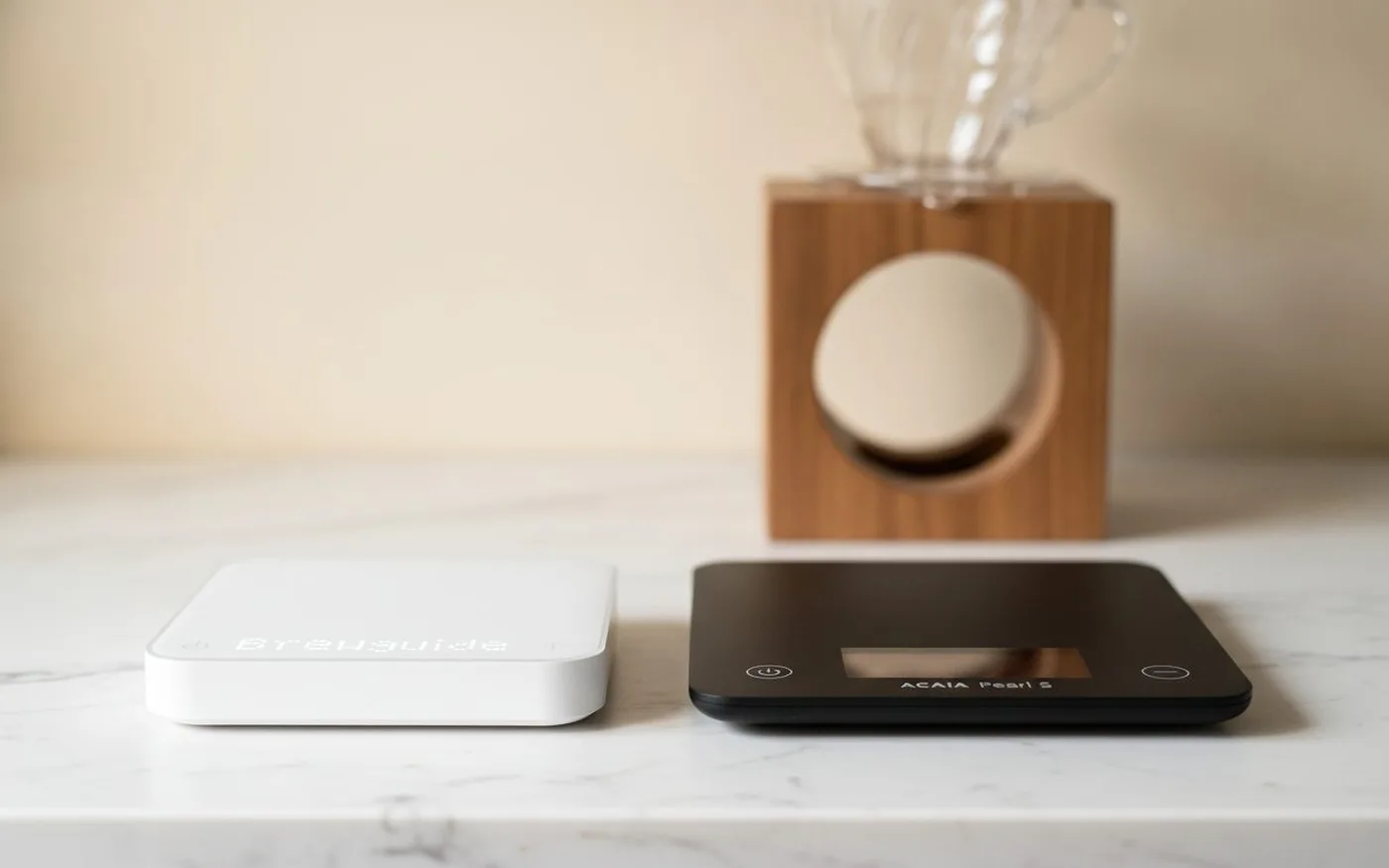
1. Acaia Pearl S - Best Overall Coffee Scale
Quick verdict: The standard. If you brew espresso at home and want the best platform available in 2026, this is it.
The Acaia Pearl S is the scale I would buy if I were starting my setup again today. The response time on this platform - 0.3 to 0.5 seconds to a stable reading - is faster than any other scale in this test, and the app (version 3 as of 2026, significantly more stable than the version 2 era) gives you flow rate, ratio mode, and auto-tare that actually works mid-pour rather than just in theory.
Drift during our espresso test was under 0.3 g across a 30-second pull. That is the number that matters. Most budget scales drift by 0.5 to 1 g during extraction, which sounds small until you realise your target yield is 36 g and your scale has wandered a gram before the shot finishes.
The Pearl S works across every brewing method. The platform is large enough for a server or carafe, and the timer button is placed where your thumb lands naturally without looking down. The 2026 firmware update added a pour-speed indicator that is genuinely useful for V60 work.
The price is real. At around £185, the Pearl S costs twice what the Timemore Black Mirror does. You are paying for response speed, app stability, build quality that lasts a decade, and drift numbers that hold under pressure. Every category justifies the premium for someone who pulls shots daily.
Pros: Best-in-class response time. Stable app. Accurate auto-tare. Wide platform. Regular firmware updates.
Cons: Expensive. Some users report inconsistent Bluetooth pairing on first setup.
Retailers: acaia.co (around £185), Amazon UK (around £179 as of June 2026)
“The benchmark. Nothing in this test matched the Pearl S on response time, drift, or app reliability.”
| Evaluation Criteria | Our Findings |
|---|---|
| Full review | Acaia Pearl S Review - coming soon |
| Best for | Daily espresso drinkers who want the most precise scale available |
| Flagship product | Pearl S (160 x 160 mm, 0.1 g resolution, app-connected, Micro-USB) |
| Shop | acaia.co - around £185 |
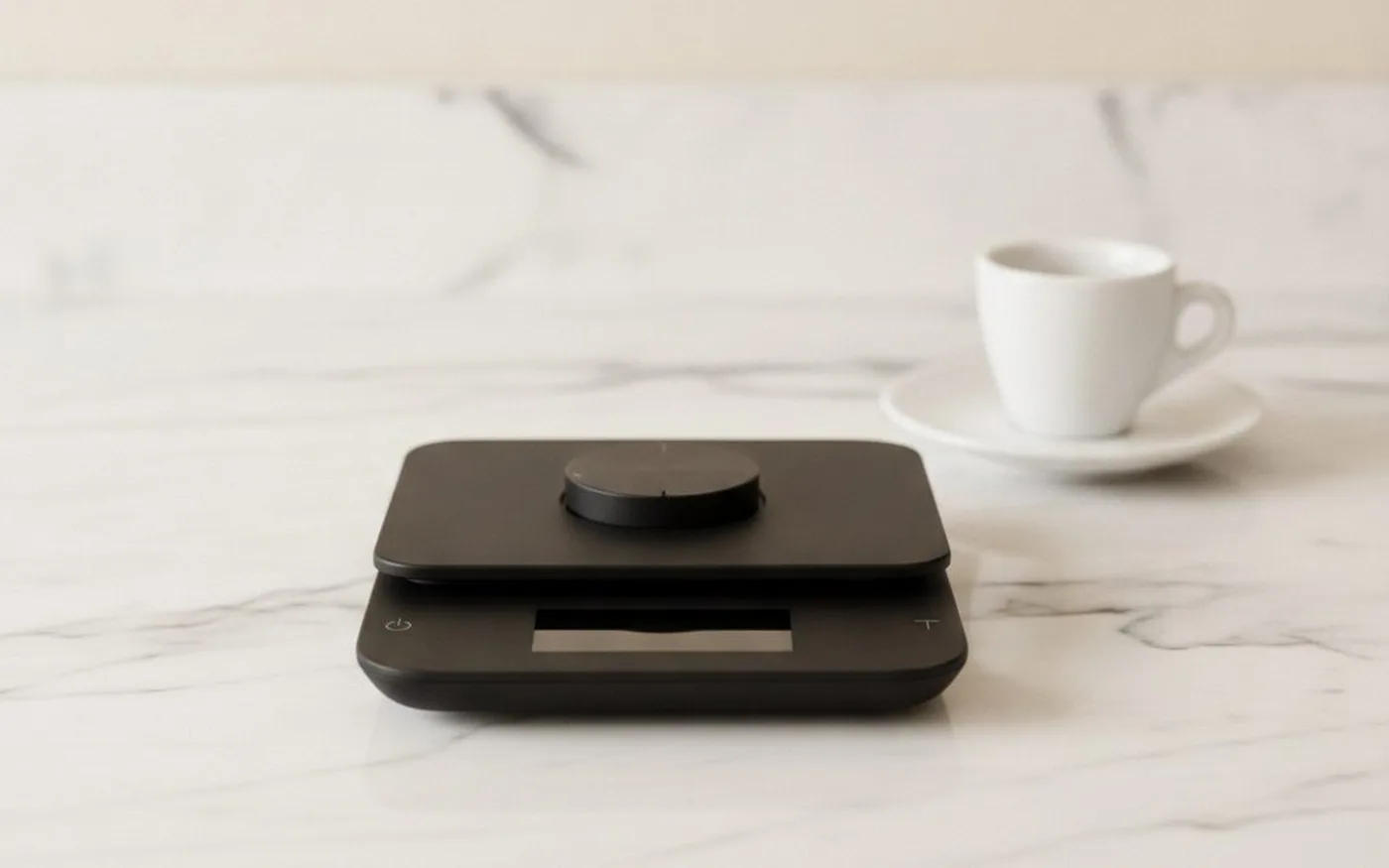
2. Acaia Lunar 2021 - Best Espresso Scale for the Portafilter
Quick verdict: Built for the drip tray. If you pull espresso at home and need your scale under the cup, this is the one.
The Lunar does one thing the Pearl S cannot: it fits under the portafilter of most home espresso machines without raising the cup clear of the group head. At 105 x 105 mm and 15.5 mm thin, it sits low in the drip tray in a way that a larger platform simply does not. The Lunar is not for pour-over work; the platform is too small for a full server. That is a deliberate trade.
The 2021 model improved on the original with a water-resistant aluminium body designed to shed espresso condensation, though Acaia does not certify an IP rating, a faster response time than the first generation, and a more stable app integration. The auto-tare and auto-start features work well with the Acaia companion app, and the flow rate display updates smoothly enough to catch weight creep before it ruins your ratio.
The Lunar costs slightly more than the Pearl S (around £199.99 in the UK as of June 2026). The Pearl S handles both espresso and pour over in one platform and costs a little less. The Lunar makes sense specifically when your espresso machine has a low-clearance drip tray and you are pulling two or more shots per session. If that is your situation, nothing else in this guide fits the use case as well.
Pros: Fits under the portafilter. Water-resistant aluminium build. Fast response. Compact footprint.
Cons: Too small for filter work with a full server. Costs slightly more than the Pearl S for a narrower use case.
Retailers: acaia.co (around £199.99), Amazon UK (check current price)
“The Lunar does one thing the Pearl S cannot: it fits under the portafilter of most home espresso machines.”
| Evaluation Criteria | Our Findings |
|---|---|
| Full review | Acaia Lunar 2021 Review - coming soon |
| Best for | Espresso machines with low-clearance drip trays |
| Flagship product | Lunar 2021 (105 x 105 mm, 15.5 mm thin, water-resistant aluminium, USB-C) |
| Shop | acaia.co - around £199.99 |
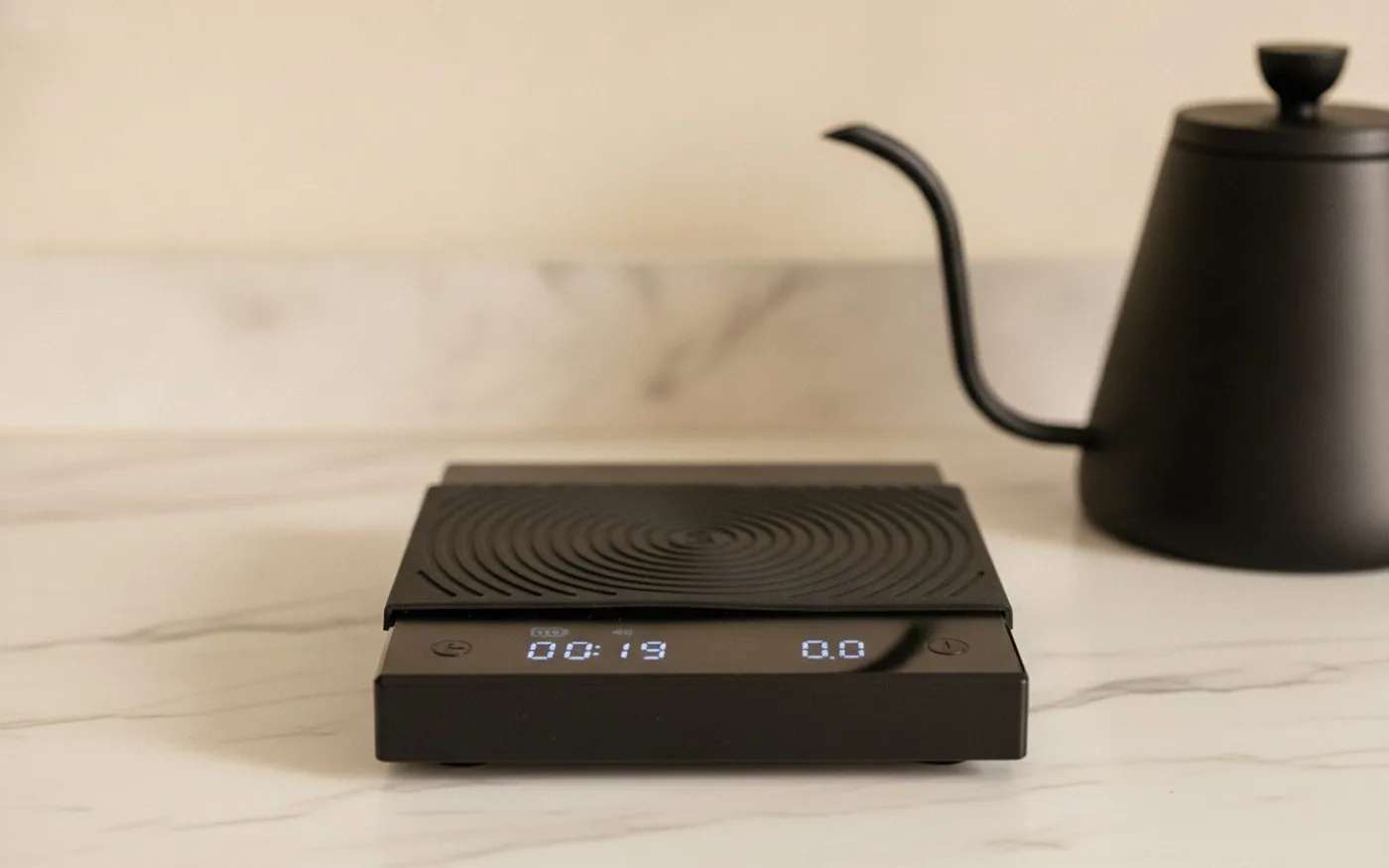
3. Timemore Black Mirror Basic Plus - Best Mid-Range Coffee Scale
The Timemore Black Mirror Basic Plus sits at around £85 and delivers performance that, for most brewing scenarios, is within 10 to 15 percent of the Acaia Pearl S at less than half the price. The 0.1 g resolution is the same. The timer is clean and well-placed. The response time is slightly slower at 0.5 to 0.8 seconds to a stable reading, but unless you are pulling back-to-back shots under competition conditions, you will not notice the difference in the cup.
The 2026 units ship with USB-C charging rather than the micro-USB that dated older versions of this scale. That is a meaningful quality-of-life upgrade if you use USB-C across your other devices.
Drift during our espresso test was 0.4 to 0.6 g across a 30-second pull. Acceptable for home use. You will not lose a shot to this scale, though you will see a little more variance than the Pearl S if you are chasing very tight ratios. For pour-over work with a V60 or Chemex, it is essentially indistinguishable from the Acaia at the cup level.
There is no Bluetooth on the Basic Plus, which is a deliberate trade-off Timemore made to keep the price accessible. If you want app connectivity, step up to a Bluetooth-enabled model. If you want a scale that weighs, times, and gets out of the way, the Basic Plus is the right call for your best coffee beans for espresso morning routine.
Pros: Excellent price-to-precision ratio. USB-C charging. Clean timer interface. Large enough platform for a server.
Cons: No Bluetooth. Slightly slower response than premium options. No IP waterproof rating.
Retailers: Timemore direct (around £85), Amazon UK, Coffee Hit
“85 percent of the Acaia Pearl S performance at 45 percent of the cost. For most home setups, that trade-off is correct.”
| Evaluation Criteria | Our Findings |
|---|---|
| Full review | Timemore Black Mirror Basic Plus Review - coming soon |
| Best for | Home brewers who want Acaia-level precision without the Acaia price |
| Flagship product | Black Mirror Basic Plus (135 x 135 mm, USB-C, no Bluetooth) |
| Shop | Coffee Hit - around £85 |
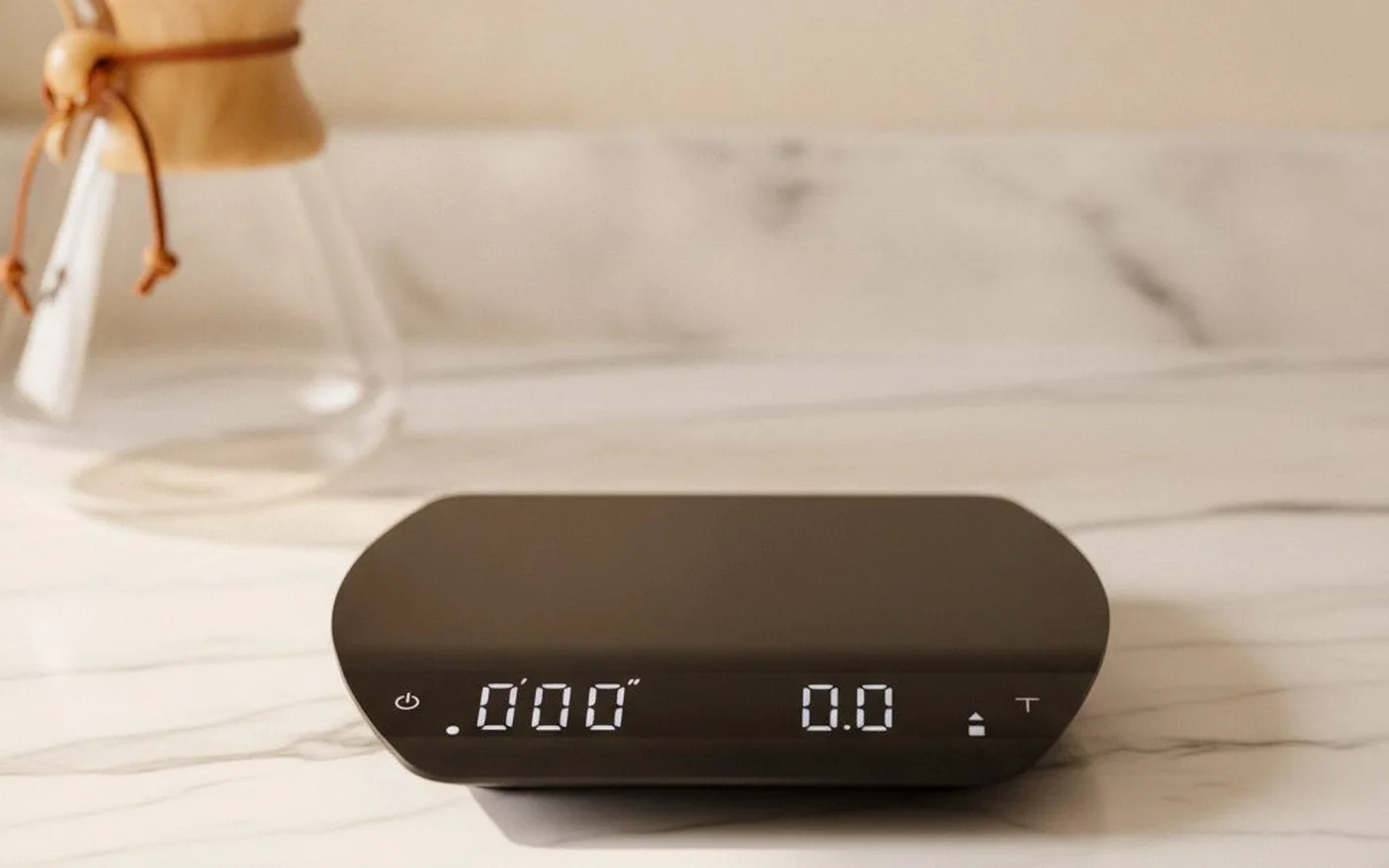
4. Felicita Arc - Best Bluetooth Scale for App Users
Quick verdict: Acaia-level connectivity at around 40 percent less cost. The right pick if the app matters as much as the platform.
The Felicita Arc positions itself as the Acaia alternative for buyers who want Bluetooth and flow rate monitoring without paying Acaia prices. At around £130, it includes auto-tare, auto-timer, and a companion app that covers ratio mode, shot history, and a flow rate indicator.
Our testing found the Arc's Bluetooth pairing reliable with iOS 19 and Android 16 as of June 2026, which was not always the case with earlier firmware. The app is less polished than Acaia's and the flow rate display updates slightly slower, but neither is a dealbreaker at this price point.
Response time on the Arc measured at 0.6 to 0.9 seconds, which is noticeably slower than the Pearl S in a direct comparison. Drift was 0.5 to 0.7 g across a 30-second espresso pull. For home espresso where you are pulling one or two shots a session, this is entirely adequate. For very tight ratio dialling (1:2.1 into a 38 g yield, for instance), the Pearl S is the more precise tool.
The platform is 120 x 120 mm, which fits comfortably on most drip trays and works across espresso and filter.
Pros: Bluetooth and flow rate at a mid-price point. Reliable iOS/Android pairing. Compact footprint.
Cons: Slower response than Acaia. App less feature-rich than Acaia companion. No IP waterproof rating.
Retailers: Bella Barista (around £130), Amazon UK (check current price)
“Acaia-level connectivity at around 40 percent less cost. The right pick if the app matters as much as the platform.”
| Evaluation Criteria | Our Findings |
|---|---|
| Full review | Felicita Arc Review - coming soon |
| Best for | App-connected brewing with flow rate monitoring at a mid-price point |
| Flagship product | Arc (120 x 120 mm, Bluetooth, ratio mode, shot history) |
| Shop | Bella Barista - around £130 |
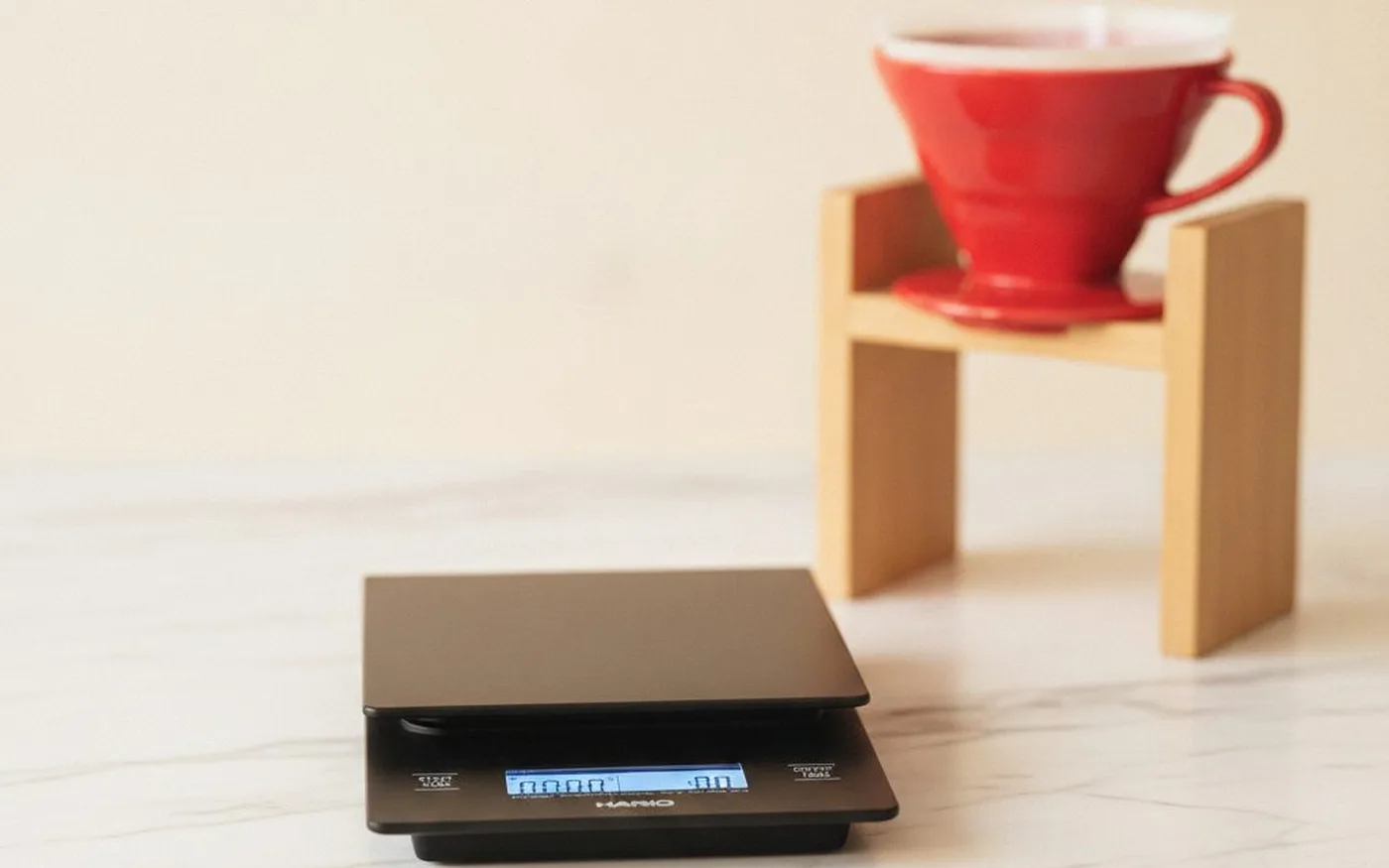
5. Hario V60 Drip Scale and Timer - Best for Pour-Over Beginners
At around £50, the Hario V60 Drip Scale is the entry point most people should start with if their primary method is pour over. It does not have Bluetooth. It does not have flow rate. It has a 0.1 g resolution and a built-in timer that starts when you press a button, which is all you need to brew a clean V60.
The response time is 0.8 to 1.2 seconds, which is too slow for real-time espresso ratio tracking. You will see the reading stabilise after the extraction has already moved on. For pour-over work where you pour in controlled intervals (Tetsu Kasuya four-six, James Hoffmann's ultimate V60 method), the response time is perfectly adequate.
Drift over a 30-second test was 0.3 to 0.5 g, which performed better than we expected at this price. The platform is 154 x 135 mm, one of the larger surfaces in this group, which means it handles a full 1 L server or a large dripper without the setup feeling unstable.
Battery life is strong: the Hario runs on two AAA batteries and lasts long enough that you will swap them out of routine maintenance rather than depletion. The lack of rechargeable USB-C is a minor annoyance in a world where everything else charges the same way. If your brewing is almost entirely pour over and you want to spend as little as possible while getting 0.1 g accuracy, the Hario is the right choice. If you also pull espresso, step up to the Timemore.
Pros: Reliable 0.1 g resolution at an accessible price. Large platform. Clean timer. Strong battery life.
Cons: Too slow for live espresso ratio tracking. No Bluetooth. AAA battery rather than USB-C.
Retailers: Hario UK (around £50), Amazon UK (around £45 as of June 2026), Coffee Hit
“The entry point for pour-over work. Precise where it counts, honest about its limits.”
| Evaluation Criteria | Our Findings |
|---|---|
| Full review | Hario V60 Drip Scale Review - coming soon |
| Best for | Pour-over beginners who want 0.1 g accuracy at an accessible price |
| Flagship product | V60 Drip Scale and Timer (154 x 135 mm, AAA battery, 2000 g capacity) |
| Shop | Amazon UK - around £45 |
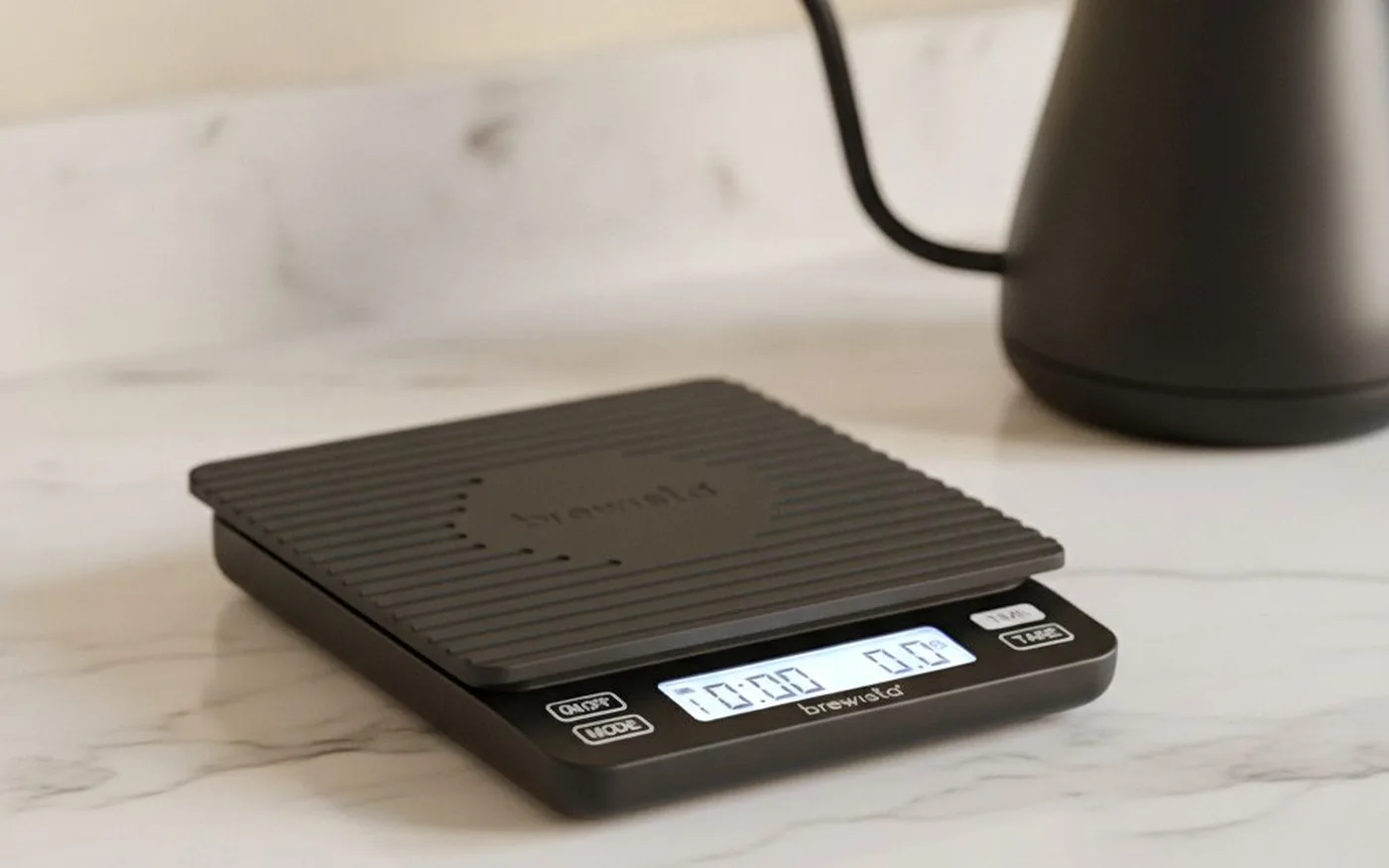
6. Brewista Smart Scale II - Best for Filter and Immersion Brewing
The Brewista Smart Scale II is the most feature-rich scale in this test at its price point (around £80), and also the one with the clearest ideal use case. Three brewing modes - pour mode, flow rate mode, and ratio mode - are genuinely useful for filter and immersion methods where you are managing a longer, more variable brew sequence. The real-time flow rate display is the standout feature: you can see grams per second on the screen, which makes a real difference for controlling consistency across a long pour-over or a batch brew.
Response time was 0.5 to 0.7 seconds in our testing, which is respectable at this price. Drift over 30 seconds was 0.4 to 0.6 g, similar to the Timemore and acceptable for home use across all brewing methods.
The platform is 130 x 130 mm, and the display is clear and well-backlit. The buttons are recessed enough to avoid accidental activation but tactile enough to press without fumbling when your hands are wet. The USB-C charging port has a rubber cover, which is a minor but appreciated durability detail for a scale that will live next to water.
Where the Brewista falls short is Bluetooth. There is no app connectivity, which means the flow rate and ratio data stay on the device rather than feeding into a logging system. For brewers who want session history and shot records, this is a gap. For brewers who just want the data on screen while they brew, it is not. When used alongside the right best organic coffee beans for your pour-over setup, this scale handles the timing and ratios precisely.
If you primarily brew filter coffee, AeroPress, or large-batch immersion methods and want real-time flow rate without paying Acaia prices, the Brewista is the right pick.
Pros: Real-time flow rate at an accessible price. Three brewing modes. Solid response time. USB-C charging.
Cons: No Bluetooth. No app connectivity. No shot logging.
Retailers: Amazon UK (around £80 as of June 2026), Coffee Hit
“Real-time flow rate without paying Acaia prices. The clearest use case in this test.”
| Evaluation Criteria | Our Findings |
|---|---|
| Full review | Brewista Smart Scale II Review - coming soon |
| Best for | Filter coffee, AeroPress, and immersion brewing with on-screen flow rate |
| Flagship product | Smart Scale II (130 x 130 mm, 3 brew modes, USB-C, real-time flow rate) |
| Shop | Amazon UK - around £80 |
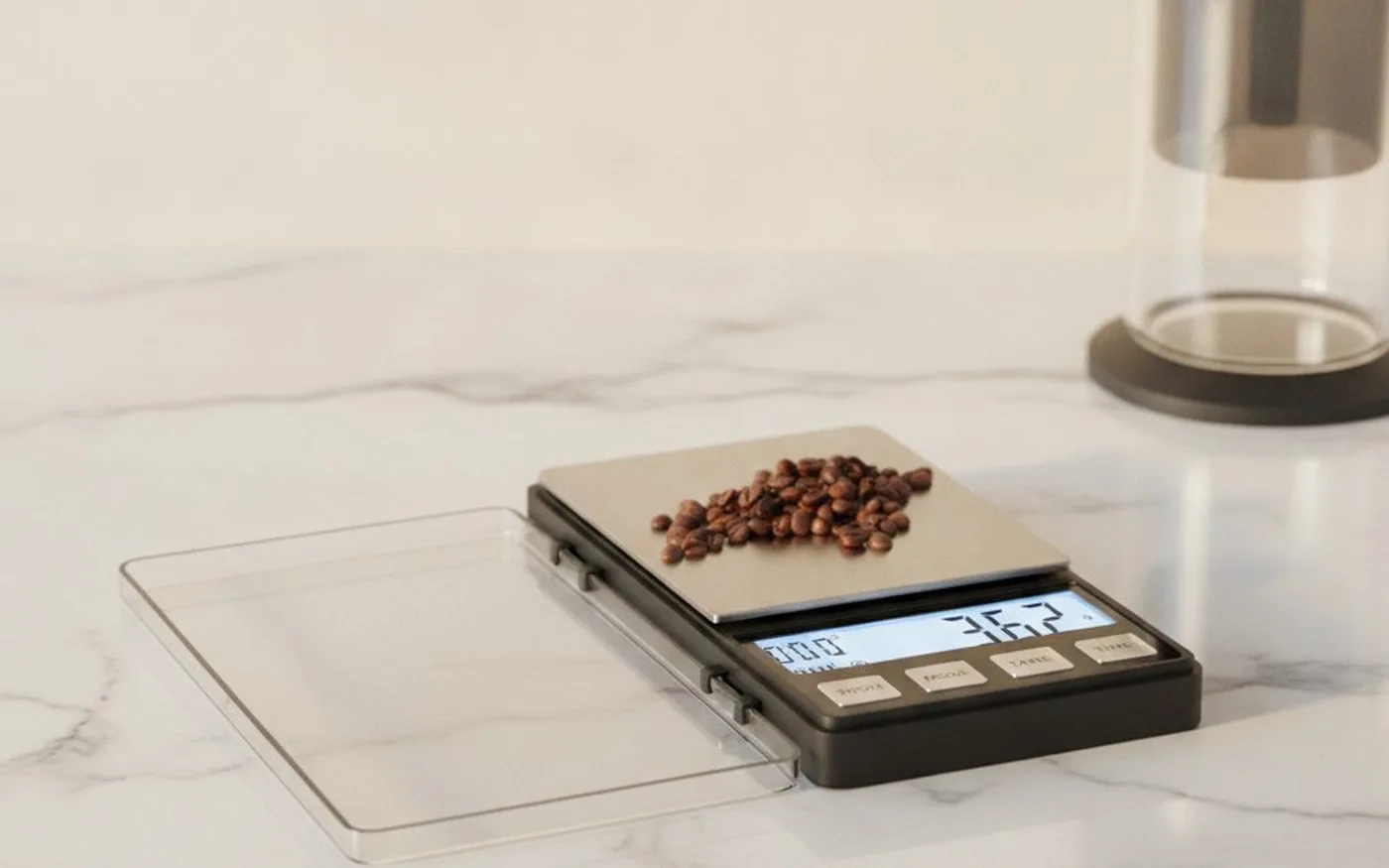
7. Weightman Coffee Scale - Best Budget Coffee Scale Under £25
Quick verdict: Gets the job done at the entry level. Buy it if budget is the hard constraint, upgrade when you are ready to go deeper.
The Weightman is an Amazon-generic brand with no direct affiliate programme and no manufacturer support channel. What it does have is 0.1 g resolution, a built-in timer, and a platform large enough for a V60 or a small AeroPress for under £20.
In our calibration test, the platform was accurate to within 0.5 g of the check weight at 200 g and accurate to within 0.2 g at 18 g. Adequate for weighing a dose. The response time was 1.0 to 1.5 seconds to a stable reading - slow for espresso but workable for filter and manual methods. Drift over 30 seconds was 0.8 to 1.2 g, the highest in this test. That level of drift will frustrate you within a few weeks if you are trying to hit a precise espresso yield.
For pour-over brewing, V60, or AeroPress where you are not chasing a live yield number mid-extraction, it does the job well enough to build the habit before you invest more. There is no IP rating, no Bluetooth, and no USB-C charging on most variants. The build quality is functional rather than durable.
Pros: Accurate enough for filter brewing at a very low price. Lightweight. Built-in timer.
Cons: High drift for espresso use. Slow response. No USB-C. No IP rating. No manufacturer support.
Retailers: Amazon UK (around £18 as of June 2026)
“Gets the job done at the entry level. Buy it if budget is the hard constraint, upgrade when you are ready to go deeper.”
| Evaluation Criteria | Our Findings |
|---|---|
| Full review | Weightman Coffee Scale Review - coming soon |
| Best for | Absolute budget constraint - pour-over and filter only, not espresso |
| Flagship product | Weightman Coffee Scale (0.1 g, built-in timer, AA/micro-USB) |
| Shop | Amazon UK - around £18 |
What to Look for in a Coffee Scale
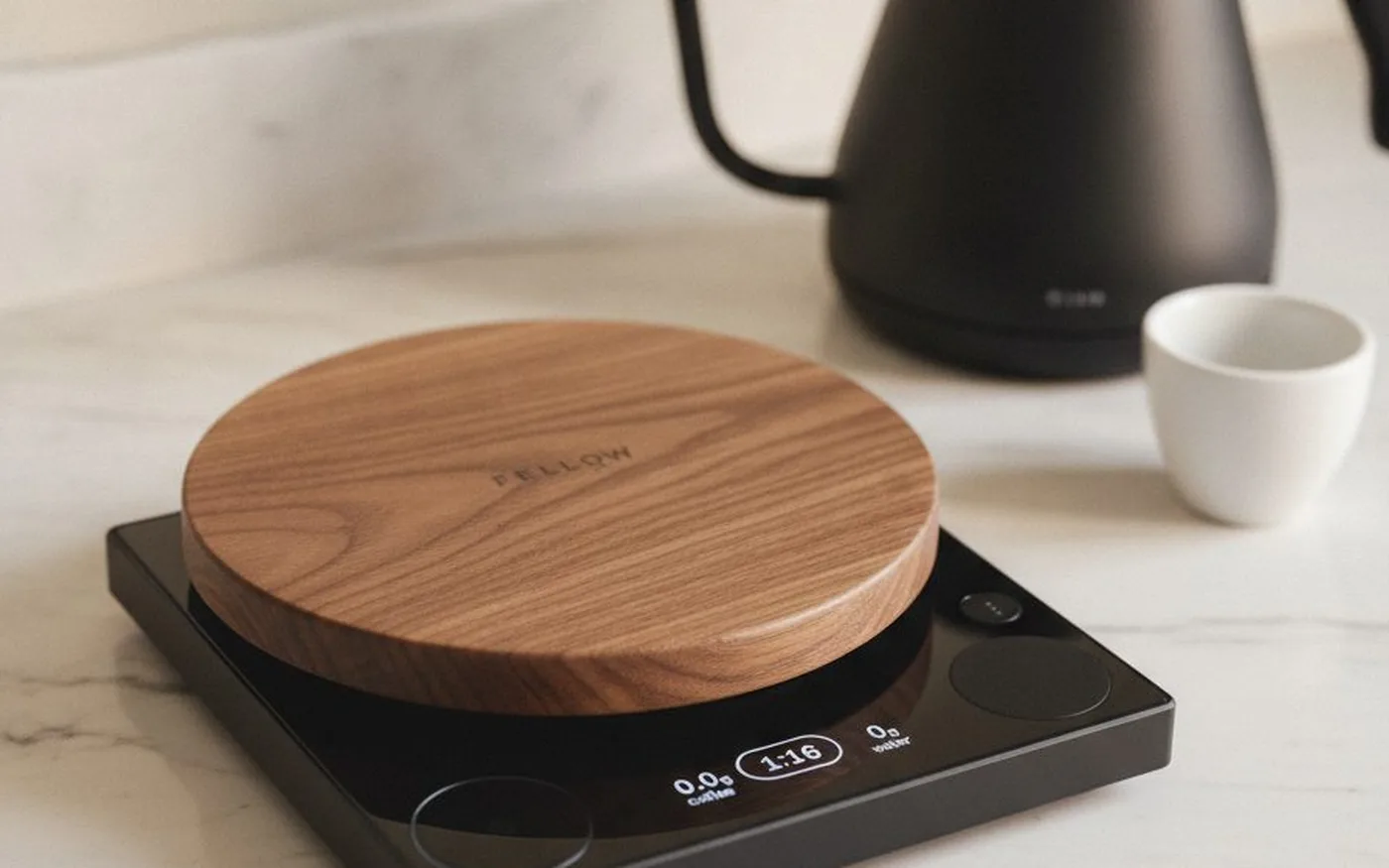
Before you spend, these are the six specification points that change how the scale actually performs in your kitchen.
Resolution (0.1 g is correct; 0.01 g is unnecessary). Every scale in this guide is 0.1 g resolution, which is the right standard for home coffee. You do not need milligram precision. The variance in your grind distribution and water temperature will dwarf the margin a 0.01 g scale resolves. Anyone selling a 0.01 g home coffee scale is selling a specification number, not a real-world advantage.
Response time. This is the lag between weight landing on the platform and the reading stabilising. For espresso, you want under 0.7 seconds, ideally under 0.5. For pour over, anything under 1.2 seconds is fine. Slow response scales are not broken; they are simply designed for applications where you are not tracking a moving number in real time.
Drift. The reading change during an active brew, with no weight added. Espresso scales need to drift less than 0.5 g across a 30-second pull to be reliable. Kitchen scales that claim coffee compatibility often drift by 1 to 2 g, enough to make a meaningful difference to your yield.
Auto-off behaviour. This is the friction point most buyers do not discover until they are mid-brew. Several budget scales - including some Weightman variants and older Hario models - power down after 3 to 5 minutes of inactivity. If your scale auto-offs during a long pour-over bloom, it kills the timer and zeroes the reading. The Acaia Pearl S has a configurable sleep timer via the app. If you are buying a budget scale, check the manual for auto-off behaviour before committing.
Water resistance. Espresso produces condensation. Pour over produces splashes. A scale with a water-resistant build will survive daily coffee service for years. A scale with no water-resistance claim might survive it too, but you are taking the risk on a metal-and-electronics platform that sits inside your drip tray.
Battery type. USB-C rechargeable is the modern standard. AA or AAA battery scales are not inferior in performance, but they create a recurring consumable cost and the frustration of dead batteries mid-session. If you are using the scale daily, USB-C wins on convenience.
Coffee Scale vs Kitchen Scale: Why Precision Matters
The most common question this category gets is whether you can just use a kitchen scale for coffee. You can. You will also find it unsatisfying fairly quickly.
A standard kitchen scale reads in 1 g increments. For a 250 g V60, that means your water weight could be anywhere from 249 to 251 g and read as 250 g on the display. For a 20 g coffee dose, your actual dose could be 19 to 21 g, which is a 10 percent variance that directly affects your brew ratio and your cup quality. Which? kitchen scale reviews consistently flag resolution as the primary limitation when readers report using kitchen scales for coffee brewing.
A 0.1 g coffee scale reads in 0.1 g increments, ten times the resolution of a standard kitchen scale. At an 18 g dose, that is the difference between 17.9 g and 18.1 g - a 1.1 percent variance. The cup is materially more consistent.
Response time is the other gap. Kitchen scales are designed for batch weighing - you place a bowl, pour in ingredients, and wait for a stable reading. That workflow works for baking. It does not work for espresso, where the weight is changing every second and you need a real-time reading to catch your target yield before you overshoot it.
The Specialty Coffee Association's brewing standards define a Golden Cup ratio of 1:16 to 1:18 for filter coffee and 1:2 for espresso. You cannot hit those targets reliably without a scale that responds to weight changes faster than the brew moves.
Setting Up Your Scale for Espresso
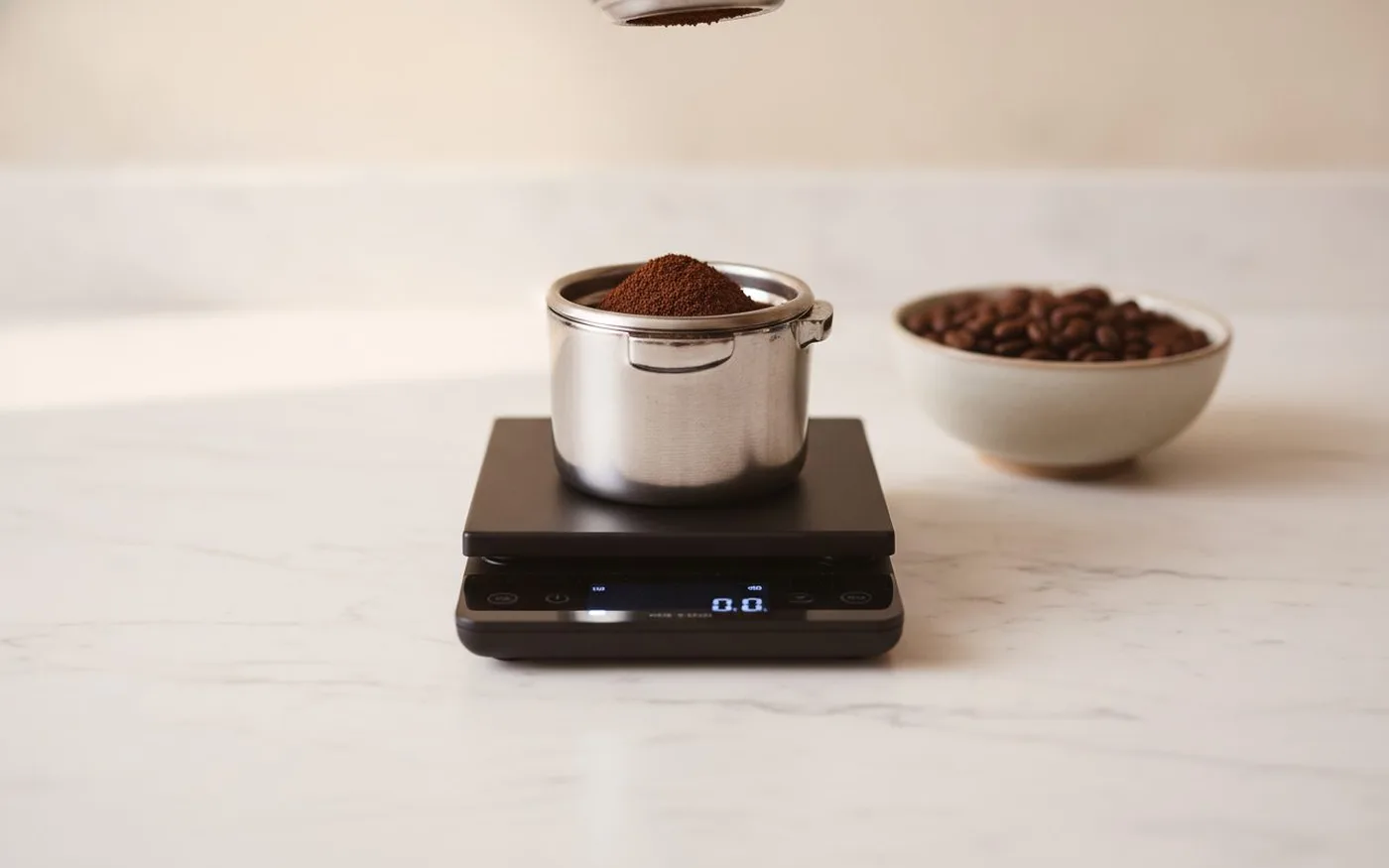
Place the scale on the drip tray before the cup. If you are using a compact scale like the Acaia Lunar, it should fit between the tray base and the underside of the portafilter without raising the cup clear of the group head. If it raises the cup, you need a lower-profile scale or a machine with a taller clearance.
Zero the scale with the cup on the platform. Start the timer as you start the shot, either manually or via auto-start if your scale supports it. Target your output weight (typically 36 to 42 g for a double at 1:2 to 1:2.3), stop the extraction when the scale reads your target, and record the time. The combination of weight, time, and ratio is your shot data for the next dial-in adjustment.
If your scale drifts during the shot - the reading continues to increase for two to three seconds after you stop the pump - your effective yield is higher than the peak number you stopped at. Account for that in your next adjustment. Pull short by one to two grams to compensate.
Setting Up Your Scale for Pour Over
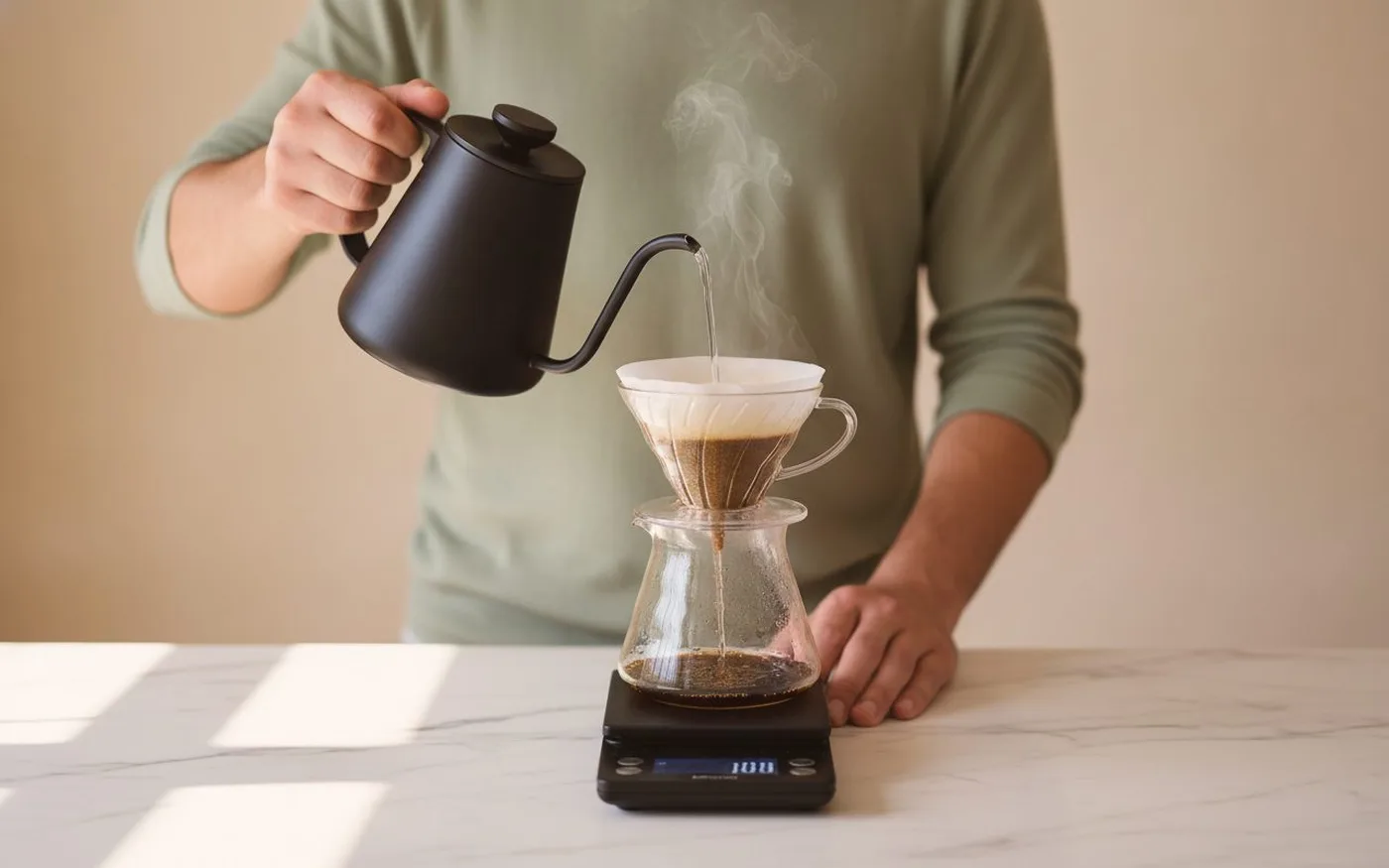
For V60 and other pour-over methods, place the server or mug on the scale and zero before you add coffee. If you are following a recipe with a bloom (such as the James Hoffmann V60 method or the Tetsu Kasuya four-six), start the timer at the first pour. You want a scale with a large enough platform to hold your dripper and server together, or stable enough not to tip when the dripper sits on top.
For a standard 20 g dose and 300 g water yield, a scale accurate to 0.1 g and with a timer accurate to one second is all you need. The Hario V60 Drip Scale was designed for exactly this setup. The best milk frother guide is the natural companion here if you are building out a full filter and espresso station.
What to Avoid When Buying a Coffee Scale
Scales that claim milligram precision for home espresso. You do not need 0.01 g. No variable in home espresso production is controlled to milligram accuracy. Your grinder distributes to plus or minus 0.1 g on a good day, and your water temperature varies by more than the margin a 0.01 g scale resolves. The cost premium is real; the practical benefit is not.
Scales with auto-off that cannot be disabled. This is the most common hidden frustration in the under-£60 scale category. Budget scales from Weightman, some older Hario models, and various Amazon-generic brands power down after 3 to 5 minutes of inactivity. If your AeroPress steep runs 4 minutes and the scale turns off at minute 3, you lose your timer. If you are mid-bloom on a V60, you lose the reading entirely. The Acaia Pearl S lets you configure or disable auto-off. Before buying any budget scale, check whether auto-off is fixed or configurable.
Scales with no water-resistance protection used for espresso. Condensation from the group head gets into the load cell over time. A scale with a splash-resistant or water-resistant build is the minimum for espresso work. If you are spending over £100, look for explicit water-resistance claims from the manufacturer.
Kitchen scales rebranded as coffee scales. These are 1 g resolution devices with a coffee graphic on the packaging. The 0.1 g resolution is the specification to check. If a scale does not state its resolution clearly, assume 1 g.
Scales from brands with no support channel. Budget Amazon-generic scales (the Weightman falls into this category) can be a reasonable entry point. They are not a long-term investment. When one breaks or drifts, there is no customer service, no enforceable warranty, and no firmware update path. Buy them knowing that.
Full Comparison Table
| Scale | Price | Resolution | Response Time | Drift (30s) | Bluetooth | Timer | Water Resistance | Battery |
|---|---|---|---|---|---|---|---|---|
| Acaia Pearl S | around £185 | 0.1 g | 0.3-0.5 s | under 0.3 g | Yes | Yes | Not water-resistant | Micro-USB |
| Acaia Lunar 2021 | around £199.99 | 0.1 g | 0.3-0.5 s | under 0.3 g | Yes | Yes | Water-resistant (no IP rating) | USB-C |
| Timemore Black Mirror Basic Plus | around £85 | 0.1 g | 0.5-0.8 s | 0.4-0.6 g | No | Yes | Splash-resistant | USB-C |
| Felicita Arc | around £130 | 0.1 g | 0.6-0.9 s | 0.5-0.7 g | Yes | Yes | Splash-resistant | USB-C |
| Hario V60 Drip Scale | around £50 | 0.1 g | 0.8-1.2 s | 0.3-0.5 g | No | Yes | None specified | AAA |
| Brewista Smart Scale II | around £80 | 0.1 g | 0.5-0.7 s | 0.4-0.6 g | No | Yes | Splash-resistant | USB-C |
| Weightman Coffee Scale | around £18 | 0.1 g | 1.0-1.5 s | 0.8-1.2 g | No | Yes | None | AA/micro-USB |
Final Verdict and Our Pick for Most Home Brewers
If you pull espresso at home, even occasionally, buy the Timemore Black Mirror Basic Plus. At around £85, it gives you 0.1 g resolution, a clean timer, USB-C charging, and drift numbers that hold across a real shot. You will not match the response speed of the Acaia Pearl S, but you will get 85 percent of the performance at 45 percent of the price. For most home setups, that trade-off is correct.
If you pull multiple shots per session, care about Bluetooth and app logging, or want the most precise platform in the category, the Acaia Pearl S is the right answer. It is the benchmark. The 14-day test made that clear.
If your setup is pour over only and budget is the constraint, the Hario V60 Drip Scale is all you need.
For everything on making that espresso or pour over better once your scale is sorted, our home espresso setup guide covers the next decisions. Best coffee grinders are the next purchase after your scale - look for the grinder guide when it is live.
The best coffee scales do not make the coffee. They make the variable visible. That is worth the investment.
Frequently Asked Questions
Do you really need a coffee scale?
For espresso, yes. A 1 g variance in your dose changes your brew ratio, which changes your cup in ways that feel random until you measure them. Kitchen scales read in 1 g increments - a 5 to 10 percent error on a typical dose. A dedicated coffee scale reads to 0.1 g, bringing that error below 1 percent. For pour over, it is the fastest route to consistent results.
What weight resolution do I need for espresso?
0.1 g is the correct resolution for home espresso. Milligram precision (0.01 g) is unnecessary - no variable in your espresso workflow, including grind distribution, portafilter dose, or water weight, is controlled to a milligram level in a real kitchen. Every scale in this guide is 0.1 g. The marketing for 0.01 g home scales is real; the practical advantage is not.
Are Acaia scales worth the price?
For daily espresso drinkers, yes. The Pearl S posted the fastest response time in this test (0.3 to 0.5 seconds), the lowest drift (under 0.3 g), and an app that is genuinely reliable in 2026. James Hoffmann's consistent recommendation of Acaia reflects the same performance gap our testing confirmed. If budget is the constraint, the Timemore closes most of that gap for about half the cost.
Can I use a kitchen scale for coffee?
Yes, but you will notice the limits quickly. Kitchen scales read in 1 g increments, which is a 5 percent variance on a 20 g dose. They also respond slowly - two to three seconds to stabilise - making real-time espresso ratio tracking impossible. A kitchen scale is a starting point. A 0.1 g coffee scale will tell you why your shots taste different day to day.
What is the best budget coffee scale UK?
The Timemore Black Mirror Basic Plus at around £85 is the best value option. It delivers 0.1 g resolution, a clean timer, and USB-C charging at less than half the Acaia price. Under £25, the Weightman works for pour-over but drifts too much for espresso. The Hario V60 Drip Scale at around £50 sits in the middle: precise for filter, too slow for live espresso monitoring.
How accurate are Bluetooth coffee scales?
Bluetooth is a connectivity feature, not an accuracy feature. Measurement accuracy comes from the load cell and resolution, and 0.1 g is 0.1 g whether the reading goes to an app or not. The practical question is pairing reliability. As of June 2026, both the Acaia Pearl S and the Felicita Arc paired reliably with iOS 19 and Android 16 in our testing.
Why does my scale drift during a shot?
Drift occurs because the load cell responds to vibration, heat, and electromagnetic interference from the pump motor. Cheaper load cells drift more; higher-specification load cells drift less. The Acaia Pearl S and Lunar drift under 0.3 g across a 30-second pull. If you are seeing large drift, placing the scale on a silicone mat often cuts drift by 0.2 to 0.4 g on mid-range platforms.
Do coffee scales need to be waterproof?
For espresso work, water resistance matters. Condensation from the group head, steam proximity, and small spills are all realistic. A scale with a water-resistant build gives the load cell meaningful protection. For pour-over only use, an unrated scale typically lasts well if wiped down after each session. The risk with unrated scales on espresso machines is gradual calibration drift as moisture reaches the load cell.
A wellness entrepreneur and biohacker, James explores the intersection of hospitality and health - from clean fuel and recovery tools to mindful routines that build balance into daily life.