Rude Health Oat Milk Review: Is the Barista Worth It?
A four-ingredient organic oat milk with no gums - but does clean-label still froth?
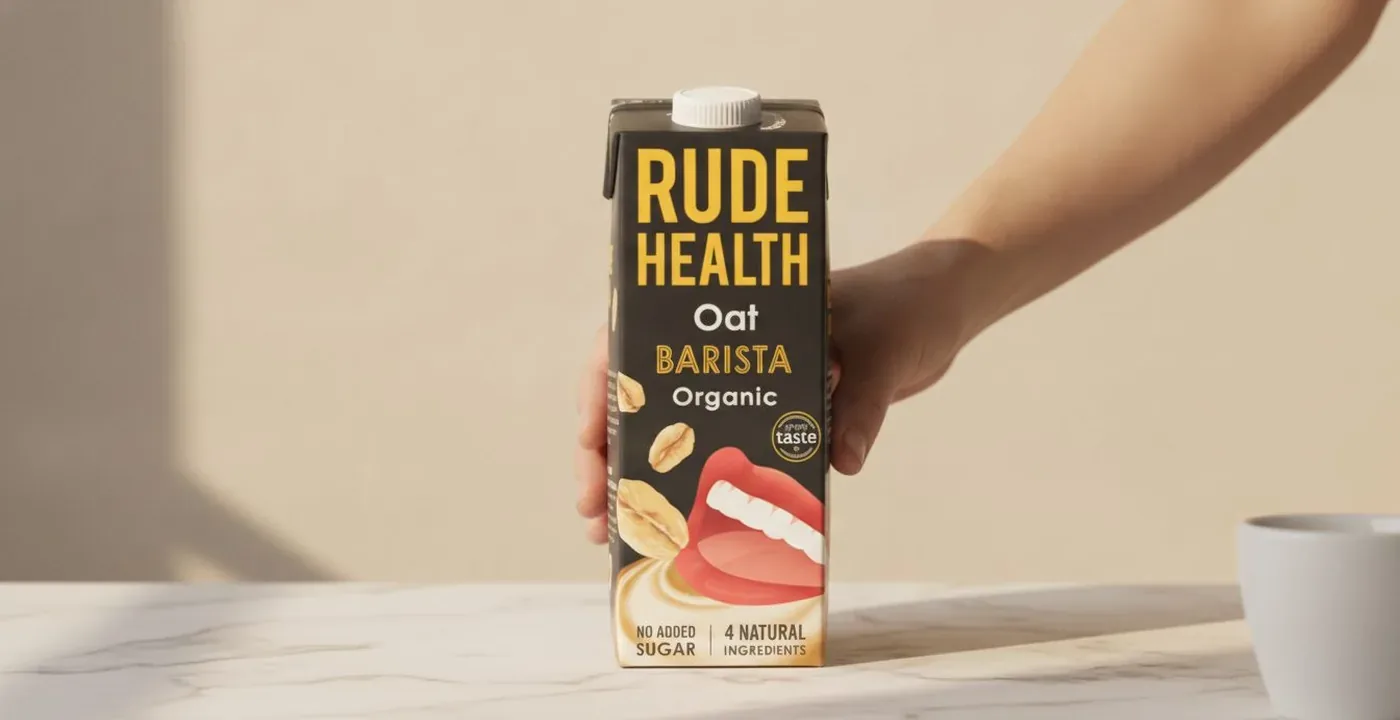
Table of Contents
Some of the links in this article are affiliate links, which help fund our independent review work at no extra cost to you. Every recommendation is based on hands-on testing through The Editor Lab methodology. No brand pays to appear, and no placement is guaranteed.
Rude Health Oat Barista is the cleanest mainstream UK barista oat milk - minimal ingredients, real foam, but not seed-oil-free and unfortified with calcium.
Rude Health oat milk makes a clear promise on every carton: four ingredients, organic, nothing unnecessary. For a reader weighing up clean-label oat milk, that promise is either the reason to buy or the first thing to interrogate. As a Nutritional Therapist, the ingredient list is where I start - not the branding, not the font choice, not the sustainability credentials on the side panel.
What I found is largely what the label says. The Rude Health Organic Oat Barista contains spring water, organic oats (14%), organic sunflower oil, and sea salt. That is genuinely short. Most oat milks on the UK market add rapeseed oil, emulsifiers such as sunflower lecithin, dipotassium phosphate, or gellan gum. None of those appear here. But "clean label" is not the same as "seed-oil-free" - the sunflower oil is present, and if that matters to your diet, you need to know it up front. This review gives you both the case for Rude Health and the honest caveats.
The Editor's Note covers my methodology and qualifications.
Editor's Note
What Makes Rude Health Oat Milk Different?
The short answer is the recipe. Co-founder Camilla Barnard spent four years developing the Organic Oat Barista before launch, with the explicit goal of achieving barista performance without a long additive list. The result is a formula with 14% oat content - higher than most mainstream oat milks - and no emulsifiers, stabilisers, or acidity regulators.
Most supermarket oat milks achieve their texture and foam stability through additives. Oatly Barista uses rapeseed oil and phosphates. Minor Figures uses rapeseed oil and phosphate-based minerals as stabilisers, with no gums. Rude Health relies on oat content and sunflower oil as the only fat source, with no gums or emulsifiers.
According to The Grocer, Rude Health launched the Organic Oat Barista in March 2024 at a recommended price of £2.40 per litre, positioning it directly against Oatly's Organic Barista Edition which launched the same week. The brand described the launch as a response to a market dominated by long ingredient lists with emulsifiers, stabilisers, and acidity regulators.
One thing the brand does not foreground: this product contains organic sunflower oil. Sunflower oil is a seed oil. It is organic and the quantity is small relative to a full daily diet, but it is present in every serving. This is the most important factual clarification a buyer researching "clean oat milk" needs to see before purchasing.
How We Assessed It
The assessment followed the Balance Journal Editor Lab framework. I checked the ingredient list, NOVA processing classification, calcium fortification and price per litre against Oatly Barista and Minor Figures, the two barista oat milks it competes with most directly.
For coffee performance, I looked at what the formulation can and cannot do: oat content and sunflower oil support foam, while the absence of emulsifiers and stabilisers affects how well it resists splitting in hot espresso.
Taste and Coffee Performance
Steam-wand microfoam: The Barista variant is formulated to foam under a steam wand, with 14% oats and sunflower oil doing the work that emulsifiers do in other brands. Without those additives, expect foam that is good but not the most durable on the market - Oatly Barista and Minor Figures are engineered to hold texture longer. With 14% oats, expect the natural oat sweetness to come through, which some drinkers prefer and others find competes with the coffee.
Splitting: Cold oat milk poured straight into hot espresso can split briefly, and a formula without stabilisers is more exposed to that. Allowing the milk to approach room temperature before pouring reduces the risk.
Taste in coffee: The Barista version contains 5.5g of sugars per 100ml - naturally occurring from the oats, not added. Expect an oaty, gently sweet profile. Under a smooth medium roast, this sweetness should work well. Paired with Balance Coffee's Stability Blend (Brazil 60%, Mexico 20% and Uganda 20%, notes of milk chocolate, hazelnut and fig - Balance Coffee is the company founded by James Bellis, who reviewed this article), the natural oat sweetness and the balanced medium roast should complement rather than compete. Under a high-acid, light-roasted single-origin, the oat sweetness and the coffee's brightness do not always align cleanly.
Ingredients and the Clean-Label Question
The four ingredients in the Rude Health Organic Oat Barista, as listed on the current UK label: spring water, organic oats (14%), organic sunflower oil, sea salt.
What is genuinely absent: emulsifiers (sunflower lecithin, rapeseed lecithin), stabilisers (gellan gum, locust bean gum), acidity regulators (dipotassium phosphate, trisodium citrate), added vitamins and minerals. The absence of fortification is the most nutritionally significant detail: the Rude Health Barista provides very little calcium per serving. The British Dietetic Association notes that not all plant-based alternatives are fortified with calcium and recommends checking labels when making the switch from dairy. Adults aged 19-55 need 700mg of calcium daily; a glass of unfortified Barista oat milk contributes minimally toward that target.
The sunflower oil question: Organic sunflower oil is a source of linoleic acid, an omega-6 fatty acid. Some nutritional frameworks recommend reducing seed oil consumption; others consider cold-pressed organic sunflower oil acceptable within a varied diet. The quantity present in oat milk is small relative to a full daily diet, but it is present in every serving. This is a more nuanced picture than the binary "clean" versus "not clean" framing the brand's marketing implies.
NOVA classification: The Rude Health Organic Oat Barista avoids the NOVA Group 4 ultra-processed classification that applies to Oatly Barista. Without synthetic emulsifiers or gums, it sits closer to NOVA Group 3. For buyers whose dietary framework includes NOVA classification, this is a real distinction.
The honest "healthiest oat milk" answer: No oat milk is a nutritional equivalent to dairy. The meaningful questions are whether the formulation avoids additives your diet is trying to limit, whether it is fortified with calcium (the Barista version is not), and whether the oat content is high enough to deliver real texture. On those three points, Rude Health scores well on the first and third, and requires the Calcium variant to address the second.
Range and Where to Buy in the UK
Rude Health produces three oat-milk variants that matter to UK buyers:
| Product | Key difference | Calcium fortified | Best for |
|---|---|---|---|
| Organic Oat Barista | 14% oats, optimised for steam-wand use | No | Coffee, flat whites, lattes |
| Oat Drink (standard) | Lower oat content, everyday format | No | Cereal, baking, cold drinks |
| Oat Drink with Calcium | Fortified standard drink | Yes - 120mg per 100ml | Dairy replacement, bone-health priority |
Barista vs standard: The Barista variant is specifically formulated to foam under a steam wand. For coffee use, buy the Barista. For cereal and cooking, the standard Oat Drink is fine and typically less expensive.
Calcium variant: If you are replacing dairy and calcium intake matters - which it should if dairy was providing a significant share of your daily 700mg requirement - the Oat Drink with Calcium is the stronger nutritional choice. The Barista version is not the right product for calcium replacement.
UK retailers: Rude Health Organic Oat Barista is available at Tesco, Sainsbury's, Waitrose, Ocado, Morrisons, Holland and Barrett, and Abel and Cole. The recommended retail price is around £2.40 per litre. It is also available on Amazon UK.
| Best for | Coffee, flat whites and lattes made with a steam wand |
| Flagship product | Organic Oat Barista - 14% oats, no emulsifiers or stabilisers |
| Price | From around £2.40 per litre |
| Where to buy | Rude Health Oat Barista on Amazon UK, plus Tesco, Sainsbury's, Waitrose and Ocado |
| Shop | Shop Rude Health Oat Barista → |
Rude Health vs Oatly vs Minor Figures
| Rude Health Barista | Oatly Barista | Minor Figures | |
|---|---|---|---|
| Oat content | 14% | ~10% | 10% |
| Emulsifiers / stabilisers | None | None | None |
| Seed oil | Sunflower (organic) | Rapeseed | Rapeseed |
| Calcium fortified | No | Yes | Yes |
| NOVA classification | Group 3 | Group 4 | Group 3-4 |
| Steam-wand performance | Good | Very good | Very good |
| Split resistance | Moderate | Good | Good |
| UK price per litre | From £2.40 | From £1.90 | From £2.00 |
Rude Health's clean-label advantage is real. Foam stability is slightly below Oatly Barista at a higher price point, and none of the three are calcium-fortified in their barista formats. For buyers specifically avoiding emulsifiers and ultra-processed formulas, Rude Health Barista is the strongest mainstream UK option. For buyers whose primary concern is microfoam quality, Oatly Barista leads at a lower price.
If you are comparing the full range of best oat milk for coffee options side by side, see the dedicated roundup at best oat milk for coffee UK.
For the broader best alternative milk for coffee picture - including almond, coconut, soy and pea milk - the parent cluster guide is at best alternative milk for coffee UK.
Pros and Cons
- Four ingredients, no emulsifiers or stabilisers
- Organic oats and organic sunflower oil
- No added sugars - naturally occurring only
- Avoids NOVA Group 4 ultra-processed classification
- Wide UK supermarket availability (Tesco, Sainsbury's, Waitrose, Ocado)
- Not calcium-fortified in the Barista variant
- Contains sunflower oil - not seed-oil-free
- Foam stability slightly below Oatly Barista
- Moderate split resistance compared to additive-using competitors
- Higher price per litre than Oatly standard
Final Verdict
Rude Health Oat Milk delivers what its label promises: a short, recognisable ingredient list and a formula built to perform in coffee. The Barista variant is built to froth, and its flavour comes from oats rather than a formula engineered to approximate oats.
The limitations are honest ones. It contains sunflower oil and is not seed-oil-free. The Barista version is not calcium-fortified. Its foam is good but not the most stable on the market. At around £2.40 per litre, the premium is for the clean recipe, not for superior coffee performance.
For the buyer specifically wanting to avoid emulsifiers, stabilisers, and ultra-processed formulas in their daily coffee, Rude Health Barista is the best mainstream UK option. For the buyer whose primary concern is microfoam quality at the lowest price, Oatly Barista is marginally ahead.
If clean-label coffee is your direction, the full stack is a short ingredient-list milk paired with independently mould-free coffee uk - our best mycotoxin-free coffee guide covers lab-tested, pesticide-free options for the same buyer profile.
See also our sibling brand reviews in this cluster: Sproud milk review and Rebel Kitchen Mylk review.
Frequently Asked Questions
What makes Rude Health oat milk different?
Rude Health Organic Oat Barista contains four ingredients: spring water, organic oats (14%), organic sunflower oil, and sea salt. There are no emulsifiers, stabilisers, or acidity regulators. Most oat milks use longer lists to achieve consistency and foam stability. Rude Health achieves its texture through oat content alone - unusual at this price point and in mainstream supermarket distribution.
Is Rude Health the healthiest oat milk?
No single oat milk qualifies as objectively healthiest - it depends on what you are optimising for. If you want the shortest ingredient list and no ultra-processed additives, Rude Health Barista is among the best UK supermarket choices. If calcium matters, the Rude Health Calcium variant or a fortified competitor is the stronger option nutritionally. The Barista version is not fortified.
Why is everyone ditching oat milk?
The main concerns cited are rising awareness of seed oils in oat milk, the NOVA ultra-processed classification for many brands, and the impact of oat starch on blood glucose compared to nut milks. Some people also find oat milk less satiating than protein-richer alternatives. None of these apply universally, and most nutritionists consider fortified plant milks a reasonable choice for most healthy adults.
Why shouldn't you drink oat milk every day?
There is no clinical evidence that daily oat milk consumption is harmful for most adults. The concern is nutritional: regular use of unfortified Rude Health Barista without other calcium sources could contribute to lower calcium intake than dairy. The British Dietetic Association recommends 700mg of calcium daily for adults aged 19-55. The simple fix is choosing the Rude Health Calcium variant or maintaining other dietary calcium sources.
Is there a downside to drinking oat milk?
The main downsides are nutritional. Oat milk is lower in protein than dairy (0.9g per 100ml versus 3.5g for cow's milk). The Rude Health Barista is not fortified with calcium or vitamin D, making it weaker as a dairy substitute on those nutrients. Oat milk also has a higher carbohydrate content than almond or soy alternatives, which may be relevant for blood glucose management.
Does Rude Health oat milk froth for coffee?
Yes. Rude Health Organic Oat Barista is formulated to produce a workable microfoam on a steam wand for flat whites and lattes. Without stabilisers, expect foam that is good but not the most durable in the category; Oatly Barista is engineered to hold texture longer. Allow the milk to warm slightly before steaming to reduce splitting when cold milk meets a hot espresso.
Does Rude Health oat milk contain seed oil?
Yes. Rude Health Organic Oat Barista contains organic sunflower oil, which is a seed oil. The product is not labelled seed-oil-free. The oil is organic, which some nutritional frameworks consider preferable to refined seed oils, but the linoleic acid content is present regardless of processing. If you follow a strict seed-oil-free diet, Rude Health Barista does not meet that standard.
Where can I buy Rude Health oat milk in the UK?
Rude Health Organic Oat Barista is available at Tesco, Sainsbury's, Waitrose, Ocado, Morrisons, Holland and Barrett, and Abel and Cole. It is also available on Amazon UK. The recommended retail price is around £2.40 per litre. The Calcium and standard Oat Drink variants are stocked at most of the same retailers.

A registered Nutritional Therapist and member of BANT, Clemmie blends science with a holistic approach to wellbeing.