Low Acid Coffee UK 2026 - 10 Best Brands Tested and Ranked


Sold to people with reflux. The pH gap between labels is smaller than they claim.
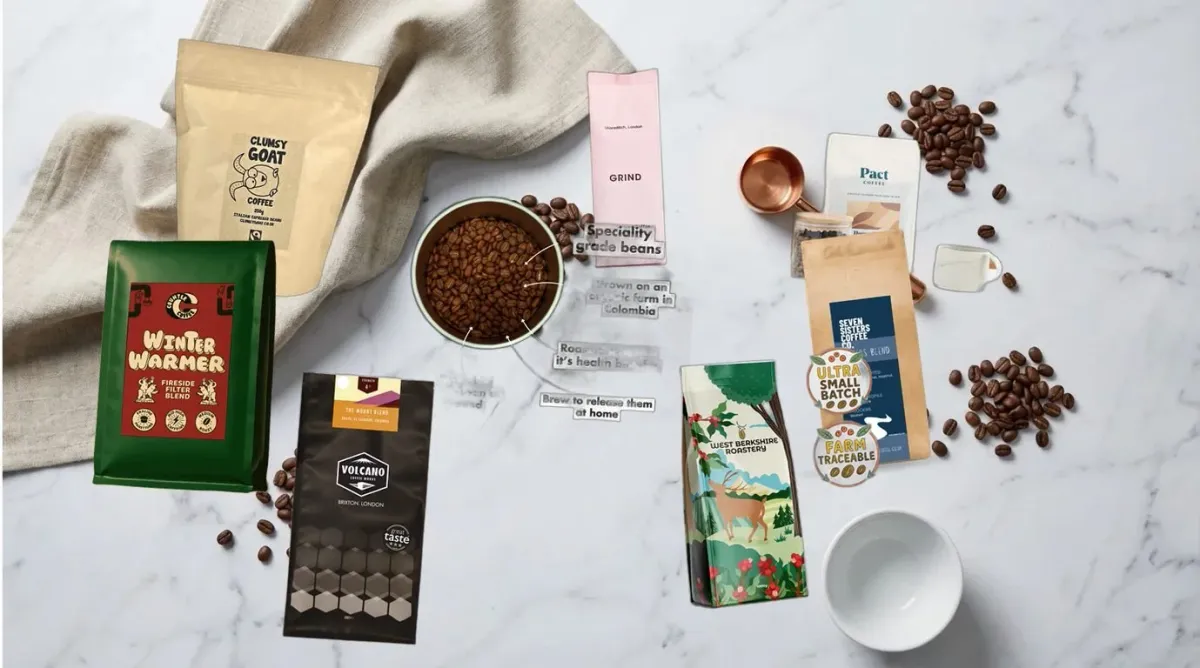
Table of Contents
Some of the links in this article are affiliate links, which help fund our independent review work at no extra cost to you. How we assessed these products is explained in this article and our Editor Lab methodology. No brand pays to appear, and no placement is guaranteed.
Why I Wrote This Guide
I learned more about acid in coffee from selling espresso machines to roasters than I ever did from drinking it. During my time with Sanremo UK, I spent five and a half years visiting roasteries across the country - almost 300 in total. Every roaster had an opinion on acidity. Some chased it. East African single origins with electric citrus and berry notes were the currency of London specialty coffee in 2015. Others built their entire range around minimising it, sourcing low-elevation Brazilians and natural-process beans specifically because their customers wanted smoothness, not brightness.
What surprised me was how much the roast profile changed the acid conversation. I sat in on cupping sessions where the same green bean, roasted at two different levels, produced cups that felt like entirely different coffees on the palate. A light roast of a Colombian Huila was sharp and lively. That same bean taken further into the roast cycle lost the sharp edge and rounded into something far more approachable. The chlorogenic acids, which are responsible for that bright, sometimes aggressive character, break down progressively as the roast develops.
This is not a medical guide. I am not a doctor. But I have tasted coffees across every roast level, origin, and processing method, and the difference between a high-acid coffee and a low-acid coffee is not subtle. If your stomach tells you something is wrong, it probably is. The 10 coffees below are the ones I would recommend to anyone who has had to choose between enjoying coffee and feeling comfortable afterwards.
James Bellis, Coffee Writer & Biohacker
What Makes Coffee Low Acid?
Origin and Elevation
Coffee grown at lower elevations tends to develop less acidity. Beans from Brazil, Sumatra, and parts of Peru grow between 800 and 1,200 metres above sea level, where the slower cherry maturation produces a heavier body and reduced brightness. By contrast, Ethiopian and Kenyan coffees grown above 1,600 metres develop the complex, fruity acid profiles that specialty roasters prize. For sensitive stomachs, origin is the first filter. Brazilian and Sumatran coffees are the most consistent starting point for anyone searching for naturally low acid coffee.
Roast Level
Darker roasts contain less chlorogenic acid than lighter roasts. The Maillard reaction and caramelisation that occur during roasting break down these acid compounds progressively. A medium-dark or dark roast will sit lower on the acidity scale than the same bean roasted light. This does not mean darker is always better - over-roasted coffee introduces quinic acid, which can cause its own form of stomach discomfort. The sweet spot for low acid is a well-developed medium or medium-dark roast.
Processing Method
Natural (dry) process coffees, where the cherry fruit dries around the bean before removal, tend to produce a softer acidity than washed (wet) process coffees. The extended contact with the fruit sugars during drying changes the acid profile, typically resulting in a sweeter, rounder cup. Washed coffees, while cleaner in flavour, retain more of the bean's inherent brightness. For low acid purposes, natural process is generally preferable.
Brewing Method
How you brew matters as much as what you brew. Cold brew coffee extracts significantly fewer acidic compounds than hot water methods. A 2018 study published in Scientific Reports found that cold brew produces a measurably higher pH (lower acidity) than hot brew across light, medium, and dark roasts. Espresso, despite its intensity, also extracts fewer total acids than a long filter brew due to the shorter contact time. French press falls somewhere in the middle.
Quick View: Our Top 3 Low Acid Coffee Picks
The 10 Best Low Acid Coffees UK - Ranked
1. Balance Coffee Stability Blend - Best Overall Low Acid
Location: London | Founded: 2020
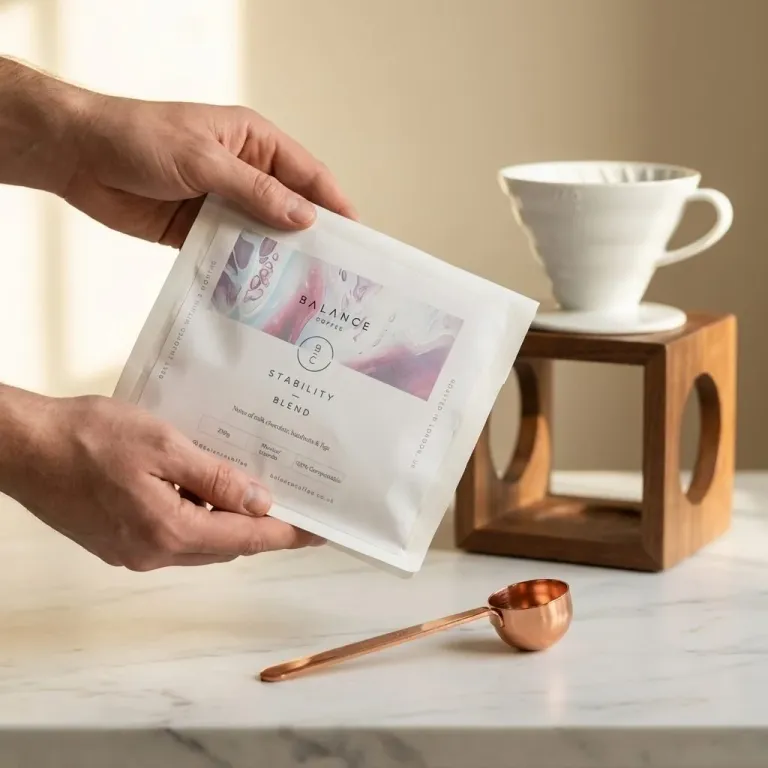
I founded Balance Coffee in 2020. The Stability Blend is not marketed as a low acid coffee, and I want to be transparent about that distinction. It does not carry a 'low acid' label on the bag. What it does carry is an origin profile and roast level that produce one of the gentlest cups we have tested in our Editor Lab.
Stability Blend is Brazil 60%, Mexico 20% and Uganda 20%, sourced from organic farms and medium roasted. Together, the acid profile is soft. Milk chocolate and hazelnut on the nose. A rounded fig sweetness through the body. A finish that does not bite. I drink this daily, and it is the coffee I built because I could not find one that met the same health standard I applied to everything else I consumed.
An independent lab tests the coffee monthly for mycotoxins, mould, heavy metals, and pesticide residues. Results are published on our website. At £9.49 for 250g, it sits at the accessible end of the speciality tier.
“Editor's verdict: Not sold as low acid, but genuinely one of the smoothest coffees on this list. Organic, lab-tested, and built for people who care about what is in their cup as much as how it tastes.”
| Evaluation Criteria | Our Findings |
|---|---|
| Full Review | Read our Balance Coffee review |
| Best For | Health-conscious drinkers who want organic, lab-tested, naturally gentle coffee |
| Acid Level | Low - naturally gentle due to origin and medium roast |
| Flavour Profile | Milk chocolate, hazelnut, fig |
| Certification | Organic (no certifier), lab-tested for mycotoxins and heavy metals |
| Price | From £9.49 / 250g |
| Shop | Shop Balance and save 20% → |
2. West Berkshire Roastery White Gold - Best High-Airflow Roasted
Location: Thatcham, Berkshire | Founded: 2014
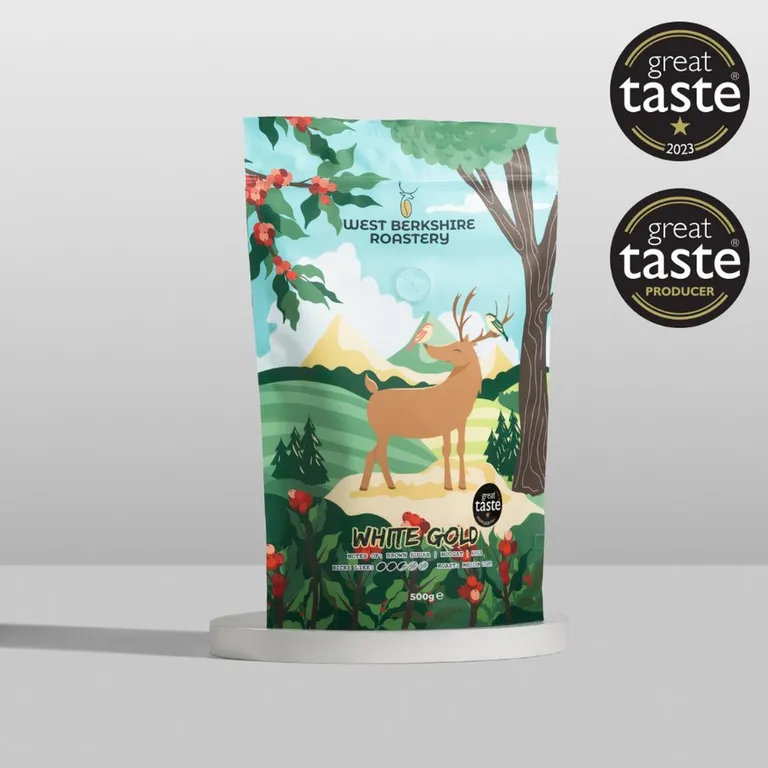
West Berkshire Roastery does something most UK roasters do not. They roast with exceptionally high airflow, a method that strips away impurities and produces a cleaner, smoother cup than conventional drum roasting. The result is coffee that carries flavour without the harsh acidic edge that bothers sensitive stomachs.
White Gold is their organic light-medium roast, with tasting notes of chocolate, almond, and maple syrup. Warm nuttiness opens the cup. A gentle sweetness carries through without sharp turns, and it closes clean, lingering without bitterness. Their entire Roastery Collection has been independently lab-tested for artificial pesticides, moulds, and mycotoxins - a commitment that mirrors the transparency standard we value at Balance Journal.
At approximately £12.50 for 250g, White Gold is priced in the mid-speciality range. Available direct from wbroast.co.uk with next-day delivery.
“Editor's verdict: The roasting method is the differentiator here. High-airflow roasting reduces the compounds that cause stomach irritation. Clean, organic, and tested.”
| Evaluation Criteria | Our Findings |
|---|---|
| Full Review | Read our West Berkshire Roastery review |
| Best For | Drinkers who want a clean, lab-tested organic option with gentle acidity |
| Acid Level | Low - high-airflow roasting reduces harsh acid compounds |
| Flavour Profile | Chocolate, almond, maple syrup |
| Certification | Organic, lab-tested for pesticides, moulds, and mycotoxins |
| Price | From £12.50 / 250g |
| Shop | Shop West Berkshire Roastery → |
3. Exhale Coffee House Roast - Best Lab-Tested Clean Option
Location: Brixton, London
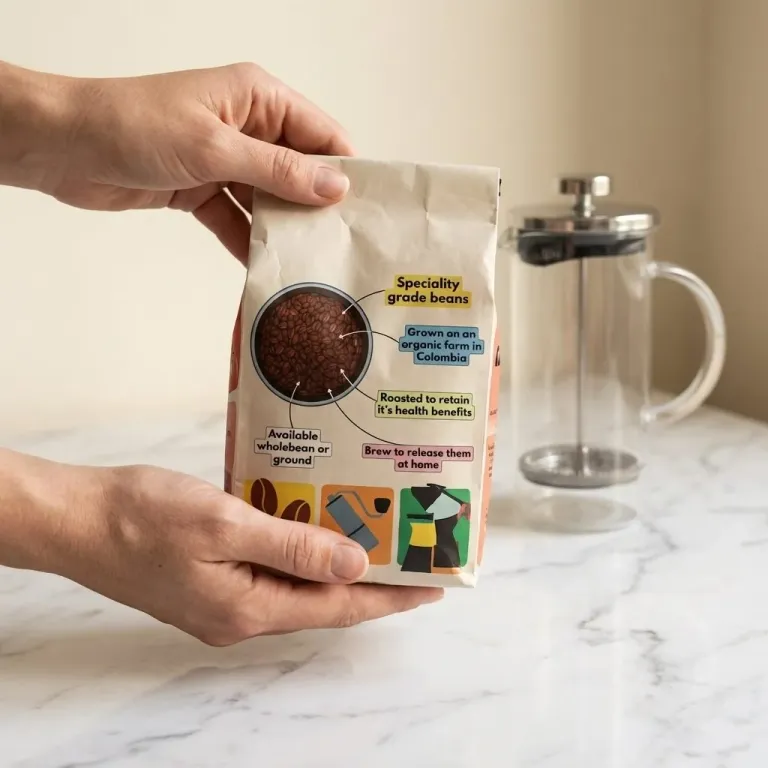
Exhale built their entire brand around the idea of 'healthy coffee', and unlike most brands making similar claims, they have the testing to support it. Their House Roast is a single-origin Ethiopian from Odo Shakiso, organic, speciality grade, and independently tested to be free from moulds, mycotoxins, and pesticides.
The low acid angle here is specific. Exhale's medium roast is optimised for high polyphenol content and antioxidant density, which happens to correlate with a smoother acid profile. Dark chocolate and dried fruit lead the aroma. The cup delivers a rich sweetness with a creamy mouthfeel, resolving rounded and comfortable. For a single-origin Ethiopian, the acidity is remarkably tame.
At £20 for 450g, Exhale sits in the premium tier. You are paying for the testing, the organic sourcing, and a coffee roasted weekly in small batches in Brixton.
“Editor's verdict: If your priority is a lab-tested, clean coffee that also happens to be gentle on the stomach, Exhale is the strongest option in the UK. The health credentials are verifiable, not just marketing.”
| Evaluation Criteria | Our Findings |
|---|---|
| Full Review | Read our Exhale Coffee review |
| Best For | Health-focused drinkers who want verified clean coffee with low acidity |
| Acid Level | Low-moderate - medium roast with naturally smooth profile |
| Flavour Profile | Dark chocolate, dried fruit, creamy body |
| Certification | Organic, speciality grade, lab-tested for moulds, mycotoxins, and pesticides |
| Price | From £20.00 / 450g |
| Shop | Shop Exhale Coffee → |
4. Clumsy Goat Peruvian - Best Budget Low Acid
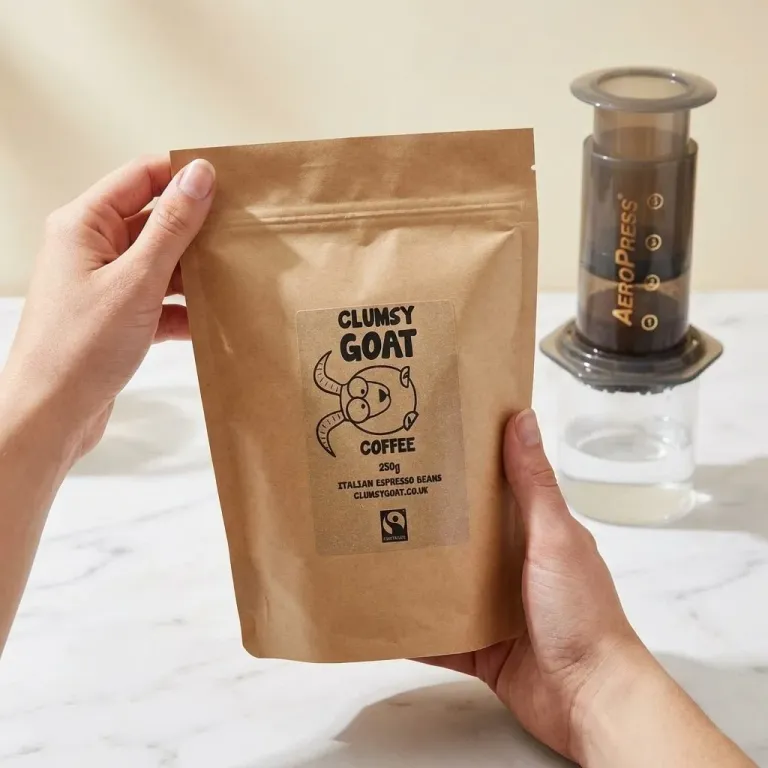
Location: Whitworth, Lancashire | Founded: 2015
Clumsy Goat's Peruvian single origin is the entry point for anyone who wants low acid coffee without paying speciality prices for it. Sourced from the Cenfrocafe cooperative in Peru's Andes, these are Fairtrade certified beans grown at elevations that keep acidity naturally in check.
The medium roast delivers walnut, caramel, and milk chocolate. A warm toasted grain character sets the tone. The cup is sweet and undemanding, closing short and clean. This is not a complex coffee. It is not trying to be. It is a reliable, affordable, stomach-friendly option that tastes better than its price suggests.
Available from clumsygoat.co.uk and Amazon UK. The 1kg bag represents some of the best value in UK low acid coffee beans.
“Editor's verdict: The lowest barrier to entry on this list. Fairtrade, naturally low acid, and priced for daily drinking. No frills, no fuss.”
| Evaluation Criteria | Our Findings |
|---|---|
| Full Review | Read our Clumsy Goat review |
| Best For | Budget-conscious drinkers who want Fairtrade, naturally low acid beans |
| Acid Level | Low - Peruvian origin, medium roast |
| Flavour Profile | Walnut, caramel, milk chocolate |
| Certification | Fairtrade |
| Price | From approx £15.00 / 1kg |
| Shop | Shop Clumsy Goat → |
5. Seven Sisters Coffee - Best Dedicated Low Acid Brand
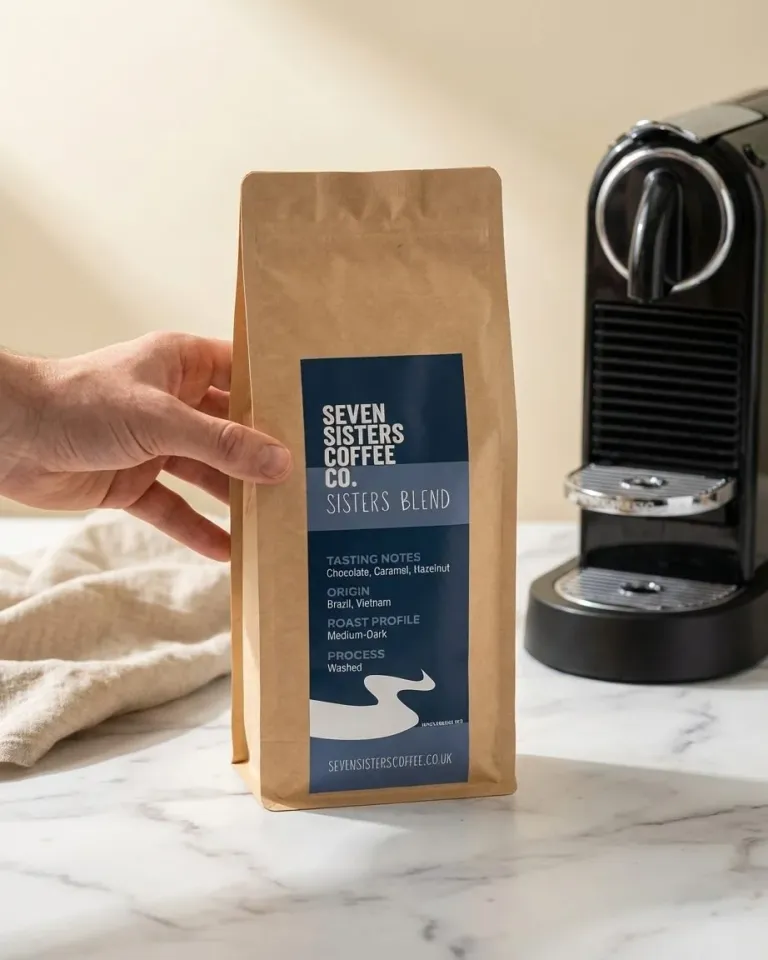
Location: East Sussex
Seven Sisters is one of the few UK roasters that has built its entire identity around low acid coffee. Based on the Sussex coast near the Seven Sisters cliffs, they use an oxygen-free roasting environment that limits the formation of quinic acid - one of the harsher compounds linked to stomach irritation.
Their sourcing strategy complements the roasting. Brazilian beans from lower elevations form the core of their range, producing a full body with minimal brightness. The dark roasts are developed specifically to break down chlorogenic acids while preserving sweetness. Deep caramel and cocoa fill the aroma. The body is smooth and rounded, and warmth carries through to a finish free of the sharpness that plagues standard dark roasts.
Their decaf range uses the Swiss Water Process, making them a solid choice for anyone searching for best decaf low acid coffee in the UK.
“Editor's verdict: The most committed low acid roaster in the UK. If acidity is your primary concern above all else, Seven Sisters has built everything around solving that problem.”
| Evaluation Criteria | Our Findings |
|---|---|
| Full Review | Read our Seven Sisters Coffee review |
| Best For | Anyone whose primary concern is minimising acidity above all else |
| Acid Level | Very low - oxygen-free roasting, Brazilian sourcing |
| Flavour Profile | Deep caramel, cocoa, smooth finish |
| Certification | Swiss Water Process decaf available |
| Price | From approx £10.00 / 250g |
| Shop | Shop Seven Sisters Coffee → |
6. Pact Coffee Sitio de Jaja - Best Brazilian Single Origin
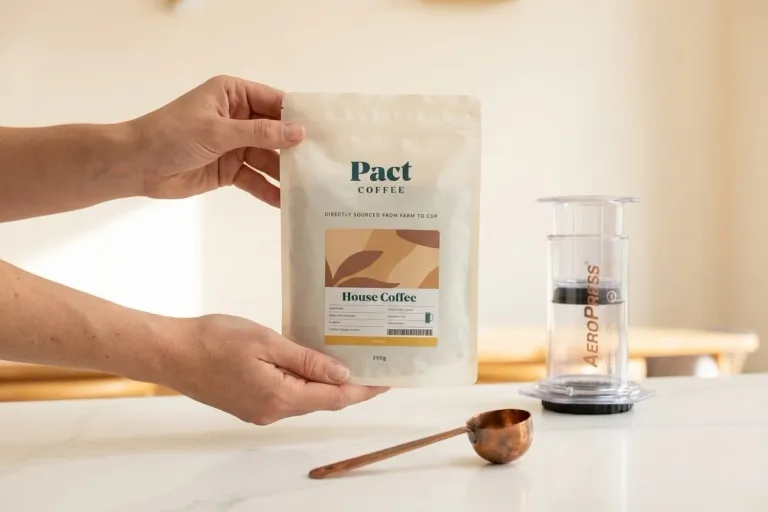
Location: London | Founded: 2012
Pact Coffee has been one of the UK's leading subscription coffee brands since 2012, and their Sitio de Jaja is a masterclass in what Brazilian coffee does well at lower elevations. This micro-lot comes from Jaceline 'Jaja' Campos's farm in Monte Santo de Minas, grown at around 1,200 metres - low enough to limit acidity naturally.
Sitio de Jaja is a naturally processed dark roast with dark chocolate and cocoa nib flavours, balanced by toffee sweetness and a controlled, mild apple acidity. Roasted cocoa and brown sugar greet you immediately. The cup is thick and indulgent without heaviness, tapering smooth and lingering. For a dark roast, the nuance here is notable.
Pact pays above Fairtrade prices and sources from over eight countries. Available through their subscription service or one-off orders from pactcoffee.com.
“Editor's verdict: The best single-origin Brazilian for low acid on the UK market. Micro-lot quality, dark roast development, and an origin that naturally favours gentle acidity.”
| Evaluation Criteria | Our Findings |
|---|---|
| Full Review | Read our Pact Coffee review |
| Best For | Single-origin fans who want Brazilian smoothness with micro-lot quality |
| Acid Level | Low - Brazilian origin, low elevation, dark roast |
| Flavour Profile | Dark chocolate, cocoa nibs, toffee, mild apple |
| Certification | Direct trade, above Fairtrade pricing |
| Price | From approx £8.95 / 250g |
| Shop | Shop Pact Coffee → |
7. Grind House Blend - Best Widely Available
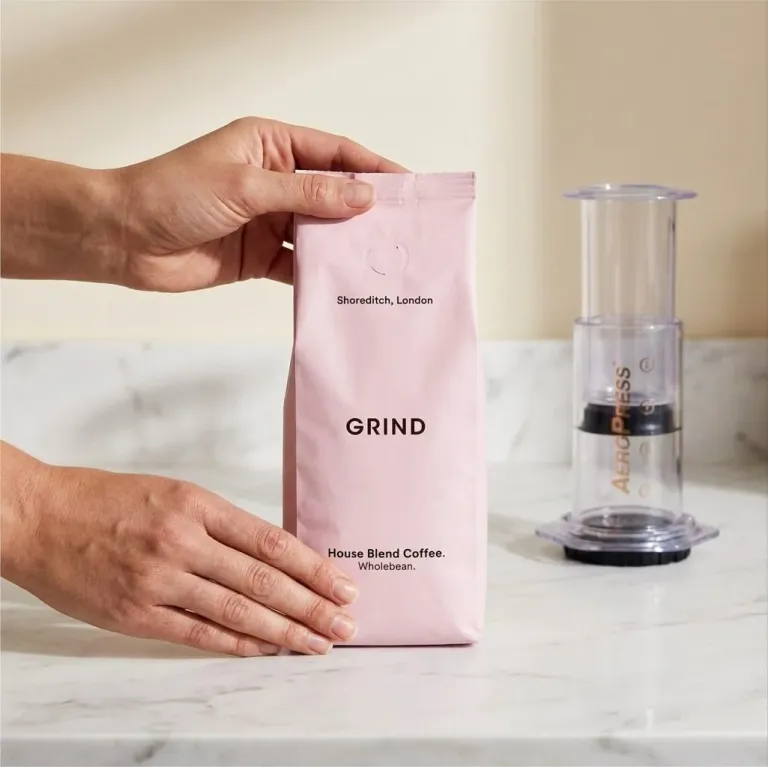
Location: Shoreditch, London | Founded: 2011
Grind started as a single coffee shop in Shoreditch and now appears on supermarket shelves in Waitrose, Sainsbury's, and Ocado. Their House Blend is a medium roast, 100% Arabica, freshly roasted in the UK, with notes of milk chocolate, almonds, cacao nibs, and walnuts.
This is not a coffee marketed at the low acid crowd. It earns its place on this list because the medium roast level and blend composition produce a naturally smooth, approachable cup. Warm chocolate and roasted nut open the cup. The body is balanced and even, closing clean without sharpness. For anyone who wants a low acid coffee uk supermarket option rather than ordering online, Grind is the most accessible choice.
Available from major UK retailers and grind.co.uk. Typically around £9-10 for 200g.
“Editor's verdict: The easiest coffee on this list to actually buy. Available everywhere, consistent quality, and a medium roast profile that keeps acidity in check without sacrificing flavour.”
| Evaluation Criteria | Our Findings |
|---|---|
| Full Review | Read our Grind Coffee review |
| Best For | Anyone who wants low acid coffee from a UK supermarket shelf |
| Acid Level | Low-moderate - medium roast, smooth blend composition |
| Flavour Profile | Milk chocolate, almonds, cacao nibs, walnuts |
| Certification | 100% Arabica, sustainably sourced |
| Price | From approx £9.00 / 200g |
| Shop | Shop Grind → |
8. Volcano Coffee Works Decaf - Best Low Acid Decaf
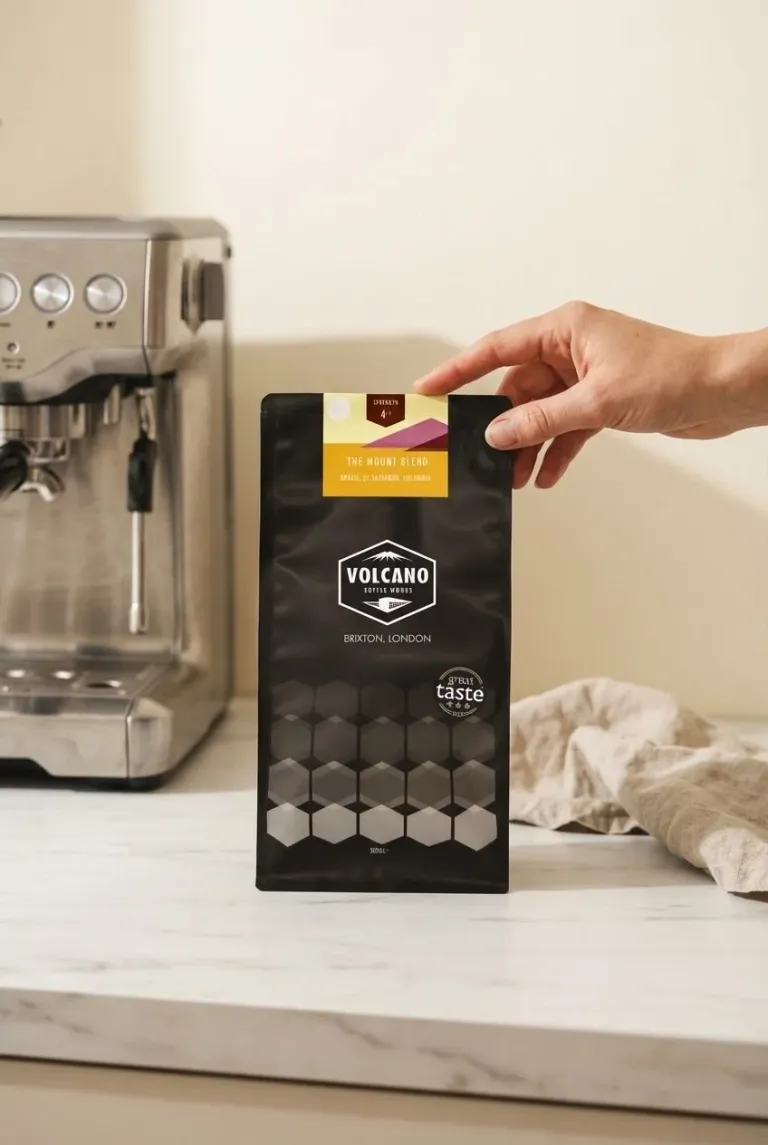
Location: Brixton, London | Founded: 2012
Volcano Coffee Works hand-roasts in South London and pays farmers over double the Fairtrade rate. Their decaf range offers two origins: a Brazilian (sugarcane EA method) with maple syrup, green grape, and dark chocolate notes, and a Peruvian (CO2 sparkling water method) with ground almond, stone fruit, and liquorice.
Decaf coffee is inherently lower in certain acid compounds because the decaffeination process strips some chlorogenic acids alongside the caffeine. Combined with Volcano's careful roast development, both options produce a cup that is comfortable for low acid coffee for sensitive stomach drinkers. The Brazilian pulls richer and sweeter. The Peruvian is cleaner and more rounded.
Available from volcanocoffeeworks.com, Amazon UK, and 85 Holland and Barrett stores across the UK. From £10 for 200g.
“Editor's verdict: Two strong decaf options, each using a chemical-free decaffeination method. If you need low acid and low caffeine, Volcano covers both bases with speciality-grade quality.”
| Evaluation Criteria | Our Findings |
|---|---|
| Full Review | Read our Volcano Coffee Works review |
| Best For | Drinkers who need both low acid and low caffeine |
| Acid Level | Low - decaffeination removes acid compounds alongside caffeine |
| Flavour Profile | Brazilian: maple syrup, green grape, dark chocolate. Peruvian: almond, stone fruit, liquorice |
| Certification | Speciality grade, chemical-free decaffeination (sugarcane EA and CO2) |
| Price | From £10.00 / 200g |
| Shop | Shop Volcano Coffee Works → |
9. Counter Coffee Uplift Espresso - Best Caffeine-Controlled
Location: UK
Counter Coffee has carved out a niche most roasters ignore: caffeine transparency. Every product carries lab-tested caffeine levels, so you know exactly what you are consuming. Their Uplift Espresso is a single-estate Brazilian from Monte Santo de Minas, medium roasted, with 113mg caffeine per double espresso shot.
The low acid relevance is twofold. First, Brazilian beans at moderate elevations naturally produce less acidity. Second, Counter's range includes half-caf and full decaf options alongside Uplift, allowing you to control both caffeine and acid exposure across the day. Praline and raisin set the tone in the aroma. The sweetness is thick, carrying a maple syrup character through a warm, lingering close.
For anyone whose low acid coffee for acid reflux needs extend to caffeine management, Counter lets you handle both variables. Available from countercoffee.uk and Selfridges.
“Editor's verdict: The only brand on this list offering lab-certified caffeine levels alongside a naturally low acid profile. For precise control over what you are drinking, this is unmatched.”
| Evaluation Criteria | Our Findings |
|---|---|
| Full Review | Read our Counter Coffee review |
| Best For | Drinkers who want control over both caffeine and acidity |
| Acid Level | Low - Brazilian single estate, medium roast |
| Flavour Profile | Praline, raisin, maple syrup |
| Certification | Lab-tested caffeine levels, speciality grade |
| Price | From approx £12.00 / 350g |
| Shop | Shop Counter Coffee → |
10. Brown Bear Ethiopia Yirgacheffe - Best Budget Entry
Location: UK | Founded: 2020
Brown Bear proves you do not need to spend heavily to drink well. Their Ethiopia Yirgacheffe is a medium roast of Ethiopian Heirloom Arabica varieties, grown at altitude in the Yirgacheffe area of southern Ethiopia. The washed process and Ethiopian origin mean this carries more brightness than the Brazilian and Peruvian coffees higher on this list.
So why include it? Because the medium roast tames the acidity enough for most sensitive stomachs, and the price point opens speciality-quality Ethiopian coffee to drinkers who would otherwise default to supermarket blends. Red berry and a light floral lift arrive first. The body is clean and tea-like with a citrus sweetness, and it finishes lively but never aggressive.
Five percent of all Brown Bear sales go to Free the Bears UK charity. Available from brownbear.co and Amazon UK.
“Editor's verdict: The most affordable Ethiopian on this list. Not the lowest acid option, but a well-roasted medium that brings the acidity down to a manageable level without losing the origin character.”
| Evaluation Criteria | Our Findings |
|---|---|
| Full Review | Read our Brown Bear review |
| Best For | Budget drinkers who want speciality Ethiopian at an entry-level price |
| Acid Level | Moderate - Ethiopian origin, but medium roast reduces sharpness |
| Flavour Profile | Red berry, floral, citrus sweetness, tea-like body |
| Certification | 100% Arabica, 5% of sales to Free the Bears UK |
| Price | From approx £9.99 / 1kg |
| Shop | Shop Brown Bear → |
Low Acid Coffee and Acid Reflux - What the Research Says
Coffee does not cause acid reflux. That needs to be said plainly, because the assumption that it does leads many people to quit coffee entirely when they may not need to. What coffee can do is aggravate existing gastro-oesophageal reflux (GERD) symptoms in some individuals, primarily by relaxing the lower oesophageal sphincter and stimulating gastric acid secretion.
Research published in PMC has found that the relationship between coffee and GERD symptoms varies significantly between individuals. For some, switching to a lower-acid coffee reduces discomfort without eliminating coffee from their diet. For others, the trigger is caffeine rather than acidity, which is why decaf options appear on this list. The Soil Association notes that organic farming practices may also influence the compound profile of the finished bean, though more research is needed on that specific link.
This is not medical advice. If you experience persistent reflux, speak to your GP. But if your goal is to reduce the acidity in your daily coffee without abandoning it, the brands on this list - particularly those using darker roasts, lower-elevation origins, and natural processing - offer a meaningful difference.
Cold Brew - The Easiest Way to Reduce Coffee Acid
If you already own coffee you enjoy but want less acid, cold brew is the simplest solution. A 2018 study in Scientific Reports found that cold brew coffee consistently measures a higher pH (lower acidity) than hot brew across all roast levels. The extended steeping time in cold water extracts flavour compounds while leaving behind a significant proportion of the chlorogenic and quinic acids that cause stomach discomfort.
The method is straightforward. Coarse grind, cold filtered water, 12-18 hours in the fridge, strain. No special equipment required. The result is a concentrate that is naturally smoother, sweeter, and gentler on the stomach than the same coffee brewed hot. For anyone on this list, making cold brew from any of the 10 coffees above will reduce the acid profile further. It is a complementary approach, not a replacement for choosing the right beans in the first place. If you are exploring the best coffee roasters in the UK for beans suited to cold brew, our dedicated guide covers that in depth.
Final Thoughts
Low acid coffee in the UK is no longer a niche concern. Taken together, the brands on this list prove that you do not need to sacrifice flavour, quality, or ethical sourcing to find a coffee that sits well in your stomach. The science is clear: origin, roast level, processing method, and brewing technique all influence acidity in measurable ways. The choice is not between good coffee and comfortable coffee. With the right beans and the right approach, you get both.
For readers exploring adjacent categories, our guide to the best organic coffee beans covers that area in detail. Best decaf coffee beans UK and best healthy coffee beans UK guides are also in progress. If you are new to speciality coffee entirely, start with our best coffee beans in the UK pillar guide, which provides the broadest overview of what is available.
Frequently Asked Questions
What Is the Least Acidic Coffee?
Is Decaf Coffee Lower in Acid?
Does Dark Roast Have Less Acid?
Is Low Acid Coffee Better for Your Stomach?
Can You Make Regular Coffee Less Acidic?
Is Cold Brew Really Lower in Acid?
What Is the Difference Between Low Acid and Stomach-Friendly Coffee?
Is Sumatran Coffee Low in Acid?
Can You Buy Low Acid Coffee in UK Supermarkets?
Does Organic Coffee Have Less Acid?

A wellness entrepreneur and biohacker, James explores the intersection of hospitality and health - from clean fuel and recovery tools to mindful routines that build balance into daily life.