Best Almond Milk for Coffee
Six UK cartons ranked on foam, split resistance and ingredient quality.
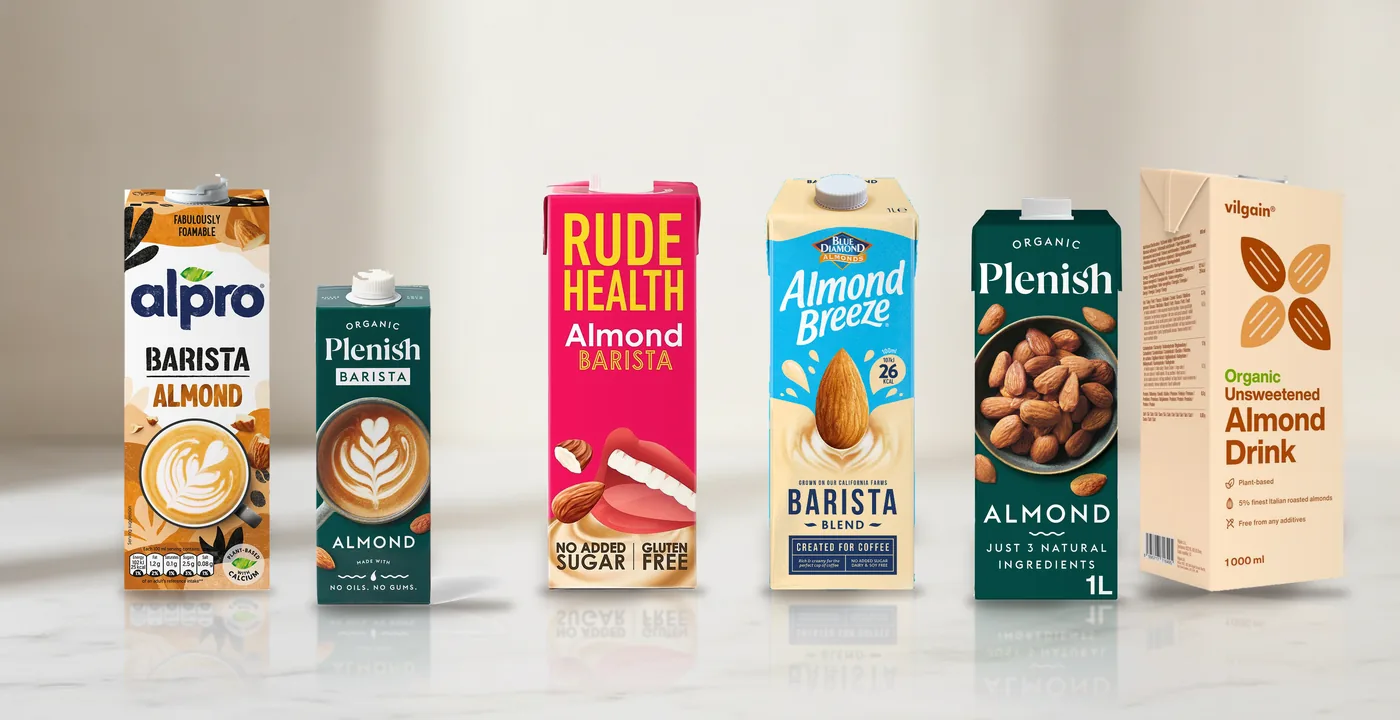
Table of Contents
Some of the links in this article are affiliate links, which help fund our independent review work at no extra cost to you. Every recommendation is based on hands-on testing through The Editor Lab methodology. No brand pays to appear, and no placement is guaranteed.
Almond milk splits in espresso. Not sometimes - regularly, and particularly in light, acidic roasts where the temperature shock and low pH combine to break the emulsion before you have had a single sip. If you have watched your flat white separate into pale foam and cloudy water, that is the problem this guide solves.
I am a Nutritional Therapist trained at the College of Naturopathic Medicine, and I have run nutrition clinics at Harrods and Google. Almond milk for coffee is a question that comes up constantly with clients who are switching to dairy-free but are not willing to compromise on how their morning coffee tastes. This guide covers the UK brands that actually hold up in hot espresso, which coffee roasts pair well with each one, and what the ingredient list is really telling you about foam performance and nutritional value.
Quick verdict: Alpro Barista Almond is the best all-round almond milk for coffee in the UK - widely available, consistent foam, and resistant to splitting in most home-espresso set-ups. For the cleanest label (no oils, no gums), choose Plenish Organic Almond Barista. For organic certification and a richer oat-almond body, choose Rude Health Barista Almond.
Top 3 Best Almond Milks for Coffee
How We Assessed
Every almond milk in this guide was assessed on its ingredient list and formulation for foam and split resistance in hot espresso, across both medium-dark and light single-origin roasts. Nutritional data was taken from current UK packaging and manufacturer data.
This article follows Balance Journal's Editor Lab testing standards. For a broader comparison of every plant milk type, see our pillar guide to the best alternative milk for coffee. For general almond milk use beyond coffee, see best almond milk UK.
The Reviews
1. Alpro Barista Almond - Best Overall
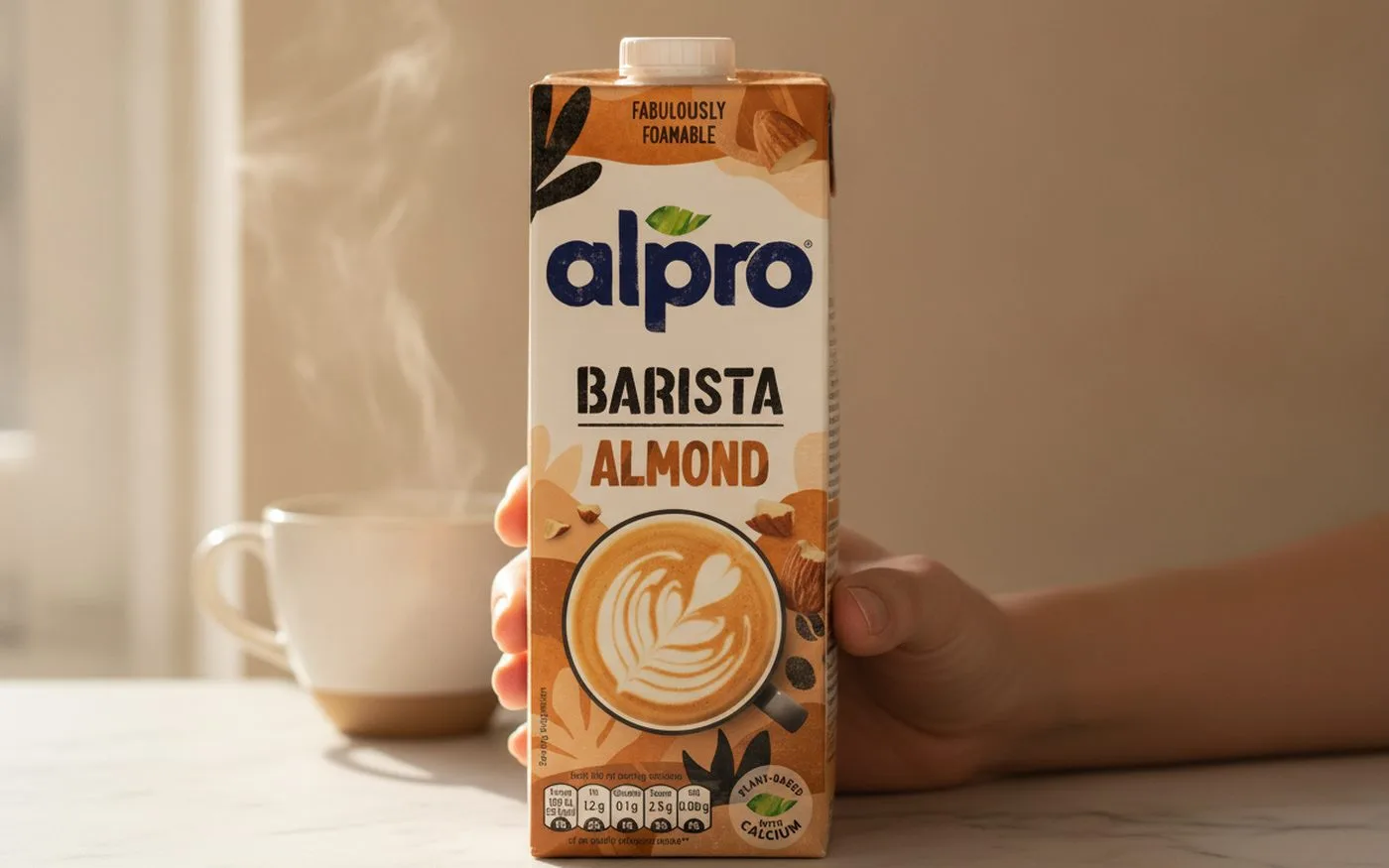
Alpro Barista Almond is the most consistent performer across the three variables that matter to home coffee drinkers: foam volume, split resistance, and UK availability. The barista formulation uses gellan gum and guar gum to create an emulsion that holds under steam, designed to give a foam that is lighter than dairy but serviceable for a flat white or latte. It holds well in medium-dark espresso. A high-acid light roast, such as an Ethiopian natural, can still make it split, but it is markedly more resistant than standard almond milk.
The almond content sits at 2.5%, which is close to the category norm for mainstream barista blends and explains both the gentle flavour and the fact that the texture comes primarily from the stabilisers rather than from the almonds themselves. That gentle, neutral profile suits coffee because it does not compete with the roast.
Alpro Barista Almond is available at every major UK supermarket - Tesco, Sainsbury's, Waitrose, Asda, Ocado - which makes it the default answer for most readers who want reliable almond milk for coffee without placing a specialist order.
“Alpro Barista Almond is the practical choice. It is not the most exciting product on this list, but it does what it promises in a home espresso set-up with minimal fuss.”
| Evaluation Criteria | Our Findings |
|---|---|
| Full review | Brand review page pending (spawned on cluster pillar publish) |
| Best for | Everyday coffee use; widest UK supermarket availability; consistent foam |
| Flagship product | Alpro Barista Almond 1L |
| Shop | Alpro Barista on Amazon UK |
| Shop | Shop Alpro → |
2. Plenish Organic Almond Barista - Best Clean-Label
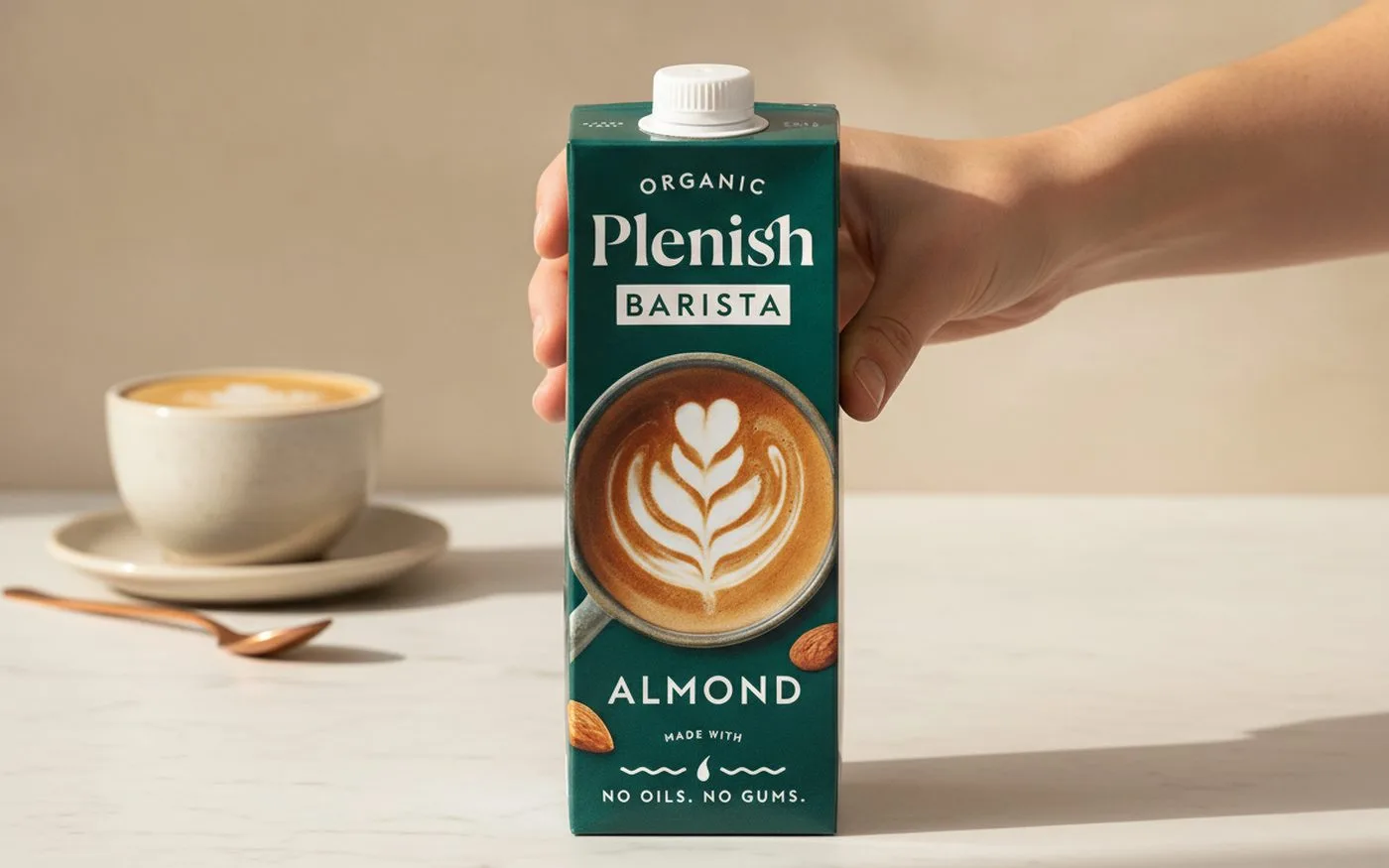
No added oils, no gellan gum, no emulsifiers. Plenish Organic Almond Barista is formulated to foam without the stabilisers that most barista milks rely on. The ingredient list is: Water, Almond Paste 3.1%*, Agave Syrup*, Coconut Milk*, Sunflower Seed Protein*, Oat Fibre*, Sea Salt (*Organic). The almond paste at 3.1% sits above the 2-2.5% norm for mainstream barista blends, and Plenish uses coconut milk and sunflower seed protein as natural emulsifiers in place of oils and gums.
Split resistance is good in medium and medium-dark roasts. In very light, high-acid single origins, it can split occasionally - similar to Alpro.
The absence of added oils is the real differentiator here. Readers who are reducing mycotoxins in coffee and similar hidden-input concerns, or who are scrutinising every additive in their daily routine, will find Plenish the most coherent clean-label option in the barista category. It is organic certified, which matters for almond milk because conventional almond farming uses significant pesticide inputs.
“Plenish is the answer for readers who want a barista almond milk that performs without a stabiliser list. The ingredient story is significantly cleaner than Alpro.”
| Evaluation Criteria | Our Findings |
|---|---|
| Full review | Brand review page pending (spawned on cluster pillar publish) |
| Best for | Clean-label priority; readers reducing seed oils and gums; organic preference |
| Flagship product | Plenish Organic Almond Barista 1L |
| Shop | Plenish Barista on Amazon UK |
| Shop | Shop Plenish → |
3. Rude Health Barista Almond - Best Organic / Richest Body
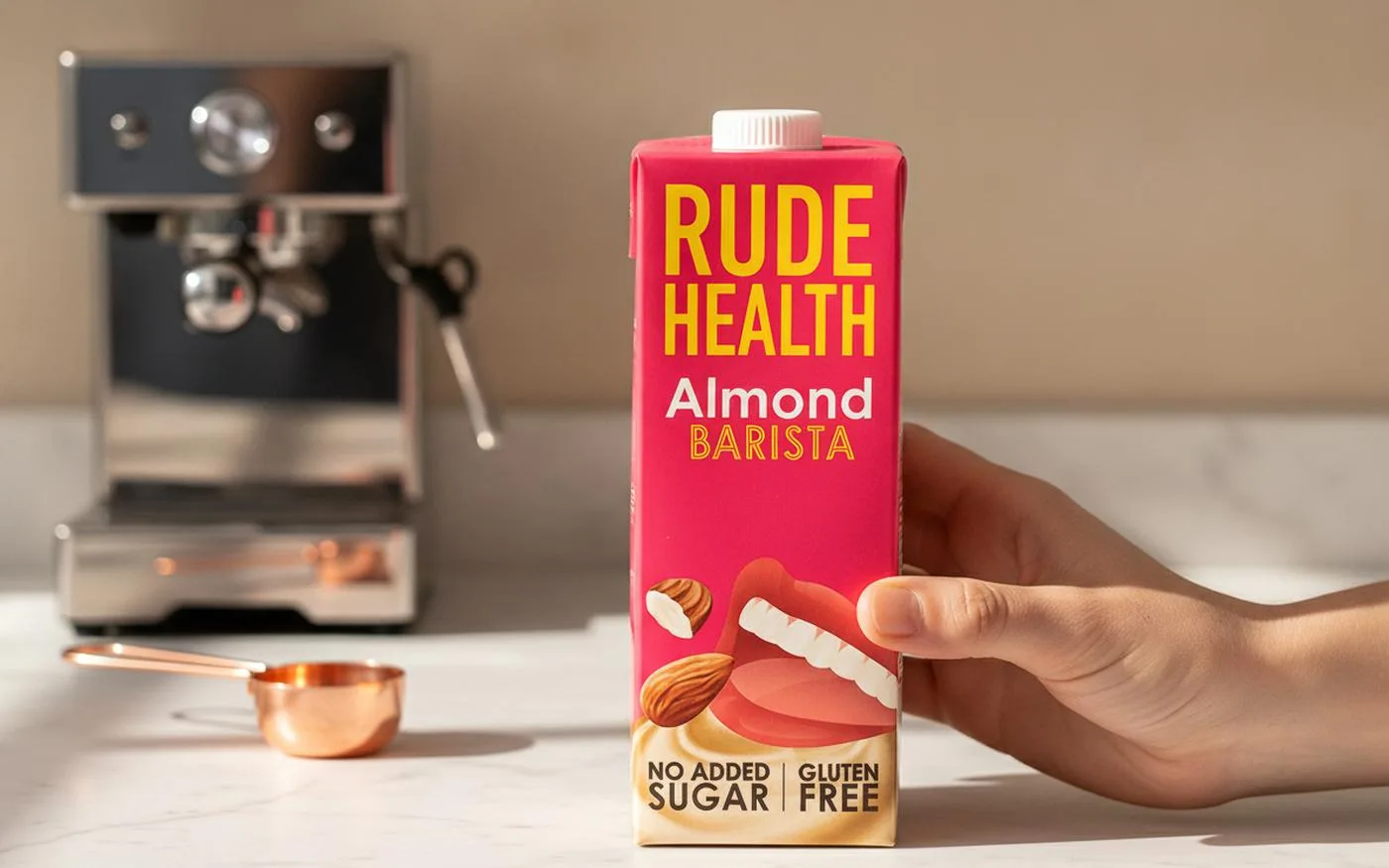
Rude Health publishes their full ingredient list: Water, Gluten-free oats (13%), Almonds (2%), Sunflower oil, Sea salt, Stabiliser: Gellan gum. The 2% almond content is in line with the category norm, but the addition of oats at 13% and sunflower oil are there to give the drink a fuller body than an almond-only blend. This is the option for readers who want their coffee to taste like something more than a neutral white liquid.
The gellan gum and sunflower oil do support the emulsion under steam, but in a light, acidic single-origin espresso the formulation is less forgiving than in a medium-dark pull. It holds well in balanced medium roasts and can split occasionally - not frequently - in high-acid light roasts. If you are drinking a Yirgacheffe, use Rude Health at a slightly lower temperature and pull the espresso first, then add the milk. In a medium roast, it will not be an issue.
The organic certification makes Rude Health an easy recommendation for readers who are already applying best organic coffee beans logic to every input in their diet. The formulation does include sunflower oil and gellan gum as stabilisers, so it is not the purest label on this list - but those who prioritise organic over additive-free will find it the most coherent pick at this end of the market. At around £2.50 per litre, it is priced at the premium end but not as expensive as specialist options.
“The fuller oat-almond body of Rude Health Barista suits medium roasts. If you want more body than a neutral carton gives, this is the one.”
| Evaluation Criteria | Our Findings |
|---|---|
| Full review | Brand review page pending (spawned on cluster pillar publish) |
| Best for | Organic priority; readers who want a richer oat-almond body; medium roast pairing |
| Flagship product | Rude Health Barista Almond 1L |
| Shop | Rude Health Barista on Amazon UK |
| Shop | Shop Rude Health → |
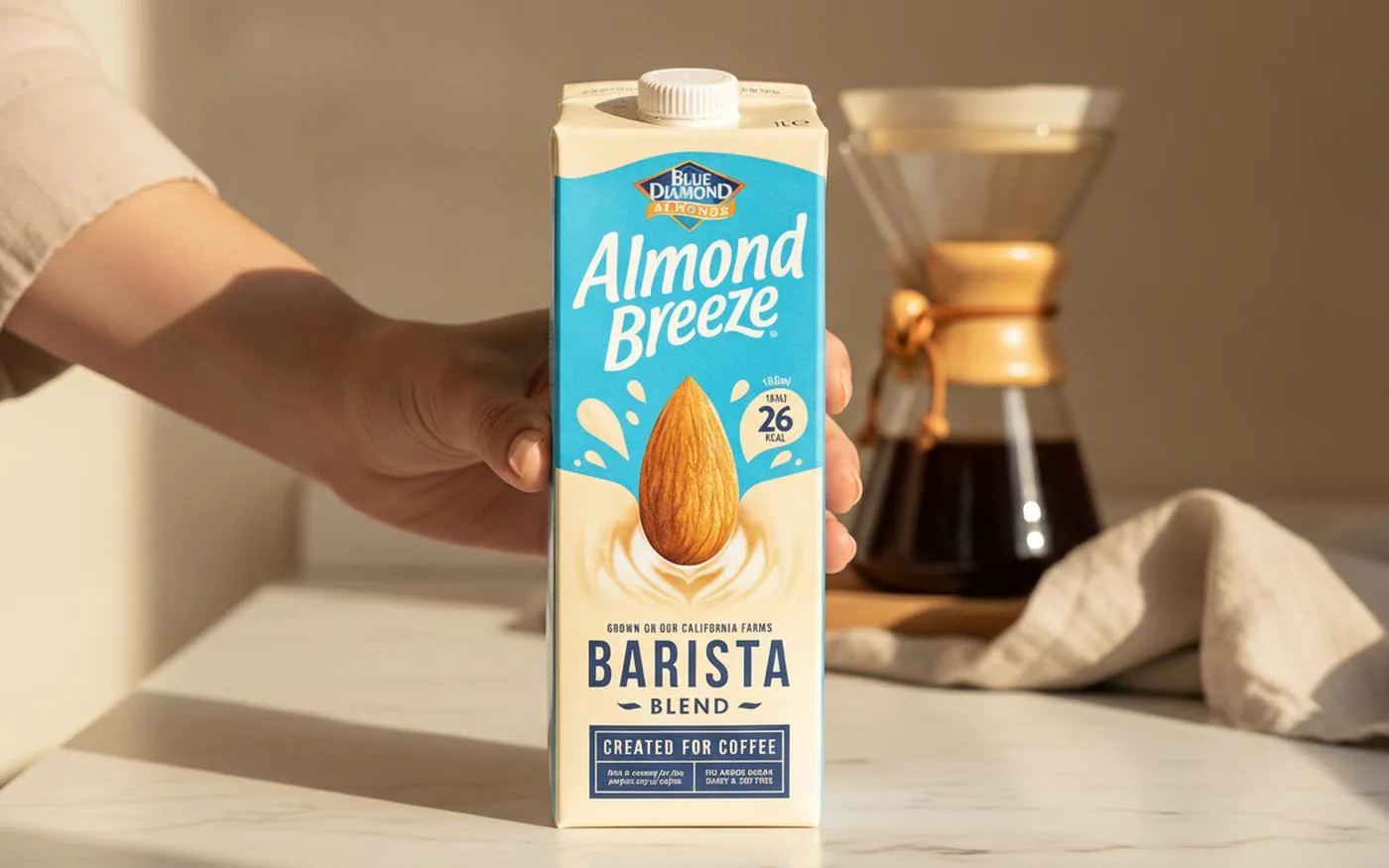
4. Almond Breeze Barista Blend - Best Non-Splitting
The most split-resistant formulation on this list. Almond Breeze Barista Blend uses gellan gum and sunflower lecithin in a formulation that Blue Diamond developed specifically in consultation with baristas, and it is built to hold without breaking even in hot, acidic single-origin espresso.
What Almond Breeze does not offer is flavour. Blue Diamond formulates it to sit back in the coffee rather than contribute to it. If you want to taste your coffee without almond milk interference, this is a positive. If you switched to almond milk for its flavour profile, this is not the right pick.
At around £2.00 per litre, it sits in the mid-range of this list. UK availability is good through Ocado, Morrisons, and Amazon. It is not organic, and it does contain gellan gum and sunflower lecithin, so it is not a clean-label choice - but for readers whose primary concern is a reliable no-drama latte with zero splitting, the trade-off is clear.
“If splitting is your dealbreaker - the flat white that separates before you reach the sofa - Almond Breeze Barista Blend is the answer. Nothing else on this list comes close for split resistance.”
| Evaluation Criteria | Our Findings |
|---|---|
| Full review | Brand review page pending (spawned on cluster pillar publish) |
| Best for | Split-resistance first; readers who want a neutral, coffee-forward taste |
| Flagship product | Almond Breeze Barista Blend 1L |
| Shop | Almond Breeze Barista on Amazon UK |
| Shop | Shop Almond Breeze → |
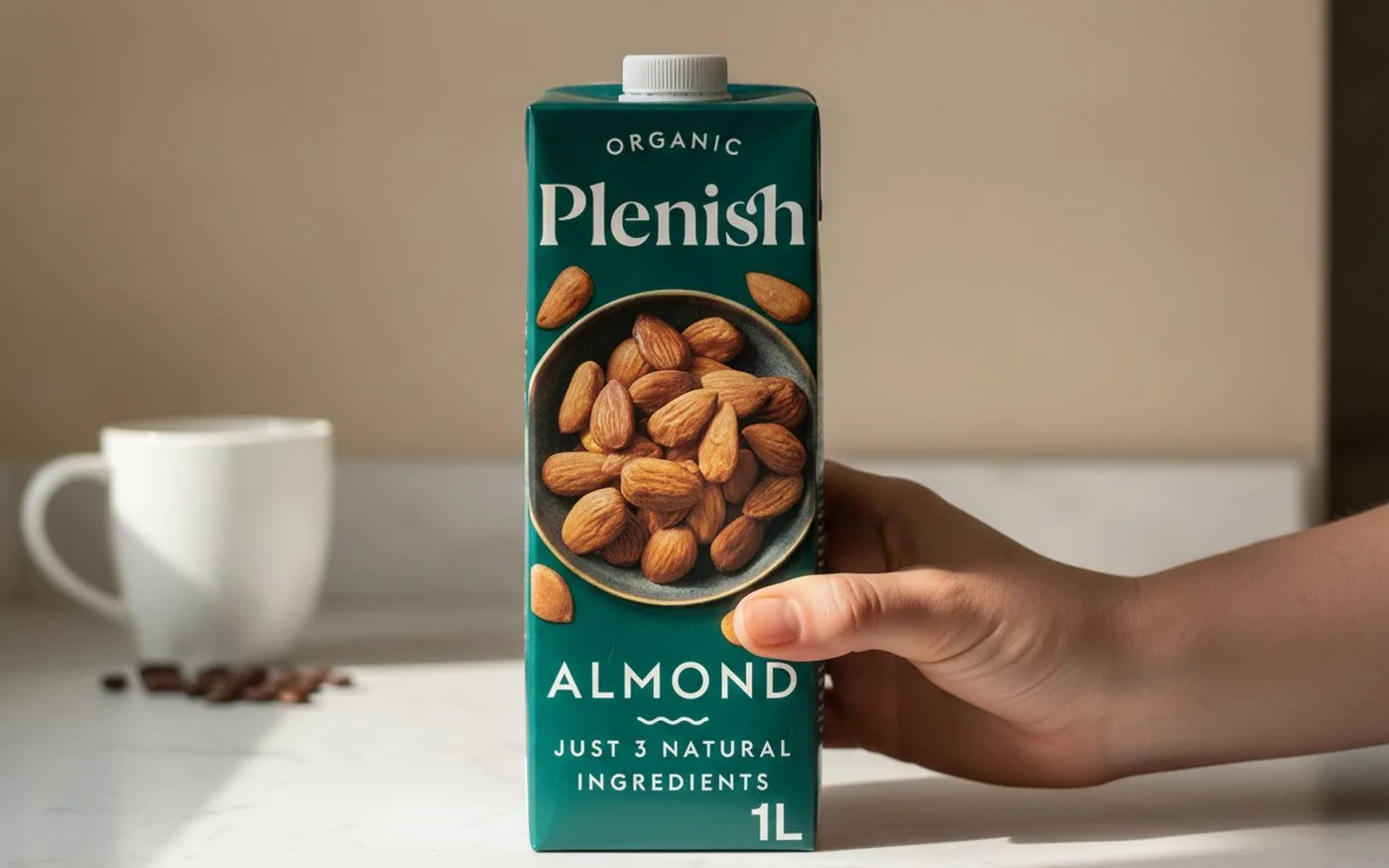
5. Plenish Unsweetened Almond - Best Minimal-Ingredient Standard
This is not a barista product. Three ingredients (filtered water, almonds, sea salt), no added stabilisers, and the foam result reflects that: expect thin, watery foam under a steam wand and frequent splitting in hot espresso. The honest recommendation is that if coffee is your main use case, the Plenish Barista formulation above is the correct choice for an extra 20 pence per litre.
Where Plenish Unsweetened earns its place on this list is for cold brew, iced coffee, and drinks where the milk is not being steamed. In cold-brew, there is no splitting risk, and a three-ingredient almond milk avoids the stabilisers that mainstream brands rely on. In an iced latte where you pour milk over ice and add cold-brew concentrate, it works well.
If you keep both on hand - the Plenish Barista for steamed drinks and the Plenish Unsweetened for cold use - you get clean ingredients across all your coffee occasions. Nutritionally, the two products are similar: low in calories, very low in protein (around 0.5g per 100ml), and high in natural almond fat without the additional vegetable oils.
“Plenish Unsweetened is the right product for iced coffee. For steamed drinks, spend the extra and go for the Barista version.”
| Evaluation Criteria | Our Findings |
|---|---|
| Full review | Brand review page pending (spawned on cluster pillar publish) |
| Best for | Iced coffee; cold brew; readers who want the cleanest ingredients in unsteamed drinks |
| Flagship product | Plenish Unsweetened Almond 1L |
| Shop | Plenish Unsweetened on Amazon UK |
| Shop | Shop Plenish → |
6. Vilgain Organic Almond - Best Additive-Free for Drinking
Vilgain's organic almond milk (water, almonds, sea salt - nothing else) is available direct from Vilgain.co.uk in the UK. Like Plenish Unsweetened, the absence of stabilisers means foam performance is poor and splitting is very frequent in hot espresso. It is not a coffee steaming product, and should not be used as one.
Vilgain suits drinking plain or on cereal, where its simple organic recipe matters more than foam. At around £2.80 per litre, it is the most expensive option on this list, and the comparison with Plenish Barista (better coffee performance, lower price) or Rude Health Barista (similar cleanliness, coffee-ready) is difficult to win on value grounds for most readers.
The specific argument for Vilgain is brand preference for readers already buying from the Vilgain health range and who want consistency across their supplement and food inputs. Availability is online-only through their UK direct store.
“Vilgain is a clean product for drinking, but for coffee use there are better-performing options at lower prices. Check the value comparison with Plenish Barista before ordering.”
| Evaluation Criteria | Our Findings |
|---|---|
| Full review | Brand review page pending (spawned on cluster pillar publish) |
| Best for | Drinking plain; cereal; readers already shopping the Vilgain range |
| Flagship product | Vilgain Organic Almond Milk 1L |
| Shop | Vilgain UK direct |
| Shop | Shop Vilgain → |
How They Compare
The table below gives you the full picture across all six brands. The individual reviews above carry the detail behind each ranking.
| Brand | Best for | Foam (by formulation) | Splits in hot espresso? | Sweetened? | Added oil/gums | Price/litre (approx) | Where to buy |
|---|---|---|---|---|---|---|---|
| Alpro Barista Almond | Best overall | Good | Rarely | No | Gellan gum, guar gum | £1.80 | Most UK supermarkets, Amazon |
| Plenish Organic Almond Barista | Best clean-label | Good | Rarely | No | None (no oils or gums) | £2.30 | Ocado, Waitrose, Amazon |
| Rude Health Barista Almond | Best organic | Good | Occasionally (light roast) | No | Sunflower oil, gellan gum | £2.50 | Waitrose, Amazon, H&B |
| Almond Breeze Barista Blend | Best non-splitting | Very good | Rarely | No | Gellan gum, sunflower lecithin | £2.00 | Ocado, Morrisons, Amazon |
| Plenish Unsweetened Almond | Best minimal (standard) | Poor | Frequently | No | None | £2.10 | Ocado, Waitrose, Amazon |
| Vilgain Organic Almond | Best additive-free drinking | Poor | Very frequently | No | None | £2.80 | Vilgain.co.uk |
Why Almond Milk Splits in Hot Coffee (and How to Stop It)
This question dominates the forums - Reddit r/nespresso, r/Coffee, UK Nespresso Facebook groups - and the short answer is chemistry: almond milk is low in both protein (around 0.5g per 100ml) and fat compared to dairy, which means it has less to buffer against the acidity and heat shock of a freshly pulled espresso. When hot, acidic espresso hits cold almond milk, the emulsion breaks and you see the familiar separation.
Barista editions address this by adding stabilisers (gellan gum, sunflower lecithin, sunflower oil) that reinforce the emulsion under heat. No barista almond milk is immune to splitting under all conditions - the claim is relative resistance, not immunity. These are the variables you control:
- Roast profile: Lower-acid medium and medium-dark roasts split almond milk far less often than high-acid light roasts. A Yirgacheffe or washed Ethiopian will challenge any almond milk barista edition. A balanced medium blend will not.
- Temperature: Cool your espresso for 20-30 seconds before adding milk, or use a slightly lower extraction temperature. Heat shock is one of the two main splitting triggers.
- Pour order: Pour the milk into the cup first, then add the espresso. This reduces the temperature differential at the point of contact.
- Milk temperature: Steam or heat the almond milk to around 60-65°C rather than 70°C+. Overheated almond milk splits more readily.
These adjustments work. Combined with a barista-edition almond milk, they make splitting an occasional event rather than a daily frustration.
Barista vs Standard Almond Milk
The barista label is not marketing - it identifies a genuinely different product with a different function. Standard almond milk is engineered for taste and nutrition in cold applications. Barista almond milk is engineered for foam stability and heat resistance.
| Feature | Standard almond milk | Barista almond milk |
|---|---|---|
| Stabilisers | None or minimal | Gellan gum, lecithin, or oil (varies by brand) |
| Foam under steam | Poor to none | Good to very good |
| Split resistance in hot coffee | Frequently splits | Rarely to occasionally splits |
| Taste | More pronounced almond | Slightly more neutral (stabilisers dilute flavour) |
| Price | Similar or slightly lower | Similar or slightly higher |
| Clean-label | Often cleaner (no gums) | Plenish Barista is the exception (no gums) |
For hot coffee drinks with steaming: use the barista version. For cold brew and iced coffee where no steaming is required: the standard version works and is often the cleaner choice on ingredients.
Buying Guide: What to Look For
Before you buy, run through these criteria against the label.
| Criterion | What to look for | Red flag |
|---|---|---|
| Barista label | Required for steaming - not optional | "Suitable for hot drinks" is not the same as a barista formulation |
| Stabilisers/gums | Present in most barista editions for a reason | Absent only if brand achieves foam another way (see Plenish) |
| Added oil | Sunflower oil appears in several barista milks as emulsifier | Rapeseed oil (also called canola) - less common in almond but appears in some |
| Sweetened vs unsweetened | Unsweetened for everyday coffee use | "Original" may mean sweetened - check back of label |
| Almond content | Higher = richer flavour; 2% is the mainstream norm | Not declared at all - minimal transparency |
| Fortification | Calcium 120mg+/100ml, vitamin D | No fortification mention at all |
| Price per litre | £1.80-£2.50 for barista editions | Over £3/litre should be justified by a specific clean-label or almond-content premium |
For readers choosing across all plant milk types, the guide to the best coffee beans UK includes pairing direction that covers which bean profiles work best with different milk types.
Almond Milk and Health: What Nutritionists Actually Say
The honest answer from a nutritional-therapy perspective is: it depends on the criteria you are applying. Almond milk has real advantages - it is the lowest-calorie mainstream option at around 24 kcal per 100ml for standard versions, it is naturally lactose-free, and the better brands are clean on additives. The British Dietetic Association's guidance on plant-based drinks is clear that fortified versions provide calcium in quantities comparable to dairy milk, which is relevant for long-term dairy switchers.
The nutritional gap is protein. Almond milk delivers around 0.5g per 100ml, compared to 3.4g for semi-skimmed dairy and around 3.3g for soy milk. If you are replacing dairy partly as a protein source, almond milk is not the right vehicle for that. The NHS guidance on dairy and alternatives recommends looking at the overall diet rather than any single food swap - the coffee milk is not where your protein strategy is decided.
What almond milk offers the health-conscious coffee drinker is a low-calorie, low-additive (in the better versions) base that does not affect insulin response the way oat milk can for carbohydrate-sensitive readers. For a comparison of how every alternative milk type stacks up on nutrition, foam, and splitting, see the best alternative milk for coffee pillar guide.
The seed-oil question is worth flagging separately. Several barista almond milks - Rude Health (sunflower oil) and Almond Breeze (sunflower lecithin) - contain added sunflower-derived fats. Alpro Barista uses gellan gum and guar gum as stabilisers with no added oil. Plenish Barista is the most minimal formulation: no added oils and no gums, achieving foam via coconut milk and sunflower seed protein instead. If seed-oil reduction is part of your health approach, Plenish Barista is the only barista-edition pick on this list that is oil-free and gum-free.
For the cardiologist question that appears regularly in this topic's PAA pool: almond milk is very low in saturated fat and the fat it does contain is predominantly unsaturated. The BDA notes that plant-based drinks except coconut-based ones are rich in unsaturated fat - a profile that research associates with a reduced cardiovascular risk profile. There is no specific cardiological concern with almond milk.
Frequently Asked Questions
What is the best almond milk for coffee?
Alpro Barista Almond is the best overall - widely available, consistent foam, rarely splits in medium or medium-dark espresso. For the cleanest label without added oils or gums, Plenish Organic Almond Barista is formulated to foam without them. For a richer, oat-boosted body, Rude Health Barista Almond is the pick. All three are unsweetened and UK-available.
Why are people ditching almond milk?
Two main reasons: the marzipan taste in lower-quality mainstream cartons, and frustration with splitting in hot espresso. A secondary driver is ingredient scrutiny - readers switching from oat milk to reduce rapeseed oil are finding that some almond milk barista editions (Rude Health, Almond Breeze) contain sunflower-derived ingredients, while others (Alpro) rely on gums. Plenish Barista is the cleanest formulation that still performs in coffee.
Which brand of almond milk is the healthiest?
For the cleanest ingredient list, Plenish Organic Almond Barista (no added oils, no gums) is the standout barista option. Rude Health Barista contains sunflower oil and gellan gum, so it is not the cleanest choice in that respect, though it is organic. For lowest calories, choose standard almond milk at around 24 kcal per 100ml. For bone health, check fortification: calcium at around 120mg per 100ml (the level in semi-skimmed dairy milk) and vitamin D. The British Dietetic Association recommends fortified plant milks as suitable long-term dairy alternatives.
Which is the best almond milk in the UK?
For coffee: Alpro Barista Almond for everyday use, Plenish Organic Almond Barista for clean-label priority, Rude Health Barista Almond for organic and a richer oat-almond body. For general use - cereal, smoothies, drinking plain - see the best almond milk UK guide, which covers Plenish standard range, Rude Health Ultimate Almond (9% almonds), and supermarket own-brand options.
Is there a downside to drinking almond milk?
The main downsides are low protein (around 0.5g per 100ml versus 3.4g for dairy) and splitting in hot espresso if you are using the wrong formulation. Almond milk is not a meaningful protein source - soy or pea milk serve that goal better. Most barista versions contain added stabilisers (gums and/or sunflower oil); Plenish Barista is the exception that achieves foam without added oils or gums, using coconut milk and sunflower seed protein instead.
What do cardiologists say about drinking almond milk?
The picture is largely positive. Almond milk is low in saturated fat and unsweetened versions are low in sugar. The British Dietetic Association notes that plant-based drinks (except coconut-based) are rich in unsaturated fats, a profile associated with reduced cardiovascular risk. No specific cardiological concern exists with almond milk. An unsweetened, calcium-fortified version is unlikely to create nutritional gaps for most adults.
Why does almond milk split or curdle in hot coffee, and how do I stop it?
Almond milk is low in protein and fat, so it has limited buffering capacity against heat and acidity in espresso. To reduce splitting: use a barista-edition formulation, choose a medium or medium-dark roast rather than a high-acid light roast, cool espresso briefly before adding milk, pour milk first, and heat almond milk to around 60-65°C. Barista editions offer relative resistance, not immunity.
Is barista almond milk better than regular for lattes?
Yes, for steamed drinks. Barista almond milk contains added stabilisers (gellan gum, lecithin, oil) that create microfoam and resist heat shock. Standard almond milk foams poorly and splits frequently. The foam is lighter than dairy microfoam but works for flat whites and lattes at home. For iced drinks where no steaming is required, standard almond milk works well and is often the cleaner choice.
What is the best unsweetened almond milk for coffee?
All six brands in this guide are unsweetened. For the best barista-edition that is also oil-free and gum-free, Plenish Organic Almond Barista is the pick. Alpro Barista and Almond Breeze Barista both perform better under steam but include stabilisers. Always check the back label: some "original" variants in standard ranges contain added sugar that "unsweetened" versions do not.
What is the difference between barista almond milk and standard almond milk?
Barista almond milk is formulated with added stabilisers - gellan gum, sunflower lecithin, or sunflower oil - so it holds under steam pressure and produces microfoam. Standard almond milk foams poorly and splits readily in hot espresso. Barista versions cost slightly more and have a more complex ingredient list, except Plenish Barista, which achieves comparable foam without added oils or gums, using coconut milk and sunflower seed protein instead.
Related Guides

A registered Nutritional Therapist and member of BANT, Clemmie blends science with a holistic approach to wellbeing.