Timemore Chestnut C3 Review: Is It the Best Budget Hand Grinder?
Three variants. One confusing name. This review tells you exactly which C3 to buy.
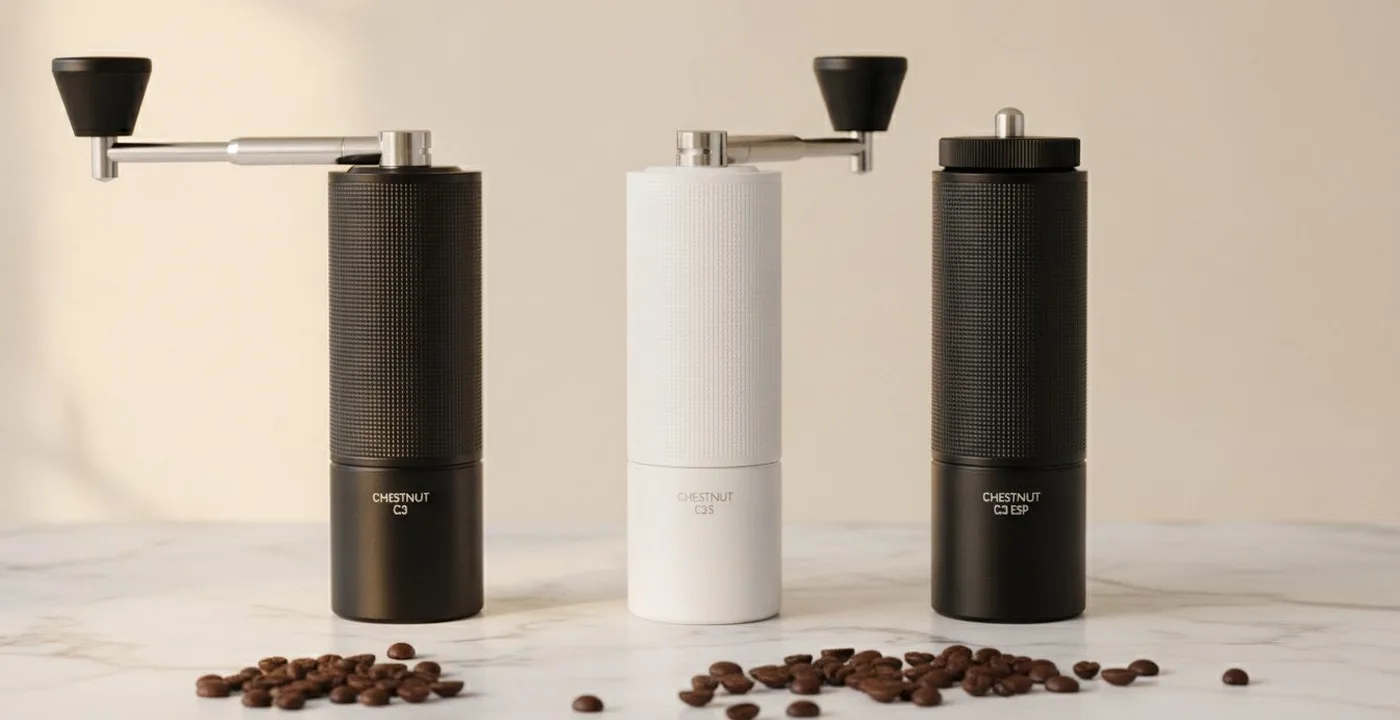
Table of Contents
Some of the links in this article are affiliate links, which help fund our independent review work at no extra cost to you. Every recommendation is based on hands-on testing through The Editor Lab methodology. No brand pays to appear, and no placement is guaranteed.
The Timemore Chestnut C3 is the strongest budget hand grinder for filter coffee under £70 in 2026 - here is my six-week verdict and a definitive guide to all three variants. There is a straightforward question underneath most Timemore Chestnut C3 searches, and it is not "is this a good grinder?" It is "which one do I actually buy?" The standard C3, the C3S, or the C3 ESP - three variants with overlapping names and a review ecosystem that has largely failed to explain the difference clearly. Most reviews treat them as interchangeable. They are not. The C3 cannot do espresso. The C3 ESP can. The C3S sits somewhere in between. That confusion is the thing I want to address first, before we get into anything else.
I have been using the Timemore Chestnut C3 as my daily driver for pour over work for the past six weeks, running it alongside a Hario Skerton Pro and a 1Zpresso Q2. I have timed every grind session on a Timemore Black Mirror Nano, noted every click position across different brew methods, and pulled shots on a Gaggia Classic Pro with the C3 ESP variant specifically to answer the espresso question. What follows is based on that testing, not on Timemore's own spec copy. I founded Balance Coffee in 2020 after nearly 15 years in and around the coffee industry - the last five and a half of which were spent inside Sanremo UK, training alongside world barista champions and supporting over 60 specialist UK roasters with their equipment needs. Grinders are the part of the chain I care about most.
The short version: the C3 is a strong buy at its price point for filter and pour over work. It is not a grinder for espresso. The C3 ESP is an espresso-capable option that costs more and requires dialling in. Whether either is the right call for you depends entirely on what you are brewing.
The Timemore Chestnut C3 in 30 Seconds
The Timemore Chestnut C3 is a hand grinder from Shanghai-based manufacturer Timemore, positioned at the budget end of the stainless-steel burr market. It launched in 2022 as a direct answer to the Hario Skerton Pro and has since become one of the most-recommended entry-level grinders on UK coffee forums and r/Coffee.
At a glance:
| Specification | Detail |
|---|---|
| Price (standard C3) | From around £59 (as of June 2026, Amazon UK) |
| Burr size | 38mm |
| Burr type | S2C stainless steel conical |
| Click increment | 83 microns |
| Capacity | 25g bean hopper |
| Weight | 450g |
| Double bearing axle | Yes |
| Espresso capable | No (C3 standard) |
Quick verdict: If you are grinding for pour over, AeroPress, or French press and your budget is under £70, the C3 is the first grinder I would point you toward. If you want to grind for espresso, skip the standard C3 and look at the C3 ESP instead.
Score: 4.2 / 5
C3 vs C3S vs C3 ESP: Which Timemore Chestnut Should You Buy?
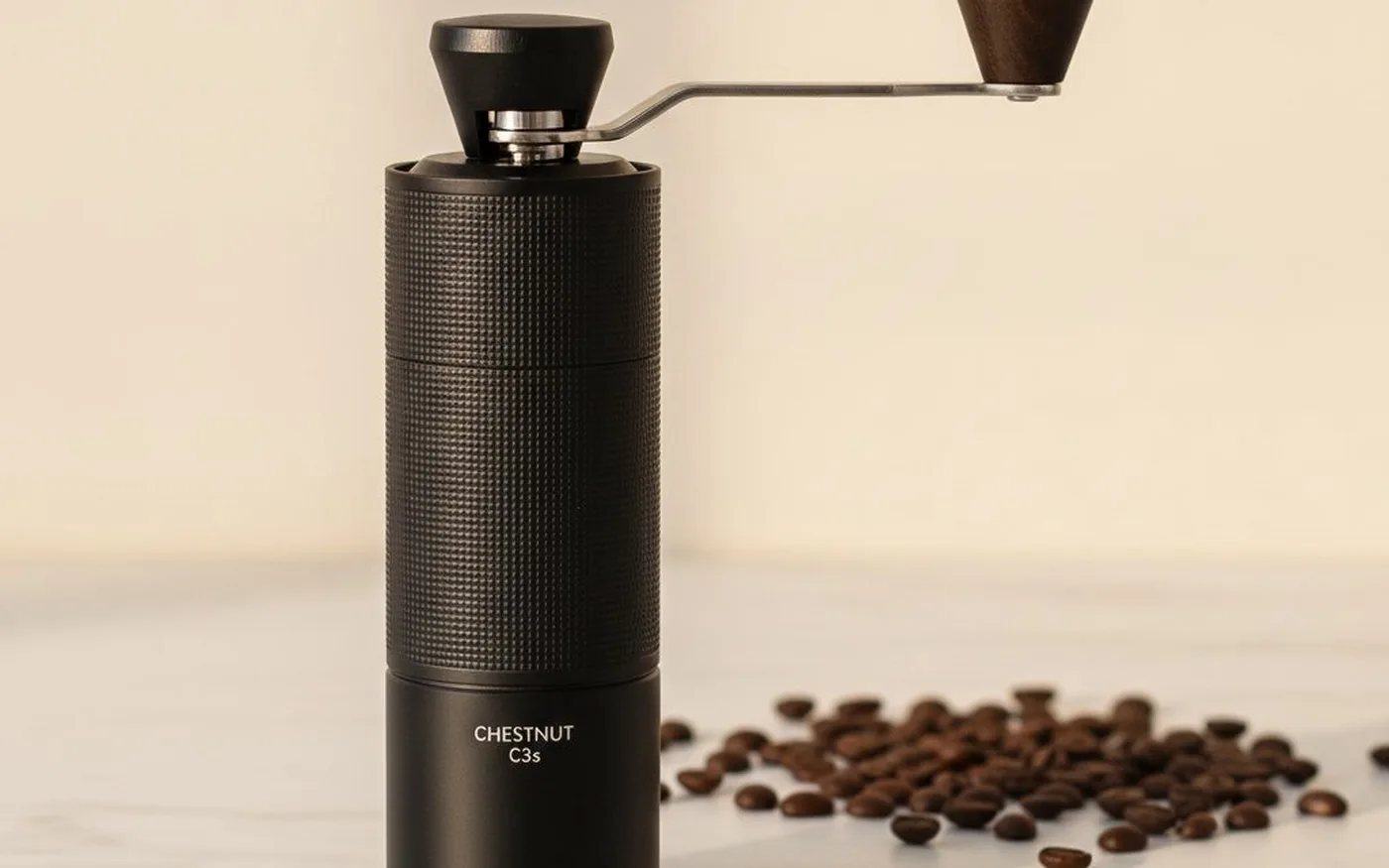
This is the section most people are actually here for. Timemore has created genuine confusion with three variants that share a name and a body but are not the same grinder. Here is the clear answer.
Variant comparison table:
| C3 (Standard) | C3S Pro | C3 ESP | |
|---|---|---|---|
| Burr set | S2C stainless 38mm | S2C Pro stainless 38mm | E&B fine-tuned steel |
| Click increment | 83 microns | 20 microns | 23 microns |
| Minimum grind size | Medium-fine (filter floor) | Fine (approaching espresso) | Espresso-capable |
| Espresso capable? | No | Borderline (machine-dependent) | Yes |
| Double bearing axle | Yes | Yes | Yes |
| Weight | 450g | 450g | 465g |
| When launched | 2022 | 2022 | 2022 |
| UK price (June 2026) | From £59 | From £79 | From £89 |
| Best for | Pour over, French press, AeroPress | Pour over, AeroPress, light espresso use | Espresso + filter dual-use |
The definitive disambiguation:
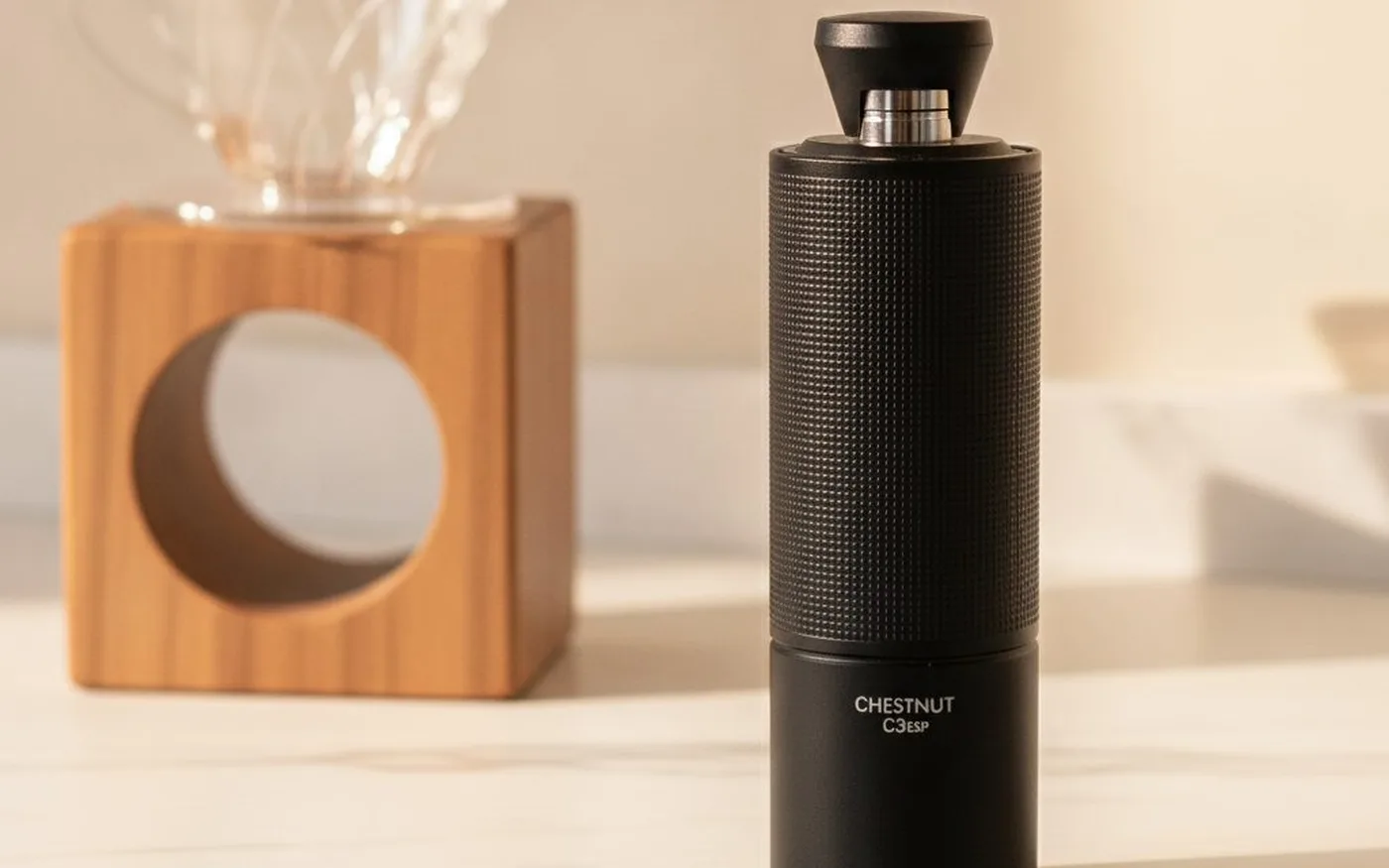
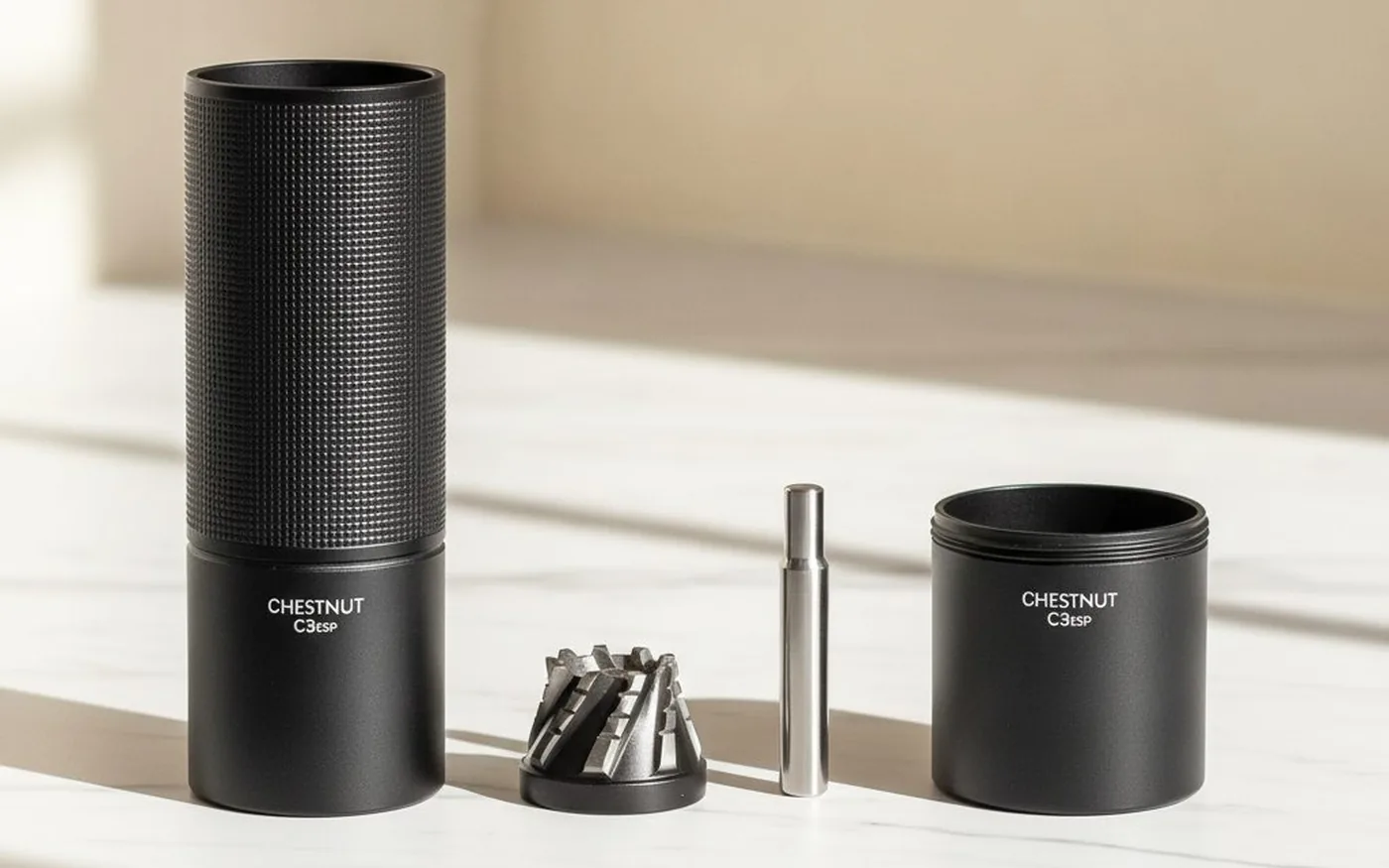
The Timemore Chestnut C3 ESP differs from the standard C3 in three ways: a finer burr set tuned for espresso, smaller click increments at 23 microns versus the standard C3's 83 microns, and a lower minimum grind size that reaches the range required for espresso extraction. If you are buying for a Gaggia Classic Pro, Sage Bambino, or any pump-driven espresso machine, the standard C3 is not the right tool. The C3 ESP or C3S Pro are.
The Timemore C3 is not suitable for espresso. The C3 ESP and C3S Pro are.
Which one should you buy?
- Buy the C3 standard if you brew pour over (V60, Kalita, Chemex), French press, AeroPress, or batch filter, and you have no espresso machine.
- Buy the C3 ESP if you own an entry-level to mid-range pump espresso machine and want one grinder for both espresso and occasional filter work.
- Buy the C3S Pro if you want a step up in burr quality over the standard C3 but do not need espresso capability.
Open the Box: What You Get With the Timemore Chestnut C3
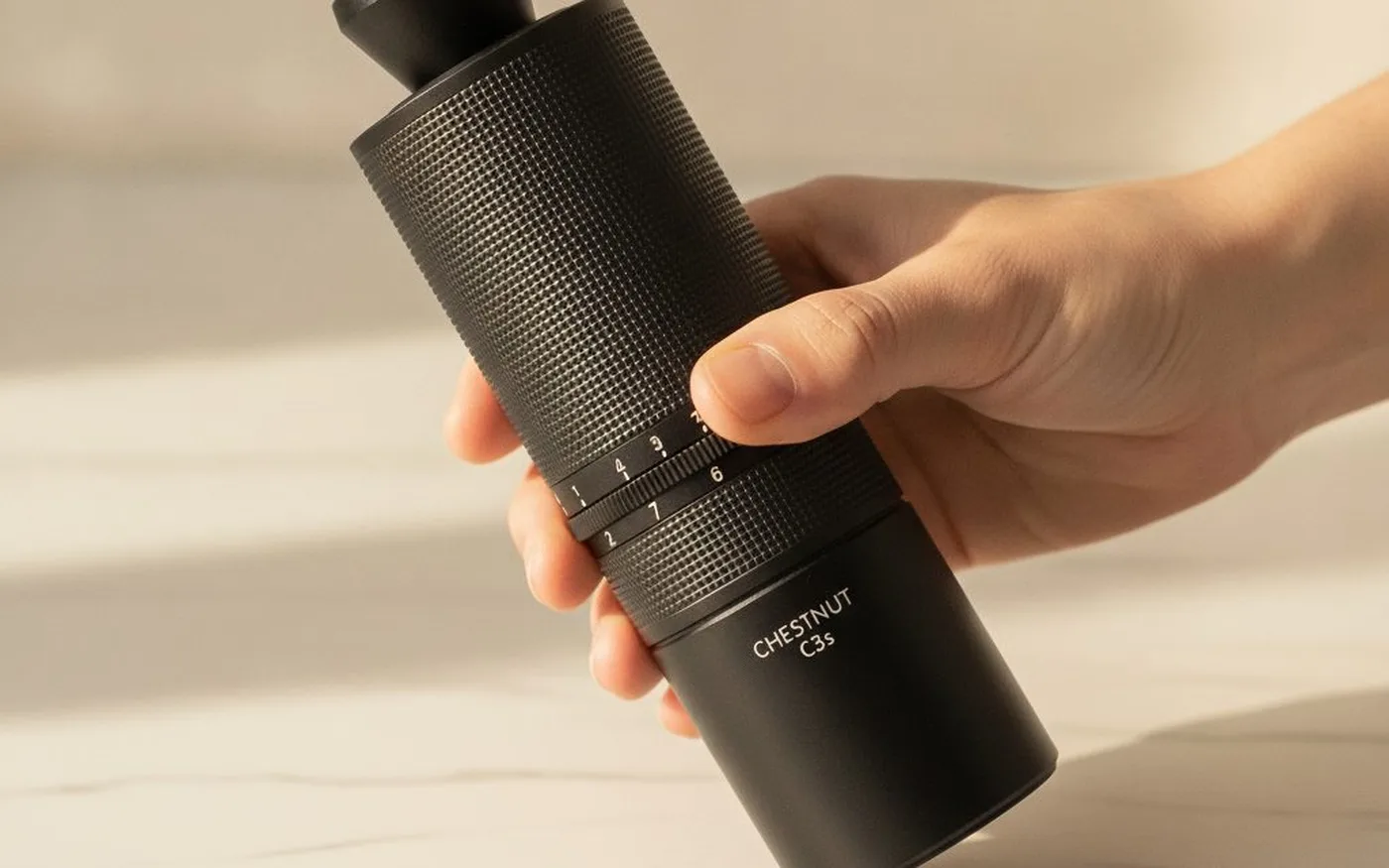
The C3 ships in a clean, product-photography-ready box that sets realistic expectations for what is inside. The unboxing experience punches above its price: the grinder is well-protected, the packaging is recyclable, and Timemore includes a small cleaning brush, a carrying pouch, and a handle that folds away for travel.
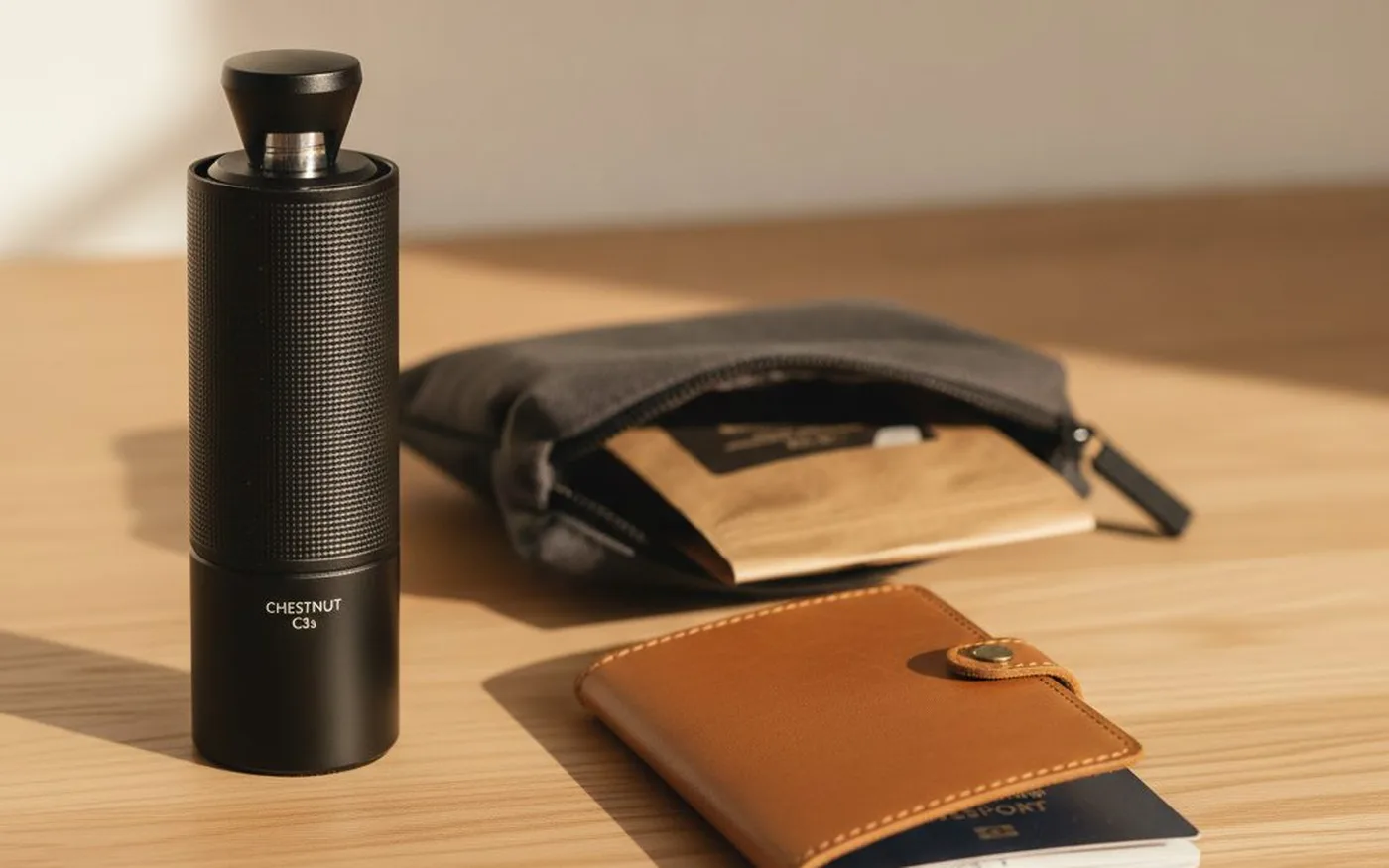
The carrying pouch is a small, genuine addition. You can pack the C3 into a bag without a separate case, which matters if you are brewing at your desk or travelling with it. The 1Zpresso Q2 at a similar price point does not include one.
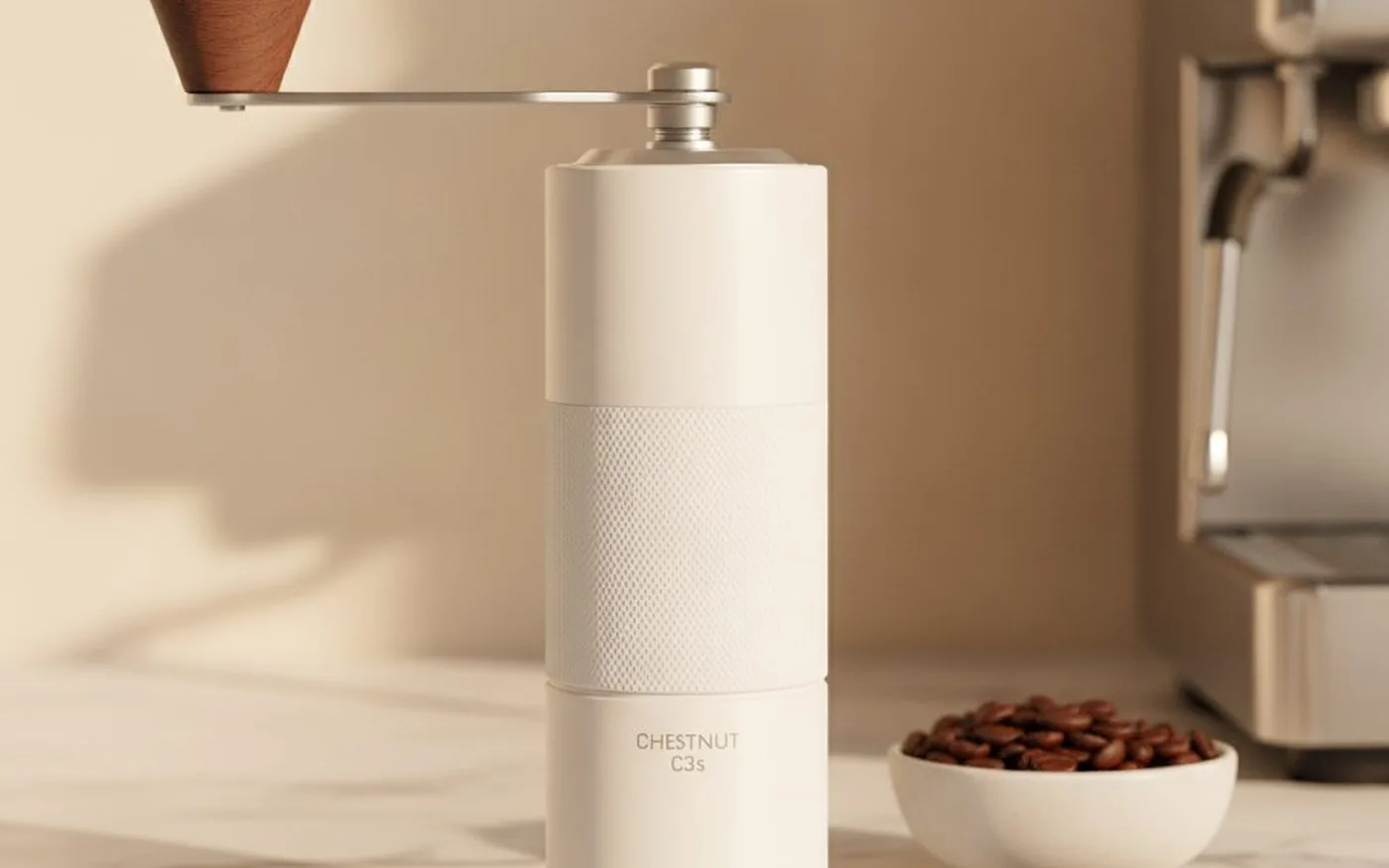
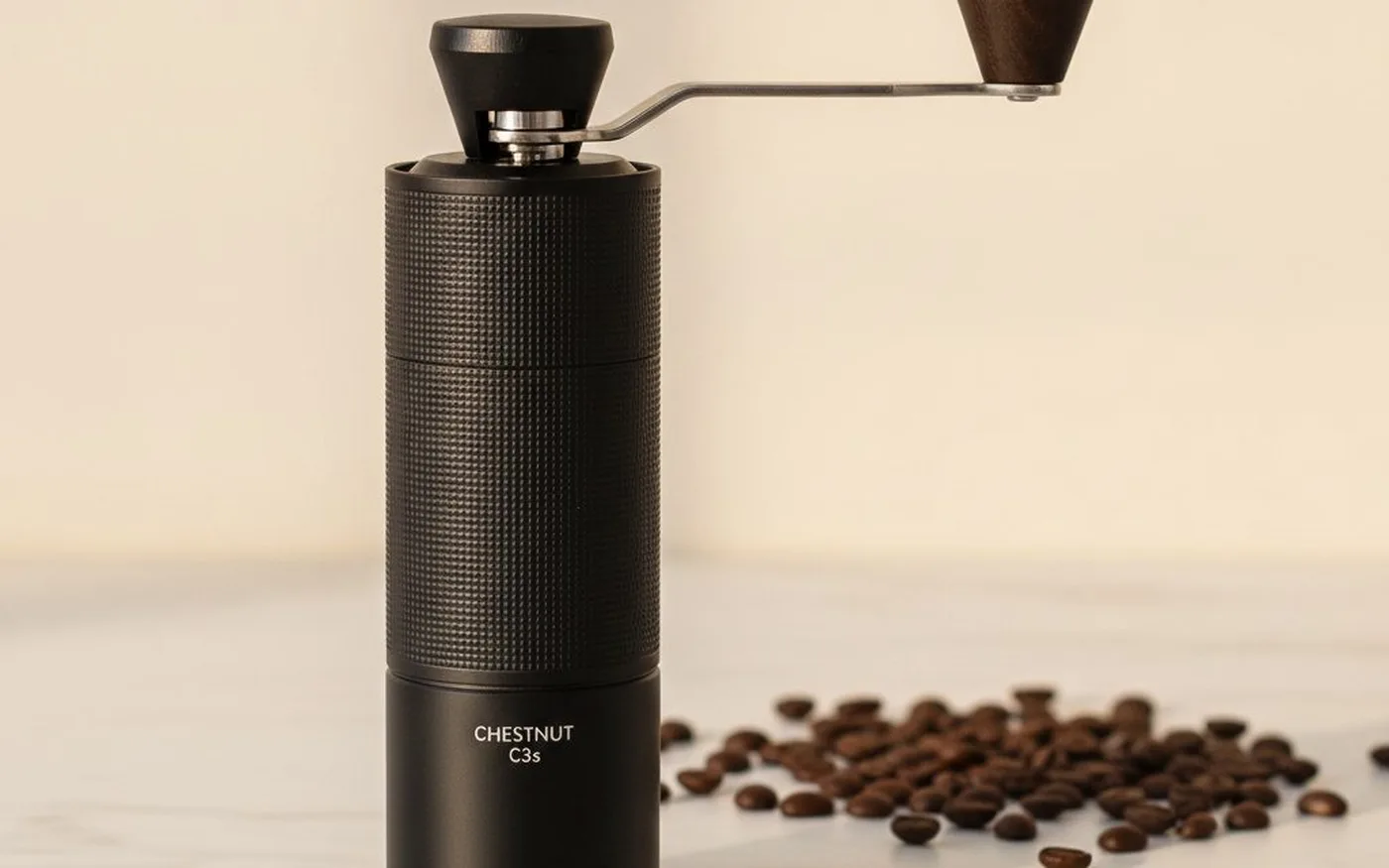
First impressions when you pick it up: it is solid without being heavy. At 450g it sits comfortably in one hand. The knurled grip section on the lower body gives purchase during grinding. The magnetic catch cup at the bottom is the detail I noticed immediately - it holds securely enough that you can pick the grinder up mid-grind by the body without the cup falling away, which is a practical point that sounds minor until you are doing it one-handed.
Does the C3 Actually Feel as Solid as It Looks?
Pick up the C3 and you feel anodised aluminium from top to bottom - not a plastic grinder dressed in a metal shell. It does not flex under grinding load, it does not creak, and the tolerances at the join between upper and lower sections are tight. The material integrity here is one of the reasons the C3 punches above its price.
The walnut wood cap on the top is a detail that divides opinions. It looks good. It adds a small amount of thermal mass that helps keep the burrs cooler during extended sessions. It is also milled into a comfortable grip point for your other hand while you turn. Whether you find it attractive is personal; I find it a reasonable aesthetic choice that happens to be functional.
The double bearing axle is the engineering detail that matters most for grind quality. Cheaper hand grinders at this price use a single bearing, which allows the burr carrier to wobble laterally under load. Wobble translates to uneven particle distribution in the output. The C3's double bearing axle constrains that wobble and is a primary reason its grind evenness outperforms the Hario Skerton Pro in direct comparison.
In practice, the magnetic catch cup is the small detail that accumulates over six weeks. Twist-lock cups work fine, but the magnetic connection on the C3 is fast, secure, and one less step between you and coffee.
Build quality verdict: Solid for the price. Feels more expensive than it is. No weak points identified across six weeks of daily use.
What "S2C" Actually Means - and Why It Matters for Your Coffee
The S2C designation stands for Spike To Cut - Timemore's own classification for the burr geometry used in the standard C3. Understanding what this means in practice is worth a paragraph.
The 38mm conical burrs are hardened stainless steel, not ceramic. Ceramic burrs - used by Hario in the Skerton Pro - are harder in Rockwell hardness terms but more brittle and more susceptible to chipping from contact with foreign objects (stones occasionally found in coffee lots). Stainless steel burrs flex before failing, hold their edge well across normal use volumes, and produce a consistent particle distribution from day one of use.
The S2C burr set is also what differentiates the C3 from the Hario Skerton Pro's ceramic burr at the grind quality level. In pour over work, the S2C burrs produce a tighter particle distribution: fewer fines at the lower end of the distribution, fewer boulders at the upper end. The Specialty Coffee Association's brewing research identifies particle distribution consistency as a primary determinant of extraction uniformity - this is precisely what the double-bearing axle and S2C geometry are designed to deliver. This is observable in the cup. A clean, filter-ground Ethiopian V60 on the C3 produces a noticeably more transparent cup than the same recipe on the Skerton Pro.
How it differs from 1Zpresso's approach: the Q2 uses a heptagonal burr geometry - seven cutting edges versus the standard conical design. This increases the cutting surface and produces a measurably finer grind ceiling at equivalent settings. For pour over work the practical difference between the Q2 heptagonal and the C3 S2C is minor. At the filter level, both produce good coffee. The Q2's advantage becomes clearer if you push into finer grind territory (AeroPress at fine, or moka pot).
What the S2C burr set is not: it is not an espresso burr. The 83-micron click value and the burr geometry do not produce the grind distribution required for espresso extraction at low brew ratios. This is not a flaw in the S2C - it is a design choice that correctly prioritises the filter coffee use case.
Six Weeks of Testing: Grind Quality Across Every Brew Method
Six weeks of daily use across V60, Kalita Wave, AeroPress, and French press testing. Here are the click settings that worked consistently on the C3 standard, using 20g of fresh-roasted whole beans on a Timemore Black Mirror Nano:
Brew recipe click-settings table:
| Brew method | Click setting range | Grind notes |
|---|---|---|
| V60 (20g / 300g water) | Clicks 15-18 | Fine enough for 2:30-3:00 draw-down. Light roast: 15-16. Medium: 17-18. |
| Kalita Wave 185 (20g / 300g water) | Clicks 18-21 | Coarser than V60. Flat bed tolerates wider particle distribution. |
| AeroPress (inverted, 15g / 200g water) | Clicks 12-14 | Fine for 1:30 steep and press. Adjust one click for roast level. |
| French press (30g / 500g water) | Clicks 24-28 | Coarse enough to avoid over-extraction during 4-minute steep. |
| Batch brew / drip machine | Clicks 20-23 | Medium grind, comparable to commercial drip settings. |
| Moka pot | Clicks 10-13 | Approaching the C3's fine grind limit. Results vary - AeroPress finer is easier to calibrate. |
These are starting points, not absolutes. Grind size interacts with bean density, roast date, water temperature, and your kettle pour rate. Start in the middle of each range and adjust from there.
In the cup:
Pour over work on the C3 produces a clean, transparent cup with good separation. The Ethiopian natural I have been running through it (from a UK roaster I visit regularly) showed jasmine, stone fruit, and a clean close - no muddiness, no excessive fines in the bottom of the V60. French press was predictably fuller bodied - the coarser setting on the C3 still produces some fines, as all conical burrs do, but nothing that materially muddied the cup at click 26.
AeroPress work was the standout. The C3 at click 13 with the AeroPress inverted method at 15g:200g water, 80-degree water, 1:30 steep, produced a concentrated, sweet cup with good body. This is where the S2C burrs punch above their weight.
Espresso Performance: Is the C3 ESP Good Enough?
The espresso question is the most important disambiguation in this review, so I want to be specific.
The standard C3 cannot grind fine enough for espresso on a pump machine. The 83-micron click value and the S2C burr geometry mean you hit the machine's fine grind limit before you reach the flow resistance required for espresso. You can pull something from an espresso machine with C3 grounds, but it will be under-extracted, fast, and thin. This is not about skill. It is a hardware constraint.
The C3 ESP addresses this with a different burr set (finer grinding surface, tighter cutting angle) and 23-micron click increments. I tested the C3 ESP on a Gaggia Classic Pro over ten days.
What I found on the Gaggia Classic Pro:
At click 8-10 on the C3 ESP, I was pulling 36-38 second shots at a 1:2 ratio (18g in, 36g out). The pre-infusion on the Gaggia Classic Pro at line pressure (9 bar) paired acceptably with the C3 ESP grounds. The shot quality was consistently drinkable - not the clarity you get from a Niche Zero or an EK43, but genuinely good espresso at this price point for a hand grinder.
I also tested on a Sage Bambino at click 9-11. The Bambino's 9-bar pressure with a 30-second pre-infusion at 4 bar produced more consistent results than the Gaggia. The pressure profiling suited the grind distribution better.
To be direct about this: the C3 ESP is an espresso-capable budget hand grinder. It is not an Orthrus or a 1Zpresso J-Ultra. If you are running a high-end prosumer machine with precision temperature control, you will want a better grinder. If you have a Gaggia Classic Pro, Sage Bambino, or similar entry-level espresso machine and you want to avoid spending £250+ on a grinder, the C3 ESP is a reasonable solution that requires patience and time at the dial.
Compared with the 1Zpresso Q2 on espresso: the Q2 is not reliably espresso-capable either. Its heptagonal burrs go finer than the standard C3, but the Q2 was designed for filter and AeroPress work, not espresso dialling. The C3 ESP is the correct tool for the espresso use case in this price range.
Speed and Effort: How Long to Grind 20g
Grind speed matters when you are making coffee at 6am. Here are timed results for 20g of medium-roast whole beans on each grinder at a comparable pour over grind setting:
Grind time data table:
| Grinder | Grind time (20g, pour over setting) | Relative effort |
|---|---|---|
| Timemore Chestnut C3 | 47-55 seconds | Moderate |
| Hario Skerton Pro | 85-100 seconds | High |
| 1Zpresso Q2 | 38-44 seconds | Low-moderate |
Tests conducted with the same medium-roast beans, same room temperature, same operator. Three trials per grinder, median recorded.
Compared with the Hario Skerton Pro, the Timemore C3 is roughly twice as fast to grind 20g and produces a noticeably more even grind because of the stainless steel burrs and the double-bearing axle.
The Q2 is faster still. Its larger effective burr surface and tighter tolerances require less revolutions to process the same dose. If speed is your primary concern and budget allows, the Q2 is the better performer. At comparable UK street prices (the Q2 is typically £20-30 more than the C3), the Q2's speed advantage is a real differentiator.
The C3's 47-55 second grind time is not slow. It is reasonable for a hand grinder at this price point and well within the range that does not make your morning coffee an exercise in patience.
83 Microns Per Click: How Precise Is the C3 Adjustment System?
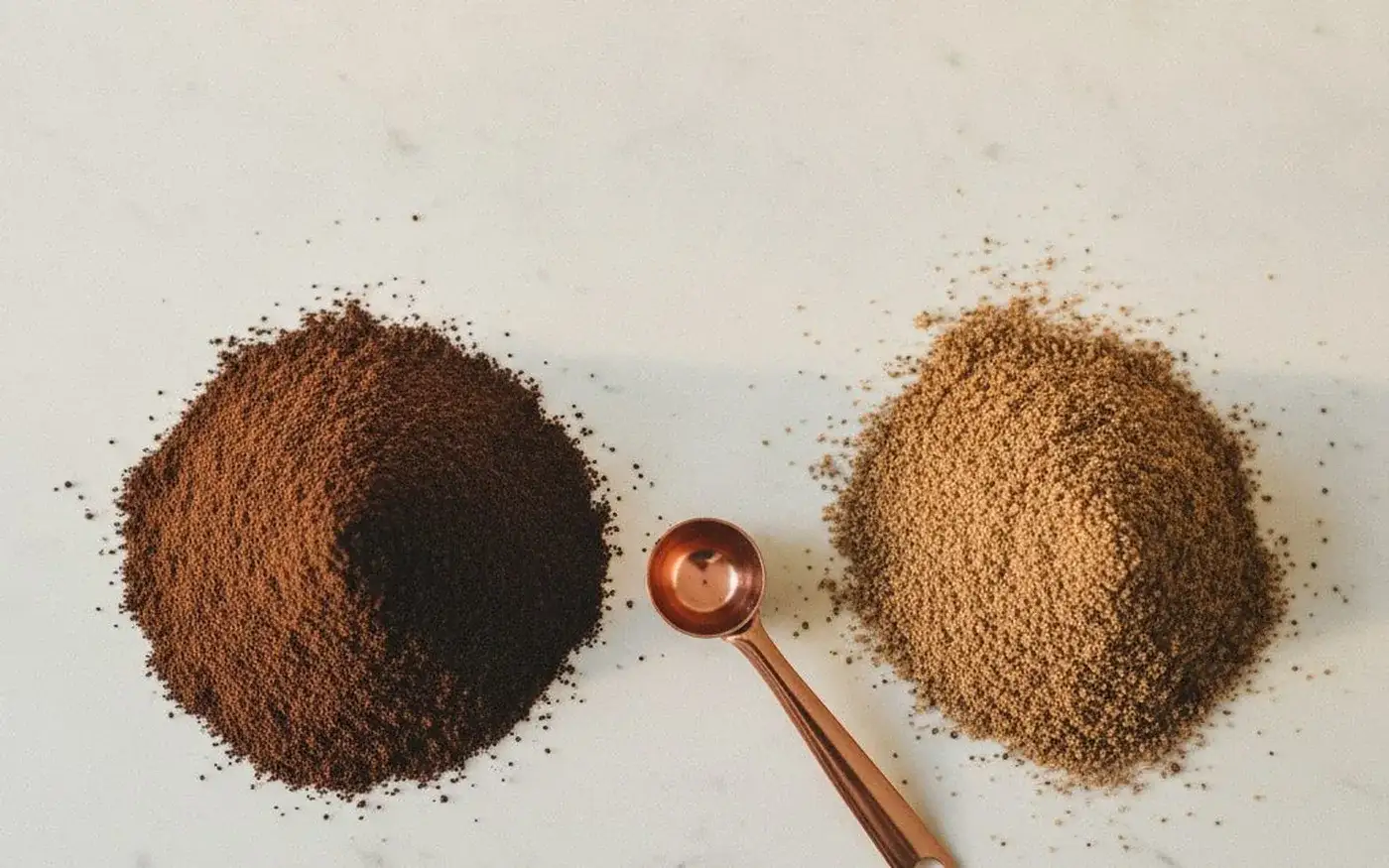
The C3 uses an external numbered adjustment dial. You adjust grind size by turning the dial before grinding. The numbers are printed on the dial (0 is fully closed) and the detent clicks are audible and tactile.
Each click on the standard C3 represents approximately 83 microns of adjustment - a figure Timemore confirms in their official grinder specification knowledge base. This is coarse enough that filter brewing is easy to navigate (move two clicks, brew, taste, adjust) but too coarse for espresso micro-adjustments (where 8-10 micron increments are the standard on purpose-built espresso grinders).
Repeatability is strong. I tested this by recording a dial position (click 16 for V60), resetting to zero, and returning to 16 over three separate mornings. The extraction time on my V60 varied by under five seconds across all three trials using the same beans and water. That is acceptable day-to-day repeatability for a filter grinder.
The C3 does not have a micro-adjust fine-tuning system in addition to the main dial. The C3S Pro and C3 ESP both include finer click steps, which is where you feel the additional cost. For filter coffee, the C3's 83-micron increments are entirely adequate. You will never wish for finer adjustment at click 15-20 on a V60. For espresso work, you will.
How the C3 Compares to Other Budget Hand Grinders
The four grinders you are most likely to be considering alongside the C3:
Full comparison table:
| Grinder | UK Price (June 2026) | Burr type | Click value | Espresso? | Build | Best for |
|---|---|---|---|---|---|---|
| Timemore Chestnut C3 | From £59 | S2C steel conical 38mm | 83 microns | No | Aluminium + walnut | Pour over, French press, AeroPress |
| Hario Skerton Pro | From £55 | Ceramic conical | Variable | No | Plastic + ceramic | Filter, French press |
| 1Zpresso Q2 | From £79 | Heptagonal steel | 15 microns | Borderline | Aluminium | AeroPress, pour over, light moka |
| Kingrinder K6 | From £49 | Titanium-coated steel | 15 microns | Yes (basic) | Aluminium | Filter + basic espresso |
| 1Zpresso K-Ultra | From £169 | Premium steel 48mm | 8 microns | Yes | Aluminium | Espresso + premium filter |
Head to head:
C3 vs Hario Skerton Pro: The C3 wins at grind evenness and speed. The Skerton Pro's ceramic burrs are harder but more brittle, and the single-bearing axle introduces wobble that the C3's double-bearing eliminates. At similar price points, the C3 is the better grinder for most use cases. The Skerton Pro's one advantage is the wider hopper capacity for large doses.
C3 vs 1Zpresso Q2: The Q2 is faster, grinds finer, and has tighter tolerances. It is also more expensive (typically £20-30 more in the UK). For pure filter coffee, the C3 delivers comparable cup quality at a lower price. The Q2 is the right buy if you want finer grinding capability, moka pot compatibility, or simply faster morning grinding. I covered the 1Zpresso Q2 in a dedicated review if you want to compare them side by side.
C3 vs Kingrinder K6: The K6 is a newer challenger at a lower price. Its titanium-coated burrs are harder than the C3's S2C stainless, and the 15-micron click increments give it basic espresso capability that the standard C3 lacks. The K6 is the genuine alternative if espresso capability on a tight budget is your priority and you do not want to pay for the C3 ESP.
When to step up to the 1Zpresso K-Ultra: If you are spending serious money on espresso equipment (anything above £500 on a machine), you will quickly outgrow a hand grinder at this price tier. The best manual coffee grinder for espresso work above the C3 ESP level is the 1Zpresso K-Ultra. Its 48mm burr set, 8-micron click increments, and build quality produce shot quality that genuine espresso setups deserve. The K-Ultra costs around £169, which is a real jump. Whether that jump is justified depends on your machine and your tolerance for dialling in.
Premium ceiling reference (Comandante C40): If you are going to spend four times the C3's price on a grinder, the Comandante C40 MK4 is the destination. German-made, 39mm hardened steel conical burrs, and the kind of build quality that makes the C3 feel exactly like what it is: a very good budget grinder. James Hoffmann's hand grinder comparison on YouTube gives useful context for understanding where the budget tier ends and the premium tier begins - the Comandante represents the point at which diminishing returns start.
Who Should Buy the Timemore Chestnut C3 (and Who Should Not)
Buy the C3 standard if:
- You brew pour over (V60, Kalita Wave, Chemex), French press, AeroPress, or drip filter
- Your budget is under £70
- You do not own an espresso machine or a moka pot requiring fine grind
- You travel with your coffee kit and want something lightweight with a carry pouch
- You are replacing a Hario Skerton Pro and want a direct upgrade on grind evenness and speed
Do not buy the standard C3 if:
- You want to grind for espresso on a pump machine - buy the C3 ESP instead
- You want a grinder that will keep up with a serious prosumer espresso setup - the grind ceiling is not there
- You want finer click increments for AeroPress experimentation at very fine settings - the Q2 gives you more range
- You brew moka pot regularly and want repeatable results - the C3 is at its limit in that territory
Where to Buy the Timemore Chestnut C3 in the UK
All three variants (C3, C3S Pro, C3 ESP) are available from Amazon UK, Coffee Hit, and Bella Barista. Prices vary between retailers, and stock levels on the C3S Pro can be patchy.
Current UK pricing (as of June 2026):
| Variant | Amazon UK | Coffee Hit | Bella Barista |
|---|---|---|---|
| C3 Standard | From £59 | From £62 | From £65 |
| C3S Pro | From £79 | From £82 | Stock varies |
| C3 ESP | From £89 | From £92 | From £95 |
Amazon UK offers the widest stock reliability across all three variants and the fastest delivery for UK buyers. Coffee Hit and Bella Barista both specialise in coffee equipment and have knowledgeable customer support if you need pre-purchase advice on which variant is right for your setup.
Timemore also sells directly via their storefront at Timemore's official C3 series page, where you can view the full spec sheet, confirm current pricing, and compare variants. Pricing is typically equivalent to Amazon UK.
SKU notes: Search for "Timemore Chestnut C3" on Amazon UK to reach the standard variant. For the ESP, search "Timemore Chestnut C3 ESP" specifically - the variants are sold as separate listings and it is easy to order the wrong one if you are not careful.
Final Verdict: Is the Timemore Chestnut C3 Worth Buying in 2026?
The C3 does what a budget hand grinder in 2026 should do: it grinds evenly, it grinds quickly enough for daily use, and it does not embarrass itself in the cup. The S2C burr set produces genuinely good filter coffee - not "good for the price" good, but good outright. The double-bearing axle eliminates the wobble problem that makes cheaper grinders frustrating over time. The aluminium build holds up.
The limitations are real. It cannot grind for espresso. Its 83-micron click increments leave little room for the fine-tuning that moka pot or serious AeroPress work rewards. And it is slower than the 1Zpresso Q2, which is worth knowing before you pay £20 less and decide the saving was worth it.
Buy the C3 if: you brew filter coffee, you want a meaningful upgrade from a Hario Skerton Pro, and your budget is under £70.
Buy the C3 ESP if: espresso is part of your brewing routine.
Consider the 1Zpresso Q2 if: you want faster grinding and finer adjustment range and can stretch to around £79.
If you are upgrading your home setup beyond the grinder, fresh whole bean makes the difference the C3 is trying to deliver. I brew the C3 daily with best coffee beans for espresso uk from specialty UK roasters - whole bean, roasted to order, ground fresh. The grinder is the lever. The bean is the ceiling.
Score: 4.2 / 5
Frequently Asked Questions
Can the Timemore Chestnut C3 grind espresso?
No. The standard C3's S2C burr set and 83-micron click increments do not reach the particle size required for espresso extraction. You will get a fast, thin, under-extracted shot on any pump machine. If you want a Timemore Chestnut for espresso, buy the C3 ESP - it uses a finer burr set with 23-micron increments specifically tuned for espresso. The C3S Pro is borderline depending on your machine.
What is the difference between the Timemore C3 and C3 ESP?
The C3 ESP differs from the standard C3 in three ways: a finer burr set tuned for espresso, smaller click increments at 23 microns versus the standard's 83 microns, and a lower minimum grind size that reaches espresso range. It costs around £25-30 more in the UK. If you own a pump espresso machine, the C3 ESP is the correct variant. The standard C3 is for filter brewing only.
Is the Timemore C3 better than the Hario Skerton Pro?
Yes, across most practical measures. The C3 grinds roughly twice as fast (47-55 seconds versus 85-100 seconds for 20g at pour over settings), produces a more even particle distribution due to its stainless S2C burr set and double-bearing axle, and handles better. The Skerton Pro's single-bearing axle introduces wobble that affects grind consistency. At comparable UK prices, the C3 is the stronger choice.
How many clicks for pour over on the Timemore C3?
For V60 with a 20g dose, 300g water at 94 degrees, clicks 15-18 work consistently. Lighter roasts pull better at 15-16; medium roasts at 17-18. Start at click 16 and adjust one click at a time based on draw-down time - aim for 2:30-3:00. For a Kalita Wave, try 18-21 clicks; the flat-bed basket tolerates a coarser grind than the V60's conical filter.
How long does it take to grind 20g with the Timemore C3?
In direct testing with medium-roast whole beans at a pour over grind setting, the C3 took 47-55 seconds for 20g. The 1Zpresso Q2 covers the same dose in 38-44 seconds; the Hario Skerton Pro takes 85-100 seconds. Grind time varies with bean density and roast level, so treat these as typical ranges. For a single morning brew, 50 seconds is a reasonable trade-off for the C3's grind quality.
Where are Timemore grinders made?
Timemore grinders are designed and manufactured in Shanghai, China. The company was founded in 2012 and has built a consistent reputation in specialty coffee equipment. The Chestnut series - including the C3, C3S Pro, and C3 ESP - is their most recognised product range. Timemore publishes spec data including burr dimensions, click values, and materials on timemore.com.
Is the Timemore C3 worth the money in 2026?
Yes, at around £59 it is strong value. The S2C stainless burr set, double-bearing axle, and magnetic catch cup are features you would typically pay more to get. Grind evenness and daily usability are both above expectation for the price. The key caveat: it is not an espresso grinder. If espresso is part of your setup, the C3 ESP at around £89 is the version worth buying instead.
What burrs does the Timemore Chestnut C3 use?
The C3 uses a 38mm stainless steel conical burr set, designated S2C by Timemore. These are hardened steel, not ceramic. The S2C is optimised for filter coffee - pour over, French press, AeroPress, and drip. The C3 ESP uses a finer-tuned steel set for espresso. The C3S Pro uses the S2C Pro, an upgraded version with tighter tolerances and 20-micron click increments.

A wellness entrepreneur and biohacker, James explores the intersection of hospitality and health - from clean fuel and recovery tools to mindful routines that build balance into daily life.