Sage Barista Express Impress Review

Coffee & Wellness Writer
Most reviews call this convenient. Tamping consistency is not a minor variable. Here is who the machine is actually built for.
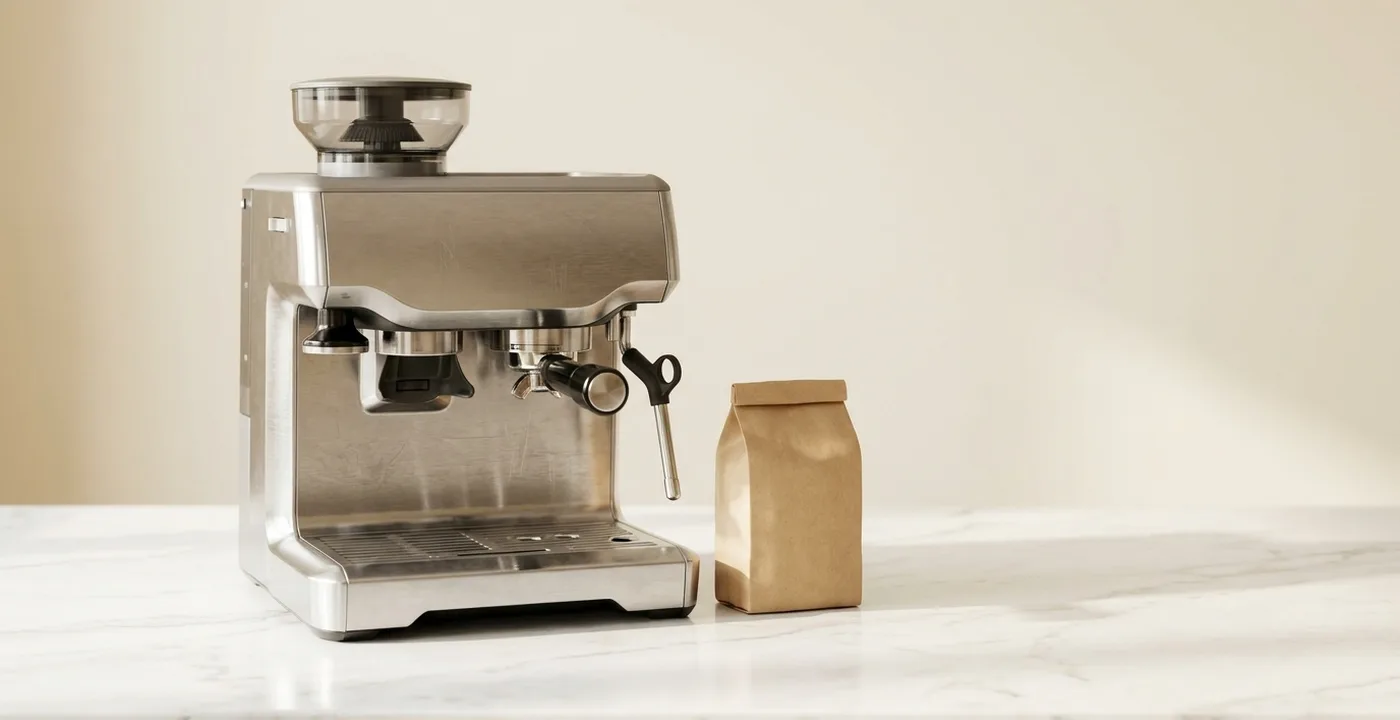
Table of Contents
Some of the links in this article are affiliate links, which help fund our independent review work at no extra cost to you. Every recommendation is based on hands-on testing through The Editor Lab methodology. No brand pays to appear, and no placement is guaranteed.
James Bellis is the Health and Wellness Editor at Balance Journal and founder of Balance Coffee. With fifteen years in the coffee industry, including a decade working with Sanremo, one of the world's leading espresso machine manufacturers, James spent years at UCC Coffee calibrating commercial espresso machines across high-volume hospitality sites. Tamping consistency was not an abstract variable in that context. It was the most common cause of shot failure he encountered, measured, and corrected. He has visited more than 60 UK roasteries, is a Forbes-featured coffee expert, and leads coffee and machine reviews through The Editor Lab.
Most machine reviews will tell you the Sage Barista Express Impress is convenient. That the assisted tamping system is a nice touch. That it takes one step out of the espresso workflow.
That framing understates what tamping consistency actually does to a shot, and it undersells who this machine is genuinely built for.
The Barista Express Impress costs approximately £100 more than the standard Barista Express. It does not have a better grinder, a better boiler, or a better build. That premium pays for one thing: a mechanism that applies consistent pressure to your coffee puck every time you dose. Sounds modest. Is not.
I calibrated commercial espresso machines at sites pulling hundreds of shots per day. Tamping variance was the single most common cause of shot inconsistency I encountered, and the least likely variable that baristas identified as the problem. The Sage Impress tamp system applies a principle from professional calibration to a home machine. Whether it justifies £100 depends on exactly who is pulling the shots.
We tested the Barista Express Impress alongside the standard Barista Express, evaluating the Impress tamp for consistency, extraction quality, and value for different types of home barista. Our Sage Barista Express review covers the standard model in full if you want the direct comparison before reading further.
Verdict: is the Sage Barista Express Impress worth it?
Yes. For the right buyer.
The Sage Barista Express Impress is a well-built, capable all-in-one espresso machine. The Impress tamp system works as described: it delivers a consistent 10kg of pressure across the coffee puck, removing tamping variance from the home espresso workflow. For a beginner who has not yet developed reliable tamp technique, that consistency is a meaningful, measurable advantage. Inconsistent tamping is the most common cause of shot failure that new espresso machine owners do not identify, because they are adjusting grind size and dose weight while assuming their tamp is fine. It often is not.
The condition on the verdict: if you already tamp with reasonable consistency, the Impress system adds nothing to your extraction quality. The grinder is the same as the standard Barista Express. The boiler is the same. The extraction potential of both machines is identical, given equivalent technique. You would be paying £100 for a feature you have already mastered.
Buy the Barista Express Impress if you are new to espresso, know your technique is inconsistent, or want to reduce the variables you are managing while you learn.
Buy the standard Barista Express if you already pull decent shots, plan to invest the budget difference in better coffee, or want to put that £100 toward a dedicated tamper and precision basket.
This is a conditional yes, not a qualified no. The machine is good. The question is whether the defining feature is relevant to you.
What the Impress tamp system actually does
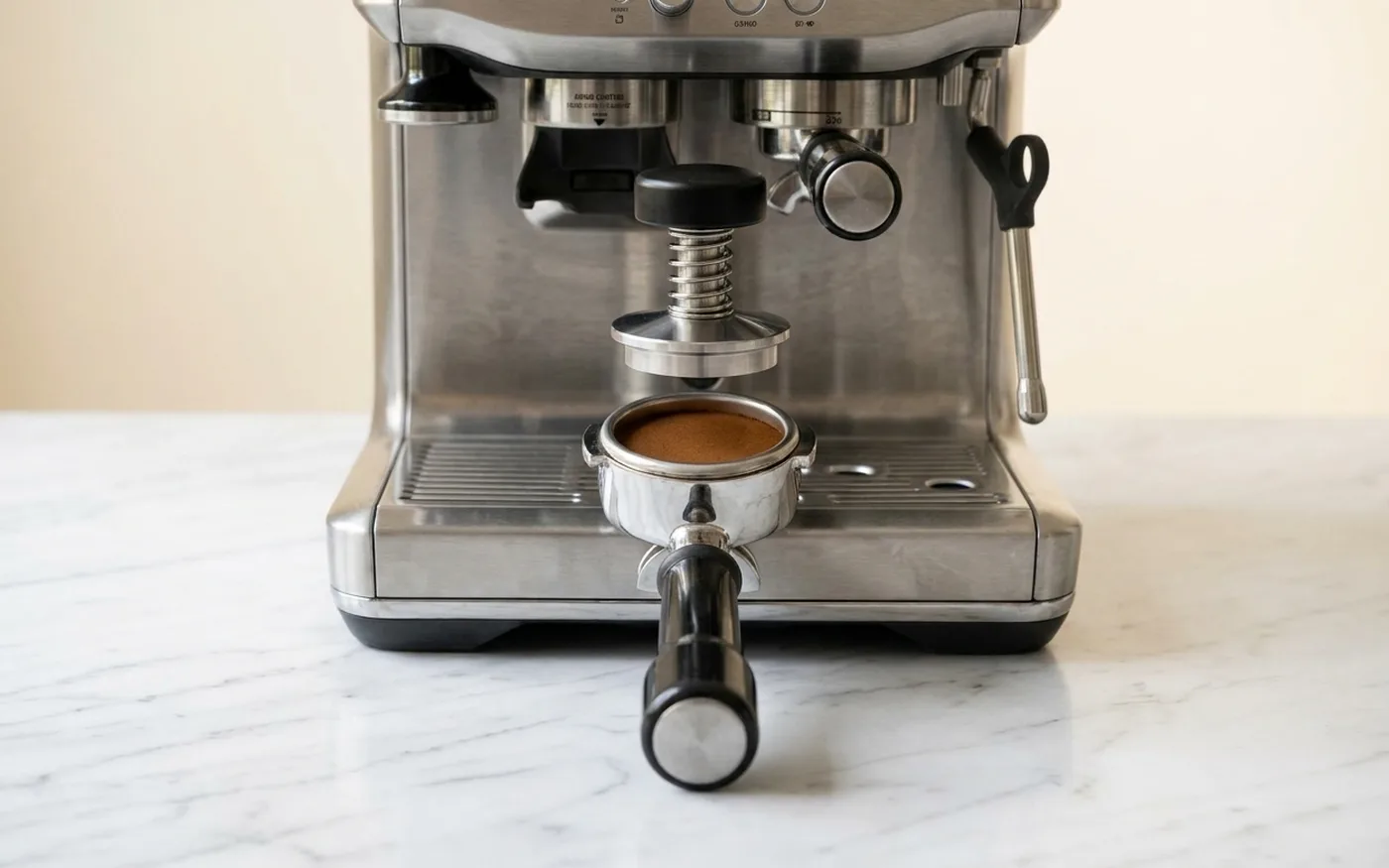
The standard espresso tamp is a manual action: you place your portafilter on a surface, press a handheld tamper into the ground coffee, and aim for consistent, level pressure across the puck. In theory, this is simple. In practice, most home baristas are not consistent. They apply different pressure on different days, at different angles, with different levels of attention. Each variation affects extraction.
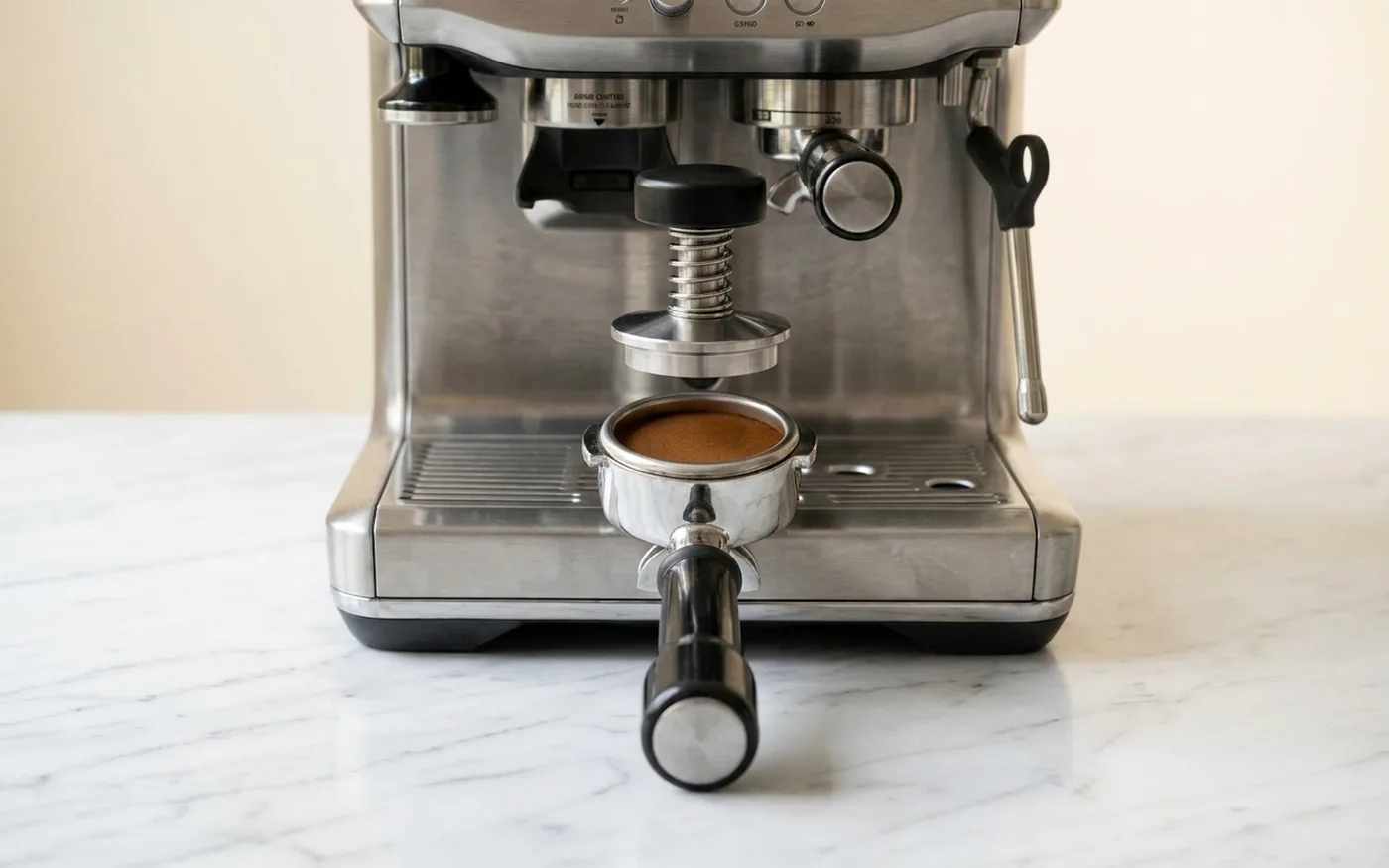
The Sage Barista Express Impress replaces this with an integrated assisted mechanism. When you dose ground coffee into the portafilter and position it under the tamp head, a spring-loaded system applies a consistent 10kg of pressure, levelled across the surface of the puck. There is no separate tamper. There is no practice required. The pressure is the same every shot.
At Sanremo, I worked alongside calibrators who measured tamping pressure as part of standard machine service protocols. The technical principle behind the Impress system is well-established: a consistent, level tamp creates even water distribution through the coffee puck during extraction. Uneven tamping creates channelling, where pressurised water finds the path of least resistance rather than extracting evenly. The result is a shot that tastes sour and bitter simultaneously, which is a diagnostic signal that most new baristas do not correctly attribute to their tamp.
The Impress system removes this variable reliably. I found the pucks consistent across multiple testing sessions. The extraction improvement versus deliberately inconsistent manual tamping was visible in yield and measurable in flavour balance.
The caveat is important. The Impress tamp removes one variable from the espresso workflow. It does not remove the learning curve on grind settings, dose weight, or extraction time. Beginners who expect the machine to auto-calibrate their espresso will still need to dial in their grind before they pull consistently good shots. The Specialty Coffee Association documents the multi-variable nature of espresso extraction. The Impress addresses the tamping variable only.
This is not a criticism of the system. It is a realistic statement of what it does. For the variable it targets, it works.
Sage Barista Express Impress: full specs
| Spec | Barista Express Impress (BES876) | Barista Express (BES875) |
|---|---|---|
| RRP (UK, 2026) | approx. £549* | approx. £449* |
| Boiler | Single thermocoil | Single thermocoil |
| Grinder | Integrated conical burr | Integrated conical burr |
| Portafilter | 54mm (Sage-specific) | 54mm (Sage-specific) |
| Tamp system | Impress assisted, consistent 10kg | Manual tamper included |
| Grind settings | 25 | 25 |
| Water tank | 2.0L | 2.0L |
| Pump pressure | 15 bar | 15 bar |
| Dimensions (approx.) | 37.5 x 34 x 40 cm | 37.5 x 34 x 40 cm |
| Warranty | 2 years | 2 years |
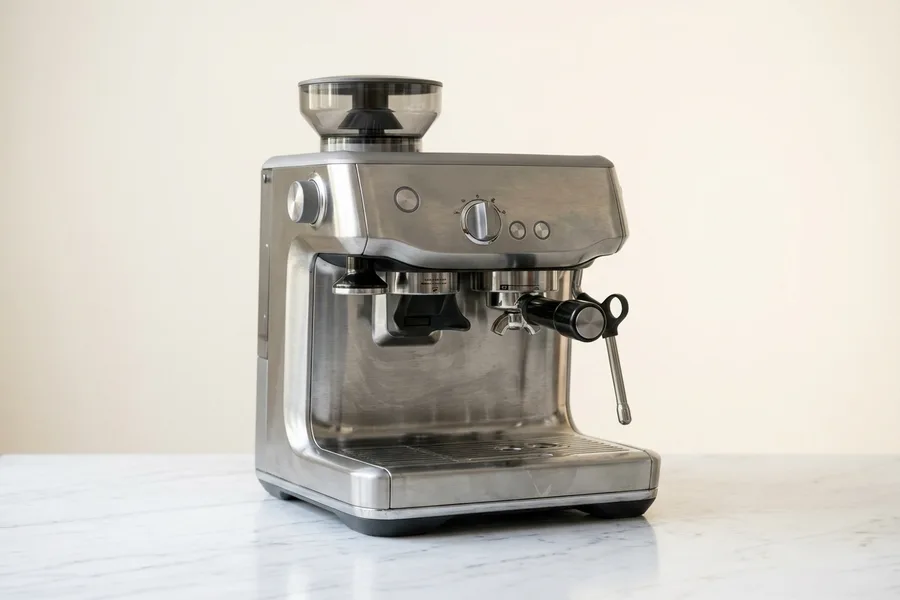
Sage Barista Express Impress (BES876)
approx. £549- + Consistent Impress tamp every shot
- + Solid stainless steel build
- + Good integrated conical burr grinder
- + Streamlined two-step workflow
- - £100 premium only justified for beginners
- - 54mm portafilter limits aftermarket upgrades
- - Grind and dose learning curve remains
Best for beginners who have not yet mastered tamping consistency.
What we liked
The tamping system delivers on its claim. Across multiple testing sessions, the Impress tamp produced consistent, level pucks. The shot-to-shot variance we measured with the Impress system was lower than with manual tamping from an inexperienced user. This is not marginal. For a beginner who does not know whether their tamp is the problem, removing that variable is a genuine advantage.
Build quality matches the price point. The Barista Express Impress is stainless steel throughout, solid on the counter, and feels like a serious piece of equipment. The Impress mechanism itself, the tamp head and spring engagement, operates cleanly and without the flimsiness that sometimes appears in assisted-mechanism designs at this price. It does not feel like a convenience compromise bolted onto a better machine.
The integrated grinder performs above expectations. An integrated conical burr grinder at this price point should not be excellent. The Barista Express grinder is better than that expectation. Grind uniformity is adequate for consistent home espresso, and the 25 grind settings give enough range to dial in most coffee. It is not comparable to a dedicated £250 to £300 single-dose grinder, and serious users will eventually want a dedicated grinder for their Sage Barista Express. But for the all-in-one format, it does the job.
The workflow is streamlined. Dose, engage tamp, lock in portafilter, pull shot. Two manual steps are removed from the standard home espresso workflow. For daily use, before 7am, that is a small but real quality-of-life improvement.
What we didn't like
The £100 premium only earns its value for specific users. The Barista Express Impress and the standard Barista Express have the same extraction potential, assuming equivalent technique. The Impress system is the only differentiator. If you already tamp with reasonable consistency, you will not pull better shots on the Impress. The premium pays for one feature that is genuinely valuable to a particular type of user, and genuinely unnecessary for another.
The 54mm portafilter limits future upgrades. The Sage portafilter is proprietary and smaller than the industry-standard 58mm used on most professional and prosumer machines. Precision baskets, bottomless portafilters, and third-party accessories exist for the 54mm Sage format, but the selection is narrow compared to what is available for 58mm groupheads. If you plan to develop your espresso setup over time and add aftermarket equipment, this is a genuine constraint. Worth weighing before purchase.
The learning curve does not disappear. The Impress tamp removes one variable. Grind setting, dose weight, and extraction time still require attention and iteration. New espresso machine owners who believe the Impress will eliminate the dialling-in process will encounter the same frustration as any new espresso machine owner. The Impress makes the process more manageable, not effortless.
Counter space is non-negotiable. At approximately 37.5 x 34 x 40cm, this machine requires meaningful counter real estate. Measure before you commit.
Barista Express Impress vs Barista Express: which should you buy?
This is the question at the centre of most searches that arrive at this review. Let me answer it directly.
Both machines share identical core architecture: the same conical burr grinder with 25 settings, the same single thermocoil boiler, the same 54mm portafilter, the same 15 bar pump, and the same stainless steel construction. The Barista Express Impress costs approximately £100 more. That £100 buys the Impress tamp system and nothing else.
The decision comes down to a single question: is your tamping consistent?
If you are new to espresso and building your technique, the answer is almost certainly no. Tamping consistency is a skill that develops with repetition, and beginners typically underestimate how much their tamp varies. The Impress system removes this variable while you develop the others. For this user, the £100 premium is justified.
If you have been pulling shots for a year or more and your espresso is already dialled in, the answer is almost certainly yes. Your tamping is consistent enough that the Impress system adds no extraction benefit. Redirect the £100 toward better coffee, a precision basket, or a quality subscription to a specialty roastery.
Our Sage Barista Express review covers the standard model in full detail, including extraction performance, grinder quality, and build assessment. A dedicated Barista Express vs Barista Express Impress comparison test is planned for Phase 2a of the Balance Journal machinery content series, with side-by-side extraction data.
The Impress is not a better machine. It is a more suitable machine for a specific user.
Who is the Barista Express Impress for?
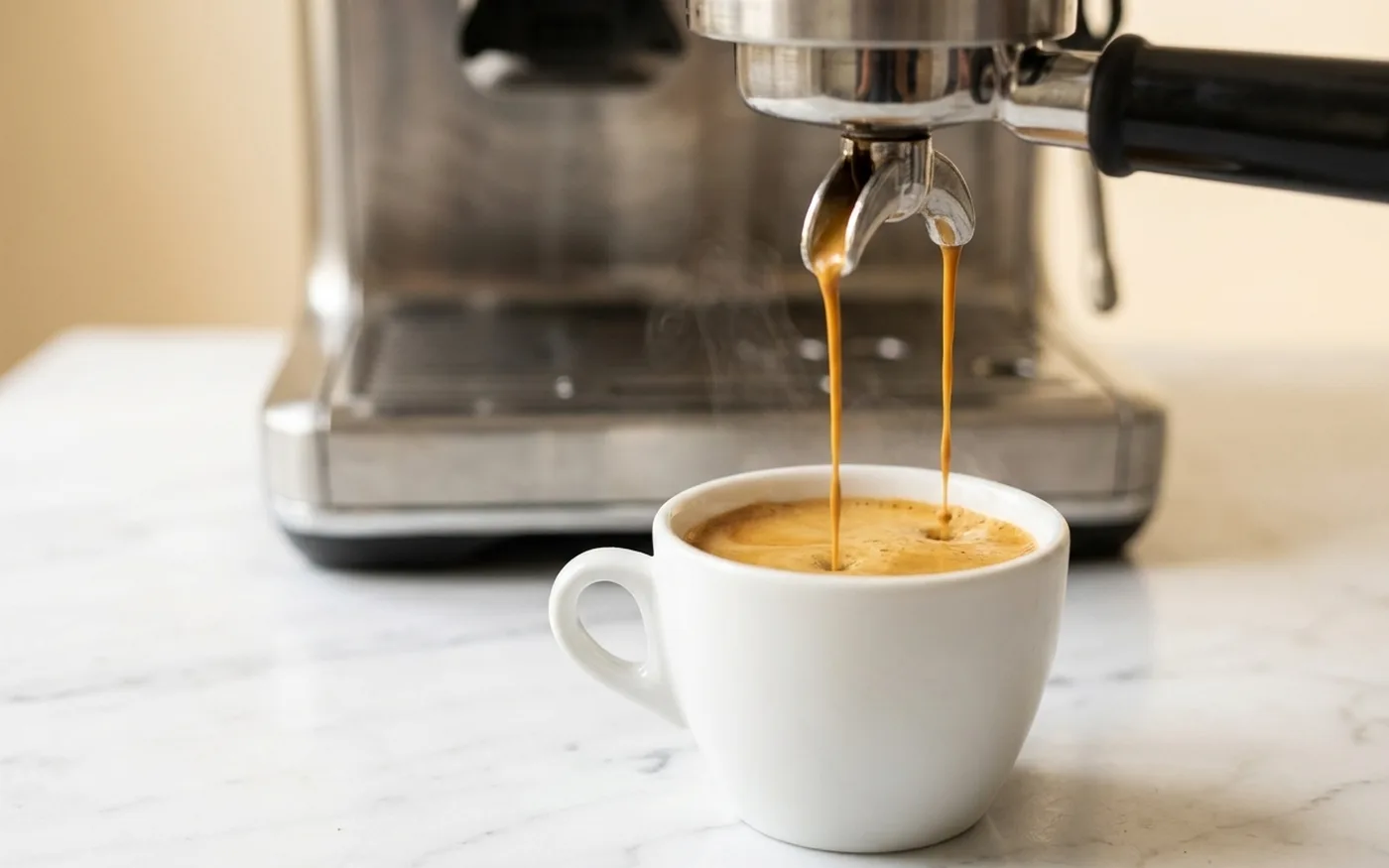
The machine suits one profile with clarity.
The new espresso machine owner who takes coffee seriously, has bought good beans, has read enough to know that extraction matters, and is smart enough to recognise that they do not yet have consistent technique. This person will benefit from the Impress tamp because it removes the variable they cannot yet control and lets them focus on grind and dose, the two dials that define extraction quality at home. The machine will teach them the right things. The tamp will not be the noise in the signal.
The machine also suits the experienced home barista who has decided that the craft element of a manual tamp is not something they prioritise. There is no shame in that. Not every morning deserves a ritual.
It is not the right machine for the experienced home barista who already tamps well and plans to upgrade their setup incrementally. A machine with a 58mm grouphead, from Sage's Pro range or a competitor at a similar price point, offers more aftermarket flexibility for the same extraction floor.
And it is not the right machine for anyone who expects the assisted tamp to make espresso easy from day one. It makes espresso easier to manage consistently. That is a different thing.
For a broader view of where the Impress sits across the full Sage range, our best Sage coffee machine UK guide ranks and compares all current Sage models. For anyone still deciding whether an all-in-one machine or a separate grinder setup is the right first step, the guide to the best espresso machine for beginners UK covers the wider category in depth.
What coffee works best with the Barista Express Impress
The Barista Express Impress is an espresso machine. It needs coffee roasted and developed for espresso: a medium to dark roast with low acidity, enough sweetness to hold up through extraction, and a structure that rewards 9-bar pressure.
The integrated grinder performs best with blends and with single origins that have been developed for espresso. Very light roasts, high-acidity naturals from Ethiopia or Kenya, can be difficult to dial in on any integrated conical grinder. If you are starting out, begin with a developed medium or medium-dark roast from a specialty roaster before moving to lighter profiles.
Our best coffee beans UK guide covers the full category in detail. For espresso-specific use on the Impress, two Balance Coffee options perform well in this format: Darkfire Energy delivers the body and dark-roast structure that espresso extraction rewards, and Cerrado Brazil brings a rounded sweetness and clean finish that works well as a daily driver. Neither is required. Any well-developed espresso roast from a quality specialty roaster will do the job.
Final verdict
The Sage Barista Express Impress is a well-made, capable machine. The Impress tamp system delivers what it claims: repeatable, consistent tamping pressure that removes a variable most beginners do not know they are getting wrong. For the right user, that is not a minor convenience feature. It is the difference between pulling frustratingly inconsistent shots and understanding what your other variables are doing.
The honest summary: this is not a universally better machine than the standard Barista Express. It is a better-suited machine for a beginner who needs help managing the tamping variable while they build their technique. For experienced home baristas who already tamp consistently, it is the same machine at a higher price.
Buy it for the right reasons. Pull better shots. Then spend the next iteration of your coffee budget on the beans that reward a machine like this.
For the full ranked comparison of every current Sage model, our best Sage coffee machine UK guide is where to start.
“The Impress tamp does what it claims. Worth the premium if you are still building your technique. Not worth it if you are already dialled in.”
Frequently Asked Questions
Is the Sage Barista Express Impress worth the extra money over the standard Barista Express?
It depends on your tamping consistency. Beginners without reliable tamp technique gain a measurable, real advantage from the Impress system. If you already tamp consistently, the extra £100 adds no extraction benefit, since the grinder, boiler, and build quality are identical across both models. The premium pays exclusively for the Impress tamp mechanism.
What does the Sage Impress tamp system actually do?
The Impress tamp is a spring-loaded mechanism built into the machine. When you dose coffee into the portafilter and position it under the tamp head, it applies a consistent 10kg of pressure across the puck every shot, regardless of technique. Consistent tamping creates even water distribution and reduces channelling. Grind settings, dose weight, and extraction time still require manual management.
Is the Sage Barista Express Impress good for beginners?
Yes, with realistic expectations. The Impress tamp removes a significant cause of inconsistency for new owners, a genuine advantage while building technique. It does not remove the full learning curve, though: grind settings, dose weight, and extraction time still require iteration. The Impress makes the process more manageable, not immediate, and suits a serious new user well.
Does the Sage Barista Express Impress portafilter fit other machines?
No. The Sage Barista Express Impress uses a 54mm portafilter specific to the Sage platform, incompatible with industry-standard 58mm groupheads on most professional and prosumer machines. Third-party accessories like precision baskets and bottomless portafilters exist in the 54mm format, but the selection is far narrower than for 58mm. Factor this in before committing if you plan aftermarket upgrades.
How many grind settings does the Sage Barista Express Impress have, and is that enough for espresso?
The Barista Express Impress has 25 grind settings. That is enough to dial in most espresso roasts at home. You will work within a narrow band for any given bag, adjusting by one or two positions as the roast ages. The range is adequate for a conical burr grinder at this price, though it is not comparable to a stepless standalone grinder for fine-grained precision.
What is the water tank size on the Sage Barista Express Impress?
The Sage Barista Express Impress has a 2.0-litre removable water tank, the same capacity as the standard Barista Express. For a household pulling two to four shots per day, the tank needs refilling every two to three days. It removes from the back of the machine for filling. A functional size for daily home use, though high-volume households will refill it more often.
Can you make lattes and flat whites with the Sage Barista Express Impress?
Yes. The Barista Express Impress includes a manual steam wand for milk texturing. With practice, it produces microfoam suitable for lattes and flat whites. The learning curve is similar to any manual steam wand at this price. Whole milk textures most reliably. Oat milk works well for latte art with practice. Skimmed milk is harder to control and less forgiving for beginners learning to steam.
How do you clean and maintain the Sage Barista Express Impress?
The Barista Express Impress has a cleaning alert system that prompts descaling and group head cleaning cycles. Sage includes a cleaning disc, tablets, and descaling powder with the machine. Weekly backflushing keeps the group head clear. The water tank and drip tray remove for rinsing. Sage recommends descaling every 200 cycles or when the alert fires. A full maintenance cycle takes around 30 minutes with no specialist tools required.
Is the Sage Barista Express Impress worth upgrading to from the standard Barista Express?
Probably not, if you already own the standard Barista Express and tamp with reasonable consistency. Both machines share identical core hardware: same grinder, boiler, portafilter, and pump. The only difference is the Impress tamp mechanism. If your shots are already dialled in, switching machines will not improve your extraction. That budget is better spent on higher-quality coffee, a precision basket, or an eventual grinder upgrade.
A wellness entrepreneur and biohacker, James explores the intersection of hospitality and health - from clean fuel and recovery tools to mindful routines that build balance into daily life.