Sage Barista Express Review

Coffee & Wellness Writer
The only machine at this price with a grinder worth discussing. But knowing its ceiling before you buy is the entire point.
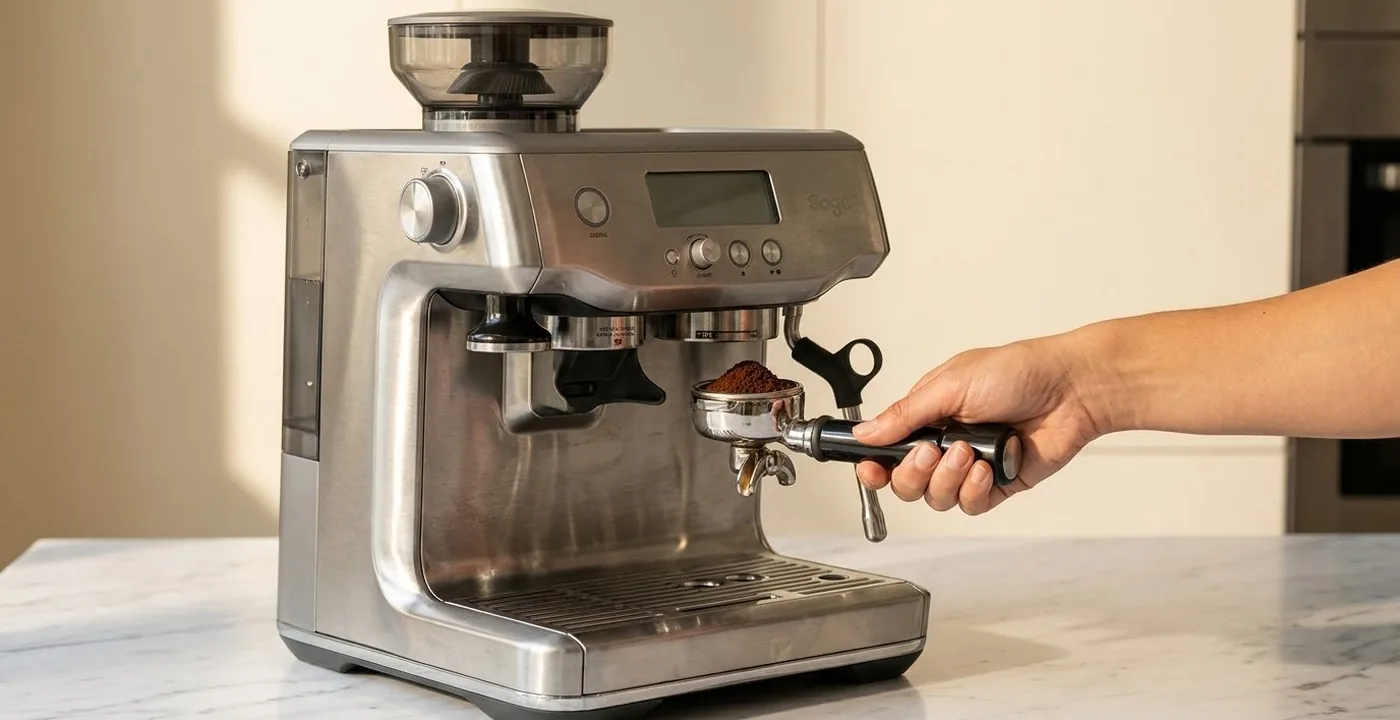
Table of Contents
Some of the links in this article are affiliate links, which help fund our independent review work at no extra cost to you. Every recommendation is based on hands-on testing through The Editor Lab methodology. No brand pays to appear, and no placement is guaranteed.
The Sage Barista Express is one machine that answers two problems at once. At £499.95 across most UK retailers in May 2026, it is the only prosumer espresso machine at this price that comes with a built-in grinder serious enough to produce genuinely good espresso. For buyers who want freshly ground coffee and café-quality shots without a separate grinder taking up counter space, it is where the conversation starts.
If you are searching for the Breville Barista Express, you have found the right machine. Sage is Breville's UK and European brand - identical hardware, different packaging depending on the market. This review covers the UK model (SES875 / BES875UK), but everything here applies equally to both names.
The one question this review answers: is the Barista Express's integrated grinder a genuine feature, or is it a compromise you will eventually work around? That question has a real answer, and it depends almost entirely on what coffee you drink.
Editor's Note
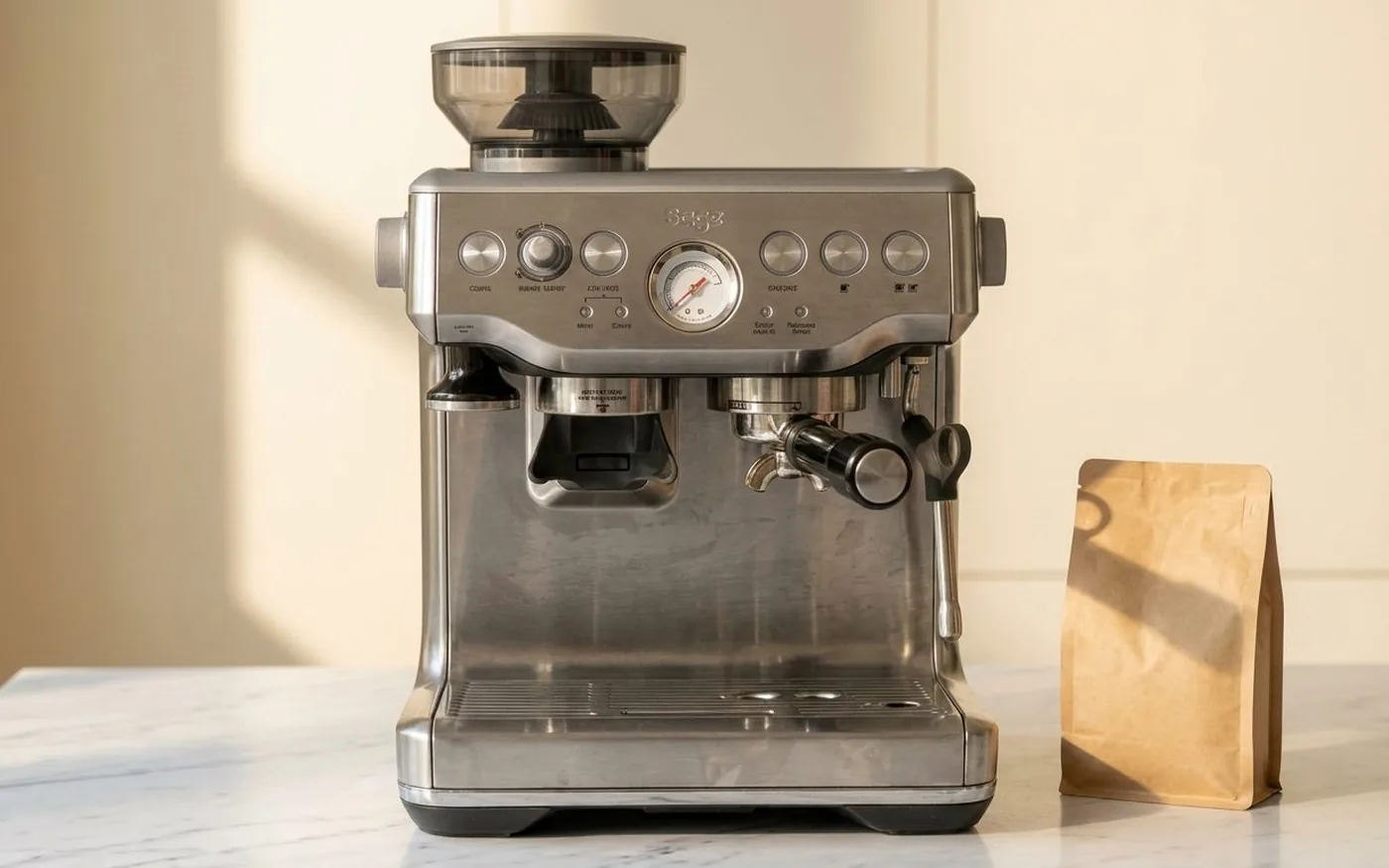
Sage Barista Express
£499.95- + Integrated grinder capable of genuine espresso quality
- + Analog pressure gauge aids dialling in
- + Consistent extraction on medium and dark roast coffee
- + Solid build quality with confident portafilter lock
- + One machine on the counter - single footprint
- - Grinder ceiling emerges with light roast specialty coffee
- - Two-hole steam wand requires 4-6 weeks to master
- - Large footprint - check counter clearance before ordering
Quick Verdict
The Barista Express is the right machine for buyers who want one device on the counter, drink medium to dark roast whole bean coffee, and are prepared to spend two to three weeks learning the machine. It is not the right choice if you drink exclusively light roast specialty coffee or already own a quality standalone grinder.
With 4.6 stars from 2,569 Amazon UK reviews as of May 2026, owner satisfaction at this price point is high, and the broad strokes of that rating are earned. The espresso hardware is strong. The analog pressure gauge - which the more expensive Barista Pro does not have - gives you real-time extraction feedback that makes dialling in noticeably more intuitive, especially in the first weeks.
The integrated conical burr grinder is capable, but it has a ceiling. For medium and dark roast whole beans, it performs well in daily use. For light roast specialty coffee - the kind most UK specialty roasters are producing in 2026 - its adjustment range and particle distribution start to show limits within a few months. Whether that ceiling matters depends on what you drink, and the Grinder section below covers exactly what you are trading off.
Buy it if: one machine on the counter, medium to dark roast, happy to dial in. Look at alternatives if: light roast specialty only, maximum grinder flexibility required, or you already own a good grinder.
Sage Barista Express vs Breville Barista Express: Same Machine
The Sage Barista Express and the Breville Barista Express are the same machine. Sage is Breville's UK and European brand - the same parent company produces both, and the hardware shares identical design, components, and performance specifications. If you see both names while comparing retailers, or if a search for the Breville Barista Express has landed you here, you are looking at one product.
The model code is consistent: SES875 in most of Sage's UK documentation, BES875UK on the product packaging and some retailer listings. The Breville name appears in the US, Canada, and Australia. In the UK and across Europe, the same machines are sold under the Sage Appliances name. It has nothing to do with product quality or specifications.
For all specification purposes, this review references Sage Appliances UK. If you are reading from outside the UK, the Breville Barista Express is the same machine at equivalent pricing in your local currency.
What the Barista Express Gets Right
The espresso hardware at this price is strong, and the 4.6-star average from 2,569 Amazon UK reviews reflects that consistently. Across both owner feedback and hands-on evaluation, the same things earn the machine its reputation.
Extraction quality is the foundation. The Barista Express uses 9-bar extraction pressure and PID temperature control to produce consistent, repeatable shots. On medium roast whole beans - the primary use case this machine is built for - the espresso quality is genuinely good. Not 'good for a home machine' good. Just good: consistent enough that comparing it against most UK coffee shop shots is not a fair fight, and not in the shop's favour.
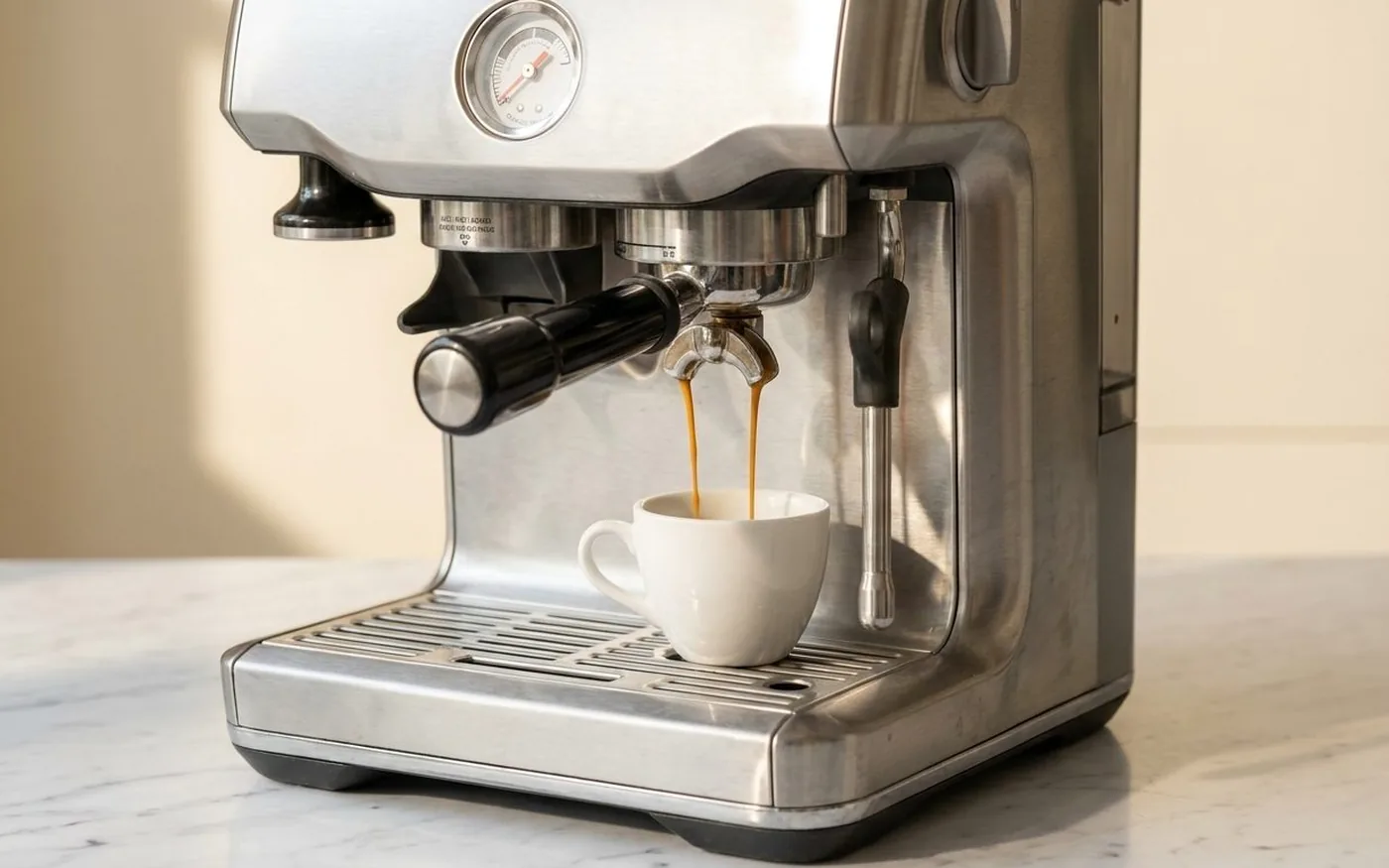
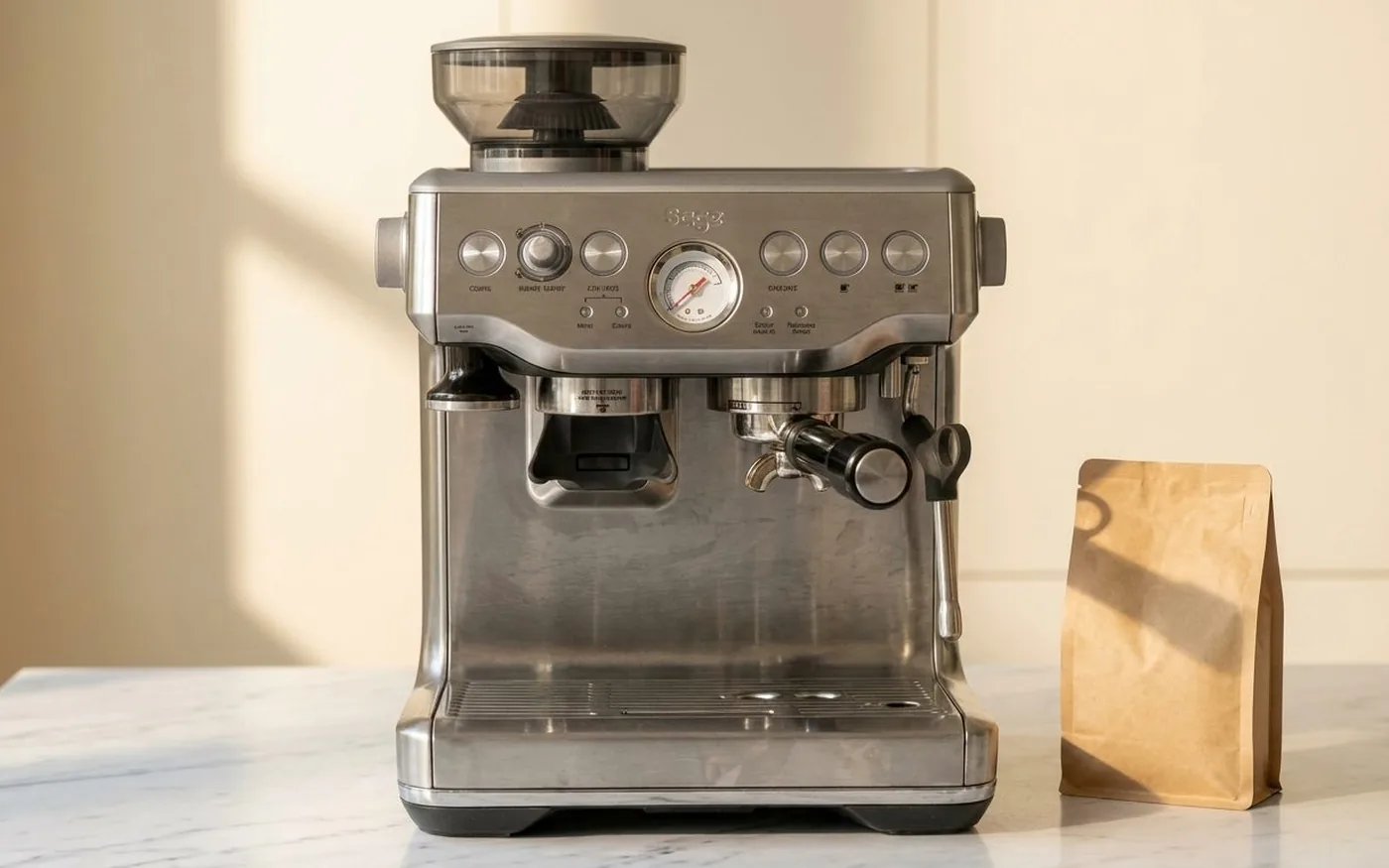
The pressure gauge is worth specific attention, because it sets the Barista Express apart from the more expensive sage barista pro review in a way that surprises most buyers. The Barista Pro has no analog pressure gauge - you dial in by shot time and taste. The Barista Express has one, and for home baristas working through the dialling-in process, you get an immediate visual signal when extraction pressure is outside the correct range. That feedback loop makes the learning process noticeably faster in the early weeks.
Build quality holds up in daily use. The stainless steel exterior feels solid, the portafilter locks in with a confident click, and the integrated bean hopper holds approximately 250g - enough for three to five days of use in a two-person household before refilling. The 2L water tank removes easily from the back for filling.
One thing worth checking before you order: the Barista Express is larger than it appears in product photographs. Verify your counter depth and the clearance between your counter and the underside of any wall cabinets. The grinder mechanism adds height, and a tight cabinet-to-counter gap will make loading beans awkward daily.
The Grinder: Where It Gets Complicated
Where does the Barista Express's integrated conical burr grinder actually fall short? The answer is specific, and it matters for what you drink.
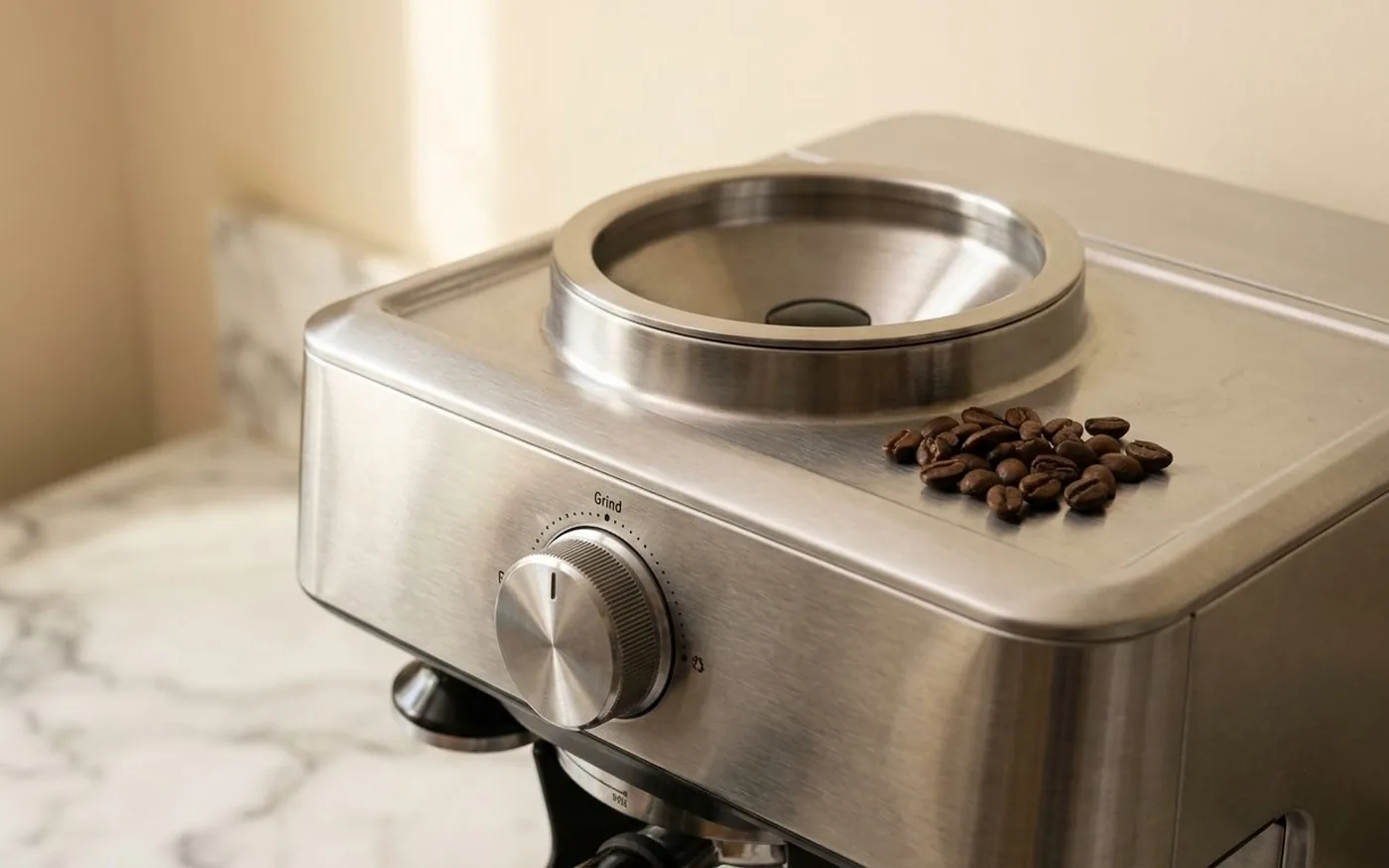
The grinder has 16 main settings plus micro-adjustment positions between each step. For medium and dark roast whole beans, this range is adequate for daily use. You will find a setting that produces a well-extracted shot, it will stay consistent across a bag of the same beans, and for most morning routines, it simply works. The Specialty Coffee Association's espresso brewing standards define correct extraction at 18-23g dose, 25-35 second extraction time, and 9 bar of pressure - and the Barista Express hits those parameters reliably on medium roast coffee.
The limitation emerges on light roast specialty coffee. Light roasts require finer grind settings and tighter particle distribution to extract correctly. If you are grinding a light roast Ethiopian natural or a Kenyan washed coffee, you need a grinder that can make small, precise adjustments across a wide fine range - and you need the burr geometry to produce an even particle distribution. The Barista Express's conical burr design at this price optimises for convenience and consistency on mainstream roast profiles. The step increments are wide enough that some light roast beans will sit between ideal settings rather than at one. You can micro-adjust, but the range is limited.
At Sanremo, working alongside the SWAT team - Sasa Sestic (2015 World Barista Champion) and Maxwell Colonna-Dashwood (three-time UK Barista Champion) among others - extraction precision was calibrated to single-gram doses and fraction-of-a-second shot times. That level of precision requires a standalone grinder with far more adjustment resolution than any integrated machine at this price offers. For home use, you do not need that level. But if you are buying whole beans from a specialty roaster and paying premium prices for the kind of coffee most UK specialty roasters are producing in 2026, you will feel the Barista Express's limits within a few months.
The practical verdict: medium to dark roast - the integrated grinder does the job well. Light roast specialty only - a sage bambino vs bambino plus machine paired with a standalone grinder at £130-150 will produce better results at a similar total cost.
The beans you pair with this machine also make a real difference to what you extract. Using specialty-grade whole beans from a quality UK roaster produces noticeably better results through the Barista Express's grinder than supermarket blends ground at inconsistent particle sizes.
Balance Coffee is the editor's own brand. It is mentioned here because bean quality directly affects how an integrated grinder machine performs - not because of commercial interest.
The Steam Wand
If you make flat whites and lattes every morning, the steam wand section is the one to read with full attention.
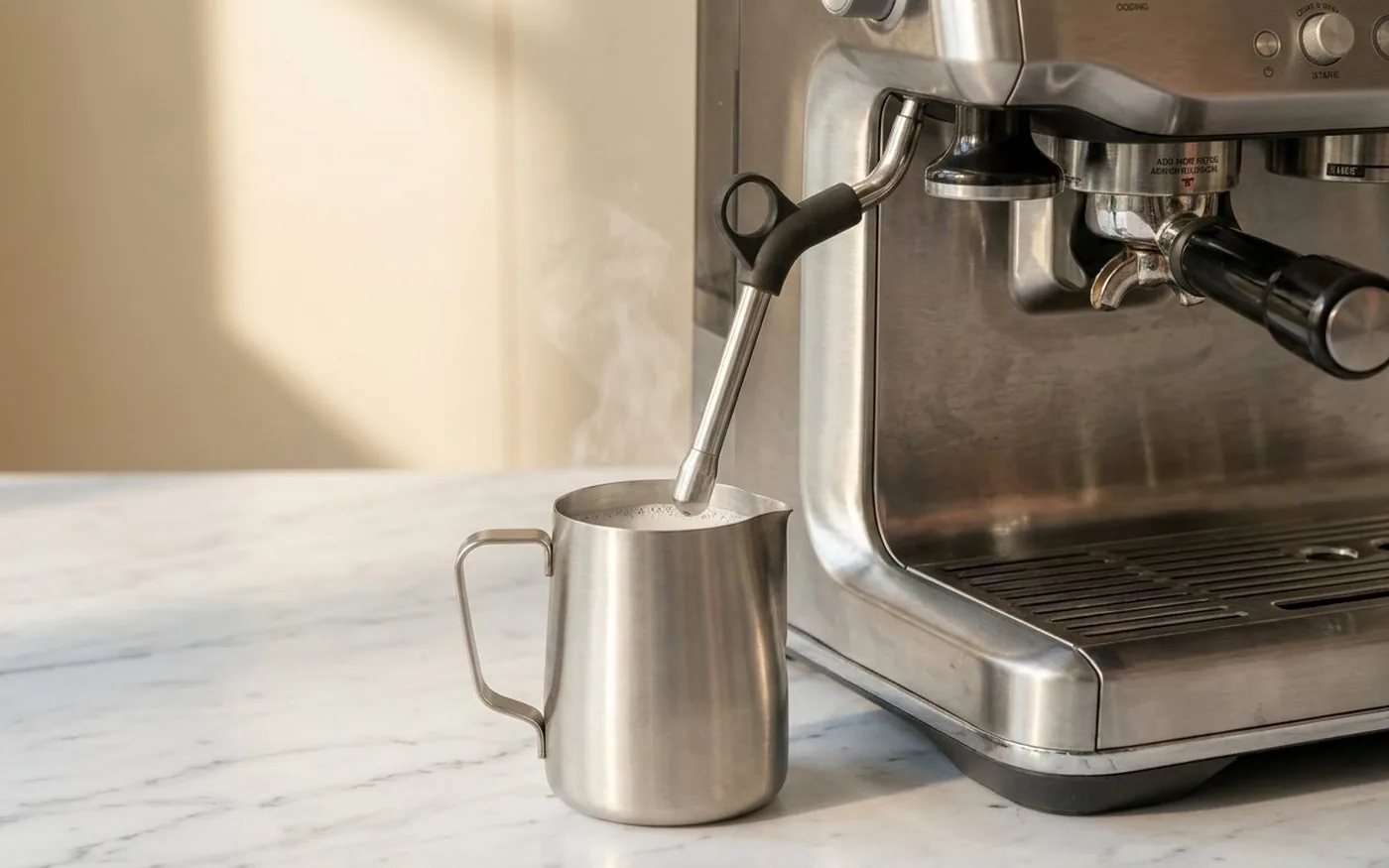
The Barista Express has a manual 2-hole steam wand. Two holes, not the four-hole tip on the more expensive Barista Pro. In practice, you will notice the difference in how long microfoam takes to develop and in the patience the process requires. A 2-hole tip produces steam at lower velocity than a 4-hole, which means you need to keep the wand in position slightly longer and move the pitcher more deliberately to build the rolling vortex that produces properly textured milk.
At Sanremo, I worked on commercial machines - the Sanremo Opera, La Marzocco, Victoria Arduino Eagle - where steam pressure is high enough that microfoam develops quickly and the margin for error is wide. The Barista Express steam wand does not operate at commercial steam pressure. The skill develops more slowly on a domestic machine, and the feedback loop takes longer. Most people making milk drinks at home take four to six weeks of daily practice before the texture is consistently what they intended. That is not a complaint about the machine. It is the honest context most reviews skip. The steam wand on the Barista Express does produce good microfoam - you just need to commit the time. If you want consistent results from the first morning without that learning curve, the sage bambino vs bambino plus with its automatic steam wand is the more practical choice.
One plant milk note: if you use oat milk, use a barista-edition product - Oatly Barista, Alpro Barista, or equivalent. Standard supermarket oat milk lacks the protein content to foam adequately on any steam wand at this pressure level.
The Learning Curve
Dialling in a new espresso machine is a real process, but it is not as daunting as espresso forums can make it sound. Your first two weeks with the Barista Express involve finding the grind setting that works for your beans, calibrating the dose, and learning to read the pressure gauge during extraction.
At Sanremo, calibrating machines to new beans was part of the standard routine - not a problem to solve once, but a process to follow each time you switched coffee. The Barista Express gives you the same process at home. When the pressure gauge reads outside the espresso zone during extraction, you know immediately whether you need to go finer or coarser - that feedback makes the process significantly faster than machines without one.
For most buyers, the dialling-in process stabilises within two weeks. Once you have found your setting, you will only need to re-dial when you switch to a different coffee. That is a one-adjustment-per-bag rhythm, not an ongoing burden.
How Long Will It Last?
Across Amazon UK owner reviews and Reddit r/espresso discussions, the Barista Express has a consistently positive reliability record for a semi-automatic machine at this price. A 5-7 year lifespan with proper maintenance is a reasonable expectation, based on how comparable semi-automatic machines in this category perform over time.
Two maintenance tasks drive most of that longevity. Descaling every two to three months is the primary one - if you are in a hard-water area (most of the UK), scale build-up inside the thermoblock affects extraction temperature and eventually damages internal components. The machine will alert you when descaling is due. Do not ignore the alert.
The portafilter gasket needs replacing at around two to three years of daily use. It is a £5-10 part and a ten-minute replacement. You will know it is due when shots start channelling inconsistently or you notice water seeping around the portafilter seal during extraction. Both are easy to catch before they become a larger problem.
Common Problems (and What to Do)
Most of the problems that come up in Barista Express ownership fall into three categories, and none of them is a defect - they are normal maintenance requirements for a semi-automatic machine in daily use.
Group head water flow blocks are the most commonly reported fault in owner feedback. You will notice it as a slow or stopped flow when you begin extraction. The fix is straightforward: backflush the machine using the cleaning disc and a small amount of espresso machine cleaner. If you do this once a week as a matter of routine, you will not encounter the block as an actual problem.
Grinder clogs happen when heavily oiled beans or very fine settings cause ground coffee to compact inside the burr mechanism. The Barista Express's integrated grinder is not designed for the kind of visibly oily dark roast espresso beans you sometimes see. Sticking to medium and light roast beans - which also happen to produce better extraction quality - prevents most clog issues. If you do get a clog, the cleaning disc and brush kit supplied with the machine sorts it.
Descale alert frequency can feel excessive in hard-water areas. If you are in London or the Midlands, your machine will alert more often than in softer-water regions. Using the best descaler for Sage machines — rather than a generic alternative — keeps the boiler clear without voiding the warranty. Set the water hardness correctly during initial setup - use a water hardness test strip rather than guessing - and the alert frequency will match your actual scale accumulation.
Sage Barista Express vs the Alternatives
The comparison most buyers land on is the sage bambino vs bambino plus paired with a standalone grinder. Here is the honest version of that trade-off.
A Bambino Plus at £399.95 plus a Sage Smart Grinder Pro at around £200 puts you at approximately £600 total - around £100 more than the Barista Express. For that extra £100, you get two machines on the counter, a noticeably better standalone grinder (40 settings, more consistent particle distribution), and the Bambino Plus's automatic steam wand, which produces technically correct microfoam with no technique required. What you give up is counter simplicity and roughly £100. For light roast specialty coffee drinkers, the Bambino Plus plus a dedicated grinder is the better setup. For medium roast drinkers who want one machine, the Barista Express makes more sense.
The sage barista express vs barista express impress comparison: the Impress adds auto-dosing - the grinder doses directly into the portafilter and presses to a preset depth - and an updated grinder with improved adjustment. If you want to remove dose variability from the equation, the Sage Barista Express Impress is worth the premium. If you are comfortable dosing manually, the Express does not leave much on the table.
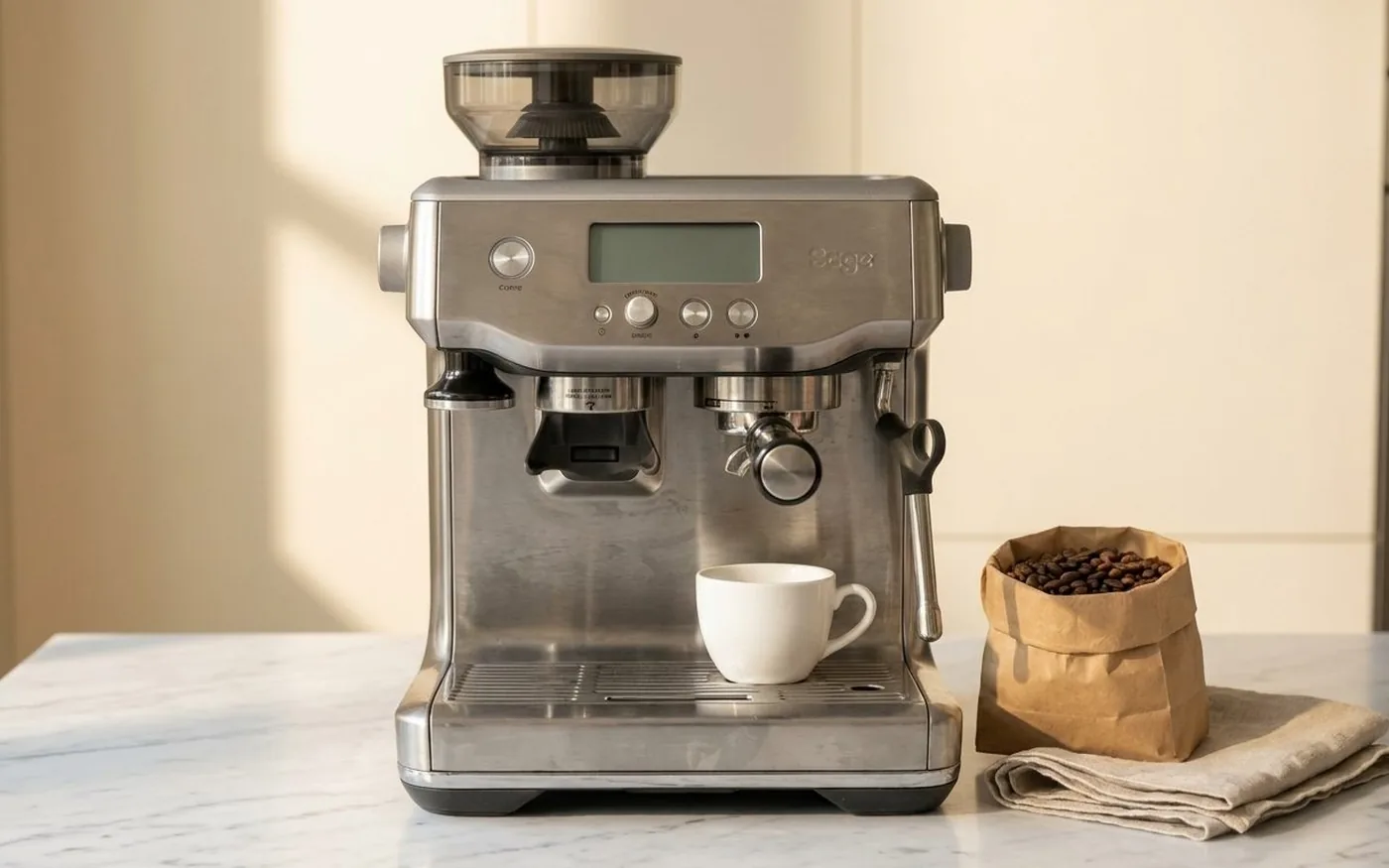
The sage barista express vs barista pro question: across nearly 300 roastery visits during my time at Sanremo, I watched this decision play out constantly - buyers weighing grinder quality against budget. The Barista Pro has 30 grind settings (versus 16 on the Express), an LCD display with a shot timer, a 4-hole steam tip for faster milk texturing, and ThermoJet 3-second heat-up. It does not have a pressure gauge. The current price gap is approximately £180-230 at UK retail (Express at £499.95, Pro at £729.95). If your budget reaches the Barista Pro, its grinder improvement and display feedback make a practical difference in daily use. If the Barista Express price bracket is your ceiling, it is a strong machine within that category - not a consolation prize.
A passing note for buyers drawn in by autocomplete searches: the Ninja Luxe Cafe has entered the integrated grinder espresso market and appears in comparison searches. It sits in a different category - filter and espresso combined - and serves a different use case. A dedicated article will cover that comparison when there is enough owner data to assess it properly.
Who Should Buy the Sage Barista Express
Buy the Sage Barista Express if you want one machine on the counter and drink medium to dark roast whole bean coffee. You get an integrated grinder capable enough for that use case, consistent espresso hardware, and a pressure gauge that makes dialling in more intuitive than most competitors at this price. The counter simplicity is genuine: one machine, one power cable, one footprint.
Do not buy it if you drink exclusively light roast specialty coffee. The grinder's limits will surface within a few months, and you will find yourself looking at an upgrade. A sage bambino vs bambino plus machine with a standalone grinder is a more considered starting point if specialty light roasts are your primary interest.
Do not buy it if you already own a quality standalone grinder. The integrated grinder adds nothing useful if you have a better one sitting next to it. The best espresso machine uk roundup covers grinder-only espresso machine options at this price bracket.
For first-time espresso machine buyers who drink medium roast coffee and are prepared to invest two to three weeks learning the machine: this is one of the stronger entry points into home espresso at under £550. The pressure gauge, solid build, and consistently high owner satisfaction make it a machine that earns its place on the counter.
“At £499, the Barista Express earns its place as the best integrated grinder machine at this price. Just know where the grinder's ceiling sits before you buy - and whether that ceiling matters for the coffee you actually drink.”
Full Spec Table
| Specification | Detail |
|---|---|
| Model number | SES875UK / BES875UK |
| UK RRP (May 2026) | £499.95 (John Lewis, Currys) |
| Grinder type | Integrated conical burr |
| Grind settings | 16 + micro-adjustment |
| Portafilter | 54mm |
| Pump pressure | 15 bar (9 bar extraction) |
| Heating system | Thermoblock |
| Steam wand | Manual, 2-hole tip |
| Pressure gauge | Yes (analog) |
| Water tank | 2L |
| Bean hopper capacity | around 250g |
| Colours (UK, May 2026) | Black Truffle, Brushed Stainless Steel |
| Warranty (UK) | 2 years |
Source: Sage Appliances UK official product page, May 2026.
| Retailer | Price |
|---|---|
| John Lewis | £499.95 |
| Currys | £499.99 |
| Amazon UK | £499.00 |
| Argos | £529.95 |
Frequently Asked Questions
Is the Sage Barista Express worth buying?
What is the lifespan of a Sage Barista Express?
What are the common problems with the Sage Barista Express?
Is Sage the same as Breville?
Should I buy the Sage Barista Express or the Barista Pro?
What does the pressure gauge on the Sage Barista Express actually tell you?
What is the difference between the single wall and double wall baskets?
How often does the Sage Barista Express water filter need replacing?
A wellness entrepreneur and biohacker, James explores the intersection of hospitality and health - from clean fuel and recovery tools to mindful routines that build balance into daily life.