Rude Health Almond Milk Review: Is It Actually Worth Buying?
Rude Health Almond Drink and Barista Almond reviewed by a registered Nutritional Therapist: ingredients, nutrition, UK prices and coffee suitability.
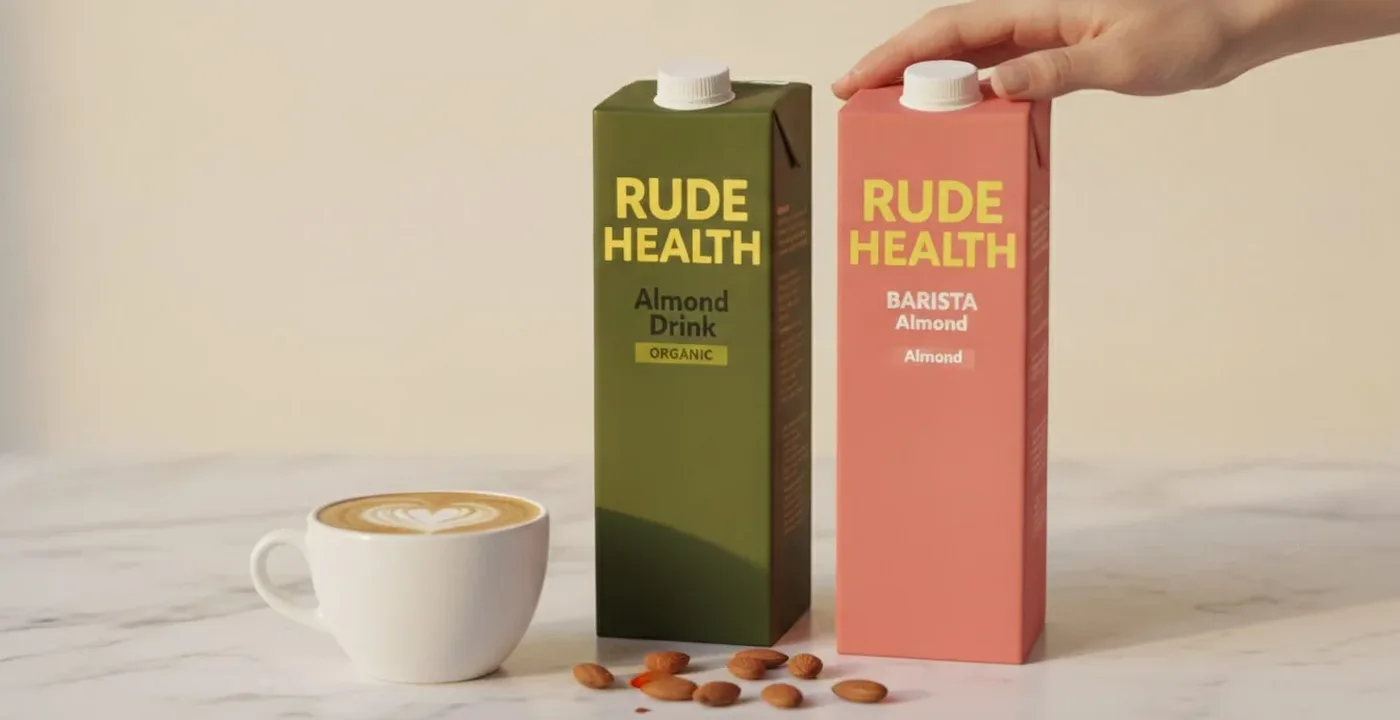
Table of Contents
Some of the links in this article are affiliate links, which help fund our independent review work at no extra cost to you. Every recommendation is based on hands-on testing through The Editor Lab methodology. No brand pays to appear, and no placement is guaranteed.
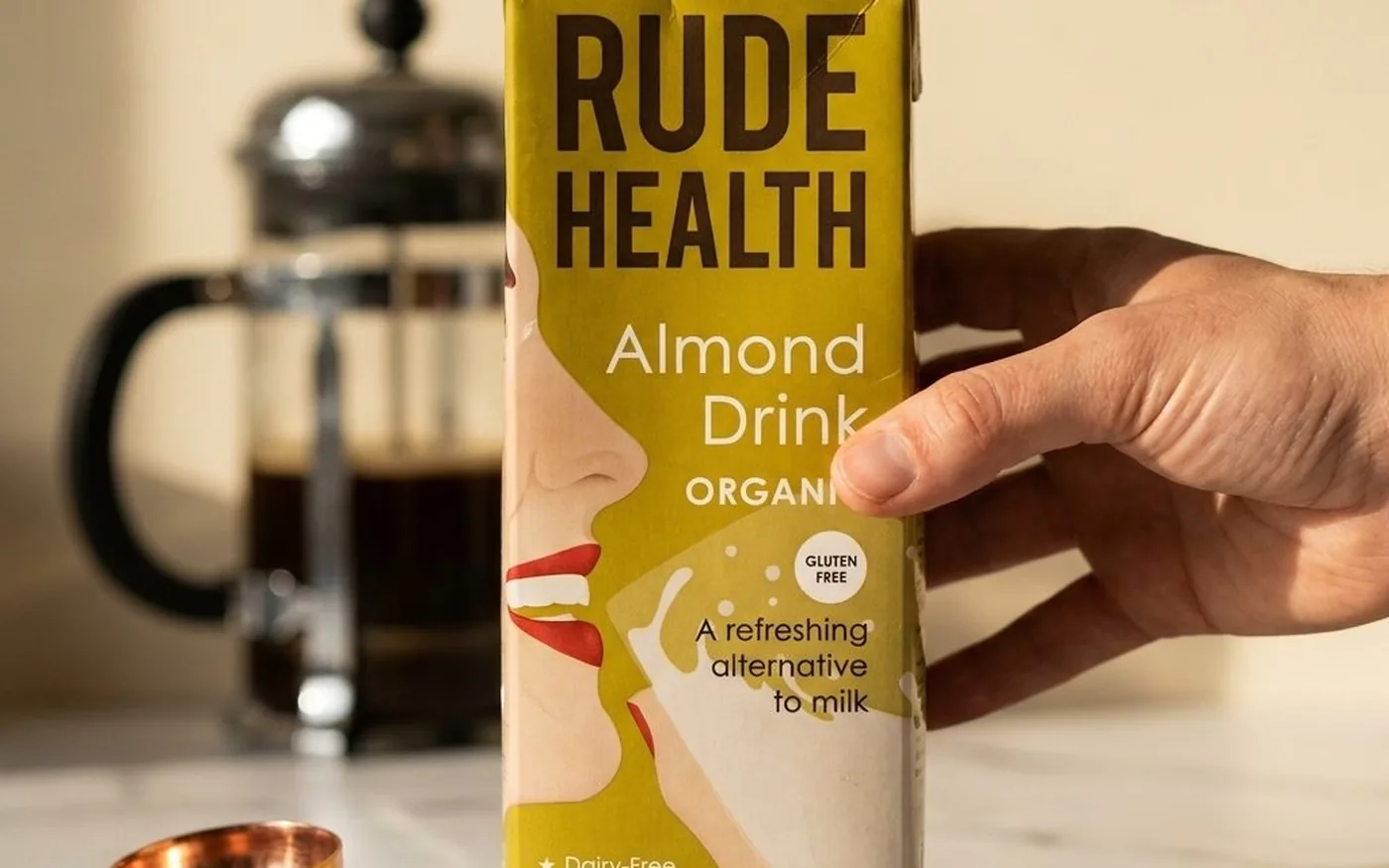
Rude Health’s standard Almond Drink is a genuinely good clean-label product - organic certified, no gums, no stabilisers - but with 1% almond content at a premium price, what you are buying depends entirely on what you want it for.
The front of the carton says “Organic Almond Drink.” Turn it over and you will find that 1% of the contents are almonds. That is the fact this review is built around - not because it makes Rude Health a bad product, but because it is the question every price-sceptical buyer ends up asking: what exactly am I paying a premium for?
This is a label-and-evidence review rather than a hands-on test: it reads Rude Health’s own product pages, the printed ingredient and nutrition panels and current UK retailer listings, against the Editor Lab review standards. It is written by Clemmie Rose, a registered Nutritional Therapist and BANT member whose clinic work has spanned The Kyros Project at Google DeepMind and The Wellness Clinic at Harrods, and who has spent years advising clients on precisely these kinds of label-versus-reality questions.
The short answer: Rude Health’s Almond Drink is a good product with a transparent ingredient list and genuine organic credentials. Whether it is worth the price depends entirely on which version you are buying and what you expect it to do.
Editor's Note
Editor’s Note: I read the ingredient panel first. As a registered Nutritional Therapist with BANT membership and a clinical background at Harrods’ Wellness Clinic, that is always where I start. Rude Health’s standard version holds up well against that scrutiny. The Barista Almond raises more questions. What follows is an honest, label-based account of both.
What Is Rude Health Almond Milk?
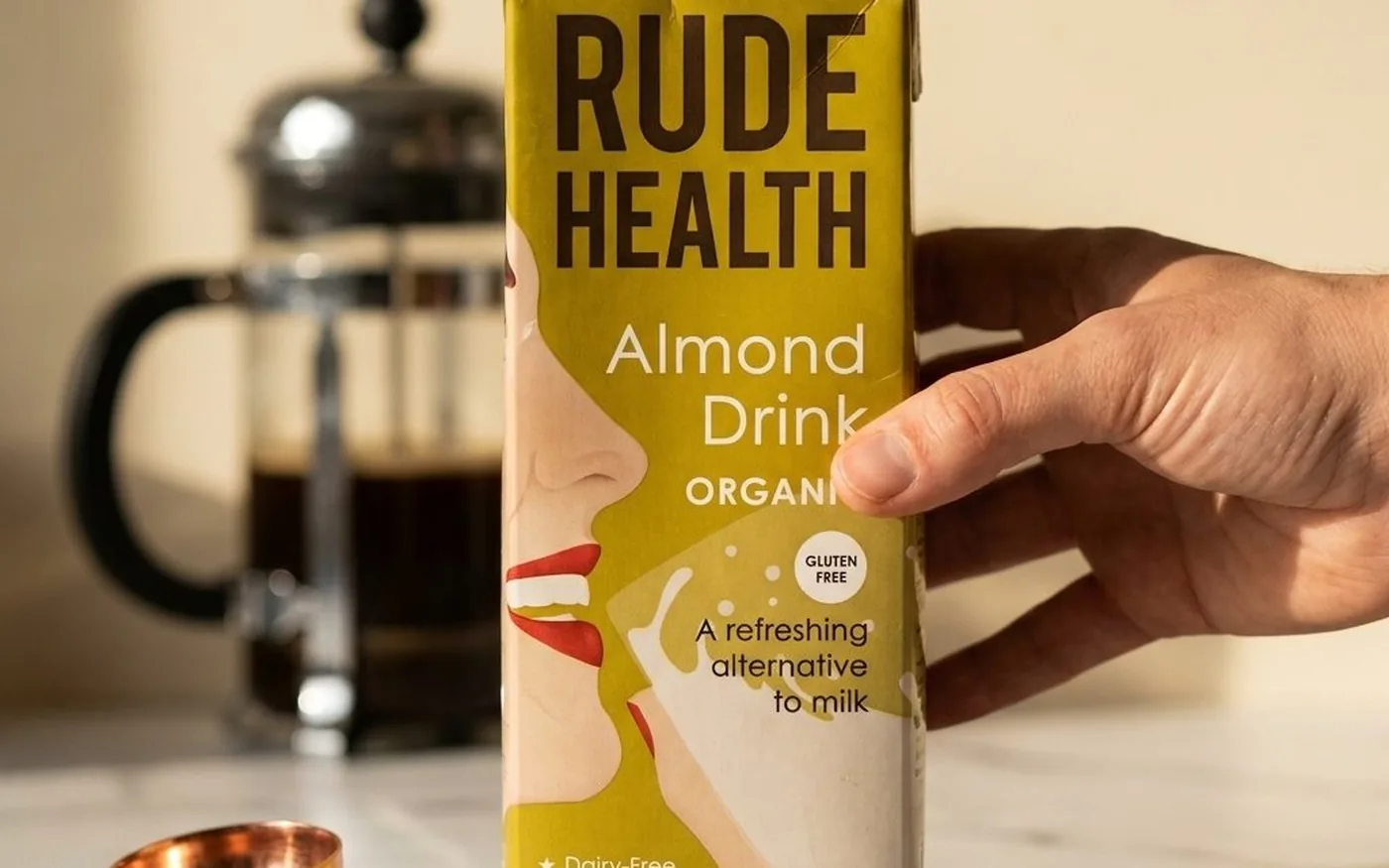
Rude Health was founded in 2005 by Nick and Camilla Barnard in London, built on a simple premise: food with nothing hidden. That founder principle still shows in the ingredient list of the standard Almond Drink, which contains spring water, organic rice, almonds (1%), organic cold-pressed sunflower oil, and sea salt. No gums, no stabilisers, no emulsifiers. For a shelf-stable carton product, that is a short list.
The brand positions itself in the premium plant-milk tier - stocked in Waitrose, Ocado, Planet Organic, and the better-end independent supermarkets. At shelf price it sits level with Alpro and just under Plenish, and it markets itself explicitly on the “no nasties” basis. The Organic certification (Soil Association) on the standard Almond Drink is genuine and verifiable.
Rude Health currently sells five variants of almond milk:
| Variant | Key difference | Best for |
|---|---|---|
| Almond Drink (standard) | 1% almonds, organic rice base, no gums or stabilisers | Everyday drinking, cereals, cooking |
| Barista Almond | 2% almonds, 13% oats, gellan gum | Coffee steaming - but read the small print |
| Ultimate Almond | 5% almonds, water only, no rice | Almond-forward flavour, cooking |
| No Sugars Almond | 3% organic almonds, carob seed flour, 0g sugars | Lower-sugar diets |
| Almond Drink with Calcium | Standard formula plus added calcium carbonate | Those replacing dairy calcium intake |
The standard Almond Drink is the one most buyers encounter first. The Barista Almond is the one with the most questions attached to it - and we will get to those.
Ingredients and Nutrition Breakdown
At 56 kcal per 100ml with only five ingredients, the standard Rude Health Almond Drink is one of the shortest ingredient lists in the plant-milk category. The full list: spring water, organic rice, organic almonds (1%), organic cold-pressed sunflower oil, sea salt. No emulsifiers, no carrageenan, no gums of any kind. From a clean-label perspective, that is exactly what you want to see on a shelf-stable carton. The Soil Association organic certification on the standard variant is the real thing.
Now, the numbers, as printed on Rude Health’s product page:
Per 100ml - Rude Health standard Almond Drink:
Energy: 236kJ / 56 kcal
Fat: 1.5g (of which saturates: 0.3g)
Carbohydrate: 10g (of which sugars: 4.7g)
Fibre: under 0.5g
Protein: under 0.5g
Salt: 0.08g
The standard Almond Drink carries no added calcium, so the panel lists none.
One thing worth stating plainly: because the standard Almond Drink is not fortified, it does not provide a meaningful calcium contribution. That matters for people who are replacing dairy entirely. The British Heart Foundation’s guidance on almond milk notes this distinction clearly - an unfortified almond drink is not a calcium equivalent to dairy or to fortified alternatives. If calcium intake is a clinical concern, the Rude Health Almond Drink with Calcium variant, or a fortified competitor, is the more appropriate choice.
The 1% almond content is the number that generates the most forum discussion. In practical terms: 1% almonds in a one-litre carton means approximately 10 grams of almonds per litre, which is a small handful. The rest is primarily spring water and rice. This is not unique to Rude Health - most shelf-stable almond drinks, including Alpro and many supermarket own-brands, contain similarly low almond percentages. But Rude Health charges a premium, which makes the question of what you are paying for entirely legitimate.
What you are paying for is the organic certification, the absence of gums and stabilisers, and the rice-based body that gives the drink a mild, gently nutty flavour without the emulsifiers used to replicate that texture in cheaper formulations. That is a real differentiator. Whether it is worth the price premium over, say, a Tesco own-brand almond drink that adds calcium and uses non-organic ingredients is a value judgment, not an objective quality call.
The WebMD overview of almond milk’s health benefits is useful context here: almond milk in general is low in protein relative to dairy, and most of the health-adjacent claims made about it apply primarily to the nut itself rather than to the diluted drink. Rude Health’s standard Almond Drink is not nutritionally exceptional - it is low-calorie, additive-free, and organic. For many buyers, that is enough.
Variant Guide: Standard vs Barista vs Ultimate vs No Sugars vs Calcium
Understanding which Rude Health almond variant to buy requires understanding what each one is made of, not just what the name implies.
Almond Drink (standard): Spring water, organic rice, almonds (1%), organic cold-pressed sunflower oil, sea salt. Organic certified, no gums, no stabilisers. The clearest label in the range and the best everyday option if coffee performance is not your primary use case.
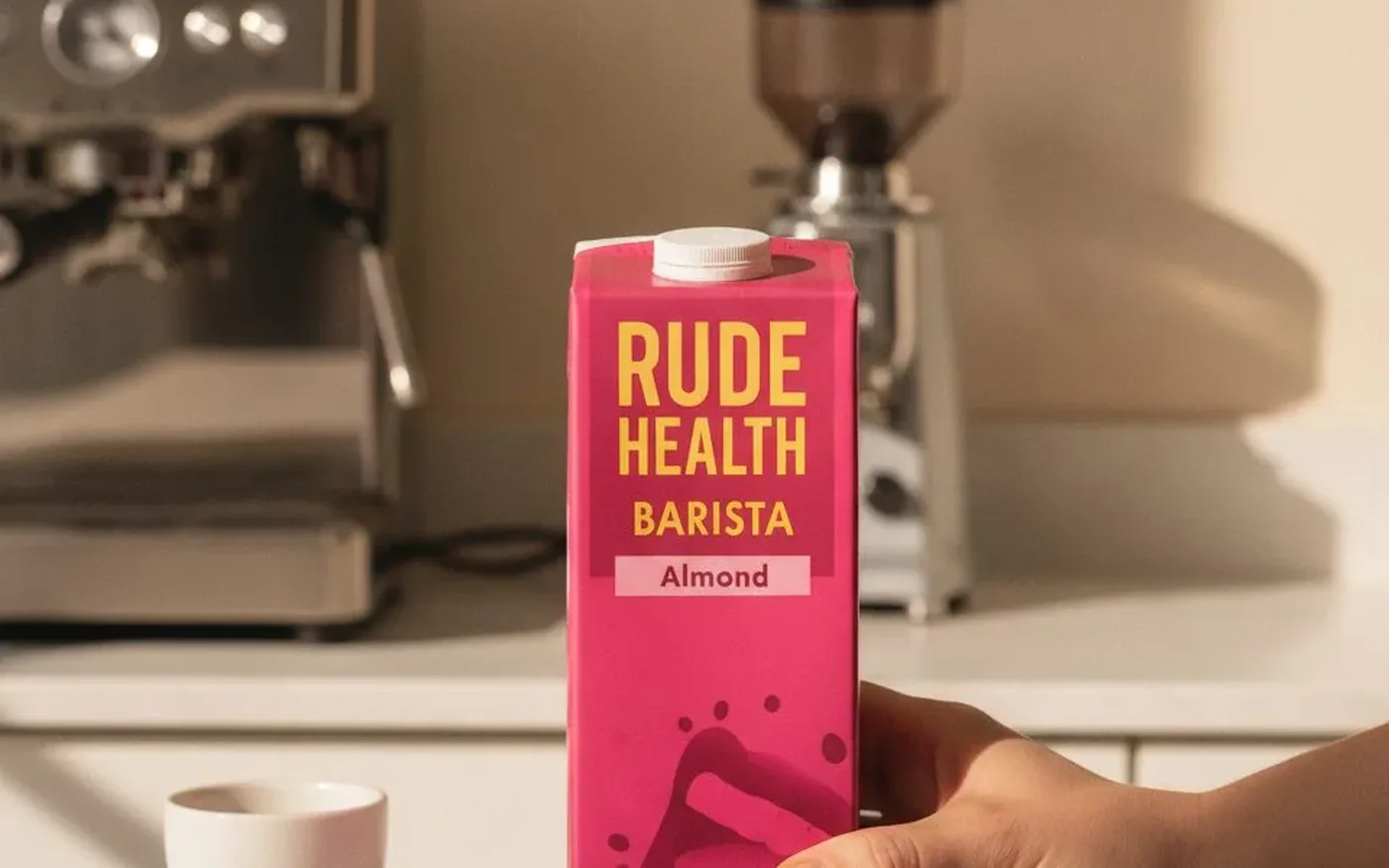
Barista Almond: Spring water, gluten-free oats (13%), almonds (2%), sunflower oil, sea salt, stabiliser: gellan gum. Not organic certified. The higher oat content (13%) provides the fat and starch structure needed for heat stability and microfoam. The gellan gum stabiliser prevents splitting under high heat and acid. The key differences from the standard Almond Drink: the Barista replaces the organic rice base with a higher oat percentage, adds a gellan gum stabiliser, and is not organic certified - none of which applies to the standard variant. Both contain sunflower oil. Here is the ingredient-label reality: the Barista is primarily an oat milk with a small amount of almond - not the reverse. We cover the coffee performance implications in the next section.

Ultimate Almond: Water and organic Italian almonds (5%), nothing else. No rice, no salt, no oil. Higher almond content gives a more pronounced, slightly denser flavour, and at 2.7g of fat and 1.3g of protein per 100ml it is the most almond-forward drink in the range. Better for cooking where you want the almond to come through, and for drinkers who want the taste to match the name on the carton.
No Sugars Almond: Spring water, organic almonds (3%), organic carob seed flour and sea salt, with 0g of sugars and under 0.5g of carbohydrate per 100ml at 18 kcal. There is no sugar alcohol in the recipe; the carob seed flour provides body. Useful for lower-carb or lower-sugar dietary approaches.
Almond Drink with Calcium: The standard Almond Drink formula with added calcium carbonate. Each 100ml provides a meaningful calcium contribution, making this the appropriate choice if you are replacing dairy and want to maintain calcium intake without supplementing separately. If you drink plant milk daily and do not have another dietary calcium source, this is the variant to default to.
Which to buy: For everyday use and clean-label priority, the standard Almond Drink. For calcium coverage, the with-Calcium variant. For cooking where almond flavour matters, the Ultimate Almond. The Barista Almond is functional in coffee but is - and this is important - not an almond-led product.
| Variant | Energy | Fat (saturates) | Carbohydrate (sugars) | Protein | Salt | Calcium |
|---|---|---|---|---|---|---|
| Almond Drink (standard) | 56 kcal | 1.5g (0.3g) | 10g (4.7g) | under 0.5g | 0.08g | None added |
| Barista Almond | 63 kcal | 2.4g (0.3g) | 8.8g (4.5g) | 1.1g | 0.10g | - |
| Ultimate Almond | 33 kcal | 2.7g (0.3g) | 0.7g (0g) | 1.3g | 0g | - |
| No Sugars Almond | 18 kcal | 1.5g (0.1g) | under 0.5g (0g) | 0.6g | 0g | - |
| Almond Drink with Calcium | 56 kcal | 1.5g (0.3g) | 10g (4.7g) | under 0.5g | 0.08g | 120mg |
Does It Actually Work in Coffee?
For the standard Almond Drink, the label points to limited coffee performance. With 1% almonds, 1.5g of fat and under 0.5g of protein per 100ml, there is little to build a dense microfoam, and thin, low-protein plant milks tend to lose body when heated much above 70C. In very hot, very acidic espresso, a drink like this is also more prone to feathering at the edges. Its mild, gently nutty flavour will not overpower the coffee, which suits stirring in cold or warming gently.
The Barista Almond is the variant Rude Health formulates for coffee. Its 13% gluten-free oats and gellan gum stabiliser are the standard approach to heat and acid stability, and its 1.1g of protein per 100ml is well above the standard drink’s under 0.5g, which is what gives a barista milk body when steamed. The label cannot confirm exact steaming temperatures, but it gives a clear signal: this one is built to be steamed and the standard drink is not. The flavour will lean oat rather than almond, so anyone expecting an almond-forward cup should read the label first. For a barista almond milk UK shoppers can buy off the shelf, this is Rude Health’s answer.
The larger question is whether the Barista Almond is really an almond milk. The name implies almond as the primary ingredient. The label says otherwise: 13% oats, 2% almonds, sunflower oil, a gum stabiliser, and no organic certification. For comparison, Oatly Barista Edition lists oats at 10%, so the Rude Health Barista Almond is, by proportion, an oat drink with almond flavouring and a barista-suitable stabiliser. That is a composition reality worth knowing before you buy it on the basis of the word “almond” in the name. If you are weighing oat milk vs almond milk for coffee, our guide to the best oat milks for coffee sets out the differences.
If you are looking for the best alternative milk for coffee across all plant-milk types - comparing almond, oat, soya, and coconut for coffee performance more broadly - our guide to the best alternative milks for coffee covers the category in detail and includes the criteria that separate a barista-grade product from a standard carton.
Rude Health also makes an oat drink, covered separately in our Rude Health oat milk review.
How It Compares: Rude Health vs Plenish vs Alpro vs Oatly
Rude Health sits in a crowded tier alongside Plenish, Alpro, and Oatly for the dairy-free buyer who shops the premium or health-food aisle. Each brand makes a different implicit promise, and it is worth mapping those honestly.
| Brand | Standard almond % | Organic certified | Additives | Fortified (standard) | Price per litre (approx) |
|---|---|---|---|---|---|
| Rude Health Almond Drink | 1% | Yes (Soil Association) | No gums/stabilisers | No | £2.30-2.40 (promos from £1.80) |
| Plenish Organic Almond | 5% | Yes | None (almonds, water, sea salt) | No | £2.50 (promos from £2.00) |
| Alpro Almond Unsweetened | 2.3% | No | Stabilisers, added vitamins | Yes | £2.30 (promos from £1.60) |
| Oatly Barista Edition | None (oat-based, 10% oats) | No | Acidity regulator, added vitamins | Yes | £2.20 (promos from £1.70) |
Note: Oatly is included as the dominant barista plant milk in the UK market for comparison context. It is an oat milk, not an almond milk - it appears here because it is the primary category alternative when buying for coffee use.
Plenish is the most instructive comparison for Rude Health on the clean-label dimension. Plenish’s Organic Almond contains only spring water, organic almonds (5%) and sea salt - no rice, no oil, no stabilisers. It lists slightly higher per litre than Rude Health but delivers five times the almond percentage. For someone who wants the ingredient list to match the name on the carton as closely as possible, Plenish wins that argument. Rude Health’s standard Almond Drink uses rice as the bulk ingredient, which gives it a milder, less almond-forward profile.
Alpro is the promotion comparison. Its shelf price is close to Rude Health’s, but it is frequently discounted to around £1.60, it contains stabilisers and added vitamins, and it is not organically certified. For buyers where price is the primary driver, Alpro or a supermarket own-brand works. For buyers where organic certification and no gums or stabilisers matter, Rude Health is the better choice. The organic and gum-free premium is what you are paying for.
The best almond milk UK verdict overall depends on use case: Plenish for highest almond content and flavour; Rude Health for clean-label organic with a milder taste; Alpro for fortification and frequent promotions.
Price and Where to Buy in the UK
Rude Health’s standard Almond Drink lists at around £2.30-2.40 per litre across the main UK supermarkets, with regular promotions bringing it down to about £1.80. Prices checked against retailer listings on 1 October 2026:

| Retailer | Product | Price per litre |
|---|---|---|
| Tesco | Rude Health Organic Almond Drink 1L | £2.30 (Clubcard £1.80) |
| Sainsbury’s | Rude Health Almond Drink 1L | £2.30 (offer £1.80) |
| Morrisons | Rude Health Organic Almond Drink 1L | £2.30 (offer £2.00) |
| Ocado and Waitrose | Rude Health Almond Drink 1L | £2.30-2.40 |
The premium variants cost more: across the almond range, Rude Health runs from about £2.30 per litre for the standard carton to about £3.85 per litre at the top end. You can also find the standard Almond Drink online via Rude Health Almond Drink on Amazon (Amazon Associates, tag balancejourna-21).
For context against the wider alternative-milk category: Rude Health’s Almond Drink at around £2.30 per litre is roughly 75% above a Tesco or Sainsbury’s own-brand unsweetened almond drink (about £1.30 per litre), and slightly below Plenish (about £2.50 per litre). The premium over supermarket own-brand is real and consistent across retailers.
What We Didn’t Love
Two things are worth naming directly, because they are the facts most online product pages omit.
First: the standard Almond Drink is only 1% almonds. It is mostly spring water and rice. Reviewers on Home Tester Club and Plant Milc have flagged this as borderline misleading given the premium price versus almonds-only competitors like Plenish. Rude Health is transparent about it - the percentage is on the label - but the marketing language emphasises the almond and the organic certification without foregrounding the rice-first composition. For a product called “Almond Drink,” most buyers reasonably expect almonds to be a more significant proportion. They are not.
Second: the Barista Almond is not really an almond milk at all by proportion. It is 13% gluten-free oats and only 2% almonds, plus sunflower oil and a gellan gum stabiliser. Unlike the standard Almond Drink, it is not organic certified and it adds gellan gum - a stabiliser absent from the standard variant. If you want a barista milk that is genuinely almond-forward, this is not it - it is a functional oat-base product that uses almond as a flavour note and name anchor rather than as the primary ingredient.
A third point if you are comparing value: Rude Health’s price per litre (about £2.30) is roughly 75% above UK supermarket own-brand almond milk (about £1.30 per litre for Sainsbury’s or Tesco own-brand). The organic certification and absence of gums and stabilisers are real differentiators. Whether they justify that premium is a personal call - but it is a call worth making consciously rather than assuming “premium” means “significantly more almonds.”
The environmental note: almond milk, as a category, has a known water-use footprint. Almond farming is water-intensive, particularly in California, where most commercial almonds originate. This does not make almond milk uniquely bad relative to dairy, but it is a trade-off worth acknowledging for buyers where sustainability is a primary driver.
Pairs Well With
If you use the standard Rude Health Almond Drink in coffee, roast character matters. Because the drink is relatively thin and mild - with a rice-forward base rather than a fat-rich one - it pairs best with darker, less acidic roasts that hold up against the dilution. Lighter, high-acidity single origins can taste sharp or thin when combined with a low-fat almond drink.
For more roast ideas beyond this pairing, see our guide to the best coffee beans in the UK.
Balance Coffee’s Stability Blend - a Brazil, Mexico and Uganda blend with milk chocolate, hazelnut, and fig tasting notes - is a sensible match on paper. Its body and sweetness suit a milk that adds little fat of its own. Balance Coffee is the company founded by James Bellis, who reviewed this article; Balance Journal receives a commission on purchases through this link.
Verdict: Is Rude Health Almond Milk Worth It?
Yes, with clear conditions attached.
The standard Almond Drink is a genuinely good product: organic certified, no gums, no stabilisers, a mild flavour that works in most everyday applications. If your priority is a plant milk with a transparent ingredient list and genuine organic credentials, it delivers that more honestly than most alternatives at this price point.
The price premium over supermarket own-brand is real, and you are paying for the organic certification and the absence of gums and stabilisers - not for a high almond content. If the almond percentage matters to you (for flavour or nutritional reasons), Plenish’s almonds-and-water formula is the more honest choice, even at a higher price.
The Barista Almond is built for coffee and for steaming. But it is not an almond-forward product - it is a stabilised oat base with a small almond contribution. If you want a barista-grade almond milk that leads with almonds, look elsewhere. If you want a stable, neutral plant milk for coffee and do not mind that it is mostly oats, the Barista Almond works.
Buy the standard if organic certification and a gum-free label are your criteria. Buy the with-Calcium variant if you are replacing dairy calcium intake. Buy the Ultimate Almond if flavour matters. Approach the Barista Almond with clear expectations about what it is.

Frequently Asked Questions
What are the ingredients in Rude Health almond milk?
The standard Rude Health Almond Drink contains spring water, organic rice, organic almonds (1%), organic cold-pressed sunflower oil and sea salt, with no gums, emulsifiers or stabilisers. It is Soil Association organic. The Barista Almond differs: gluten-free oats (13%), almonds (2%), sunflower oil, sea salt and gellan gum stabiliser, and it is not organic certified.
Which is the healthiest brand of almond milk?
No brand is healthiest on every measure. Plenish has the simplest label: organic almonds (5%), spring water and sea salt. Rude Health’s standard drink is organic with no additives. Alpro and own-brand drinks are usually fortified with calcium and vitamins, which matters if you are replacing dairy. Choose by priority: clean label, calcium fortification or fewest additives.
Why are people ditching almond milk?
Two reasons come up most. Almond milk can thin or split in hot espresso more readily than oat or soya milk, which frustrates daily coffee drinkers. It is also low in protein (under 0.5g per 100ml in Rude Health’s standard drink), and almond farming is water-intensive, particularly in California. Some buyers switch to oat milk, which has a lower water footprint.
Is there a downside to drinking almond milk?
The main downside is low protein: under 0.5g per 100ml for Rude Health’s standard Almond Drink, against about 3.4g for cow’s milk. Unfortified versions are also low in calcium, so they are not a dairy equivalent for anyone replacing it entirely. The WebMD overview of almond milk makes the same point about protein.
Why can’t you drink almond milk after 7 days?
Once opened, almond milk should be refrigerated and used within about five to seven days, or by the date on the carton. Unopened UHT cartons like Rude Health’s are shelf-stable, but opening lets bacteria in, and they grow quickly at room temperature. The guideline is a food safety limit, not a quality preference, because spoiled milk may not smell off.
What do cardiologists say about drinking almond milk?
The British Heart Foundation notes almond milk can fit a heart-healthy diet because it is low in saturated fat (0.3g per 100ml in Rude Health’s standard drink). Unfortified versions are not nutritionally equivalent to dairy, so calcium, vitamin D and protein must come from elsewhere. At 1% almonds, the drink adds few of the unsaturated fats found in whole almonds.
Which almond milk is the healthiest in the UK?
It depends on your priority. For the highest almond content and fewest ingredients, Plenish (almonds, water, sea salt). For organic certification with no emulsifiers, Rude Health’s standard Almond Drink. For calcium to support dairy replacement, Rude Health’s Almond Drink with Calcium or Alpro. Read the label for almond percentage, fortification and additives; that is more reliable than any single ranking.
Is Rude Health almond milk good for coffee?
The standard drink is thin: 1% almonds and under 0.5g protein per 100ml mean little body and weak microfoam, so it suits stirring into coffee more than steaming. The Barista Almond is formulated for coffee, with 13% oats and gellan gum for heat stability. It is mostly an oat base with 2% almonds, so expect little almond flavour.

A registered Nutritional Therapist and member of BANT, Clemmie blends science with a holistic approach to wellbeing.