Rocket vs Sage Oracle Touch: The Prosumer Upgrade Question

Coffee & Wellness Writer
Six years on a Rocket, two on the Oracle Touch - the comparison I wish had existed when I bought both.
Table of Contents
Some of the links in this article are affiliate links, which help fund our independent review work at no extra cost to you. Every recommendation is based on hands-on testing through The Editor Lab methodology. No brand pays to appear, and no placement is guaranteed.
If you are spending around £2,000 on an espresso machine, you will eventually land on the same shortlist as almost everyone else at this price point: a Rocket espresso machine or the Sage Oracle Touch. They appear on the same Reddit threads, the same forum discussions, and the same shortlists - not because they are similar machines, but because they cost roughly the same and do completely opposite things.
That is the whole comparison, really. One is a fully manual Italian prosumer machine that rewards skill and patience with genuinely exceptional espresso. The other is a one-touch super-automatic that delivers a consistent flat white without you having to think about grind size, tamp pressure, or steam wand technique. Same price point. Opposite philosophies. And one of them is right for you in a way the other simply is not.
I have owned a Rocket Giotto Evoluzione R for six years and a Sage Oracle Touch for two years. This article is the comparison I wish had existed when I was making the second purchase.
Editor's Note
The Honest Answer Up Front
If you want milk drinks at one touch, every morning, without thinking about extraction variables, buy the Sage Oracle Touch while stock lasts - it has been discontinued, and the Oracle Jet is now Sage's current flagship.
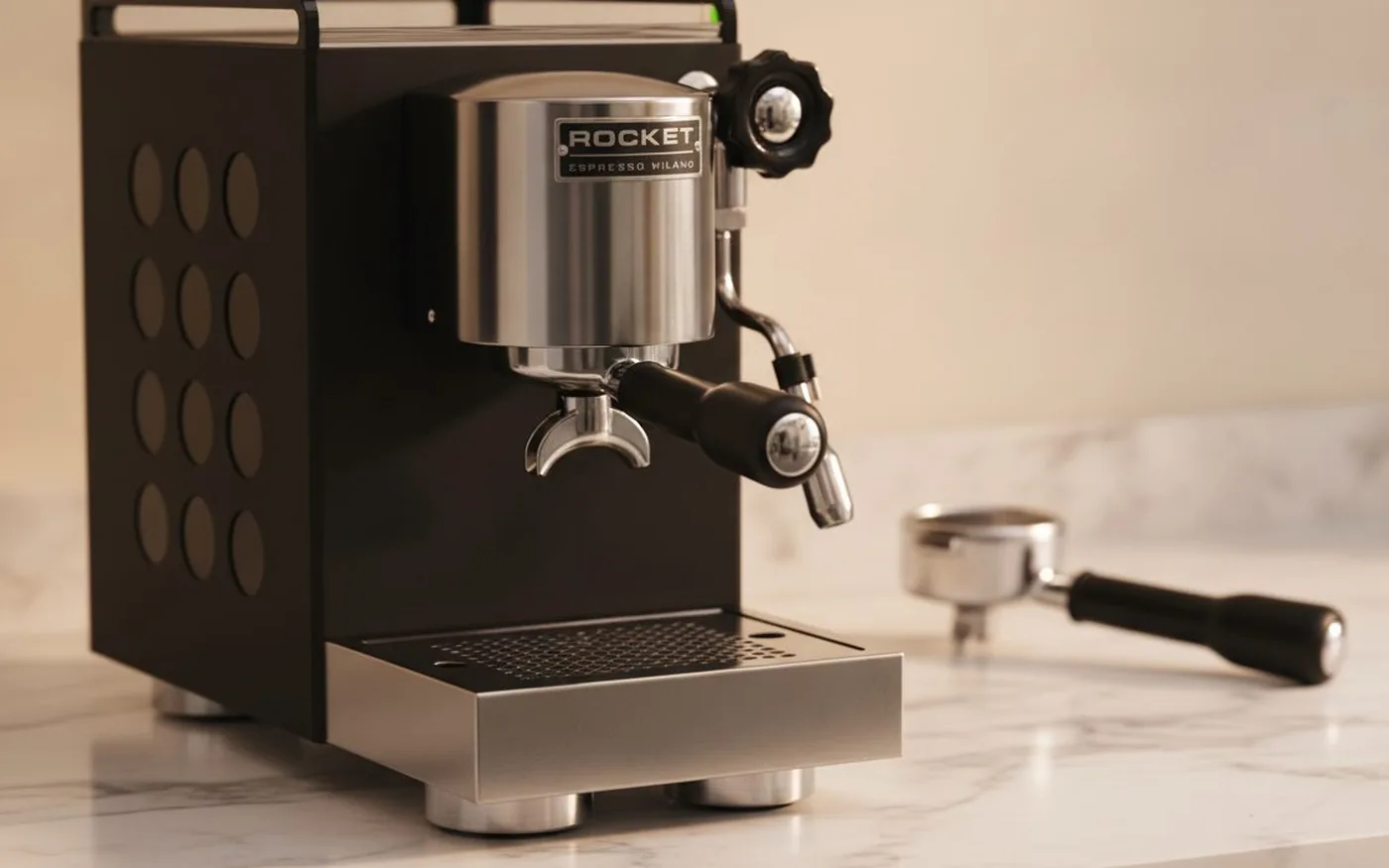
If you want espresso as a craft, with the cup quality ceiling and 20-plus-year service life of a traditionally built Italian machine, buy a Rocket. The Mozzafiato Type V is the closest price match to the Oracle Touch. The Appartamento gets you into the Rocket ecosystem for less.
The choice is not about quality. Both machines make excellent coffee in the right hands. It is about what kind of hands you want to use.
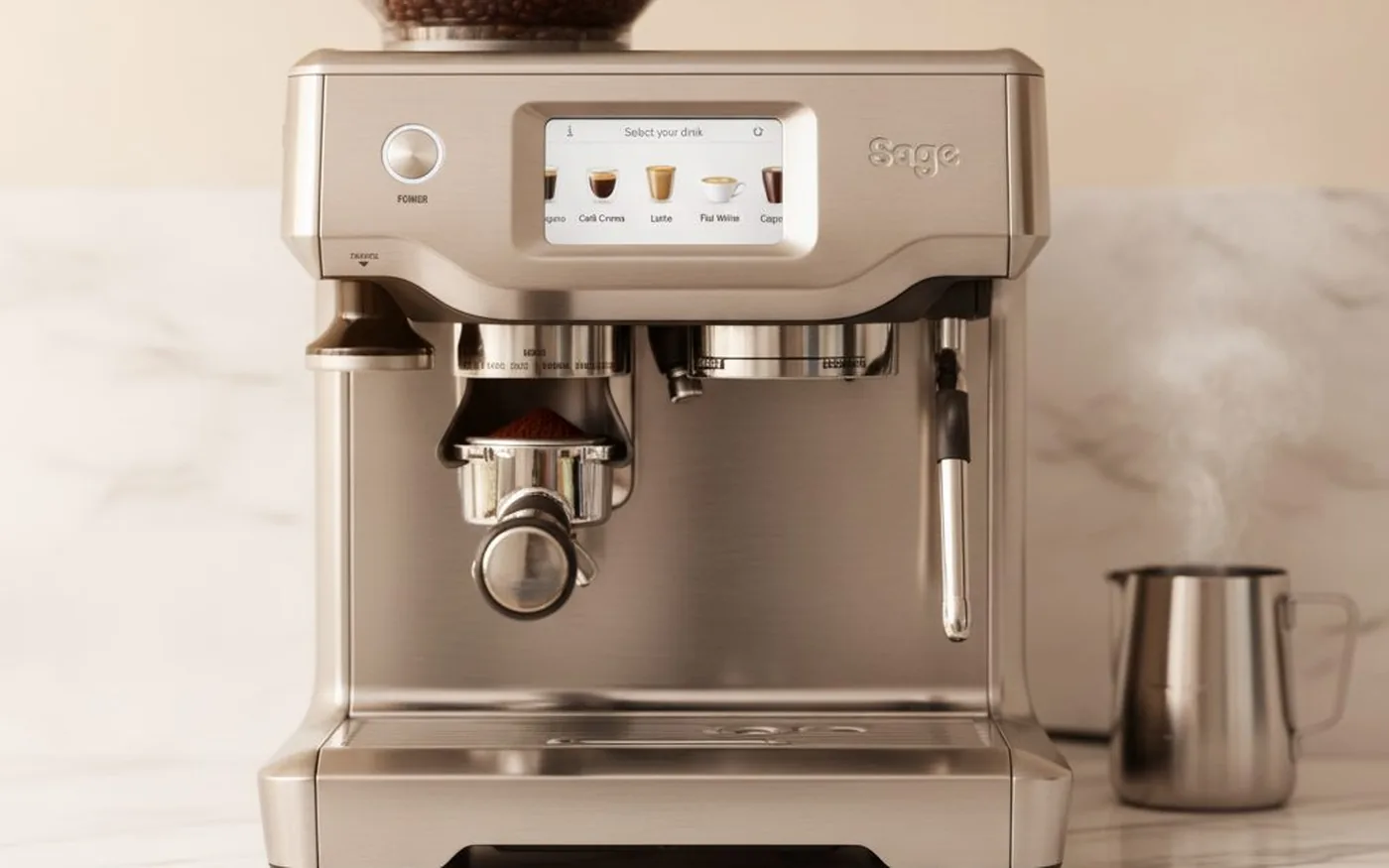
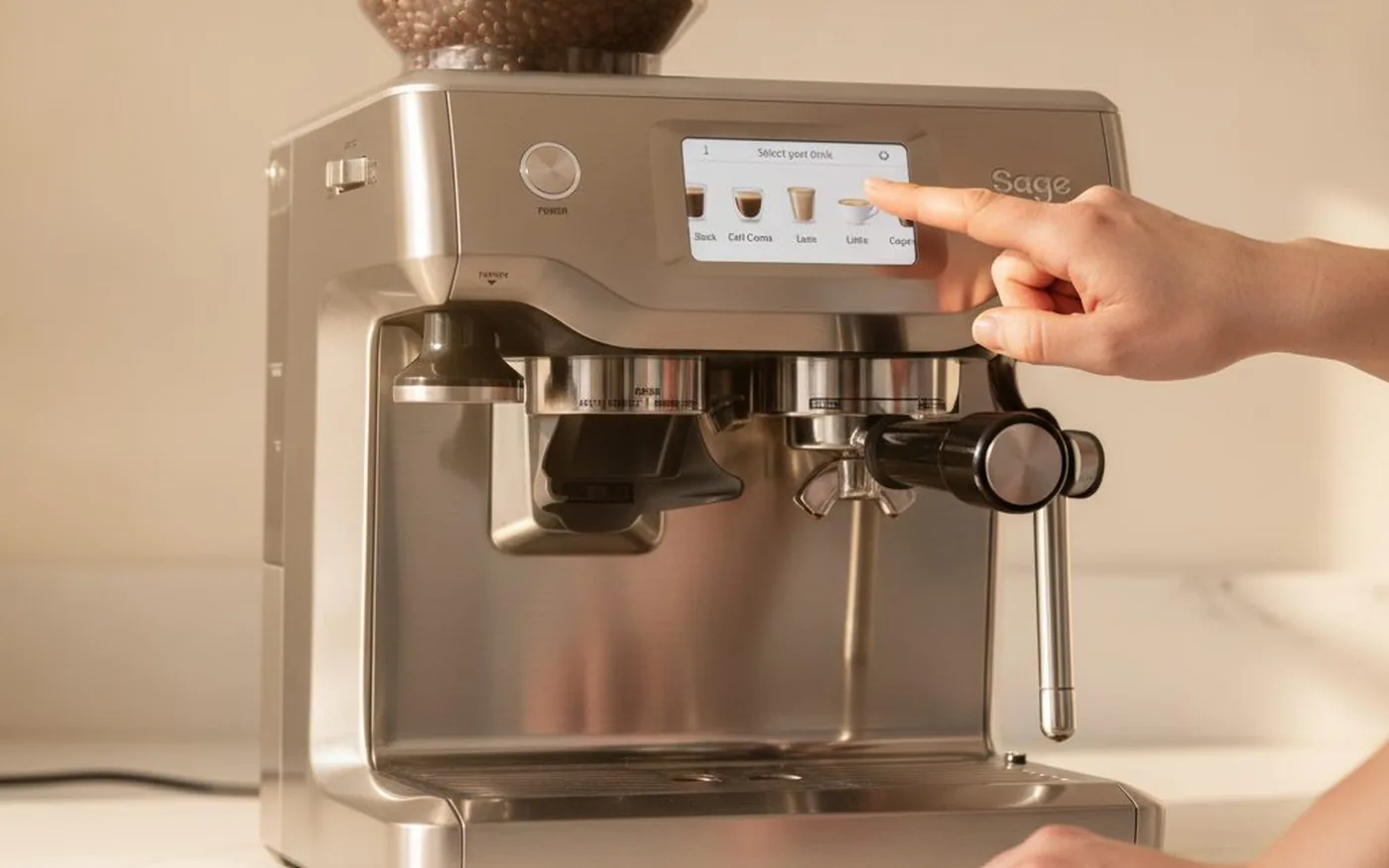
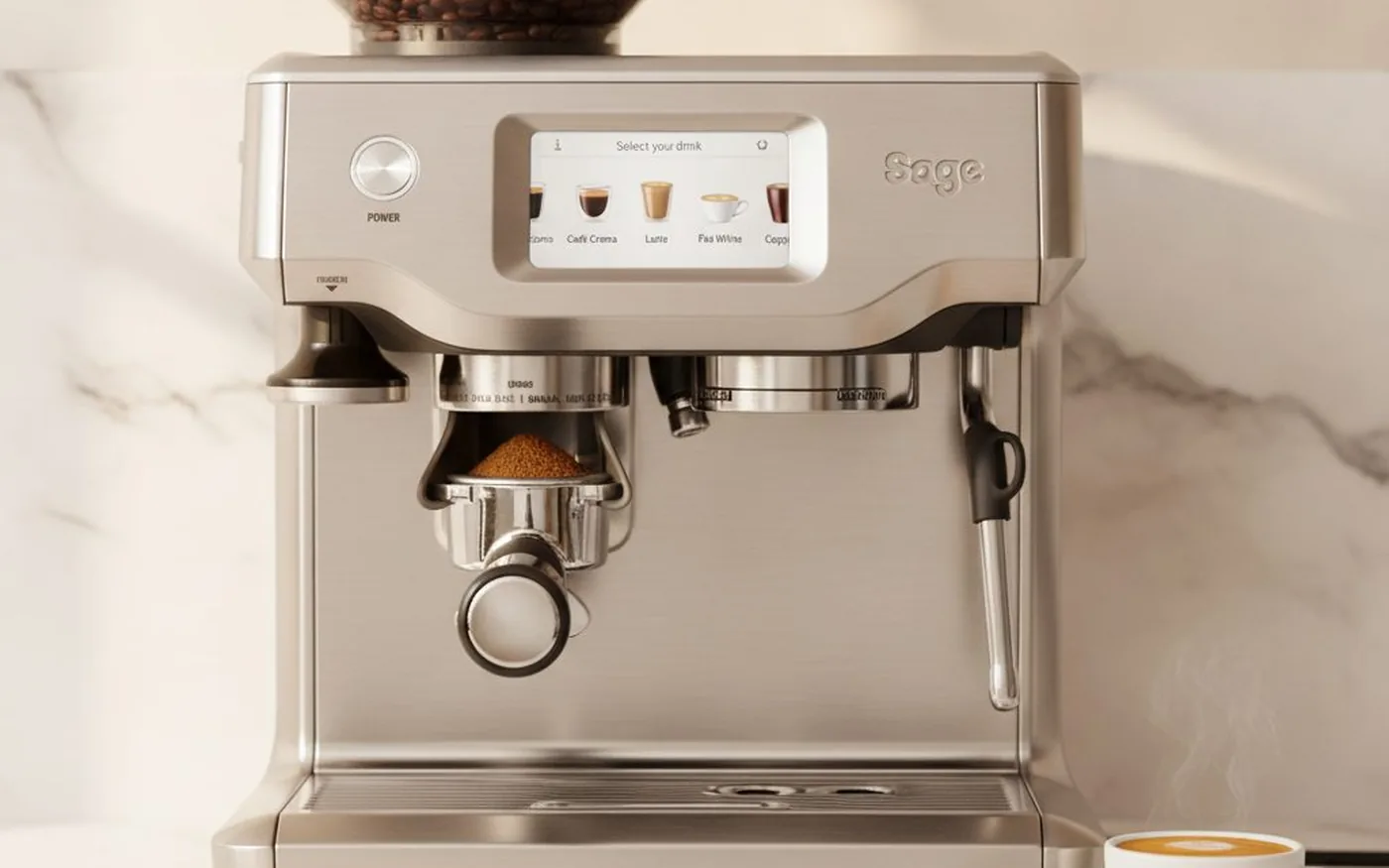
The Sage Oracle Touch is a super-automatic espresso machine. That term gets used loosely, so here is what it means precisely in this context: the Oracle Touch has a built-in conical burr grinder, an automatic tamper, a programmable shot timer, and a self-texturing steam wand that heats milk to a target temperature without manual technique. You press a touchscreen button. It grinds, doses, tamps, extracts, and steams. You collect the drink.
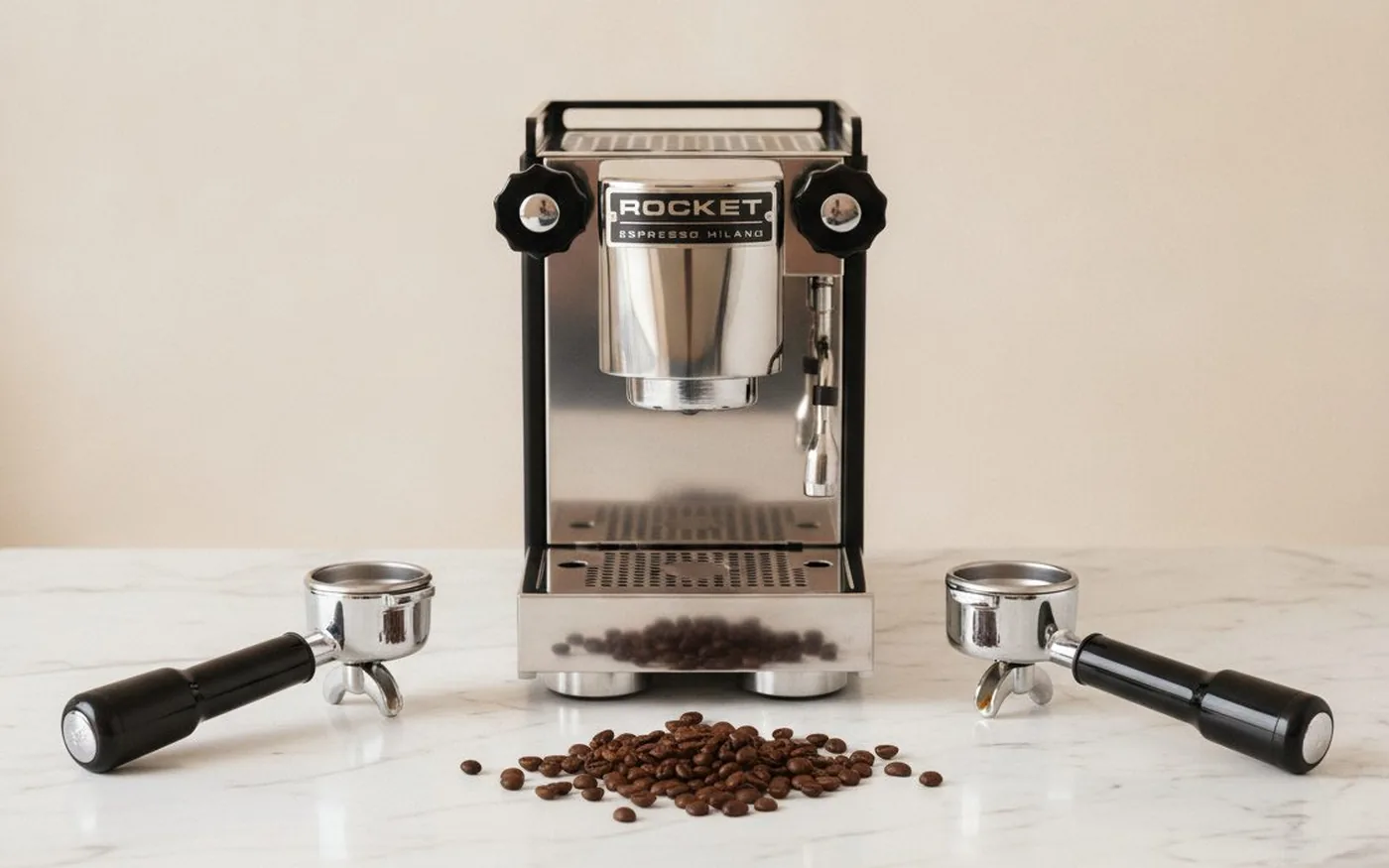
Prosumer espresso machines sit at the category boundary between domestic and professional equipment. The term covers machines with commercial-grade group heads (typically E61), 58mm portafilters, separate boiler circuits for brew and steam, and build quality designed to last decades. A prosumer machine requires a separate grinder, manual dosing, manual tamping, and manual steam wand technique. Rocket Espresso's Appartamento, Mozzafiato Type V, and R58 Cinquantotto are all prosumer machines.
What is an E61 group head? The E61 is a lever-style group head design first introduced by Faema in 1961, now standard across premium prosumer machines including all three Rocket models. It uses thermosiphon circulation to pre-warm the group head and portafilter, reducing thermal loss during extraction. The 58mm basket diameter matches commercial machine standards, which matters for puck preparation and interchangeable accessories.
What is the difference between an HX and a dual-boiler machine? A heat exchanger (HX) machine has a single large boiler for steam, with a narrow copper tube running through it to heat brew water as it passes. The Rocket Appartamento and Mozzafiato Type V are HX machines. A dual-boiler machine has two separate boilers - one for steam, one for brew - each controlled independently. The R58 Cinquantotto is Rocket's dual-boiler flagship. Dual boiler means you can steam milk and pull a shot simultaneously without thermal management. HX machines require a short cooling flush before extraction because the brew water can overheat slightly inside the heat exchanger.
These two machines keep appearing on the same shortlist because they occupy the same £1,500-2,500 purchase bracket and serve buyers coming from the same upgrade moment - usually someone who has outgrown a Sage Barista Express or Bambino and wants to know what the next level looks like.
Price-Matched Specs: All Four Machines Side by Side
| Evaluation Criteria | Our Findings |
|---|---|
| Best for | Buyers who want to run the machine themselves |
| Architecture | E61 heat exchanger, commercial build |
| What you give up | Automation - you grind, dose, tamp and texture |
| Shop | Shop the Appartamento → |
| Evaluation Criteria | Our Findings |
|---|---|
| Best for | Buyers who want the cup without the workflow |
| Architecture | True dual boiler with auto grind, dose, tamp and milk |
| What you give up | Ceiling on extraction control and long-term rebuildability |
| Shop | Shop the Oracle Touch → |
One important note before the table: the Sage Oracle Touch has been discontinued. Sage has launched the Oracle Jet as its current flagship, with an updated interface and revised milk system. The Oracle Touch remains available at UK retailers while stock lasts - Harvey Norman and 200 Degrees Coffee had it listed from around £1,249 up to £1,799-2,099 at selected UK premium retailers at the time of writing (July 2026). If you are buying new, factor the discontinued status into your value calculation. Buying a machine where replacement parts and firmware support may phase out is a different proposition to buying one in active production.
| Rocket Appartamento TCA | Rocket Mozzafiato Type V | Rocket R58 Cinquantotto | Sage Oracle Touch | |
|---|---|---|---|---|
| UK retail price (2026) | £1,300-1,600 | £1,895-2,150 | £2,500-3,000 | from around £1,249 (while stock lasts) |
| Boiler type | Single (HX) | Single (HX) with PID | Dual boiler | Single (thermocoil) |
| Group head | E61 58mm | E61 58mm | E61 58mm | 54mm proprietary |
| PID temperature control | No | Yes (Cronometro V) | Yes (independent per boiler) | Yes (pre-set profiles) |
| Built-in grinder | No | No | No | Yes (conical burr) |
| Auto tamp | No | No | No | Yes |
| Auto milk | No | No | No | Yes (self-texturing wand) |
| Shot timer | Yes (Cronometro V, included) | Yes (Cronometro V) | Yes | Yes (touchscreen) |
| Plumbable | No | No | Yes | No |
| Water tank | 2.5L | 2.5L | 1.8L (plumb or tank) | 2.5L |
| Build material | Stainless, copper internals | Stainless, copper internals | Stainless, brass, copper | Stainless exterior, plastic internals |
| Footprint | 270 x 330mm | 270 x 370mm | 295 x 398mm | 370 x 380mm |
| Weight | 14kg | 18kg | 22kg | 12.4kg |
| Warranty | 2 years | 2 years | 2 years | 2 years |
| Expected service life | 20+ years (serviceable) | 20+ years (serviceable) | 20+ years (serviceable) | 7-10 years |
| Status | In production | In production | In production | Discontinued (stock remaining) |
The Sage Oracle Touch costs roughly the same as a Rocket Mozzafiato Type V (£1,999-2,499 vs £1,895-2,150), but the Oracle Touch includes a built-in grinder and the Rocket does not.
What Each Machine Actually Does to the Cup
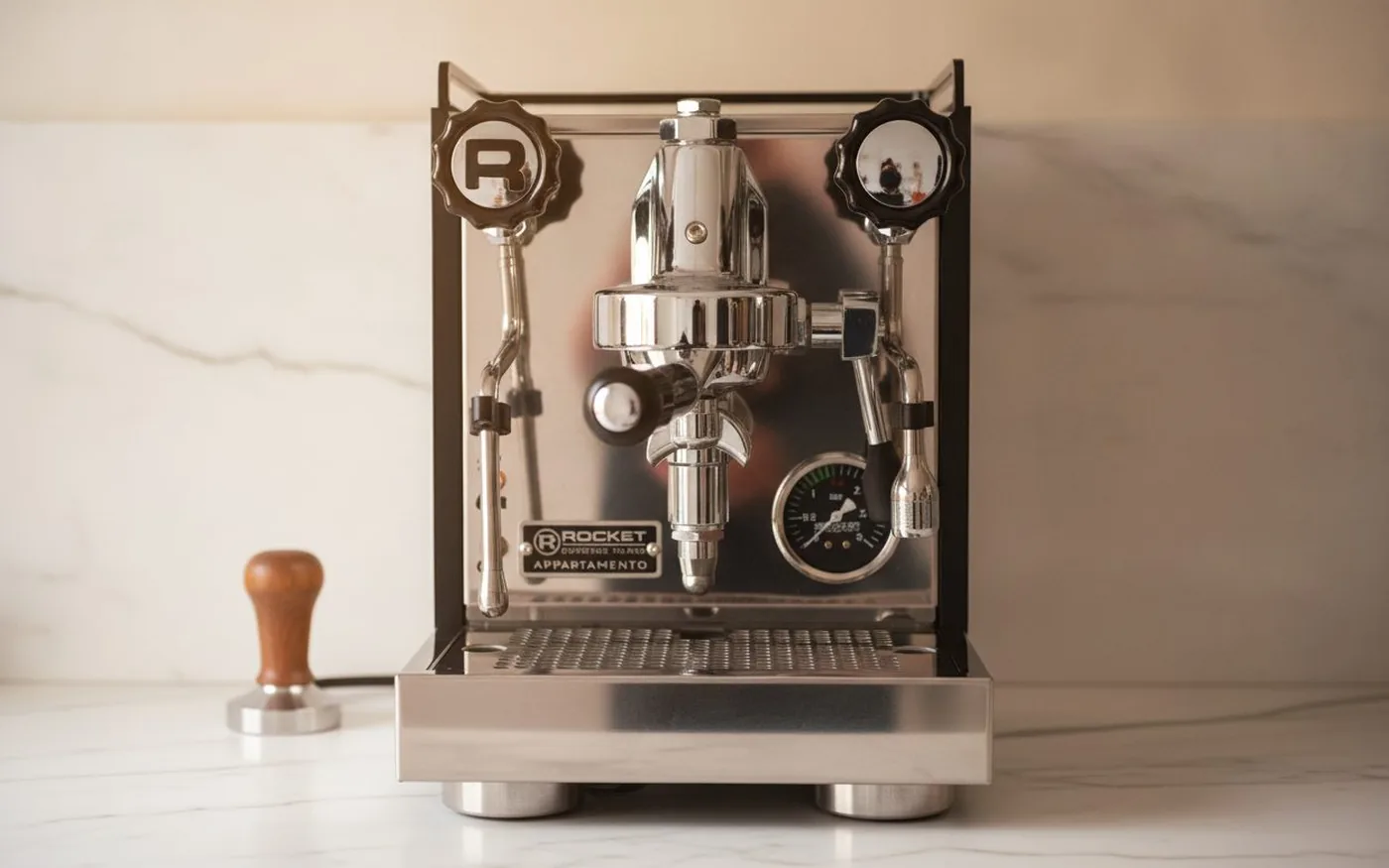
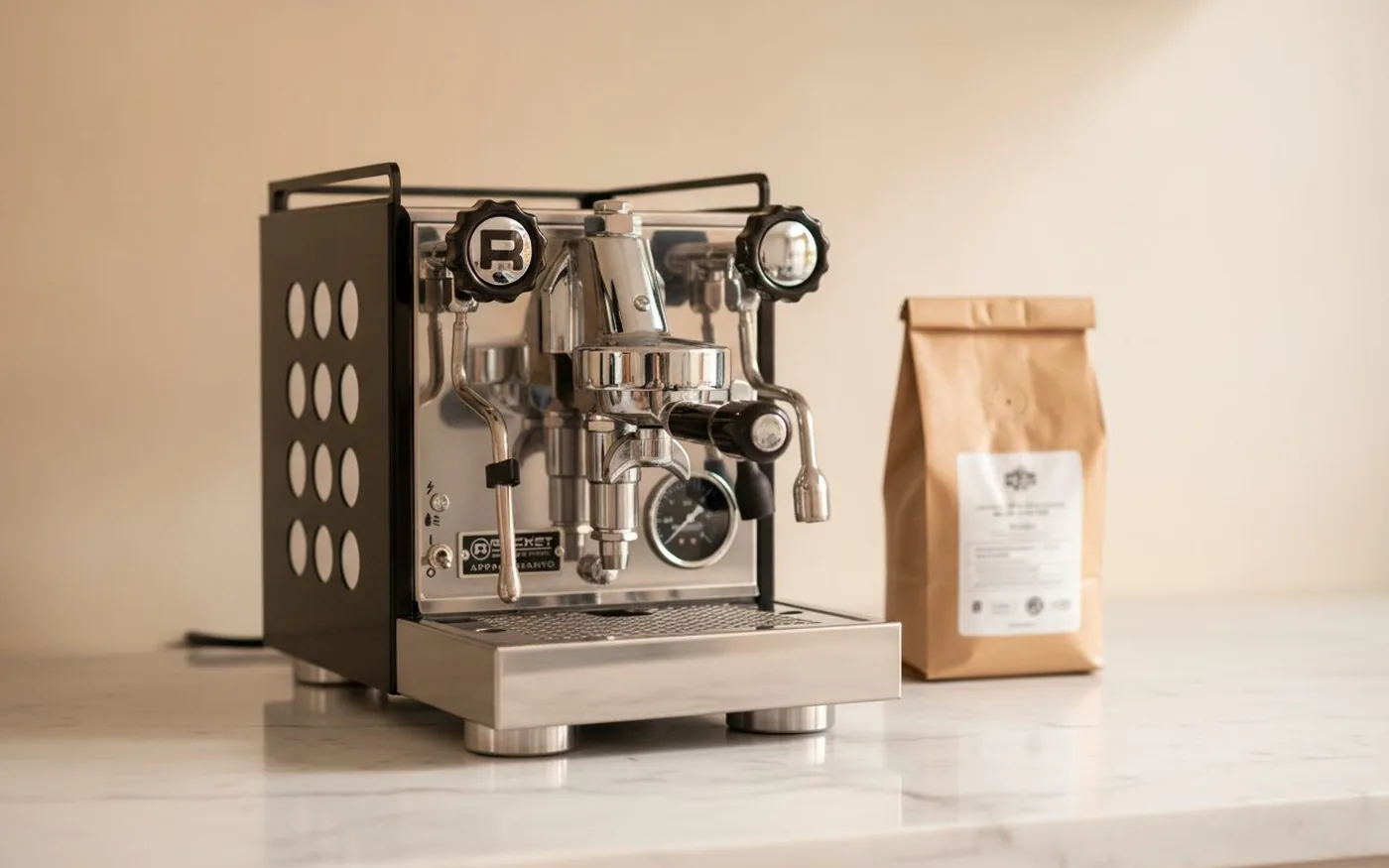
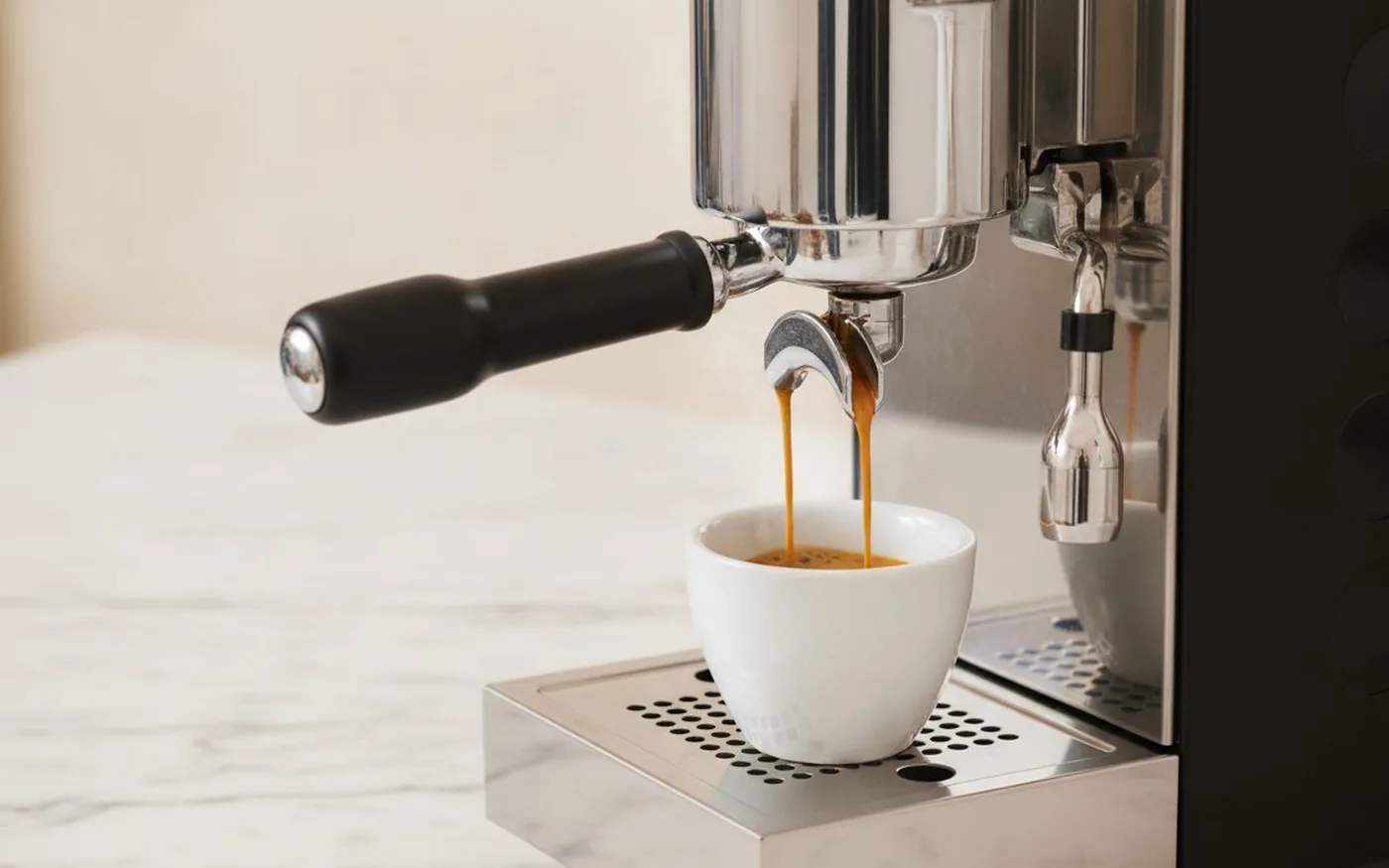
The Rocket Appartamento is the entry point to the Rocket range. At £1,300-1,600 without a grinder, you are buying an HX machine with a commercial E61 group head, copper and stainless internals, and a manual workflow that places all extraction variables in your hands. Dial in your grind, dose to 18g, distribute, tamp to around 15kg pressure, lock the portafilter, pull a 36g yield in 27-31 seconds. The cup is shaped by the bean and the puck. When you get it right, the Appartamento produces espresso that an experienced barista would be happy with in a commercial setting.
In testing with our Aurora Reserve - a Brazil single-origin with a chocolatey base and clean bright finish - the Appartamento rewarded careful puck preparation with shots that opened up on the palate in a way the Oracle Touch could not quite replicate. The clarity at the front of the shot was noticeably cleaner when the grind was dialled precisely.
The Sage Oracle Touch takes a different approach. The 54mm conical burr grinder doses directly into the portafilter, an automatic tamper applies consistent pressure, and the touchscreen lets you programme shot volume and temperature per drink. The auto-steaming wand heats milk to a set target (between 55-75C, adjustable) and cuts off when it reaches temperature.
For milk drinks, the Oracle Touch wins on consistency. I tested it back-to-back with our Rotate Espresso - a 100% Mexico single origin with a clean, rounded profile that works well through milk - across 30 flat whites over two weeks. The Oracle Touch delivered a noticeably more uniform result shot after shot. The microfoam quality was good, not exceptional, but reliably good every time.
Honest verdict on cup quality: the Oracle Touch makes an excellent cappuccino or flat white very consistently. A Rocket machine, with a skilled operator and a quality separate grinder, makes a better espresso - and the gap matters if you drink espresso straight.
The Workflow Difference
Morning routine reality, side by side.
Oracle Touch workflow (cold start to first drink): Switch on, 30-second warm-up (thermocoil heats fast), select your drink on the touchscreen, press start. The machine grinds, doses, tamps, extracts, and steams automatically. From switch-on to collected flat white: approximately 90 seconds to 2 minutes. You do not touch the grinder. You do not hold a steam wand. You do not time a shot.
Rocket Appartamento workflow (cold start to first drink): Switch on, 15-20 minute warm-up (the E61 group head needs time to reach thermal equilibrium - a warm flush at 5 minutes accelerates this but does not replace it), grind on your separate grinder, dose 18g into the portafilter, distribute, tamp, lock in, pull the shot watching your timer and yield, steam milk with the wand by hand, pour. From switch-on to collected flat white: 25-30 minutes including warm-up, or around 5-7 minutes if you started the machine when you got up and it is already warm.
The warm-up time is the detail most Rocket reviews understate. The Appartamento is a weekend machine for most households. That is not a criticism - the owners I have spoken with who use one daily simply get into the habit of switching it on before their shower. But if you need coffee in 90 seconds on a Tuesday morning before school drop-off, the workflow does not suit you.
Mozzafiato Type V note: The Cronometro V PID upgrade means the Mozzafiato V runs a tighter temperature stability curve than the Appartamento, with a shorter effective warm-up. It does not make the workflow automatic - you still do everything manually - but the extraction consistency is notably better than the Appartamento's once you learn to read the HX machine.
The Total Cost Reality
The sticker price comparison is misleading because the Rocket range requires a separate grinder.
The Rocket Appartamento starts at around £1,300. Add a grinder and the realistic all-in cost is:
- Appartamento + Sage Smart Grinder Pro (£200): around £1,500
- Appartamento + Eureka Mignon Specialita (£400): around £1,700
- Appartamento + Niche Zero (£500): around £1,800
The Oracle Touch at £1,799-2,099 includes a grinder. On a direct total-cost comparison, the Appartamento plus a Niche Zero at around £1,800 is roughly equivalent to the Oracle Touch. But the Niche Zero is a meaningfully better grinder than the Oracle Touch's built-in conical burr, which is why the Appartamento-plus-separate-grinder setup produces a higher cup quality ceiling.
10-Year Total Cost of Ownership (estimated, July 2026):
| Rocket Appartamento + Niche Zero | Rocket Mozzafiato Type V + Eureka Specialita | Oracle Touch | |
|---|---|---|---|
| Machine purchase | £1,300 + £500 = £1,800 | £2,000 + £400 = £2,400 | £1,899 (mid-range stock price) |
| Annual descaling/maintenance | £20/yr (Puly Caff, scale tabs) | £20/yr | £30/yr (manufacturer descale kits) |
| Service (10 yr estimate) | £150-200 (gaskets, shower screen, steam wand tip) | £150-250 | £200-400 (out-of-warranty screen, brew unit) |
| Resale value (10 yr) | £600-900 (Appartamento holds value well) | £1,000-1,400 (Mozzafiato holds better) | £150-300 (discontinued premium drops fast) |
| 10-yr total (after resale) | £1,250-1,550 | £1,250-1,700 | £1,820-2,380 |
The Rocket comes out cheaper over ten years, primarily because it holds resale value and service parts remain available. The Oracle Touch's discontinued status will accelerate value depreciation - buyers of a second-hand Oracle Touch in five years' time will be purchasing into a shrinking support ecosystem.
Pricing verified at Bella Barista and sageappliances.com/uk, July 2026.
Build Quality and Lifespan
This is where the machines diverge most sharply, and it is the section most reviews underplay.
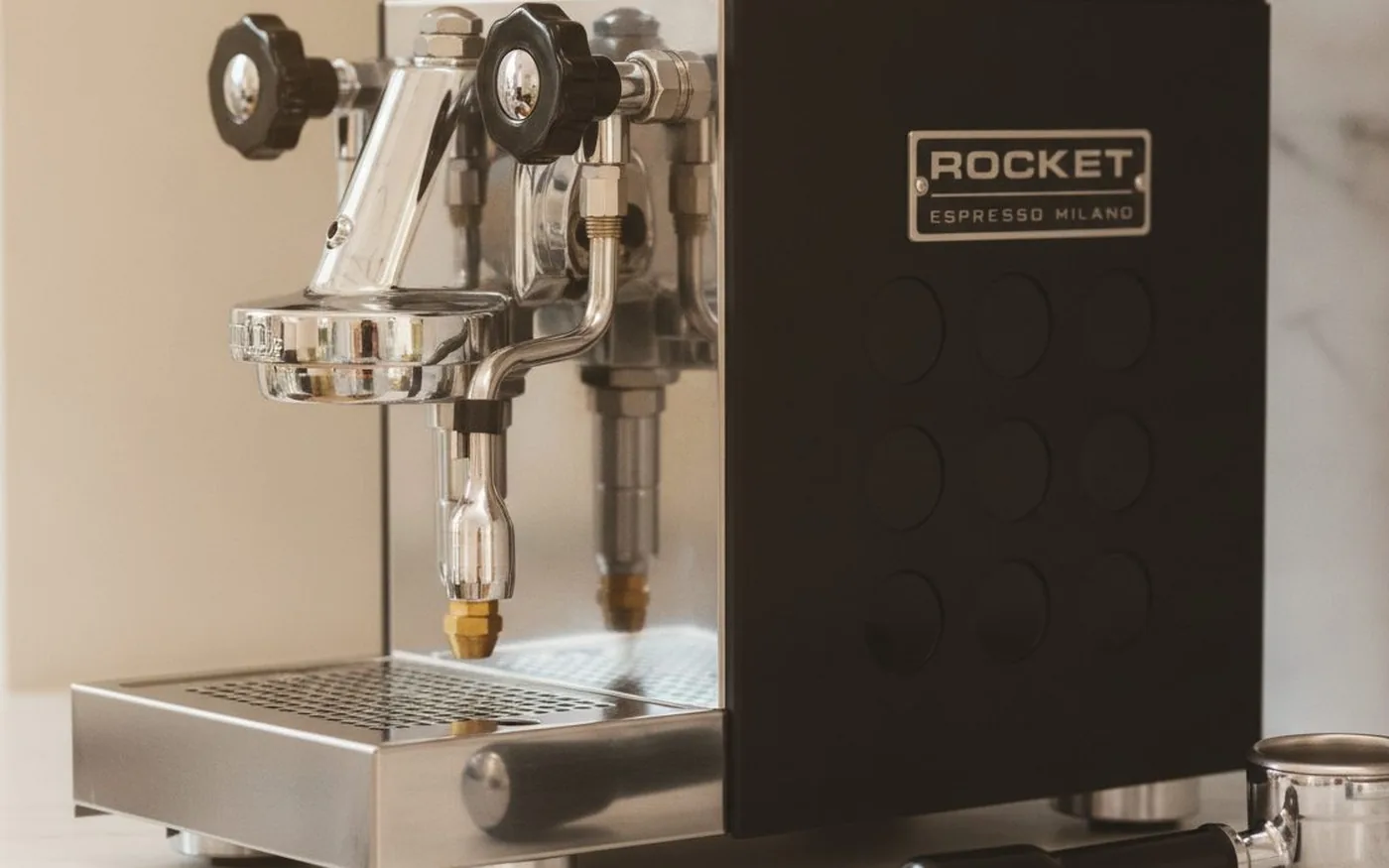
Rocket Espresso machines are hand-assembled in Milan. The Appartamento and Mozzafiato use 304-grade stainless steel shells, copper thermosiphon tubing, and brass boiler bodies. Every wearing component - gaskets, shower screens, steam wand tips, group head seals - is a standard replacement part available from any Rocket-approved service centre and from the independent prosumer community at home-barista.com prosumer forum. The E61 group head design has been in continuous production for over 60 years. Parts will exist for these machines in 30 years.
I have had my Rocket Giotto Evoluzione R for six years. Total maintenance cost: one set of group head gaskets (£12), one shower screen (£8), and a Puly Caff backflush kit every six months (£8 each time). The machine has required no professional service.
The Sage Oracle Touch is a different engineering philosophy. The thermocoil heating system, touchscreen interface, and sealed brew unit are well-engineered for a domestic machine at this price point, but they are not user-serviceable in the same way. The electronic components - the touchscreen, the auto-tamp mechanism, the self-texturing steam wand sensors - are failure points with no field-repair option. When the touchscreen on an Oracle Touch fails out of warranty, you are looking at a manufacturer repair at £200-400 or a replacement machine.
What is a prosumer espresso machine in terms of expected lifespan? A prosumer machine is distinguished from a domestic machine partly by service life. Entry-level domestic machines (£200-600) are typically designed for 3-5 years of daily use. A well-maintained prosumer machine should outlast the owner's interest in the hobby. Rocket machines have users reporting active daily use at 15-20 years. The Sage Oracle Touch sits in a middle category: better built than a standard domestic machine, with an expected service life of 7-10 years before electronics become a reliability concern.
Resale value is not academic. A Rocket Appartamento bought in 2026 for £1,300 will realistically sell for £600-900 in 2031 on the UK prosumer market (eBay, Bella Barista used). A discontinued Oracle Touch in 2031 will struggle to find buyers willing to pay premium prices for a machine with no current software support path.
Milk Drinks: Who Actually Wins
For milk-led households - flat whites, lattes, cappuccinos as the primary drink - the Oracle Touch is the honest recommendation.
The auto-steaming wand hits its target temperature reliably, produces milk texture suitable for latte art, and requires no skill. I tested this across the full two years I owned the machine. Every milk drink that came out of the Oracle Touch was good. None were transcendent. But in a household where the primary user is not a trained barista, "reliably good every time" beats "exceptional when perfectly executed and undrinkable when not."
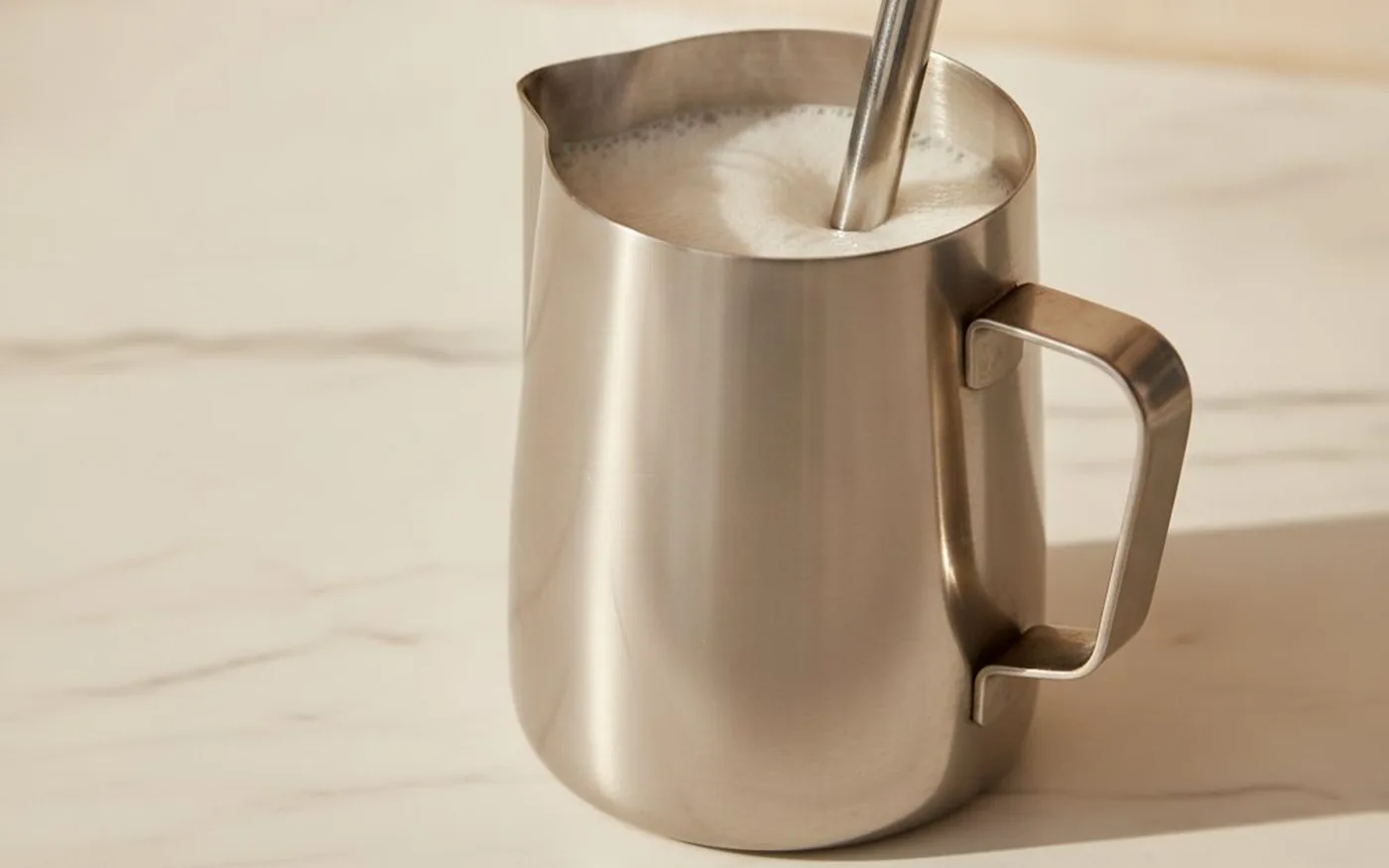
The Rocket steam wand at this price point is a commercial-grade wand. It produces faster, finer microfoam than the Oracle Touch in skilled hands. I know exactly where to hold the pitcher, the angle to use, and how to read the thermometer without touching it. That took me approximately three months of daily practice when I first moved to a traditional machine. If you are willing to spend those three months learning, the Rocket's milk output will eventually surpass the Oracle Touch's. If you are not, or if your household includes users who will not be learning steam wand technique, the Oracle Touch wins clearly on this axis.
One important framing: the Oracle Touch's steam wand does not give you "more margin" than a commercial wand because it runs at lower pressure. Lower pressure means slower texturing and requires you to manage the pitcher more deliberately. The Oracle Touch makes it easier because it removes your judgment from the equation, not because lower-pressure steaming is inherently simpler.
Buyer Profile Recommendations
You are a first-time buyer at the £2,000 mark, and you drink mostly flat whites and lattes.
Buy the Sage Oracle Touch while you can still find stock. The workflow suits you. You will drink consistently well-made milk drinks every morning without a learning curve. Factor the discontinued status into your purchase - if you want a machine with a longer support window, look at the Oracle Jet instead (Sage's current flagship) or budget up to the Rocket Mozzafiato Type V with a mid-range grinder for a longer-horizon investment.
You already own a Sage Barista Express or Barista Pro and you want to upgrade.
This is the most common Rocket buyer profile on UK forums. Buy the Rocket Appartamento TCA plus the Eureka Mignon Specialita or Niche Zero. You already understand manual workflow - grind, dose, tamp, pull, steam. The Appartamento is a significant step up in cup quality and build longevity. The learning curve from a Barista Express to the Appartamento is shorter than from a pod machine because you already have the muscle memory. Our Sage Barista Express review covers how the machine performs at that starting level.
You want the best espresso you can buy under £2,500, and you do not care about automation.
Rocket Mozzafiato Type V. The PID-controlled HX machine with the Cronometro V shot timer gives you precise extraction temperature management at a price point significantly below the R58 Cinquantotto. Pair it with the Eureka Mignon Specialita (£400) and you have a setup that outperforms the Oracle Touch on espresso quality in experienced hands by a clear margin.
You want a 20-year machine and you have the budget.
Rocket R58 Cinquantotto. The dual-boiler flagship is the only machine in this comparison that lets you steam and extract simultaneously without thermal management. It is £2,500-3,000 before a grinder, but it is the machine you buy once. Profitec and Lelit Bianca are worth considering at this price point as well.
Your household wants fast coffee with no faff, every single morning.
Oracle Touch, full stop. Or the Oracle Jet if you want a machine with an active production life. Either way, the super-automatic category is right for you. See our Sage Oracle Jet review for the current-generation comparison.
| Your situation | Our recommendation |
|---|---|
| First-time £2k buyer, milk-led | Oracle Touch (stock) or Oracle Jet (current production) |
| Upgrading from Barista Express | Rocket Appartamento TCA + Niche Zero |
| Serious espresso, no automation needed | Rocket Mozzafiato Type V + Eureka Specialita |
| Want a 20-year machine | Rocket R58 Cinquantotto |
| Fast mornings, no fuss | Oracle Touch or Oracle Jet |
Where Each One Fails
Every machine has an honest failure mode. These are the situations where the wrong choice costs you more than money.
Sage Oracle Touch failure modes:
Locked grind range. The built-in grinder covers espresso well but cannot go coarse enough for filter coffee. If your coffee interests expand, it is a dead end.
Touchscreen electronics. Any screen failure, sensor fault, or firmware issue out of warranty pushes you into a repair or replacement decision quickly. The discontinued status means long-term firmware support is now on a countdown clock.
Limited pressure variability. You cannot pressure-profile a shot on the Oracle Touch. For specialty single-origin espresso where pressure profiling makes a material difference to the cup, the Oracle Touch hits a ceiling. If your bean interests grow, you will outgrow the machine.
Repair cost. Sage UK service for an out-of-warranty Oracle Touch is not cheap. An independent repair on sealed electronics often ends up at more than the machine is worth.
Rocket espresso machine failure modes:
The learning curve is real. Your first month of shots will not be good. This is not a reflection of the machine - it is a reflection of the workflow. Every variable is manual. If you cannot tolerate a month of mediocre shots while you learn, this is the wrong choice.
Grinder is a required additional purchase. Factor £300-600 into your budget before you spend a penny on the machine.
Warm-up time is non-negotiable on HX machines. You cannot rush an E61 group head. The Appartamento needs 15-20 minutes. The Mozzafiato's PID cuts this slightly but does not eliminate it.
No automation. If anyone else in your household needs to operate the machine without instruction, they will struggle. The Oracle Touch is multi-user by design. Rocket machines are single-operator by practice.
What We Would Buy at This Price
I drink two espressos per day, black, no milk. For my situation, I would buy the Rocket Mozzafiato Type V and a Eureka Mignon Specialita. The PID-controlled HX machine with a quality flat burr grinder is the combination that consistently produces the cup I am looking for - the Aurora Reserve single-origin we roast at Balance Coffee rewards this setup with a shot that has clarity at the front and a long clean finish. That combination, at around £2,400 all-in, is where I would put my money.
If I drank two flat whites per day and needed them in under 2 minutes every morning, I would buy the Oracle Jet (the current Sage flagship) rather than the Oracle Touch. The Oracle Touch is available, and it is still a good machine, but buying a discontinued product when the current-generation replacement is available is a value calculation that does not add up at the £1,800-2,100 price point. See our Sage Oracle Jet review for a full comparison of the two Sage machines.
The beans we use for testing: We pulled every shot in this comparison on our own Aurora Reserve (Rocket, black espresso) and Rotate Espresso (Oracle Touch, milk drinks). Aurora Reserve is a Brazil single-origin with a chocolatey base and fruity undertones that responds well to careful manual extraction. Rotate Espresso is a 100% Mexico roast with a clean, rounded profile that works well through milk. If you want to taste what either machine is capable of at its best, try both. Aurora Reserve is available as Aurora Reserve via Balance Coffee and Rotate Espresso as Rotate Espresso via Balance Coffee.
“This article is published independently - we sell beans, not hardware, and have no commercial stake in the Rocket vs Sage decision. The testing used our own Balance Coffee roasts because we know exactly how they behave at the espresso machine.”
What Else at This Price
If neither the Oracle Touch nor the Rocket range is hitting your requirement exactly, two other machines deserve attention at the £2,000-2,500 price point.
Lelit Bianca is a dual-boiler E61 prosumer machine with an integrated flow control paddle. At around £2,100-2,300, it is a direct competitor to the Mozzafiato Type V and a more capable machine for pressure profiling. Our review is coming. Profitec Pro 600 is another dual-boiler option at a similar price, well regarded for build quality and temperature stability.
For a broader look at the prosumer category, our guide to the best Sage coffee machines covers how the Oracle Touch and Oracle Jet sit within the full Sage lineup. And for context on where the Oracle Touch sits within Sage's own range, our Sage Barista Pro review covers the step below it.
Verdict
The Rocket vs Sage Oracle Touch comparison resolves to a single question: what role do you want espresso to play in your morning?
If the answer is I want excellent coffee fast, consistently, every day, without becoming a barista - buy the Oracle Touch while stock lasts. If you want current production, buy the Oracle Jet. Either way, the super-automatic category is designed for you.
If the answer is I want to pull better and better shots over years, I want a machine that will still be working in 2040, and I am willing to spend three months learning the workflow - buy a Rocket. Which one depends on your budget and your use case. The Appartamento TCA is the entry point. The Mozzafiato Type V is the sweet spot. The R58 Cinquantotto is the machine you buy once.
Both routes have active affiliate programmes. Rocket machines are available from Bella Barista (Rocket's UK authorised distributor). The Oracle Touch and Oracle Jet are available from Sage direct and from John Lewis, Currys, and Amazon UK.
The best espresso machine is the one you use every morning for the next decade. Work out which workflow that is, and the choice makes itself.
Frequently Asked Questions
Has the Sage Oracle Touch been discontinued?
Yes. Sage confirmed the Oracle Touch as discontinued. The Oracle Jet is the current Sage flagship. Stock of the Oracle Touch remains at UK retailers at £1,799-2,099 as of July 2026. If you are buying new, the Oracle Jet's active production status is a meaningful factor in the long-term value calculation at a similar price point.
Is the Sage Oracle Touch worth £2,000 in 2026?
At under £1,900, remaining Oracle Touch stock is decent value for a milk-drink household wanting one-touch automation. At £2,099, the Oracle Jet is a stronger purchase because it is in active production. The discontinued status will reduce resale value and eventually affect software support. Buy below £1,899 or switch to the Oracle Jet.
What are the common problems with the Sage Oracle Touch?
Touchscreen faults and auto-tamp mechanism failures are the most reported UK ownership issues. Both require manufacturer repair rather than field fixes. The built-in grinder struggles on very fine specialty grind settings, causing inconsistent dosing on single-origin espresso. Descaling intervals are every 2-3 months in hard-water areas. Sage recommends its own descaling kits rather than third-party alternatives.
How long does a Rocket Appartamento last?
A well-maintained Rocket Appartamento has a realistic service life of 20 or more years. It uses standard wearing parts - group head gaskets, shower screens, steam tip o-rings - available from Rocket-approved service centres and the prosumer community. Active Home-Barista users report daily use of Rockets purchased in 2010-2012. Annual maintenance cost is typically under £50.
How long does a Sage Oracle Touch last vs a Rocket?
The Sage Oracle Touch has an expected service life of 7-10 years before electronic components become a reliability concern. A Rocket machine at the same price has an expected service life of 20-plus years. The Oracle Touch's sealed brew unit and touchscreen are the longevity limits; Rocket's E61 group head and copper internals are fully user-serviceable.
Is the Sage Oracle Touch as good as a Rocket?
For milk drinks and one-touch automation, the Oracle Touch matches a Rocket in practical daily use. For black espresso in skilled hands, a Rocket with a quality separate grinder produces a higher cup quality ceiling. Neither is objectively superior. The right machine depends on how you drink coffee and how much you want to engage with extraction.
Do you need a separate grinder with a Rocket espresso machine?
Yes, without exception. All Rocket espresso machines are sold without a grinder. Budget at minimum for a Sage Smart Grinder Pro (around £200) to start. For the Mozzafiato Type V or R58, a Eureka Mignon Specialita (£400) or Niche Zero (£500) matches the machine's capability better. Grind quality directly limits espresso quality; do not underbudget on the grinder.
Which is better for milk drinks, Rocket or Sage Oracle Touch?
For most households, the Sage Oracle Touch is better for milk drinks. The auto-steaming wand delivers consistent microfoam at a programmable temperature with no manual technique required. The Rocket's commercial steam wand produces finer microfoam in experienced hands, but requires proper technique and 2-3 months of practice to match the Oracle Touch's consistency. For no-skill milk drinks: Oracle Touch wins.
A wellness entrepreneur and biohacker, James explores the intersection of hospitality and health - from clean fuel and recovery tools to mindful routines that build balance into daily life.