The Gaggia Brera is a reliable, genuinely compact entry bean-to-cup machine - just know the De'Longhi Magnifica S is the more current rival at the price.
Table of Contents
Some of the links in this article are affiliate links, which help fund our independent review work at no extra cost to you. Every recommendation is based on hands-on testing through The Editor Lab methodology. No brand pays to appear, and no placement is guaranteed.
The Gaggia Brera is one of those machines that has been quietly sitting in the entry bean-to-cup conversation for well over a decade, and the question worth answering in this Gaggia Brera review is not whether it works. It does. The real question is whether a machine this old still deserves your money in 2026, now that the De’Longhi Magnifica S sits at the same price with newer parts behind it.
I have spent enough time with bean-to-cup machines to know the gap between a spec sheet and a morning routine. The short version: the Brera is a genuinely compact, reliable super-automatic that makes good coffee for its class, with two honest weak points you should know about before you buy. This review reflects first-hand use alongside the years I spent calibrating commercial bean-to-cup machines in the field, and every specification and the current UK price below were checked against the official Gaggia listing and UK stockists in June 2026.
Editor's Note
I started in coffee on the commercial side, recalibrating bean-to-cup machines in some of London’s biggest corporate accounts before I ever wrote a word about one. At UCC Coffee between 2012 and 2014 I programmed and dialled in Jura, Thermoplan, and Eversys automatics across law firms, high-street chains, and contract caterers, adjusting grind, dose, temperature, and volume through the settings menu alone. That is the lens I bring to a domestic super-automatic like the Brera: I judge it against what a properly dialled-in automatic can actually do, not against a marketing claim. I founded Balance Coffee, a UK coffee roaster, in 2020. We do not sell coffee machines.
Gaggia Brera Review: The Verdict
A super-automatic bean-to-cup machine grinds whole beans, doses, tamps, and extracts at the push of a button, with no separate grinder and no manual technique required. The Gaggia Brera is the compact, entry-level version of that idea, and on the core job it does well.
You get clean, consistent espresso and lungo from a 100% ceramic burr grinder, a footprint narrow enough to fit where most automatics will not, and the kind of mechanical simplicity that tends to keep working for years. The owners who keep these machines for a decade are not rare, and that says something real about the build of the parts that matter.
Where it shows its age is everywhere your hands actually touch it. The casing feels cheaper than the price suggests, and the manual milk wand asks more of you than a modern automatic should. None of that stops it making a good cup. It just means you are buying a machine designed before its current rivals existed.
Here is the honest framing. If you specifically want a Gaggia, need the small footprint, or like the hands-on milk wand, the Brera is a sound buy. If you are brand-neutral and simply want the best entry bean-to-cup at this price, you owe it to yourself to look hard at the De’Longhi Magnifica S first. It is the more current machine. I will lay out exactly why further down.
How the Brera Works: Grinder, Drinks and Controls
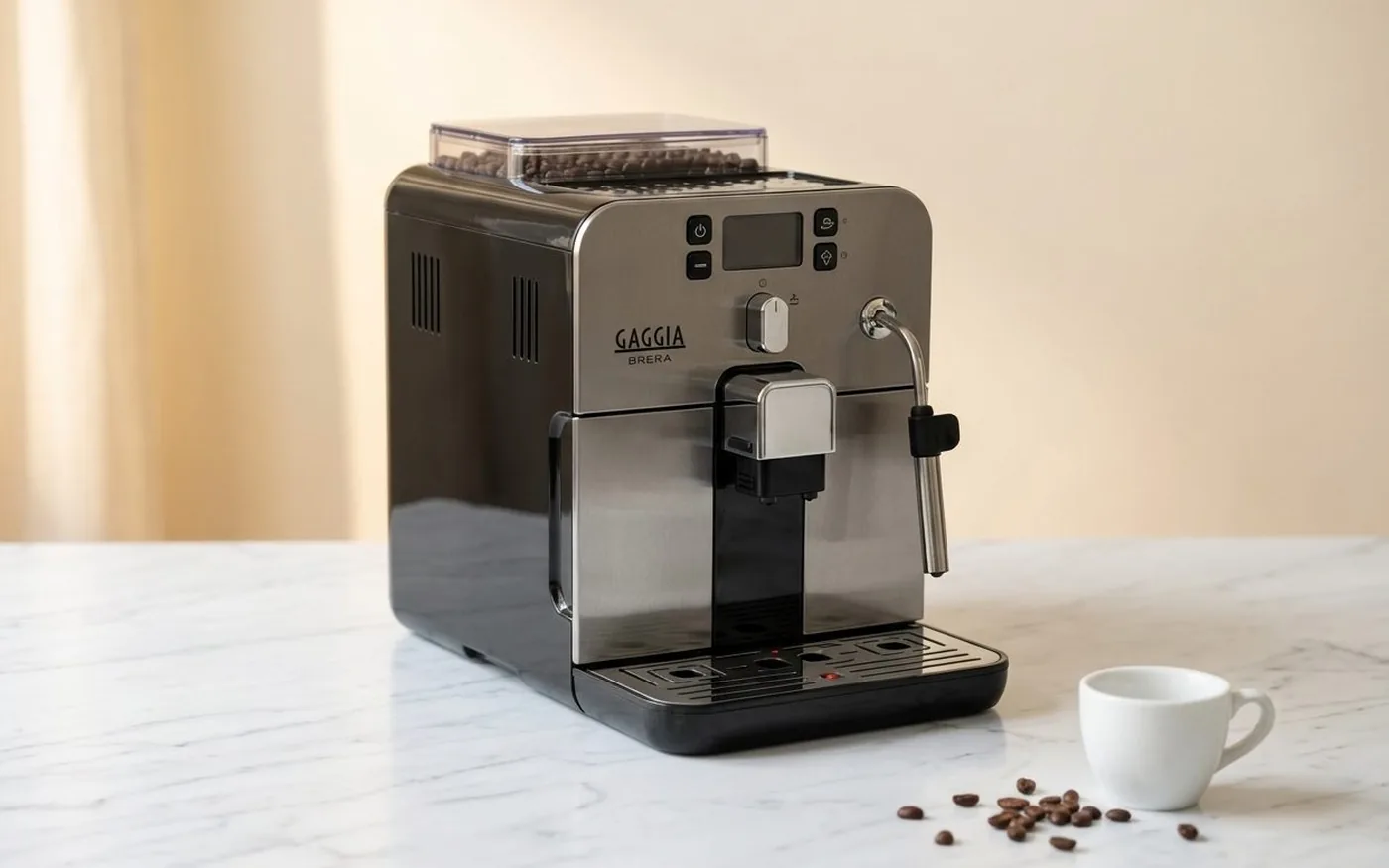
The workflow is the whole appeal of bean-to-cup, so it is worth walking through how the Brera runs day to day. You fill the 250g bean hopper, fill the 1.2-litre water tank, and select a drink. The machine grinds a fresh dose, tamps it inside a removable brew group, runs a pre-infusion that wets the puck before extraction, and pulls the shot. Spent grounds drop into an internal container that holds around eight pucks before it needs emptying. There is no portafilter to lock in and no grinder to buy separately.
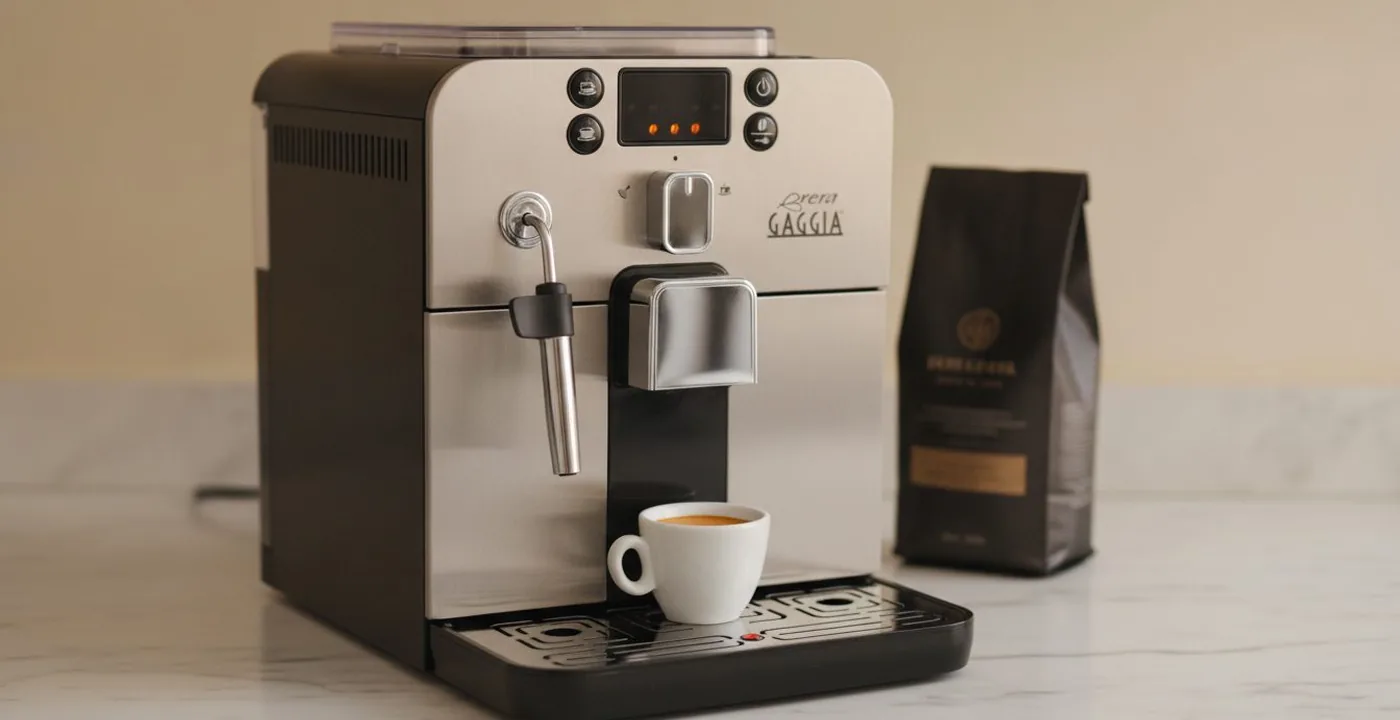
The Gaggia Brera's simple button-and-LED control layout.
The grinder is the part I always judge a super-automatic on, because a bean-to-cup machine lives or dies on grind consistency. Get the same grind every time and the cup is repeatable. Get drift and the whole point of the machine collapses. The Brera uses a 100% ceramic flat burr grinder, and ceramic is the right call here. It runs cooler than steel, so it will not cook the grounds on a busy morning, and it holds its edge for years. You adjust it across 5 settings by pushing and turning a knob inside the hopper while the grinder is running.
Five settings is the honest limit of the machine. It is enough to dial a roast in roughly, but it is coarse adjustment, not fine. If your taste develops and you start chasing a specific extraction, you will feel the ceiling. For most people making espresso and lungo at home, it lands where it needs to.
The controls are deliberately simple. Buttons and LED icons handle one-touch espresso and one-touch espresso lungo, a knob switches the machine to steam or hot water, and three things let you shape the cup: Gaggia’s Optiaroma sets the dose strength across three levels, a memo function lets you save your preferred cup length, and the pre-infusion adds body. There is also a ground-coffee bypass chute, which matters more than it sounds. It lets you brew a decaf or a second blend without emptying the hopper, which is the kind of small convenience you appreciate at 9pm. Full verified specifications are on the official Gaggia Brera product page.
The other thing the spec sheet undersells is the footprint. At 25.6cm wide it is one of the narrowest bean-to-cup machines you can buy, and the water tank, grounds container, and drip tray all pull out from the front. If your worry is whether a super-automatic will swallow your worktop, the Brera is the answer to that specific anxiety. It fits where a wider De’Longhi or Jura simply will not. If you are weighing the whole Gaggia range rather than just this model, our guide to the best Gaggia coffee machine sets the Brera against its stablemates.
Coffee Quality and What to Put In It
The Brera makes good, repeatable espresso and lungo for an entry bean-to-cup machine, and that is the headline you want. Pre-infusion gives the shot a bit more body than you expect at this price, the 15-bar pump and ceramic grinder do their jobs, and once you have dialled the grind across two or three brews the cup settles into something genuinely enjoyable. It is not specialty-cafe espresso, and a super-automatic at this money never is, but it clears the bar for a reliable everyday coffee comfortably.
The honest constraint is the same one I flagged on the grinder. With 5 grind steps you are working in broad strokes, so you optimise the cup with beans and Optiaroma rather than precision grinding. That is not a flaw unique to the Brera. It is the trade every entry automatic makes.
Here is the part most reviews skip, and it is the part that actually moves your cup. Super-automatics are unusually sensitive to bean quality, far more than a manual machine where you control every variable. The grinder, dose, and extraction are fixed by the machine, so the one big lever you hold is what you put in the hopper. A clean, consistent roast dials in noticeably better than a cheap, oily, commodity dark roast, which can clog the grinder and bury the cup in bitterness. The Specialty Coffee Association sets out why grind and extraction consistency matter so much to the final cup, and on an automatic the bean is doing a lot of that work for you. If you want the general guidance on choosing beans, our roundup of the best coffee beans uk covers it across roasters.
A note in the interest of transparency, since I founded Balance Coffee: we do not sell coffee machines, but we do roast coffee, and the bean point above is one I have a commercial interest in. With that said plainly, a clean single-origin espresso roast such as Balance Coffee’s Rotate Espresso is the kind of consistent, low-oil bean that suits an automatic, precisely because the machine cannot compensate for a roast that fights it. The principle holds whatever brand you choose: feed an automatic a clean, consistent bean and it rewards you.
Build Quality and the Steam Wand
This is the section where I have to be straight with you, because it is where the Brera’s age shows and where most reviews go soft to protect a sale.
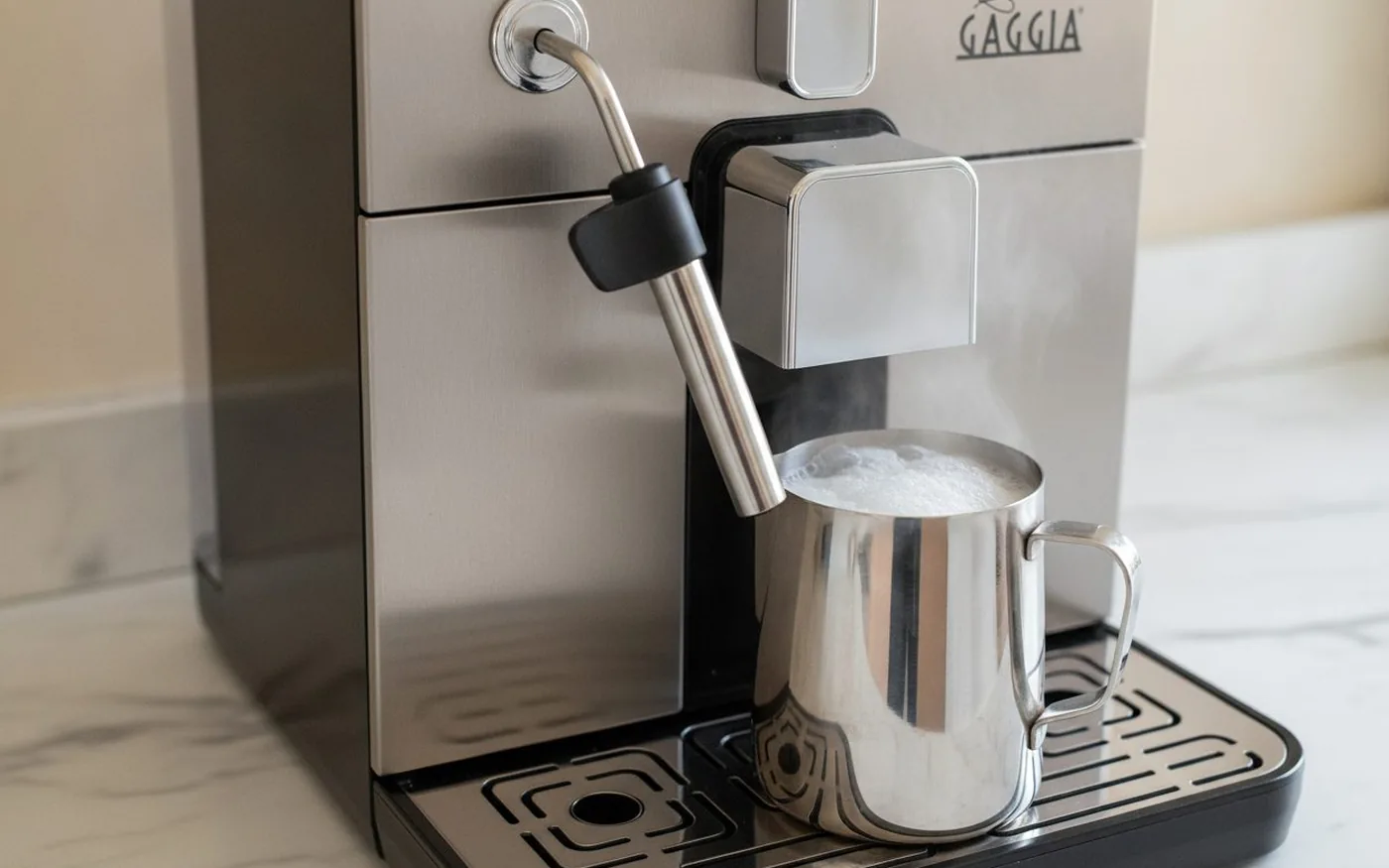
The manual Pannarello wand froths milk rather than texturing true microfoam.
The Brera’s build quietly undersells its price. The casing is largely black ABS plastic with a stainless steel front panel, and while that front looks the part in photos, the machine feels lighter and cheaper in the hand than a £400-plus price tag implies. The manual Pannarello steam wand is the bigger issue. It will froth milk for a basic cappuccino, and the steam pipe heats up quickly once you switch the knob over, but a Pannarello aerates milk rather than texturing it. It will not give you the tight, glossy microfoam that latte art needs, and no amount of practice changes the physics of the tool.
I want to be fair about what that wand is and is not. I have worked on commercial machines most home users will never touch, where higher boiler pressure textures milk into microfoam quickly and forgivingly. The Brera is not in that conversation, and it is not trying to be. For someone making a flat white or a cappuccino at home and not chasing a rosetta, the Pannarello does the job. It steams milk hot, it adds foam, and it is genuinely simple to use. The honest framing is this: it is adequate for milk drinks, limited for milk art, and that ceiling is fixed by the hardware, not your skill.
The flip side of the simple build is reliability. The brew group pulls out and washes under the tap, the machine flags when it needs descaling, and there is very little clever electronics to fail. These machines have a real reputation for lasting, and that plain mechanical honesty is part of why. You are trading a premium feel for a machine that tends to keep going, and depending on what you value, that is not a bad trade.
If milk-based drinks are your main reason for buying, set your expectations here before you commit, not after.
Gaggia Brera vs De’Longhi Magnifica S
This is the comparison that decides the purchase for most people, because the De’Longhi Magnifica S sits at a very similar price and is the machine a brand-neutral buyer is genuinely choosing between. So I will make the call cleanly.
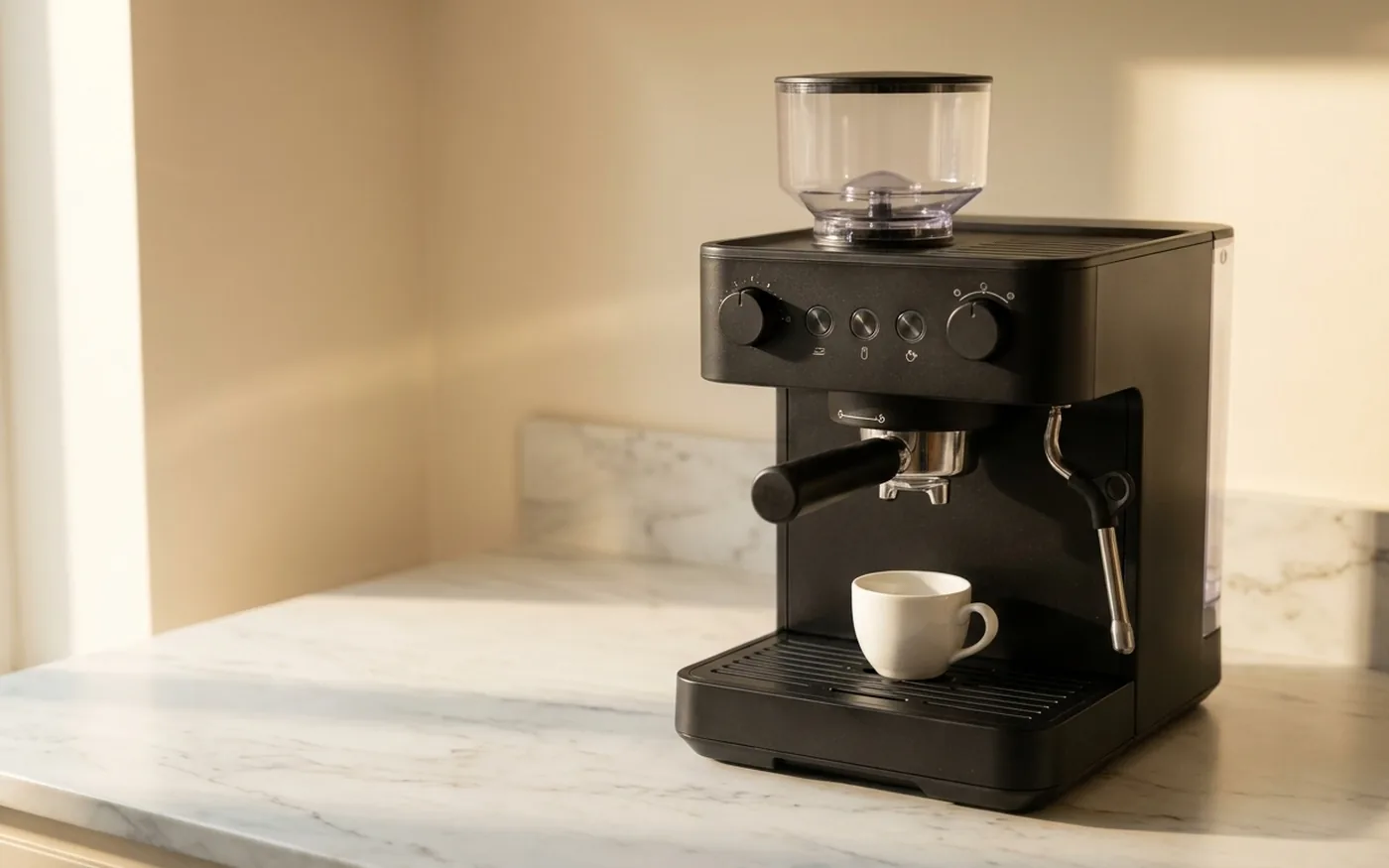
The De'Longhi Magnifica S, the Brera's closest price-and-class rival.
If brand is not a factor, this is the honest verdict: at the same money the Magnifica S is the more current machine. It uses newer machine architecture, a more intuitive control layout, and in side-by-side use it extracts slightly more consistently shot to shot. It is also the machine that gets refreshed and replaced in De’Longhi’s range, where the Brera has stayed largely the same for years. For a buyer who just wants the best entry bean-to-cup at this price and has no loyalty either way, the Magnifica S is the one to evaluate first. The independent testers at Which? cover both bean-to-cup machines in their UK testing if you want a second reference point.
The Brera does not lose this on every front, though, and the two places it wins are real. The first is footprint. At 25.6cm wide it is meaningfully narrower than the Magnifica S, and in a tight UK kitchen that is not a tie-breaker, it is the whole decision. The second is the manual wand. The Magnifica S also uses a manual frother, but buyers who specifically want hands-on control over their milk, rather than a one-touch system, will find the Brera’s Pannarello familiar territory.
So the split is clean. Buy the Magnifica S for the more modern machine and slightly better consistency. Buy the Brera if the compact size or the Gaggia name matters to you specifically. The closest sibling in Gaggia’s own range is the larger gaggia anima review, and for the broader brand-versus-brand picture there is a dedicated gaggia vs delonghi comparison. If you want to see how the Magnifica S ranks across the wider De’Longhi lineup, our guide to the best delonghi coffee machine places it in context.
Who Should Buy the Gaggia Brera
The Brera is the right machine for a specific buyer, and naming that buyer is more useful than a blanket recommendation.
Buy it if you want the bean-to-cup convenience of fresh-ground coffee at the push of a button without the price or the bulk of a mid-range automatic, and you specifically value a compact footprint that fits a small kitchen. Buy it if you want a Gaggia, like the simplicity of a manual milk wand, and care more about a machine that lasts than one that feels premium. For that person, the Brera has earned its long run for good reason, and it will make you a reliable coffee every morning.
Do not buy it if you are brand-neutral and simply want the strongest entry bean-to-cup at this price, because the De’Longhi Magnifica S is the more current machine and the more sensible default. Do not buy it if microfoam latte art is the point of the purchase, because the Pannarello wand cannot deliver it. And do not buy it expecting a premium feel in the hand, because the build is the clearest place it shows its age.
The Brera is a good machine that is honest about what it is. Know which buyer you are, and the decision is simple. The compact, reliable bean-to-cup that still makes a good cup, as long as you go in with your eyes open on the build and the wand.
Specification Table
Specification
Gaggia Brera
Machine type
Super-automatic bean-to-cup espresso machine
Price (as of June 2026)
Around £425 via the official Gaggia UK distributor; widely available from around £350 on Amazon UK depending on stock and colour
Grinder
100% ceramic flat burr, integrated
Grind settings
5
Drinks
Espresso, espresso lungo, hot water, steam (one-touch espresso and lungo)
For its class, yes. The Gaggia Brera is a good entry-level super-automatic that makes clean, consistent espresso and lungo from a fresh-ground bean, helped by pre-infusion and a 100% ceramic grinder. It is not specialty-cafe quality, and the 5 grind settings limit fine tuning, but for reliable everyday coffee at the push of a button it performs well.
Is the Gaggia Brera worth it?
It is worth it for the right buyer. If you want a compact, reliable bean-to-cup machine and value the small footprint or the Gaggia name, the Brera earns its place and tends to last for years. If you are brand-neutral, the De’Longhi Magnifica S is the more current machine at the same price and the more sensible default for most people.
What are common problems with the Gaggia Brera?
The two most common complaints are a build that feels cheaper than the price suggests, with plenty of plastic behind the steel front panel, and a manual Pannarello wand that froths milk but cannot make microfoam for latte art. Like any bean-to-cup machine, it also needs regular descaling and brew-group cleaning to keep running well.
Is Gaggia better than DeLonghi?
Neither brand is universally better, it depends on the model. At the entry bean-to-cup price, the De’Longhi Magnifica S is the more current machine and extracts slightly more consistently than the Gaggia Brera. The Brera wins on a genuinely compact footprint. Pick by what matters to you: footprint and the Gaggia name, or newer architecture and consistency.
Can the Gaggia Brera make lattes?
It can make milk drinks, with a caveat. The manual Pannarello wand steams and froths milk hot enough for a cappuccino or a basic latte, but it aerates rather than textures, so it will not produce the tight microfoam that proper latte art needs. For an everyday milky coffee it is fine. For barista-grade foam it is the machine’s clearest limit.
What is the Rolls Royce of coffee machines?
That title usually goes to high-end commercial and prosumer espresso machines such as La Marzocco or Victoria Arduino, machines I have worked on in professional settings, where the price runs into thousands. The Gaggia Brera is at the opposite, entry-level end of the market. It is built for convenience and reliability rather than top-tier performance, and it is priced accordingly.
What are the common problems with Gaggia?
Across Gaggia’s automatic range the recurring themes are descaling and brew-group maintenance, both of which are normal for any bean-to-cup machine and manageable with regular cleaning. On the manual side, Gaggia machines reward a learning curve rather than offering one-touch ease. The Brera specifically draws comments on its plastic-heavy build and its basic milk wand.
Gaggia Brera vs Gaggia Classic Pro - which should I buy?
They are different machines for different people. The Brera is a fully automatic bean-to-cup that grinds and brews at the push of a button, ideal if you want convenience. The Gaggia Classic Pro is a manual espresso machine that needs a separate grinder and hands-on technique, ideal if you want to learn the craft. Choose the Brera for ease, the Classic Pro for control.
A wellness entrepreneur and biohacker, James explores the intersection of hospitality and health - from clean fuel and recovery tools to mindful routines that build balance into daily life.