De'Longhi Stilosa Review 2026: Honest Verdict

Coffee & Wellness Writer
The cheapest realistic way into proper espresso in the UK, defined by one genuinely good decision and a long list of honest compromises.
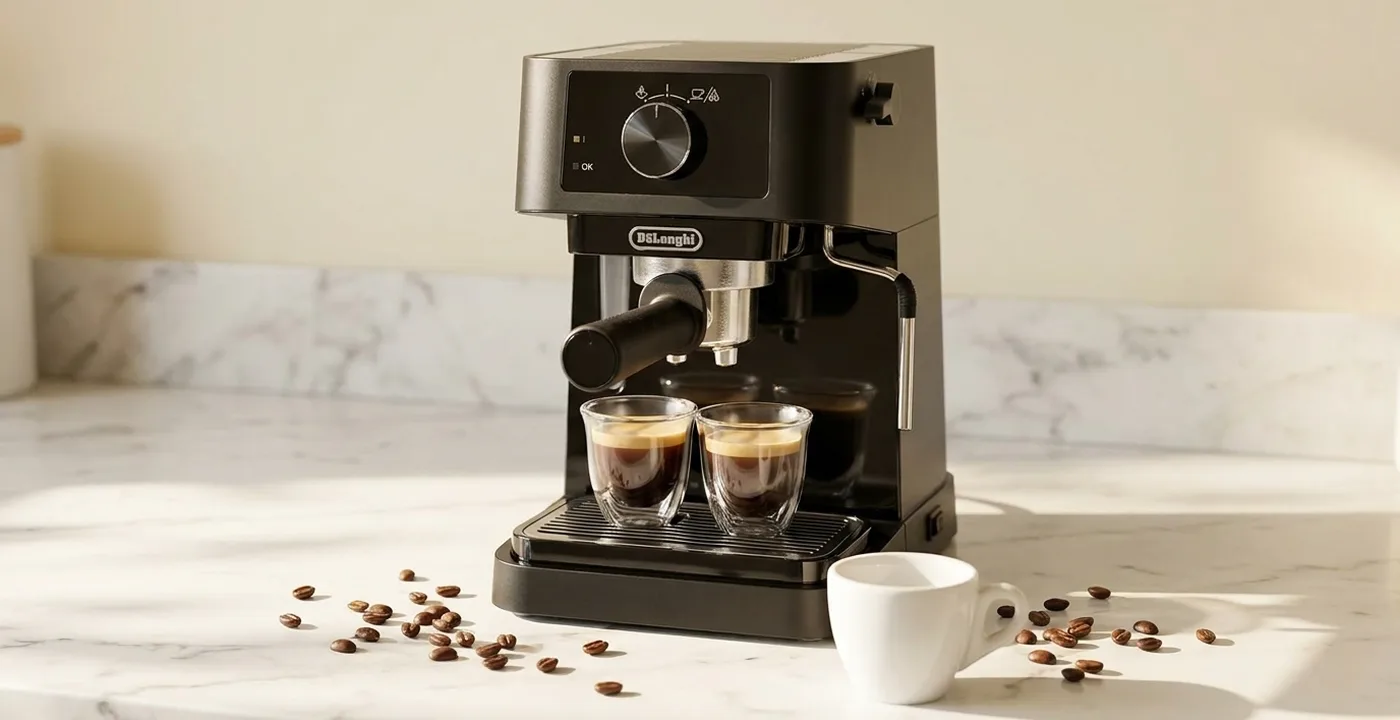
Table of Contents
Some of the links in this article are affiliate links, which help fund our independent review work at no extra cost to you. Every recommendation is based on hands-on testing through The Editor Lab methodology. No brand pays to appear, and no placement is guaranteed.
Editor's Note
Overall: 3.8 / 5
Best for: First-time espresso buyers on the tightest budget who want a real metal steam wand.
Not for: Anyone who wants a forgiving, fuss-free machine or a premium build.
UK price: From around £99 (as of May 2026).
One-line verdict: The cheapest realistic way into proper espresso in the UK, defined by one genuinely good decision and a long list of honest compromises.
Can a manual espresso machine that costs less than dinner for two actually make real espresso? That is the question the delonghi stilosa review searches really ask, and it is the one this piece answers. The De'Longhi Stilosa EC230 sits at the entry door of De'Longhi's manual range, often the cheapest way in the UK to put a proper portafilter on a kitchen counter. Most reviews of the Stilosa stop at the price tag. This one starts at the steam wand, which is where the real story sits.
This review reflects first-hand use of the Stilosa EC230 plus manufacturer-level espresso machine training, and every spec and the current UK price was web-verified at time of writing in May 2026. The machine is judged on what it does, what it cannot do, and which buyer should ignore reviewers calling it "great value" and which buyer should hear that phrase as a warning.
Editor's Note
Fourteen years in coffee, five of those spent inside a traditional espresso machine manufacturer being trained on the same engineering that powers the machines I now review. I worked alongside world-class baristas on the Sanremo SWAT team, including 2015 World Barista Champion Sasa Sestic, and visited almost 300 UK roasteries during that period. Disclosure: I founded Balance Coffee, a UK coffee roaster, in 2020. We do not sell coffee machines, so this review recommends no product of mine.
De'Longhi Stilosa Review: The Verdict
The Stilosa punches above its sub-£100 price tag for one specific reason, and trips over its own price tag for a longer list of reasons that the buyer has to be ready for before they hand over £99. The single decision that makes the machine worth recommending is the metal steam wand. The single problem that makes it frustrating is everything else around that wand.
The Stilosa is De'Longhi's entry-level manual espresso machine, currently available in the UK from around £99 (as of May 2026, verified across De'Longhi UK, Amazon UK, Argos, and John Lewis). It is a 15-bar pump machine with a stainless steel boiler, a standard 51mm portafilter, and a real metal steam wand rather than the Pannarello frother that almost every other budget machine ships with. That is the headline.
The catch is that everything else has been built down to the price. There is no pressure gauge, no PID temperature control, no over-pressure valve, no shot timer, and a body that is largely plastic. The water tank holds around one litre. The single boiler takes about a minute to warm up, and then a further wait between brewing espresso and steaming milk. None of these compromises is a fault. They are how De'Longhi gets the price under £100. The buyer who understands that walks away happy. The buyer who expects forgiveness from a budget manual machine will not.
The honest framing: this machine costs roughly one-third of a Sage Bambino Plus and one-fifth of a Sage Barista Pro. Judge it on that scale, not on the scale of a £1,500 prosumer machine, and the Stilosa starts to make sense.
What You Get for Around £100
For around £99 you get a real manual espresso machine with a 15-bar vibration pump, a stainless steel single boiler, a 51mm portafilter with single and double baskets, a removable drip tray, a roughly one-litre water tank, and the metal steam wand that earns the machine most of its goodwill. No frills, no electronics beyond two buttons and a power light, and no help.
The body is plastic-heavy with stainless steel accents on the front fascia and the steam wand. It feels light when you lift it, around 4kg, and the build communicates exactly what it is: a budget machine engineered to a price. The footprint is compact at roughly 27cm wide by 28cm deep, which makes it a realistic option for small kitchens where counter space is the real constraint, not budget.
The portafilter is the standard 51mm De'Longhi size, which means the basket options are limited compared with the 58mm standard the specialty world uses, but the supplied baskets work as designed. The Stilosa EC230 currently ships with two single-wall baskets in the UK, although De'Longhi has shipped the machine with different basket combinations over its life, so verify what is in the box when you buy. The single-wall baskets reward a decent grind and proper technique. They will punish stale supermarket pre-ground.
Two things are missing that you would expect on a more expensive machine. There is no over-pressure valve, which we will come back to, and there is no PID temperature control, which means the boiler temperature varies more between shots than it does on a Sage Bambino or a Gaggia Classic Pro. For around £99, the absences are honest. You are paying for a working manual espresso machine and a real steam wand, not for the electronic refinements that sit above it.
If you are deciding between this and any Pannarello-equipped budget rival, the steam wand alone is the reason to choose the Stilosa.
Espresso Quality: Honest Expectations at This Price
A properly extracted espresso is defined by the Specialty Coffee Association as a 25-35ml shot pulled in 20-30 seconds at around 9 bar of brew pressure (see the Specialty Coffee Association for the full extraction reference). The Stilosa, dialled in with a decent grind and fresh beans, gets there. Hands-on testing across multiple sessions, plus consistent reports from other reviewers who have measured extraction yields, confirms the machine can produce a genuinely good shot in the cup. The catch is everything that has to be true before that shot lands.
The Stilosa gives the user no help. There is no pressure gauge to tell you whether you are at 9 bar or 11. There is no shot timer. There is no PID, so the boiler temperature drifts a few degrees between shots in ways a more refined machine would correct for. There is no over-pressure valve, so if your grind is too fine the machine simply forces water through at higher pressure rather than releasing it. You read the shot from the cup, not from instruments.
In practice, that means the Stilosa rewards the user who is willing to learn dose, grind, and tamp pressure as one connected variable, and frustrates the user who wants the machine to absorb mistakes. With a half-decent grinder and freshly roasted beans (the best coffee beans uk matter as much as the machine here, see our best coffee beans uk guide), the Stilosa pulls a shot that holds its own against machines three times the price. Without those inputs, it pulls a shot that tastes like the budget machine it is.
The pressurised vs single-wall basket question matters here. Some Stilosa shipments include a pressurised basket alongside the single-wall, which acts as a forgiveness layer for pre-ground coffee at the cost of mouthfeel and crema authenticity. Other shipments are single-wall only. Check the box before you buy, and budget for a separate grinder of at least the Sage Smart Grinder Pro or Baratza Encore tier if you want to take the single-wall basket seriously. A grinder will add £130-£150 to the total cost and roughly the same counter footprint as the machine itself, which is the moment many buyers should pause and ask whether the best espresso machine under 500 range makes more sense than the Stilosa plus a grinder. Judge the shot once technique is in place, not on the first three tries.
The Steam Wand Surprise
The Stilosa includes a proper metal steam wand. That sentence reads bland on the page. In a sub-£100 manual espresso machine it is genuinely rare, and it is the feature that separates the Stilosa from every Pannarello-equipped rival at the same price.
A Pannarello is a plastic sleeve over a basic wand that aerates milk by injecting air through pre-set holes. It produces foam, technically, but the foam is large-bubbled and dry, more like cappuccino topping from a sachet than the silky microfoam a flat white needs. A bare metal wand, used correctly, produces the dense, paint-like microfoam that pours latte art and integrates with espresso rather than sitting on top of it.
The Stilosa's wand has a single-hole tip, low pressure compared with a commercial machine, and a slow texturing curve. Having worked on Sanremo Opera, La Marzocco Linea, and Victoria Arduino Eagle commercial machines daily, the step up to commercial steam pressure is real and noticeable. The Stilosa is not trying to compete with those machines, and for the home barista learning to texture milk for the first time, the lower pressure rewards patience and deliberate wrist position. It does the job. It will not feel like a commercial wand.
The proof is in the cup. With around 150ml of cold whole milk in a 350ml jug, the Stilosa textures to roughly 60-65°C with proper microfoam in about 35-45 seconds. The result pours flat whites and lattes that look and taste like flat whites and lattes, not like coffee with cappuccino foam dumped on top. This single feature is why the Stilosa is recommended over pricier Pannarello-only rivals for any buyer who wants real milk drinks at home.
The Compromises: Portafilter Sneeze, No OPV, Plastic Build
Portafilter sneeze is the wet spatter of coffee grounds that sprays from the portafilter when you release it after a shot. It happens when residual pressure in the brew chamber has not had a chance to release, and on machines without an over-pressure valve it is unavoidable. The Stilosa has no OPV, so portafilter sneeze is the daily reality the price tag hides.
The fix is technique, not engineering. Wait 10-15 seconds after the shot finishes before twisting the portafilter out. The residual pressure dissipates, and the sneeze becomes a damp puck rather than a wet coffee fan across the worktop. If your grind is too fine, no waiting period will save you. Coarsen the grind, and the problem largely disappears. None of this makes the absence of an OPV pleasant, but the price of an OPV-equipped machine is around three times higher.
The plastic-heavy build is the second compromise. The water tank, drip tray, top panel, and rear housing are all plastic. The portafilter handle is plastic on the inside under a metal sleeve. The machine feels light when you lift it, around 4kg, where a similarly sized Sage Bambino sits closer to 5kg with more steel content. None of the plastic feels likely to fail, but it feels what it is: a budget machine. There is no premium tactile reward when you lift the portafilter or turn the steam knob.
The third compromise is the single boiler and the waits it produces. From cold, the boiler reaches espresso temperature in around 40-60 seconds. After pulling a shot, the boiler must climb to steam temperature before you can texture milk, which takes another 30-40 seconds. After steaming, you cannot pull another shot until the boiler cools back down, which means running water through the group head for 10-15 seconds first. None of this is unusual at the price. It is part of why a Sage Bambino Plus (dual ThermoJet heating) costs three times more.
These are not faults. They are the price compromises De'Longhi made to get the machine under £100. The buyer who knows them in advance is happy. The buyer who discovers them after purchase posts the angry Amazon review.
Stilosa vs Dedica vs Stepping Up
The choice the Stilosa buyer often did not realise they were making is between three machines at three different price tiers. The honest comparison sits below.
| Machine | UK Price (May 2026) | Steam Wand | Boiler | OPV | Best For |
|---|---|---|---|---|---|
| De'Longhi Stilosa EC230 | From £99 | Metal, single-hole | Single | No | Tightest budget, learners |
| De'Longhi Dedica EC685 | From £179 | Pannarello (Pro versions: metal) | Single ThermoBlock | Yes (Dedica Maestro) | Slim kitchens, pressurised basket users |
| Sage Bambino Plus | From £399 | Automatic milk texturing wand | Dual ThermoJet | Yes | Milk drinks without the learning curve |
The delonghi dedica review is the natural step up if you want a slimmer footprint and a more forgiving pressurised basket experience, but the original Dedica ships with a Pannarello frother rather than a real metal wand, which gives the Stilosa the edge on milk texturing despite the price gap. The newer Dedica Maestro and Dedica Arte variants close that gap with metal wands. Verify which Dedica the listing is selling before you compare.
The honest step up is the Sage Bambino Plus, which is four times the price of the Stilosa but introduces a dual ThermoJet heating system (no waits between espresso and steam), an automatic milk texturing wand, and an over-pressure valve. The Bambino removes most of what the Stilosa makes you do yourself. The cost is the cost.
For independent UK testing context, Which? coffee machine reviews place the Stilosa alongside the Dedica in their budget category, and the wider De'Longhi range is covered in our best delonghi coffee machine guide. If you are looking at bean-to-cup as an alternative, the De'Longhi Magnifica review is a fair head-to-head against a machine that automates the espresso entirely.
The steer per buyer: tightest budget and willing to learn, Stilosa. Slim kitchen and pre-ground convenience, Dedica. Milk drinks without the learning, Bambino Plus.
Who Should Buy the De'Longhi Stilosa
If you are buying your first espresso machine and your budget is around £100, the Stilosa is the right call. The metal steam wand alone is the reason to choose it over any Pannarello-equipped rival at the same price, and the standard portafilter rewards the same techniques you would use on a £1,500 machine. You will learn faster on the Stilosa than on a more forgiving budget machine because the Stilosa gives you nothing to hide behind.
If you already know how to dose, grind, and tamp, and you want a cheap second machine for a kitchen, an office, or a holiday flat, the Stilosa is a serviceable working tool. It will not delight you, but it will produce a real espresso every morning for years.
If you want a forgiving, fuss-free, push-button experience and you have £400 to spend, do not buy the Stilosa. Buy the Sage Bambino Plus and skip the learning curve. If you are weighing the Stilosa against any bean-to-cup machine at the same price, the bean-to-cup will give you more reliable convenience at the cost of every variable that makes espresso interesting. That is a personal call.
If you want a machine that feels premium, do not buy the Stilosa. The plastic build is what it is. Spend more, or spend less and accept the trade-off.
Specification Table
| Spec | Value |
|---|---|
| Model | De'Longhi Stilosa EC230 |
| UK price (May 2026) | From £99 |
| Pump pressure | 15 bar |
| Boiler type | Single, stainless steel |
| Portafilter | 51mm, plastic-handled |
| Baskets | 1-cup and 2-cup single-wall (varies by shipment) |
| Steam wand | Metal, single-hole |
| Water tank | ~1 litre, removable |
| Heat-up time | ~40-60 seconds from cold |
| Dimensions (W x D x H) | 27 x 28 x 30 cm |
| Weight | ~4kg |
| Warranty (UK) | 2 years |
| Manufacturer source | De'Longhi UK (https://www.delonghi.com/en-gb/) |
Frequently Asked Questions
Is the De'Longhi Stilosa good for beginners?
Yes, with the right expectation. The Stilosa is designed for first-time espresso buyers on a sub-£100 budget who want a real portafilter machine. It rewards learners willing to develop dose, grind, and tamp technique, because the lack of PID, gauge, or over-pressure valve forces you to read the shot from the cup rather than the instruments. Forgiving it is not, accessible it is.
Does the De'Longhi Stilosa froth milk?
Yes, and notably better than almost any other sub-£100 machine. The Stilosa includes a real metal steam wand rather than the plastic Pannarello frother that ships on most budget rivals. Used correctly, it produces dense microfoam suitable for flat whites and lattes, not just cappuccino topping. The texturing is slower than a commercial machine because the steam pressure is lower, which suits learners.
Why does my Stilosa portafilter spray coffee?
This is portafilter sneeze, and it happens because the Stilosa has no over-pressure valve to release residual brew chamber pressure after the shot. Wait 10-15 seconds before twisting the portafilter out and the spray largely disappears. If the grind is too fine, the problem worsens, so coarsen the grind by one step. The behaviour is a price compromise, not a fault.
Does the De'Longhi Stilosa use pressurised baskets?
It depends on the shipment. The current UK Stilosa EC230 typically ships with single-wall (non-pressurised) baskets, which require freshly ground coffee and reward technique. Earlier shipments included a pressurised basket option as a forgiveness layer for pre-ground coffee. Check the box before you buy, because the basket type changes the espresso experience significantly and dictates whether you also need a grinder.
Is the De'Longhi Stilosa worth it?
Yes, if you understand what you are buying. For around £99 you get a real metal steam wand, a standard portafilter, and a 15-bar pump capable of pulling a properly extracted espresso once dialled in. The compromises (no OPV, no PID, plastic build, single boiler) are the price compromises that any sub-£100 manual machine has to make. The Stilosa makes the right ones.
A wellness entrepreneur and biohacker, James explores the intersection of hospitality and health - from clean fuel and recovery tools to mindful routines that build balance into daily life.