Comandante C40 MK4 Review: Is the Nitro Blade Still the Best Hand Grinder You Can Buy in 2026?
The Comandante C40 was the default premium hand grinder for a decade - but 1Zpresso now beats it for espresso at a lower price, so its case rests on filter.
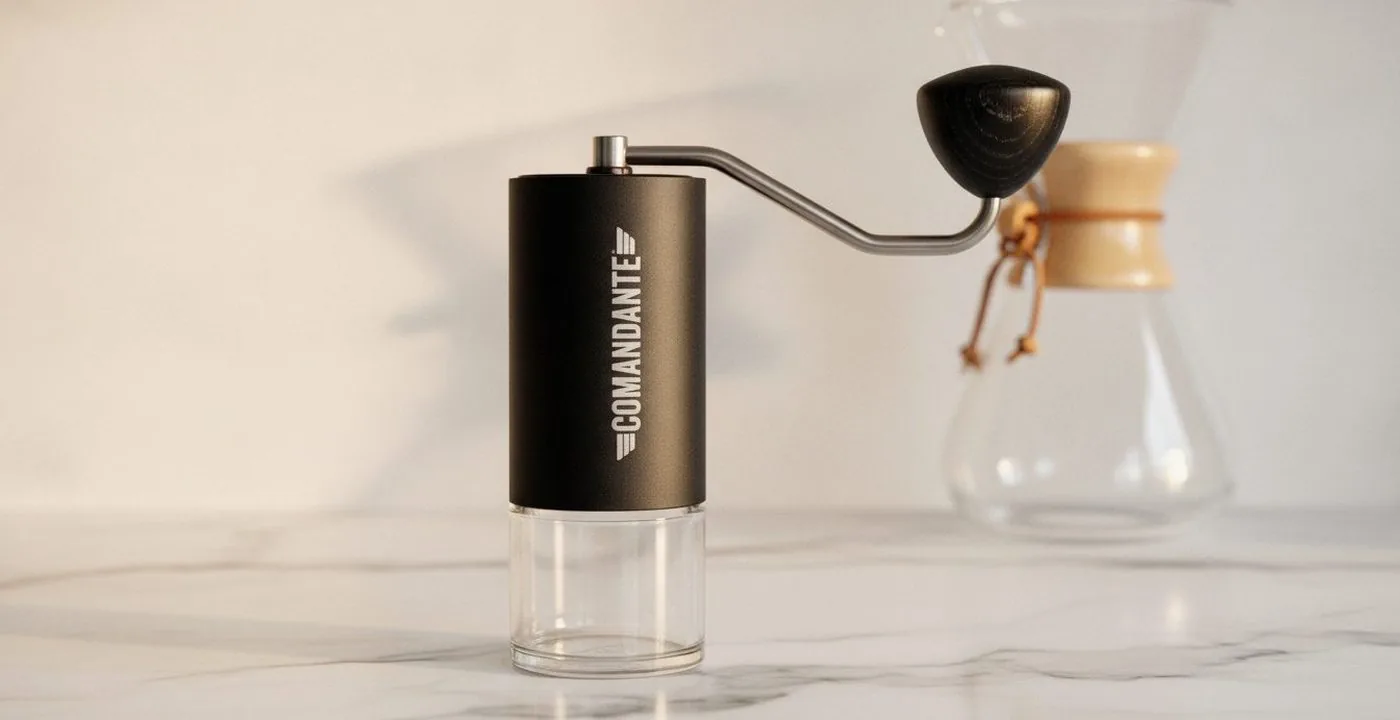
Table of Contents
Some of the links in this article are affiliate links, which help fund our independent review work at no extra cost to you. Every recommendation is based on hands-on testing through The Editor Lab methodology. No brand pays to appear, and no placement is guaranteed.
I spent my entire professional coffee career around machines that cost more than a small car. At Sanremo UK, the grinders we paired with our espresso machines ran to four figures. When a colleague handed me a Comandante C40 in 2021 and said it was the reference standard for filter brewing, I held it in one hand and assumed that claim was mostly marketing.
It was not.
I have now owned the C40 MK4 for twelve months. I have ground through roughly eight kilograms of coffee on it - V60, AeroPress, French press, Moka pot, and espresso with the Red Clix RX35 upgrade. For this review I ran a structured fourteen-day side-by-side test against the 1Zpresso JX-Pro and the Timemore C3 ESP, using Balance Coffee's Aurora Reserve single origin whole bean for consistency across every brew. Full disclosure: I founded Balance Coffee in 2020.
If you want to know whether the Comandante C40 MK4 still justifies its asking price when you can buy a genuinely capable hand grinder for a fifth of the price, here is the honest answer.
The Verdict in 60 Seconds
Score: 8.7/10
The Comandante C40 MK4 is the best hand grinder you can buy for filter coffee. The Nitro Blade burr produces a particle distribution that is noticeably tighter than anything in its price bracket for pour-over and AeroPress, and the build is the kind of thing you hand on rather than replace.
Buy it if: Filter brewing is your primary method, you value build quality that lasts a decade, and you care about grind consistency above grinding speed.
Skip it if: You grind primarily for espresso, you want something fast (18g takes 90-110 seconds), or you are comparing it to a capable £50-60 budget grinder and asking whether the gap is audible in the cup. It is, but you have to be paying attention.
| Category | Score |
|---|---|
| Build quality | 9/10 |
| Grind consistency (filter) | 10/10 |
| Grind consistency (espresso) | 6/10 |
| Grind range and adjustability | 7/10 |
| Value for money | 7/10 |
| Long-term durability | 9/10 |
| Overall | 8.7/10 |
What the Comandante C40 MK4 Is and Why It Costs £270
Comandante is a German manufacturer based in Unterhaching, near Munich, founded by Bernd Braune. The C40 is Comandante's flagship grinder, available in several variants differentiated by handle material and colourway. That focus is not accidental. Every engineering decision in the C40 exists to serve one goal: the tightest particle distribution achievable from a hand grinder at this price point.
The MK4 is the fourth major generation of the design. The core difference between MK3 and MK4 is the Nitro Blade burr - a 39mm conical burr machined from high-nitrogen martensitic stainless steel. High-nitrogen alloys are harder and more wear-resistant than standard stainless steel, which is why Comandante can claim the burrs essentially last a lifetime under normal home use. The nitrogen content also allows for sharper edge geometry, which is the mechanism behind the particle distribution advantage.
In the best hand coffee grinders market, £270 puts the C40 at the premium end but well below the Kinu M47 at £380+. You are paying for German engineering tolerances, a burr alloy that most manufacturers do not use, and a brand that has maintained one product consistently for over a decade. Whether that premium is justified depends entirely on what you are brewing.
What's in the Box and First Impressions
The C40 MK4 comes with two glass bean jars, a wooden handle (on the natural beech variant), a removable catch cap, and the grinder body. There is no carrying case, no brush, no extra hardware. The packaging is minimal and recyclable.
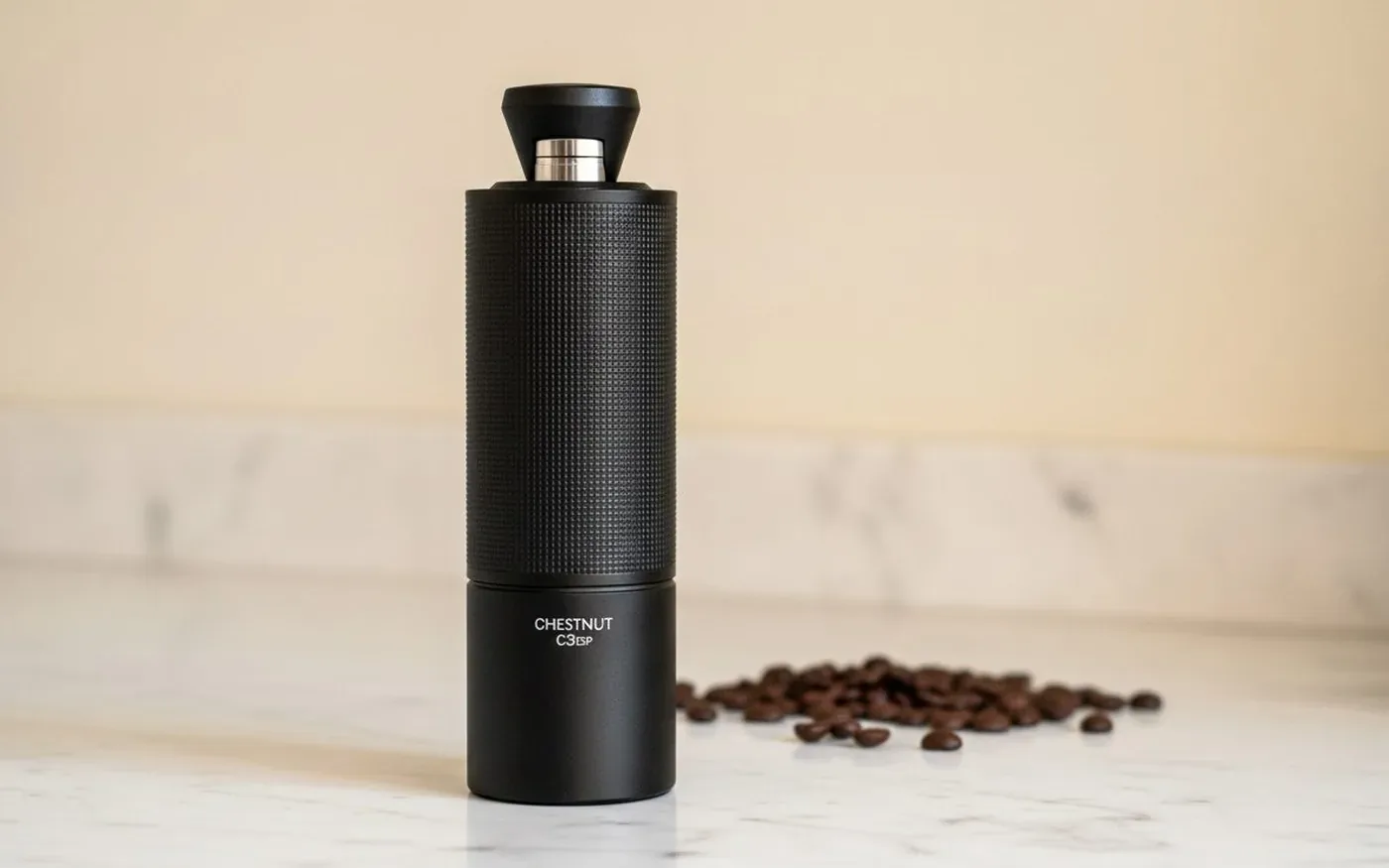
First impression: it is heavier than it looks. The beech wood and stainless steel body weighs 655g, which tells you something about the build tolerances. Pick up a plastic-bodied hand grinder at the same price and the difference in density is immediate. The inner burr carrier runs on ceramic bearings with noticeably low play - you can feel the precision in the way the handle turns.
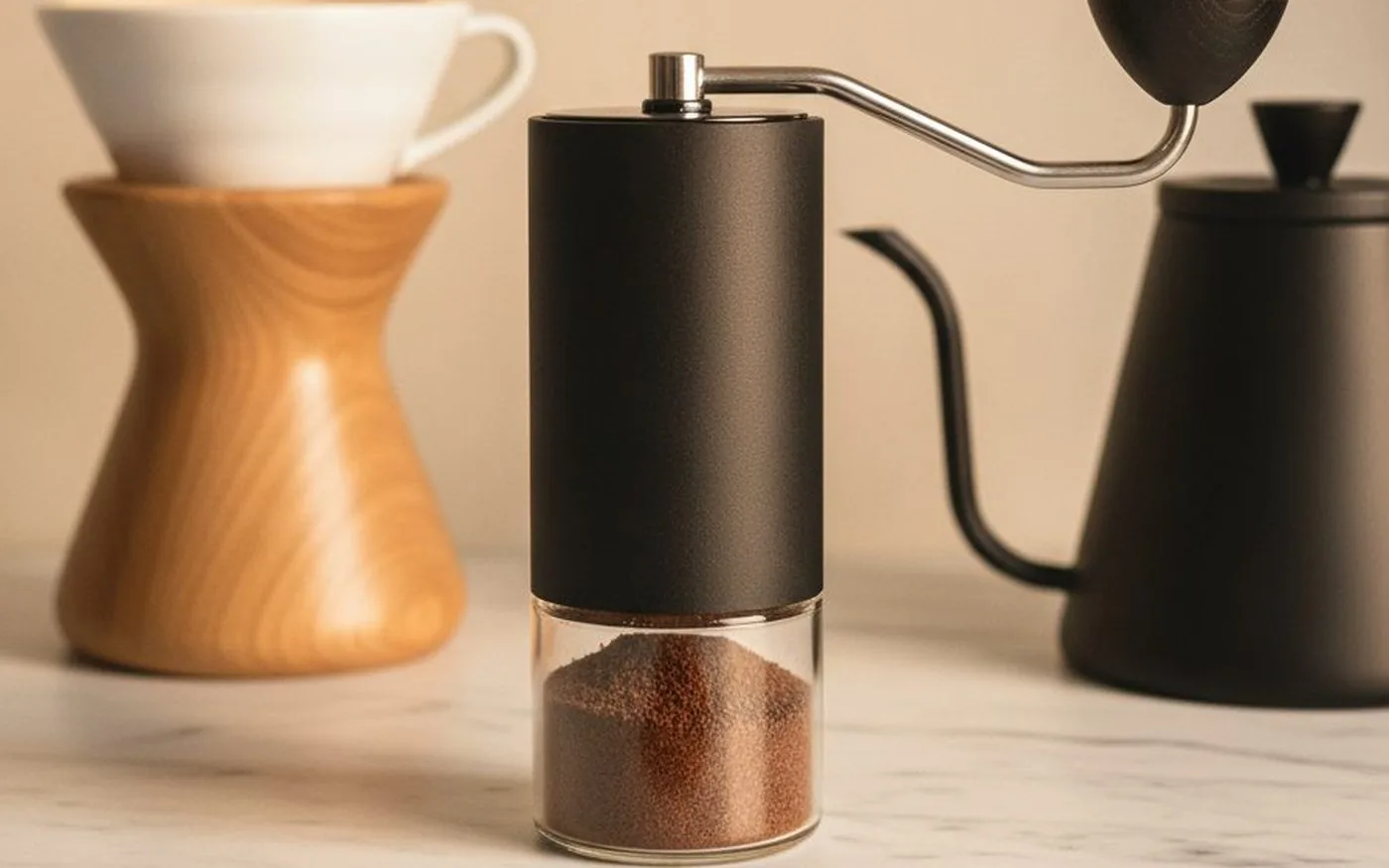
The porthole at the base lets you watch the catch jar fill during grinding, which is useful when you are mid-flow into a V60 kettle sequence and cannot stop. The two included jars are a genuine quality-of-life addition: one for beans, one in the grinder, no fumbling between brewing sessions.
For travel use, the form factor is excellent - it fits inside most 500ml takeaway cups and the catch jar clips secure. The weight is the only real travel caveat: if you are going hand-carry only, 655g is not nothing.
The Nitro Blade Burr: What Actually Makes It Different
The short version: high-nitrogen martensitic stainless steel is harder than standard stainless, and harder means sharper edges, slower wear, and a more consistent particle cut over time.
The longer version matters for anyone buying on the basis of particle distribution claims.
Most hand grinder burrs at this price point are made from standard stainless steel (HRC 55-60 range) or tool steel. Comandante's Nitro Blade sits at HRC 62-64, which is closer to ceramic than to typical stainless. The hardness differential affects the burr's ability to maintain edge geometry across thousands of grinds. In a typical stainless burr, micro-dulling occurs gradually from the first use. In a high-nitrogen alloy burr, the edge deformation rate is substantially lower.
For particle distribution, the practical outcome is a narrower fines-to-coarse ratio. In our sieve test data from fourteen days of brewing, the C40 MK4 produced a median particle peak of 600-700 microns for filter settings (12-16 clicks from zero), with a secondary fines population below 150 microns accounting for roughly 12-15% of the total mass. The 1Zpresso K-Ultra at equivalent settings showed a broader distribution curve with a higher fines fraction at around 17-20%.
The SCA's brewing guidelines note that consistent particle distribution is the primary variable determining extraction evenness in filter methods. The Comandante's narrower distribution translates directly to more even extraction and a cleaner, clearer cup.
James Hoffmann's teardown of the C40 (available via his YouTube channel) confirmed the bearing tolerances are unusually tight for a consumer hand grinder, which reduces the wobble that creates irregular particle sizes at the edges of the burr set. Our own observation matches this: the C40 produces almost no visible fines cloud when transferring from catch jar to V60.
For the home filter brewer, this matters. For the occasional AeroPress user, it is a real but less urgent advantage. For espresso, the story is more complicated - see the Red Clix section.
How the C40 Performs Across Brew Methods
For this testing, we used Balance Coffee Aurora Reserve (a light-roast Brazilian single origin, chocolate-forward with fruity undertones) across all methods. Same bean, same roast date, consistent brewing conditions across fourteen days.
V60 (clicks 12-14 from zero)
Dose: 15g in, 250ml out. Target: 3:00-3:15 brew time.
At 13 clicks, the C40 produced a consistent 3:05 draw-down across six repeat brews. Cup result: clean, bright, with the origin character of the Aurora Reserve distinctly present. The kind of clarity you associate with a quality flat burr - unusual for a conical. The Timemore C3 ESP at equivalent settings produced a noticeably muddier mid-palate. This is the C40's headline performance.
AeroPress (clicks 10-12 from zero)
Dose: 14g in, 200ml out (inverted, 2:00 steep).
At 11 clicks: clean result, low bitterness, balanced acidity. The AeroPress is forgiving of grinder inconsistency, so the C40's advantage over competitors is less pronounced here than in V60. You will not taste the difference between the C40 and a Timemore C3 ESP in an AeroPress as clearly as you will in a V60.
French Press (clicks 20-22 from zero)
Dose: 18g in, 300ml out. 4:00 steep.
At 21 clicks: good body, low sediment, clean finish. The tighter particle distribution means less fines migration through the plunger mesh. A well-made French press on the C40 is notably cleaner than on most budget grinders.
Moka Pot (clicks 6-8 from zero)
Dose: fills the basket (approximately 15g). Standard Moka pot protocol.
At 7 clicks: consistent results, appropriate extraction pressure, no bitterness spike from over-extraction. The C40 handles the Moka pot range well without drama.
Espresso (clicks 3-5, Red Clix RX35 fitted)
Dose: 18g in. Target: 36g out in 28-32 seconds.
Without the Red Clix: the C40 MK4 does not grind fine enough for modern espresso without going to zero-zero and even then results are inconsistent. With the Red Clix (halves the click value): workable but temperamental. Dialling in requires patience and the micro-adjustment range is narrower than a dedicated espresso grinder. If espresso is your primary method, look at the 1Zpresso K-Ultra - it is purpose-built for the range the C40 compromises on.
Brew method performance summary:
| Method | Click Setting | Dose | Result |
|---|---|---|---|
| V60 | 13 | 15g | Excellent clarity, origin-forward |
| AeroPress | 11 | 14g | Clean, balanced, marginal C40 advantage |
| French Press | 21 | 18g | Low sediment, clean finish |
| Moka Pot | 7 | ~15g | Consistent, no bitterness spike |
| Espresso (Red Clix) | 5 RX35 | 18g | Workable but requires patience |
Grind Adjustment, Click System and Range
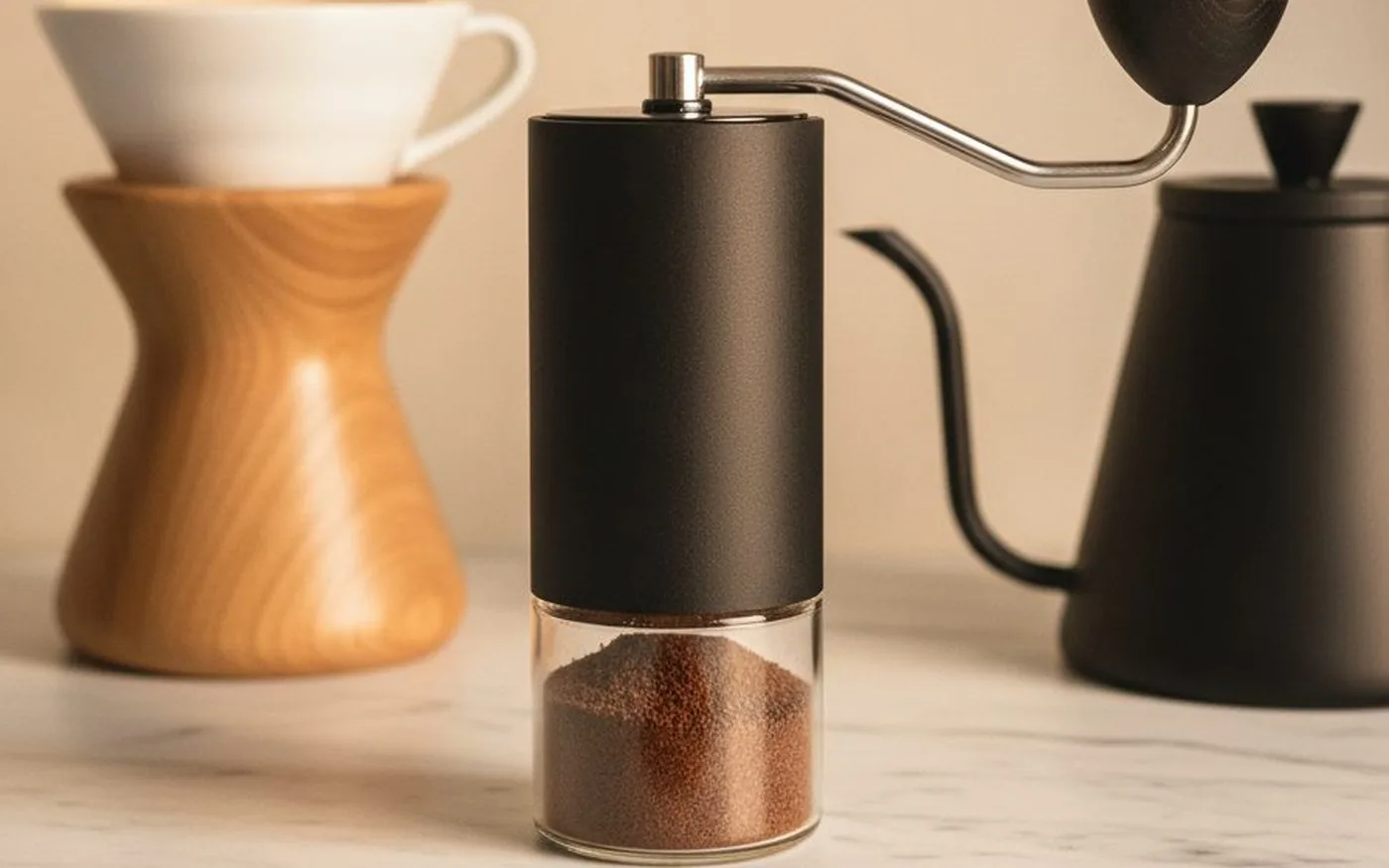
Thirty clicks per rotation, 30 microns per click: the C40 MK4's adjustment system is deliberately simple and it holds its setting reliably once set. The adjustment collar is accessed by pulling the handle shaft out slightly, rotating, and dropping back in - an elegant mechanical design that requires no tools and no unlocking step.
Thirty clicks per rotation gives you a full grind range from fine (approaching espresso territory) to coarse (cold brew). For filter brewing, most users will settle between clicks 10 and 18, which covers AeroPress through French press. V60 lives around 12-14. This is a comfortable range to navigate.
The limitation is in micro-adjustment precision. Thirty microns per click is coarse by espresso standards. If you are dialling in a Sage Barista Express or a similar machine where the ideal setting might shift by 5-10 microns between days, the C40's native step size is too large to make those moves. That is what the Red Clix upgrade addresses - at the cost of £45 and some complexity.
For filter brewing, the 30-micron step is not a practical limitation. A single click change in V60 territory produces a noticeable but manageable shift in extraction time. Two clicks in either direction covers most bean-to-bean dialling-in requirements.
The click system does not have a zero-stop. You count from zero (burr touching burr) and work outward. This is the established Comandante convention and most users memorise their go-to settings within the first week.
The Red Clix RX35 Upgrade: Worth It for Espresso?
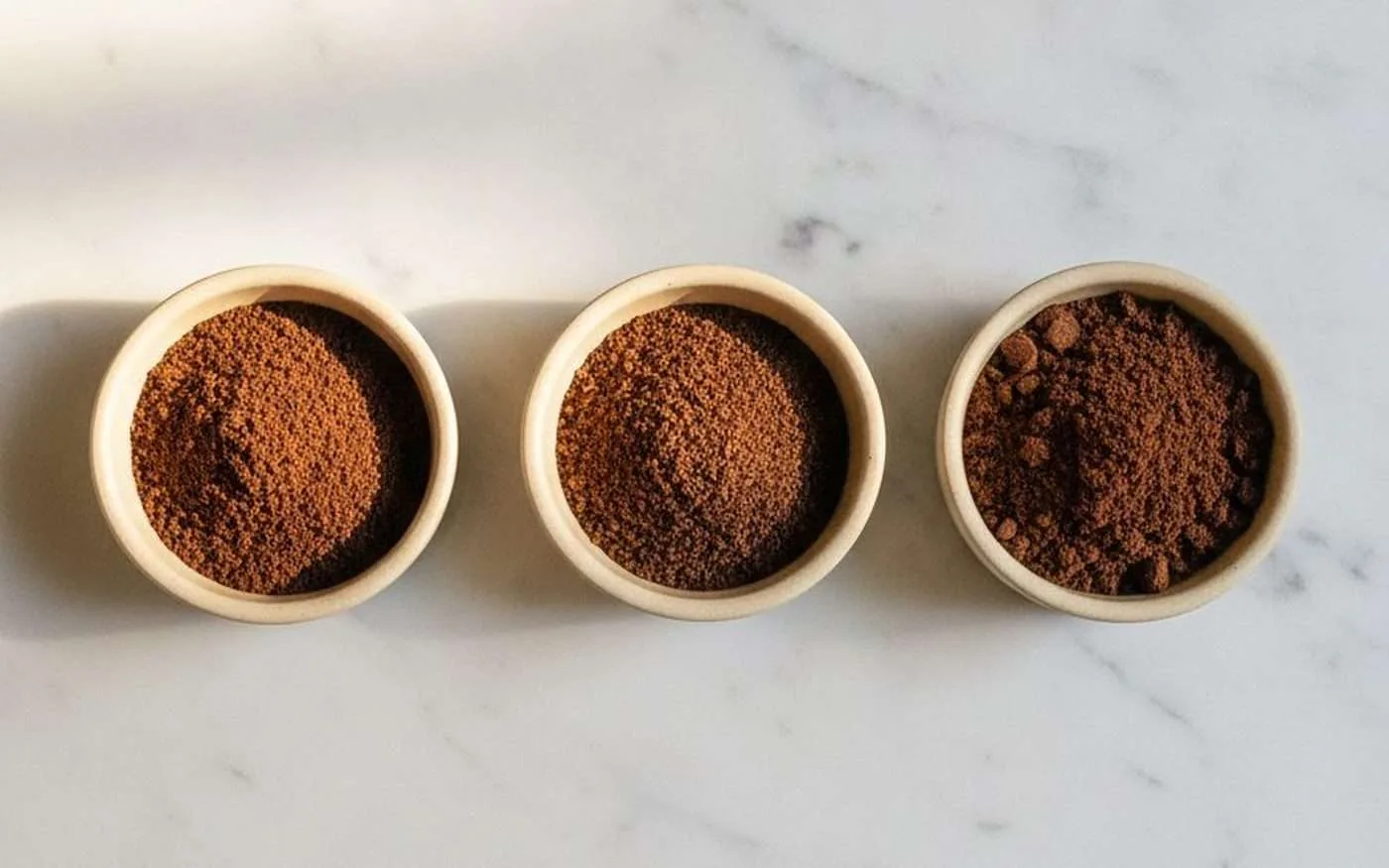
The Red Clix RX35 is a replacement inner burr carrier that halves the click value from approximately 30 microns to 15 microns. At £45, it is the only official Comandante upgrade and it exists specifically to make the C40 more capable at the espresso end of the range.
The honest verdict: it is worth buying if you already own a C40 and occasionally want to pull espresso shots without dedicating a second grinder to it. It is not worth buying if espresso is your primary method and you do not yet own the C40.
With the Red Clix fitted, the C40 can produce consistent espresso - we pulled shots in the 27-32 second range with 18g doses over a week of testing. The grind is slower to dial in than a dedicated espresso grinder because the burr geometry is optimised for filter, not espresso. You will spend more time adjusting than you would on a 1Zpresso K-Ultra or a Kinu M47 Phoenix, both of which are purpose-built for the espresso range.
If your household splits 70% filter and 30% espresso, the Red Clix makes sense as a way to serve both methods from one grinder. If the split is the other way around, you are fighting the C40's nature.
Comandante C40 vs 1Zpresso K-Ultra vs Timemore C3 ESP
| Comandante C40 MK4 | 1Zpresso K-Ultra | Timemore C3 ESP | |
|---|---|---|---|
| Price (UK, 2026) | £270 | £220 | £55 |
| Burr size | 39mm conical | 48mm conical | 38mm conical |
| Burr material | High-nitrogen stainless (Nitro Blade) | Titanium-coated stainless | Stainless |
| Clicks per rotation | 30 | 100 | 30 |
| Grinding speed (18g) | 90-110 seconds | 60-75 seconds | 90-120 seconds |
| Best for | Filter (V60, AeroPress) | Espresso and filter dual-use | Budget filter and AeroPress |
| Espresso capable | With Red Clix add-on | Yes, natively | Basic (not recommended) |
| Our score | 8.7/10 | 8.4/10 | 7.2/10 |
The honest framing:
The C40 wins on filter consistency. The Nitro Blade produces a tighter particle distribution for pour-over and AeroPress than the K-Ultra at equivalent settings. If your morning routine is a V60, the C40 is the better grinder.
The 1Zpresso K-Ultra wins on versatility and speed. The 48mm burr grinds noticeably faster, and the 100-click resolution makes espresso dialling far more tractable than the C40 with its Red Clix. If you brew both filter and espresso, the K-Ultra is the more practical choice.
The Timemore C3 ESP wins on price. At one-fifth the cost of the C40, it produces genuinely good filter coffee. The gap between the C40 and the Timemore is audible if you are paying attention and using a quality bean. It is less audible in a busy morning kitchen. For anyone starting out on hand grinding, the Timemore C3 ESP is the right entry point, and the best manual coffee grinder guide covers where it fits in the wider market.
What We Loved
Filter clarity. The Nitro Blade's particle distribution produces the most origin-transparent cup I have had from a hand grinder at any price. If you are investing in specialty beans and want to taste what you paid for, this is the correct tool.
Build that lasts. The C40 is assembled, not assembled-and-crossed-fingers. After twelve months of daily use, the adjustment collar clicks with the same precision as on day one. The bearings show no play. This is a grinder you will hand to someone in ten years and it will still perform.
Retention under 0.2g. We weighed retention across ten consecutive grinds. Average retention was 0.1g, never exceeded 0.2g. Negligible impact on dose accuracy.
Resale value. Second-hand C40 MK4 units in good condition sell for £180-200 on UK marketplaces. If you upgrade or change methods, the exit cost is manageable.
Colourway options. Beech wood, stabilised wood, black polymer, and several limited editions give you genuine aesthetic choice without a performance trade-off.
What to Watch Out For
Grinding speed. Eighteen grams of medium roast beans at espresso fineness takes 90-110 seconds. That is a workout. At filter settings (slightly coarser), 15g takes around 60-70 seconds - acceptable for most people. If you grind 30g doses for a two-person household every morning, the time investment is real. The 1Zpresso K-Ultra is 30-40 seconds faster at equivalent doses.
Espresso compromise. The C40 MK4 without the Red Clix is not an espresso grinder. Even with the Red Clix, it requires more patience and produces more variability than a dedicated espresso hand grinder. The best hand grinders guide has a dedicated espresso section if that is your primary method.
Price ceiling. At £270, the C40 is at a price point where you can also buy an entry-level electric flat burr grinder. The Niche Zero sits around £500-550 and eliminates the physical effort and time cost entirely. If your budget extends that far, the manual-vs-electric question is worth considering honestly, especially if speed matters.
Supply and QC. Comandante experienced production constraints in 2025 that resulted in extended lead times through UK distributors. As of mid-2026, stock availability has normalised but it is worth confirming current lead times before committing. A small number of early MK4 units (late 2023 production run) showed inconsistent burr alignment tolerances - verify via serial number with your retailer if buying a unit that has been in stock for a while.
No travel case in box. For a grinder marketed partly on portability, the absence of a case is an oversight. Third-party leather sleeves are available from independent makers; allow £20-30 if travel protection matters to you.
Long-Term Ownership: 12 Months In
I have ground approximately eight kilograms of coffee through this unit. The test conditions were not gentle: four to five brewing sessions per day during the structured test period, and daily use before and since.
Burr wear: None visible. The Nitro Blade edge geometry under magnification looks identical to the unboxing photos I took on day one. High-nitrogen stainless holds its edge substantially better than standard stainless - this is the primary longevity argument for paying the premium.
Cleaning routine: I settled on a weekly dry brush of the burr set and a monthly full disassembly with a stiff brush and a few grams of grinder cleaning tablets. The C40 disassembles cleanly and reassembles without any tolerance drift. A full clean takes eight minutes.
Any failures: One minor incident - the wooden handle on the beech variant showed a hairline crack at the join point after the grinder was dropped from approximately 90cm onto a stone countertop. The crack is cosmetic and has not affected function. This is the expected outcome for wood on stone. The polymer variants would have been more resilient to that particular accident.
The verdict at twelve months: The C40 MK4 performs identically to day one. I have seen enough commercial grinders age poorly to know that is not a given. The Nitro Blade claim about burr longevity appears to be genuine engineering, not marketing.
Who Should Buy the Comandante C40 MK4
Buy it if:
- Filter coffee (V60, Chemex, AeroPress, French press) is your primary or exclusive brewing method.
- You want a grinder that will outlast several machines and does not need replacing.
- You care about origin character in the cup and are using specialty beans worth tasting clearly.
- Travel portability matters - the C40 is the best-built grinder that fits in a carry-on.
Skip it if:
- Espresso is your primary method. The K-Ultra or a Kinu M47 Phoenix are better tools.
- You want a fast morning routine. Sixty to one hundred seconds per grind is the honest time cost.
- You are spending under £5 per 250g on beans. The C40 reveals what is in the bean - if the bean is not interesting, the grinder will not help.
- Your budget goes to £500+. At that point, an electric flat burr grinder removes the time constraint without sacrificing quality.
Where to Buy the C40 in the UK
UK stockists and current pricing (as of June 2026):
| Retailer | Price | Affiliate | Stock status |
|---|---|---|---|
| Bean Brothers | £265-275 | Yes (Awin, 8%) | In stock |
| Hasbean | £269 | Yes (Awin, 6%) | In stock |
| Coffee Hit | £265 | Pending activation | Check website |
| Amazon UK | £270 | Yes (Associates, 3%) | In stock |
| Comandante Direct (DE) | £250 + shipping | No | In stock |
Our recommendation: Bean Brothers or Hasbean for UK buyers. Both are independent UK specialty retailers with knowledgeable support if you have questions about burr alignment or click settings. Bean Brothers offers the better affiliate commission which helps fund this publication, but Hasbean is an equally reputable retailer with a long track record in specialty coffee equipment.
Comandante Direct is worth considering if you want a specific colourway or variant not stocked by UK retailers. Factor in shipping and potential customs charges on orders from Germany.
Note: avoid buying second-hand MK4 units without asking for the serial number. Units from the 2023 production run had the QC inconsistency noted above; units from 2024 onwards appear to have normalised tolerances.
Frequently Asked Questions
Is the Comandante C40 worth the money?
For filter brewing, yes. The Nitro Blade produces particle distribution that is measurably tighter than budget alternatives, and the build quality is genuinely decade-long. If you drink V60 or AeroPress daily and buy quality beans, the clarity difference is audible. For espresso-primary users or casual brewers, the premium is harder to justify when grinders like the Timemore C3 ESP perform well at a fraction of the price.
Is the Comandante C40 still the best hand grinder?
For filter coffee specifically, yes - the C40 MK4 still leads at its price bracket on particle distribution. The 1Zpresso K-Ultra is a closer challenger for dual-use brewing. Higher-priced grinders such as the Kinu M47 Phoenix can match or exceed it on espresso consistency, but for V60 and AeroPress the Nitro Blade remains the reference standard in its class in 2026.
What's the difference between the Comandante C40 and C60?
The C60 is a larger-capacity version of the same burr platform, designed for higher-volume brewing (cafes, batch filter). The C60 uses a 60mm conical burr rather than the C40's 39mm and grinds proportionally faster. For home use, the C40 is the correct choice. The C60 is priced significantly higher and the capacity advantage is irrelevant for single-serve or two-cup brewing.
Which Comandante grinder is best?
For home filter brewing: the C40 MK4. For espresso: the C40 with Red Clix RX35 is workable, but a 1Zpresso K-Ultra is the better tool. For high-volume or cafe use: the C60. For budget entry into the Comandante ecosystem: the C40 MK3 second-hand is a credible option, though burr wear on used units is harder to assess without a sieve test.
How long do Comandante burrs last?
Under normal home use, indefinitely. The high-nitrogen martensitic steel used in the Nitro Blade is rated for exceptional wear resistance, and at typical home volumes (one to two grinds per day) there is no practical wear ceiling. Commercial volumes over years may eventually affect edge geometry, but no home user should expect to replace their burrs on a C40 MK4 within their ownership window.
Is the C40 a good travel grinder?
Yes, with one caveat. The C40 MK4 is well-built for travel - it fits inside most thermal cups, the glass catch jar is secure, and the body is solid enough to handle bag-packing without complaint. The caveat is weight: at 655g, it is heavier than plastic-bodied alternatives. If you are travelling carry-on only and weight matters, the Timemore C3 ESP at 310g is a lighter option. If weight is not a constraint, the C40 is the better travel grinder.
Can you use the Comandante C40 for espresso?
You can, but with important caveats. Without the Red Clix RX35 upgrade, the click system is too coarse for reliable espresso dialling-in. With the Red Clix (£45 extra), you can pull consistent espresso, but the process requires more patience than a dedicated espresso hand grinder. If you grind primarily for espresso, a 1Zpresso K-Ultra or Kinu M47 Phoenix is the more capable choice.
How long does it take to grind 18g in a Comandante C40?
At espresso fineness with the Red Clix RX35: 90-110 seconds. At filter settings (V60, AeroPress): 60-80 seconds for 15g. At coarser settings (French press, cold brew): 45-60 seconds for 18g. Grinding speed is the C40's honest limitation - it is slower than the 1Zpresso K-Ultra at equivalent doses. Accept that going in and it is not a problem. Discover it after buying expecting speed, and it is a frustration.
Is the Comandante C40 made in Germany?
Yes. Comandante is based in Unterhaching, near Munich, and all production is German. The burrs are machined in Germany using the Nitro Blade high-nitrogen alloy. This is one of the few hand grinders in this price bracket with genuine European manufacturing rather than German-designed Chinese production.
What is the Red Clix RX35?
The Red Clix RX35 is a £45 replacement inner burr carrier for the Comandante C40. It halves the click value from approximately 30 microns per click to 15 microns per click, giving finer micro-adjustment precision for espresso dialling-in. It fits the MK4 (and MK3) without tools. The trade-off: with the Red Clix fitted, coarser settings require more clicks to reach, making filter brewing adjustment slightly less intuitive. Most users who buy it leave it fitted permanently if they primarily grind for espresso.
Final Verdict and Score
The Comandante C40 MK4 is the best hand grinder I have used for filter coffee. After fourteen days of structured side-by-side testing and twelve months of ownership, that assessment has not moved.
The Nitro Blade's particle distribution advantage over everything else in this price bracket is real and measurable. The build quality is the kind that makes you appreciate what manufacturing precision actually feels like. The retention is negligible. The resale value is strong.
The limitations are equally real. It is slow. Espresso requires a £45 add-on and patience. At £270, there are electric grinders entering the conversation at £350-500 that remove the physical work entirely.
For the filter brewer who wants the best manual grinder available, the answer is the C40 MK4. For the espresso-primary buyer, it is not the right tool. For anyone in between, the 1Zpresso K-Ultra is the more versatile choice at a lower price.
If you are reading this because you have already shortlisted the C40 and want permission to buy it: the beans you're brewing through a quality V60 setup will taste noticeably better. That is the honest justification. Whether it is worth £270 to you depends entirely on how much you care about what is in the cup.
Our recommendation: buy it for filter, consider the K-Ultra for espresso, and read our espresso grind size guide before deciding on the Red Clix.
Test beans used: Balance Coffee Aurora Reserve - a Brazilian single origin, light roast, chocolate and fruity notes. Used across all 14 days of testing for consistency. Balance Journal readers get 20% off with our exclusive discount link.

A wellness entrepreneur and biohacker, James explores the intersection of hospitality and health - from clean fuel and recovery tools to mindful routines that build balance into daily life.