Alpro Review: Is the UK's Top Plant Milk Any Good?


We compared Alpro Barista, Soya and Oat for coffee and audited each for oils, UPF status and taste. A nutritionist-led UK review of the whole range.
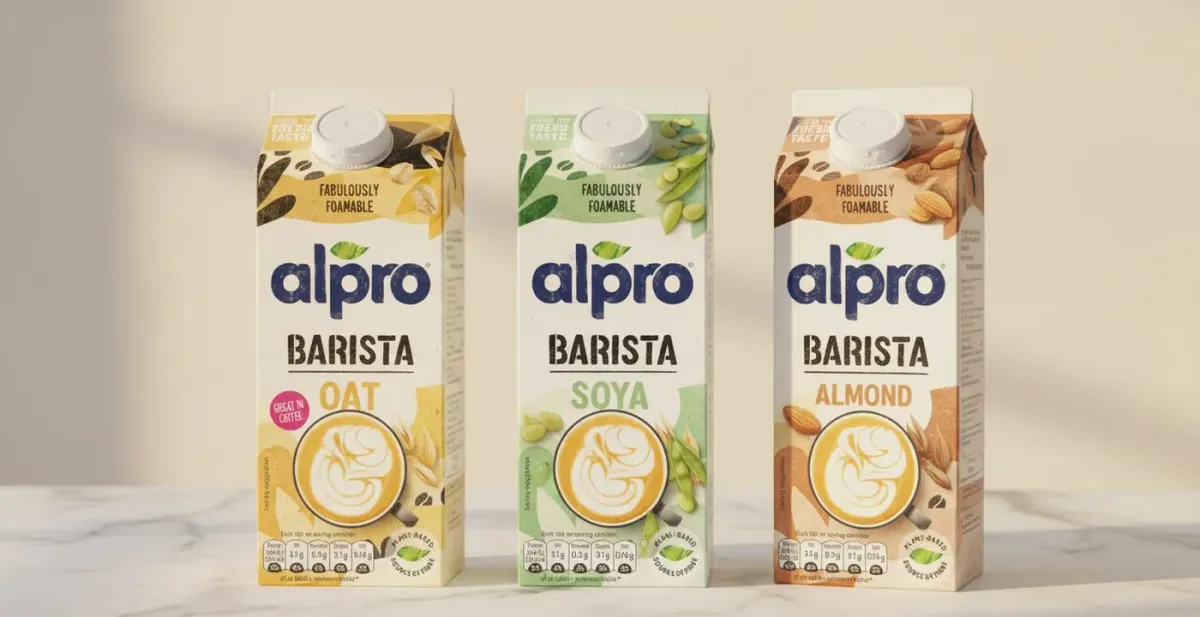
Table of Contents
Some of the links in this article are affiliate links, which help fund our independent review work at no extra cost to you. How we assessed these products is explained in this article and our Editor Lab methodology. No brand pays to appear, and no placement is guaranteed.
Alpro Barista Oat earns 7/10 - a competitively priced, widely stocked barista oat milk, with honest UPF caveats.
Alpro is inescapable. Walk into any UK supermarket and you will find a shelf devoted almost entirely to that distinctive white carton. It is one of the best-known plant-milk brands in the UK, the one many people reach for first, and also one of the most debated - from loyal regulars who swear by it in their morning coffee to critics who question the corporate ownership and the additives. So which is it?
For this review I compared the Alpro barista range - oat, soya and almond variants - for espresso drinks and flat whites, and then turned my nutritionist hat on to audit the ingredient lists, Nova UPF classification, the soy-hormone evidence, and the honest competitive position of a Danone-owned mass-market brand. Nothing here is sponsored by Alpro.
Editor's Note
The Verdict in 30 Seconds
Alpro is a widely available, competitively priced plant milk and a competent everyday barista option - but it is not without compromise.
The Alpro Barista Oat is the standout performer in the range: it stretches to a respectable microfoam, integrates cleanly with espresso, at a lower shelf price than most specialist barista brands. The Barista Soya is a strong second - protein-rich, stable in coffee, and well-suited to anyone prioritising nutrition alongside taste. The Barista Almond is pleasant but struggles to hit the foam heights of oat or soya, and is best reserved for black or cold-brew coffee styles rather than milk-forward espresso drinks.
On ingredients, Alpro’s unsweetened lines are relatively straightforward. The barista variants carry added oils and stabilisers that push several products into Nova Group 4 ultra-processed territory - something clean-label shoppers should factor in.
Versus Oatly and craft rivals, Alpro wins on availability and everyday value and loses on barista ceiling and ingredient simplicity. It is an honest everyday pick, not a specialty upgrade.
7/10
Pros
- Competitively priced barista oat milk
- Widely available in all major supermarkets
- Barista Oat produces solid microfoam at home
- Barista Soya: highest protein of the three + best heat stability
- Barista Soya is fortified with calcium, vitamin D2 and B12
- Unsweetened standard lines are relatively clean-label
Cons
- Barista range classified Nova Group 4 UPF
- Lower barista ceiling than Oatly or Minor Figures
- Barista Almond foam quality is weak
- Owned by Danone - not an independent brand
- Barista Soya and Barista Almond contain added sugar
Who Is Alpro?
Alpro is not a British company. It was founded in 1980 in Belgium as a soya business within the Vandemoortele group. Vandemoortele sold it to Dean Foods in 2009; Dean spun off its WhiteWave arm in 2013, and Danone acquired WhiteWave in 2017. Alpro is now a subsidiary of one of the world’s largest food conglomerates.
That ownership history matters for two reasons. First, it explains Alpro’s scale: Danone’s distribution reach helps explain why Alpro is easy to find on supermarket shelves and in many cafés. Second, it sits at the heart of the brand’s reputation tension - Alpro is a corporate product marketed with plant-based and sustainability credentials, which some consumers find uncomfortable.
Today the range covers soya, oat, almond, coconut, hazelnut and blended varieties, plus a dedicated Barista range, high-protein options, and a growing yoghurt and dessert line. The brand is stocked across the major UK supermarkets.
The Alpro Range Decoded
Soya - the flagship. Alpro Soya Unsweetened is the product that built the brand. Soya carries far more protein than the oat or almond lines, close to dairy levels, and the unsweetened version has no added sugar. The sweetened variant adds sugar; choose unsweetened unless you specifically want it.
Oat. Alpro Oat has grown rapidly alongside the oat-milk boom. It is smooth, mildly sweet, and much lower in protein than soya (under 1 g/100 ml). The standard version works well in cereal, cooking, and black coffee; for espresso-based drinks you want the Barista version.
Almond. Lower calorie, lower protein (0.5 g/100 ml), a nutty flavour that works well in tea and smoothies. Not the strongest coffee pairing unless you enjoy a lighter, more delicate texture.
Coconut. Best as a cooking milk; the flavour profile is too assertive for most coffee drinks. Not reviewed for barista use here.
Barista Range (Oat / Soya / Almond). These are the formulations engineered for hot coffee, with recipes adjusted for better stretch and heat stability. The three Barista SKUs are the core of this review.
High Protein Soya. Around 5 g protein per 100 ml. Post-workout or protein-boosting context; not covered for barista use here.
For coffee: always choose the Barista range. The standard oat and soya work at a push in black coffee or americanos, but foam quality and heat stability are noticeably inferior to the Barista SKUs.
How the Barista Variants Compare
Here is how the three Alpro Barista variants - Oat, Soya, and Almond - compare across espresso, flat white, and cortado formats:
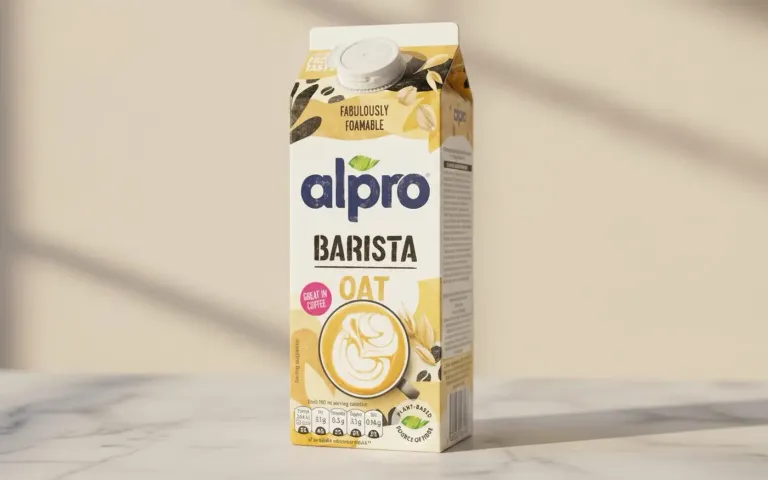
Alpro Barista Oat
This is the one to buy if you want a fuss-free Alpro barista experience. Cold from the fridge (4°C), it stretches readily under steam and produces a glossy, reasonably fine microfoam - not as silky as Minor Figures or Oatly Barista at their best, but good enough for latte art at home and entirely workable for an everyday flat white. Flavour is mild and slightly sweet with a gentle cereal note that does not compete with the espresso. It integrates cleanly.
Where it falls short: the foam begins to separate a little faster than premium-tier barista milks if your pour is slow, and at higher steaming temperatures (above 68°C) it can take on a slightly cooked, cardboard edge. Steam at 62-65°C and pour immediately.
Alpro Barista Soya
Soya is the dark horse. It is the most heat-stable of the three Alpro Barista variants - it holds microfoam longer without separation, which matters if you are making multiple drinks or if your espresso pull runs slow. The protein content (3.3 g/100 ml) drives that stability. Taste-wise it is the most neutral of the three: clean, very slightly beany in isolation but near-invisible behind a well-pulled espresso.
The soya Barista also curdles less readily with high-acidity espresso than almond - a practical advantage if your espresso machine is running a light-roast, fruit-forward coffee. For protein-conscious drinkers, this is the pick.
Alpro Barista Almond
The most limited of the three for espresso work. Almond milks - even engineered barista versions - simply do not foam as efficiently as oat or soya due to lower protein and different fat-protein interactions. The Alpro Barista Almond produces a passable froth but it is thinner, quicker to collapse, and more prone to splitting with hotter espresso shots. Flavour is pleasant: light, faintly nutty, works especially well with light-roast or naturally sweet espresso.
Best suited to: iced coffee, flat whites with a lighter espresso blend, or for drinkers who specifically want almond flavour in their cup. Not recommended as your primary barista milk if foam quality is a priority.
| Variant | Protein (g/100ml, label) | Added sugar | Best For |
|---|---|---|---|
| Barista Oat | 0.8 | No | Everyday flat white, cappuccino |
| Barista Soya | 3.3 | Yes | High-acidity espresso, protein focus |
| Barista Almond | 0.5 | Yes (sugar, fructose) | Iced coffee, light-roast espresso |

Ingredient & UPF Audit
This is where a nutritionist perspective adds something that taste tests alone cannot. Let’s look at what is actually in each Alpro Barista product.
Alpro Barista Oat - Ingredients & Nova Classification
Oat base (95.6%) (Water, Oat (10%)), Sunflower oil, Chicory root fibre, Pea protein, Acidity regulator (Potassium phosphates), Sea salt, Vitamins (B2, D2)
The base is straightforward: oat at 10% (lower than some premium oat milks), sunflower oil to add the fat needed for barista performance, and pea protein and chicory root fibre to build body. There is no added sugar in the ingredient list, and no stabiliser gum. Unlike the soya version, this one carries no added calcium.
Nova classification: Group 4 (ultra-processed). The added oil, isolated pea protein, added fibre and the industrial-scale extraction process classify this as UPF under the Nova framework. This is common across virtually all barista-engineered plant milks - the additives are what make the foam work, and the British Heart Foundation notes that most plant-based drinks are classed as ultra-processed because of added stabilisers, oils or salt - but clean-label shoppers should be aware.
Alpro Barista Soya - Ingredients & Nova Classification

Soya base (97%) (Water, Hulled soya beans (8.7%)), Sugar, Acidity regulators (Potassium phosphates), Calcium (Calcium carbonate), Sea salt, Stabiliser (Gellan gum), Natural apple juice flavouring, Vitamins B2, B12, D2
The soya content is lower than you might expect (8.7%), and this one contains added sugar alongside a flavouring, so it is not a no-sugar product. The protein content (3.3 g/100 ml) comes from the soya beans rather than added protein isolates. It is also fortified with calcium and vitamins B2, B12 and D2.
Nova classification: Group 4 (ultra-processed). Same reasoning as the oat: added sugar, flavouring, an industrial stabiliser and an industrially processed base.
Alpro Barista Almond - Ingredients & Nova Classification
Water, Almond (2.5%), Sugar, Fructose, Acidity regulators (Potassium phosphates), Calcium (Calcium carbonate), Natural flavourings, Stabilisers (Gellan gum, Guar gum), Sea salt
The almond content (2.5%) is very low - characteristic of almond milks across the market, not just Alpro. It contains added sugar and fructose, plus two stabilisers (gellan gum and guar gum), which is more additives than the oat version needs.
Nova classification: Group 4 (ultra-processed).
The Cleaner Alpro Picks
The barista range is UPF. If that matters to you, look at the standard Unsweetened and No Sugars Alpro lines instead, and read the ingredient list on the carton before you buy. They trade barista performance for a simpler recipe, though several still carry added oil or fibre, so shorter does not mean additive-free.
Added sugar warning: several Alpro products contain added sugar, including the Barista Soya and Barista Almond. Always check for “Unsweetened” or “No Sugars” on the label if you want to avoid it.
| Product | Energy (kcal) | Protein (g) | Fat (g) | Carbs (g) | Sugar (g) |
|---|---|---|---|---|---|
| Barista Oat | 59 | 0.8 | 3.0 | 6.7 | 3.3 |
| Barista Soya | 42 | 3.3 | 1.9 | 2.7 | 2.5 |
| Barista Almond | 24 | 0.5 | 1.2 | 2.6 | 2.5 |
The Soy-Health Question
The question “is soya milk healthy?” remains one of the most persistent points of confusion around plant milks. As a registered Nutritional Therapist, here is a straightforward answer.
Phytoestrogens: the concern, and the evidence. Soya contains isoflavones - plant compounds that can bind weakly to oestrogen receptors in the body. The evidence does not support harmful hormonal effects for typical consumption levels. The British Dietetic Association (BDA) notes that the oestrogenic activity of isoflavones in soya foods is much weaker than the body’s own oestrogen, and that studies consistently show eating soya foods does not affect hormone levels in men.
The exception: individuals with thyroid conditions or those taking thyroid medication should discuss soya intake with their GP, as soya may interfere with absorption of thyroid medication. A 2021 systematic review of levothyroxine and food interactions found limited evidence that soy products reduce levothyroxine absorption.
The protein advantage. Soya is one of the closest plant milks to dairy for protein quality - containing all essential amino acids in meaningful amounts. Alpro Barista Soya provides 3.3 g protein per 100 ml, against 0.8 g for Barista Oat and 0.5 g for Barista Almond, so soya is the stronger choice for anyone prioritising protein intake. The British Heart Foundation describes soya milk as one of the closest plant-based alternatives to dairy for protein, at around 7 to 8 g per 200 ml.
The bottom line: for most healthy adults, Alpro Soya in moderation is a nutritionally sound choice. The soy-hormone fear is largely unfounded at normal consumption levels.
Alpro vs Oatly + Craft Rivals
Alpro vs Oatly Barista: Oatly Barista has a narrow but real edge in foam quality and microfoam texture. Taste-wise, Oatly’s oat-forward flavour is more distinctive; Alpro Barista Oat is milder and more neutral. On ingredients, both are Nova Group 4 UPF. The meaningful difference is value and availability: Alpro is easier to find and usually sits at a lower shelf price.
Alpro vs Minor Figures: Minor Figures is widely regarded as among the best-performing for microfoam texture and espresso integration. It is typically priced higher, less widely stocked, and formulated for professional espresso machines. For a home setup, the performance gap narrows - Alpro Barista Oat is a sensible everyday option for much less money.
Alpro vs Plenish: Plenish positions as a premium, clean-label brand with shorter ingredient lists. The barista performance is good but not class-leading. Plenish typically costs more than Alpro and is less widely available.
Honest positioning: Alpro is a Danone-owned mass-market product, not a craft roaster’s oat milk. It competes on price and availability, and on those criteria it wins clearly. It does not match the barista ceiling of Minor Figures or the clean-label positioning of Plenish.
| Brand | Product | Positioning |
|---|---|---|
| Alpro | Barista Oat | Mild, neutral flavour; solid everyday microfoam; widely available |
| Alpro | Barista Soya | Most heat-stable of the three; highest protein |
| Alpro | Barista Almond | Thin foam; best for iced or black coffee |
| Oatly | Barista | Narrow edge in foam quality; more distinctive oat flavour |
| Minor Figures | Barista Oat | Among the best microfoam; typically pricier and less widely stocked |
| Plenish | Oat M*lk | Premium, clean-label positioning; typically pricier |
The Reputation Question
Why does one of the UK’s best-known plant milks also attract so much criticism? The criticisms cluster around: reformulations (the soya milk recipe has changed over the years); a perception of corporate “greenwashing” given Danone ownership; and the UPF/additive question.
The counterpoint is that Alpro has a loyal base of everyday buyers who appreciate the price, availability and consistent quality.
The most honest read: Alpro is a reliable, widely accessible, affordable plant milk that has been reformulated over the years as market demands and corporate ownership changed. Consumers who expected an artisan brand feel misled. Consumers who expect a functional, affordable, widely available plant milk are generally satisfied. Expectations set the experience.
Where to Buy Alpro in the UK
No other barista plant milk is easier to source in the UK.
Supermarkets: Available in Tesco, Sainsbury’s, Asda, Morrisons, Waitrose, M&S and Ocado. The full barista range (Oat/Soya/Almond) is stocked in most large-format stores; smaller stores may carry only the standard soya and oat.
Convenience and discount: Aldi and Lidl stock their own-label plant milks but also periodically carry Alpro. Co-op and Waitrose Local typically carry the standard soya and oat.
Online: Amazon UK offers the full barista range with Subscribe & Save discounts. Ocado has reliable full-range stock. Alpro’s own website ships direct.
In cafés: Costa uses Alpro Soya, Almond and Coconut.
Pairs well with: If you are using Alpro Barista Oat or Soya as your everyday milk, the Balance Coffee Stability Blend is a natural match - it is designed to be smooth, balanced and approachable, the kind of everyday espresso that lets the milk shine rather than fighting it. Balance Coffee also offers Stability Blend in Nespresso-compatible pods. (Balance Coffee is the company founded by James Bellis, who reviewed this article - full disclosure.)
Final Verdict and Score
Alpro is not the most exciting plant milk on the market, and it does not pretend to be. It is a widely available, competitively priced barista-capable plant milk, owned by a global food corporation, with an ingredient profile that reflects the compromises of engineered foam performance at mass-market scale.
The Barista Oat is a genuinely solid everyday milk for espresso drinks. The Barista Soya is underrated for its stability and protein content. The unsweetened standard lines are the cleaner nutritional picks. The criticism of the brand is real but context-dependent - Alpro delivers exactly what it promises if your expectations are calibrated to price and availability rather than craft-milk performance.
Score: 7/10. The score reflects formulation, ingredients, price and availability rather than a tasting panel. Recommended as the everyday, budget-conscious pick for UK home barista users. Step up to Oatly or Minor Figures if you want the best foam ceiling; step across to Alpro Soya Unsweetened if you want the best nutrition with fewer additives.
Frequently Asked Questions
Is Alpro actually good for you?
Is Alpro soya milk healthy?
Is Alpro ultra-processed?
Is Alpro a British company?
Which is better, Oatly or Alpro?
Is there a downside to drinking soy milk?
Which Alpro is best for coffee / does Alpro Barista froth well?
Which Alpro milk has the fewest additives?

A registered Nutritional Therapist and member of BANT, Clemmie blends science with a holistic approach to wellbeing.