1Zpresso Q2 Review: Is It the Best Budget Travel Coffee Grinder?

Coffee & Wellness Writer
Twelve months, two continents, daily V60 and AeroPress. This is the grinder I actually packed.
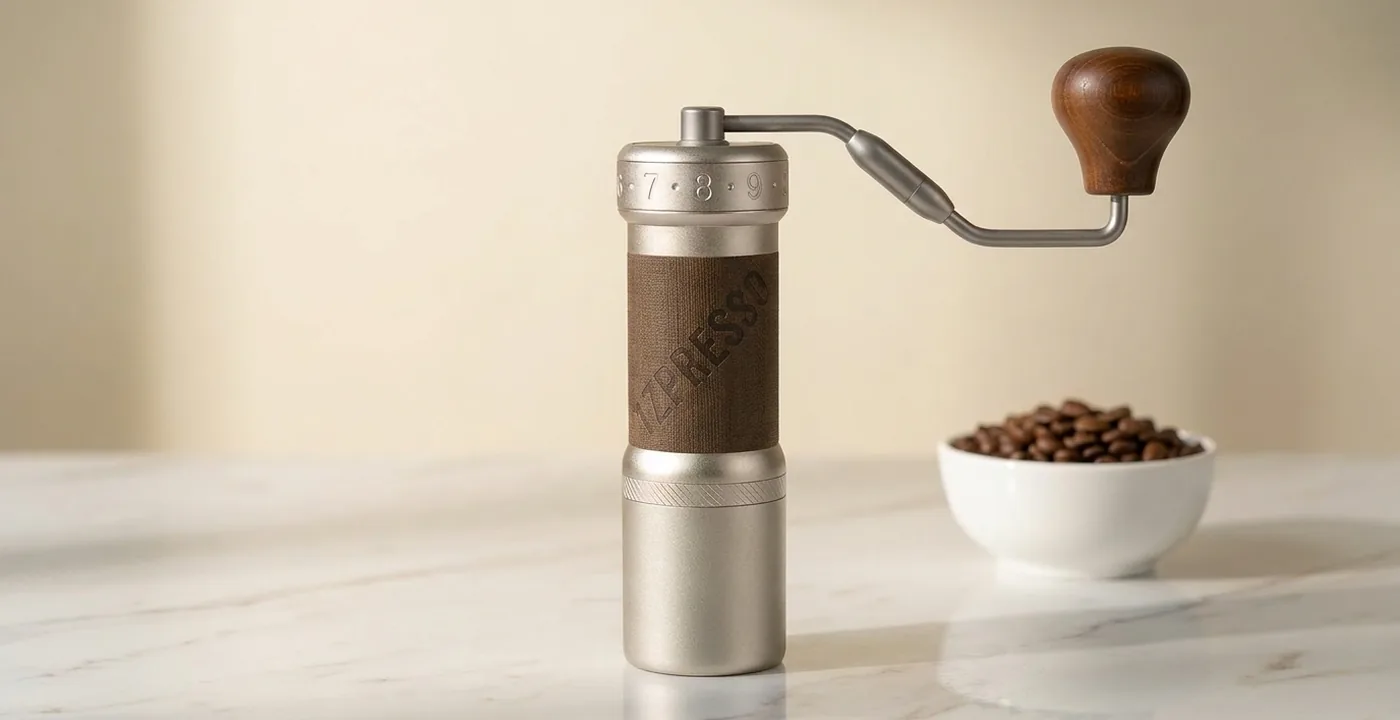
Table of Contents
Some of the links in this article are affiliate links, which help fund our independent review work at no extra cost to you. Every recommendation is based on hands-on testing through The Editor Lab methodology. No brand pays to appear, and no placement is guaranteed.
The 1Zpresso Q2 is the best travel grinder under £100 for filter coffee - here is my 12-month verdict from daily use across two continents. The Q2 is the grinder I packed when I moved my base to Bali in 2024. Not the JX-Pro I use for V60 work at home. The Q2, because at 465g it fits in a side pocket, and the internal adjustment mechanism with its readable numbered dial means you can dial straight back in after a long-haul flight without counting clicks from zero.
I have used this grinder daily across two continents over more than a year - filter sessions in Bali, French press in Heathrow transit, AeroPress on a terrace at 6am. What follows is an honest account of what it does well, where it falls short, and who should buy it.
I run Balance Coffee. If you want a bean that plays well with a Q2 on V60, Aurora Reserve is the light-roast Brazilian single origin I reach for - linked below for transparency, not because this review depends on it.
1Zpresso Q2 At a Glance
The Q2 is a compact, single-cup hand grinder aimed at travellers and filter buyers who want better-than-Hario consistency without paying Comandante money.
| Spec | Detail |
|---|---|
| Burr type | 420 stainless steel heptagonal conical |
| Weight | 465g |
| Capacity | 15-20g |
| Adjustment | Internal mechanism; numbered dial readable externally |
| Clicks per rotation | 30 |
| Body | Aluminium alloy + 304 stainless |
| Price (UK, June 2026) | From £89 |
Who it is for: The traveller who brews filter daily. Single-cup V60 or AeroPress drinkers. Someone buying their first serious grinder on a sub-£100 budget.
Who it is not for: Anyone running a home espresso machine as their primary setup. Multi-cup households. Light-roast filter obsessives who need the precision the JX or Comandante delivers.
Who the Q2 Is Built For
The Q2 answers a specific question: can you get a genuinely good cup of filter coffee from a grinder that fits in a backpack side pocket? The answer is yes, with the caveats this review covers.
The buyer who gets the most from it travels regularly, drinks one or two cups per day, and brews pour-over or immersion. The 465g weight is the threshold below which a grinder stops feeling like a concession and starts feeling like the right tool.
The Q2 is also a credible first grinder for anyone transitioning away from pre-ground. The numbered dial is readable from outside the body without disassembly - you can see your setting at a glance and return to it every time without counting from zero.
Skip it if your primary use case is home espresso. The 30-click-per-rotation resolution is too coarse for dialling in a shot with real precision. For espresso work you need the best manual coffee grinder with finer adjustment - the K-Plus or K-Max in the 1Zpresso range.
Build Quality and Design
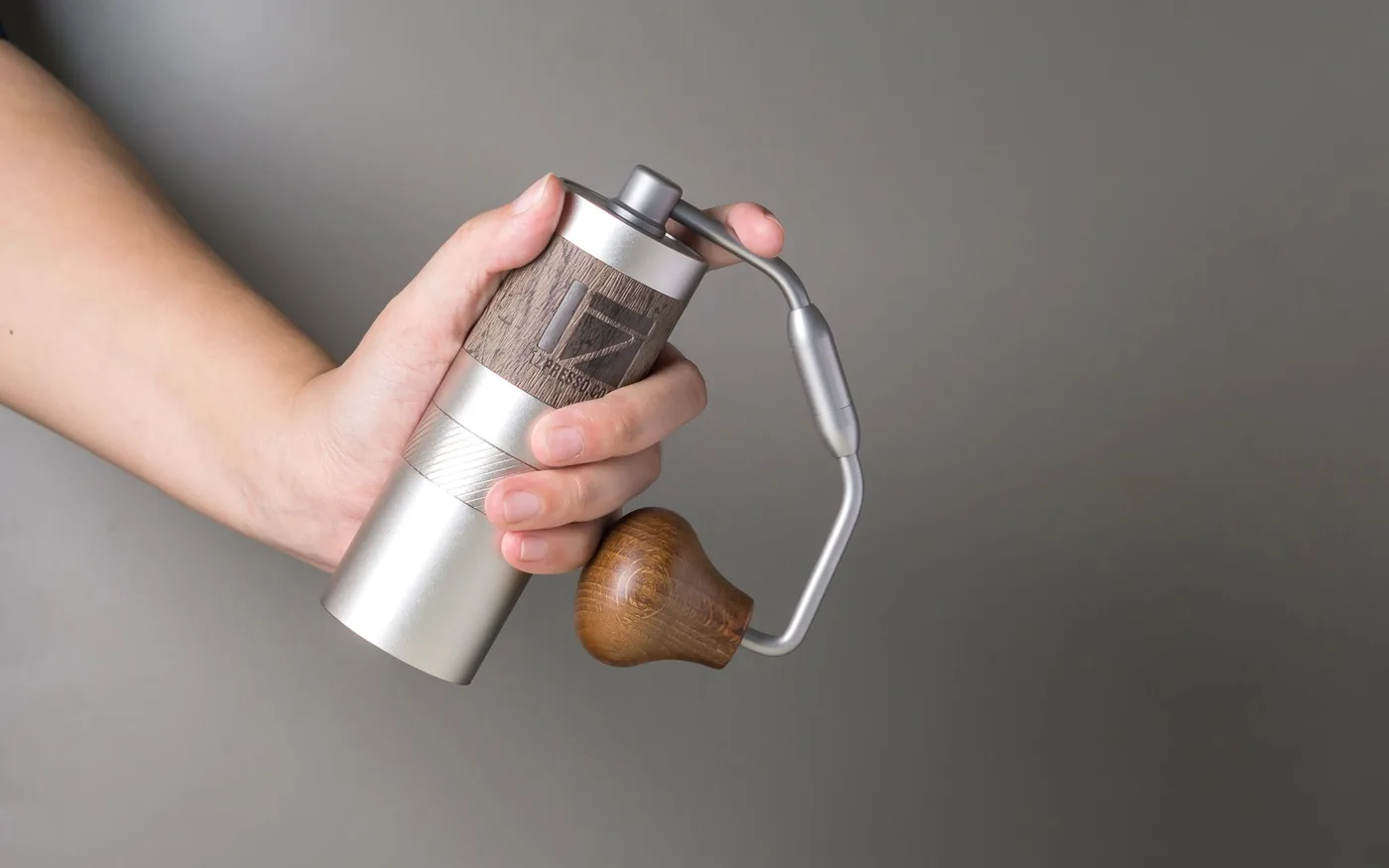
Pick up the Q2 and it passes the first test: it does not feel like a sub-£100 purchase. The aluminium body is well-machined, the fit between components is tight, and there is no audible wobble when you load the burr assembly. That wobble is the failure mode of every cheap hand grinder at this price. The Q2 does not have it.
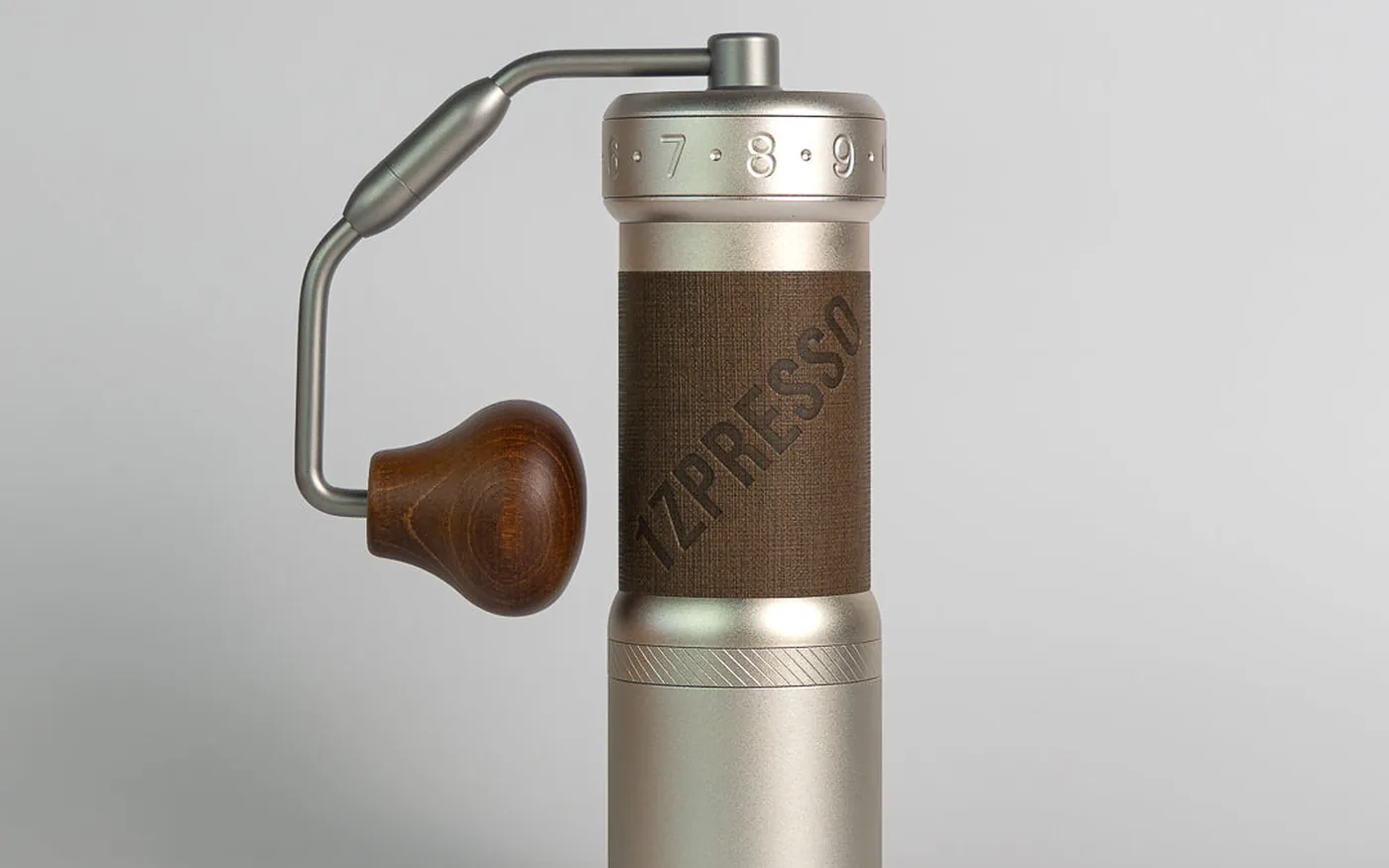
The adjustment mechanism is what earns its place in a travel context. The Q2 uses an internal adjustment system reached from inside the body after removing the handle cap - full details in the official 1Zpresso Q series manual - but the numbered dial is readable from the outside without disassembly. You can see your setting at a glance. Most competing grinders require counting clicks up and back from zero every time you reassemble. The Q2 does not. You set it at 3.2 for your V60, pull it apart to clean it, read the dial, reassemble at 3.2. No counting, no guesswork, no ruined first cup.
The magnetic dust cap keeps the grinding chamber closed during transit. The fold-out handle collapses cleanly. The grinder fits upright in most bottle pockets on hiking packs.
Q2 vs Q2 S: The S variant uses the same body and burr but ships with a different handle option. The performance difference is zero - choose on handle preference.
One build note worth flagging: the grounds container is on the small side for a French press dose above 20g. For AeroPress and V60 use at 15g, it is fine.
Grind Range and Burr Performance
The Q2 uses a 420 stainless heptagonal conical burr. The heptagonal design - seven cutting faces rather than the standard four or six - produces fewer fines than equivalent flat-burr grinders at this price tier. That matters for filter extraction.
The 30 clicks per rotation is the critical spec for understanding the Q2's precision ceiling. At filter range (clicks 3-5), each click represents a perceptible change in extraction time on a V60. At espresso range (clicks 0.5-1.5), the 30-click system shows its limits - the steps between clicks are large enough that you are jumping between shots that pull differently. You can reach espresso range, but not with the dialling-in precision a dedicated grinder provides.
The grind range covers:
- French press: clicks 5-7
- V60 / filter: clicks 3-4.5
- AeroPress standard: clicks 2.5-3.5
- Light espresso attempt (lever only): clicks 0.5-1.5
Grind retention is low for a conical. Most ground coffee exits cleanly into the catch cup. One tap releases the remainder. The Specialty Coffee Association research on burr geometry and particle distribution is the clearest external reference for understanding why conical design matters at this price tier.
How the Q2 Performs in the Cup
V60: I use 15g dose, 250g water, 93 degrees, 2:30-2:45 draw-down target. On the Q2 at click 3.4, the extraction is clean and even. Sweetness comes through without excessive bitterness on the finish. The cup is not at the level of the same recipe on a Niche Zero, but it is meaningfully better than any hand grinder under £70 I have used. On medium-roast Colombians and Brazilian single origins, the results are genuinely excellent. On high-end light-roast Ethiopian naturals, some choppiness in the particle distribution becomes audible in the cup - the grinder is doing what its price point allows.
AeroPress: The Q2 excels here. At click 2.8-3.2 for a standard 15g, 200g water, 80-second steep, the cup is full-bodied, clean, and consistent session to session. The AeroPress is more forgiving of particle distribution variation than the V60, and the Q2 makes the most of that tolerance. This is where I would point anyone buying primarily for travel.
French press: At clicks 5.5-6, the grind is coarse enough for a clean French press without over-extraction. At 20g you will be right at the capacity limit of the catch cup.
Espresso attempt: I ran a session on a Flair Neo at click 1.2. The result was extractable and produced crema. It was not a dialled-in espresso shot - the channel control that a dedicated espresso grinder enables is not present at this resolution. If espresso is your primary use, look elsewhere.
1Zpresso Q2 vs the Travel Grinder Field
Here is how the Q2 sits against the grinders you are likely comparing it to:
| Grinder | Price (June 2026) | Weight | Clicks/Rotation | Capacity | Best For |
|---|---|---|---|---|---|
| 1Zpresso Q2 | From £89 | 465g | 30 | 15-20g | Travel filter, AeroPress |
| Timemore Chestnut C3 | From £69 | 450g | S2C burr | 20-25g | Home filter, larger doses |
| Comandante C40 MK4 | From £230 | 540g | 40 | 25g | Premium filter, all methods |
| Porlex Mini II | From £65 | 350g | 13 | 15g | Ultra-light travel |
| Hario Skerton Pro | From £50 | 440g | Fixed | 20g | Entry level only |
| 1Zpresso JX | From £125 | 490g | 30 | 30g | Filter precision at home |
Q2 vs Timemore Chestnut C3: The closest budget rival. At £69 for the base C3, it is cheaper and has a larger 20-25g capacity. What you give up is the readable numbered dial - the C3's adjustment gives no external position indicator, so you must count clicks from zero each time you reassemble. For travel, that is a meaningful difference. The Q2 wins on convenience. The C3 wins on capacity and price.
Q2 vs Comandante C40 MK4: The gold standard at this form factor. The 1Zpresso Q2 is cheaper than the Comandante C40 by roughly £140 and lighter by around 75g. The Comandante's 40-click resolution and particle distribution consistency are noticeably better at filter range. If budget is not a constraint and filter precision is your priority, the Comandante wins. Under £100 for travel filter or AeroPress, the Q2 is the correct choice.
Q2 vs Porlex Mini II: The Porlex is lighter at around 350g and has been the default travel grinder recommendation for a decade. The burr geometry is older, the 13-click-per-rotation adjustment is too coarse for serious filter work, and the grind range is narrower. The Q2 is better at everything except weight. If every gram counts, take the Porlex. Otherwise, take the Q2.
Q2 vs Hario Skerton Pro: The price anchor. Consistency is not in the same league as the Q2, particularly at coarser ranges. The Skerton is a first-grinder. The Q2 is the step up.
Q2 vs the Rest of the 1Zpresso Range
Q2 vs JX: The JX has 30 clicks per rotation - the same as the Q2 - but a larger 30g hopper and a heavier 490g body suited to a kitchen counter rather than a backpack. Compared to the 1Zpresso JX, the Q2 trades hopper capacity for a smaller, lighter form factor. If you brew mostly at home, the JX is the better long-term buy. If you travel regularly, the Q2 earns its place.
Q2 vs JX-Pro: I switched from the Q2 to the JX-Pro for my home V60 sessions because the finer resolution makes a noticeable difference with washed Ethiopian light-roasts. The Q2 remains my travel grinder. The JX-Pro also covers light espresso at higher confidence.
Q2 vs K-Plus: The K-Plus is espresso-focused with a 90-click internal adjustment. Not a travel grinder. If espresso is your use case, the K series is where you look.
What I Would Avoid the Q2 For
Espresso as a primary use case. The 30-click resolution does not give you the dialling-in precision espresso requires. Buy the JX minimum, and realistically the K-Plus or K-Max for serious espresso work.
Multi-cup households. The 15-20g hopper means separate grinding per cup. Two cups back-to-back works. Three or more is a chore. Buy the Timemore C3 S Pro or the JX if you grind for more than one person regularly.
Light-roast filter obsessives. The Q2 produces a genuinely good cup on medium-roast coffees. On high-end light-roast Ethiopian naturals where you are chasing maximum clarity, the particle distribution limitations become audible. The Comandante or JX-Pro will serve you better if this is your primary use case and budget allows.
Where to Buy the 1Zpresso Q2 in the UK
The Q2 is available from UK specialist retailers and Amazon. Prices as of June 2026:
Retailers: Bluestar Coffee (preferred - 1Zpresso UK distributor, longer affiliate cookie window), Amazon UK (reliable stock and Prime delivery).
The Q2 typically retails from £89. The Q2 S variant (different handle, same performance) is priced similarly. Check live pricing before purchasing as stock levels vary by retailer.
If you are pairing the Q2 with a filter-focused coffee, Aurora Reserve is the light-roast Brazilian single origin from Balance Coffee that I brew with it daily in Bali. Whole bean or ground for filter.
My Verdict
Rating: 4.2 / 5
| Dimension | Score |
|---|---|
| Build quality | 4.5 / 5 |
| Grind range | 3.5 / 5 |
| Grind consistency | 4.0 / 5 |
| Value | 4.5 / 5 |
| Portability | 4.5 / 5 |
The 1Zpresso Q2 is the travel grinder I actually pack. Not because it trends on Reddit, or because it photographs well on a Bali terrace (it does). Because after 12 months of daily use across two continents, it is still producing filter coffee I am happy to drink every morning.
At £89-£99, you are buying the best hand grinder with a readable numbered dial available under £100. The burr quality beats the Porlex. The convenience beats the Timemore for travel. The price beats the Comandante by £140.
The Q2 will disappoint you as an espresso grinder. It will not disappoint you for what it was designed for: clean, consistent filter coffee in whatever city or timezone you are in. If you are spending under £100 on a travel grinder and you brew filter or AeroPress, start here.
Frequently Asked Questions
Is the 1Zpresso Q2 good for espresso?
The Q2 can reach espresso range but the 30-click-per-rotation system lacks the resolution to dial in a shot with precision. You can produce a workable result on a lever machine, but the stepping between clicks is too coarse for consistent espresso work. The 1Zpresso JX-Pro or K-Plus are the correct choices if espresso is your primary use case. The Q2 is a filter and AeroPress grinder first.
What is the difference between the 1Zpresso Q2 and the JX?
The JX and Q2 both use 30 clicks per rotation, but the JX has a larger 30g hopper and a heavier 490g body suited to a kitchen counter rather than a backpack. The JX-Pro goes further, with 40 clicks for finer precision. The Q2 wins on portability and price for travellers on a sub-£100 budget. Home brewers get more value from the JX.
How many clicks per rotation does the 1Zpresso Q2 have?
The Q2 has 30 clicks per rotation. This resolution is adequate for filter coffee and AeroPress but too coarse for dialling in espresso with precision. The numbered dial is readable from outside the body, so you can record your setting and return to it without counting from zero - a significant advantage for travel use, where rebuilding grind settings from scratch after reassembly would be frustrating.
Is the 1Zpresso Q2 worth the money?
Yes, for the right buyer. At £89-£99, the Q2 offers better burr quality, a readable numbered dial, and more consistent grind output than any rival at the same price. The Timemore C3 is cheaper with higher capacity, but no competitor at this price matches the Q2's externally readable dial - a real advantage for travel. If you brew filter or AeroPress and travel often, it earns its price.
How long does a 1Zpresso Q2 take to grind for one cup?
A 15g dose at filter range takes approximately 60-90 seconds at a steady pace. At coarser French press settings the time drops to 45-60 seconds. At espresso-range settings expect 90-120 seconds due to increased resistance. The Q2 is not slow by hand grinder standards - the dual bearing design keeps rotation smooth throughout - and grinding speed improves with consistent technique over the first few weeks.
Where is the 1Zpresso Q2 made?
1Zpresso is a Taiwanese brand and the Q2 is manufactured in Taiwan. The brand designs and manufactures its burrs in-house rather than using third-party burr sets. This is part of why the burr quality and machining tolerances on the Q2 stand noticeably above grinders from Chinese-manufactured competitors at similar price points, including earlier Porlex models and the Hario Skerton range.
What is the best hand grinder under £100 for travel?
The 1Zpresso Q2 is the best hand grinder under £100 for travel in 2026. It pairs a numbered dial readable from outside the body - no rival at this price offers this - with 420 stainless conical burrs that deliver genuinely good filter and AeroPress results. The Porlex Mini II is lighter but uses an older burr design, and the Timemore C3 lacks a readable position indicator.
Should I buy the 1Zpresso Q2 or the Timemore C3?
Buy the Q2 if you travel regularly - the externally readable numbered dial makes the difference. Buy the Timemore C3 if you brew mainly at home, want a larger 20-25g capacity, and do not mind counting clicks from zero after reassembly. The C3 starts from £69 with S2C burrs that hold their own at home filter range. Q2 wins on portability; C3 wins on capacity and price.
A wellness entrepreneur and biohacker, James explores the intersection of hospitality and health - from clean fuel and recovery tools to mindful routines that build balance into daily life.