Bulk Vegan Protein Review UK 2026: Is It Worth It?


Five plant sources, 24g protein, £17.99/kg - and a digestive enzyme complex most rivals skip.
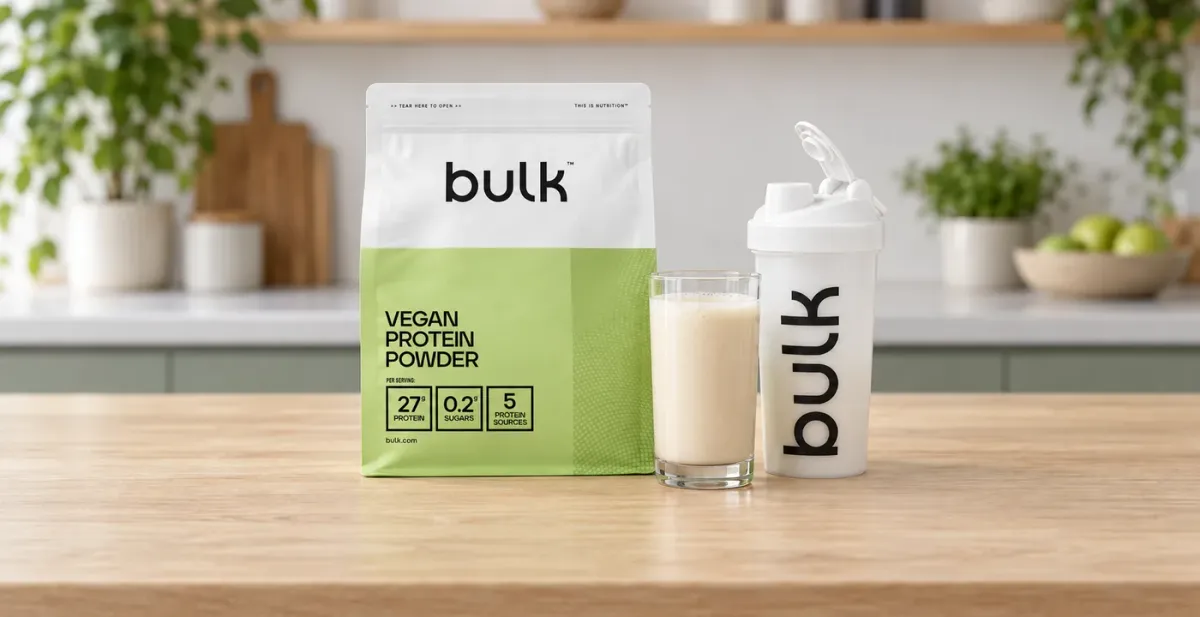
Table of Contents
Some of the links in this article are affiliate links, which help fund our independent review work at no extra cost to you. How we assessed these products is explained in this article and our Editor Lab methodology. No brand pays to appear, and no placement is guaranteed.
Bulk Vegan Protein is one of the best-value blended plant proteins in the UK.
At £17.99 for a kilogram, Bulk Vegan Protein is asking you to trust that a five-source plant blend can do what a single-ingredient pea protein or soy isolate can do - at a price that undercuts most of the market by a meaningful margin. That price point is where a bulk vegan protein review should start.
I am a registered Nutritional Therapist and BANT member, having led the nutrition clinic at The Kyros Project with Google DeepMind. This review assesses the label amino profile against the blend's claims, uses Bulk's published flavour listing and aggregate rating for context on taste, and compares price per kg like-for-like against three nearby UK rivals. What follows is the complete picture.
“Under £18 per kilo, with 24g protein per serving and a digestive enzyme complex, Bulk Vegan Protein looks strong on paper. Do taste and amino match?”Clemmie Rose, Registered Nutritional Therapist
Quick Verdict: Is Bulk Vegan Protein Worth It?
Bulk Vegan Protein is a strong entry-level to mid-tier plant protein option for anyone who wants a blended amino profile at an accessible price. The five-source formulation - pea, soy, pumpkin seed, quinoa, and flaxseed - addresses the single-source limitation that makes straight pea protein a less complete option. At 24g of protein per 35g serving, the yield is competitive. The DigeZyme enzyme complex is a genuine added-value feature that most sub-£20 plant proteins do not include.
The main unknown is taste. This review has not tasted the product, so it makes no call on flavour or mixability. Bulk lists a 4.3 average rating from 2,098 reviews across the range.
| Evaluation Criteria | Review Summary |
|---|---|
| Protein per serving | 24g per 35g serving |
| Price per kg (1kg) | £17.99 (was £29.99) |
| Protein blend | Pea, soy, pumpkin seed, quinoa, flaxseed |
| Digestive support | DigeZyme enzyme complex included |
| Mixability | Not tested in this review |
| Flavour range | Seven options |
| Suitable for | Vegan, vegetarian, halal |
| Informed Sport certified | No |
| Rating | 7.5/10 |
Who Bulk Is and How This Review Works
Bulk (formerly Bulk Powders) is a UK-based sports nutrition brand that operates primarily direct-to-consumer through its website. It occupies the value-to-mid tier of the UK supplement market - cheaper than premium specialist brands, more rigorously formulated than supermarket own-label products. The vegan protein range sits at the centre of its plant-based offering.
This review has no hands-on testing. Taste and mixability were not assessed. The only taste-related facts used are Bulk's flavour listing, its own product description and its aggregate rating. I cross-referenced the label nutrition information against published data on plant protein amino acid profiles and compared the price-per-kg figure against three comparable UK products.
Nutrition and Protein Blend Breakdown
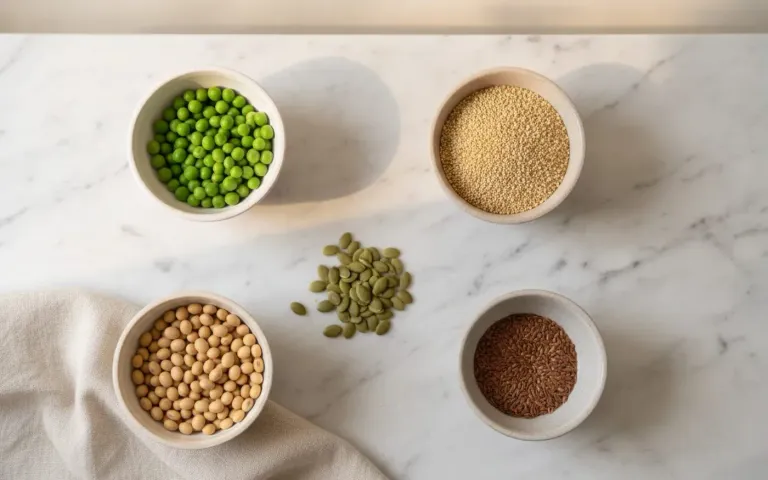
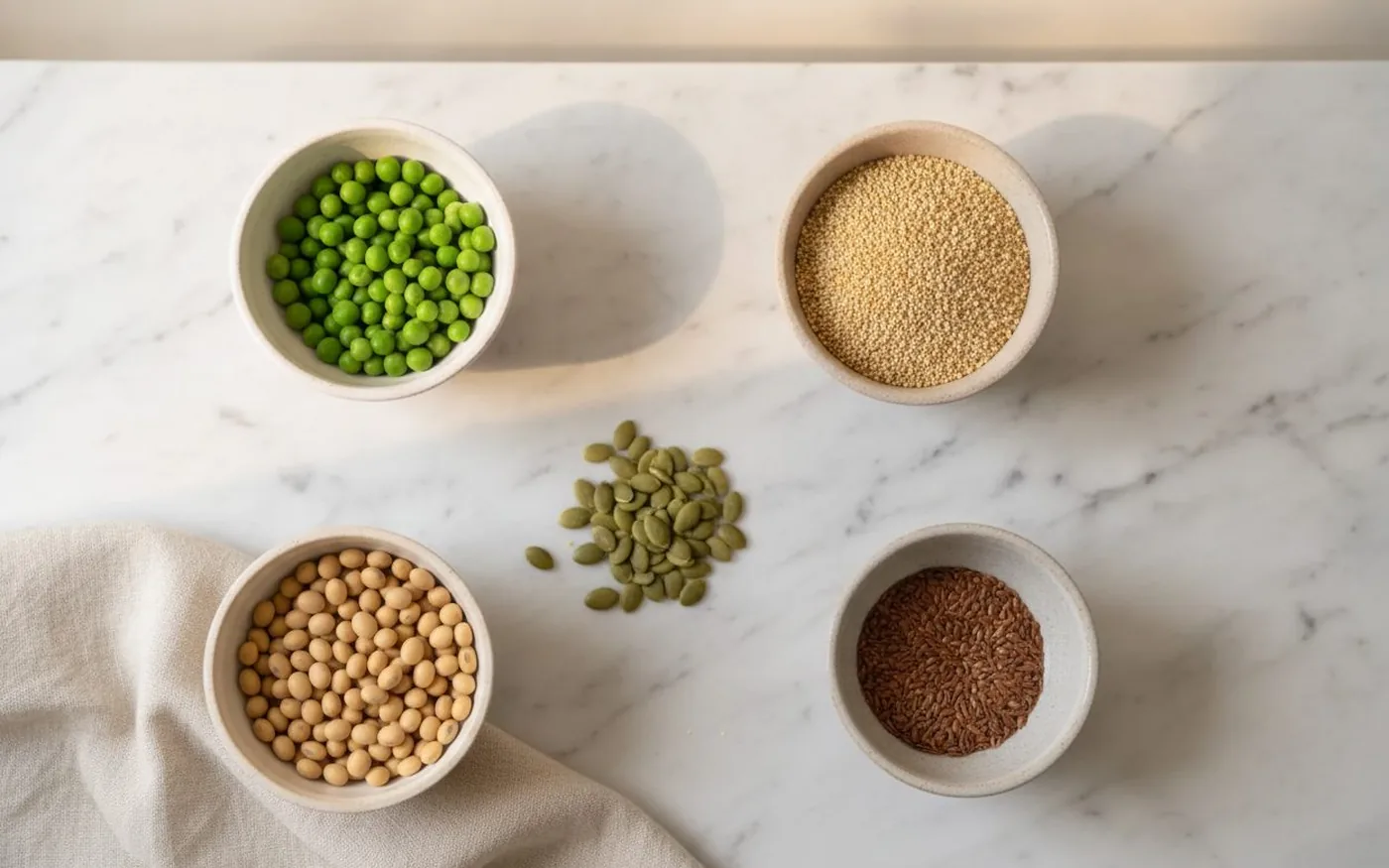
The central question for any blended vegan protein blend is whether the combination of sources produces a functionally complete amino acid profile. A single-source pea protein isolate is high in BCAAs but lower in methionine. A single-source soy isolate is a complete protein but raises questions for those avoiding phytoestrogens. Bulk's five-source approach - pea protein isolate, soya protein isolate, pumpkin seed protein, quinoa flour, and flaxseed powder - is designed to address both gaps.
The Amino Profile
Pea protein isolate and soya protein isolate together provide the leucine-rich base the formula needs. Leucine is the primary trigger for muscle protein synthesis, and at the blend ratios Bulk uses, the combined leucine yield per serving is in the range most resistance training guidelines target. Pumpkin seed protein contributes methionine, which offsets the pea protein's relative weakness in that amino. Quinoa and flaxseed add breadth across the essential amino acid panel and provide a small but meaningful contribution to fibre (1.5g per serving) and omega-3 fats from the flaxseed fraction.
The DigeZyme complex - comprising amylase, protease, cellulase, lactase, and lipase - is more than a marketing addition. Plant proteins carry more dietary fibre and antinutrients than whey, which can reduce absorption efficiency and cause the bloating commonly reported with straight pea protein isolate. A protease in the blend actively breaks down the protein chains to improve bioavailability. A meta-analysis of 49 trials in the British Journal of Sports Medicine (Morton et al., PMID 28698222) found that protein supplementation significantly increases muscle size and strength during resistance training, with no further gain in fat-free mass beyond about 1.6g of protein per kg of bodyweight per day. At 24g per serving, Bulk's dose makes a useful contribution towards that daily target.
Per-Serving Numbers (35g)
| Nutrient | Per 35g serving |
|---|---|
| Calories | 127 kcal |
| Protein | 24g |
| Carbohydrates | 3.8g |
| of which sugars | 0.3g |
| Fat | 1.3g |
| Fibre | 1.5g |
| Salt | 0.63g |
The carbohydrate and fat figures are low - this is a lean protein source by any measure. The sugar content (0.3g per serving) is negligible. The salt figure of 0.63g per serving is worth noting for anyone tracking sodium intake across multiple servings per day.
One point on completeness: if you are currently comparing plant protein vs whey, the leucine ceiling is the honest trade-off. Whey concentrate typically delivers 10-12% leucine by weight. Pea-dominant blends like this one typically sit at 7-9%. That difference matters most at the extremes - high-volume training blocks where leucine signalling per session is at a premium. For the majority of active adults training three to five times per week, the gap is not clinically significant, and a review of plant-based diets and exercise performance concluded they appear to be viable options for adequately supporting athletic performance (Lynch H et al., Nutrients, PMID 30513704).
Taste, Texture and Mixability
This review has not tasted Bulk Vegan Protein, so it does not rank or describe individual flavours. Bulk sells seven: Caramel Latte, Chocolate Cookies, Chocolate Peanut, Strawberry, Unflavoured, Vanilla and White Chocolate Coconut.
Bulk lists an average rating of 4.3 out of 5 from 2,098 reviews for the product, and describes the result as "a smooth, silky shake". That is Bulk's own description and an aggregate score, not a flavour-by-flavour verdict.
The formula includes xanthan gum and sunflower lecithin, which are typically added to help a powder mix. The DigeZyme complex is designed to ease the bloating that is a common complaint about plant proteins, though individual response varies.
Price and Value vs Rivals
At £17.99 per kilogram (current price), Bulk Vegan Protein is one of the most cost-competitive blended plant protein products in the UK market. The comparison matters most on a per-serving basis.
| Brand | Price per kg | Protein per serving | Serving size | Price per serving |
|---|---|---|---|---|
| Bulk Vegan Protein | £17.99 | 24g | 35g | around £0.63 |
| Huel Complete Protein | around £30 (subscription); around £33 one-time | 20g | 29g | around £0.87 (subscription) |
| Vivo Life PERFORM | around £46 | 25g | 37g | around £1.73 |
| MyProtein Impact Plant Protein | around £22 | 22g | 30g | around £0.67 |
Bulk delivers competitive protein per serving at a meaningfully lower cost than Huel and Vivo Life, and a slightly lower cost than MyProtein. The comparison that requires qualification is MyProtein: its Impact Plant Protein is cheaper than the regular Bulk price (£29.99) but more expensive than Bulk at the current sale price. On formulation, Bulk's five-source blend with DigeZyme gives it an edge over MyProtein's simpler pea and fava bean combination at a similar price point.
The caveat is certification. Vivo Life PERFORM is listed as third-party lab tested, while Bulk Vegan Protein does not carry Informed Sport certification. For recreational gym-goers and plant-based eaters, this is not a meaningful difference. Competitive athletes under anti-doping rules should confirm Informed Sport certification on the exact product before buying.
Bulk's discount code ecosystem is worth addressing directly - the 'bulk vegan protein discount code' secondary keyword signals purchase intent from people who have found the regular price and are looking for a better deal. The honest position: the brand runs frequent sitewide sales that bring the 1kg to £17.99 and the 5kg to significant per-kg savings. Subscribing to the mailing list gives access to these promotions before general release. There is no persistent affiliate code for a permanent reduction - the sale pricing is the deal.
Pros, Cons and Who It Is For
Pros
- Five-source blend provides a more complete amino acid profile than single-source pea or soy alone
- DigeZyme enzyme complex reduces bloating risk - a genuine differentiator at this price point
- 24g protein per 35g serving is a strong yield
- £17.99/kg at sale price is among the lowest cost-per-gram of blended plant protein in the UK
- Seven flavours, from Chocolate Peanut and Caramel Latte to Unflavoured
Cons

- No Informed Sport certification - not suitable for drug-tested competitive athletes
- Taste has not been tested in this review, so check the flavour you want before buying a large bag
- Salt content (0.63g per serving) is worth tracking for high-frequency users
- Contains soy - not suitable for those avoiding phytoestrogens or with soy allergies
- Regular price (£29.99/kg) is less compelling without a sale active
What to Avoid
Avoid Bulk Vegan Protein if you are a competitive athlete under anti-doping rules and need batch-tested certification - pay the premium for Informed Sport-certified products instead. Also avoid if you have a soy allergy; the soya protein isolate is a primary blend component, not a trace allergen.
If taste matters for sticking with a daily shake, start with a smaller size, because this review has not tasted any of the seven flavours.
Who It Is For
If you are a budget-conscious UK gym-goer or plant-based eater who wants a formulated blend rather than a single-source powder - and who is not subject to anti-doping certification requirements - Bulk Vegan Protein is the right product for your budget. It also works well for anyone wanting to know how much protein per day for muscle and looking for a low-cost, flexible way to hit their daily target without the digestive discomfort of single-ingredient pea protein.
The NHS notes that a balanced diet can include protein from "non-animal sources such as beans and pulses". A blended plant protein powder achieves what whole pulses alone cannot: a concentrated, convenient dose of essential amino acids in a single serving, without the preparation time.
Frequently Asked Questions
Is Bulk a good brand of protein?
Bulk (formerly Bulk Powders) is a well-established UK sports nutrition brand with a strong reputation in the value-to-mid tier of the market. Its vegan protein range is competitively formulated for the price, includes genuine added-value features such as the DigeZyme enzyme complex. It is a credible option for recreational athletes and plant-based eaters who do not need Informed Sport certification.
Is Bulk Vegan Protein good quality?
At the formulation level, yes. A five-source blend of pea, soy, pumpkin seed, quinoa, and flaxseed addresses the amino acid gaps that single-source pea protein leaves, and the DigeZyme complex adds a digestive benefit. The limitation is certification - it is not Informed Sport tested, so batch-level purity is not independently verified.
What's better, MyProtein or Bulk?
On blended vegan protein specifically, Bulk has the edge on formulation. Bulk's five-source blend with DigeZyme compares favourably with MyProtein's simpler pea and fava bean Impact Plant Protein. At sale pricing, Bulk is also cheaper per kilogram. MyProtein has broader range depth and steadier availability. Both are credible. For formulation quality at the lowest cost, Bulk wins on the current vegan protein comparison.
What is the best vegan protein powder in the UK?
Bulk Vegan Protein is one of the strongest choices at the value tier. For those willing to spend more, Vivo Life PERFORM is third-party lab tested and has a broader micronutrient profile. Huel Complete Protein prioritises completeness for meal-replacement contexts. The 'best' answer depends on budget, use case, and whether certification matters. Our full guide to the best plant-based protein powder UK covers the complete market comparison.
Why do dietitians say no to protein powder?
Some dietitians raise concerns about ultra-processing, unnecessary supplementation in people already meeting protein targets through diet, and marketing that overstates the need for supplemental protein. The nuance is that plant-based diets require more careful planning to achieve adequate leucine and methionine intake - and a blended plant protein powder is one practical tool for addressing that gap when whole-food sources are insufficient.
Is Bulk Vegan Protein worth it?
Yes, at the sale price. At £17.99 per kilogram, it delivers 24g of protein per serving from a five-source blend with a DigeZyme enzyme complex. Bulk lists a 4.3 average rating from 2,098 reviews. The limits are no Informed Sport certification and that this review has not tasted the product. For recreational gym-goers without anti-doping requirements, it is strong value.
Does Bulk Vegan Protein cause bloating?
Possibly less than straight pea protein, though this is formulation-based reasoning rather than tested. The DigeZyme enzyme complex includes a protease, which is designed to break down plant protein chains and targets the digestive discomfort that is the most common complaint about pea-dominant powders. Individual response varies, but the formulation is better-engineered for digestive comfort than straight pea protein isolate at a comparable price.
What does Bulk Vegan Protein taste like?
This review has not tasted Bulk Vegan Protein, so it cannot say. Bulk sells seven flavours: Caramel Latte, Chocolate Cookies, Chocolate Peanut, Strawberry, Unflavoured, Vanilla and White Chocolate Coconut. Bulk rates the product 4.3 out of 5 from 2,098 reviews and describes it as "a smooth, silky shake".
A registered Nutritional Therapist and member of BANT, Clemmie blends science with a holistic approach to wellbeing.