Sage Bambino vs Bambino Plus: Which One Should You Buy?

Coffee & Wellness Writer
An espresso machine specialist breaks down the one real difference between the Sage Bambino and Bambino Plus, and tells you which one to buy in 2026.
Table of Contents
Some of the links in this article are affiliate links, which help fund our independent review work at no extra cost to you. Every recommendation is based on hands-on testing through The Editor Lab methodology. No brand pays to appear, and no placement is guaranteed.
The Sage Bambino and the Sage Bambino Plus are almost the same machine. Same portafilter, same pump, same PID temperature control, and the same espresso shot quality. The £70 between them - as of April 2026, that is £329.95 versus £399.95 - buys exactly one meaningful difference: how your milk comes out.
If you drink flat whites, cappuccinos, or lattes, buy the Bambino Plus. If you drink espresso black, save the £70. The rest of this article explains the engineering behind that recommendation, and covers the few situations where it gets more nuanced.
Editor's Note
James Bellis is the Health and Wellness Editor at Balance Journal and founder of Balance Coffee. He spent five and a half years at Sanremo UK, one of the world's leading traditional espresso machine manufacturers, where he received hands-on technical training from the Sanremo engineering team on PID controllers, ThermoCoil systems, and thermal stability in commercial espresso machinery. He has tested both the Bambino and Bambino Plus directly. He knows these machines from both sides: the technical and the practical.
Quick Verdict
The Bambino Plus is the better machine for most people. At £399.95 versus £329.95 for the standard Bambino, the £70 premium covers an automatic steam wand with three texture and three temperature presets, a 1.9L water tank (35% larger than the standard model's 1.4L), and a ThermoCoil heating system that sustains the consistent steam pressure the automatic wand needs to work well. If you make milk-based drinks regularly, those three things combine into one practical outcome: consistent flat whites and cappuccinos from day one, with no technique required.
If you drink espresso black, buy the Bambino. If you already have manual steaming technique from a previous machine and want a compact, lower-cost setup, it works just as well. Beyond those two situations, get the Plus.
One thing neither machine does better than the other: pull espresso. The shot quality is identical on both. If you have read anything suggesting the Bambino Plus extracts better coffee, that is not accurate.
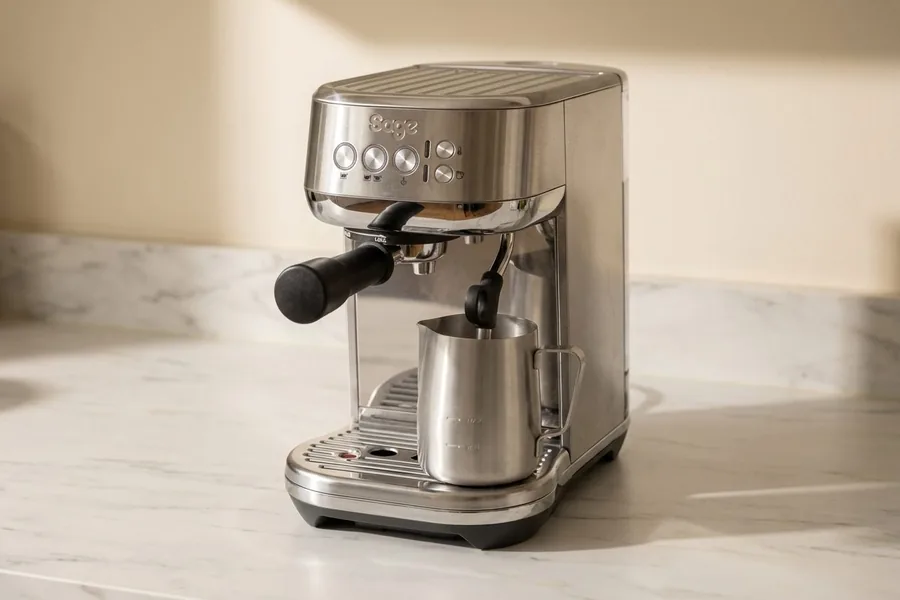
Sage Bambino Plus (BES500)
£399.95- + Automatic steam wand with three texture presets and three temperature settings
- + 1.9L water tank - 35% larger than the standard Bambino
- + ThermoCoil heating for consistent steam pressure
- + Best choice for milk drink makers and first-time buyers
- - £70 premium over the standard Bambino
- - 4.2cm deeper than the standard Bambino - tighter fit on shallow counters
- - Drip tray fills faster than expected in multi-drink households
The right machine for most buyers. If you make milk drinks regularly, the £70 premium is rational.
Shop at Sage - £399.95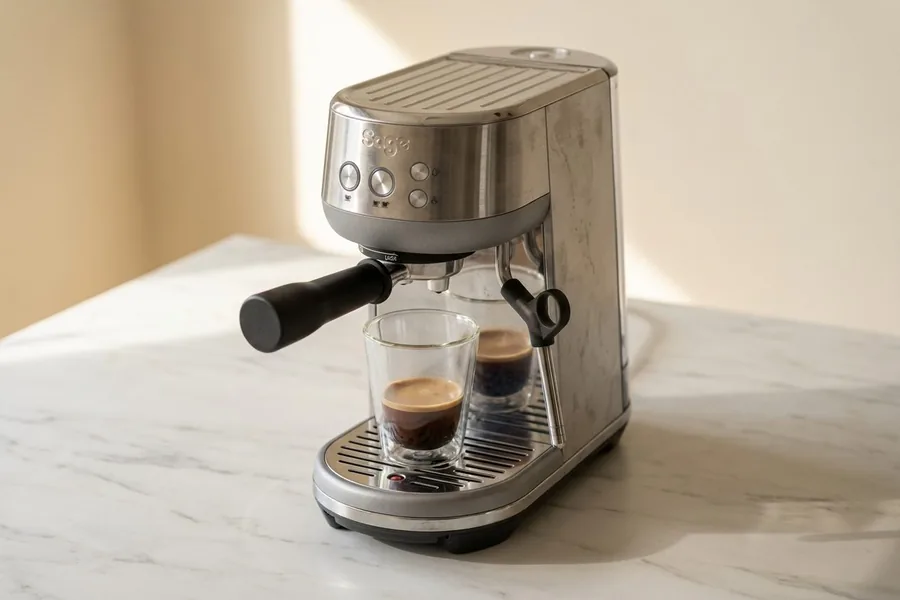
Sage Bambino (BES450)
£329.95- + £70 less than the Bambino Plus
- + Identical espresso shot quality
- + More compact - 32cm deep vs 36.2cm on the Plus
- + Correct choice for black coffee drinkers and experienced steamers
- - Manual steam wand requires technique - a barrier for beginners making milk drinks
- - 1.4L water tank means more frequent refills in multi-person households
- - ThermoJet heating rather than ThermoCoil
The right machine for black coffee drinkers and experienced steamers. Not recommended for beginners making milk drinks.
Shop at Sage - £329.95What's Actually Different
Four differences separate these machines in practice. The spec table at the bottom of this article lists everything by number. These four areas are where the numbers translate into something you actually feel during the morning routine.
The Steam Wand
This is the one your entire decision should rest on.
The standard Bambino has a manual steam wand. You hold the pitcher, control the angle and depth of the wand in the milk, monitor the temperature by feel, and cut the steam when you judge the milk is ready. On a commercial machine with high steam pressure, this is a skill most people develop in a week or two. On a domestic machine with lower pressure, the margin for error is narrower.
In my experience at Sanremo, and then testing the Barista Pro in my parents' kitchen during COVID, consistent manual microfoam on a home machine takes three to four weeks of daily practice to get right. Most people aiming for a flat white standard take longer.
The Bambino Plus replaces all of that with an automatic wand. You submerge it in cold milk, select your texture setting (Silky, Velvety, or Dense) and your temperature setting, press the button, and the machine handles the rest. Silky at the middle temperature setting produces the kind of microfoam a trained barista would call technically correct: glossy, pourable, without large bubbles. Dense is the right setting for a cappuccino.
The consistency across drinks is high because technique is no longer a variable in the process.
My honest take: the automatic wand produces better results than most people achieve manually in their first six months. That is not a criticism of home baristas. It is an acknowledgement that the skill takes real time to develop, and the Bambino Plus removes the need to develop it.
One important detail for plant-based milk drinkers: the automatic wand is calibrated around dairy milk temperatures. It works with oat milk, but you need a barista-edition product - Oatly Barista, Alpro Barista, or a similar version designed for steaming. Standard supermarket oat milk lacks the protein content to foam well on any machine.
The automatic programme runs slightly warmer than the optimal temperature for most plant-based milks (around 55°C versus the 65°C dairy target), so some oat milk drinkers prefer switching to manual mode on the Plus for more precise temperature control. Both modes are available on the Bambino Plus, so it is an option, not a limitation.
The Bambino Plus drip tray fills faster than you would expect. In a two-person household making three or four drinks a day, you will be emptying it every one to two days. It is a consistent gripe in owner feedback, and it is worth knowing before you buy rather than discovering after a week.
Water Tank
The gap is 35% - 1.4 litres on the standard Bambino, 1.9 on the Plus. In practice, it comes down to how often you want to be thinking about the machine rather than just using it.
When I set up the Barista Pro for my parents during COVID - two adults, a few coffees in the morning and another round in the afternoon - the small practical irritants were the first things that surfaced. Not the espresso quality, which was excellent from day one, but the maintenance rhythm: the drip tray needs emptying more often than feels reasonable for a machine of that size, and the tank needs topping up on a schedule that is easy to ignore until it is inconvenient. A larger tank does not eliminate that. It just extends the interval.
If it is just you making two drinks a day, the 1.4L tank on the standard Bambino lasts three to four days between refills. Add a second person and milk-based drinks, and the maths change. The steam cycle draws significantly more water per drink than a straight espresso pull, so a two-person milk-drink household on the standard Bambino will be refilling every day or every other day. The Plus extends that to three to four days.
It is the kind of convenience difference that sounds trivial on paper and accumulates into genuine friction across a year of daily use.
ThermoJet vs ThermoCoil
Both heat from cold to ready in three seconds. The difference between the two systems is real, but it only matters for milk - not for the espresso itself.
ThermoCoil, used in the Plus, is a resistive coil system where a coil element wraps around the water path and heats the water as it passes through. I worked with similar coil heating architectures at Sanremo, where they appear in several commercial machine designs. The engineering advantage is consistent heat distribution through the water path, which produces stable steam pressure across the duration of a steam cycle.
Sage has not published a direct technical comparison of ThermoJet and ThermoCoil in the Bambino context. The practical implication, consistent with both the machine design and the observed performance, is that ThermoCoil provides the stable steam pressure the automatic programme on the Plus needs to deliver consistent results. For espresso extraction, where both machines use the same PID controller and operate at the same 9 bar extraction pressure, the ThermoCoil advantage does not translate. The brew-side performance in your cup is equal on both machines.
Size and Kitchen Fit
Width is nearly identical - 19.5 cm for the Bambino, 19.4 cm for the Plus. The number that matters is depth. The Plus is 36.2 cm front-to-back; the standard model is 32 cm. That 4.2 cm difference is the measurement worth checking against your actual counter before you order.
When I was setting up my parents' kitchen with the Barista Pro, depth was the first dimension I measured. Their kitchen has wall cabinets that sit close to the counter edge - common in UK fitted kitchens - and a few extra centimetres front-to-back is the difference between a machine that fits comfortably and one you have to angle the portafilter around. My current kitchen in Bali has the same issue: a narrow counter strip where appliance depth matters more than width. If you have ever stood a machine on your counter and found the handle catches the cabinet door, you know exactly what I mean.
Both machines clear standard UK wall cabinet height at 30-31 cm tall. If your counter has less than 40 cm of usable depth, the Plus is a tight fit. If you have 45 cm or more, neither machine will feel cramped.
Who Should Buy the Bambino
If you drink black coffee, buy this one. Americanos, long blacks, and straight shots pull identically on the Bambino as on the Plus. You save £70 on a milk system you will never use.
If you already have manual steaming technique from a previous machine, the Bambino is not a step down. The manual wand works the same way as any other domestic espresso machine - your existing skill transfers directly.
Learning to steam from scratch on the Bambino is genuinely achievable on the machine. At Sanremo, I worked alongside baristas who were among the best in the country - Dhan Tamang won six UK Latte Art Championships and trained on machines far less forgiving than this. Having worked on commercial machines most home baristas will never touch - Sanremo Opera, La Marzocco, Victoria Arduino - there is a real and noticeable step up at that level. The Bambino is not trying to compete with them. For someone learning to steam milk at home, or at an intermediate level, it absolutely does the job. But the skill still requires commitment. Daily practice, proper pitcher technique, deliberate attention to wrist position and the sound of the milk. It does not come automatically.
One honest check before you buy: if you are expecting manual steaming to come naturally without that deliberate practice, push back on that assumption. According to the Specialty Coffee Association's espresso extraction standards, small variables produce significant differences in the final cup.
The same is true for milk texture. Occasional undisciplined steaming produces warm frothy milk, not the glossy microfoam a flat white requires. If flat whites and lattes are a regular part of your daily routine, the £70 for the Plus is not an upgrade - it is the right machine.
Who Should Buy the Bambino Plus
If you are buying your first espresso machine, get the Plus. The same goes for most households moving from a pod machine or bean-to-cup machine to home espresso.
The automatic steam wand removes the hardest skill barrier in home espresso. In my time at Sanremo, working with roasters and their equipment across the UK, the pattern I kept seeing was the same: someone buys a manual espresso machine with real enthusiasm, pulls a technically correct shot within a few days because the machine handles extraction, and then the milk defeats them. Three weeks later it is a black coffee machine they overpaid for.
The Plus removes that possibility. You will produce technically sound microfoam on the first morning. Silky setting, mid temperature, cold milk from the fridge - the machine calibrates to the milk density and stops at the right texture. That experience is what motivated the Bambino Plus to exist.
If more than one person in your household makes coffee, that is often the deciding point. Consistent milk texture across multiple people requires either that everyone has the same steaming skill - unlikely - or that technique is taken out of the equation. The auto wand does the second.
On the £70 premium: the standard Bambino is a good machine. The Plus is the right machine for most people. Set those £70 against the alternative, which is weeks of inconsistent results, genuine frustration, and the real chance the machine ends up used only for black coffee. For most people at this price point, it is not a close call.
One friction to flag: the Plus runs a brief automatic purge cycle after each milk steam - a few seconds to clear residual milk from the internal path. It keeps the wand clean without manual intervention, but it is an extra beat in the routine that the standard Bambino does not have. The drip tray fills faster than you expect in daily use - see the Water Tank section for the fuller picture. Neither is a dealbreaker. They are the honest frictions of a well-engineered machine.
For oat milk households: the automatic mode works with barista-edition oat milk. Standard supermarket oat milk will not foam adequately on either machine. If you use plant-based milk exclusively, manual mode on the Plus gives more temperature control and typically produces a better result.
What's Exactly the Same
Espresso shot quality. This point is worth stating plainly because it is the most common misconception about these two machines.
Both machines use a 54mm portafilter, a 15-bar pump operating at 9 bar extraction pressure, the same pre-infusion system (low-pressure saturation of the coffee puck before full extraction pressure is applied), and the same PID temperature controller. The Specialty Coffee Association specifies 9-bar pressure and a brew temperature between 90 and 96°C as the reference extraction parameters for espresso. Both machines hit these figures. The filter baskets included in the box are identical on both models - single and dual-wall variants for one and two-cup extractions.
The shot that lands in your cup is the same shot. The Bambino Plus costs more because of what happens to your milk, not because of anything that happens to your coffee.
Both machines also carry Sage's standard two-year UK warranty, which is strong for this price category. Which? tests both machines under their espresso machine methodology and rates them positively in the sub-£500 field. Both appear regularly in UK editorial roundups for this price bracket.
If the espresso extraction were meaningfully different between the two, the standard Bambino would be a harder sell. It is not. The two machines are engineered from the same extraction platform, with the same hardware on the brew side.
What About a Grinder?
Whichever you choose, you will need a grinder too. Neither the Bambino nor the Bambino Plus includes one, and neither should be used primarily with pre-ground coffee if you want to get the most from the machine.
The natural pairing in the Sage ecosystem is the Sage Smart Grinder Pro, which integrates with both Bambino models and allows consistent, repeatable grind size adjustment. It retails at around £200, bringing the total setup cost to approximately £530 for the standard Bambino or £600 for the Bambino Plus.
Both machines include dual-wall filter baskets that produce acceptable espresso with pre-ground coffee. The dual-wall design is forgiving of inconsistent particle size, and if you are not yet ready to invest in a grinder, the results are drinkable. But the extraction quality that justifies the price of either machine - the kind of espresso that competes with a coffee shop shot - only comes through with freshly ground beans at the correct particle size. For which beans extract best on Sage hardware specifically, see our best coffee beans for espresso UK guide.
A dedicated guide to the best coffee grinders for home espresso is in production at Balance Journal.
If you are deciding between saving for a grinder and upgrading to the Plus: buy the standard Bambino plus a good grinder first. A well-extracted shot through the Bambino with fresh-ground coffee outperforms the Bambino Plus with pre-ground, every time.
The grinder is the first decision. The machine is the second.
Spec Comparison Table
Both machines were verified against Sage UK's official product pages (sageappliances.com, April 2026). SKU references (BES450 for the standard Bambino, BES500 for the Bambino Plus) are included below for specification purposes only.
| Specification | Bambino (BES450) | Bambino Plus (BES500) |
|---|---|---|
| Price (UK RRP, April 2026) | £329.95 | £399.95 |
| Heating system | ThermoJet | ThermoCoil |
| Heat-up time | 3 seconds | 3 seconds |
| Steam wand | Manual | Automatic (3 texture + 3 temperature presets) |
| Portafilter size | 54mm | 54mm |
| Pump pressure | 15 bar (9 bar extraction) | 15 bar (9 bar extraction) |
| PID temperature control | Yes | Yes |
| Pre-infusion | Yes | Yes |
| Water tank capacity | 1.4L | 1.9L |
| Dimensions (W x D x H) | 19.5 x 32 x 31 cm | 19.4 x 36.2 x 30.4 cm |
| Weight | Not published by manufacturer | 6.48 kg |
| Filter baskets | Single + dual wall (1 and 2 cup) | Single + dual wall (1 and 2 cup) |
| Warranty (UK) | 2 years | 2 years |
| Colour options | Black, Brushed Stainless, Sea Salt, others | Black, Brushed Stainless, Sea Salt, others |
Sources: Sage UK Bambino product page and Sage UK Bambino Plus product page, April 2026. Bambino Plus weight confirmed via Amazon UK product listing. Bambino weight not published by manufacturer or major UK retailers.
Do You Need a Grinder?
Neither the Bambino nor the Bambino Plus comes with a grinder. Most buyers do not factor this in. You have two options.
Option 1 - Pre-ground espresso coffee. The easier route. The downside: ground coffee goes stale within days of opening. Espresso is particularly sensitive to freshness, and you will notice the difference in the cup. This is always a compromise.
Option 2 - Buy a grinder separately. The better option for coffee quality. Whole beans stay fresh far longer, and freshly ground coffee makes a genuine difference to the shot. Budget an extra £50-£150 for a decent entry-level grinder (Sage Smart Grinder Pro or Baratza Encore are solid starting points). Also factor in counter space - a grinder and espresso machine together take up meaningful room in a typical kitchen.
That counter space question is worth raising directly: if you are already planning to buy a grinder alongside the Bambino, the Sage Barista Pro is worth considering as an all-in-one alternative. One machine, one footprint. Whether the price difference makes sense depends on your kitchen and your budget - but it is a comparison most Bambino reviews do not surface.
Note: The Bambino Plus includes a single-wall (non-pressurised) basket alongside the pressurised basket. The non-pressurised basket requires freshly ground coffee to extract properly - it is built for grinder users, not pre-ground buyers.
Frequently Asked Questions
What is the difference between the Sage Bambino and Bambino Plus?
Is the Sage Bambino Plus worth the extra money?
Can you make a flat white with the standard Sage Bambino?
Is the Sage Bambino good for beginners?
Do you need a grinder for the Sage Bambino?
Is the Sage Barista Pro worth the extra money over the Bambino Plus?
A wellness entrepreneur and biohacker, James explores the intersection of hospitality and health - from clean fuel and recovery tools to mindful routines that build balance into daily life.