Nespresso vs Dolce Gusto: Which Pod Machine Is Actually Worth Buying in 2026?
Nespresso vs Dolce Gusto - real ground coffee and espresso against milk-powder variety and a lower price. A coffee pro settles it.
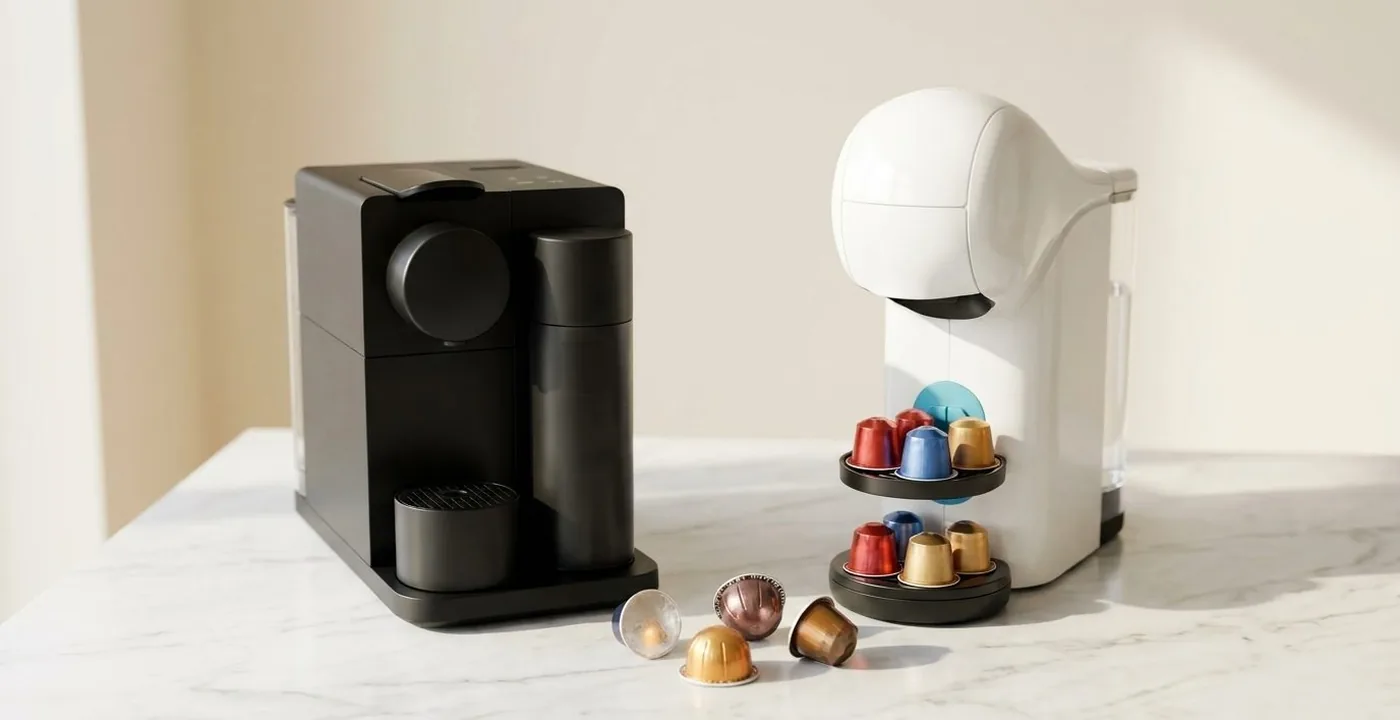
Table of Contents
Some of the links in this article are affiliate links, which help fund our independent review work at no extra cost to you. Every recommendation is based on hands-on testing through The Editor Lab methodology. No brand pays to appear, and no placement is guaranteed.
Here is the thing almost nobody tells you when you start comparing Nespresso vs Dolce Gusto: both systems are owned by the same company. Nestlé sits behind both ranges, which is why you will see them on the same supermarket shelf at similar prices. Yet they are not the same kind of machine, and treating them as interchangeable is the single most common mistake I see buyers make.
The real split is simpler than the marketing suggests. Nespresso is a coffee system built around espresso extraction, and Dolce Gusto is a drinks system built around variety. If you understand that one line, you are already ahead of most reviews that lump them together as generic pod machines.
The Short Answer: Which System Wins For Which Buyer
If you mostly drink espresso, flat whites, or black coffee and you care about how the coffee itself tastes, buy Nespresso. If you want one machine that makes coffee, hot chocolate, chai latte, and iced drinks for a household with mixed tastes, buy Dolce Gusto. Those two sentences settle the decision for most people.
On running cost, Dolce Gusto is cheaper at the machine pod level, averaging around 28p per pod against Nespresso Original at roughly 36p (as of early 2026, UK retail). Nespresso flips that result the moment you switch to third-party compatible pods at 15p to 25p, which Dolce Gusto cannot match because its pod market is almost entirely Nestlé-owned.
Quick verdict by buyer type:
- The espresso drinker: Nespresso Original, every time, for crema and shot quality.
- The milk-drink and variety fan: Dolce Gusto, for the broadest menu from a single machine.
- The family household with kids: Dolce Gusto, because hot chocolate, Nesquik, and iced drinks keep everyone served.
“I have been in coffee for fourteen years, founded Balance Coffee in 2020, and tested ten of the best pod machines on the market while developing our own lab-tested capsules. This comparison comes from pulling hundreds of shots across both systems, not from reading spec sheets.”James Bellis, founder, Balance Coffee
How the Two Systems Actually Differ
The clearest difference is pressure. Nespresso uses 19-bar pressure for espresso extraction; Dolce Gusto uses 15-bar pressure designed for milk-based drinks. That is not a small technical footnote. It shapes the crema, the body, and the entire category each machine belongs to.
Pod construction differs too. Nespresso Original pods are aluminium, Nespresso Vertuo pods are aluminium with a barcode rim, and Dolce Gusto pods are hard plastic with a foil membrane. The aluminium versus plastic split matters for both taste preservation and recycling, which I cover further down.
Drink format is where the two systems separate hardest. A Nespresso shot is a single capsule of espresso, or a larger cup on the Vertuo line. A Dolce Gusto milk drink usually needs two pods, one for the coffee and one for the milk, slotted in sequence. That two-pod method is exactly what lets Dolce Gusto build a cappuccino or a chococino straight from the machine without a steam wand.
Recycling reality in the UK has improved for both. The Podback scheme now collects Nespresso, Tassimo, and Dolce Gusto capsules through kerbside bags and drop-off points, so neither system leaves you stranded. The honest gap is in real-world participation, not scheme coverage.
| System Differences at a Glance | Nespresso | Dolce Gusto |
|---|---|---|
| Pressure | 19 bar | 15 bar |
| Pod material | Aluminium | Plastic with foil |
| Core drink | Single-shot espresso | Two-pod milk drinks |
| Recycling (UK) | Podback | Podback |
| Third-party pods | Wide (Original line) | Very limited |
Coffee Quality, Side By Side
On the coffee itself, Nespresso wins, and it is not especially close. The 19-bar extraction pulls a denser shot with a thicker, more stable crema, more aroma off the cup, and a rounder body through the middle. Put a Nespresso Original shot next to a Dolce Gusto Espresso Intenso and the difference in the cup is immediate.
Dolce Gusto pods labelled as espresso do not produce true espresso. True espresso requires a minimum of around 9 bars of extraction pressure forcing hot water through a compacted puck, and while Dolce Gusto runs higher nominal pressure, the capsule design is built for volume and milk drinks rather than a concentrated extraction. You get a pleasant coffee, but not an espresso in the technical sense.
“Across the hundreds of shots I pulled testing both systems, the pattern held every time. Nespresso gives you the better coffee in isolation, and Dolce Gusto gives you the better milk drink without any skill required.”
Where Dolce Gusto earns its place is the finished drink. A chococino or a cappuccino out of a Dolce Gusto tastes balanced and complete with zero technique from you, because the milk pod does the work a steam wand would otherwise demand. If your daily cup is a milky drink rather than a shot, that convenience can matter more than crema.
Cost Per Cup and Total Cost of Ownership
Pod price is where Dolce Gusto looks cheapest on paper. Dolce Gusto pods average 28p each; Nespresso Original pods average 36p each in the UK in 2026, with Nespresso Vertuo closer to 50p and the newer Dolce Gusto Neo around 36p. For a single black coffee, that is a genuine saving on the Dolce Gusto side.
The picture changes with third-party pods. Compatible capsules drop Nespresso Original to roughly 15p to 25p per pod, while Dolce Gusto compatibles are far less common because the format is tightly held by Nestlé. If you are happy to buy outside the brand, Nespresso Original becomes the cheaper long-term system per cup.
Run it over a year at two cups a day, or 730 cups, and the gap is concrete. Dolce Gusto at 28p costs about £204 a year, Nespresso Original at 36p costs about £263, and Vertuo at 50p costs about £365. Switch your Nespresso Original to compatible pods at 20p and the annual figure drops to around £146, undercutting everything else. If you want the wider context on whether the machine pays for itself at all, that feeds directly into the question of are coffee machines worth it.
Machine entry prices favour Dolce Gusto upfront. The Dolce Gusto Piccolo XS starts around £69 and the Genio S Plus around £119, against the Nespresso Essenza Mini at about £99 and the CitiZ at about £159 (as of early 2026, UK retail). The verdict on cost is split cleanly: Dolce Gusto is cheaper to buy and cheaper per branded pod, while Nespresso is cheaper to run if you move to compatible capsules.
Machine Range: Which Nespresso vs Which Dolce Gusto
Nespresso splits into two ranges before you even pick a model. The Nespresso Original line uses traditional 19-bar pump extraction and includes the Essenza Mini, Pixie, CitiZ, and the milk-capable Lattissima Touch and Gran Lattissima. The Nespresso Vertuo line uses centrifusion, spinning the pod and reading a barcode on the rim to set brew parameters automatically, and covers the Vertuo Pop, Vertuo Next, Vertuo Plus, and Vertuo Deluxe.
One sourcing note worth knowing: the Nespresso Lattissima models are manufactured by De'Longhi, not by Nestlé directly, which is why their milk systems feel more like an appliance than a capsule gadget. If you want the deeper split between the two ranges, the full breakdown sits in our Nespresso Vertuo vs Original comparison.
Dolce Gusto keeps it to a single family of machines. The range runs from the compact Piccolo XS through the Genio S Plus, Genio S Touch, Infinissima, the Mini Me and Lumio, up to the Neo, which is the newer model built around a part-paper compostable pod. Every one of them uses the same two-pod milk-drink method, so the choice is mostly about size, automation, and budget rather than coffee quality.
There is also a bridge option. The Sage Creatista uses Nespresso Original pods but adds a proper steam wand, so you can texture milk yourself rather than relying on a milk capsule. It is the natural upgrade for a buyer who outgrows a stock Nespresso machine but still wants the pod convenience.
| Pick by need | Best choice |
|---|---|
| Best entry-level | Dolce Gusto Piccolo XS (around £69) |
| Best for milk drinks | Dolce Gusto Genio S Plus or Nespresso Lattissima |
| Best for variety | Dolce Gusto Genio S Touch |
| Best for compact spaces | Nespresso Essenza Mini |
If you have already settled on the Nespresso side, our guide to the best Nespresso machine walks through each model in detail, and the Dolce Gusto Genio S review does the same for the most popular Dolce Gusto.
Drink Variety and Customisation
On range, Dolce Gusto offers the broader drink range (including hot chocolate and chai latte); Nespresso offers the better coffee. Dolce Gusto covers chococino, chai tea latte, cortado, cappuccino, iced cappuccino, Nesquik, and a full Starbucks-branded line, all from sealed capsules. For a house where one person wants a latte, another wants hot chocolate, and a child wants Nesquik, that menu is hard to beat.
Nespresso gives you depth rather than breadth. On the Original line you get espresso, lungo, and Americano-style drinks, with milk options on the Lattissima models. The Vertuo line adds larger cup sizes, including mug-sized coffee and cold brew, by changing the pod rather than the setting.
This is the reason family households so often land on Dolce Gusto. You are not buying the best coffee in the room, you are buying the machine that keeps four different people happy with minimal effort. That trade is completely valid, and pretending otherwise would be dishonest.
Pod Availability, Third-Party Pods and Where to Buy
Nespresso has a far wider third-party pod ecosystem, including specialty roasters; Dolce Gusto pods are almost exclusively Nestlé-branded. For the Nespresso Original line, the compatible market is huge, with Lavazza, Whittard, Starbucks, and specialty options all making capsules that fit. That competition is what drives the per-pod price down and the quality range up.
The Vertuo line is the exception. Its barcode system locks the machine to pods Nestlé has encoded, so third-party support is minimal and you are largely tied to buying Nespresso-branded capsules. If open pod choice matters to you, Original beats Vertuo before you even compare anything to Dolce Gusto.
Full disclosure: Balance Journal is the editorial publication of Balance Coffee, which sells Nespresso Original compatible specialty pods. We list them alongside Lavazza, Whittard, and Starbucks because that is the honest competitive landscape, not because we sell them. They are an option for buyers who want speciality-grade coffee in a Nespresso machine once the system decision is made, and they exist only for the Original line, not Vertuo or Dolce Gusto.
For delivery, Nespresso runs its own Boutique subscription and both brands sit on Amazon Subscribe and Save. Dolce Gusto buyers are mostly limited to Nestlé and Starbucks ranges through the supermarket or Amazon, which keeps the system simple but caps how far you can push quality.
Reliability, Build Quality and Warranty
Both systems carry a two-year UK warranty, so on paper they are level. Nespresso machines are generally robust, with the notable exception of the Vertuo Next, whose lightweight plastic body has a reputation for feeling and failing cheaper than the rest of the line. If long-term reliability is your priority, that is the one model to approach with caution.
Dolce Gusto machines are plastic-heavy but mechanically simple, and simplicity has a quiet advantage. Fewer moving parts means fewer failure points, and the Krups-built internals tend to keep working even when neglected. They are not premium objects, but they rarely break in ways that matter.
Here is the honest pattern from years of watching these machines in real kitchens. Dolce Gusto units tend to outlast their owners' interest in them, sitting unused long before they fail. Nespresso machines get repaired more often, mostly because owners keep using them daily for years and care enough to fix them. Repairability and parts availability in the UK favour Nespresso for that reason.
Sustainability and Recycling Honestly Compared
Recycling coverage is now even between the two. Nespresso Original aluminium pods are recyclable through Podback; Dolce Gusto plastic pods are also Podback-accepted as of 2024, alongside Tassimo. So whichever system you choose, there is a real UK route to recycle the used capsules through Podback, provided you actually use it.
The genuine environmental story is the Dolce Gusto Neo. Its part-paper, home-compostable pod, launched into the UK from 2024, is the most credible sustainability move either brand has made, because composting at home removes the collection step that recycling schemes depend on. That is a real point in Dolce Gusto's favour for an eco-minded buyer.
The honest take is broader, though. Compostable Neo pods are the better environmental choice within this comparison, but pod machines as a category remain less sustainable than ground coffee brewed in a French press or a cafetiere. No capsule, recycled or composted, beats simply not producing one.
Who Should Buy Nespresso, Who Should Buy Dolce Gusto
| Evaluation Criteria | Our Findings |
|---|---|
| Best for | Espresso quality and the widest third-party pod range |
| Pod range | 50+ compatible brands on Original line |
| Entry price | £139.95 |
| Shop | Shop Essenza Mini → |
| Evaluation Criteria | Our Findings |
|---|---|
| Best for | Drink variety, milk recipes and tea from one machine |
| Pod range | Dolce Gusto pods only, limited third-party |
| Entry price | £75.00 |
| Shop | Shop Genio S Plus → |
Buy Nespresso if you drink espresso, you want speciality-grade third-party pod options, and you care about crema and coffee quality. The Original line specifically gives you the best coffee in this comparison and the widest pod market to grow into, which is why it is the system I point most coffee-led buyers towards.
Buy Dolce Gusto if you want one machine that handles coffee, hot chocolate, and milk drinks, you have a family with mixed preferences, and you want the lowest upfront cost. You are trading peak coffee quality for range and simplicity, and for a lot of households that is the right trade.
Buy neither if you want true cafe-quality espresso. At that point a small manual machine like the Sage Bambino, paired with a grinder, will outperform any capsule on flavour and cost per cup, and you should look there instead.
The decision in three branches:
- Coffee comes first: Nespresso Original.
- Variety and family come first: Dolce Gusto.
- Cafe-grade espresso comes first: neither, look at a manual machine.
What to avoid: skip the Nespresso Vertuo Next if reliability is a priority, given the weak plastic body, and skip the Dolce Gusto Mini Me if pod variety is your goal, since its compact format steers you towards the narrowest part of the range.
How We Tested
Every claim here comes from hands-on use, not spec sheets. I tested ten of the best pod machines on the market during Balance Coffee's own pod development, pulling hundreds of shots across both the Nespresso and Dolce Gusto systems and comparing them on the same beans, the same water, and the same cups where the format allowed. The full method sits in our Editor Lab write-up. According to the British Coffee Association, UK adults drink around 98 million cups of coffee a day, and a growing share of that is now pulled from a capsule, which is exactly why getting this decision right matters. Prices were checked against UK retail as of early 2026 and are re-verified within 30 days of publishing.
Frequently Asked Questions
Is Nespresso better than Dolce Gusto?
Can you use Dolce Gusto pods in a Nespresso machine?
Is Dolce Gusto cheaper than Nespresso?
Can you use Nespresso pods in a Dolce Gusto machine?
Are Dolce Gusto pods stronger than Nespresso?
Which is more environmentally friendly?
Are third-party pods worth it for Nespresso?
Which is healthier, Nespresso or Dolce Gusto?
A wellness entrepreneur and biohacker, James explores the intersection of hospitality and health - from clean fuel and recovery tools to mindful routines that build balance into daily life.