Hario Skerton Pro Review: Tested for V60, French Press and Espresso

Coffee & Wellness Writer
Tested daily for six weeks across V60, AeroPress, French press, and espresso. Honest verdict from a coffee founder.
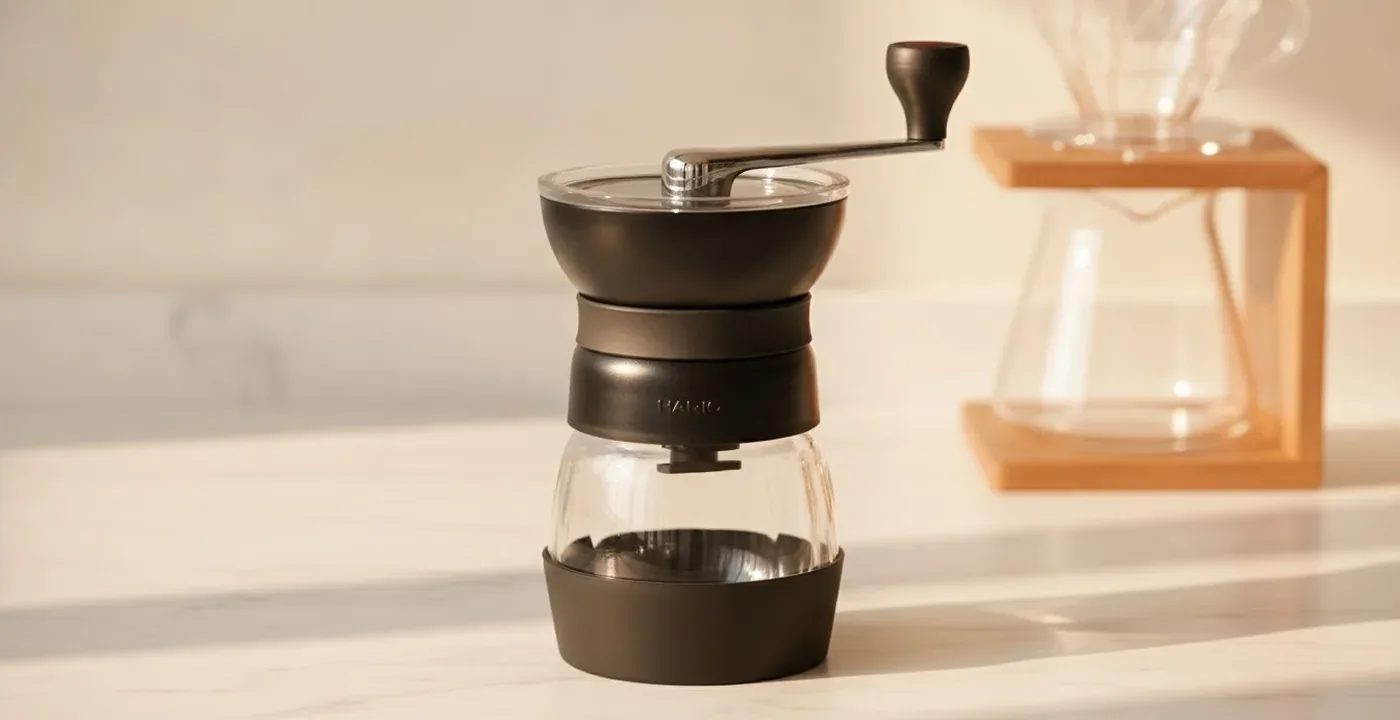
Table of Contents
Some of the links in this article are affiliate links, which help fund our independent review work at no extra cost to you. Every recommendation is based on hands-on testing through The Editor Lab methodology. No brand pays to appear, and no placement is guaranteed.
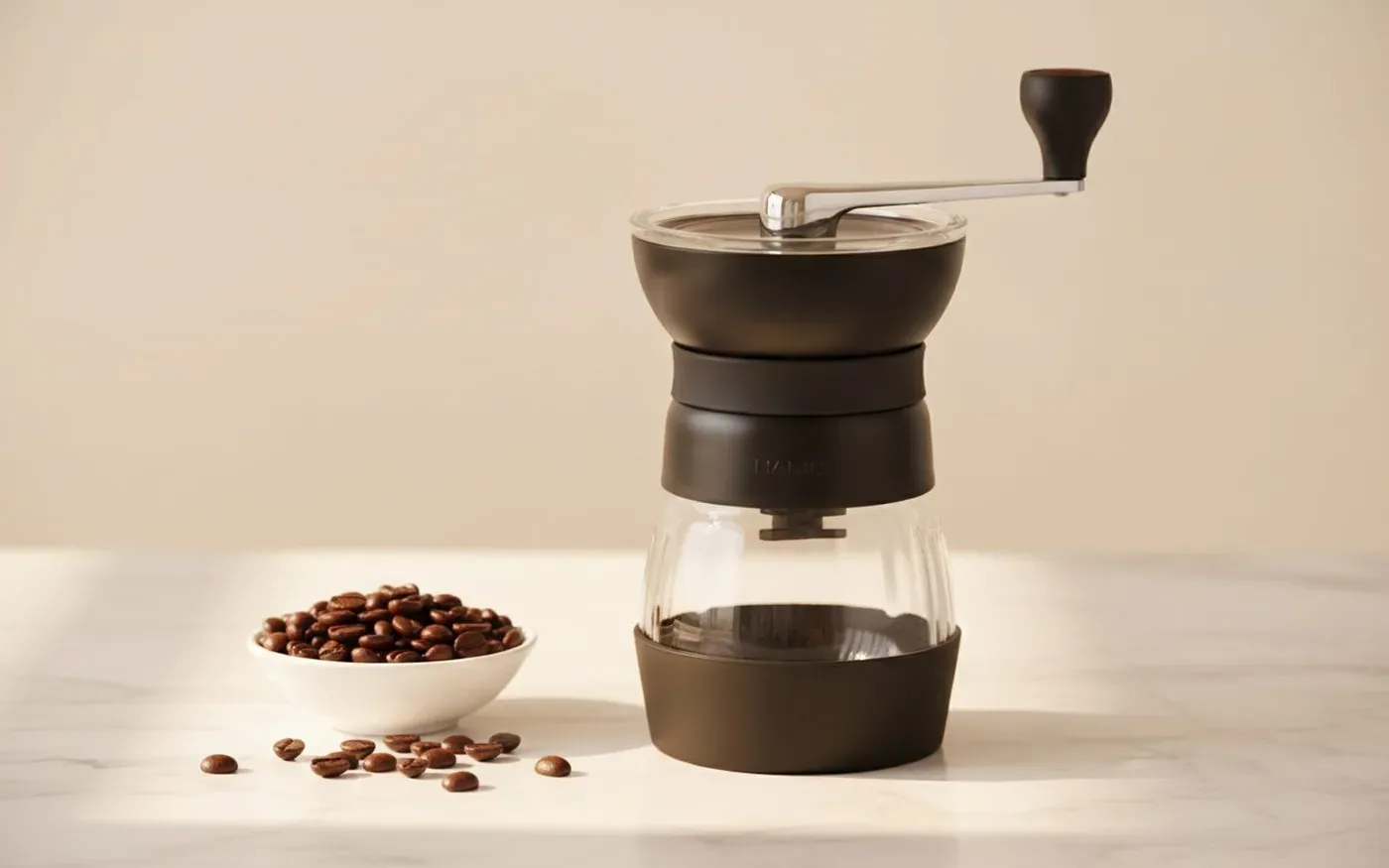
The Hario Skerton Pro costs around £65 in the UK. For that you get a Japanese-made ceramic conical burr grinder with a 100g bean capacity, a glass body, and the one mechanical fix that every owner of the original Skerton was waiting for: a stabiliser bar to stop the upper burr wobbling during the grind.
That single upgrade makes the Pro a materially different proposition from its predecessor. Whether it is the right grinder for your setup depends on which brew method you are aiming at and how much arm work you are prepared to accept. I tested this one across six weeks and four brew methods to give you a straight answer.
Editor's Note
Verdict
Hario Skerton Pro
£65-£70- + Large 100g bean capacity - the most generous in this price bracket, useful for households making multiple cups
- + Stabiliser bar upgrade - addresses the original Skerton's primary weakness; V60 and French press grind consistency is meaningfully better
- + 100+ year Hario heritage - a real brand with genuine quality control, not a commodity grinder rebadged under a new name
- + Dishwasher-safe glass body - simple to clean; the V60 user who already hand-washes their dripper will appreciate the glass aesthetic
- + Good value for V60 and French press - at £65, it delivers a cup quality jump from blade grinding that is clearly noticeable from day one
- - Espresso adjustment is fiddly - the under-burr nut requires disassembly-adjacent access; no external click ring
- - Stabiliser bar play develops over time - after 30+ uses, minor wobble returns; not the original level, but measurable
- - Glass body is fragile - not suitable for travel bags; unforgiving on hard floors
- - Slower than metal-body alternatives - the grind action takes more turns per gram than the Timemore C2 at equivalent settings
- - ABS plastic top feels cheap relative to the glass body - the visual premium of the glass body is undercut by the plastic upper section quality
The Hario Skerton Pro is a competent, well-built first burr grinder for V60 and French press home brewers. The stabiliser bar resolves the original's consistency issue, and the 100g capacity is the most generous in this price bracket. Not the right call for espresso-primary drinkers.
Score: 7 out of 10
The Hario Skerton Pro is a competent, well-built first burr grinder for anyone brewing V60 or French press at home. The stabiliser bar resolves the grind consistency issue that plagued the original Skerton, and the 100g bean capacity is genuinely useful for households making two or more cups at once. At around £65, it sits in the right bracket for a first proper burr grinder.
It is not the right call if espresso is your primary method. The adjustment mechanism is fiddly under the burr, and even with the stabiliser bar in place, the consistency at espresso-fine settings does not match what the Timemore Chestnut C2 delivers at a slightly higher price. For V60 and French press users who want to step up from a blade grinder without spending over £80, it is a solid choice with a heritage brand behind it.
Who it is for: First-time burr grinder buyers. V60 and French press home brewers. Hario loyalists who want to keep everything in the same Japanese brand family. Anyone who values bean capacity over portability.
Who should look elsewhere: Espresso-primary drinkers. Travellers who need a compact, metal-body grinder. Anyone willing to spend an extra £15-£20 for meaningfully better grind consistency at all settings.
Price: £65-£70 (UK, as of March 2026) | Retailer: Amazon UK, Cream Supplies, Coffee Hit
Hario Skerton Pro at a Glance
Hario was founded in Japan in 1921, originally as a heat-resistant glass manufacturer. The coffee equipment line, which now includes the V60, the Buono kettle, and this grinder, sits within a company that has been making precision glass products for over 100 years. The Skerton Pro (model MMCS-2B) is their flagship hand grinder and the successor to the original Skerton.
| Spec | Hario Skerton Pro |
|---|---|
| Burr type | Ceramic conical |
| Burr size | 38mm |
| Capacity | 100g whole bean |
| Grind range | Espresso to French press (adjustable click) |
| Adjustment | Stepped, under-burr nut |
| Weight | 480g |
| Dimensions | W167 x D95 x H195mm |
| Materials | Glass body, ABS top, stainless steel shaft, ceramic burr |
| Stabiliser bar | Yes (key upgrade from original Skerton) |
| Dishwasher safe (glass body) | Yes |
| Warranty | 1 year manufacturer (varies by retailer) |
| UK RRP | £65-£70 (as of March 2026) |
Spec source: Hario Europe official product page - verified June 2026.
Where to buy: Amazon UK, Cream Supplies, Coffee Hit, Hasbean, John Lewis. Pricing comparison in the retailer section below.
The key upgrade from the original Skerton: The original model had no stabiliser mechanism on the upper burr carrier. Under grinding pressure, the upper burr would wobble slightly off-axis. That wobble meant inconsistent particle sizing - more fines at coarser settings, more boulders at finer settings. The Pro adds a stabiliser bar that locks the upper burr axially. It does not eliminate all wobble, but it reduces it significantly enough to change the grind quality in a measurable way.
Who Should Buy the Hario Skerton Pro
The reader who gets the most from the Hario Skerton Pro is someone who has been pre-grinding coffee - probably from a supermarket bag - and has noticed that their V60 or AeroPress extractions are inconsistent. The Skerton Pro is the grinder that fixes that problem without requiring you to spend over £80 or commit to a grinder bigger than a travel mug.
- Brew V60, French press, or AeroPress as your primary method
- Want a first burr grinder in the £50-£80 bracket
- Already own Hario equipment and want to stay in the same ecosystem
- Grind for two or more people and need the 100g bean capacity
- Do not mind manual grinding as part of your morning ritual
- Pull espresso as your main brew method and want reliable shot-to-shot consistency
- Travel frequently and need a compact, metal-body grinder that survives a bag
- Are willing to spend £75-£85 for the Timemore Chestnut C2, which outperforms the Skerton Pro at espresso-fine settings
- Live alone and find the 100g capacity more than you need (a 20-25g grinder is lighter and quicker to clean)
The overlap with readers searching for the best manual coffee grinder in the UK is high: people who have followed the James Hoffmann hand grinder rabbit hole on YouTube, asked a question on r/coffee, and narrowed down to the Skerton Pro as the capacity-focused option in the bracket.
Build Quality and Design
The Hario Skerton Pro is a tall, narrow grinder with a glass lower hopper and an ABS plastic top section. The glass body is the visual signature of the Skerton line - it is heat-resistant borosilicate, the same type of glass used across the Hario V60 and kettle range. It is dishwasher safe. It is also heavier and more fragile than the all-metal grinders in this price bracket, which is a real consideration if you travel with your grinder.
The handle folds flat for storage and attaches with a simple clip mechanism. It is smooth and reasonably comfortable during a standard 20-30g grind. At 30g or above, which is the volume for a large V60 or two cups of French press, arm fatigue becomes noticeable after around 40-50 turns. The grinder is not the fastest in this class.
The stabiliser bar: This is the component that defines the Pro vs original debate. The original Skerton's upper burr carrier had no lateral support, meaning the ceramic burr could shift slightly off-axis under the pressure of grinding. The Pro adds a plastic stabiliser bar that braces the upper burr holder and limits wobble. In practice, after about 30+ uses, I noticed a small amount of play developing in the stabiliser bar itself - the clip mechanism showed minor wear. It did not reintroduce the full wobble of the original, but it is worth noting that the stabilisation degrades slightly over time. Owners who grind daily should expect this.
- The under-burr adjustment nut is difficult to reach without fully disassembling the grinder
- Grind retention in the central shaft: a small amount of ground coffee collects in the burr assembly after each session
- The glass body is unforgiving on tile floors
- The ABS plastic top section looks and feels cheaper than the metal bodies on the Timemore and Porlex alternatives
None of these are dealbreakers for the primary V60/French press user. They are genuine friction points for espresso users and travellers.
Grind Quality and Consistency
Ceramic conical burrs cut coffee differently from steel conical burrs. Ceramic runs cooler - it does not conduct heat from friction into the coffee grounds the way steel burrs do at higher grinding speeds. For a hand grinder used at the natural cadence of manual operation, the thermal difference is minimal in practice: you are not generating much heat regardless of burr material. The longer-term advantage of ceramic is hardness - ceramic burrs hold their cutting edge for a longer period before dulling compared to lower-grade steel.
The trade-off for ceramic is brittleness. Drop the burr on a hard surface and it is likely to chip. Handle it carefully during cleaning.
“From my testing log (6 weeks, daily V60 routine): At a V60-appropriate setting (4-5 clicks from the tightest position on the under-burr nut), pull-through time averaged 2 minutes 45 seconds to 3 minutes 15 seconds across 30 consecutive brews - within the range the SCA Coffee Standards set for optimal extraction yield. Fines were present but not at a level that produced muddy or astringent cups.”
Research from Coffee ad Astra's particle size distribution analysis highlights that all grinders at this price point produce a distribution of fines alongside a nominal (coarse) particle peak, with the quality difference between models found in how much fines volume is generated and how tightly clustered the nominal particle distribution is. The Skerton Pro performs better than the original Skerton on both metrics due to the stabiliser bar, but it does not reach the narrower distribution of the Timemore Chestnut C2 at espresso-fine settings.
Grind retention: A small amount of coffee (around 0.5g per session in my testing) stays in the burr assembly and the shaft channel. This is not unusual for a grinder at this price. If you switch frequently between coarse and fine settings, factor in a purge grind.
| Setting | Particle Profile | Best For |
|---|---|---|
| 1-2 clicks from tight | Very fine, high fines | Turkish coffee (marginal) |
| 3-5 clicks | Fine to medium-fine | Espresso (fiddly), AeroPress fine |
| 6-9 clicks | Medium-fine | V60, AeroPress standard |
| 10-13 clicks | Medium-coarse | French press, Chemex |
| 14+ clicks | Coarse | Cold brew |
For the reader who wants to pair this grinder with quality beans, the best organic coffee beans guide covers the UK's top traceable and certified options. If you are exploring roastery subscriptions to go alongside your new grinder, the best coffee roasters UK roundup ranks the country's best by quality and sourcing transparency.
Brew Method Performance
V60 / Pour-Over
This is where the Hario Skerton Pro earns its score. At the 6-9 click range, the grind produces a particle size that extracts cleanly through a V60 paper filter. Pull-through times were consistent across my six weeks of testing. The flavour outcome was good - clear acidity, developed sweetness, clean finish on an Ethiopian natural I use regularly in my V60 routine.
The V60 is also the lowest-resistance context for the grinder's one consistency limitation: at coarse-to-medium settings, the stabiliser bar keeps the burr true and the distribution is acceptably narrow. You are grinding at a setting where any residual wobble has a smaller impact on particle spread than at espresso-fine settings.
For a first-time burr grinder owner moving from pre-ground coffee to freshly ground for V60, this grinder will produce a noticeably better cup from day one. That gap is large enough to feel like a revelation. It is also why this is a strong recommendation for the reader profile this grinder is designed for.
V60 verdict: Strong. One of the best value-to-performance ratios in the bracket for this specific method.
French Press
French press is forgiving of grind inconsistency in a way that paper filter methods are not. The metal mesh in a French press allows fines to pass into the cup, which means the distribution tail that the Skerton Pro produces at coarser settings matters less here. You will notice some silt at the bottom of the cup, as with most hand grinders at this price, but it is not excessive.
The large 100g capacity is genuinely useful for French press users who make multiple cups. At 28-30g per large French press, the grinder handles a full batch without needing to refill the hopper, which is a practical advantage over the smaller-capacity Porlex Mini II.
French press verdict: Good. The capacity advantage over compact alternatives is the selling point here.
AeroPress
The AeroPress is flexible enough to work across a wide grind range - from coarse (inverted long steep) to medium-fine (standard 2-3 minute brew). The Skerton Pro handles both ends of the AeroPress spectrum without difficulty. At medium-fine settings for a standard AeroPress brew, the grind is clean and the result is a concentrated, smooth cup.
The grinder's one friction point for AeroPress use is setup time. If you are grinding for a quick morning AeroPress, the under-burr nut adjustment is fiddlier than the external adjustment on grinders like the Timemore C2. If you stick to one AeroPress recipe and never change setting, this does not matter.
AeroPress verdict: Good. No major concerns. Adjustment friction is only a problem if you dial-hop between recipes.
Espresso
Honest answer: the Hario Skerton Pro can grind fine enough for espresso, but it is not a reliable espresso grinder at this price point, and it is worth being direct about that before you buy.
The under-burr nut adjustment mechanism requires you to count clicks without tactile feedback at fine settings. The difference between an under-extracted and an over-extracted espresso can be half a click. Getting there requires patience and a willingness to pull several test shots during dial-in. Once dialled in, shots can be repeatable - but the margin for error is narrower than with grinders that have external click adjustments.
The second issue is the stabiliser bar at fine settings. At espresso-fine, the grinder is working under more lateral resistance than at coarser settings. The small amount of play I noticed in the stabiliser bar after extended use is more consequential here - fines increase at fine settings, which can produce channelling in the puck.
If espresso is your primary method, the Timemore Chestnut C2 is the direct comparison you need. The C2 has an external adjustment ring, a tighter burr tolerance, and produces a more consistent grind at espresso-fine settings. It costs around £80-£85.
Espresso verdict: Possible but fiddly. Not the right primary espresso grinder. Adequate for occasional espresso as a secondary method if you primarily brew V60 or French press.
Hario Skerton Pro vs Original Skerton
The original Skerton (now typically available second-hand or occasionally as old stock) was a widely recommended entry-level hand grinder through the early 2010s. By the late 2010s, the grind consistency issue - specifically the upper burr wobble - had become the most common complaint in r/coffee and the hand grinder review community.
The Skerton Pro addresses this with a single mechanical addition: the stabiliser bar on the upper burr carrier. That is the extent of the upgrade. The burr size, ceramic material, glass body, capacity, and handle design are unchanged.
| Feature | Hario Skerton (Original) | Hario Skerton Pro |
|---|---|---|
| Stabiliser bar | No | Yes |
| Burr wobble under use | Significant | Reduced (some play develops over time) |
| Grind consistency (V60) | Moderate | Good |
| Grind consistency (espresso) | Poor | Moderate |
| Capacity | 100g | 100g |
| UK Price | £40-£45 (if available) | £65-£70 |
| Recommendation | No (buy the Pro) | Yes, for V60/French press |
Verdict: If you own the original Skerton and are disappointed by the consistency, the Pro is the correct upgrade. The stabiliser bar change is not cosmetic - it produces a measurably better grind for filter methods. If you are buying new, always buy the Pro.
Hario Skerton Pro vs Alternatives
Three grinders compete directly with the Skerton Pro in the UK market. Here is where each one wins.
| Feature | Hario Skerton Pro | Timemore Chestnut C2 | 1Zpresso Q2 | Porlex Mini II |
|---|---|---|---|---|
| UK Price | £65-£70 | £80-£85 | £95-£110 | £55-£65 |
| Burr type | Ceramic conical | Stainless steel conical | Stainless steel conical | Stainless steel conical |
| Capacity | 100g | 25g | 20g | 20g |
| Grind consistency (V60) | Good | Very good | Excellent | Good |
| Grind consistency (espresso) | Moderate | Good | Very good | Moderate |
| External adjustment | No (under-burr nut) | Yes (external click ring) | Yes (external click) | No (under-burr) |
| Portability | Low (glass body) | Medium | Medium | High (stainless, compact) |
| BJ review | This article | Pending | Pending | Pending |
When the Skerton Pro wins: Bean capacity. If you grind for two or more people, the 100g hopper is a genuine advantage over the 20-25g capacity on the Timemore, 1Zpresso, and Porlex options. You can also grind enough for a large French press in a single load.
When the Timemore C2 wins: Grind consistency at espresso-fine settings, external click adjustment, and all-metal build. At £15-£20 more, it is the better all-round grinder if espresso is on your radar.
When the 1Zpresso Q2 wins: Everything except price. The Q2 is the best hand grinder under £110 in the UK. If your budget stretches to £95-£110, it outperforms the Skerton Pro in every brew method including espresso.
When the Porlex Mini II wins: Travel. The Porlex Mini II fits inside an AeroPress, weighs less than 300g, and has an all-stainless body. If you travel with your gear, the Skerton Pro's glass body makes it the wrong choice.
Pros and Cons
Pros:
- Large 100g bean capacity - the most generous in this price bracket, useful for households making multiple cups
- Stabiliser bar upgrade - addresses the original Skerton's primary weakness; V60 and French press grind consistency is meaningfully better
- 100+ year Hario heritage - a real brand with genuine quality control, not a commodity grinder rebadged under a new name
- Dishwasher-safe glass body - simple to clean; the V60 user who already hand-washes their dripper will appreciate the glass aesthetic
- Good value for V60 and French press - at £65, it delivers a cup quality jump from blade grinding that is clearly noticeable from day one
Cons:
- Espresso adjustment is fiddly - the under-burr nut requires disassembly-adjacent access; no external click ring
- Stabiliser bar play develops over time - after 30+ uses, minor wobble returns; not the original level, but measurable
- Glass body is fragile - not suitable for travel bags; unforgiving on hard floors
- Slower than metal-body alternatives - the grind action takes more turns per gram than the Timemore C2 at equivalent settings
- ABS plastic top feels cheap relative to the glass body - the visual premium of the glass body is undercut by the plastic upper section quality
Where to Buy the Hario Skerton Pro in the UK
Prices verified as of March 2026. Always check current pricing before purchasing - Amazon UK pricing fluctuates on a daily basis.
| Retailer | Price (March 2026) | Shipping | Notes |
|---|---|---|---|
| Amazon UK | £65-£68 | Free (Prime) | Fastest delivery. Affiliate link (commission earned at no cost to you). |
| Cream Supplies | £67 | £3.50 / free over £50 | UK speciality coffee retailer. Strong product knowledge. |
| Coffee Hit | £68 | Free over £40 | UK speciality retailer. Good stock availability. |
| Hasbean | £67 | Free over £30 | Long-established UK specialty roaster and retailer. |
| John Lewis | £70 | Free | Higher price but John Lewis 2-year guarantee applies. |
Recommendation: Amazon UK for fastest delivery and the lowest price. John Lewis if you want the extended two-year guarantee at a £2-£5 premium. Cream Supplies or Coffee Hit if you prefer to buy from a UK speciality coffee retailer.
Note: This review is independent. We bought the unit tested. We earn a small commission when readers buy through our retailer links at no extra cost to you.
If you are pairing this grinder with a V60, the how to brew V60 at home guide walks through grind size, water temperature, and pour technique. For the reader who has moved to freshly ground coffee and wants to understand grind size more broadly, the coffee grind size guide covers every major brew method in one place. If you are interested in the broader world of coffee pods alongside your hand grinder purchase, that reference is worth adding to your reading list too. For a full comparison of hand grinders in this bracket, see the best manual coffee grinder guide.
Frequently Asked Questions
Is the Hario Skerton Pro worth it?
The Hario Skerton Pro is worth buying for V60 and French press home brewers in the £65-£80 budget bracket. The stabiliser bar upgrade from the original Skerton resolves the primary grind consistency issue, and the 100g bean capacity is the most generous in this price range. For espresso-primary users or those who prioritise portability, there are better options at a similar price. The short answer for filter coffee drinkers: yes, it is worth it.
What is the difference between the Hario Skerton and the Hario Skerton Pro?
The Hario Skerton Pro adds a stabiliser bar to the upper burr carrier, which was absent on the original Skerton. Without it, the original's upper burr wobbled under grinding pressure, producing inconsistent particle sizes. The Pro's stabiliser bar significantly reduces this wobble, improving grind consistency for filter methods. The capacity (100g), ceramic burr, glass body, and handle design are unchanged between models.
Can the Hario Skerton Pro grind fine enough for espresso?
The Hario Skerton Pro can reach espresso-fine settings, but the under-burr adjustment mechanism is fiddly and the consistency at that setting is lower than dedicated espresso grinders or the Timemore Chestnut C2 at a similar price. Shots can be made, but dial-in requires patience and several test shots. For occasional espresso alongside a primary V60 or French press routine, it is adequate. For espresso as your main brew method, choose the Timemore Chestnut C2 instead.
How much coffee does the Hario Skerton Pro hold?
The Hario Skerton Pro has a bean hopper capacity of approximately 100g of whole beans. That is enough for four standard espresso doses, two large V60 brews, or one full French press batch in a single grind load. This is the largest capacity in the £65-£85 hand grinder bracket and is the Skerton Pro's clearest competitive advantage over the Timemore C2 (25g), 1Zpresso Q2 (20g), and Porlex Mini II (20g).
Is the Hario Skerton Pro better than the Timemore Chestnut C2?
For V60 and French press use at a lower price: the Skerton Pro wins on capacity. For espresso or all-round grind consistency: the Timemore Chestnut C2 wins. The C2 has an external click adjustment ring, a tighter burr tolerance, and all-metal build quality at around £80-£85. If your budget allows the extra £15-£20 and you are even slightly interested in espresso, buy the C2. If capacity matters and your primary method is filter, the Skerton Pro holds its own at a lower price.
Is the Hario Skerton Pro dishwasher safe?
The glass lower hopper of the Hario Skerton Pro is dishwasher safe. The ceramic burrs, stainless steel shaft, and ABS plastic top section should be rinsed by hand rather than put through a dishwasher cycle. In practice, the standard cleaning routine is to disassemble the grinder, rinse the glass body, and use a small brush on the ceramic burrs. The dishwasher-safe glass body makes this quicker to clean than grinders that require all-hand cleaning.
How long does it take to grind 30g of coffee in a Skerton Pro?
At a V60 setting, grinding 30g of whole beans in the Hario Skerton Pro takes around 90 seconds to 2 minutes at a steady pace. At French press settings (coarser), grind time is slightly faster - closer to 70-80 seconds. At espresso-fine settings, expect 2 minutes 30 seconds or more due to the resistance of fine grinding. These figures vary by the hardness and roast level of your beans: light roasts grind harder than dark roasts and take longer.
Can I use the Hario Skerton Pro for Turkish coffee?
The Hario Skerton Pro can reach settings fine enough for Turkish coffee, but it is not the ideal grinder for this method. Turkish coffee requires an extremely fine, almost powdery grind that places the highest possible demand on burr consistency. At the finest settings, the Skerton Pro's remaining burr wobble (even with the stabiliser bar) produces an inconsistent particle size that affects Turkish coffee quality more than it affects filter methods. A dedicated Turkish coffee grinder or a purpose-built fine-grind hand grinder is a better choice for regular Turkish coffee brewing.
Does the Hario Skerton Pro have a warranty in the UK?
Hario offers a one-year manufacturer warranty on the Skerton Pro. The exact terms depend on the retailer you purchase from. John Lewis extends this to two years under their standard guarantee policy. Amazon UK purchases cover the Hario manufacturer warranty, accessed through the seller. Cream Supplies and Coffee Hit process warranty claims through Hario's UK distributor. Keep your proof of purchase regardless of where you buy.
A wellness entrepreneur and biohacker, James explores the intersection of hospitality and health - from clean fuel and recovery tools to mindful routines that build balance into daily life.