De'Longhi Dedica Maestro Plus Review

Coffee & Wellness Writer
Five years at Sanremo UK, training alongside authorised engineers. Here is whether the Maestro Plus earns the Dedica upgrade.
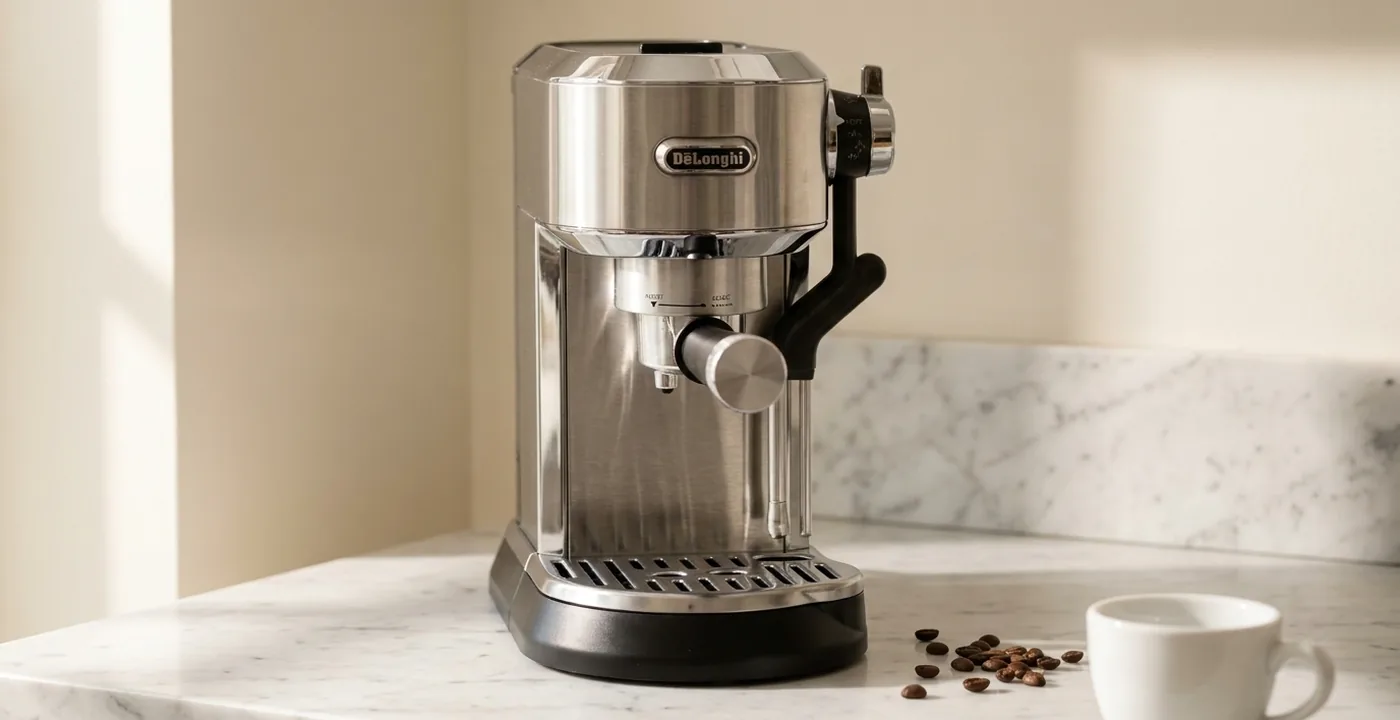
Table of Contents
Some of the links in this article are affiliate links, which help fund our independent review work at no extra cost to you. Every recommendation is based on hands-on testing through The Editor Lab methodology. No brand pays to appear, and no placement is guaranteed.
Overall: 4.0 / 5
Best for: Milk-drink drinkers who want room to grow into proper espresso without learning to steam milk by hand.
Not for: The absolute-budget buyer or anyone chasing latte-art microfoam.
Price (as of May 2026, UK): around £279 to £329 depending on retailer.
Verdict in one sentence: A real upgrade on the standard Dedica for the right buyer, but the new single-wall baskets quietly assume you will also buy a grinder.
The question every Maestro Plus buyer reaches before they commit is the one this review is built to answer: is the step up from the standard Dedica worth the money for you, or are you paying for a wider footprint and a few features you will never use? The De'Longhi Dedica Maestro Plus is De'Longhi's wider, upgraded take on the Dedica line, built around two changes that matter and a handful that do not. The headline additions are single-wall (non-pressurised) baskets that reward proper grinding and a dual-mode steam wand that will froth your milk for you if you ask it to.
This review reflects first-hand use plus manufacturer-side training, and all specs and the current UK price were web-verified at time of writing. Disclosure: I founded Balance Coffee, a UK coffee roaster. We do not sell coffee machines, so this review recommends no product of mine.
Editor's Note
De'Longhi Dedica Maestro Plus Review: The Verdict
The Maestro Plus is a genuine upgrade on the standard Dedica, but only if you are the right buyer. The two real changes are the single-wall baskets and the auto and manual steam wand. Everything else, the wider chassis, the bigger drip tray, the metal tamper, is welcome polish rather than a reason to spend the extra money on its own.
If you mainly drink milk-based coffee at home and you have no interest in learning to steam milk by hand, the auto-frothing wand makes the Maestro Plus a stronger buy than the standard Dedica. It gives you consistent, repeatable milk with zero technique. For a household that wants two flat whites in the morning without anyone leaning over the steam jug, that is genuinely useful and earns most of the price gap on its own.
If you mainly drink black coffee, the single-wall baskets are the headline reason to consider the upgrade. They lift the skill ceiling the standard Dedica deliberately caps. Pull a good shot on the Maestro Plus and you can taste the difference. Pull a careless shot and you can also taste the difference, which is exactly what an espresso machine of this tier should do.
The fair criticism of the "pricier Dedica" framing is that it understates the change. The basket swap alone shifts this from a forgiving consumer machine to a real entry espresso machine. The fair concession in the other direction is that the Maestro Plus assumes you will buy a grinder, and your value calculation needs to include that line item before you decide.
What's New: How the Maestro Plus Differs from the Standard Dedica
The Maestro Plus is roughly three inches wider than the standard Dedica. That extra space gives you a usable drip tray rather than the awkward postage stamp on the original, and it lets the chassis accommodate the upgraded portafilter without feeling cramped. On the counter the machine is still compact by espresso-machine standards, but you can no longer claim it is the narrowest option in the room.
The bigger change is in the baskets. The standard Dedica ships with pressurised (dual-wall) baskets that force coffee through a small exit hole, generating fake pressure on whatever grounds you load in. They are forgiving of supermarket-ground coffee, and that forgiveness is the whole point of the standard Dedica. The Maestro Plus replaces them with single-wall (non-pressurised) baskets, the kind professional machines use, which rely entirely on the grind, dose, and tamp for resistance.
A single-wall (non-pressurised) basket is an espresso basket that requires fresh, properly ground coffee to build extraction pressure naturally, rather than relying on a restricted exit hole. That definition is the most important thing on the spec sheet for you to understand. It means the Maestro Plus behaves like a real entry-level espresso machine instead of a pod-machine substitute.
You also get a metal tamper rather than the plastic apology that ships with the standard Dedica, and an upgraded portafilter with more weight in the hand. Both are quality-of-life improvements once you start dialling in. The steam wand is the second headline change: it is a dual-mode design that switches between an automatic frothing setting and a manual setting for users who want to do it the proper way.
Everything else is the Dedica you know. Thermoblock heating system, ESE pod compatibility (yes, still there), a similar water tank, and the same single boiler that means you wait between brewing and steaming. If you have used a standard Dedica before, this will feel familiar within thirty seconds. The differences are in the parts that touch the coffee, which is where they should be. Full specs are verified against the official De'Longhi UK product page in the spec table below.
The Auto-Frothing Steam Wand: Does It Work?
The auto mode does exactly what De'Longhi claims. You insert the wand into a jug of milk, press a button, and the machine textures it for you. Across multiple test runs the output was consistent: properly warmed, decently foamed, and ready to pour into a cappuccino or a flat white. For a beginner or a household where nobody wants to learn to steam milk, this is the single most useful feature on the machine.
The manual mode is there for the buyer who does want to learn. It works like any conventional steam wand on a single-thermoblock machine: not particularly powerful, requiring you to position the jug deliberately and stretch the milk before submerging the wand. With practice you can get a workable result. You will not get the dense, glossy microfoam that comes off a dual-boiler machine, because the wand simply does not have the pressure on tap.
Here is the honest trade with the auto mode. It produces consistent milk, every time, with no skill required from you. It also takes away the part of espresso-making that some people fall in love with. Steaming milk well is a craft, and if learning that craft is the point of buying an espresso machine for you, the auto mode is a feature you are paying for and then ignoring.
The other quiet trade is the microfoam quality. Auto-frothing systems aim for repeatability, which means they settle on a milk texture that works for most drinks. It is not the silk-textured pour you need for serious latte art. If you watch barista videos and want to chase that yourself, the Maestro Plus is the wrong machine for you.
For the buyer who wants reliable milk with no learning curve, this wand is the headline reason to choose the Maestro Plus over the standard Dedica. For everyone else, it is a feature to weigh honestly rather than fall for.
Espresso Quality
With the single-wall baskets fitted, the Maestro Plus behaves like a real entry espresso machine for the first time in the Dedica's history. The thermoblock heating system is unchanged, so temperature stability is still middle-of-the-road rather than exceptional. The change is in what the machine asks of you and what it returns when you meet it halfway.
A good shot is genuinely achievable. Dial in a fresh single-origin or blend, dose properly, and the cup comes through with the structure you expect from a £300 espresso machine. On a Brazilian-leaning blend pulled into a small cup, the shot read milk chocolate on the nose with a rounded fig sweetness through the body and a clean close that did not linger into bitterness. That is a shot you can build a flat white around.
A careless shot is now equally honest. Stale supermarket grounds in the basket and a sloppy tamp will give you a thin, sour, or muddy extraction, where the standard Dedica would have papered over the same mistakes with its pressurised basket. The Maestro Plus shows you the work. That is a feature of any real espresso machine, but it does change the daily experience.
Here is the friction nobody flags clearly for you. The single-wall baskets reward proper grinding, which means the Maestro Plus quietly assumes you will buy a decent grinder. Without one, the upgrade over the standard Dedica is largely wasted, because pre-ground supermarket coffee will not extract well in a non-pressurised basket. Budget for an entry grinder of around £100 to £150, or stay with the standard Dedica that is designed for pre-ground use. The best coffee beans uk decision and the grinder decision arrive together when you buy this machine, and our roundup of the best coffee beans in the UK is a sensible first stop.
The Specialty Coffee Association sets out the same principle on their espresso research pages: a single-wall basket is only as good as the grind feeding it. Treat the Maestro Plus as a machine that wants fresh whole beans, and you will get the favour returned in the cup.
Living With the Maestro Plus
The wider chassis is the first thing you notice on the counter. The standard Dedica is famous for fitting almost anywhere. The Maestro Plus is still compact by espresso-machine standards, but it is no longer the narrowest option, and the extra width will matter in a smaller kitchen.
The trade you get is a usable drip tray that catches drips without you choreographing the pour, and enough body to fit the bigger portafilter. After a week of daily use the wider footprint stops feeling like a loss and starts feeling like sense. The original Dedica's drip tray was the part most reviewers, including me, would have changed first.
Heat-up sits around forty seconds, which is what you expect from a thermoblock. The single-boiler architecture means there is a wait between pulling your shot and steaming your milk, with the machine cycling up to steam temperature for around twenty seconds. You can use that time to weigh out your shot or wipe the group head, and after a week the rhythm becomes automatic. If you make four milk drinks in a row, that wait stops feeling negligible and starts to nag at you.
The water tank is a familiar shape and sits at the rear, refillable in place, and the tray pulls out cleanly for daily wiping. The drip tray itself is dishwasher safe, so you get no surprises at the sink. Cleaning is in the same league as the standard Dedica - quick, predictable, no hidden corners.
The auto-frothing wand needs a daily purge and a deeper clean every week or so from you, since milk residue inside the wand is where things go wrong with any auto-steaming system. It is not a deal-breaker, but it is one more thing to keep on top of compared with a manual wand. Plan it into your routine before the machine arrives.
Maestro Plus vs Standard Dedica vs Sage Bambino Plus
Three machines, three different buyers. This is the decision most readers actually want help with, and you deserve a clean steer rather than a feature checklist.
The delonghi dedica review target, the standard EC685 Dedica, is the cheapest of the three and the most forgiving. Pressurised baskets, manual Pannarello wand, the narrowest chassis on any espresso machine at this price. Buy it if you want a no-fuss entry into espresso, you intend to use pre-ground coffee or pods, and counter space is the binding constraint in your kitchen. It is the right machine for the buyer who does not want to learn anything new.
The Maestro Plus is the middle option. Single-wall baskets, auto or manual steam wand, wider but still kitchen-friendly chassis. Buy it if you want consistent milk drinks without learning to steam by hand, and you are open to buying a small grinder so the baskets earn their keep. It is the right machine for the buyer who wants a few years of growth without committing to a full craft project.
The Sage Bambino Plus is the technical milk benchmark at this price. Its steam wand produces better microfoam than the Maestro Plus auto wand, and the machine is faster from cold thanks to its ThermoJet heating system. The trade-off is that the Bambino Plus has no built-in grinder slot in the chassis, so you still need a grinder, and the build feels lighter in the hand than the Maestro Plus. Buy it if latte art is the goal and you accept a steeper learning curve on the wand. Which? maintains an independent UK testing reference if you want a second opinion on any of the three.
The clearest steer for you: the standard Dedica is for the budget buyer, the Maestro Plus is for the milk-drinker who wants room to grow, and the Bambino Plus is for the latte-art chaser. The best espresso machine under 500 roundup covers more machines in this tier, but these three are the natural shortlist.
Who Should Buy the Dedica Maestro Plus
Buy the Maestro Plus if you make milk drinks at home most mornings and you want consistent, hands-off milk without learning to steam from scratch. The auto wand is the feature that earns the upgrade price for this buyer, and the single-wall baskets give you a real espresso machine to grow into rather than a pod substitute.
Buy the Maestro Plus if you are willing to spend an extra £100 to £150 on a decent grinder so the baskets work as intended. Without the grinder, your spend on the Maestro Plus is partially wasted, because you are paying for capability you cannot access. If a grinder is not in your budget, the standard Dedica is the smarter pick.
Do not buy the Maestro Plus if absolute counter space is your binding constraint and the extra three inches will be a daily annoyance. The standard Dedica still wins on footprint and that is a real advantage in a small kitchen.
Do not buy the Maestro Plus if you want to learn proper latte art with dense microfoam. The auto wand is a convenience tool, not a craft instrument. The Sage Bambino Plus is the better choice at similar money for that buyer.
If you find yourself drawn to less hands-on operation entirely, the De'Longhi Magnifica review covers the bean-to-cup side of the range. If you are weighing this against the wider De'Longhi lineup, the best delonghi coffee machine roundup covers every model with the same honest steer.
Specification Table
| Spec | Value |
|---|---|
| Pump pressure | 15 bar |
| Portafilter | 51 mm |
| Baskets supplied | Single-wall (non-pressurised), ESE pod compatible |
| Steam wand | Auto and manual dual mode |
| Heating system | Single thermoblock |
| Heat-up time | Around 40 seconds |
| Water tank capacity | 1 litre |
| Approximate width | Around 18 cm |
| Energy feature | Auto off |
Frequently Asked Questions
What is the difference between the Dedica and the Dedica Maestro Plus?
The Dedica Maestro Plus is around three inches wider, uses single-wall (non-pressurised) baskets, and adds a dual-mode auto and manual steam wand. The standard Dedica uses pressurised baskets and a manual Pannarello wand. The Maestro Plus is built for buyers who want a step up in cup quality and hands-off milk; the standard Dedica is built for forgiving, narrow-footprint everyday use.
Does the Dedica Maestro Plus froth milk automatically?
Yes. The dual-mode steam wand has an auto setting that textures milk for you with one button press, and a manual setting for buyers who want to learn the craft. The auto mode produces consistent milk for cappuccinos and flat whites, but the texture is not the dense microfoam needed for serious latte art.
Is the Dedica Maestro Plus good for beginners?
Yes, if you buy a small grinder alongside it. The auto wand removes the steaming learning curve, and the espresso side is forgiving enough to learn on. Without a grinder, the single-wall baskets will not extract well from pre-ground coffee, and your money is partially wasted on a capability you cannot access.
Does the Dedica Maestro Plus need a separate grinder?
For best results, yes. The single-wall baskets rely on fresh, properly ground coffee to build extraction pressure. Pre-ground supermarket coffee will produce thin, sour shots in a non-pressurised basket. Budget around £100 to £150 for an entry-level burr grinder if you are buying this machine.
Is the Dedica Maestro Plus worth it over the Sage Bambino Plus?
For milk drinks where you do not want to learn to steam, the Maestro Plus auto wand wins on convenience. For latte art and faster cold starts, the Bambino Plus wins on milk texture and its ThermoJet heating system. Price is similar at this tier, so pick by which feature matters more to you in daily use.
A wellness entrepreneur and biohacker, James explores the intersection of hospitality and health - from clean fuel and recovery tools to mindful routines that build balance into daily life.