AG1 Review: A Nutritionist's Honest Assessment of the UK's Most Talked-About Greens Powder
Registered Nutritionist Clemmie Rose tested AG1 daily for 30 days and audited all 83 ingredients against clinical research levels. Here is what she found.
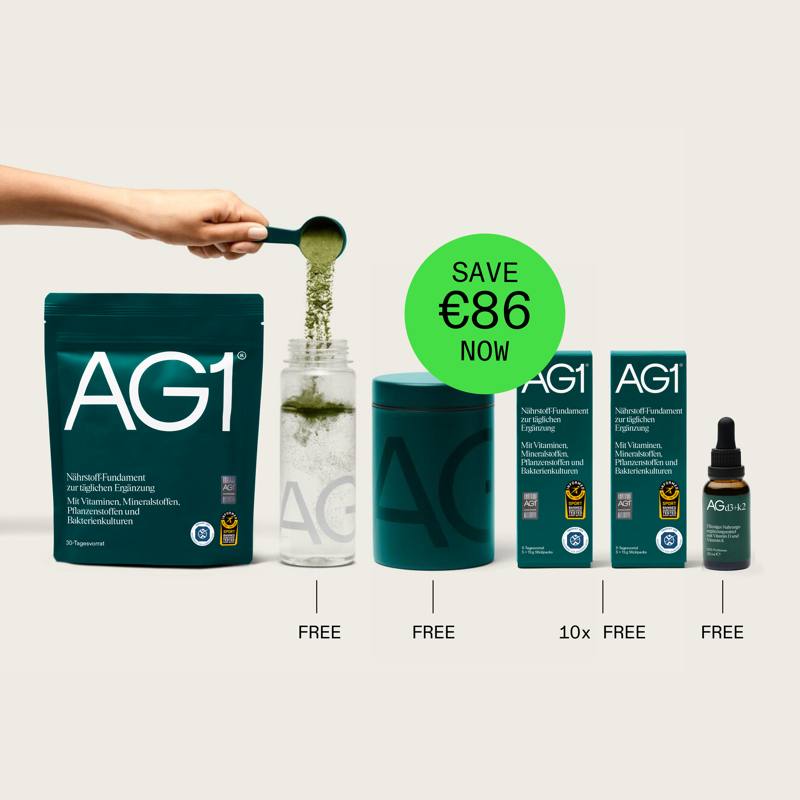
Table of Contents
Some of the links in this article are affiliate links, which help fund our independent review work at no extra cost to you. Every recommendation is based on hands-on testing through The Editor Lab methodology. No brand pays to appear, and no placement is guaranteed.
Every week, at least one client mentions AG1. They have heard it on a podcast, seen it in a friend's kitchen, or noticed the shaker bottle in a YouTube thumbnail. And the question is always the same: "Is it actually worth it, or is it just clever marketing?"
I hear you. I had the same question. So I tested AG1 daily for 30 days and worked through every ingredient against published clinical research to give you the clearest possible picture I can.
What you will find here is not a sponsored verdict. As a registered Nutritional Therapist holding a Diploma in Nutritional Therapy from the College of Naturopathic Medicine and a BANT member who has led the nutrition clinic at The Kyros Project with Google DeepMind, I approach supplement formulations the way I would any clinical protocol: ingredient by ingredient, dose by dose. That is the lens I brought to AG1's 83-ingredient formula.
The short version: AG1 is a genuinely well-formulated product. But "well-formulated" does not automatically mean "right for you." Let me walk you through what the ingredients actually show, what I felt over 30 days, and who this product genuinely suits.
If you are still researching the category, start with our guide to the best greens powders available in the UK in 2026 before committing to a single brand.
What Is AG1?
AG1 (formerly Athletic Greens) is a daily greens powder formulated to cover multiple nutritional bases in a single serving. The current formula - marketed as AG1 Next Gen and updated in 2025-2026 - contains 83 ingredients across four proprietary blends: a raw superfood complex, a nutrient-dense extracts complex, a digestive enzyme and mushroom complex, and a probiotic and prebiotic complex.
One scoop (12g) stirred into water delivers vitamins, minerals, adaptogens, probiotics, and plant compounds in a single drink. That breadth is both the product's biggest selling point and, as I will discuss, its most legitimate clinical limitation.
AG1 ships direct to UK customers at drinkag1.com. It is not available through UK retailers. The subscription price as of April 2026 is £59 per month.
Who Is AG1 For?
Before the ingredient audit, it is worth being clear about the target user. AG1 is designed for people who:
- Want a single supplement to cover multiple nutritional gaps simultaneously
- Have the budget flexibility for a £59/month commitment
- Are time-poor and value convenience over customising a supplement stack
- Trust that a single, well-marketed product will do the job
That framing matters. If you are a nutrition-savvy person who already eats a varied, whole-food diet and supplements strategically, AG1's value proposition looks different to someone who is starting from a low nutritional baseline.
The Ingredient Audit: What I Found
This is the section most AG1 reviews skip. They mention "75+ vitamins and minerals" and leave it there. That is not good enough when you are spending £59 a month.
I worked through the four blends methodically.
Probiotic Complex (7.2 billion CFU)
AG1's probiotic blend contains Lactobacillus acidophilus, Bifidobacterium bifidum, and Bifidobacterium longum. The current formula delivers 7.2 billion CFU per serving. This is a clinically meaningful dose. Research on gut health consistently shows that probiotic benefits require multi-strain formulations at viable CFU counts - and AG1 meets that threshold. The NHS page on probiotics confirms that multi-strain products with adequate CFU counts are the best-evidenced format for supporting digestive health.
What I would note: the strains themselves are well-chosen. L. acidophilus and B. bifidum are among the most studied strains for gut microbiome support. This is not a token probiotic inclusion.
Vitamin and Mineral Complex
AG1's vitamin and mineral profile is broad and covers most common UK deficiency areas: vitamin D3 (at 700 IU, which is adequate but not therapeutic for deficiency), vitamin C, zinc, and the full B-complex. For most people eating a typical UK diet - where deficiencies in D, B12, and zinc are genuinely common - this coverage is useful. For someone already taking targeted supplements, there will be overlap and some redundancy.
Adaptogen and Mushroom Complex
AG1 contains ashwagandha, along with reishi and shiitake mushrooms. This is where I want to be precise, because the clinical picture here is more nuanced.
Ashwagandha has genuine clinical support for stress and cortisol management - but at doses of 300mg to 600mg per day, which is the range used in published trials. AG1 does not disclose the individual dose of ashwagandha within its proprietary blend, which means I cannot verify whether the amount present matches research levels. The PubMed database on ashwagandha clinical dosing shows consistent results at 300-600mg, with diminishing evidence below that threshold.
Reishi and shiitake are included at undisclosed amounts within the mushroom sub-blend. If adaptogens and functional mushrooms are a specific priority for you, a dedicated product with disclosed ingredient quantities will give you more clinical confidence. Our coverage of the best mushroom coffee brands UK explores options where dosages are fully disclosed.
Enzyme Complex
Digestive enzymes (protease, lipase, amylase) are included to support macronutrient breakdown. This is a sensible addition that is unlikely to cause harm and may benefit people with compromised digestive function. The clinical evidence for broad-spectrum digestive enzyme supplementation in healthy adults is less clear-cut than for probiotics, but the inclusion is not a red flag.
The Proprietary Blend Problem
Here is the honest limitation you need to know before buying.
AG1's four blends are proprietary, meaning individual ingredient quantities within each blend are not publicly disclosed. This is a standard industry practice, not unique to AG1 - but it is a genuine transparency issue for anyone trying to make clinical decisions.
What this means in practice: AG1 tells you that ashwagandha is in the formula. It does not tell you how much. If the dose is below the research threshold, you may be getting the psychological benefit of knowing ashwagandha is present more than the physiological benefit.
This is not a reason to dismiss the product - AG1 has published four randomised controlled trials (RCTs) supporting aspects of its formula's efficacy, which is unusual clinical investment for the greens powder category. You can review the trial summaries at drinkag1.com/science. But readers who want full ingredient transparency - dose by dose - should know that AG1 does not provide it.
For comparison, Verve V80 (see our Verve V80 review when live) discloses every ingredient quantity on-label. That is a meaningful differentiator if dosage transparency matters to your decision.
My 30-Day Test: Energy, Digestion, Skin
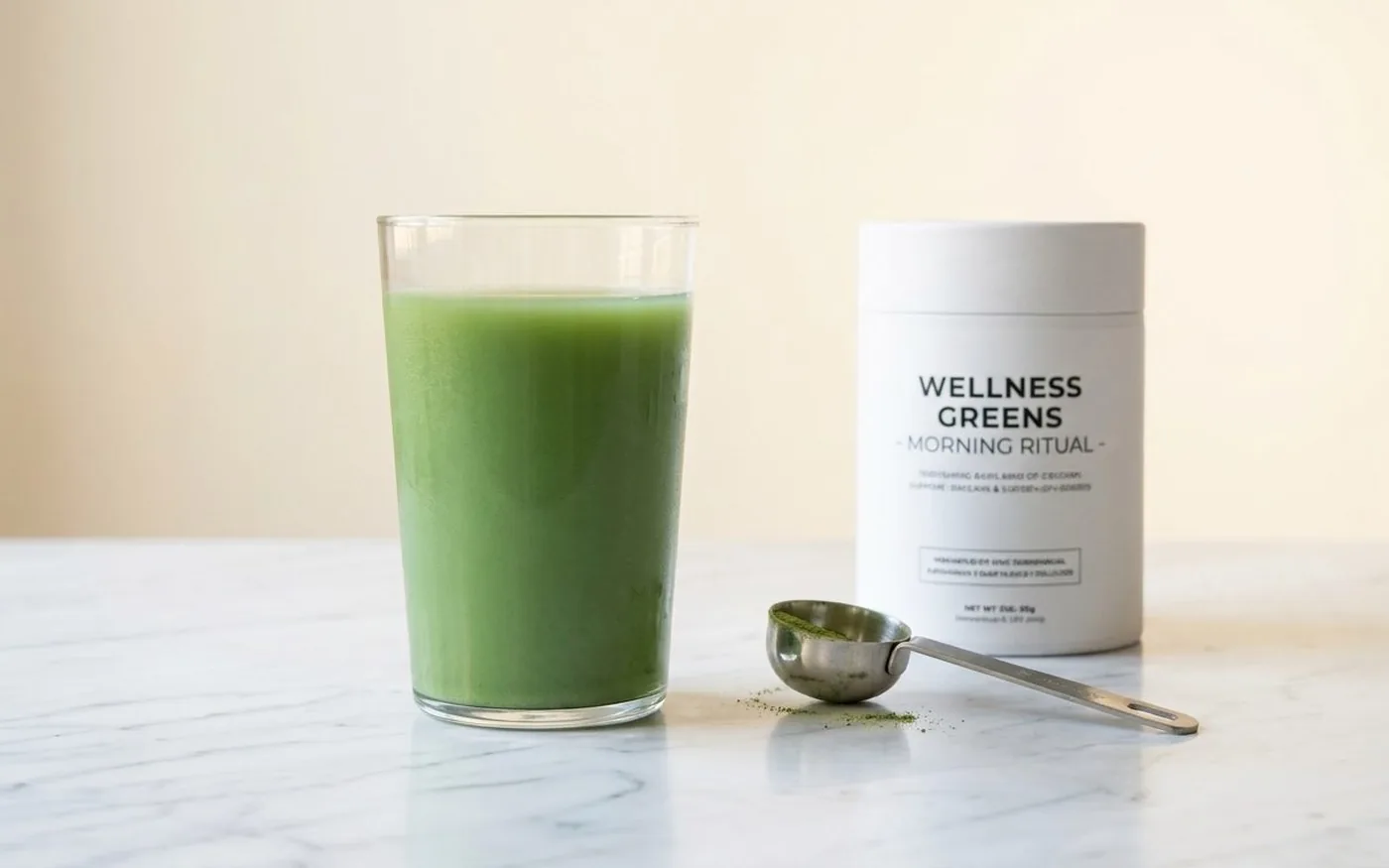
I tested AG1 every morning for 30 days. Same time, same conditions, stirred into water at room temperature. No other significant supplement changes during this period.
Week 1
Honestly, not much to report. The habit itself was the main thing I noticed - having a consistent morning supplement ritual has its own value. Taste was fine (more on that below). No digestive disruption, which matters because high-dose probiotic introductions can cause bloating for some people in the first week.
Week 2
Digestion felt noticeably steadier. I tend to have mild fluctuations around the second half of my cycle, and that week felt more settled than usual. I cannot attribute this solely to AG1 - there are too many variables - but it was the first thing I logged in my notes.
Week 3
This was the week I noticed afternoon energy more consistently. Not a sudden alertness - more that the 3pm slump I sometimes get was less pronounced. Whether that is the B-vitamin complex, the adaptogen component, or simply better hydration from drinking a large glass of water each morning, I genuinely cannot say with certainty.
Week 4
The skin observation surprised me. Nothing dramatic - I did not expect it - but my skin felt slightly clearer. I have since read that the vitamin C and zinc combination in AG1's formula is consistent with skin-supportive supplementation. It is a subtle signal, not a before-and-after.
The honest summary: my 30-day experience was positive. But I am a clinical nutritionist, I eat well, I exercise consistently, and I was not supplementing from a low baseline. Someone starting from a nutritional deficit may see more pronounced effects. Someone already optimally nourished may see less.
Taste and Mixability
Mildly tropical, smooth, and mixes clean with just a spoon. The taste is on the sweeter side without being artificial - AG1 uses natural fruit flavouring and does not include artificial sweeteners or synthetic additives. As someone who flags sweetener choices in most supplement reviews, this is a genuine positive. No sucralose, no acesulfame-K, no stevia aftertaste. It mixes easily into cold water with minimal foaming.
The flavour profile is not overpowering and does not linger. If greens powders have put you off in the past because of a grassy, earthy taste, AG1 is notably more palatable than most.
AG1 Price UK: Is It Worth It?
This is the question everyone is actually asking.
UK pricing as of April 2026:
Subscription: £59 per month (30 servings, £1.97 per serving). One-time purchase: £97 (30 servings, £3.23 per serving).
The subscription is the product's intended delivery model. AG1's packaging, starter kit, and pricing all push towards monthly commitment.
Now for the honest calculation. To approximate AG1's formula independently, you would need - at minimum - a quality probiotic (£15-25/month), a vitamin D and K2 stack (£8-12/month), a B-complex (£8-12/month), a zinc supplement (£5-8/month), and an adaptogen product such as ashwagandha (£10-15/month). That totals roughly £46-£72 per month, before factoring in a digestive enzyme product, the mushroom complex, or the raw greens blend.
So the maths on AG1 is not obviously bad. What you are paying for is formulation quality, manufacturing standards, and - most significantly - Informed Sport certification, which means the product is batch-tested for substances banned in sport. For athletes, that certification alone narrows the price comparison significantly.
The friction point is this: for most people eating a varied diet, AG1 is supplementing supplements. If you already eat plenty of vegetables, maintain a good gut microbiome through dietary fibre, and get adequate sun exposure for vitamin D, AG1 is largely convenience spending. That is not a reason not to buy it - convenience has real value - but you should buy it with clear eyes, not because a podcast host implied you need it.
For price context: Huel Daily Greens (see our Huel Daily Greens review when live) comes in at around £1.17 per serving. The formula is narrower, but so is the price.
AG1 UK Availability
AG1 is available in the UK exclusively through its direct website at drinkag1.com. It does not stock in UK health stores, pharmacies, or retailers such as Holland and Barrett. The subscription model is the most economical route. First-time subscribers typically receive a starter kit including a shaker and a travel packet bundle. Delivery to UK addresses is standard.
Verdict
AG1 is a well-constructed product. The probiotic strand is clinically dosed. The vitamin and mineral coverage is broad and relevant. The manufacturing standards (Informed Sport certified, NSF certified, GMP compliant) are above average for the category. And the absence of artificial sweeteners and synthetic additives reflects genuinely good formulation intent.
My honest assessment of who it is genuinely for: people who travel frequently and cannot maintain a supplement stack; people whose diet quality is inconsistent and who want broad-spectrum nutritional insurance; athletes who require Informed Sport certification on every product they take; and people who respond well to a single-product morning habit over managing multiple bottles.
Who it is less suited to: anyone who needs full ingredient transparency to make clinical decisions (the proprietary blend issue is real), people who are already well-nourished and supplementing strategically, and anyone for whom £59/month is meaningful money.
My mantra is that most people have no idea how good they are meant to feel. AG1 can be part of the answer to that. But it should not cost you £59 a month by default, without understanding what you are actually buying.
If you are still exploring the category, our guide to the best greens powders will help you compare across price points and formulation approaches before committing.
| Criteria | Score | Notes |
|---|---|---|
| Formulation quality | 9/10 | Strong probiotic dose, good vitamin/mineral coverage, clean additives |
| Taste and mixability | 8/10 | Mildly tropical, mixes clean, no artificial sweetener aftertaste |
| Value for money | 6/10 | Defensible at £1.97/serving, but requires honest self-assessment of need |
| Ingredient transparency | 5/10 | Proprietary blends mean individual doses cannot be verified |
| Gut response | 8/10 | Steady digestion from week 2, no bloating during introduction |
| Skin response | 7/10 | Subtle improvement by week 4, consistent with zinc and vitamin C profile |
| Shop | Shop AG1 → |
Frequently Asked Questions
Is AG1 worth it in the UK in 2026?
What does AG1 taste like?
Is AG1 safe?
Does AG1 have side effects?
Is AG1 available in the UK?
How long does it take to see results from AG1?
Can AG1 replace a multivitamin?
Is AG1 vegan?
How does AG1 compare to Huel Daily Greens?
Can you take AG1 if you are pregnant or on medication?

A registered Nutritional Therapist and member of BANT, Clemmie blends science with a holistic approach to wellbeing.