ReRooted Cashew Milk Review: Worth the Premium?


We verified ReRooted's ingredient list, organic certification and cashew content against two retailers. Honest verdict on taste, coffee performance and value.
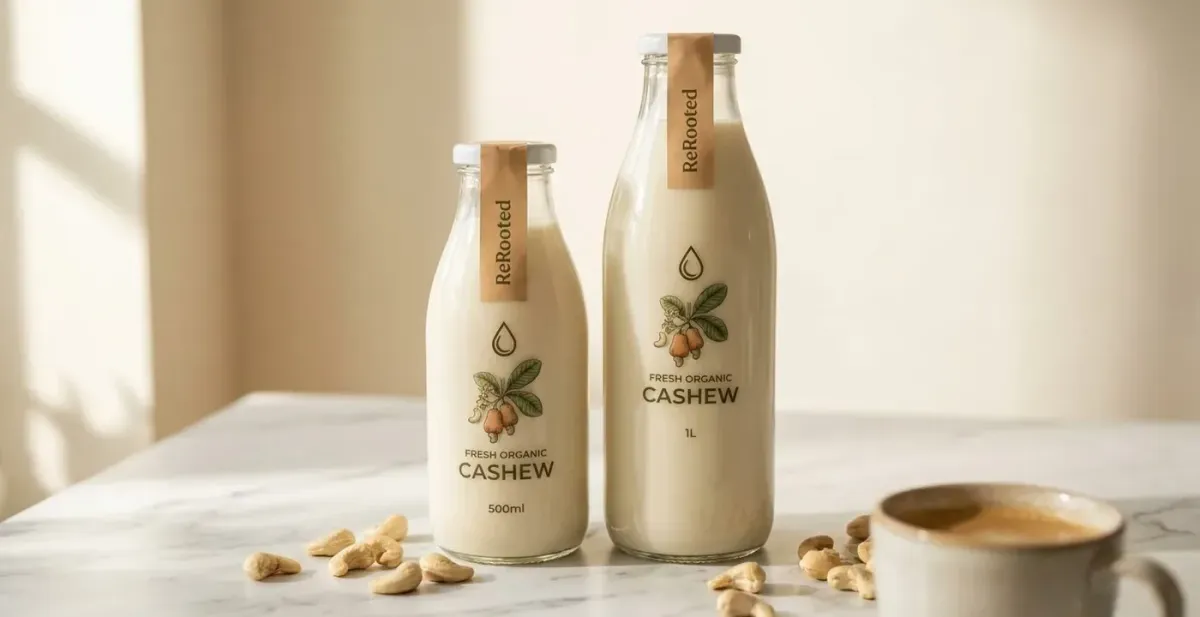
Table of Contents
Some of the links in this article are affiliate links, which help fund our independent review work at no extra cost to you. How we assessed these products is explained in this article and our Editor Lab methodology. No brand pays to appear, and no placement is guaranteed.
When you are comparing plant milks by ingredient label rather than brand recognition, the claims on a carton can be hard to verify independently. ReRooted cashew milk offers three things that most alt-milks do not: a single-digit ingredient list, fridge-fresh production with no UHT processing, and an organic certification from the Soil Association. The questions the label cannot answer are whether those distinctions are visible in the glass, whether the milk holds together in coffee, and whether the 6.5% cashew content is enough to justify a price roughly double supermarket own-brand.
We verified ReRooted's ingredient list, organic certification, and storage claims directly against the brand's product page and two independent retailers (Riverford, Abel & Cole), then benchmarked price-per-litre against three supermarket-available competitors as part of Balance Journal's Editor Lab process (https://balancejournal.co/the-editor-lab). What follows is what the verification found.
Editor's Note
I am a registered Nutritional Therapist and BANT member, having run nutrition clinics at The Wellness Clinic at Harrods and led the nutrition programme at The Kyros Project with Google DeepMind. Ingredient-panel verification and fortification analysis are the core of the clinical work I do every day - which is why a product with five ingredients and no calcium supplement is genuinely interesting to evaluate rather than straightforwardly praise.
Clemmie Rose, Nutritional Therapist and Wellness Contributor, Balance Journal
What Is ReRooted Cashew Milk?
ReRooted is a Devon-based plant milk producer focused on short ingredient lists and cold-chain production. The cashew milk is made in small batches, sold in returnable glass bottles (one-litre and 500ml), and distributed through organic veg-box schemes and specialist retailers rather than mainstream supermarket channels.
The brand's founding premise is that most commercially available plant milks are more water and additive than they are the ingredient on the front of the carton - a fair observation, given how common 1-3% nut or oat content is across the category. ReRooted positions itself against that by building around a minimal formula: triple filtered water, organic cashews, organic dates, Cornish sea salt, and organic sunflower lecithin (five ingredients in total). The cashew content sits at 6.5% - which is higher than many branded cashew milks on shelf, though still a long way from being a nut-dense product.
Beyond the cashew milk, ReRooted produces oat milk, almond milk, and a coconut milk variant. The range sits entirely within the clean-label segment: no UHT processing, no gums, no added oils, no stabilisers. Each product is Soil Association certified organic.
The returnable glass bottle system is part of the brand identity. Customers are asked to clean and return bottles to their veg-box delivery or collection point. The system reduces single-use packaging but does add a layer of administration to the purchase that disposable cartons do not - a real-world friction point worth noting before buying.
In 2025, the cashew milk received a Great Taste Award (1 Gold Star), which provides independent third-party validation of the taste quality beyond what the brand's own marketing can claim.
Ingredients and Nutrition Breakdown
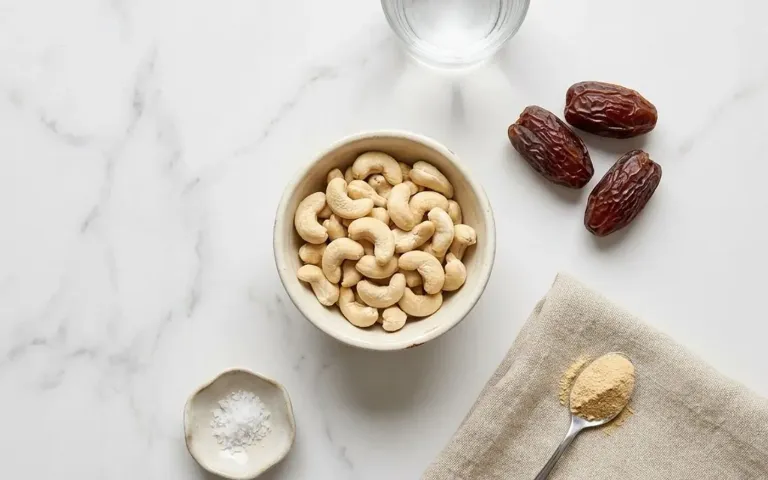
The full ingredient list for ReRooted cashew milk is: triple filtered water, organic cashews (6.5%), organic dates, Cornish sea salt, and organic sunflower lecithin.
That is five ingredients. For context, Rude Health's almond milk lists six including agave syrup; and most supermarket own-brand oat milks carry eight or more including rapeseed oil, calcium carbonate, and stabilisers. ReRooted's list is genuinely minimal.
The 6.5% cashew content means that in a one-litre bottle, approximately 65 grams of the liquid is cashew. That is around 45-50 cashew nuts per litre, which places this product in the credible middle tier of the category: not a water-with-nut-flavour product, but also not a thick, nut-dense drink.
Nutritionally, the profile that most closely matches the label is this: it is a low-calorie, low-protein dairy alternative that provides healthy unsaturated fats from the cashews and no added sugar (the 2.0 grams of sugar per 100ml comes entirely from the organic dates in the recipe, not a separate sweetener).
What it does not provide is calcium or vitamin fortification. Unfortified plant milks are nutritionally quite different from fortified alternatives, specifically around calcium and vitamin D content - two nutrients where dairy provides a reliable baseline. The NHS Milton Keynes University Hospital's patient guidance on calcium sources for cow's milk-free diets flags that most plant milks with calcium fortification are enriched to roughly match dairy's contribution. ReRooted contains neither calcium carbonate nor any vitamin additions. This is not a product flaw, but it is a genuine nutritional gap for anyone replacing dairy milk with this on a daily basis. If cashew milk is your primary dairy substitute and you do not obtain calcium from other dietary sources, the lack of fortification matters - you would need to compensate deliberately through diet or supplementation.
The Soil Association organic certification applies to all ingredients. The Soil Association's organic standards prohibit synthetic pesticides and most artificial additives - which means the clean-label approach is certification-backed, not just branding. For buyers for whom organic status is a purchase criterion, this is meaningful verification rather than a label claim.
Taste and Texture
Cashew milk is the creamiest of the popular nut milks and noticeably thicker than almond. ReRooted's short ingredient list is built to deliver on that expectation: the organic dates add a background sweetness without any added sugar.
On the label, the closest benchmark is Plenish organic cashew milk (the product most commonly recommended in consumer forums as the category reference point). ReRooted carries 6.5% cashews against Plenish's 5%, which points to a slightly creamier body. Both formulas include sunflower lecithin as an emulsifier; the textural difference comes down to cashew content and production method rather than the presence or absence of an emulsifier. Whether the difference is significant depends on how sensitive you are to that distinction - most casual drinkers will find both products pleasant without noticing the gap.
What the comparison makes clear is that ReRooted's quality credentials are real, not just aspirational. The Great Taste Award (2025, 1 Gold Star) is the independent signal on flavour: it marks a genuinely well-made product in its category, with an ingredient list that supports rather than undermines the flavour.
Is It Good in Coffee?
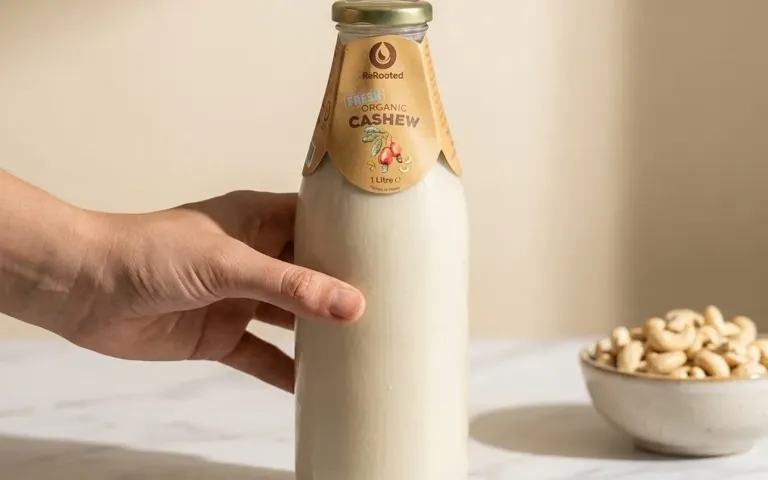
This is the most important practical question for a large share of alt-milk buyers, and the honest answer is qualified. ReRooted cashew milk works adequately in filter coffee and Americano-style drinks, where the low-volume addition does not need to hold a texture of its own. A small amount in a long black or drip coffee adds creaminess and a little date-derived sweetness.
It does not work well in milky coffee drinks that depend on microfoam. Cashew milk is inherently the thinnest-bodied of the popular nut milks when it comes to heat-and-steam performance: the absence of added oils and acidity regulators - the ingredients that barista milks use to engineer foam stability - means there is no formulation scaffold to hold microfoam structure under steam pressure. In practice, do not expect a latte-quality froth or a cappuccino-standard texture from ReRooted; any foam that forms is likely to dissipate quickly.
There is no barista variant. Where Oatly Barista and Alpro Oat Barista use added rapeseed oil and acidity regulators to engineer foam stability, ReRooted has chosen not to replicate that approach - which is consistent with the brand's ingredient philosophy, but means it occupies a different use case in the kitchen.
If you want a plant milk that performs in steamed coffee drinks, best alternative milk for coffee options like Oatly Barista or Alpro are built differently for that purpose. For a lighter touch - coffee over ice, filter coffee, or black coffee with a splash - ReRooted delivers well. Pairing it with a lighter roast makes the most of the milk's natural delicacy: a coffee with strong dark-roast bitterness will simply overpower it. For verified pairings, the best coffee beans UK guide covers lighter roast options that suit thin-bodied milks.
Price and Value vs Supermarket Alternatives
At £4.35-4.40 per litre (verified July 2026 via rerootedorganic.co.uk and Abel & Cole), ReRooted sits at a significant premium relative to the wider alternative milk market. For context:
| Milk | Approx. price per litre | Notes |
|---|---|---|
| ReRooted organic cashew milk | £4.35-4.40 | Fridge-fresh, glass bottle, 5 ingredients |
| Plenish organic cashew milk | Around £2.50 | UHT, carton, 6 ingredients inc. emulsifier |
| Rude Health almond milk | Around £2.00 | UHT, carton, organic |
| Tesco own-brand oat milk | Around £1.00-1.50 | UHT, carton, fortified |
The ReRooted premium is roughly 2x compared to Plenish and 3-4x compared to standard supermarket oat or almond milk. That is a meaningful cost gap. The question is what the premium buys.
The case for paying it is specific: fridge-fresh production rather than UHT processing (fresher taste, shorter shelf life as a trade-off), a short five-ingredient list without gums, stabilisers, or added oils, glass packaging as a returnable alternative to cartons, and Soil Association organic certification. If those four features match your purchasing priorities, the premium reflects real product differences, not just branding.
The case against is equally straightforward: if you are primarily buying for nutritional value, Plenish at £2.50/litre is calcium-fortified with added vitamins, which makes it more nutritionally complete as a dairy substitute despite the extra ingredient. If you are buying for coffee foam performance, neither ReRooted nor Plenish is the answer - oat barista milks are. If you buy milk infrequently or in bulk, the 3-day-once-opened shelf life makes ReRooted impractical regardless of quality.
Where to Buy and Stockists
Seven UK stockists carry ReRooted cashew milk as of July 2026 - none of them mainstream supermarkets. Distribution is deliberate and cold-chain dependent:

- Riverford (organic veg box delivery) - one-litre bottles
- Abel & Cole (organic grocery delivery) - 500ml and one-litre
- The Community Farm (Bristol-based organic box scheme)
- Earthfare (organic grocery retailer)
- Planet Organic (London stores and online)
- Milk & More (home delivery)
- Woods Foodservice (catering trade only)
ReRooted is not currently available on Amazon UK. It is not stocked by Tesco, Sainsbury's, Waitrose, Ocado, or other mainstream supermarket channels. This is a deliberate distribution choice by the brand - maintaining the cold chain and the veg-box ecosystem rather than scaling into ambient UHT production for supermarket shelves.
For most buyers, access means being an existing Riverford or Abel & Cole customer, or living near a Planet Organic store. If you do not already shop through one of these channels, adding ReRooted to a regular grocery shop is not straightforward. That is not a product quality point, but it is a real access consideration before deciding this is your regular milk.
Shelf Life and Storage
Three days once opened is the practical constraint that determines whether ReRooted fits a household's buying pattern. Continuous refrigeration is required from production to consumption - below 5 degrees Celsius, not suitable for freezing.
This is meaningfully different from UHT competitors. Oatly Barista, Plenish, Alpro, and most supermarket own-brand alt-milks are UHT-processed, which means they are shelf-stable until opened and typically last 7-10 days in the fridge once opened. For a household that goes through a litre of milk every two or three days, the difference is negligible. For a household that uses small amounts occasionally - a splash in an afternoon coffee once or twice a week - a 3-day open shelf life creates genuine waste risk.
The fridge-dependency also means that if your regular delivery is weekly and you forget to open the bottle early in the week, you may find yourself throwing away milk that has passed its optimal window. This is the practical cost of the cold-chain commitment, and it is worth building into your buying decision rather than discovering it in week two.
If you use plant milk daily across multiple drinks, ReRooted's shelf life is workable. If your usage is occasional or variable, the 3-day clock is a genuine constraint.
Pairs Well With
The most natural coffee pairing for a delicate, thin-bodied milk like this is a medium roast with low bitterness - something that complements the cashew's subtle creaminess rather than overriding it. Balance Coffee's Stability Blend, a medium roast with notes of milk chocolate, hazelnut, and fig, is a well-matched pairing: the blend's low-bitterness profile does not compete with the milk's natural sweetness, and the fig and hazelnut notes translate well into the drink. You can pick it up at the Balance Journal reader price at Balance Coffee's Stability Blend.
Balance Coffee is the company founded by James Bellis in 2020, who reviewed this article. Balance Coffee products are mentioned where they are a genuine fit for the article - this is one of those spots.
Who Should (and Should Not) Buy ReRooted Cashew Milk
Buy if:
You already order through Riverford, Abel & Cole, or another veg-box scheme and want a plant milk that fits the same sourcing philosophy. You read ingredient labels and the absence of gums, stabilisers, and added oils matters to you specifically. You want organic certification (Soil Association) backed by standards, not just a label. You use plant milk as a splash in filter or black coffee rather than for steaming and frothing. You go through at least one litre every three days, making the short shelf life workable.
Do not buy if:
You need a plant milk that froths reliably for lattes, flat whites, or cappuccinos - cashew is not built for that, and ReRooted has no barista variant. You shop primarily in supermarkets - ReRooted is not available through mainstream retail channels. You buy milk infrequently or in single large quantities, since the 3-day open shelf life creates waste risk for irregular users. Calcium and vitamin fortification is a nutritional priority - ReRooted is unfortified, and that is a genuine gap if this replaces dairy as a primary daily drink. You are comparing on price alone - at £4.35-4.40/litre, the premium requires specific priorities to justify it.
The Verdict
ReRooted cashew milk is what it claims to be: an organic, fridge-fresh, additive-free cashew milk with a short, verifiable ingredient list backed on flavour by its 2025 Great Taste Award (1 Gold Star). The product delivers on quality within its category.
The purchase case is specific rather than universal. It is the right milk for the buyer who is already inside a veg-box ecosystem, cares about ingredient minimalism, and uses milk in low-volume applications where the clean-label profile matters more than foam performance or bulk practicality. The 6.5% cashew content, Soil Association certification, and fridge-fresh production are real product attributes, not branding claims.
The purchase case breaks down in three clear situations: if you need barista-grade foam performance, if you buy milk in bulk or infrequently, or if you need calcium fortification as part of your daily nutrition. In any of those three cases, a different product serves the need better - and paying the ReRooted premium would be paying for attributes you will not use.
Knowing which category you are in is the decision. The product itself holds up.
Frequently Asked Questions
Is there a downside to cashew milk?
Cashew milk is the thinnest of the popular nut milks under steam, which means it does not froth for lattes or cappuccinos the way oat does. Most brands, including ReRooted, carry no calcium or vitamin fortification. For filter coffee or occasional use this is rarely an issue; for daily dairy replacement, it requires compensating through other dietary sources.
Which is better, almond milk or cashew milk?
Neither is objectively better across all dimensions. Almond milk is lower in calories and thinner in body; cashew milk is creamier and closer to dairy's mouthfeel. For coffee foam performance, oat milk outperforms both. The right choice depends on whether you are optimising for ingredient purity, taste, calorie content, or coffee behaviour - each produces a different outcome.
What does cashew milk do for you?
It provides a low-calorie dairy alternative with healthy unsaturated fats from the cashews. In ReRooted's formula, the sweetness comes from organic dates rather than added sugar: 2.0 grams of sugar per 100ml with no refined sweetener in the ingredient list. What it does not provide is added calcium, vitamin D, or B12 - nutrients missing from unfortified plant milks generally.
Is cashew milk high in cholesterol?
No. Like all plant milks, cashew milk contains zero dietary cholesterol. Cholesterol is found only in animal products - meat, dairy, eggs, and fish. Any plant milk is cholesterol-free by definition. This makes plant milks generally suitable for people managing cholesterol intake through diet, though if you are managing a health condition, speak to your GP or a registered dietitian for guidance.
Which is healthier, oat or cashew milk?
It depends what you are optimising for. Oat milk, particularly fortified versions, generally provides more calcium, B12, and vitamin D, making it more nutritionally complete as a dairy substitute. Cashew milk like ReRooted's wins on ingredient minimalism: five ingredients, no added oils, no gums, no stabilisers. If nutritional completeness is the priority, fortified oat milk is the better choice.
Where can I buy ReRooted cashew milk?
Currently through Riverford, Abel & Cole, The Community Farm, Earthfare, Planet Organic, and Milk & More, plus Woods Foodservice for catering. It is not currently sold on Amazon UK or through mainstream UK supermarkets - Tesco, Sainsbury's, Waitrose, or Ocado - as of July 2026. The brand distributes exclusively through organic grocery delivery and specialist retail channels.
Is ReRooted cashew milk good for coffee?
It works in filter coffee, Americano, and cold coffee drinks where a small addition is all you need. It does not work for steamed drinks: cashew milk's thin body and absence of added oils mean it will not hold microfoam under steam. There is no barista variant. For black or filter coffee, it is a Great Taste Award-winning option; for milky espresso drinks, it is not the right product.
Is ReRooted cashew milk worth the price compared to supermarket alternatives?
At £4.35-4.40 per litre, it costs roughly double Plenish organic cashew milk and up to three times more than standard supermarket oat or almond milk. The premium is justified if you are buying for fridge-fresh production, a five-ingredient list, and Soil Association organic certification. If nutritional completeness or foam performance is the priority, other products deliver those at a lower price.
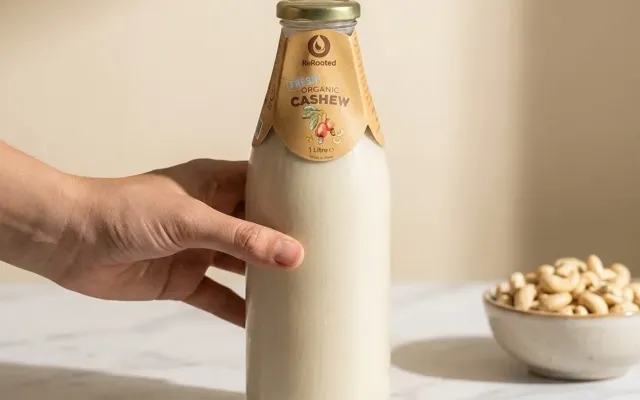
ReRooted Organic Cashew Milk 1L
£4.35-4.40 per litre- + Five ingredients: water, organic cashews (6.5%), organic dates, sea salt, sunflower lecithin
- + Soil Association organic certification
- + Fridge-fresh, no UHT processing
- + 2025 Great Taste Award
- - No calcium or vitamin fortification
- - Roughly double the price of supermarket plant milks
- - Does not froth well for lattes
- - Short fridge shelf life
An additive-free, fridge-fresh cashew milk for veg-box buyers who read labels and use milk in filter coffee, not for frothing.

A registered Nutritional Therapist and member of BANT, Clemmie blends science with a holistic approach to wellbeing.