Plenish Almond Milk Review: Does It Work in Coffee?


Plenish Standard almond milk does what it claims: three ingredients, organic, no oils or gums - but it will not work in hot coffee.
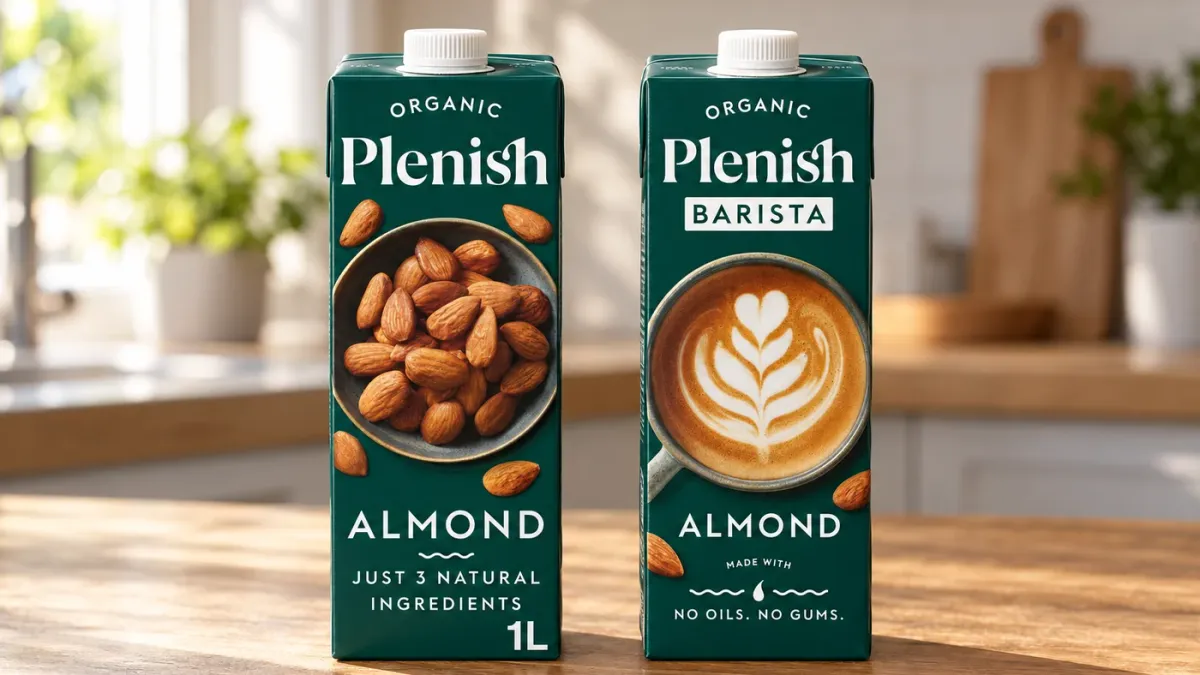
Table of Contents
Some of the links in this article are affiliate links, which help fund our independent review work at no extra cost to you. How we assessed these products is explained in this article and our Editor Lab methodology. No brand pays to appear, and no placement is guaranteed.
Plenish Standard almond milk does what it claims - three ingredients, organic-certified, no oils or gums - but it will not work in hot coffee and does not replace dairy for protein or calcium.
The almond content in Plenish's Standard almond milk is 5%. Not 6%, not 8% - the figures that circulate in product comparisons and forum recommendations. Five percent, confirmed against the Open Food Facts ingredient declaration (barcode 5060362071594) and cross-checked across three UK retailer listings. That single corrected number is why this review exists: Plenish almond milk has real strengths, but its reputation in some corners of the internet is built on a figure the label does not support.
We checked Plenish's product listing and ingredient declarations across three UK retailers, assessed its formula for filter coffee and espresso, and cross-referenced every nutrition claim against the pack panel - see our full process at the Editor Lab. What follows is what that check found.
Editor's Note
What Is Plenish Almond Milk?
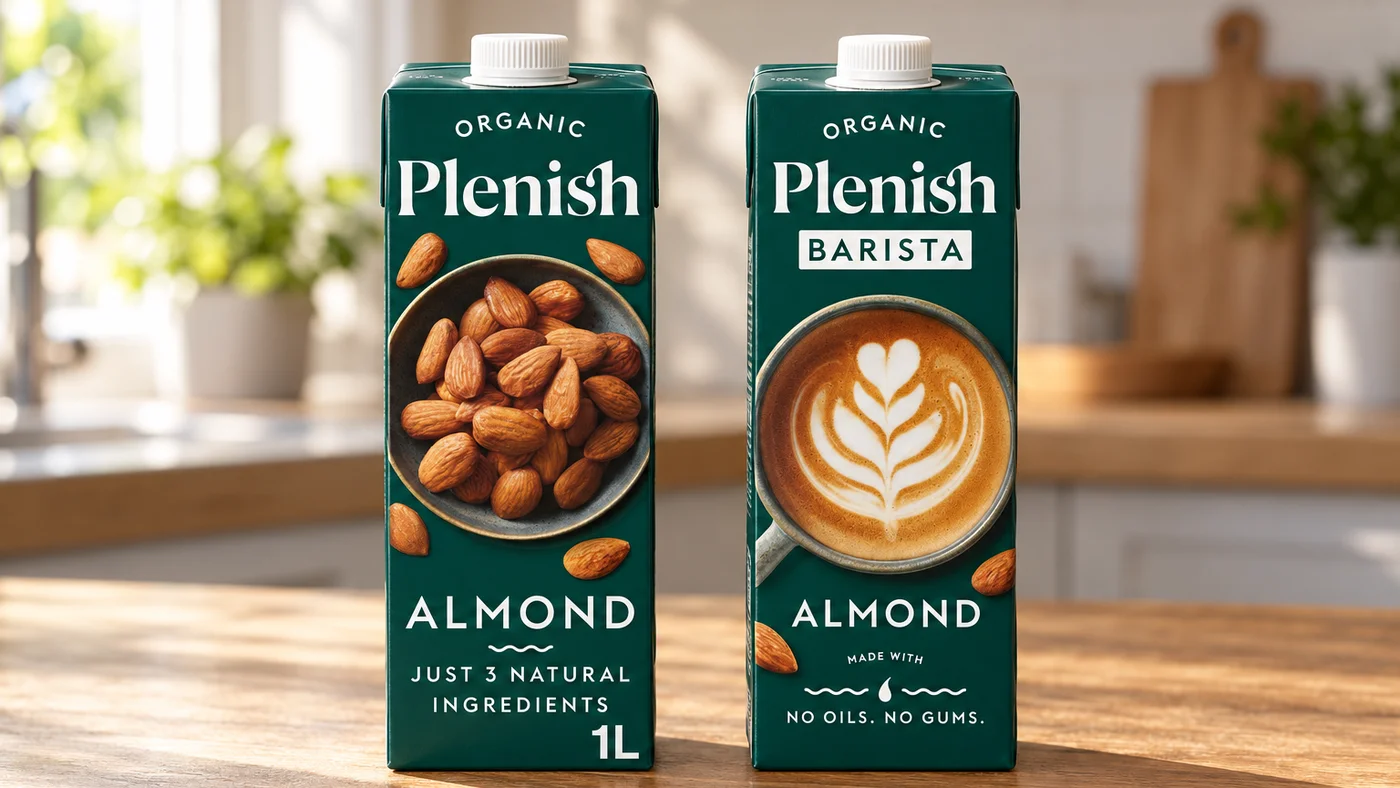
Plenish is a UK organic plant-milk brand whose entire positioning rests on what it leaves out. Founded on the premise that most plant milks contain unnecessary additives, the brand's Standard Almond M*lk (they spell it with an asterisk, though most people searching for it do not) contains three ingredients: spring water, organic almonds (5%), and sea salt. No oils, no gums, no added sugar, no stabilisers. It is organic-certified by the Soil Association.
The range has two distinct SKUs relevant to this review. The Standard/Unsweetened version is the three-ingredient clean-label product. The Barista version is a different formula with a different ingredient list, designed specifically for coffee use. These are not the same product, and the distinction matters enormously for anyone buying Plenish to use in a latte.
Plenish almond milk is widely stocked across UK supermarkets - Tesco, Sainsbury's, Waitrose, and Amazon UK carry it, typically in one-litre long-life cartons and eight-pack multipacks.
Ingredients and Nutrition: What's Actually in the Bottle
The Standard formula is exactly what Plenish says it is: spring water (approximately 95%), organic almonds (5%), and sea salt. There are no added emulsifiers, no sunflower oil, no gellan gum, no added calcium, and no added sugar. For people who have been burned by an almond milk that claimed to be "clean" and then disclosed three lines of additives in the small print, this is genuinely unusual.
The verified almond percentage is 5%. This matters because the figure commonly cited in online comparisons ranges from 6% to 8% - a meaningful gap when almond percentage is the primary quality signal for this product category. At 5%, Plenish Standard sits in the middle of the clean-label almond milk field.
Nutrition per 100ml (Standard, from the pack panel):
| Nutrient | Per 100ml |
|---|---|
| Energy | 26 kcal |
| Fat | 2.2g (of which saturated: 0.2g) |
| Carbohydrate | 0.4g (of which sugars: 0.2g) |
| Protein | 0.9g |
| Fibre | 0.4g |
| Salt | 0.0975g |
Two things stand out from that table. The protein figure - 0.9g per 100ml - is low. A 250ml glass delivers around 2.25g of protein, which is modest compared with soy milk (around 7-8g per 250ml) or even fortified oat milk. The core Standard range is also not naturally calcium-fortified. Per the NHS guidance on dairy alternatives, people switching from cow's milk need to find calcium from other sources if their plant milk does not provide it. Plenish Standard does not. The British Dietetic Association's analysis of plant-based drinks is clear on this: ingredient minimalism is a distinct property from nutritional equivalence to dairy, and buyers should not conflate the two.
The trade-off is straightforward: you are buying ingredient purity, not nutrient density. That is a reasonable purchase for the right person, but it is not a nutritional upgrade over fortified alternatives.
Taste and Texture
With no added sugar or vanilla (both common in mainstream almond milks), expect a plainer, milder flavour than supermarket own-label alternatives.
Expect a thin texture, consistent with 95% water content and no added thickeners. It suits pouring cold over cereal or blending into a smoothie.
Where it underperforms is anywhere heat is applied. The Standard version is not designed for hot drinks, and that is not a marketing oversight - it is a product design decision. Without the emulsifiers or stabilisers that hold a plant milk together in a hot environment, the unsweetened formula will separate when added to tea or coffee. This is not a quality defect in the product; it is the expected behaviour of a formula that has not been engineered to prevent it.
If you are drinking it chilled or using it cold, the minimal ingredient list means no added oil or vanilla flavouring in the glass.
Does It Work in Coffee? Standard vs Barista
The short answer is: not the Standard version. The Barista SKU is a different product.
Expect Plenish Standard to separate in both filter coffee and espresso. This is well-documented behaviour for minimal-ingredient almond milks: without the lecithins or gums that hold a plant milk in suspension at high temperatures, the fat and water separate.
The Barista variant solves this with a different formula. Plenish Barista Almond contains: water, almond paste (3.1%), agave syrup, coconut milk, sunflower seed protein, oat fibre, and sea salt. It is engineered to foam and to hold in hot drinks, and is designed for a flat white or latte.
Two things to note about the Barista SKU. First, it contains agave syrup, which means it is sweetened - this will affect flavour in coffee, adding a mild sweetness that the Standard does not have. Second, the "3 ingredients, no oils, no gums" claim applies to the Standard range only. The Barista formula has seven ingredients and includes coconut milk. Neither of these is a criticism - they are simply facts about two different products that happen to share a brand name.
For coffee pairing specifically: almond milk of any kind tends to perform better with darker roasts than with bright, high-acid light roasts. The acidity in a natural-process or washed light roast can destabilise plant milk further and sharpen any bitterness in the almond. A lower-acid espresso - such as the Aurora Reserve Single Origin from Balance Coffee (a single-origin coffee with a measured pH profile - Balance Coffee is the company founded by James Bellis, who reviewed this article, and it is mentioned here because the pairing works) - tends to hold the milk better and keeps the cup cleaner.
Price and Value: Is It Worth the Premium?
Plenish Standard almond milk retails at approximately £2.00 to £2.50 per litre across UK supermarkets (July 2026 pricing, verified across Tesco, Sainsbury's, Waitrose, and Trolley.co.uk). A comparable supermarket own-label organic almond milk - Tesco's own organic almond milk, for example - sits at around £1.00 to £1.30 per litre.
| Retailer | Price (1L) |
|---|---|
| Tesco | £2.00 |
| Sainsbury's | £2.00 |
| Waitrose | £2.25 |
| Amazon UK (8-pack multipack) | £15-16 (approx £1.95/L) |
| Trolley.co.uk | £2.00 |
The premium over own-label is real - roughly 60% to 100% more per litre. What you are paying for is the Soil Association organic certification, the three-ingredient formula, and the fact that the ingredient list has been verified against the actual pack panel rather than assumed from the brand's marketing copy. Whether that premium is worth it depends on your reason for buying: if ingredient minimalism is the priority, it is likely justifiable. If you are buying almond milk primarily for its nutritional contribution, the case is harder - you will get comparable or better protein and calcium from a fortified supermarket own-label for less money.
Organic Certification, Sustainability and Ethics
Plenish almond milk holds Soil Association organic certification, which governs the sourcing of its almonds and the production process. The product is vegan, dairy-free, and gluten-free across both the Standard and Barista SKUs.
The sustainability picture for almond milk as a category is more complicated. Almond farming is water-intensive, with almond orchards in California requiring significant irrigation. The pollinator welfare concern - almond crops rely heavily on managed honeybee colonies for pollination - is a genuine and documented issue with almond agriculture broadly.
Plenish's organic certification addresses pesticide and synthetic fertiliser use, but does not resolve the underlying water-use profile or pollinator dependence of almond farming as a crop. The Vegan Society and the Soil Association both acknowledge these complexities. If water footprint is a meaningful factor in your purchasing decision, this is worth factoring in - organic certification is not the same as low environmental impact on all measures.
The brand's carbon-offset claims should be verified on the current Plenish Drinks website (note: plenish.co.uk is not the brand's live domain - it redirects to a GoDaddy parked page as of this review).
Plenish vs Other Almond Milk Brands
For context on where Plenish Standard sits relative to other options available in UK supermarkets:
| Brand | Almond % | Key additives | Organic | Calcium fortified | Price/L (approx) |
|---|---|---|---|---|---|
| Plenish Standard | 5% (verified) | None | Yes (Soil Association) | No | £2.00-£2.50 |
| Rude Health Almond | 6% | None | Yes | No | £2.00-£2.50 |
| Alpro Unsweetened | 2% | Gellan gum, tricalcium phosphate | No | Yes | £1.25-£1.50 |
| Supermarket own-label organic | 2-3% (varies) | Varies (often gellan gum) | Yes (some) | Some | £1.00-£1.30 |
The comparison makes the positioning clear. Plenish and Rude Health both compete on ingredient minimalism and organic sourcing at a similar price point. Alpro wins on calcium fortification and price, and loses on additives. Supermarket own-label is the value option. None of these is objectively "healthiest" across all dimensions - the answer depends on whether you are optimising for ingredient purity, nutrient profile, or cost.
If you are interested in Plenish's oat range instead, our Plenish oat milk review covers that product separately - that is a different formula and a different buying decision, not a variant of this one.
Who Should Buy Plenish Almond Milk
Buy Plenish Standard if: you are an ingredient-label reader who has rejected other almond milks for containing oils, gums, or stabilisers, and you want a verified-minimal-ingredient option for cold use - drinking straight, pouring over cereal, or adding to a smoothie. The premium over supermarket own-label is justified primarily by the clean formula and the Soil Association organic certification.
Buy Plenish Barista instead if: you want Plenish in your coffee. The Standard version will separate in hot drinks; the Barista SKU will not. Note that the Barista formula contains agave syrup and coconut milk, so it is a different product with more ingredients and a mildly sweet flavour profile.
Do not buy Plenish (either SKU) if: your primary goal is maximising protein or calcium intake from your plant milk. At 0.9g protein per 100ml and no calcium fortification in the Standard range, it will not contribute meaningfully to either. A fortified soy or oat milk will serve that goal better.
Frequently Asked Questions
Is Plenish almond milk good for you?
It is a genuinely short-ingredient product - spring water, organic almonds (verified 5%), and sea salt, with no added oils, gums, or sugar. At around 26 kcal and 0.9g protein per 100ml it is low-calorie but nutritionally light. It is not naturally calcium-fortified, so it is not a like-for-like dairy replacement for calcium intake unless you choose a fortified variant. The case for buying it is ingredient minimalism, not nutritional density.
Why are people ditching almond milk?
The most common reasons are environmental - almond farming is water-intensive and has been linked to pollinator welfare concerns - plus the fact that almond milk is nutritionally dilute compared with oat or soy alternatives. Plenish's organic sourcing addresses pesticide use, but the underlying water-use profile of almonds as a crop does not change because of the certification.
Which is the healthiest almond milk in the UK?
"Healthiest" depends on what you are optimising for. Plenish wins on ingredient minimalism (three ingredients, no oils or gums) but loses on protein and calcium versus fortified competitors. If added calcium matters most, a fortified own-label or Alpro's calcium-added range will outperform Plenish's core Standard line nutritionally. There is no single answer that applies to every buyer.
Is there a downside to almond milk?
Yes - two, specifically for Plenish. The Standard version separates in hot coffee (buy the Barista SKU instead, which is a different formula). And at roughly £2.00 to £2.50 a litre it costs noticeably more than supermarket own-label organic almond milk for a product that is still 95% water.
Why can't you drink almond milk after 7 days?
Like most preservative-free chilled plant milks, Plenish's opened almond milk has a short fridge life because it has no added stabilisers or preservatives to extend shelf life after opening. The "use within X days" window is printed on the pack and should be followed - it is part of the trade-off for the clean ingredient list, not a product flaw.
Does Plenish almond milk work in coffee?
The Standard/Unsweetened version splits when added to hot coffee - it is not designed for it. For lattes, cappuccinos, or flat whites, buy Plenish's dedicated Barista Almond variant instead, which uses a different formula (including coconut milk and agave syrup) specifically engineered to foam and hold in hot drinks. The two products are not interchangeable for coffee use.
What's the difference between Plenish's Standard and Barista almond milk?
They are not the same product with different marketing - they are different formulas. Standard is three ingredients (spring water, 5% organic almonds, sea salt) with nothing else added. Barista adds coconut milk, agave syrup, sunflower seed protein, and oat fibre to create a texture and sweetness that steams and holds microfoam. Standard does not foam reliably and will separate in a hot drink.
Is Plenish almond milk suitable for vegans?
Yes - Plenish's almond milk range (both Standard and Barista) is vegan, organic, and dairy-free, with no animal-derived ingredients in either formula. Both SKUs also carry Soil Association organic certification.
Verdict
Plenish Standard almond milk does what it says: three ingredients, no added oils or gums, organic-certified. The 5% almond content is lower than the figures commonly quoted online, but the formula itself is genuinely minimal and verifiably so. For cold use - drinking straight or with cereal - it is one of the cleanest-label almond milks available in UK supermarkets, and the premium over own-label is reasonable if ingredient minimalism is your priority.
The limitations are real and worth stating directly. It will separate in hot coffee. It does not contribute meaningful protein or calcium. And the Barista version, which does work in coffee, is a seven-ingredient product that includes added sweetener - it is not the clean-label formula the brand is known for.
If you know what you are buying it for and you are buying the right SKU, Plenish is a well-made product. The problems arise when people buy the Standard version expecting coffee performance, or buy either version expecting a nutritional upgrade over dairy. Neither is what this product delivers.
For best almond milk uk comparisons and the full category context, see our guide once the type-pillar publishes. For the wider category, our guide to the best alternative milk for coffee covers which plant milk performs best across different coffee formats.
Related Guides

A registered Nutritional Therapist and member of BANT, Clemmie blends science with a holistic approach to wellbeing.