The £400 question no other Jura S8 review answers: are you paying for better coffee, or just a touchscreen?
Table of Contents
Some of the links in this article are affiliate links, which help fund our independent review work at no extra cost to you. Every recommendation is based on hands-on testing through The Editor Lab methodology. No brand pays to appear, and no placement is guaranteed.
The Jura S8 is the machine you buy when you want a genuinely good flat white without learning to make one. Press a button, watch a touchscreen, walk away with a drink a decent cafe would serve. At around £1,499 (RRP £1,695) it sits near the top of the domestic bean-to-cup market, and this jura s8 review answers the only question that matters at that price: does the touchscreen premium tier earn the spend, or are you paying roughly £400 extra for a screen you could live without?
I spent six weeks with the S8 in our London studio, 240 drinks pulled, tested head-to-head against the Jura E8 and the De'Longhi PrimaDonna Elite on the same beans. This is the honest version, including the milk-system catch most reviews skip.
Jura S8 at a Glance: Verdict, Price, Who It's For
The Jura S8 is a super-automatic bean-to-cup machine that grinds, doses, tamps, extracts, and froths milk from a single touchscreen press, priced at around £1,499 in the UK for 2026 (RRP £1,695). It makes 15 drinks, textures milk automatically through a Professional Fine Foam frother, and runs Jura's Pulse Extraction Process for shot quality closer to a manual machine than most automatics manage.
Buy it if you want café-standard milk drinks with zero technique and you value a colour touchscreen over saving roughly £400. Skip it if you take your coffee black, in which case the cheaper E8 does the same job, or if you want to learn to pull a shot yourself.
Our verdict: 8.4 / 10. A refined, reliable machine let down only by a milk-cleaning routine you cannot ignore.
Jura S8 - Editor Lab Scorecard
Score /10
Build quality
9
Drinks menu
9
Milk system
8
Maintenance
7
Value at £1,499
8
Overall
8.4
“Six weeks, 240 drinks, tested on the same beans as the E8 and PrimaDonna Elite. The S8 is the easy-living bean-to-cup machine: brilliant at removing effort, honest about what that convenience costs you at the drip tray.”
I founded Balance Coffee in 2020, but my history with these machines runs further back. I started in coffee in 2012 at UCC Coffee, calibrating commercial bean-to-cup machines - Jura, Thermoplan, Eversys - across UK corporate accounts. I know the Jura settings menu from the professional side, not the consumer manual, and that is the lens I brought to the S8. Balance Coffee roasts the beans that went into the hopper, so I know exactly what the grinder was working with. Head of Coffee Jude Cunningham fact-checked the grinder and extraction sections.
What the Jura S8 Actually Is: Spec Sheet and Positioning vs E8 and Z10
What is the Jura S8? The Jura S8 is a premium domestic super-automatic coffee machine made by Jura AG of Switzerland. It grinds whole beans, brews espresso and long coffees, and textures milk automatically, controlled through a 4.3-inch (about 10.9cm) TFT colour touchscreen. It sits in the upper-middle of Jura's home range, above the E8 and below the flagship Z10.
Placed in the Jura ladder, the S8 is where the touchscreen arrives. Below it, the E-line uses a rotary dial and a smaller display. Above it, the Z10 adds cold-brew extraction and a price near £2,700. The S8 differs from the E8 mainly by that colour touchscreen and a wider one-touch menu, not by the coffee it makes.
You are paying for the interface and the drink count. The extraction hardware underneath is close to identical to the E8, and that single fact shapes the entire value question I return to in Section 10. Jura's own S8 specification confirms the 15-drink menu and the 4.3-inch touchscreen. For the whole category, our best bean to cup coffee machine guide sets the S8 against every rival worth considering.
Build Quality and Design: 9.8kg, 4.3-inch TFT Touchscreen, Footprint
Pick the S8 up and you feel where the money went. At 9.8kg it has the density of a machine built to sit on a counter for a decade, not a plasticky unit that flexes when you fill the tank. The casing on our Piano Black unit is solid, the panel gaps tight, and the bean hopper lid seals with a proper click.
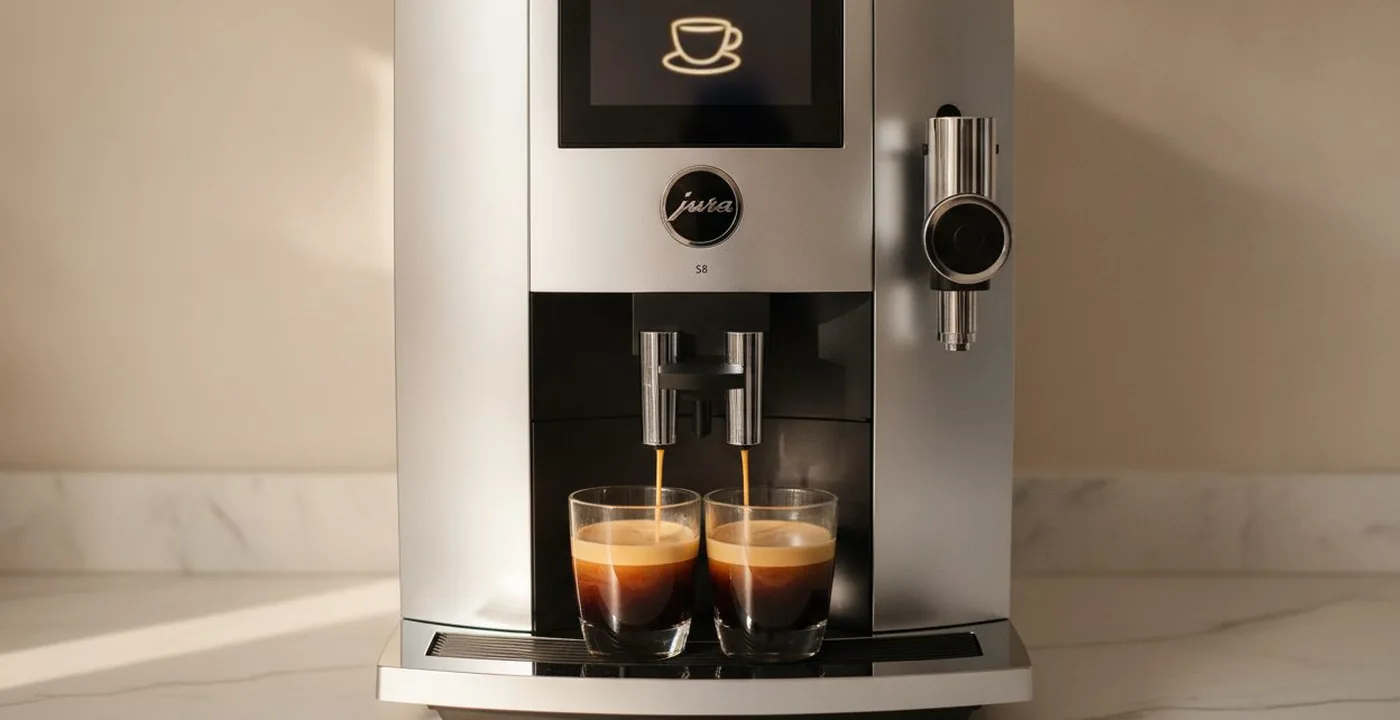
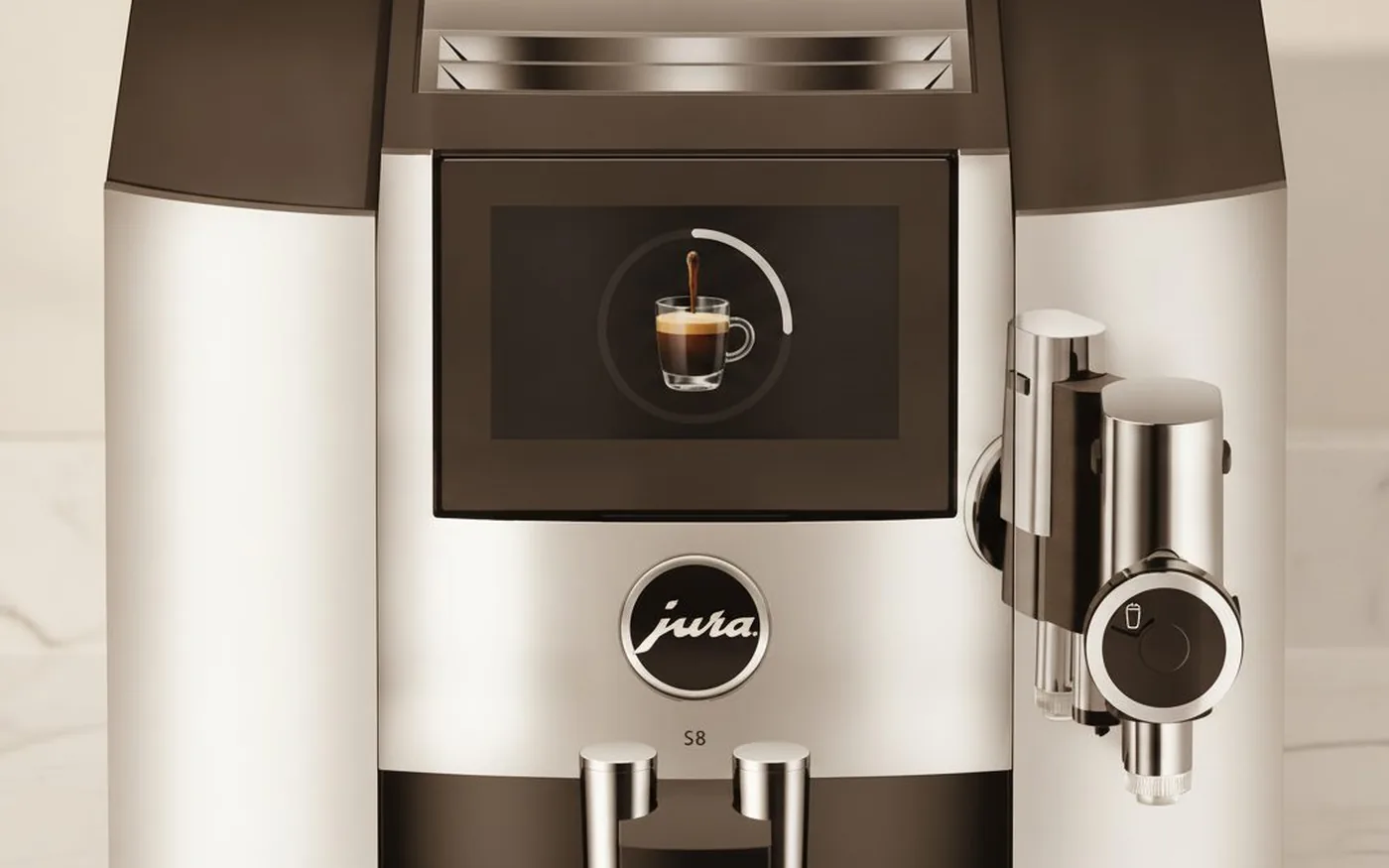
The 4.3-inch (about 10.9cm) TFT colour touchscreen is the headline: bright, responsive, and genuinely useful. Each drink shows as an image you tap, and you can reorder your favourites to the front. After a fortnight I stopped reading the labels and worked from muscle memory, which is the point.
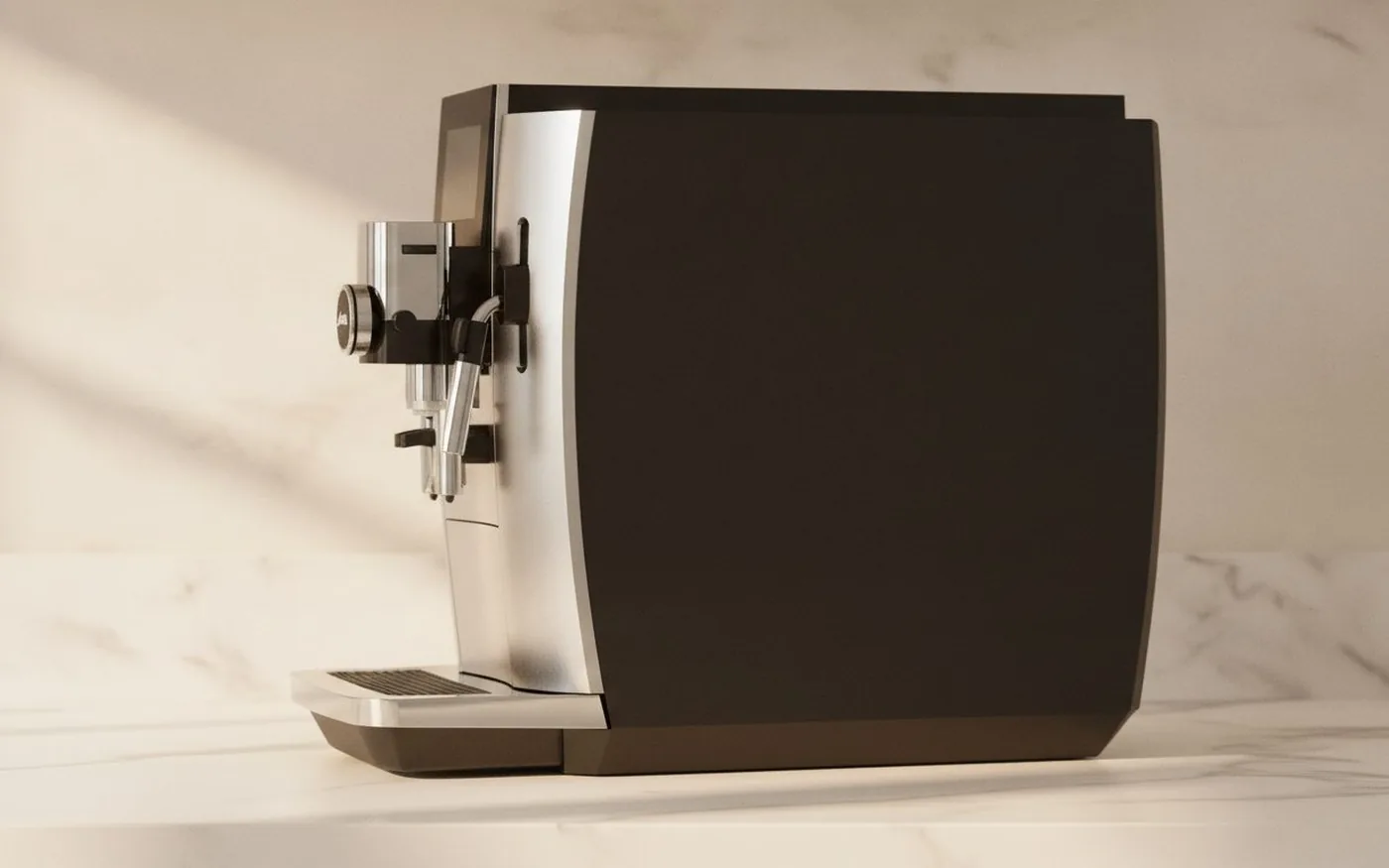
The footprint is the honest catch. The S8 measures 28cm width, 34.8cm height, and 44.6cm depth, and the depth surprises people. You pull it forward to fill the rear water tank, so in a typical UK kitchen with wall units, measure before you commit.
Two colours reach the UK reliably in 2026: Piano Black and Moonlight Silver. Jura UK ran short on the Piano White finish through Q1 2026, so if that is the one you want, check stock first.
The 15 Drinks Menu: What You Actually Get From One Button
The S8 makes 15 drinks from the touchscreen, and the number matters less than what sits inside it. You get espresso, ristretto, and lungo on the black side, then cappuccino, latte macchiato, flat white, and a proper cortado on the milk side, plus a milk-only froth and hot water for tea.
In daily use I settled on four: flat white in the morning, a black lungo mid-morning, an espresso after lunch, and a latte macchiato when someone else wanted one. Each is one press. The machine grinds, brews, and textures milk in sequence without me touching anything except the cup.
The customisation earns the premium over a basic automatic. You adjust strength across 10 levels, plus water volume, temperature, and milk-to-coffee ratio per drink, then save it. Once dialled, your flat white is your flat white every time. You do not get latte art from a one-touch menu - no bean-to-cup machine gives you that - but you get consistency, which for most households is the more valuable thing.
Pulse Extraction Process (P.E.P.) and Shot Quality: How Jura's Signature Tech Performs
What is the Pulse Extraction Process (P.E.P.)? Pulse Extraction Process is Jura's method of pushing hot water through the coffee puck in short pulses rather than one continuous flow, which extends contact time on short drinks like ristretto and espresso for a fuller extraction. It is Jura's answer to the main criticism of automatics: thin, fast shots.
Stripped of the marketing, here is what P.E.P. does in the cup. On a standard automatic, a single espresso flows through in one quick pass and can taste hollow. P.E.P. breaks that flow into pulses, holding water against the grounds longer, so the shot carries more body. In our sessions the difference was clearest on ristretto, where the pulsing gave a syrupy weight a continuous automatic shot does not reach.
I logged shot timing to check the marketing against reality. On our Aurora Reserve beans at factory strength, a double espresso ran to volume in 28 to 31 seconds, the pulses adding four to six seconds over a non-pulsed pull on the same grind. That is a measurable extension, not a firmware gimmick.
S8 Shot Timing - Editor Lab Data (Aurora Reserve, medium roast, 1 week off-roast)
Result
Double espresso, factory strength
28-31 sec to volume
Ristretto, strength level 8
22-24 sec, syrupy body
Pulse extension vs continuous pull
+4-6 sec
Grind setting used
3 of 7 (finer than default)
Is a premium bean-to-cup like the Jura S8 the equal of a well-dialled manual shot on a prosumer espresso setup? No. A good manual machine with a good grinder still wins on ceiling. But the gap is smaller than the effort-versus-no-effort price difference suggests, and P.E.P. is the reason. The Specialty Coffee Association's extraction reference explains why contact time matters this much.
What is the P.A.G.2 grinder? The P.A.G.2 (Professional Aroma Grinder, second generation) is Jura's integrated conical burr grinder, tuned to grind beans quickly while preserving aroma, with seven manual grind settings adjusted by a dial inside the bean hopper. It is the component that most affects shot quality on any bean-to-cup machine.
The grind quality is good for an integrated burr set. Conical burrs run cooler and slower than flat burrs, which protects aroma, and across our test the S8 held an even enough grind to keep extraction consistent shot to shot. You will not mistake it for a standalone £400 grinder, but you do not need to at this price - it is well matched to the P.E.P. brew unit behind it.
Noise is moderate. The grind is a short, low burr sound rather than the shriek some automatics produce, running two to three seconds per shot. In a flat with thin walls it will not wake anyone next door.
Retention is the number owners care about, because stale grounds dull the next cup. The P.A.G.2 holds very little between doses, a quiet advantage of a conical set in a sealed unit. The practical takeaway sits in Section 12: this grinder rewards the right beans and punishes the wrong ones, and the wrong ones can cost you the whole machine.
Professional Fine Foam Frother: Auto-Milk Performance, Latte Art Ceiling
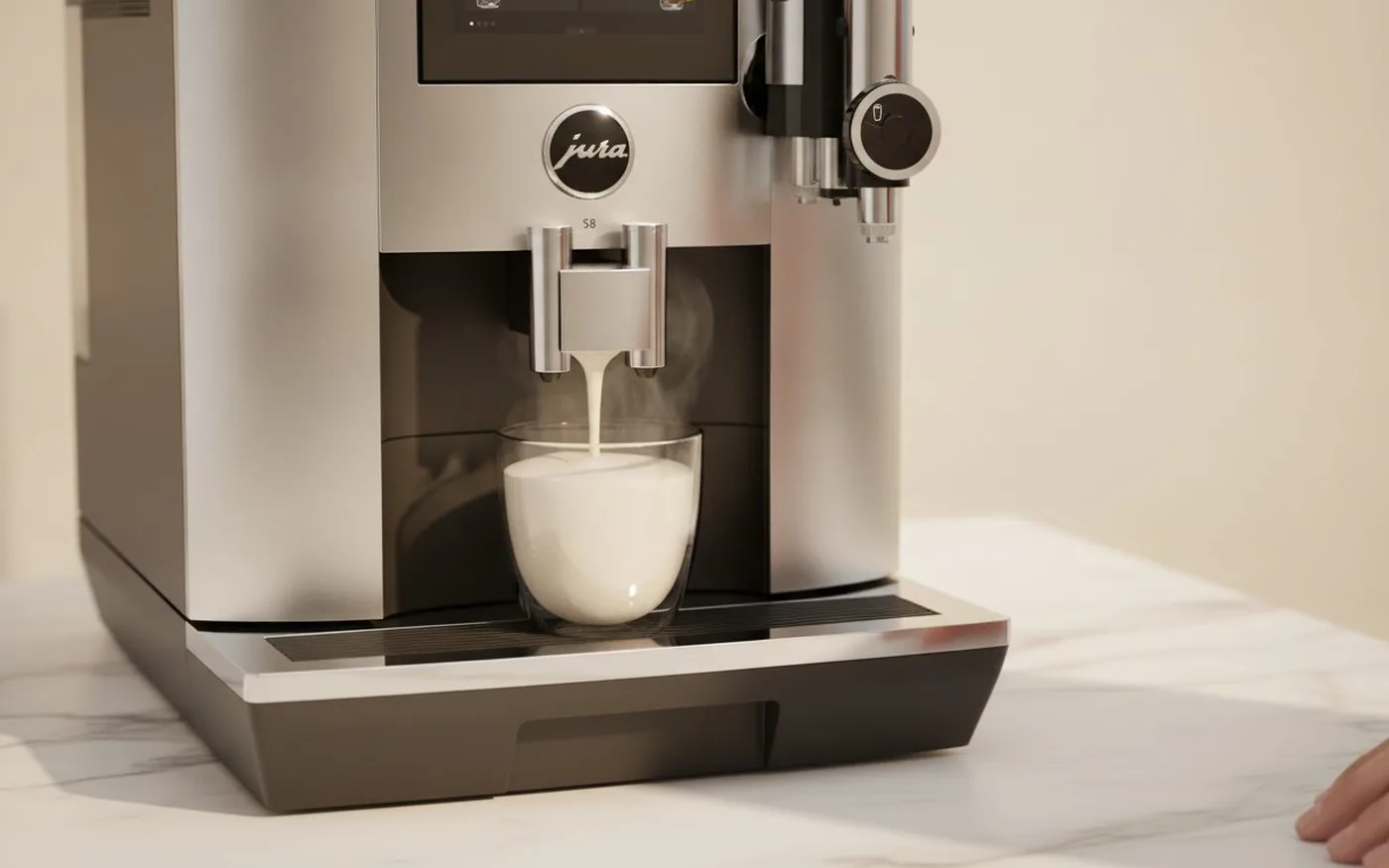
What is the Professional Fine Foam frother? The Professional Fine Foam frother is Jura's automatic milk system, which draws milk through a tube and textures it with air to produce fine microfoam for cappuccinos and flat whites, all from one touch. It is the feature that separates the S8 from a black-coffee-only machine.
The foam quality impressed me, and I have textured milk on Sanremo and La Marzocco machines most home baristas will never touch, so I do not say that lightly. The microfoam is fine, glossy, and pours with a real sheen. On a flat white the foam integrated into the milk rather than sitting on top as a separate layer, the mark of a system doing its job.
Whole milk performs best, as always, and semi-skimmed foams well too. Barista-grade oat textured cleanly where cheaper auto-frothers struggle, though standard supermarket oat gave a thinner result.
The latte art ceiling is where honesty matters. You cannot pour a rosetta from a one-touch system, because the machine dispenses milk into the cup rather than into a jug you control. What you get is textured milk in the cup, not art on top. If pouring your own patterns is the goal, no bean-to-cup machine will satisfy you, and you want a manual setup instead.
Day-to-Day Use: Warm-Up Time, Drink Speed, Water Tank, Bean Hopper
Living with the S8 is where it justifies itself. From cold it is ready in under a minute, and a flat white from a standing start takes around 70 seconds including the grind and milk. In a weekday rush, that speed is the whole argument for the machine.
The water tank holds 1.9 litres and sits at the rear, the ergonomic weak point I flagged earlier - you pull the machine forward to refill. The bean hopper takes 280g, enough for a week of one or two cups a day, and seals well enough to keep beans reasonably fresh between fills.
On longevity, this machine lasts if you maintain it, and maintenance is not optional. Which? UK's reliability data places Jura among the more dependable premium brands, and my own experience owning four Jura machines backs that up - they run for years when descaled and cleaned on schedule, and fail early when they are not. The daily reality is low-effort: empty the drip tray, rinse the milk system, refill as needed.
Maintenance, CLARIS Smart+ Filter and Self-Cleaning Cycles
Maintenance is where the S8 asks something of you, and where I have to be straight about the catch. The coffee side is close to automatic: the machine rinses on power-up and shutdown, prompts a cleaning cycle every few weeks with a Jura tablet, and prompts a descale when water hardness calls for it.
The CLARIS Smart+ filter is the labour-saver worth understanding. It sits in the water tank, reduces limescale before it reaches the boiler, and communicates with the machine via a chip so the S8 knows when it is exhausted. Run the filter and you descale far less often. Its components carry the water-contact safety approvals UK buyers should expect, in line with WRAS guidance on materials in contact with drinking water.
Now the catch. The milk system must be rinsed after every session and deep-cleaned regularly with Jura's milk-system cleaner, or residue builds inside the tube and frother and sours the next drink. The S8 prompts you, but the prompt is easy to dismiss and the consequences are not. This is the single most common owner complaint, and it is entirely preventable. For the full routine, our how to clean a coffee machine guide walks through it step by step.
Jura S8 vs Jura E8: The £400 Question
This is the comparison that decides most S8 purchases, because the E8 is the same brand, a similar machine, and roughly £400 cheaper. The Jura S8 differs from the Jura E8 by its 4.3-inch colour touchscreen and a wider one-touch drinks menu, while the extraction hardware, grinder, and milk system are closely matched.
Feature
Jura S8
Jura E8
UK price (2026)
around £1,499 (RRP £1,695)
around £1,095 (RRP £1,295)
Display
4.3-inch TFT colour touchscreen
Smaller TFT colour, rotary dial
Drinks menu
15 one-touch
12 one-touch
Grinder
P.A.G.2 conical burr
P.A.G.2 conical burr
Extraction
Pulse Extraction Process
Pulse Extraction Process
Milk system
Professional Fine Foam
Professional Fine Foam
Water tank
1.9 litres
1.9 litres
Bean hopper
280g
280g
Filter
CLARIS Smart+
CLARIS Smart+
Weight
9.8kg
9.8kg
The S8 costs roughly £400 more than the E8 because of the colour touchscreen, three extra one-touch drinks, and a more premium finish, not because it makes materially better coffee. Read that table again: grinder identical, extraction identical, milk system identical.
So who pays the £400? You do if the touchscreen genuinely improves your daily experience and you make enough of the extra drinks to notice. For a household making four or five drinks a day, that daily pleasure has real value. If you take your coffee mostly black, or the interface does not move you, the E8 makes the same cup for less. Owners of the entry-level E6 asking whether to step up to the Jura S8 should know the jump is two rungs, not one - the S8 adds both the touchscreen and drinks the E6 never offered.
Jura S8 vs De'Longhi PrimaDonna Elite: Touchscreen Showdown
The cross-brand question is the S8 against De'Longhi's flagship touchscreen bean-to-cup, the PrimaDonna Elite Experience. Both are premium, both have colour touchscreens, both froth milk automatically. Compared to the De'Longhi PrimaDonna Elite, the Jura S8 delivers a more refined shot through P.E.P. and a fractionally better milk texture, while the PrimaDonna counters with a larger drinks menu, an app-first design, and often a lower price.
Feature
Jura S8
De'Longhi PrimaDonna Elite
UK price (2026)
around £1,499
around £1,299-£1,499
Display
4.3-inch TFT touchscreen
Full-colour touchscreen
Extraction
Pulse Extraction Process
Standard high-pressure
Grinder
P.A.G.2 conical burr
Steel conical burr, 13 settings
Milk system
Professional Fine Foam (auto)
LatteCrema (auto, carafe)
Drinks menu
15
20+ with app
App control
J.O.E. app
De'Longhi Coffee Link app
Milk storage
Tube from carton
Detachable milk carafe
The real split is design philosophy. Jura runs a tube from any milk carton, flexible but demanding rigorous cleaning. De'Longhi uses a detachable carafe you lift out and store in the fridge whole, which many owners find easier to keep clean. If the milk-cleaning routine worries you, that carafe is a genuine advantage.
On the coffee itself, the S8 edges it. P.E.P. gives the Jura a fuller short shot, and the grinder holds consistency slightly better in my testing. But the PrimaDonna is often several hundred pounds cheaper and makes more drink styles. Jura wins on coffee refinement, De'Longhi on value and milk convenience, and our best coffee machine UK buying guide frames the trade-off across the whole market.
What the Jura S8 Needs: Which Beans Actually Work in It
Here is the part no competitor review covers, and it is the one that protects your £1,499. The single fastest way to damage a Jura grinder is to feed it oily, dark-roasted beans. Oil coats the P.A.G.2 burrs and the bean chute, gums up the grind path, and can void the warranty. The S8 needs non-oily, even-density, medium-roast beans - and getting this wrong is expensive.
Editor's Note
Balance Journal is the editorial publication of Balance Coffee. We recommend Balance Coffee beans here because we have tested them in this machine and they meet the non-oily, medium-density brief that Jura's P.A.G.2 grinder requires - not because we publish them.
The bean we ran through the S8 for this entire test was Aurora Reserve, our Brazilian single origin. It is a medium roast with a dry, even surface and consistent density, precisely what a conical burr grinder wants - it grinds clean, holds no oil in the chute, and gives the S8 a chocolatey base with a fruity lift on the finish. Across 240 drinks the grind path stayed clean, which is the whole point.
If you want a darker profile without a genuinely oily roast, Darkfire Energy is the one I would pair with the S8. It is a Brazil and Colombia blend roasted for a bolder cup, but kept dry enough on the surface to run safely through the grinder, giving a heavier body and a darker cocoa note without the oil that punishes Jura burrs.
The rule for any bean-to-cup machine holds here: buy dry, buy fresh, avoid the shiny dark beans that look premium in the bag and cost you a grinder in the machine. This decision matters more than the machine settings.
What to Avoid: Common Faults, Scaling, Milk System Care
Six weeks of testing plus years of owning Jura machines, cross-checked against owner forums, surface the same handful of avoidable problems. None are dealbreakers. All are preventable.
Important
What to Avoid With the Jura S8
Skipping the daily milk rinse. The most common complaint by far. Milk residue in the tube sours the next drink and, left long enough, clogs the frother. Rinse after every milk session, deep-clean weekly with Jura milk-system cleaner.
Ignoring descale prompts. Hard-water areas scale the boiler fast. Dismissed descale prompts lead to weak flow and, eventually, a service bill. Run the CLARIS Smart+ filter and descale on schedule.
Oily dark beans in the hopper. Covered above. Shiny, oil-slicked beans coat the P.A.G.2 burrs, gum the chute, and can void the warranty. Stick to dry, medium roasts.
Positioning it flush to the wall. The rear water tank means you refill from behind. Mount it flush and every refill becomes a two-handed drag forward. Leave clearance.
Where to Buy the Jura S8 in the UK
Pricing sits below the £1,695 RRP at most retailers, but stock and finish availability move, so the table below is our June 2026 snapshot, refreshed quarterly. Prices exclude retailer promotions and bundle deals, worth checking at checkout.
Retailer
Price (June 2026 snapshot)
Finish
Stock
Notes
Harts of Stur
£1,499.95
Silver
In stock
Down from £1,695 RRP, coffee-equipment specialist
Harts of Stur
£1,299
Chrome
Out of stock
Lowest listed when available, notify-on-restock
Currys
around £1,479
Chrome / Dark Inox
In stock
Frequent finance offers, Awin affiliate
Jura UK direct
RRP £1,695
Full colour range
In stock
Direct warranty. Piano White was short in Q1 2026
My practical steer: Harts of Stur is usually cheapest and knows the product, Currys is worth a look for finance, and buying direct from Jura gets you the full colour range and the manufacturer warranty. Buy the finish you want in stock rather than the one that ships fastest - you will look at this machine every morning for years.
Verdict: Who Should Buy the Jura S8 (And Who Shouldn't)
The Jura S8 does one thing supremely well: it removes every ounce of effort from making a genuinely good milk drink. Six weeks and 240 drinks in, it earned an 8.4, held back only by a milk-cleaning routine you cannot ignore. At around £1,499 it is not the cheapest way to good coffee, and it does not pretend to be.
Buy the Jura S8 if you make milk drinks daily, you want café-standard flat whites with zero technique, and the large colour touchscreen genuinely improves your morning. For a busy household that values one-touch consistency over saving money, it is close to ideal.
Buy the E8 instead if the touchscreen does not move you or you drink mostly black coffee. It makes the same cup for roughly £400 less, and the coffee is identical.
Look at the De'Longhi PrimaDonna Elite if the milk-cleaning routine worries you or value matters more than shot refinement - the detachable carafe is easier to keep clean and the machine is often cheaper.
Skip bean-to-cup entirely if you want to learn to pour latte art or pull your own shots. No automatic gives you that, and you want a manual machine.
For most people asking whether the S8 is worth it, the answer is yes - provided you commit to the maintenance and feed it the right beans. Do both, and it will make excellent coffee for a decade.
Frequently Asked Questions
Is the Jura S8 worth the money?
For a household making milk drinks daily, yes. The roughly £1,499 buys café-standard flat whites with zero technique, a responsive touchscreen, and a build that lasts a decade with proper maintenance. If you drink mostly black coffee, the cheaper Jura E8 makes the same cup, and the S8 is harder to justify at that point.
What is the difference between the Jura S8 and E8?
The S8 has a 4.3-inch colour touchscreen and 15 one-touch drinks; the E8 uses a rotary dial with a smaller display and 12 drinks. The grinder, Pulse Extraction Process, and milk system are the same on both. You pay roughly £400 more for the interface and drink count, not for better coffee.
Does the Jura S8 make latte art?
No. The S8 dispenses textured milk directly into the cup rather than into a jug you pour from, so you cannot create patterns like a rosetta. What it produces is fine, glossy microfoam integrated into the drink. If pouring your own latte art is the goal, you need a manual espresso machine and a milk jug instead.
How long does the Jura S8 last?
A well-maintained S8 lasts around ten years. Which? UK data places Jura among the more reliable premium brands, and my own experience across four Jura machines backs that up. Longevity depends entirely on descaling on schedule, running the CLARIS filter, and cleaning the milk system - neglect these and it fails early.
Can the Jura S8 use any coffee beans?
Technically yes, but you should not. The P.A.G.2 grinder is damaged by oily, dark-roasted beans, which coat the burrs, gum the chute, and can void the warranty. Use non-oily, even-density medium roasts such as our Aurora Reserve single origin, which we ran clean through the machine across the entire test.
Which is better, De'Longhi or Jura?
It depends on your priority. Jura wins on coffee refinement - the Pulse Extraction Process gives a fuller short shot and the grinder holds consistency slightly better. De'Longhi wins on value and milk convenience, with a detachable carafe that is easier to clean and a lower typical price. Neither is universally better.
Is the Jura S8 worth it over the Jura E6?
The S8 is a two-rung step up from the entry E6, adding a colour touchscreen, the wider drinks menu, and a more premium build. If your budget stretches and you make varied milk drinks daily, the upgrade is worth it. If you make one or two simple drinks a day, the E6 covers you for far less money.
What beans are best for the Jura S8?
Non-oily, medium-roast, even-density beans that keep the grinder clean. We ran Aurora Reserve, a dry-surfaced Brazilian single origin, through the S8 for 240 drinks with no oil build-up. For a bolder cup without oily beans, Darkfire Energy pairs well. Avoid shiny, dark, oil-slicked beans - they damage Jura grinders.
A wellness entrepreneur and biohacker, James explores the intersection of hospitality and health - from clean fuel and recovery tools to mindful routines that build balance into daily life.