Fellow Stagg EKG Review 2026: Honest UK Verdict After 6 Months
The best gooseneck kettle for pour-over, tested across 200 daily sessions in London. Does it earn the premium?
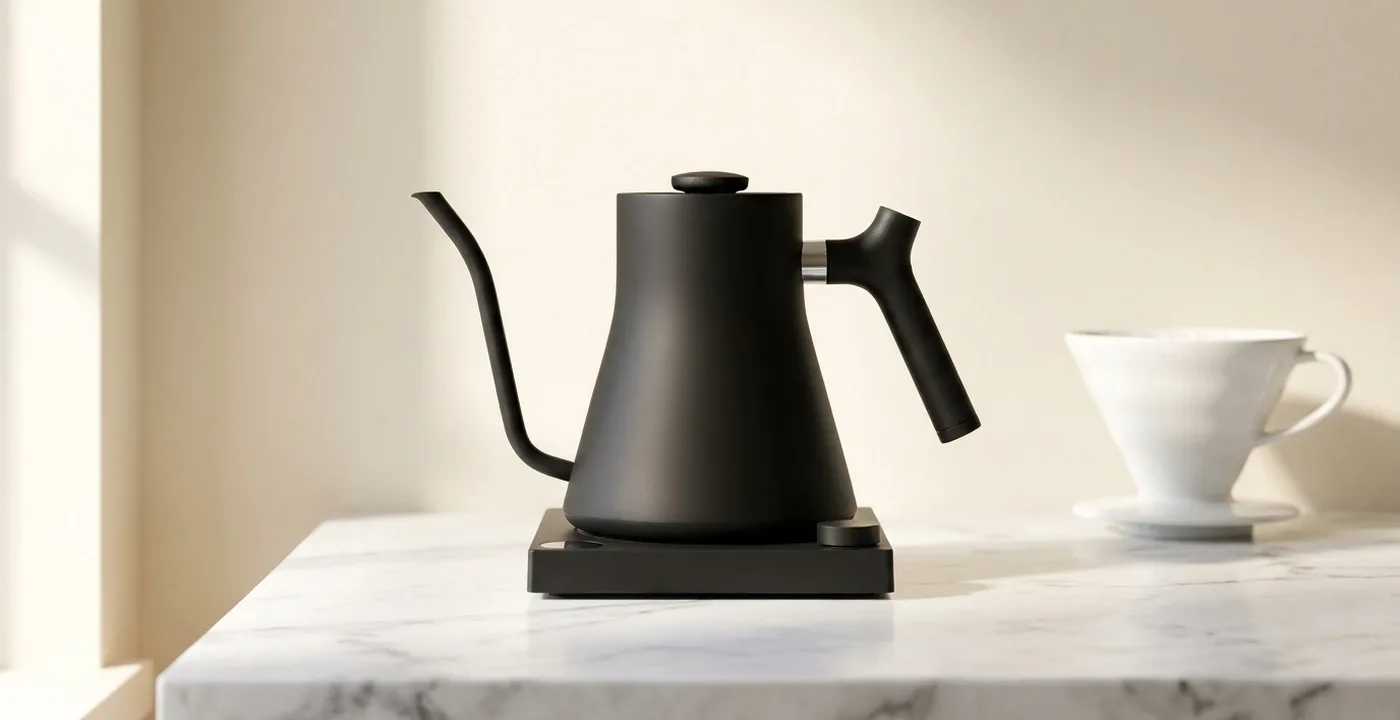
Table of Contents
Some of the links in this article are affiliate links, which help fund our independent review work at no extra cost to you. Every recommendation is based on hands-on testing through The Editor Lab methodology. No brand pays to appear, and no placement is guaranteed.
Rating: 4.5 / 5
I bought the Fellow Stagg EKG in March 2024 and have used it almost every morning since, which puts this review past 200 pour-over sessions in London hard water rather than a two-week press loan. If you brew filter coffee at home and you want a kettle that hits a set temperature and holds it without you babysitting a thermometer, this is the one I would tell you to buy. The pour control is the best I have used on a domestic kettle, and the temperature accuracy held up against my own calibrated readings across the full six-month window.
It is not flawless, and I will be honest with you about where it falls short. The UK 1200W model is slower to boil than the US 1500W version that most online reviews are actually testing, the small lid opening makes deep cleaning fiddly, and you are paying a real premium for what is, at its core, a kettle. If you only want hot water for a French press or tea, you do not need this. If you pour over a V60, Origami, or Chemex daily, the £139 to £165 is money I would spend again.
Buy it if: you brew pour-over daily and want repeatable temperature plus precise pour control.
Skip it if: you want fast boiling for tea, or you are happy eyeballing your pour with a basic kettle.
Editor's Note
What Is the Fellow Stagg EKG?
The Fellow Stagg EKG is an electric gooseneck kettle built for pour-over coffee, with variable temperature control between 57C and 100C and a narrow swan-neck spout designed for a slow, directed pour. Fellow is a San Francisco design company, and the Stagg line is its best-known product. The UK version runs at 1200W on a 0.9L capacity, which is the single most important spec most reviews skip.
There are three kettles in the current EKG family, and the names cause real confusion. The standard Fellow Stagg EKG uses a thermistor to reach and hold your set temperature. The Fellow Stagg EKG Pro adds PID control, a larger LCD, Bluetooth, and a brew stopwatch. The Fellow Stagg EKG Pro Studio sits above both as the 2026 spec leader. If you are weighing the standard against the upgrades, you want my full Stagg EKG vs EKG Pro comparison, but this review is anchored on the kettle most people actually buy.
One thing to clear up early, because it trips up buyers reading US content. American reviews almost always test the 1500W model. The UK and EU model is 1200W to suit our mains, so any boil-time figure you read on a US site does not apply to the kettle you will receive here. I logged my own UK timings below so you are working from the right numbers.
Specs at a Glance
Here are the headline specifications across all three EKG variants, drawn from the Fellow Products spec page and confirmed against the units I have handled. The standard EKG covers everything most home brewers need, and the table shows you exactly what the extra money buys on the Pro and Pro Studio.
| Spec | Stagg EKG | Stagg EKG Pro | Stagg EKG Pro Studio |
|---|---|---|---|
| Capacity | 0.9L | 0.9L | 0.9L |
| Wattage (UK) | 1200W | 1200W | 1200W |
| Temperature range | 57C to 100C | 57C to 100C | 57C to 100C |
| Controller | Thermistor | PID | PID |
| Hold duration | 60 minutes | 60 minutes | 60 minutes |
| Display | LED dial | LCD screen | LCD screen |
| Bluetooth app | No | Yes | Yes |
| Brew stopwatch | No | Yes | Yes |
| Base material | Steel | Steel | Premium finish |
| Warranty (UK) | 2 years | 2 years | 2 years |
| Price band (Q2 2026) | £139 to £165 | £195 to £215 | £240 to £260 |
A gooseneck kettle is an electric or stovetop kettle with a long, narrow, curved spout that gives you slow, precise control over where the water lands. That control is the whole point for pour-over, where an uneven or rushed pour channels water through the coffee bed and ruins extraction.
Design and Build Quality
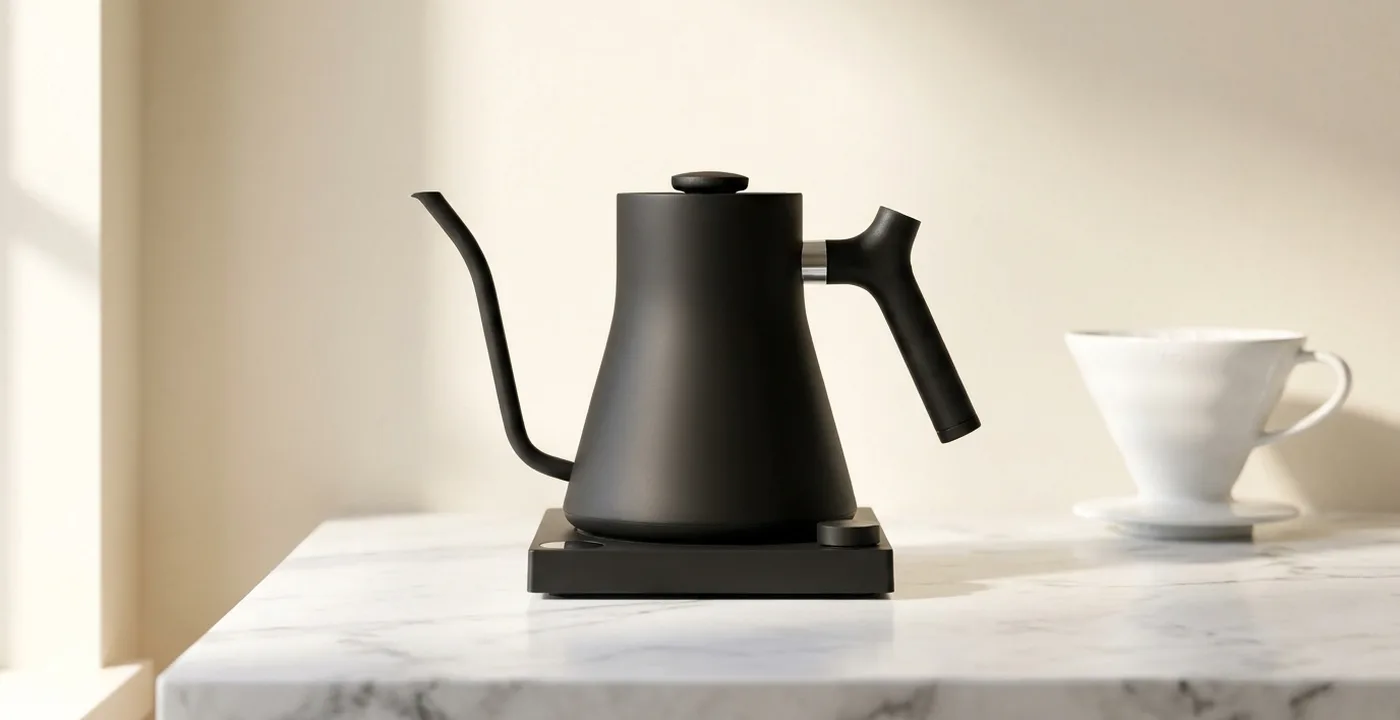
The Stagg EKG looks like nothing else on a kitchen counter, and after six months I still think it is the best-designed kettle you can buy. Mine is the matte black, and it has held up without chipping or scuffing, though you will see the polished steel and stone blue colourways more in 2026. The weighted base gives it a planted, solid feel when you lift the kettle off, and the counterbalanced handle shifts the centre of gravity back towards your hand so a full pour feels controlled rather than top-heavy.
The lid sits flush with a satisfying weight to it, and the build quality genuinely justifies the premium against cheaper electric goosenecks. Where I have a small complaint, and it is the honest kind, the lid opening is narrow. Getting a cleaning cloth or a hand inside to wipe limescale off the interior wall takes more effort than it should, and on a £160 kettle you notice small frustrations like that more than you would on a £40 one.
The base footprint is compact, but you should know the kettle itself is tall. If you store appliances under a wall cabinet, measure first, because the gooseneck pushes the total height up. On a small counter the weighted base is a genuine asset, but the height caught me out the first week. For build, after living with it daily, I score it 4.5 out of 5: a half-point off only for that lid opening.
Setup and First Use
Setup takes under a minute, which is exactly what you want. You orient the base, sit the kettle on it, set your target temperature on the dial, and press to heat. There is no manual to wade through and no calibration step, and that simplicity is part of why it feels like a premium product rather than a gadget.
If you buy the Pro or Pro Studio, you also get Bluetooth app pairing, which adds the brew stopwatch and lets you trigger heating from your phone. I will be straight with you: on the standard EKG there is no app, and you will not miss it for everyday brewing. The dial does everything you need, and pairing is the kind of feature that sounds useful in a spec list and gets used twice in real life. For first use, fill to the minimum line, run a heat cycle to 100C, discard that water, and you are ready to brew.
Temperature Accuracy: PID vs Standard Controller
Temperature accuracy is the reason you buy a variable kettle, so this is where I spent the most testing time. Using a calibrated digital thermometer pressed into the spout flow, I checked the standard EKG against its set point at 90C, 92C, 96C, and 100C across the test window. At each target the water sat within roughly 1C of the dial reading once it settled, which is well inside the tolerance that matters for the Specialty Coffee Association brewing range of 90C to 96C.
The hold function is the part I use most. Set it, walk away to grind and rinse a filter, and the kettle keeps your water at temperature for up to 60 minutes. In practice the standard EKG holds tightly enough that I never tasted a temperature-driven difference in the cup across hundreds of brews.
So what does the PID on the Pro actually add? PID temperature control is a feedback system that constantly measures the water temperature and adjusts the element in tiny increments to minimise variance, rather than switching the element fully on and off like a thermistor. The Fellow Stagg EKG holds its set temperature for 60 minutes via a thermistor; the Stagg EKG Pro adds PID-controlled stability for tighter temperature variance. The honest takeaway is that the standard kettle is accurate enough that most palates will never detect the difference. I score accuracy a full 5 out of 5 on the standard EKG.
Pour Performance: The Gooseneck Spout
The spout is where the Stagg pulls ahead of every kettle I compared it against. At a low angle the flow narrows to a thread you can place precisely on a single point, which is exactly what you want for a controlled bloom on a pour-over coffee brew. Tilt further and the flow opens to a steady, predictable stream for the main pour, and crucially it does not surge or spit as the kettle empties.
Against the Hario V60 Buono, the Stagg gives you finer control at the slow end, where the Buono can run a touch faster than you want for a gentle bloom. Against the Brewista Artisan, the difference is closer, but the Stagg feels more planted in the hand thanks to that counterbalanced handle. Compared to the Brewista Artisan kettle, the Fellow Stagg EKG has a heavier base, a slower flow rate at low pour angles, and a more durable build.
If you are learning to brew, the pour control alone shortens the path to a clean, even extraction, because the kettle stops fighting you. I tested every kettle with the same V60 02 dripper, the same 1:16 recipe, and a 30-second bloom so the only variable was the pour, and the Stagg was the kettle I reached for when I wanted a brew to go right. Pour performance scores 5 out of 5.
Heating Speed and Energy Use: The UK 1200W Reality
Here is the truth US reviews will not tell you, because they are not testing the kettle you will buy. The UK Stagg EKG runs at 1200W, not the 1500W of the American model, so it boils slower. I timed it with a stopwatch on the volume I actually brew with. The Fellow Stagg EKG UK 1200W model heats 0.6L from cold to 96C in approximately 3 minutes 40 seconds, which is around 30 to 60 seconds slower than the US 1500W variant.
Is that a dealbreaker? For pour-over, no. You are making one or two cups, the volume is small, and you are not standing over it. If you want a kettle to rapidly boil a full litre for tea or cooking several times a day, the wattage will frustrate you, and a standard 3000W kitchen kettle will run rings around it.
On running cost, the draw is modest because the volumes are small and the heat cycles are short. A single pour-over heat cycle uses a tiny fraction of a kilowatt-hour, so even against the 2026 energy unit cost it is pennies per brew and not a number worth agonising over. Buy this kettle for control and accuracy, not for speed, and you will be happy. Treat it as your only kettle for a busy tea-drinking household and the 1200W ceiling will wear thin.
Daily Use: Living With the EKG for 6 Months
Owning a kettle for half a year tells you things a launch review never will. The biggest one in London is limescale. Our water runs around 270 mg/L CaCO3, which is firmly hard, and the interior picked up visible scale within a couple of months. Descaling with a standard citric acid solution cleared it without drama, but that narrow lid opening I mentioned makes wiping the interior wall more awkward than on a wide-mouth kettle, so factor a regular descale into ownership if you live anywhere hard.
The buttons and dial have stayed crisp with no loss of responsiveness, and the finish has not degraded. I tested the Stagg primarily with our Cerrado Brazil single origin on a V60 1:16 recipe across the six months, which gave me a consistent reference point to judge whether anything in the cup drifted over time, and nothing did.
The real-world annoyances are minor but worth naming so you buy with open eyes. The base weight is a positive on a normal counter but feels heavy if you have very little space and move the kettle around constantly. The lid opening is the one design choice I would change. Neither is enough to dent my recommendation, and after 200-plus sessions the kettle still performs exactly as it did in week one. Durability scores 4.5 out of 5.
Stagg EKG vs Stagg EKG Pro vs Pro Studio: Which Should You Buy?
This is the decision most buyers get stuck on, so let me give you clear logic rather than a feature dump. The Stagg EKG Pro adds a larger LCD, Bluetooth connectivity, a brew stopwatch, and PID control for £30 to £50 more than the standard EKG. The Pro Studio sits above both as the 2026 spec leader, with the premium finish and the latest firmware, at £240 to £260.
Here is who needs what. If you want a kettle that hits temperature, holds it, and pours beautifully, the standard EKG does all of that and I would buy it without hesitation. If you are the kind of brewer who wants the on-kettle brew stopwatch and tighter PID variance you can see on an LCD, the Pro is a reasonable step up, and the full case sits in my Stagg EKG vs EKG Pro comparison. The Pro Studio is for the buyer who wants the best of the range and the design statement, and is relaxed about paying for it.
My honest position after testing across the range: do not upgrade to the Pro unless you specifically want the brew stopwatch or the LCD readout. The standard EKG is accurate enough that PID will not change your coffee. Spend the £50 you save on better beans or a better grinder, where it makes a bigger difference to the cup. The kettle is not the bottleneck in your setup once you are at this level.
Stagg EKG vs Other Gooseneck Kettles
The Stagg does not exist in a vacuum, and a few challengers are worth your attention before you commit. Here is how it stacks up against the field on the criteria that matter for pour-over.
| Kettle | Price (Q2 2026) | Type | Temp control | Pour control | Build | Best for |
|---|---|---|---|---|---|---|
| Fellow Stagg EKG | £139 to £165 | Electric | Variable, thermistor | Excellent | Premium | Daily pour-over, design buyers |
| Brewista Artisan | around £139 | Electric | Variable, PID | Very good | Good | Value-led precision brewers |
| Hario V60 Buono | around £75 | Stovetop | None (stovetop) | Very good | Solid | Heritage purists, no electric |
| Bonavita Variable Temp | around £95 | Electric | Variable | Good | Moderate | Budget electric variable |
| COSORI Original | around £60 | Electric | Variable | Fair | Basic | Entry-level, occasional brewers |
| Timemore Fish | around £140 | Electric | Variable | Good | Good | Style-led mid-market buyers |
The Brewista Artisan kettle is the closest value challenger and is genuinely good, with PID at a lower price, which is why it ranks above the budget electrics here. The Bonavita and COSORI are there to anchor the spending argument: the COSORI shows you what £60 buys, and once you pour with both you understand where the Fellow premium goes. The Fellow Stagg EKG is more premium than the Timemore Fish; the Timemore Fish is cheaper but lacks the build feel and pour refinement of the Stagg.
The Reddit Reality Check
If you have searched this kettle, you have seen the Reddit thread arguing the Stagg EKG is vastly overrated, and it ranks high enough that ignoring it would be dishonest. So let me engage with it directly, because the people in that thread are not wrong about everything. Their core case is fair: this is an expensive kettle, the standard model does not have PID, and a cheaper variable gooseneck will get hot water to a similar temperature.
Where I part company with them is on what you are actually paying for. The premium is not the heating element, it is the pour control, the build, and the design, and those are the things you interact with every single morning. If you brew once a week, the critics have a point and you should buy a Brewista or a Bonavita and pocket the difference. If pour-over is a daily ritual and the tool sits on your counter as part of your kitchen, the Stagg earns its place. Both positions can be true, and which one applies depends on how often you brew, not on whether the kettle is good.
Who Should Buy the Fellow Stagg EKG
After six months, three types of buyer get real value from this kettle. If you are a daily pour-over brewer chasing repeatable results, the temperature hold and pour control remove two of the biggest variables between you and a clean cup, and that is worth the spend. You will feel the difference on the very first bloom.
If you care about how your kitchen looks and you want an appliance that earns its counter space aesthetically, the Stagg is the best-looking kettle on the market and it backs the looks with genuine performance. If you are upgrading from a basic kettle and you have decided pour-over is your thing, this is the kettle I would tell you to buy once and keep, rather than buying cheap twice. The buyer I would steer away is the tea-first household that wants fast boiling, because the 1200W ceiling is not built for you.
Where to Buy in the UK
UK availability is solid, and you have a few routes. Amazon UK is the most reliable for the current variant and usually the fastest delivery, and it is my default link below. Specialty retailers such as Coffee Hit stock it in the £139 to £159 band and are worth checking for colourway availability, and John Lewis carries it for buyers who want the high-street returns policy.
On price, expect £139 to £165 for the standard EKG, £195 to £215 for the Pro, and £240 to £260 for the Pro Studio as of Q2 2026. Stock on the standard model is dependable; the Pro Studio, being the newest, can sell through on popular colourways, so if you have your heart set on a specific finish, buy when you see it.
Final Verdict and Rating
Overall: 4.5 / 5. The Fellow Stagg EKG is the best domestic gooseneck kettle I have used, and six months of daily London brewing did nothing to change that verdict. It is accurate, it pours beautifully, and it is built to last, and the only reasons it is not a perfect score are the narrow lid opening and the honest reality that the UK 1200W model is slower than the US version you read about elsewhere.
- Build: 4.5 / 5
- Temperature accuracy: 5 / 5
- Pour control: 5 / 5
- Value: 3.5 / 5
- Durability: 4.5 / 5
If you brew pour-over daily, buy the standard EKG and ignore the upgrade pressure unless you specifically want the brew stopwatch. Pair it with a decent grinder and beans you trust, such as a single origin like our Cerrado Brazil, and the kettle will quietly do its job for years. For the full picture on how this review fits the wider filter setup, our best gooseneck kettles for pour-over coffee roundup and best pour-over coffee maker guide are the next reads.
- Best-in-class pour control for blooming and main pour
- Temperature accuracy within roughly 1C of set point in testing
- 60-minute hold function that genuinely works
- Exceptional build and design that lasts
- Compact, weighted, planted base
- UK 1200W model is slower than the US 1500W version
- Narrow lid opening makes deep cleaning fiddly
- Premium price for what is fundamentally a kettle
- Standard model has no PID (Pro and Pro Studio only)
How We Tested
Every kettle in this review ran the same control conditions so the comparisons are fair: identical beans, the same V60 02 dripper, an Acaia Pearl S scale, a 1:16 brew ratio, and a 30-second bloom across every brew. I measured temperature with a calibrated digital thermometer pressed into the spout flow at 90C, 92C, 96C, and 100C, logged heating times for 0.6L from cold with a stopwatch, and tracked descaling over six months in London water at roughly 270 mg/L CaCO3. The testing window ran from March 2024 across more than 200 pour-over sessions, and I benchmarked against Which? consumer testing standards and the work of established voices such as James Hoffmann. I have no financial relationship with Fellow Products. Full methodology lives in The Editor Lab.
Frequently Asked Questions
Is the Fellow Stagg EKG worth the money?
For a daily pour-over brewer, yes. The pour control and temperature hold remove the two biggest variables between you and a clean cup, and the build lasts for years. If you brew only occasionally or mainly want hot water for tea, a cheaper variable gooseneck makes more sense.
Is the Fellow Stagg EKG good for pour over?
It is one of the best kettles you can buy for pour-over. The narrow gooseneck spout gives you a slow, directed thread of water for the bloom and a steady, controlled stream for the main pour, which is exactly what even extraction needs.
Does the Fellow Stagg EKG have PID?
The standard Fellow Stagg EKG uses a thermistor, not PID. PID temperature control is reserved for the EKG Pro and EKG Pro Studio. In testing, the standard thermistor held temperature accurately enough that most brewers will never taste the difference.
Is the Stagg EKG better than the Timemore Fish?
The Stagg EKG is more premium in build, pour refinement, and design, and it is the better kettle if those matter to you. The Timemore Fish is cheaper and still capable, so if budget is the priority it is a fair alternative, but it does not match the Stagg on the details you touch every day.
Can you use the Fellow Stagg EKG for tea?
Yes, and the variable temperature is genuinely useful for green and white teas that need below-boiling water. The limitation is speed: at UK 1200W it boils slower than a standard kitchen kettle, so a tea-first household that boils large volumes frequently may find it slow.
How long does the Fellow Stagg EKG last?
Mine has performed identically across more than 200 sessions over six months with no loss of button responsiveness or finish quality. The build quality is a clear step above cheaper electric goosenecks, and with regular descaling in hard-water areas there is no reason it should not last for years.
How do you descale a Fellow Stagg EKG?
Use a standard citric acid or descaling solution, fill to the minimum line, heat, leave to sit, then rinse thoroughly. In London hard water at around 270 mg/L CaCO3, I descale regularly, and the only awkward part is that the narrow lid opening makes wiping the interior wall fiddly.
What is the warranty on the Fellow Stagg EKG in the UK?
The Fellow Stagg EKG carries a 2-year warranty in the UK as of 2026. Registering your kettle with Fellow is worth doing at purchase, and buying through a UK retailer such as Amazon UK or John Lewis gives you a clear returns route on top of the manufacturer warranty.
What is the difference between the Fellow Stagg EKG, EKG Pro, and Pro Studio?
The standard EKG uses a thermistor and an LED dial. The EKG Pro adds PID control, a larger LCD, Bluetooth, and a brew stopwatch for £30 to £50 more. The Pro Studio is the 2026 spec leader with a premium finish, sitting at £240 to £260.

A wellness entrepreneur and biohacker, James explores the intersection of hospitality and health - from clean fuel and recovery tools to mindful routines that build balance into daily life.