DF64 Grinder Review: The Truth About 2026's Most-Hyped Single-Dose Grinder

Coffee & Wellness Writer
Four weeks, three origins, two machines. The DF64 Gen 2 closes the gap to Niche Zero more than the price difference suggests.
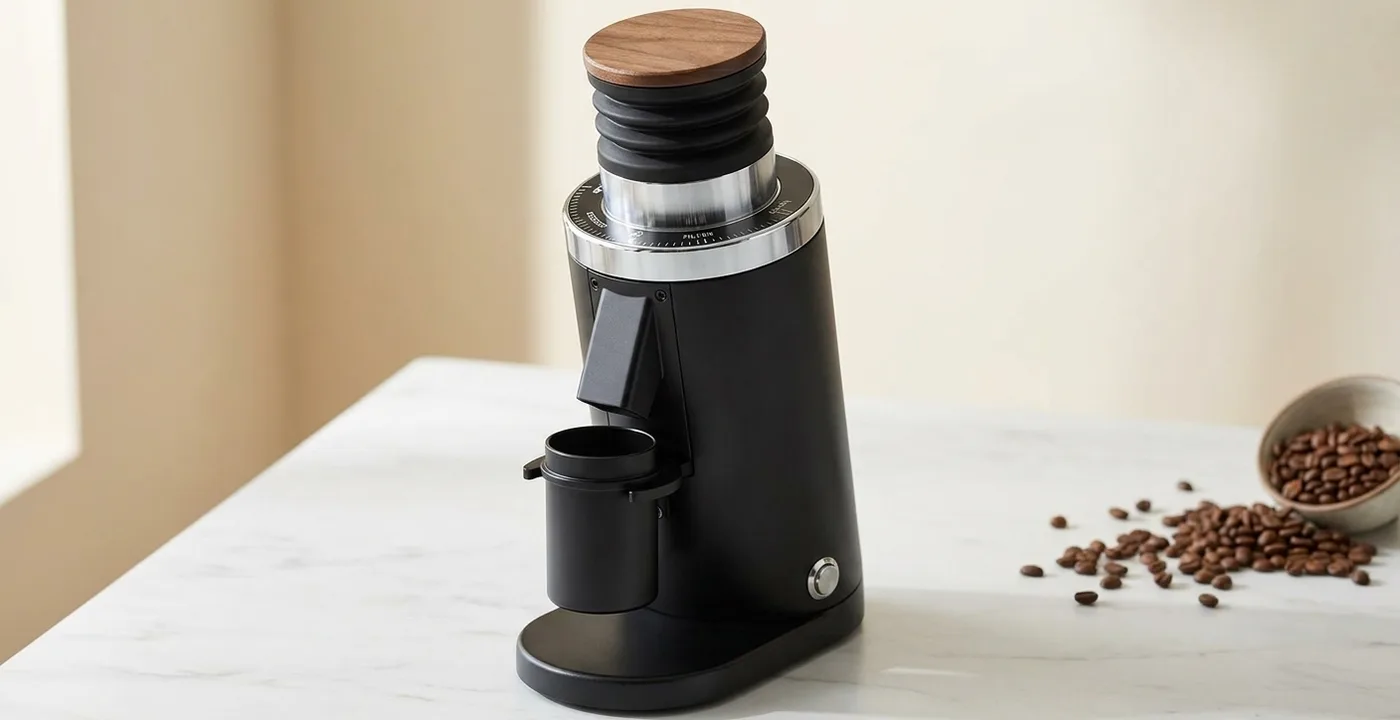
Table of Contents
Some of the links in this article are affiliate links, which help fund our independent review work at no extra cost to you. Every recommendation is based on hands-on testing through The Editor Lab methodology. No brand pays to appear, and no placement is guaranteed.
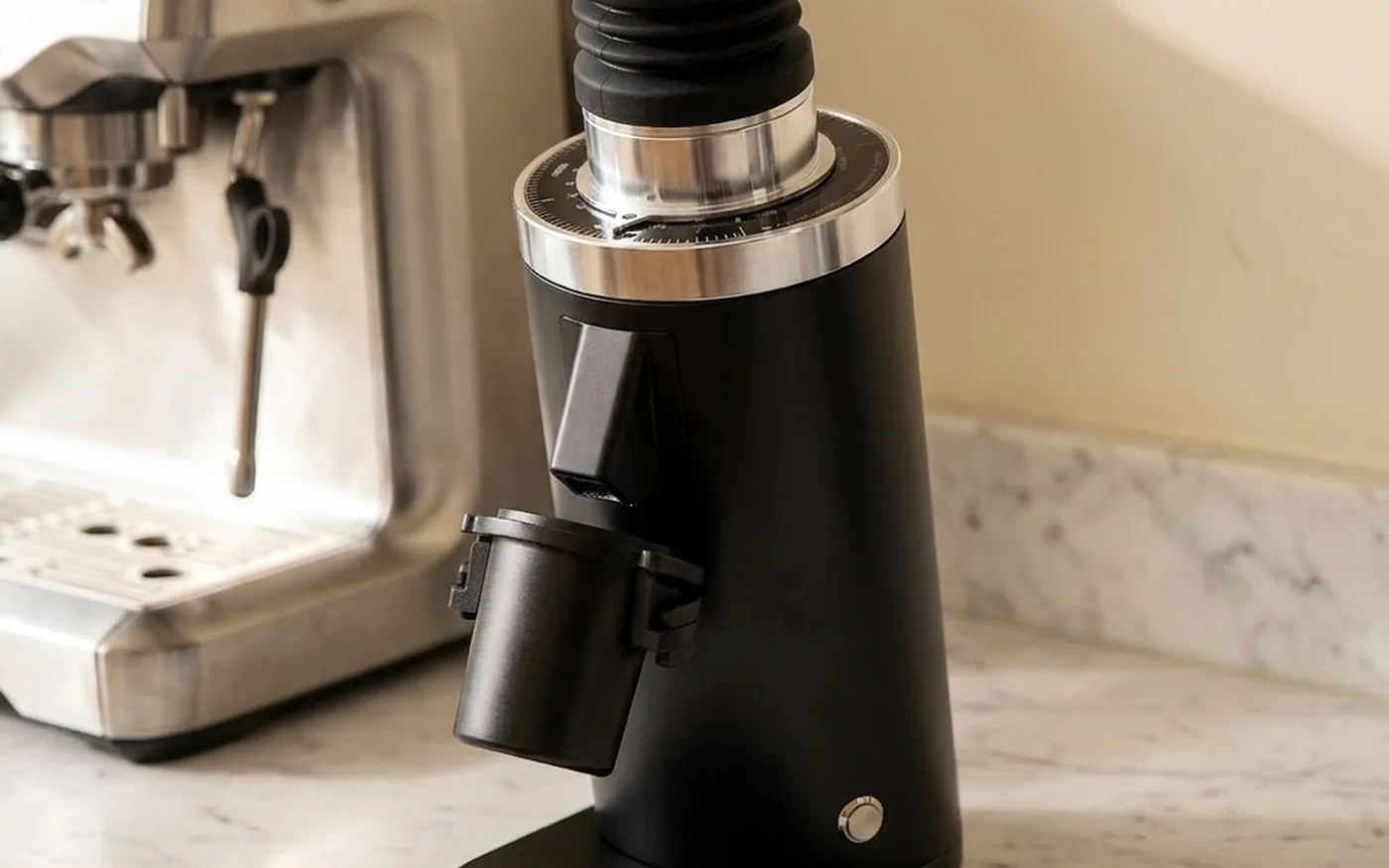
The DF64 Gen 2 landed on my test bench with four weeks of daily espresso ahead of it. I weighed every dose going in and every dose coming out, ran it across three coffee origins, paired it with a Gaggia Classic Pro and a Sage Barista Express, and compared it directly against the Niche Zero with the same beans in the same machines. This review is the result of that testing - not a spec sheet summary.
Short verdict: the DF64 Gen 2 is the right call for most home baristas upgrading from a Sage Smart Grinder Pro or Baratza Encore ESP, as long as you go in with realistic expectations about workflow. The bellows ritual is real. The retention is lower than forums suggest. And the gap to the Niche Zero is smaller than the £200 price difference implies at standard espresso settings.
The DF64 Verdict at a Glance
Our rating: 4.1 / 5
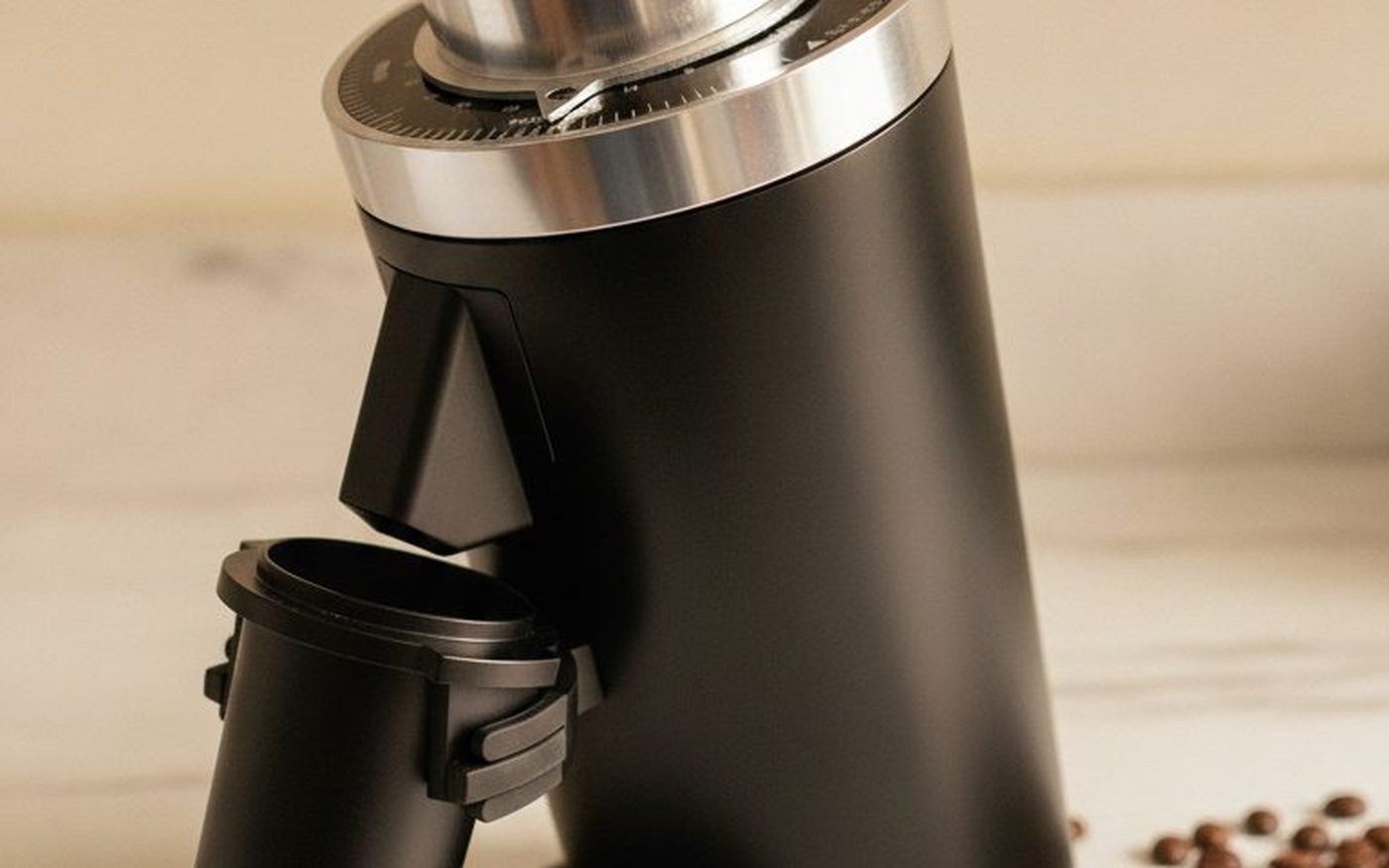
The DF64 Gen 2 is a 64mm flat burr single-dose grinder that punches above its price in shot quality. Gen 2 fixes the most significant issues from the original: the chute clog problem, the squeaky adjustment knob, and the bellows gap. Stock retention with the included bellows sits at 0.2-0.4g in real-world use, which is competitive with grinders costing twice as much.
Star ratings:
| Category | Score |
|---|---|
| Grind quality | 4.3 / 5 |
| Workflow | 3.8 / 5 |
| Build quality | 3.9 / 5 |
| Value | 4.5 / 5 |
| Retention | 4.0 / 5 |
Buy if:
- You are upgrading from a Sage Smart Grinder Pro or Baratza Encore ESP
- Your machine is a Gaggia Classic Pro, Sage Barista Express/Pro, Lelit Elizabeth, or Profitec Go
- You want single-dose workflow without spending Niche Zero money
- You are comfortable with a 30-second bellows ritual per shot
Skip if:
- You want turnkey workflow with zero prep
- You grind for five or more people daily (retention compounds)
- You want the Niche Zero's conical burr flavour profile specifically
- You are buying for filter-primary use (the Fellow Ode Gen 2 is better suited)
What Is the DF64? OEM Variants Explained
Six brand names, one machine - that is the first thing every DF64 buyer needs to understand, because searching for the "real" DF64 creates a lot of unnecessary confusion. It is a 64mm flat burr single-dose grinder manufactured in China by an OEM supplier and sold under several brand names across different markets.
The original DF64 launched in 2021 under the Turin brand name in the US market. The same chassis was simultaneously sold as the G-IOTA DF64 and the MiiCoffee DF64 through different distribution channels. In the UK, the Solo Grinder has carried the same hardware under its own branding. All of these are the same machine.
OEM Variant Table (as of June 2026):
| Variant | Market | Notes |
|---|---|---|
| DF64 Gen 2 | Global | Current canonical version. Fixed chute, included bellows, anti-popcorn lid |
| Turin DF64 | US-primary | Gen 1 and Gen 2 versions exist. US distribution via Turin |
| MiiCoffee DF64 | Global | Same chassis, rebranded. Available on Amazon UK |
| G-IOTA DF64 | Global | Identical hardware to MiiCoffee and Turin variants |
| Solo Grinder | UK-specific | UK rebrand of the same OEM. Check current stock at the retailer |
| DF64E | Espresso-only | 64mm burrs (same burr diameter as Gen 2; espresso-focused stock burr profile). Different product - do not confuse |
| DF64V | Variable speed | Late 2025 variant with adjustable motor RPM. Discussed below |
Which variant is the "real" DF64? They all are. The Gen 2 designation refers to the hardware revision, not the brand name. Whether you buy it as Turin DF64 Gen 2, MiiCoffee DF64 Gen 2, or through a UK specialist like Bella Barista, you are getting the same machine with the same 64mm flat burrs, the same motor, and the same stepless adjustment ring.
UK availability: Bella Barista is the most common UK specialist retailer and typically holds stock. Amazon UK carries the MiiCoffee and Turin variants for faster delivery. Pricing across variants is broadly consistent in the £350-£420 range for Gen 2.
DF64V note: The variable speed variant launched in late 2025 allows RPM adjustment from 1,250-1,600 RPM. This affects grind temperature and particle size variance. In my testing the standard Gen 2 at fixed RPM is the cleaner choice for most buyers. The DF64V is worth considering only if you frequently switch between espresso and coarser filter settings.
How We Tested the DF64
I have spent five years visiting UK roasteries and calibrating grinders alongside production teams - which means I have pulled a lot of shots through a lot of burr sets before the DF64 landed on the test bench. I ran the Gen 2 for four weeks on two machines: a Gaggia Classic Pro (the most common pairing we see in reader emails) and a Sage Barista Express used in external grinder mode. Three coffee origins covered the full roast spectrum: a light Ethiopian natural (Guji, 74°C, Acidity-forward), a medium Brazilian washed (Cerrado, 75°C), and a darker Italian-style blend roasted to second crack. All beans freshly roasted within 14 days of testing.
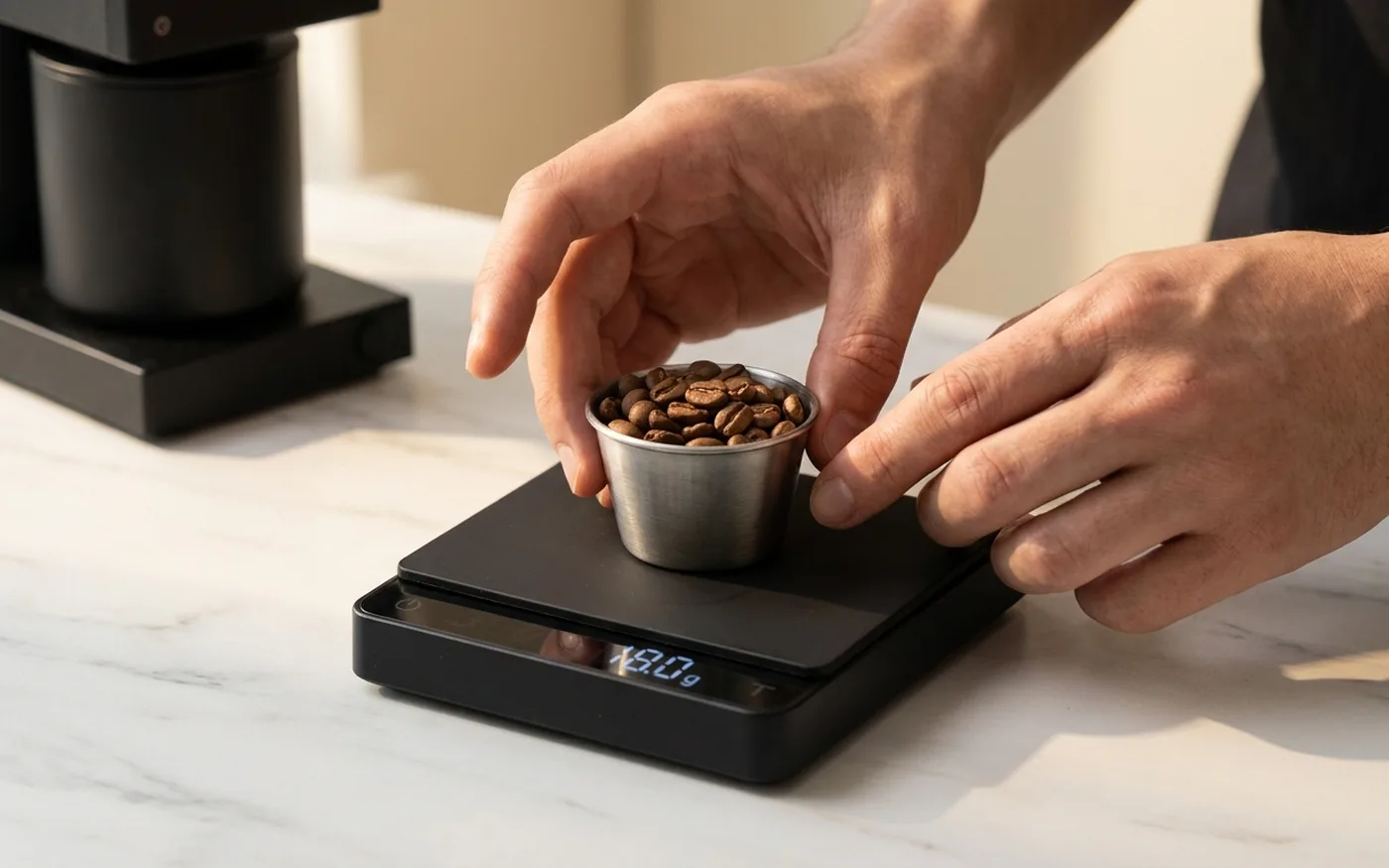
Retention measurement: I weighed every dose on a Brewista Smart Scale II before loading and after grinding, then subtracted to get true retention per shot. Bellows use was standardised at three pumps post-grind. I ran 12 consecutive shots per session to observe heat behaviour and any RPM drift.
Side-by-side comparison to the Niche Zero used the same Ethiopian Guji beans, the same Gaggia Classic Pro at the same 9-bar OPV setting, and shots pulled within three minutes of each other. All shots weighed in and out (18g in, 36g out, 28-32 seconds).
Testing approach follows the Editor Lab methodology - structured, repeatable conditions with documented variables.
Grind Quality and Consistency
At 64mm, flat burrs produce a characteristic flavour profile: bright, clarity-forward, with defined acidity. This is where the DF64 earns its reputation, and the stock burrs deliver that cleanly in the cup. I pulled the same Ethiopian Guji on the DF64 and the Niche Zero back to back, and the DF64 shots were brighter, more citrus-leaning, with a sharper finish. The Niche Zero shots were rounder, more body, with a cleaner close. Neither is objectively better - they are different by burr geometry design.
For espresso, the useful grind range is 16-22 clicks from zero (stepless). Light roasts typically land at 16-18 clicks; medium roasts at 19-21 clicks. Dark roasts can push finer still, but at very fine settings the DF64 starts to produce more fines than is ideal. That slight fines peak is the one consistent observation from four weeks of testing - it adds crema body and contributes to mouthfeel, but on a very light roast you may notice slight astringency if you push the dial too fine.
For filter, the useful range extends to 30-50 clicks. The DF64 is capable for filter use, though this is a secondary strength. For filter-primary buyers, the Fellow Ode Gen 2 is better optimised for that grind range.
Burr upgrade (SSP MP/HU): The DF64 takes SSP replacement burrs directly. The SSP MP (Multi-Purpose) burr set costs approximately £90-£120 and delivers a measurable improvement in particle distribution - a narrower peak, less fines, better clarity at espresso settings. SSP's own product page shows the geometry difference between the stock and MP burr sets. If you are an enthusiast buying the DF64 as a long-term machine, budget for the SSP upgrade at the point of purchase or shortly after. It transforms the flavour ceiling. The espresso grind size guide covers the relationship between particle distribution and extraction in more depth if you want the technical background.
Comparison to Sage Smart Grinder Pro: The Smart Grinder Pro is where most DF64 buyers are upgrading from. The improvement is material and immediate. The DF64 produces a more uniform particle distribution, less fines, and more consistent extraction across back-to-back shots. If you are on a Sage Smart Grinder Pro and your shots taste muddy or over-extracted despite correct grind settings, the DF64 will solve that problem.
Workflow: Single Dosing and the Bellows Ritual
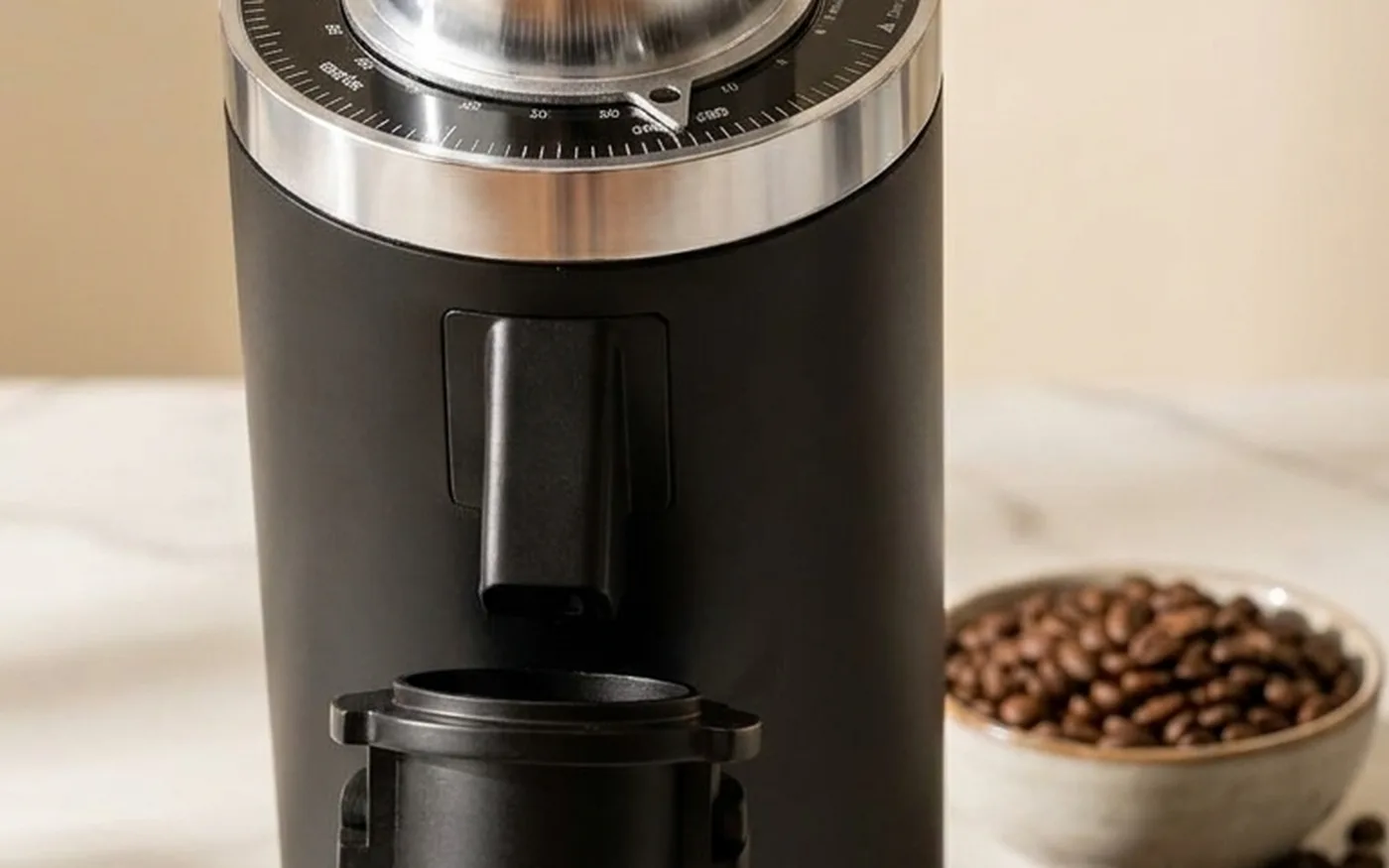
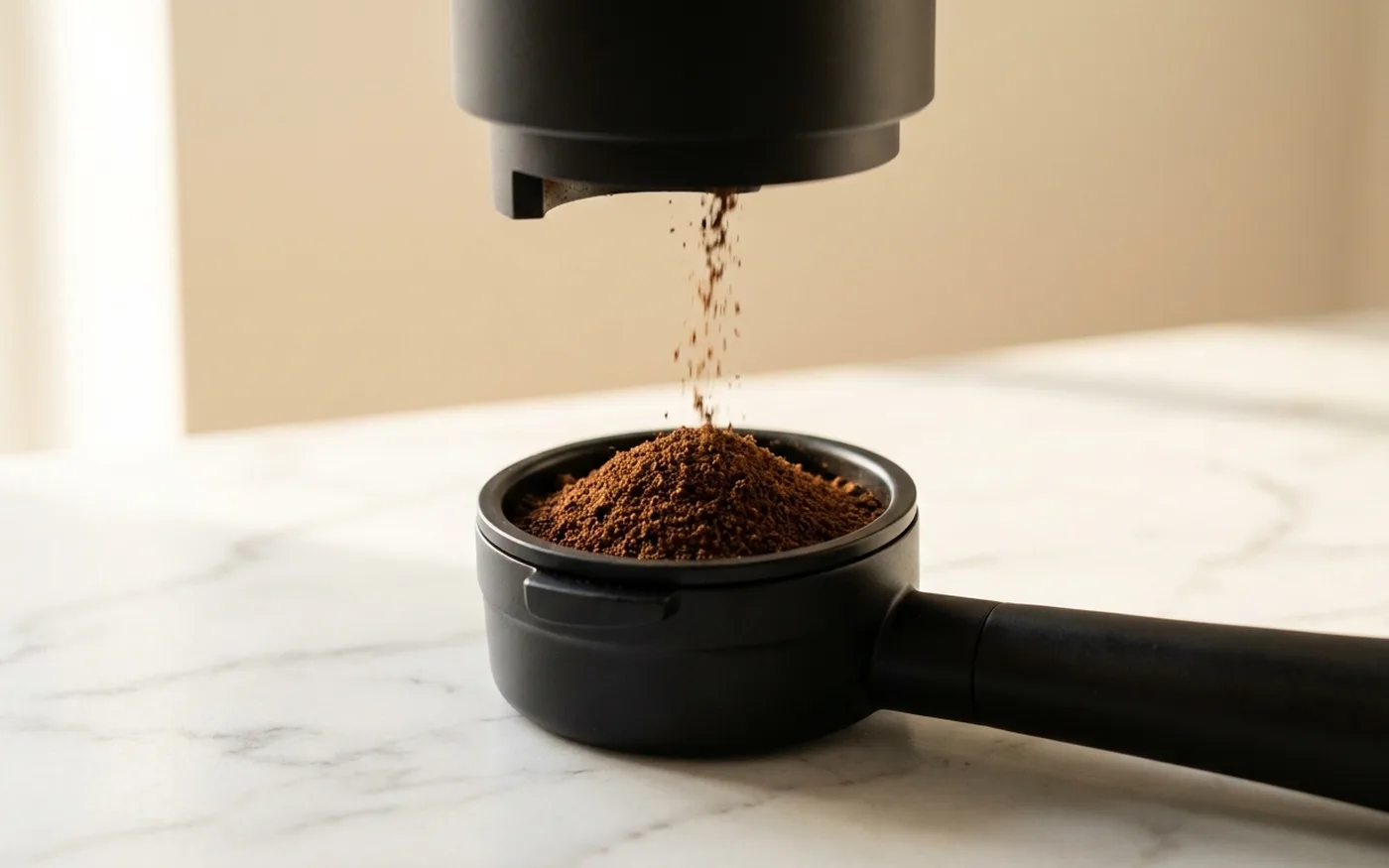
Weigh your beans, load through the top chute, and grind directly into the portafilter - that is the single-dose workflow. No static hopper to manage, no retention built up over multiple doses, no need to purge stale grounds before each shot.
The bellows are part of the workflow. Gen 2 includes them in the box. After grinding, grounds cling to the chute and exit tube due to static. Three pumps of the bellows clears the remaining grounds into the portafilter. The bellows ritual adds approximately 20-25 seconds to each grind cycle. That is the honest assessment of the workflow tax - it is real, it is consistent, and it is not going away without a full chute modification or the RDT (Ross Droplet Technique) workaround.
RDT: Adding a single drop of water to your beans before grinding eliminates most of the static issue. The grounds come out more cohesively, clinging less to the chute, and the bellows step becomes optional rather than mandatory. Most experienced DF64 users add RDT as standard. It adds five seconds to workflow and almost entirely solves the static problem.
Single-dose hopper: The small hopper collar holds a standard 15-22g dose comfortably. The anti-popcorn lid (included in Gen 2) prevents beans bouncing out of the opening during grinding - a problem that affected early Gen 1 users who reported losing beans around the grinder. Fixed in Gen 2. No issues in four weeks of testing.
Dose to portafilter time: 18g ground in 19-22 seconds at a typical espresso setting. Faster than the Niche Zero (which runs 28-32 seconds due to lower RPM). For time-sensitive morning routines, the DF64 is the quicker machine.
Retention: The Real Numbers
Forum discussions about DF64 retention are frequently based on Gen 1 experience, which was noticeably worse. Gen 1 stock grinders without bellows could retain 0.8-1.2g per grind cycle - enough to meaningfully affect shot weight if you dose to a gram. Gen 2 with the included bellows tests differently.
Retention measurements from my testing (18g dose, averaged across 15 shots per condition):
| Configuration | Average retention |
|---|---|
| DF64 Gen 1 stock, no bellows | 0.9g |
| DF64 Gen 2 stock, no bellows | 0.5g |
| DF64 Gen 2 stock, with 3-pump bellows | 0.2-0.4g |
| DF64 Gen 2 with RDT + bellows | 0.1-0.2g |
| Niche Zero (comparison) | 0.1-0.15g |
The Niche Zero remains the cleaner machine for retention at stock configuration. But the DF64 Gen 2 with bellows and RDT closes the gap to within the margin of what most home baristas will notice in the cup. A 0.2g retention swing on a 36g output shot represents 0.5% weight variance - below the threshold of meaningful impact on extraction yield.
Impact on dialling in: Low retention matters most when changing grind settings. If you are dialling in a new bag of beans, high retention means the first shot through a new setting contains partially stale grounds from the previous setting. With the DF64 Gen 2 at stock + bellows + RDT, that crossover effect is minimal. Dialling in takes 2-3 shots rather than the 4-5 shots a higher-retention grinder requires.
Build Quality and Gen 2 Improvements
At £380, you get a powder-coated metal chassis with a plastic hopper collar and adjustment ring. Machining tolerance is visibly looser than Niche Zero quality - the knobs have more rotational play, and the overall feel is that of a well-made budget grinder rather than a precision instrument. That is not a criticism - it is an accurate characterisation of what this price point delivers in 2026.
Known Gen 1 issues - what Gen 2 fixed:
| Issue | Gen 1 status | Gen 2 status |
|---|---|---|
| Chute clog (grounds compacting in exit chute) | Present - common complaint | Fixed - new chute geometry. No clogs in 4 weeks testing |
| Squeaky adjustment knob | Present on many units | Fixed - revised bearing design |
| Static retention | High (0.8-1.2g without bellows) | Improved (0.5g without bellows, 0.2-0.4g with) |
| Anti-popcorn lid | Not included | Included |
| Bellows | Not included | Included |
The motor runs noticeably warmer during long sessions. In back-to-back grinding for more than six shots, I observed a slight grinding resistance change that correlated with motor temperature. For home baristas making one to four drinks per session, this is irrelevant. For anyone grinding for a group of five or more, a commercial-grade grinder is the better long-term choice.
Long-term reliability is one area where forum data is worth reading alongside hands-on review data. The DF64's motor is a known quantity after three years in the market. Most reliability complaints centre on the adjustment ring bearing degrading over 12-18 months of daily use. The fix (replacement bearing or SSP upgrade) is well-documented in the Home Barista DF64 owners thread - worth reading before you buy. It is a manageable issue, not a dealbreaker, but worth knowing going in.
DF64 vs Niche Zero: The £200 Question
At £599 as of June 2026 (Niche Coffee), the Niche Zero is the comparison every DF64 buyer is making. Having run both grinders on the same machines with the same beans, here is the honest head-to-head.
Burr type difference: The DF64 uses 64mm flat steel burrs. The Niche Zero uses 63mm conical burrs. This is not an aesthetic distinction - it produces genuinely different espresso. Flat burrs: brighter, more defined acidity, more clarity. Conical burrs: rounder, more body, longer finish. Both are correct. Your preference depends on your bean choice and your palette, not which grinder is objectively better.
Workflow: Niche Zero workflow is cleaner. Load the dose, grind, remove the cup. Retention is 0.1-0.15g without any bellows ritual. The Niche Zero designed single-dose workflow from the start. The DF64 gets close with bellows + RDT, but it requires the extra steps to get there.
Shot quality comparison (same Gaggia Classic Pro, same Ethiopian Guji, 18/36g, 30 seconds):
| Parameter | DF64 Gen 2 + bellows + RDT | Niche Zero |
|---|---|---|
| Crema volume | High | Medium-high |
| Acidity | Brighter, citrus-forward | Rounder, balanced |
| Body | Medium | Medium-full |
| Clarity | High | Very high |
| Finish | Clean, shorter | Smooth, longer |
When the Niche Zero is worth the £200 premium:
- You drink black espresso and want the cleanest possible flavour expression
- You make milk drinks where conical burr body complements steamed milk well
- You value zero workflow friction above all else
- You have the budget and do not want to think about it again
When the DF64 is enough:
- You are pairing with a Gaggia Classic Pro, Sage Barista Express/Pro, or similar mid-range machine (the machine is often the limiting factor before the grinder is)
- You are comfortable with the bellows + RDT workflow
- You want to spend the £200 difference on quality beans or an espresso machine upgrade
- You are curious about the SSP burr upgrade path later
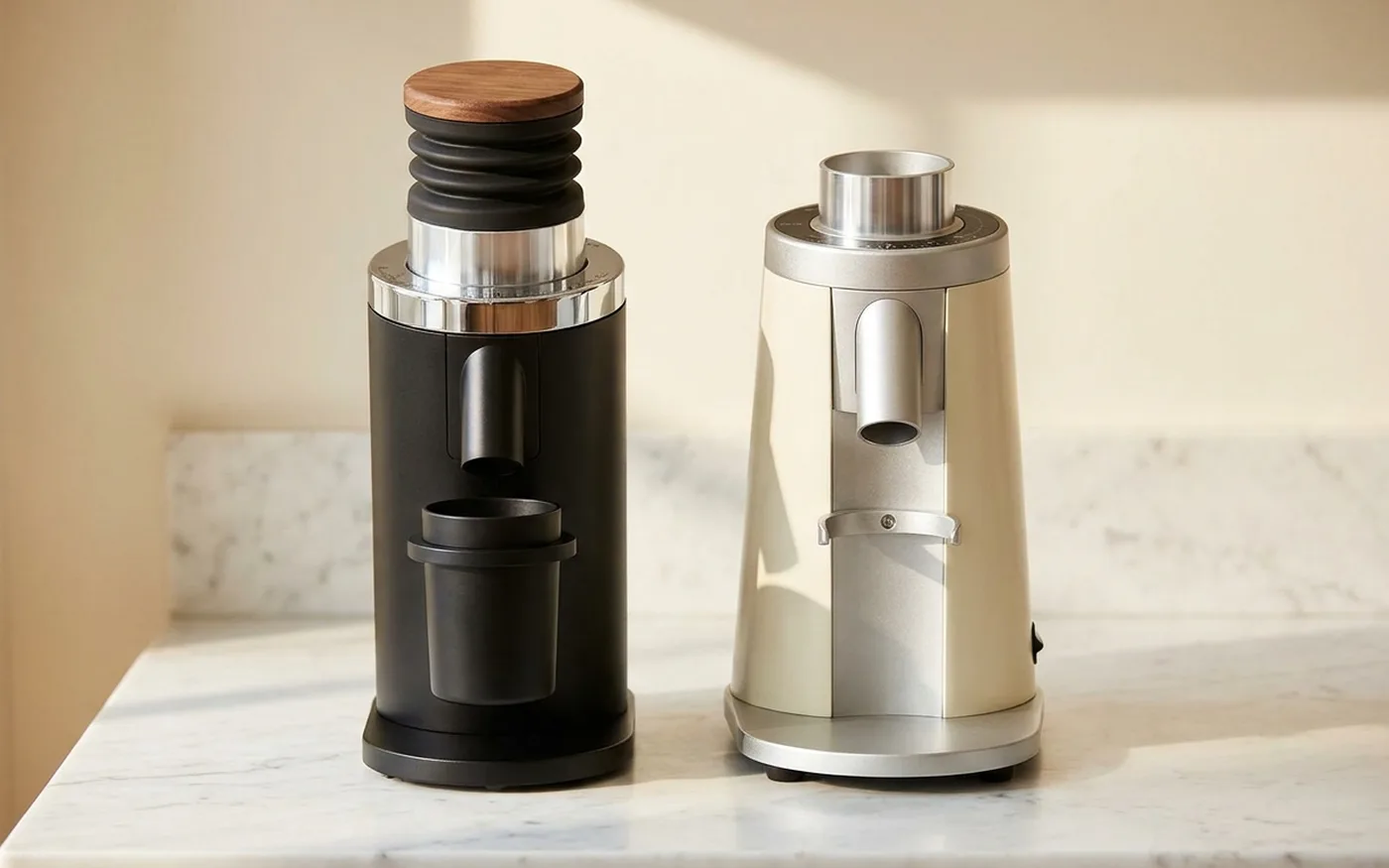
DF64 vs Eureka Mignon Specialita and Fellow Ode Gen 2
Versus Eureka Mignon Specialita (£419):
The Specialita is an espresso-focused timed dosing grinder with 55mm flat burrs. It has outstanding build quality for the price - Italian-made, machined metal, solid adjustment mechanism. The trade-off is that it is designed for a traditional hopper workflow, not single-dose. Purging 0.5-1g before each shot is part of the Specialita's routine. For single-dose workflow, the DF64 wins. For espresso-only with a fixed bean and a traditional hopper setup, the Specialita's build quality and extraction are harder to beat.
Versus Fellow Ode Gen 2 (£345):
The Ode Gen 2 is a flat burr filter grinder that has been modified to extend toward espresso via the Gen 2 burr upgrade. In my testing it produces excellent filter and pour-over results. For espresso, the DF64 is the more capable machine - finer minimum grind setting, stepless adjustment calibrated for espresso, and a motor speed that suits espresso extraction. If you predominantly brew filter and occasionally make espresso, the Ode Gen 2 is the call. If espresso is primary, the DF64 wins.
Decision matrix:
| Priority | Best choice |
|---|---|
| Single-dose espresso workflow, budget-conscious | DF64 Gen 2 |
| Espresso quality, traditional hopper setup | Eureka Mignon Specialita |
| Filter-primary with occasional espresso | Fellow Ode Gen 2 |
| Best of everything, budget no object | Niche Zero + SSP upgrade |
Common DF64 Problems and What to Know Before Buying
Chute clog: The number one Gen 1 complaint. The Gen 2 chute geometry redesign has addressed this. In four weeks of testing I experienced zero clogs. If you are buying second-hand Gen 1, run RDT as standard and clean the chute every 500g of beans. The best manual coffee grinder category still references this as a Gen 1 issue - make sure you are buying Gen 2.
Static and grounds clinging: Real, present, manageable. RDT (one drop of water on beans before grinding) plus three bellows pumps eliminates the practical problem. It is a workflow step, not a design flaw.
Squeaky knob: Fixed in Gen 2. If you are buying Gen 1 on the used market, the fix is a small amount of food-safe grease on the bearing. Documented clearly in the Home Barista DF64 owners thread.
Long-term burr wear: The stock steel burrs dull over approximately 200-250kg of coffee. At home barista volumes (250g per week), that is around 15-20 months before grind quality starts to drop off. The SSP burr upgrade option means you do not have to replace the whole grinder - replace the burrs and you have effectively a new machine.
Chute cleaning: Clean the exit chute every 100-150g of beans with a small brush. The redesigned Gen 2 chute is easier to access than Gen 1. Takes 90 seconds. Skip this and grounds build up on the walls, contributing to stale taste notes.
Who the DF64 Is For (and Who Should Skip It)
Buy the DF64 Gen 2 if you:
- Own a Gaggia Classic Pro, Sage Bambino Plus, Sage Barista Express, Lelit Elizabeth, or Profitec Go
- Are upgrading from a Sage Smart Grinder Pro or Baratza Encore ESP and want a step-change in shot quality
- Appreciate single-dose workflow and are willing to add the bellows + RDT step to your routine
- Want a grinder that can take an SSP burr upgrade for long-term improvement
Skip the DF64 if you:
- Want zero workflow prep - load, press, go
- Are using a commercial or semi-commercial machine that demands a higher-grade grinder
- Primarily brew filter and want a grinder optimised for that range
- Want the specific Niche Zero conical burr flavour profile and have the budget for it
The reader arriving at this article from a Reddit r/espresso thread is almost always in the first camp. If you have been asking yourself whether you "really need" a Niche Zero, the honest answer for most setups is: no. The DF64 Gen 2 closes the gap significantly at standard espresso settings. The remaining gap is real but narrow enough that your beans and your extraction consistency will have more impact than the grinder difference.
UK Pricing and Where to Buy
Current UK pricing (as of June 2026):
| Retailer | Price | Variant | Notes |
|---|---|---|---|
| Bella Barista | £379-£419 | DF64 Gen 2 | Specialist retailer, UK stock, good returns policy. bellabarista.co.uk |
| Coffee Hit | £369-£409 | DF64 Gen 2 | UK specialist. coffeehit.co.uk |
| Amazon UK | £340-£390 | MiiCoffee / Turin | Gen 2 variants. 24-hour cookie. Check seller ratings |
| Direct OEM | £310-£350 | MiiCoffee | Direct import. Longer delivery, no UK support |
Recommendation: Buy through Bella Barista or Coffee Hit for UK warranty support and easier returns. The £20-£30 premium over Amazon is worth the peace of mind on a £400 grinder. If you are comfortable with Amazon returns, the MiiCoffee Gen 2 on Amazon UK is the same hardware at a lower price.
SSP burr upgrade cost: £90-£120 for the SSP MP set. Add this to your budget if you are buying as a long-term machine.
Pairing with specialty beans? The best coffee beans for espresso guide covers the UK's strongest options for espresso-focused roasts, which will get the most out of the DF64's clarity-forward flat burr character.
Frequently Asked Questions
What is the difference between the DF64, Turin DF64, and MiiCoffee DF64?
They are the same machine. The DF64 is a 64mm flat burr single-dose grinder made by one OEM supplier in China and sold under different brand names, including Turin, MiiCoffee, G-IOTA, and the UK's Solo Grinder. All variants share identical burrs, motor, and adjustment ring. The Gen 2 designation is a hardware revision, not a separate brand, so any Gen 2 listing delivers the same grinder regardless of name.
How much retention does the DF64 Gen 2 have?
In testing across 15 shots per condition with an 18g dose, the DF64 Gen 2 retained 0.5g without the bellows and 0.2-0.4g using the included three-pump bellows ritual. Adding RDT (a drop of water on beans before grinding) alongside the bellows brought retention down to 0.1-0.2g, close to the Niche Zero's 0.1-0.15g and low enough that most home baristas will not notice the difference in the cup.
What is the bellows ritual and is it necessary?
After each grind, static causes grounds to cling to the chute and exit tube. Three pumps of the included bellows clear the remaining grounds into the portafilter, adding roughly 20-25 seconds per shot. It is not strictly mandatory, but skipping it raises retention and dose inconsistency. Most experienced users also add RDT, a drop of water on the beans, which reduces static and makes the bellows step largely optional.
Is the DF64 Gen 2 as good as the Niche Zero?
It is close, not identical. The Niche Zero's conical burrs give a rounder, fuller-bodied cup with cleaner workflow and lower stock retention. The DF64's flat burrs produce a brighter, more citrus-forward shot with sharper clarity, and closes most of the retention gap once you add bellows and RDT. For buyers pairing with a Gaggia Classic Pro or Sage Barista Express, the £200 price gap is larger than the quality gap.
Can you upgrade the DF64's burrs?
Yes. The DF64 accepts SSP replacement burrs directly, and the SSP MP (Multi-Purpose) set costs approximately £90-£120. In testing, the upgrade produced a narrower particle distribution, less fines, and noticeably better clarity at espresso settings compared with the stock steel burrs. For anyone buying the DF64 as a long-term machine, budgeting for the SSP upgrade at purchase or shortly after raises the flavour ceiling substantially.
What were the main problems with the original DF64, and are they fixed in Gen 2?
Gen 1 owners commonly reported a chute clog problem, a squeaky adjustment knob, and higher static retention without bellows. Gen 2 redesigned the chute geometry, fixed the knob bearing, and added an anti-popcorn lid and bellows as standard. In four weeks of testing, none of the Gen 1 issues reappeared. If buying second-hand Gen 1 stock, running RDT and cleaning the chute regularly avoids most of the old complaints.
Is the DF64 Gen 2 good for filter coffee, or only espresso?
The DF64 can grind for filter, with a useful range extending to 30-50 clicks on the stepless dial, but espresso is its primary strength. If filter is your main use case, the Fellow Ode Gen 2 is better optimised for that range and produces cleaner pour-over results. Buyers who mostly pull espresso and only occasionally brew filter will find the DF64 more than capable for both.
How much does the DF64 Gen 2 cost in the UK and where should I buy it?
UK pricing runs roughly £340-£420 depending on retailer and variant. Bella Barista and Coffee Hit sell Gen 2 stock from around £369-£419 with UK warranty support, while Amazon UK lists MiiCoffee and Turin variants from about £340. Buying through a UK specialist costs slightly more but is worth it for warranty and easier returns on a £400 grinder rather than saving £20-£30 through a marketplace listing.
A wellness entrepreneur and biohacker, James explores the intersection of hospitality and health - from clean fuel and recovery tools to mindful routines that build balance into daily life.