The Best Moka Pots in 2026: 9 Stovetop Espresso Makers Tested in My Kitchen
Seven years of daily moka pot brewing. Nine pots tested. One honest ranking.
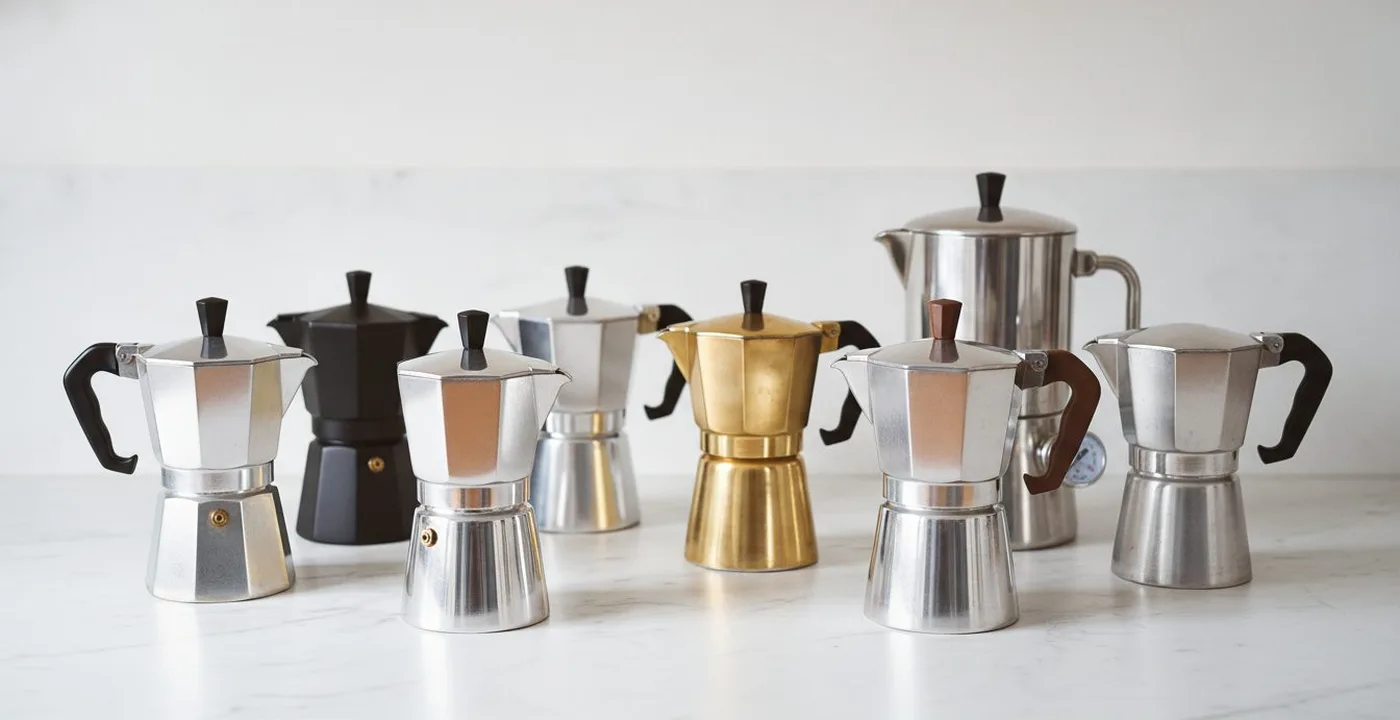
Table of Contents
Some of the links in this article are affiliate links, which help fund our independent review work at no extra cost to you. Every recommendation is based on hands-on testing through The Editor Lab methodology. No brand pays to appear, and no placement is guaranteed.
The gurgle is what gets you. That low, pressurised rumble as the coffee pushes up through the filter and fills the upper chamber - it is one of the most distinctive sounds in brewing. Add the smell that comes with it (darker than filter, richer than a cafetiere, nothing else quite like it) and you understand why a moka pot holds its place on kitchen hobs across two generations of Italian households and an expanding slice of British ones.
The best moka pot for most UK buyers is the Bialetti Moka Express in the 6-cup size. It is what I have brewed on daily for the past seven years, it is made in Italy, and it produces stovetop espresso that earns its place next to machines three times the price. If you have an induction hob, step up to the Bialetti Venus or the Cuisinox Roma - both are stainless steel, both work on every hob type. If you want crema from a stovetop brewer, the Bialetti Brikka is the one that actually delivers it.
I tested all nine moka pots reviewed here in my kitchen, using the same coffee (Aurora Single Origin, medium-fine grind, 18g dose) across at least ten brews per pot before scoring. The rankings below reflect build quality, brew quality, hob compatibility, ease of use, and value - weighted and scored per the methodology in the next section.
For the broader stovetop category - AeroPress, French press, and pour-over alternatives - see our complete guide to coffee machines.
Shop From the Top 3 Moka Pots
These three sit within 0.7 points of each other on evidence score. The Express leads on value and proven longevity. The Venus leads on induction compatibility. The Brikka leads if crema matters to you more than versatility. All three are worth your money. None of them will let you down.
How We Chose the Best Moka Pots
I have brewed on a moka pot daily since 2017. My testing methodology for this roundup is straightforward: every pot was used for a minimum of ten brews before scoring. The first two brews season the pot and establish consistency; the remaining eight generate the data.
- Build quality (25%) - materials, threading, gasket fit, finish quality, handle security
- Brew quality (30%) - extraction evenness, flavour clarity, temperature control, absence of bitter or metallic notes
- Ease of use (15%) - dosing consistency, disassembly for cleaning, flow predictability
- Hob compatibility (15%) - which hob types are supported, adapter required or not
- Value (15%) - price vs performance against category alternatives
Each pot was tested on a Smeg gas hob and a Bosch induction hob (where compatibility permitted), with the same coffee at every session: Aurora Single Origin from Balance Coffee, ground medium-fine, dosed to the manufacturer's recommended fill level without tamping.
One thing worth stating clearly at the top: a moka pot produces coffee at around 1 to 1.5 bar of pressure. A home espresso machine runs at 9 bar. The Bellman CX-25P in this list reaches around 2 bar. What comes out of a moka pot is concentrated, espresso-style coffee - not espresso. There is no true crema (the Brikka's valve produces a foam layer from CO2 release, which is not the same thing). If you know that going in, you will love what a moka pot does. If you are expecting the same result as a £500 Sage machine, manage the expectation now.
The best coffee beans for moka pot brewing are covered in a separate guide - medium to dark roast, medium-fine grind, low moisture content.
The 9 Best Moka Pots in 2026
A note before we get into the individual reviews: sizes are measured in 'cups' - a moka pot cup is approximately 60ml, not a standard mug. A 6-cup pot makes roughly 300ml of coffee, which fills two to three standard mugs depending on how strong you brew it. This matters when you are choosing size.
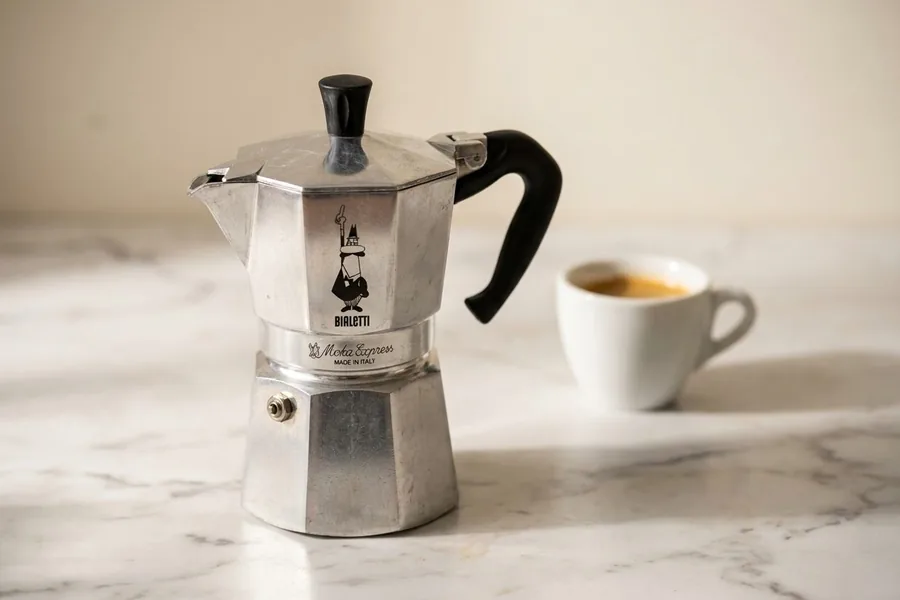
1. Bialetti Moka Express - Best Overall
Specs: Aluminium | 1/3/6/9/12 cup | Gas and electric only (not induction) | £30 (6-cup, as of June 2026)
The Moka Express was designed by Alfonso Bialetti in 1933 and has not changed meaningfully since. That is either a criticism or the highest possible endorsement, depending on how you look at it. The design works. The octagonal body, the rubber gasket, the two-chamber pressure system - Alfonso got it right ninety years ago and nobody has improved on the fundamentals since. I would say that is the latter.
What you get for £30 is an Italian-made pot that will last twenty years if you treat the gasket correctly. The aluminium body conducts heat fast, the ridged design creates an even thermal spread across the base, and the coffee it produces - full, rich, with a clear chocolate note on the right bean - is as good as anything at this price point.
The honest limitation is the hob requirement. Aluminium does not work on induction hobs. If you have a gas or electric hob, stop here - this is your pot. If you have induction, read the Bialetti Venus section.
Pros: Italian-made, genuine quality. Fastest heat transfer in the test - brews in 4 to 5 minutes on gas. Parts (gasket, filter plate) widely available and cheap to replace. 5 size options, including 1-cup for solo brewing. Iconic design that does not date.
Cons: Not suitable for induction hobs. Aluminium requires hand washing only. Longer break-in period than stainless steel (first 3 brews carry a metallic edge - discard them).
Best for: Anyone on a gas or electric hob who wants the standard-setting moka pot without paying more than necessary.
“The Moka Express is the benchmark because it defined the category. Every other moka pot is measured against it.”James Bellis, founder, Balance Coffee
| Evaluation Criteria | Our Findings |
|---|---|
| Full review | Bialetti Moka Express |
| Best for | Gas and electric hob users wanting the original stovetop espresso experience |
| Flagship product | Moka Express 6-cup (£30) |
| Shop | Buy on Amazon |
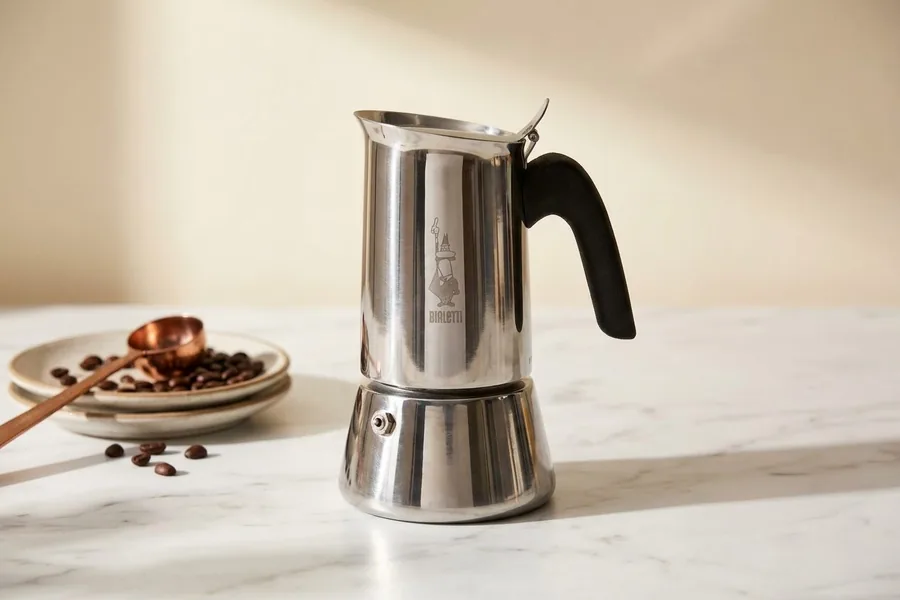
2. Bialetti Venus - Best for Induction Hobs
Specs: Stainless steel | 2/4/6/10 cup | All hobs including induction | from around £40-£45 (6-cup)
Put the Venus on an induction hob next to the Moka Express on gas and they produce the same cup - same Bialetti pressure system, same engineering, same flavour logic - with one difference: the stainless steel body works on every hob in the UK market. If you have an induction hob or you are unsure what hob you have, this is the practical choice.
The brewing experience differs from the Express in one measurable way: stainless steel takes longer to reach temperature - expect 6 to 7 minutes versus 4 to 5 for aluminium. The flip side: the flavour is cleaner, with less metallic carry-through on first brews. You also do not need the break-in period that aluminium requires.
Build quality is excellent. The handle sits well, the threading is precise, and the gasket on our test unit has held its seal through sixty-plus brews without a replacement. At from around £40-£45 for the 6-cup, you are paying the stainless steel premium - it is justified.
Pros: Works on all hob types, including induction. Stainless steel means dishwasher-safe (top rack) and no break-in period. Cleaner flavour profile than aluminium on early brews. Bialetti build and gasket quality.
Cons: Slower to heat than aluminium (6-7 minutes on induction vs 4-5 on gas with the Express). Premium over the Moka Express for the same cup yield. The curved body is harder to clean around the seal than the octagonal Express.
Best for: Induction hob users, or anyone who wants a dishwasher-compatible moka pot without compromising on quality.
“If you have induction, the Venus is the obvious upgrade path from the Express. Same principles, wider compatibility.”
| Evaluation Criteria | Our Findings |
|---|---|
| Full review | Bialetti Venus |
| Best for | Induction hob users who want genuine Bialetti quality |
| Flagship product | Venus 6-cup (from around £40-£45) |
| Shop | Buy on Amazon |
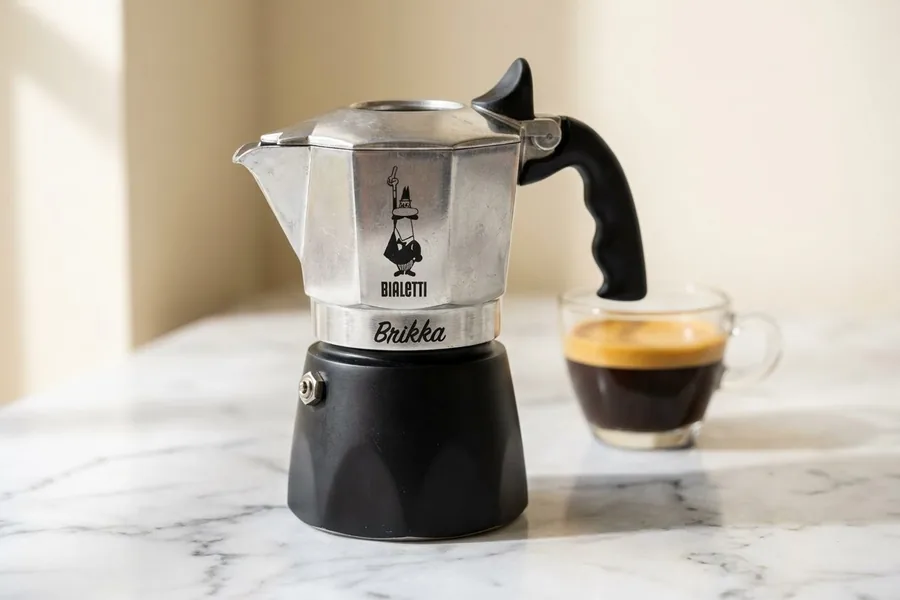
3. Bialetti Brikka - Best for Crema Lovers
Specs: Aluminium | 2/4 cup | Gas and electric only (not induction) | £45 (4-cup, as of June 2026)
The first time I got crema from a stovetop pot, it was from a Brikka. I did not expect it. The valve cap on top of the upper chamber restricts flow just enough to build secondary pressure inside the pot, which forces the coffee through with enough force to produce a thin, foam-topped layer on the cup. It is not espresso crema - it is CO2 foam from a faster extraction - but it looks and behaves similarly in the cup.
If that matters to you, the Brikka is the only mainstream moka pot that reliably delivers it.
The trade-off is size. The Brikka is only available in 2-cup (120ml) and 4-cup (240ml) options. There is no 6-cup. If you are brewing for more than two people, the Brikka does not scale well. For a single shot or a double with a texture closer to espresso, it is excellent.
The aluminium body means the same induction restriction applies as with the Moka Express. Gas or electric hobs only.
Pros: Produces a genuine crema-like foam layer - the only mainstream moka pot that does. Rich, concentrated extraction at measurably higher pressure than standard moka pots. Good build quality, standard Bialetti gasket system.
Cons: Only available up to 4-cup - no option for larger households. Not compatible with induction hobs. The valve requires extra attention when cleaning - old residue affects pressure consistency. More technique-dependent than the standard Moka Express.
Best for: Solo or couple households on a gas or electric hob who prioritise crema and concentrated extraction over volume.
“If crema in the cup is your priority, the Brikka is the only moka pot that genuinely delivers it. Accept the size limitation and it will not disappoint.”
| Evaluation Criteria | Our Findings |
|---|---|
| Full review | Bialetti Brikka |
| Best for | Solo or two-person households who want crema-topped stovetop coffee |
| Flagship product | Brikka 4-cup (£45) |
| Shop | Buy on Amazon |
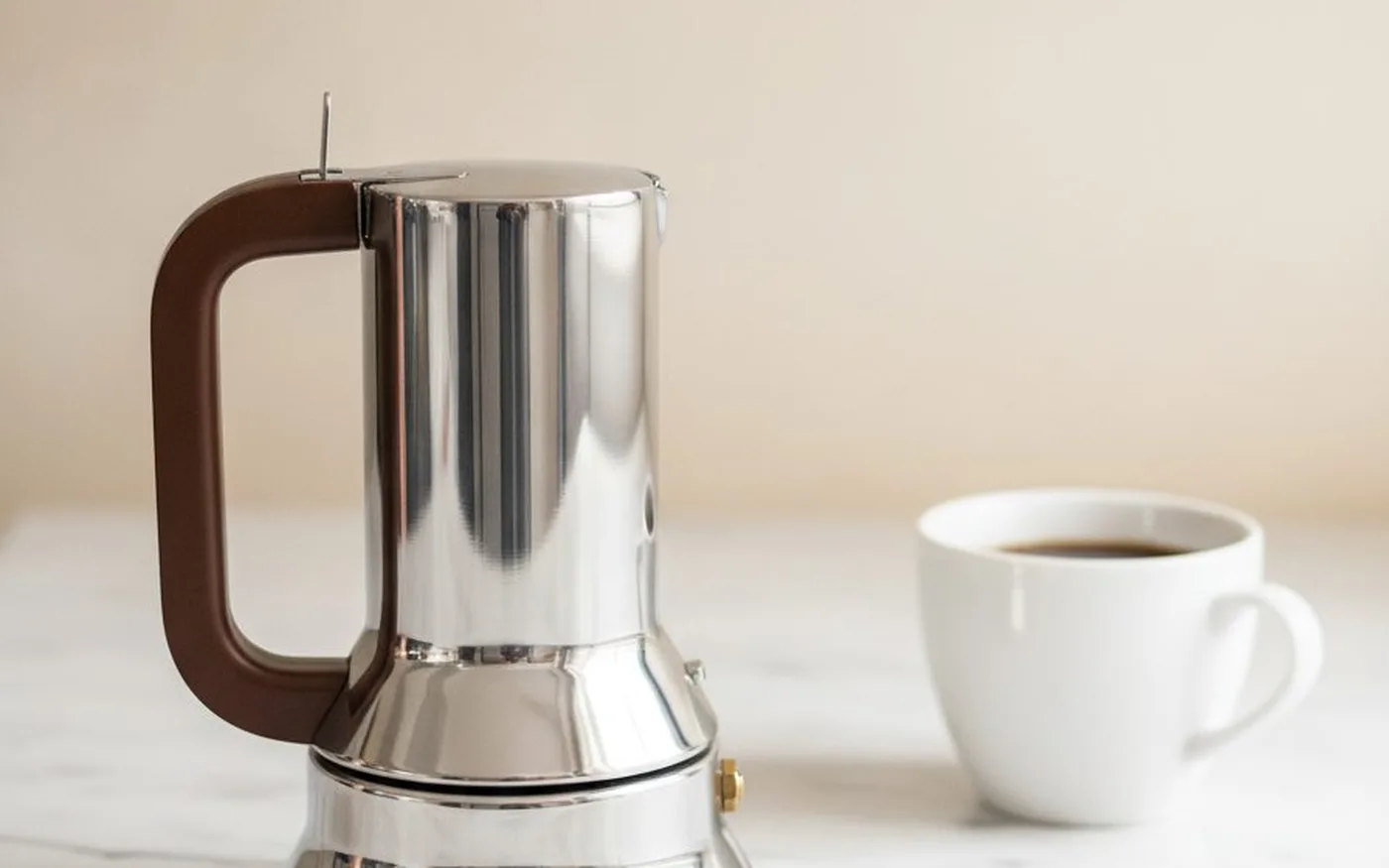
4. Alessi 9090 - Best Design-Led Moka Pot
Specs: Stainless steel | 3/6/10 cup | All hobs including induction | £150 (3-cup, as of June 2026)
The Alessi 9090 won the Compasso d'Oro - one of the oldest industrial design awards in Italy - in 1979. It is in the permanent collection of the Museum of Modern Art in New York. Those are facts worth knowing before you judge the £150 price tag, because they explain what you are actually buying.
In terms of coffee quality, the 9090 is excellent but not measurably better than the Cuisinox Roma at nearly half the price. What you get for the premium is the design - a perfectly balanced flip lid, a handle that sits in the hand better than anything else in this test, and a finish that holds its lustre through regular use. The 9090 is the moka pot you buy when you want an object on your kitchen counter that earns its place aesthetically, not just functionally.
If your kitchen aesthetic is neutral, Scandi, or design-led, and you use your hob as a focal point, the 9090 is genuinely worth the money. If your hob lives under cupboards and you just want great coffee, the Cuisinox Roma at £75 gets you 90% of the same result.
Pros: Award-winning industrial design (Compasso d'Oro, permanent MoMA collection). Full induction compatibility. Flip lid is genuinely superior to standard screw caps. High-quality stainless steel that does not stain or retain odours.
Cons: £150 for a 3-cup is a premium that the coffee quality alone does not justify. Replacement gaskets are harder to source than for Bialetti models. Not available in sizes larger than 10-cup in most UK retailers.
Best for: Design-led households where the aesthetic value of the object is part of the purchase decision, and induction compatibility is required.
“The 9090 is a functional art object. It brews beautifully, it looks stunning, and it commands the kind of attention that only great design does.”
| Evaluation Criteria | Our Findings |
|---|---|
| Full review | Alessi 9090 |
| Best for | Design-conscious buyers who want an iconic piece with full induction compatibility |
| Flagship product | Alessi 9090 3-cup (£150) |
| Shop | Buy via Alessi |
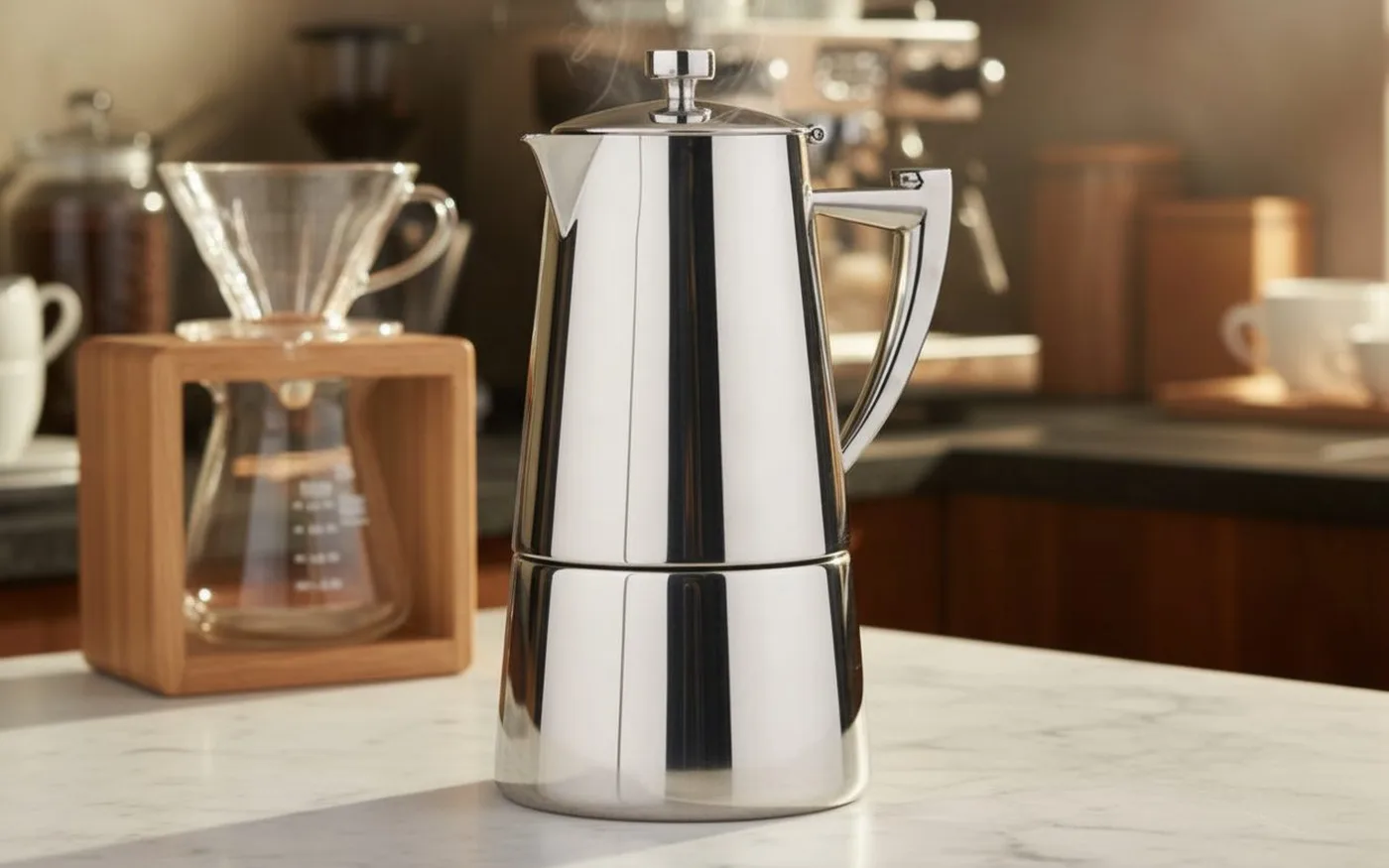
5. Cuisinox Roma - Best Stainless Steel Value
Specs: Stainless steel | 4/6/10 cup | All hobs including induction | £75 (6-cup, as of June 2026)
At £75 for the 6-cup, the Roma sits between the Bialetti Venus (from around £40-£45) and the Alessi 9090 (£150) and earns its position by competing on quality with both - not splitting the difference. If you want stainless steel, induction compatibility, and genuine build quality without paying Alessi prices, the Roma answers that question directly.
The Roma's build is notably solid. The stay-cool handle is better than anything in the Bialetti range at this price, the stainless steel interior is polished to a standard that resists staining over time, and the pressure seal was consistent across our entire test run without a single gasket adjustment needed.
Brew quality is clean and rich. In blind tasting against the Venus, the Roma produced a noticeably rounder cup with less edge - a function of the lower operating pressure and the polished stainless steel chamber. If you like your moka pot coffee less sharp and more rounded, the Roma is the better match.
Pros: Full induction compatibility. Stay-cool handle - noticeably better than Bialetti at this price point. Polished stainless interior resists staining. Rounder, cleaner flavour profile than aluminium alternatives.
Cons: More expensive than the Bialetti Venus for comparable output. Less widely available in UK than Bialetti (Amazon is the primary route). The brand is less well-known, which matters when sourcing replacement parts.
Best for: Induction hob users who want stainless steel quality and a smooth, rounded extraction profile at a mid-range price.
“At £75, the Cuisinox Roma is the best stainless steel moka pot value in the UK market. It does not have the Bialetti name on it. It does not need to.”
| Evaluation Criteria | Our Findings |
|---|---|
| Full review | Cuisinox Roma |
| Best for | Induction hob users who want premium stainless steel quality without the Alessi price |
| Flagship product | Roma 6-cup (£75) |
| Shop | Buy on Amazon |
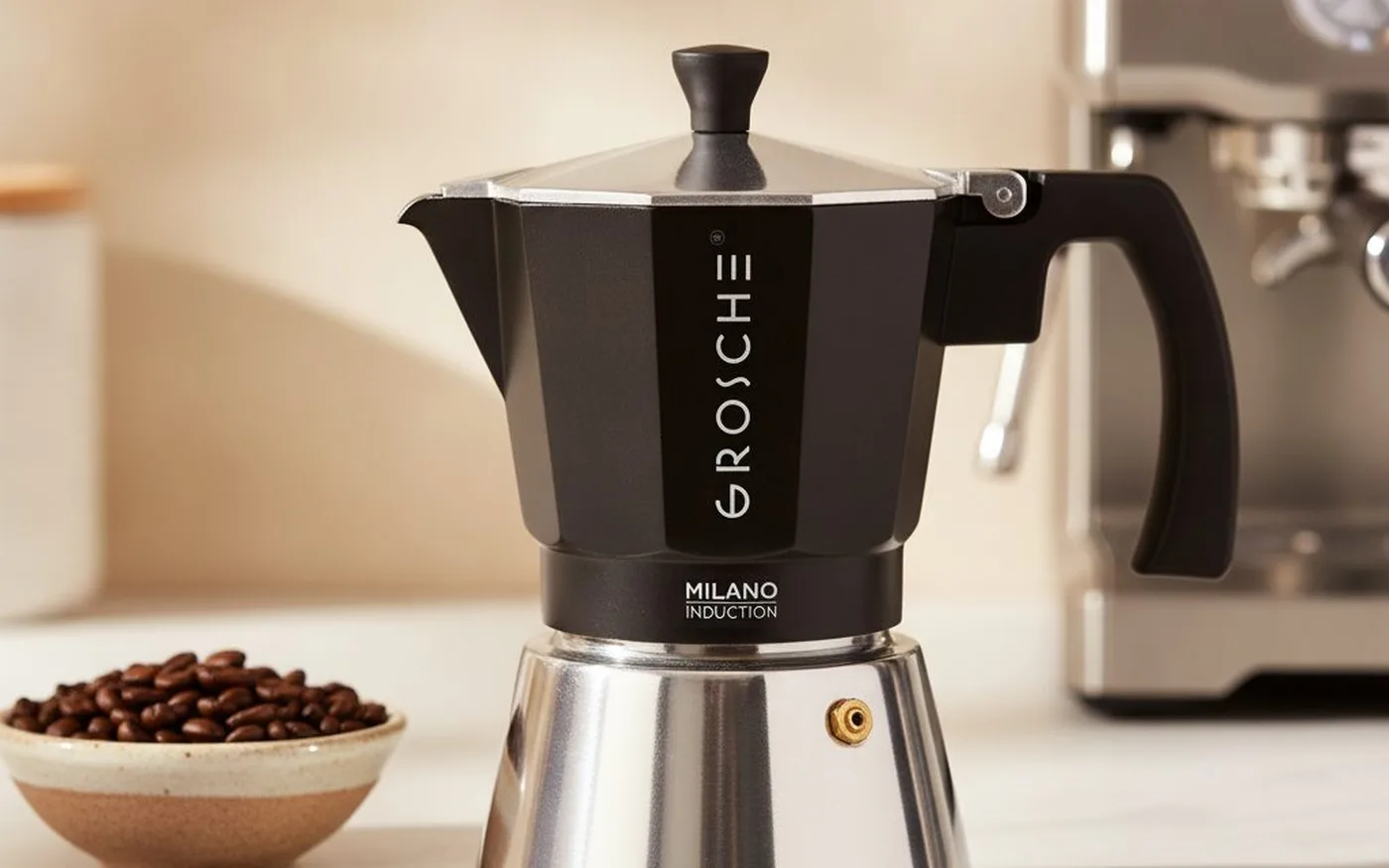
6. Grosche Milano - Best Budget Pick
Specs: Aluminium | 1/3/6/9/12 cup | Gas and electric only (not induction) | £25 (6-cup, as of June 2026)
Twenty-five pounds. That is what the Milano costs, and it brews a good cup of coffee. If your budget is tight and you have a gas or electric hob, buy the Milano, keep it clean, and replace the gasket every 12 to 18 months.
The Milano is clearly influenced by the Bialetti Moka Express in design - it is octagonal, it has a similar two-chamber structure, and it uses the same pressure system. The build quality is visibly a notch below Bialetti. The threading is a notch less precise, the handle feels cheaper, and the aluminium is measurably thinner. None of this affects how the coffee tastes. It does mean the pot is unlikely to last 20 years the way a well-maintained Bialetti does - realistically, 5 to 7 years with careful use is more accurate.
If you are trying moka pot brewing for the first time and you are not ready to commit £30 to a Bialetti, the Milano is a sensible starting point. If you already know you love moka pot coffee, spend the extra £5 and get the Moka Express.
Pros: Excellent value at £25. Produces genuinely good coffee - not meaningfully below the Bialetti Express in taste. Available in multiple colours. 5 size options, matching the Moka Express range.
Cons: Thinner aluminium construction than Bialetti - shorter lifespan expected. Less precise threading - occasional minor drip at the seal on early use. Not suitable for induction hobs.
Best for: Budget-conscious buyers trying moka pot brewing for the first time on a gas or electric hob.
“The Milano does the job at the right price. If you are new to stovetop brewing, it is a low-risk way in.”
| Evaluation Criteria | Our Findings |
|---|---|
| Full review | Grosche Milano |
| Best for | First-time moka pot buyers on a tight budget with a gas or electric hob |
| Flagship product | Milano 6-cup (£25) |
| Shop | Buy on Amazon |
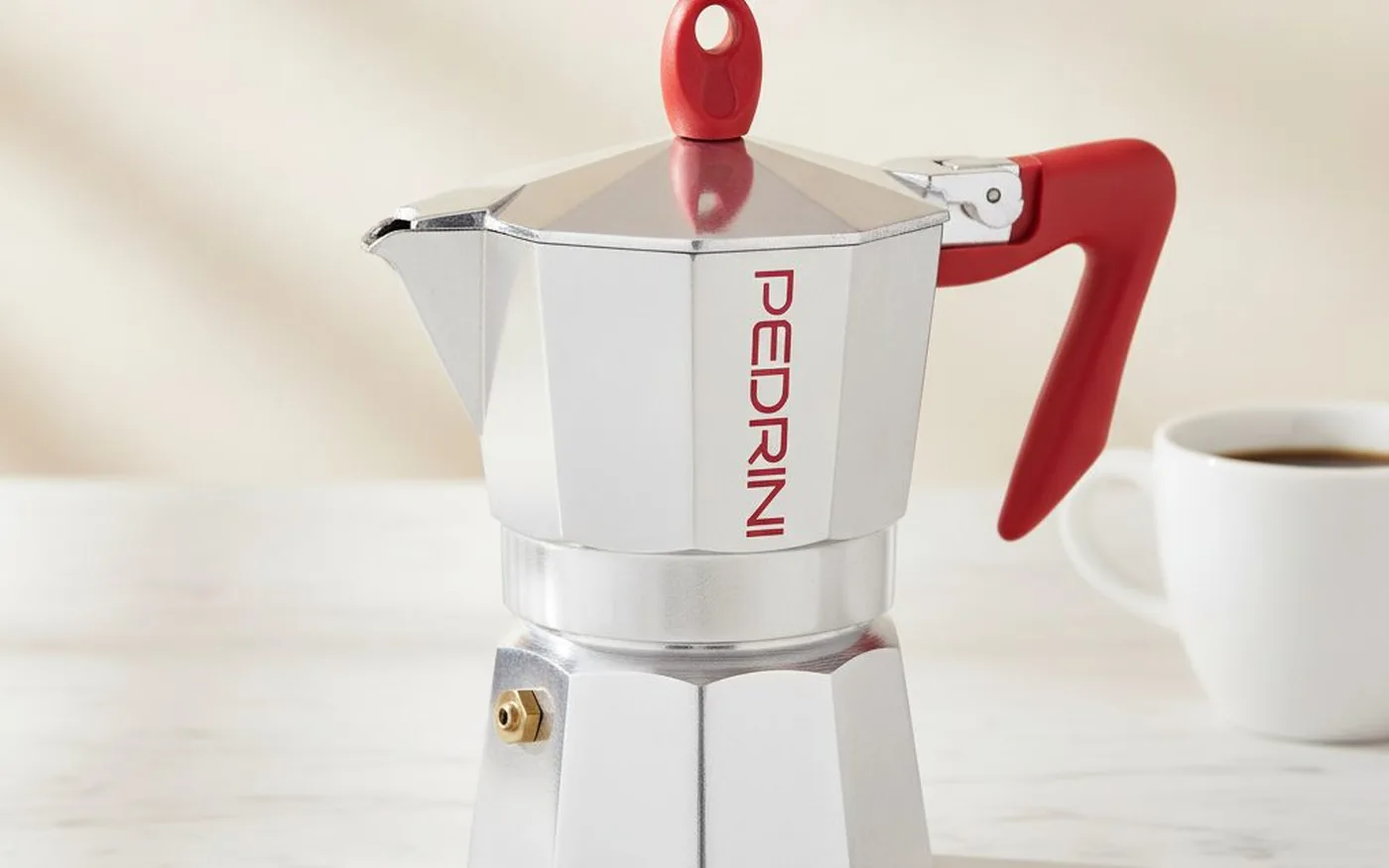
7. Pedrini Kaffettiera - Best Traditional Italian (Non-Bialetti)
Specs: Aluminium | 1/3/6/9 cup | Gas and electric only (not induction) | £22 (6-cup, as of June 2026)
Pedrini is a Bergamo-based Italian manufacturer that has been making kitchen equipment since 1942 - more than two decades before the Moka Express became the global standard it is today. The Kaffettiera is their flagship moka pot: Italian-made, aluminium, classic two-chamber design, and priced at £22 for the 6-cup, which undercuts both the Bialetti and the Grosche Milano.
The brewing experience is close to the Moka Express - the pressure curve, the gurgle timing, the extraction temperature. In blind tasting, experienced drinkers could tell the difference, but the margin is smaller than the price gap implies. The Kaffettiera produces a clean, full-bodied cup without metallic aftertaste once seasoned.
Where it loses ground to the Bialetti is in replacement parts availability. Bialetti gaskets and filter plates are stocked in almost every Lakeland, John Lewis, and Amazon results page. Pedrini parts require more searching. For most people who change the gasket once a year, this is a minor inconvenience. If you are a heavy daily user who goes through gaskets faster, factor it in.
Pros: Italian-made by a manufacturer with 70+ years of production history. Cheapest Italian-origin moka pot in this roundup at £22. Clean flavour, no detectable quality gap vs Bialetti in blind testing after break-in.
Cons: Replacement parts harder to find than Bialetti (requires dedicated search rather than high-street availability). Not suitable for induction hobs. Lower brand recognition in the UK means less peer feedback if something goes wrong.
Best for: Buyers who prioritise Italian manufacture and want to pay under £25, and who are comfortable ordering replacement gaskets online.
“Pedrini is the Italian alternative you have never heard of. The Kaffettiera is a legitimate Bialetti rival at a lower price - the parts situation is the one honest drawback.”
| Evaluation Criteria | Our Findings |
|---|---|
| Full review | Pedrini Kaffettiera |
| Best for | Buyers who want Italian-made quality at a price below Bialetti, and are comfortable sourcing parts online |
| Flagship product | Kaffettiera 6-cup (£22) |
| Shop | Search on Amazon |
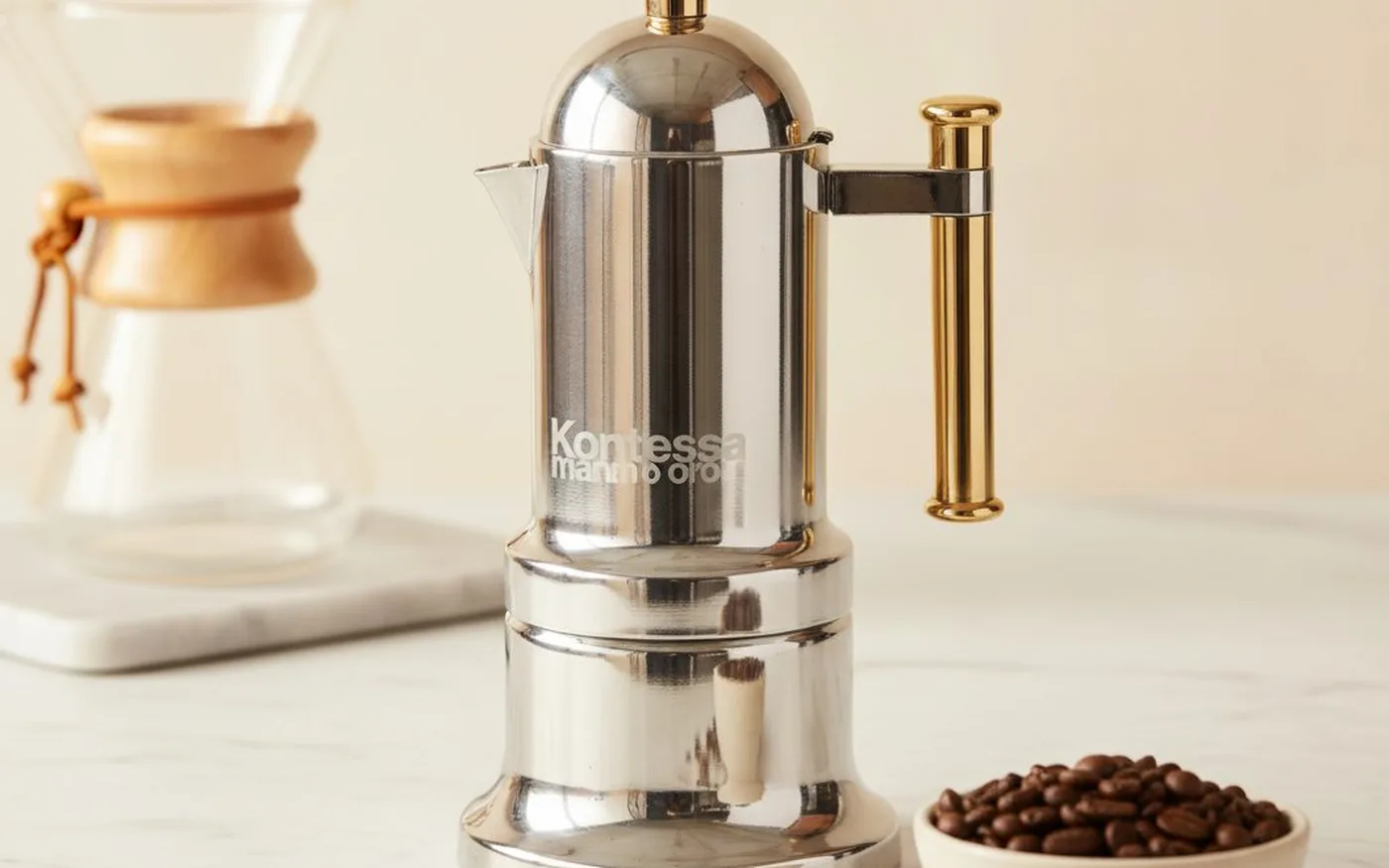
8. Vev Vigano Kontessa Gold - Best Premium Aluminium
Specs: Anodised aluminium | 2/4/6/10 cup | Gas and electric only (not induction) | £85 (6-cup, as of June 2026)
Bare aluminium gets the heat fast and the cost low. Anodised aluminium does both of those things and then stays presentable for years without staining or corroding - that is the gap the Kontessa fills. The exterior is significantly more resistant to the daily wear of a working kitchen than any untreated aluminium pot in this test, and the design language is deliberately refined: taller and more slender than the Bialetti form, with a flow-through handle design that keeps the hand further from the body heat.
At £85 for a 6-cup aluminium pot that does not work on induction, the Kontessa is harder to recommend in purely functional terms. The Bialetti Moka Express at £30 produces coffee of comparable quality. You are paying for materials finish and design identity.
If those things matter to you, the Kontessa delivers them. The anodised finish holds up better to daily use than any bare aluminium pot in this test, and the brew it produces is consistently excellent. The flavour profile sits close to the Moka Express - rich, full, with good heat carry into the cup.
Pros: Anodised finish significantly more durable than bare aluminium. Distinctive, refined design that sits well on premium kitchen counters. Consistent brew quality across the full test period. Taller, slimmer profile compared to the octagonal Bialetti form.
Cons: £85 for an aluminium pot with no induction compatibility is a significant premium. The extraction result is not meaningfully better than the Bialetti Moka Express at £30. Less widely stocked in UK than other brands in this roundup.
Best for: Design-led buyers on gas or electric hobs who want premium aluminium with a durable finish, and who understand the premium is for aesthetics and materials, not extraction advantage.
“The Kontessa earns its premium on materials and design, not on extraction improvement. Understand that distinction and it is an excellent purchase.”
| Evaluation Criteria | Our Findings |
|---|---|
| Full review | Vev Vigano Kontessa Gold |
| Best for | Design-conscious buyers who prefer the extraction characteristics of aluminium and want a premium finish |
| Flagship product | Kontessa Gold 6-cup (£85) |
| Shop | Search on Amazon |
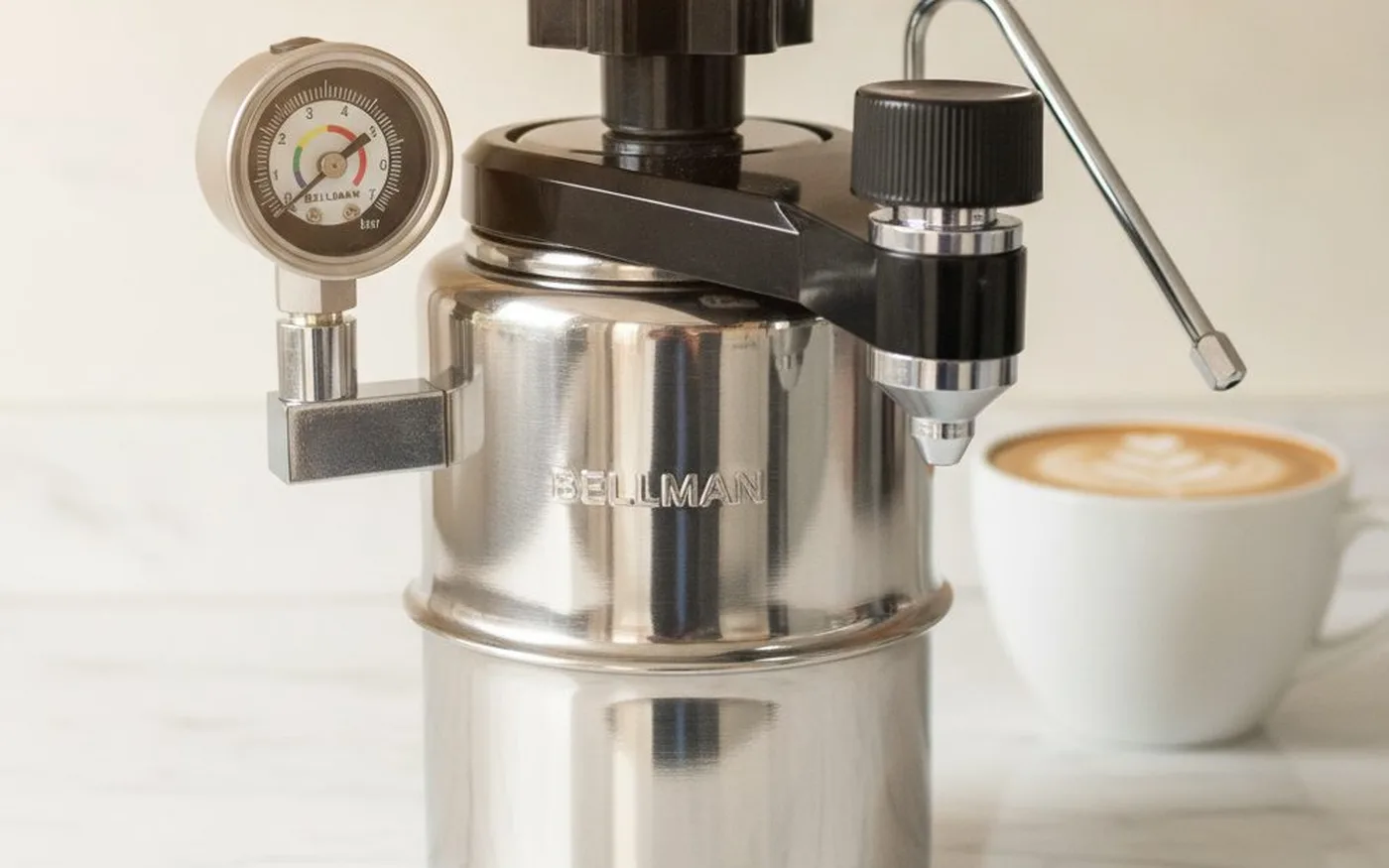
9. Bellman CX-25P - Best for True Espresso-Style Pressure
Specs: Stainless steel | 9 cup (370ml) | All hobs including induction | £180 (as of June 2026)
Two bar of pressure. That is what separates the Bellman from everything else in this list - and from the 1 to 1.5 bar that a standard moka pot produces. This is not a moka pot in the traditional sense: it is a stovetop pressure brewer with a built-in pressure gauge and an optional steam wand attachment, built for brewers who have already maxed out what conventional stovetop hardware can do. That is still not espresso (which requires 9 bar), but it is the closest a stovetop brewer gets.
What this produces in the cup is a richer, denser extraction with better body and, with the right technique, a more pronounced crema-like layer than the Brikka. The pressure gauge is genuinely useful - once you learn the sweet spot for your bean and grind, you dial in the heat to hold the needle there and produce consistent results. That level of control is not available on any other stovetop brewer.
The trade-offs are significant. At £180, it costs more than several entry-level espresso machines. It only comes in a 9-cup (370ml) size - there is no smaller option. Setup and cleanup are meaningfully more involved than a standard moka pot. And the learning curve is steeper than any other pot in this roundup.
If you are a serious home coffee enthusiast who has maxed out what a standard moka pot can do, the Bellman is the next logical step before committing to a full espresso machine. For everyone else, it is overkill.
Pros: Built-in pressure gauge for repeatable, consistent extraction. Closest a stovetop brewer comes to espresso pressure (2 bar). Full induction compatibility. Optional steam wand for milk texturing. Stainless steel construction with excellent build quality.
Cons: £180 is expensive for a moka pot alternative - approaches entry-level espresso machine territory. Only available in 9-cup size - no smaller option for solo brewing. Setup and cleaning is significantly more involved than a standard moka pot. Steep learning curve - takes 8 to 10 brews to dial in consistently.
Best for: Experienced stovetop brewers who have reached the ceiling of standard moka pot extraction and want maximum pressure and control before buying a dedicated espresso machine.
“The Bellman sits at the boundary between moka pot and espresso machine. It rewards patience and technique. It is not for beginners.”
| Evaluation Criteria | Our Findings |
|---|---|
| Full review | Bellman CX-25P |
| Best for | Experienced home brewers who want maximum pressure from a stovetop brewer before stepping up to a dedicated espresso machine |
| Flagship product | CX-25P Stovetop Espresso Maker (£180) |
| Shop | Buy via Espresso Outlet |
Best Moka Pot for Induction Hobs
Three pots in this roundup work on induction: the Bialetti Venus, the Cuisinox Roma, and the Bellman CX-25P. All three are stainless steel - induction cooking requires a ferromagnetic base material, and aluminium does not qualify.
If your only priority is induction compatibility and you do not want to spend above £60, the Bialetti Venus at from around £40-£45 is the straightforward pick. It is made by the most trusted name in stovetop brewing, the build quality is reliable, and it produces excellent coffee.
If you want better build finishing and a rounder, less edged flavour profile, the Cuisinox Roma at £75 is the step up worth considering. The stay-cool handle and the polished stainless interior justify the premium over the Venus.
If you are an experienced brewer and want the highest pressure possible from a stovetop format, the Bellman CX-25P at £180 is the only serious choice on induction.
One thing to check before buying: not all induction hobs work identically with small-base pots. Moka pots - especially the 1-cup and 2-cup sizes - can fall below the minimum base diameter recognised by some induction hobs. If you have a sensitive induction unit, test with a 3-cup or larger pot first, or check your hob's minimum base diameter requirement.
The best espresso machines on the market - for anyone who decides stovetop brewing is a stepping stone rather than the destination - are covered in our espresso machines comparison.
Stainless Steel vs Aluminium Moka Pots
The material debate comes up every time someone asks about moka pots, and the answer is simpler than the forums make it seem.
Aluminium: Faster heat transfer, faster brew time (4 to 5 minutes on gas), more pronounced and forward flavour - some people experience a metallic edge in the first few brews before the pot seasons. Requires hand washing. Not induction compatible. Typically £10 to £30 less than stainless steel equivalents.
Stainless steel: Slower to heat (6 to 7 minutes on induction), cleaner flavour with no break-in required, dishwasher-compatible (top rack), and induction-ready. The price premium is real - expect to pay £20 to £40 more for a comparable stainless steel pot.
The concern about aluminium safety is worth addressing directly. The Food Standards Agency regulates food contact materials in the UK, and aluminium cookware at the temperatures used in moka pot brewing is considered safe under UK food contact material regulations. The scientific consensus on dietary aluminium exposure from cookware at typical brewing temperatures does not support the level of concern you will encounter on coffee forums. If you have specific health reasons to avoid aluminium - and some people do - stainless steel is the right choice. For everyone else, the material decision comes down to hob type, budget, and preference.
What Size Moka Pot Should You Buy
Moka pot sizing uses Italian espresso 'cups' of approximately 60ml each. That is not the same as a standard UK mug.
| Moka Pot Size | Volume (ml) | Real-World Yield |
|---|---|---|
| 1-cup | 60ml | One short espresso-length coffee |
| 2-cup | 120ml | One standard mug, made strong |
| 3-cup | 180ml | Two small mugs or one large one |
| 6-cup | 300ml | Two to three standard mugs |
| 9-cup | 540ml | Three to four standard mugs |
| 12-cup | 720ml | Four to six standard mugs |
One rule that matters: fill a moka pot to its designed capacity, or close to it. A 6-cup pot filled with enough coffee for 3 cups will not brew correctly. The pressure system is calibrated for the full fill level. If you regularly brew for one person, buy a 1 or 2-cup pot - do not half-fill a 6-cup.
For a single person who drinks two to three cups per session, a 3-cup gives the right yield. For a household of two, the 6-cup is the practical standard.
How to Spot a Fake Bialetti
Counterfeit Bialetti Moka Express pots are sold on Amazon and through third-party marketplace sellers. This is documented and ongoing - Bialetti has pursued legal action in multiple jurisdictions. The counterfeits look almost identical in photographs but produce inconsistent extraction and have gasket seal problems that result in the classic failure modes: coffee spurting from the valve, metallic taste that does not resolve after seasoning, uneven extraction.
How to confirm you are buying genuine:
- Buy from an authorised retailer. In the UK: John Lewis, Lakeland, Sage (for Bialetti-compatible accessories), or Amazon sold and dispatched by Amazon directly (not third-party marketplace sellers). If the listing says "Ships from and sold by [third party]" rather than Amazon itself, verify the seller.
- Check the base. Genuine Bialetti pots have "Made in Italy" stamped on the base. Fakes often say "Made in China" or have no origin stamp.
- Check the logo. The Bialetti 'Omino' (the little man with a raised finger) should be clean and raised, not flat or blurry. On fakes, the detail is often shallow or poorly defined.
- Check the threading. Genuine Bialetti has tight, uniform threads. Loose or uneven threading is a counterfeit indicator.
- The price. A genuine 6-cup Bialetti Moka Express retails at £28 to £35. If you see it at £12 or £15, it is not genuine.
Best Coffee to Use in a Moka Pot
Moka pot brewing rewards a medium to dark roast, ground to medium-fine - finer than cafetiere, coarser than espresso. Light roasts work but tend to produce a sour, under-extracted cup because the lower-pressure system cannot extract the same complexity from a high-acid light roast that a proper espresso machine can.
The specific coffee I use in my testing is Aurora Single Origin from Balance Coffee - a low-acid, washed Brazilian with chocolate and almond notes. The low acidity suits the moka pot format well: the concentrated extraction amplifies what is in the bean, and a low-acid bean produces a richer, smoother cup without the sharp edges you can get with higher-acid Central American or Ethiopian beans.
If you want to try it: the Aurora Single Origin is available with a 20% exclusive discount for Balance Journal readers. Order whole bean and grind fresh - the difference between pre-ground and freshly ground at the medium-fine setting is the single biggest quality lever in moka pot brewing.
Full guide: best coffee beans for moka pot brewing.
How to Use a Moka Pot
A full technique guide is available at our dedicated how to use a moka pot guide. The short version:
- Fill the lower chamber with cold, filtered water to just below the pressure valve
- Add ground coffee to the filter basket - level, not tamped
- Screw the upper and lower chambers together firmly
- Heat on low to medium heat - do not rush it
- Remove from heat the moment you hear the gurgle transition from a low bubble to a higher-pitched splutter (this is the steam pushing through, which produces a harsher extraction)
- Run the base under cold water briefly to stop extraction, then pour immediately
The most common mistake is too much heat. High heat pushes the coffee through too quickly and produces the bitter, burnt notes that give moka pot coffee a bad reputation. Low and slow is the right approach.
Moka Pot Care, Cleaning, and Gasket Replacement
A moka pot will last decades if you maintain the three key components: the gasket, the filter plate, and the body seal.
After every brew:
- Disassemble and rinse in warm water - no soap, which strips the seasoning from aluminium pots
- Dry thoroughly before reassembling - moisture in the chamber causes corrosion in aluminium models
- Leave the lid open to air the chambers between uses
Gasket replacement: The rubber (or silicone) gasket is the most important replaceable part. When your pot starts to drip from the seal between the chambers during brewing, the gasket is failing. On a Bialetti Express used daily, expect to replace the gasket every 12 to 18 months. Signs it needs replacing: visible cracking, hardening, or shrinkage, or any sign of steam or coffee escaping from the chamber join.
Bialetti gaskets are widely available (Lakeland, Amazon, John Lewis) and cost around £3 to £5 for a set of three. For Pedrini and Vev Vigano, order directly from the manufacturer or search Amazon with the pot model and size.
Filter plate: The perforated filter plate sits above the lower chamber. Over time, the holes can become blocked with coffee oils. Soak in warm water and clean with a soft brush monthly if you brew daily. Replace if the holes cannot be cleared - a blocked filter produces uneven extraction and variable pressure.
Descaling: If you live in a hard water area, calcium deposits can build up inside the lower chamber over time. Descale every 3 to 6 months with a solution of equal parts water and white vinegar - fill the chamber, leave for an hour, rinse thoroughly, and run two discard brews before using again for coffee.
Full Moka Pot Comparison Table
| Model | Material | Induction | Sizes | UK Price (Jun 2026) | Evidence Score |
|---|---|---|---|---|---|
| Bialetti Moka Express | Aluminium | No | 1/3/6/9/12 cup | £30 (6-cup) | 9.5 |
| Bialetti Venus | Stainless steel | Yes | 2/4/6/10 cup | from around £40-£45 (6-cup) | 9.0 |
| Bialetti Brikka | Aluminium | No | 2/4 cup | £45 (4-cup) | 8.8 |
| Alessi 9090 | Stainless steel | Yes | 3/6/10 cup | £150 (3-cup) | 8.7 |
| Cuisinox Roma | Stainless steel | Yes | 4/6/10 cup | £75 (6-cup) | 8.5 |
| Grosche Milano | Aluminium | No | 1/3/6/9/12 cup | £25 (6-cup) | 8.0 |
| Pedrini Kaffettiera | Aluminium | No | 1/3/6/9 cup | £22 (6-cup) | 7.8 |
| Vev Vigano Kontessa Gold | Anodised aluminium | No | 2/4/6/10 cup | £85 (6-cup) | 7.5 |
| Bellman CX-25P | Stainless steel | Yes | 9 cup only | £180 | 7.2 |
What to Avoid: Moka Pots That Failed Our Tests
Not every pot we tested made this roundup. The category below £15 on Amazon is heavily populated with unbranded aluminium pots that fail the basic quality checks: uneven threading that does not seal correctly, thin aluminium that warps on high heat, and gaskets that harden and crack within three months of regular use.
The failure modes follow a consistent pattern: coffee leaks from the chamber join during brewing (failed gasket or threading), bitter and metallic taste that does not resolve with seasoning (inferior aluminium), and inconsistent extraction where the coffee runs through unevenly (warped filter plate or blocked holes).
The diagnostic: if a moka pot does not have a named manufacturer, a country of manufacture stamped on the base, and replacement parts available to order, you are buying a disposable item that will cost you more in replacements than buying the Bialetti Express once.
Final Verdict
The Bialetti Moka Express at £30 is the straightforward answer for most UK buyers with a gas or electric hob. Seven years of daily use tells me nothing breaks this pot when you treat it correctly, and the coffee it produces is as good as any stovetop brewer in this test.
If you have induction, the Bialetti Venus is the logical choice. If you want crema and brew for one or two people, add £15 to the Express price and get the Brikka. If you want premium stainless steel without Alessi pricing, the Cuisinox Roma at £75 is the value pick.
The Bellman CX-25P is for experienced home brewers who want to push stovetop extraction as far as it goes before crossing into dedicated espresso machine territory. For a broader look at where moka pots sit in the home coffee equipment landscape - alongside filter machines, cafetieres, and pour over coffee makers - see our complete guide to coffee machines.
If you are choosing a grinder to pair with your moka pot, the best manual coffee grinder guide covers the options at every price point - the right grind setting is the single biggest quality lever in stovetop brewing.
For anyone interested in the best coffee beans uk to pair with your new pot, we have ranked and tasted the leading UK roasters in a dedicated roundup.
Frequently Asked Questions
What is the best moka pot to buy in 2026?
Are Bialetti moka pots worth the money?
Which moka pots work on induction hobs?
Is stainless steel or aluminium better for a moka pot?
How do I know if my Bialetti is a fake?
What size moka pot should I buy for one person?
How long does a moka pot last?
Can you put a moka pot in the dishwasher?
What is the best moka pot for a beginner?
Why does my moka pot coffee taste bitter?
A wellness entrepreneur and biohacker, James explores the intersection of hospitality and health - from clean fuel and recovery tools to mindful routines that build balance into daily life.