Aroy-D Coconut Milk Review: Is It Actually Good for Coffee?
Aroy-D coconut milk reviewed by a Nutritional Therapist: ingredients, E435 emulsifier truth, coffee performance, format comparison and UK prices.
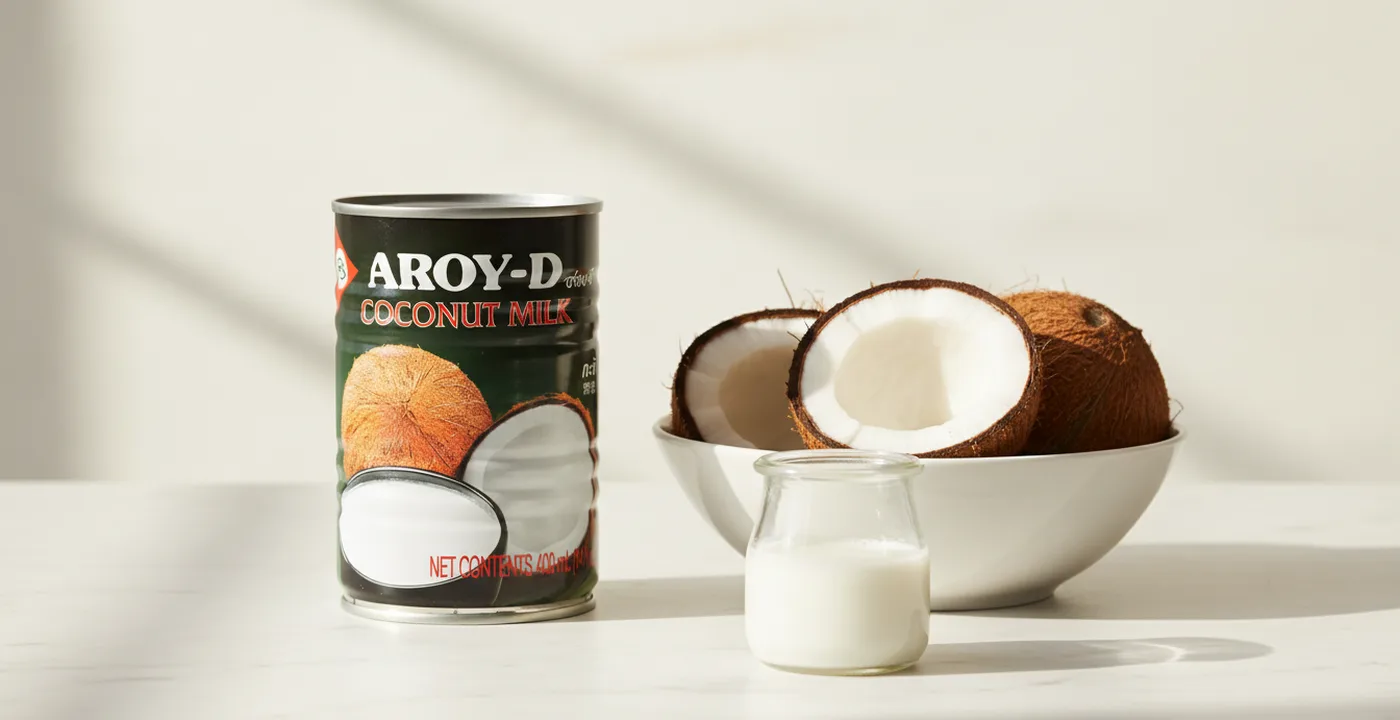
Table of Contents
Some of the links in this article are affiliate links, which help fund our independent review work at no extra cost to you. Every recommendation is based on hands-on testing through The Editor Lab methodology. No brand pays to appear, and no placement is guaranteed.
Aroy-D coconut milk works in iced coffee and filter coffee without modification, and in hot espresso when warmed and whisked first - but it will not microfoam and is not fortified.
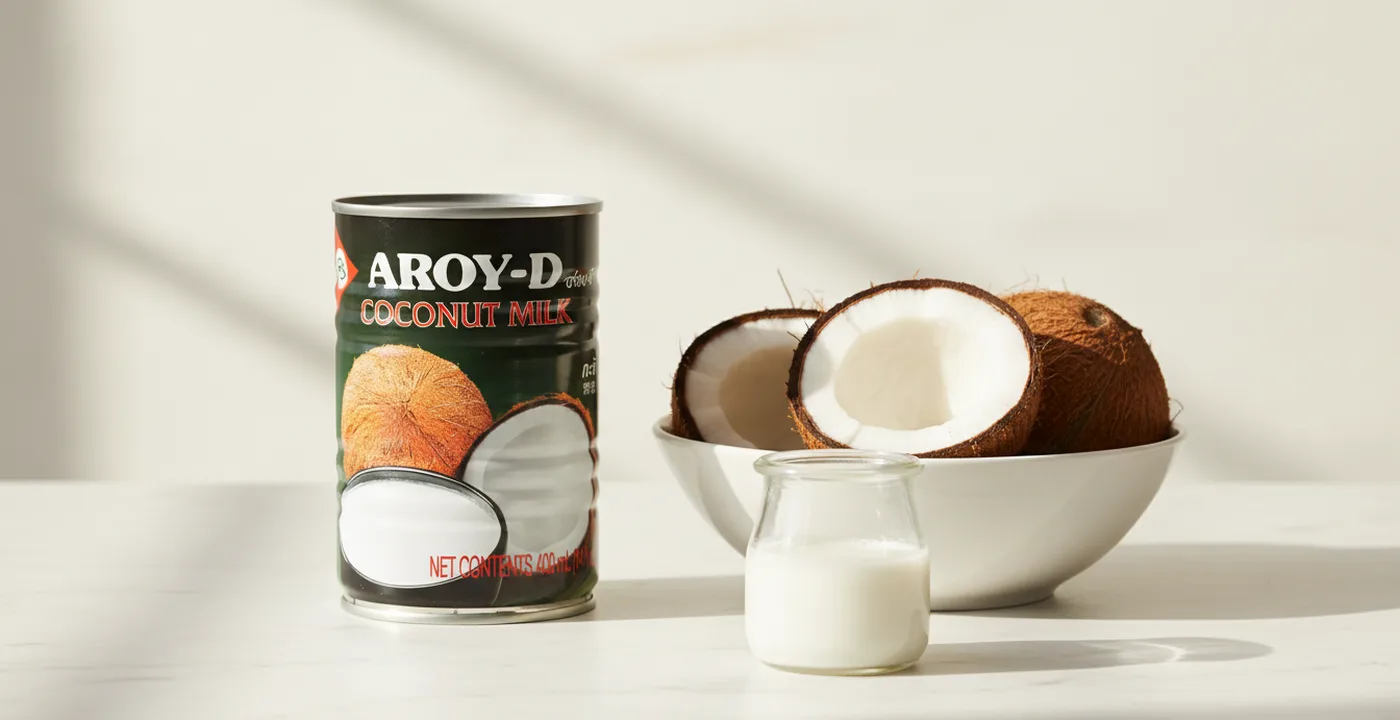
The label says "coconut extract and water." The online forums ask whether that is "too good to be true." And any buyer who has cooked with Aroy-D coconut milk and then tried it in coffee knows they are dealing with something richer, fattier, and less predictable than a barista oat carton.
I reviewed Aroy-D’s three UK-available formats - the 400ml can, the 1L UHT carton, and the "Lite" variant - against their current UK ingredient labels for The Editor Lab. The question I wanted to answer was not "is this good coconut milk?" (it clearly is, by cooking standards). It was whether it earns a place in coffee, and whether the near-pure-coconut marketing holds up when you look at what is actually in each format.
I hold a Diploma in Nutritional Therapy from the College of Naturopathic Medicine, am a registered member of BANT, and have run nutrition clinics at The Kyros Project with Google DeepMind and at The Wellness Clinic at Harrods. My interest here is ingredient integrity and nutritional reality, not brand enthusiasm.
What Is Aroy-D?
Aroy-D is a Thai brand produced by Thai Agri Foods Public Company Limited, a Bangkok-listed food manufacturer that has been supplying coconut products to the global market since the 1990s. The name is sometimes written "Aroy-D" and sometimes "Aroy D" without the hyphen in UK retail listings - both refer to the same brand.
In the UK, Aroy-D is distributed widely through Asian grocery retailers (Longdan, Tradewinds Oriental Shop, Thai Food Direct), mainstream supermarkets (Sainsbury’s and Morrisons stock it as of July 2026), and Amazon. It is not a boutique or specialist-only product.
The brand’s core claim - that it contains very few ingredients beyond coconut - is broadly accurate, though the detail matters. E435 (Polysorbate 60) appears across multiple UK retail formats, which I will cover in the Ingredients section below.
Aroy-D’s product range available in the UK includes:
- 400ml can (standard coconut milk, the format most buyers know from cooking)
- 1L UHT carton (long-life format, suited to bulk buying and fridge storage once opened)
- Lite variant (lower fat, available in can and some carton formats - thinner texture, significantly less saturated fat)
- Coconut cream (higher fat concentration than the standard milk - not reviewed here for coffee use, as it is not suitable as a direct coffee milk substitute)
Is Aroy-D Good Coconut Milk? Our Verdict
For cooking, Aroy-D is excellent. The fat content in the standard 400ml can is high enough to give curries, soups, and rice dishes genuine body. The ingredient list is short. The price-per-litre is competitive, particularly when bought by the case.
For coffee, the answer is conditional. Aroy-D works well in cold-brew, iced coffee, and filter coffee where fat integration is gentler. In a fast-pulled hot espresso, the very high fat content (19g fat / 17g saturated per 100g on the standard can) creates a meaningful risk of the milk turning oily or separating - particularly if poured cold into a hot shot without warming or whisking first.
It is also worth being clear about what Aroy-D is not: it is not fortified. There is no added calcium, no vitamin D, no B12, no iodine. A barista oat or almond milk is a nutritional substitute for dairy in ways that Aroy-D is not. If your reason for switching milks is nutritional equivalence with dairy, Aroy-D does not deliver that. If your reason is flavour, fat richness, and a short ingredient list, it delivers both - with caveats around format and preparation.
Ingredients: What Is Really in the Tin vs the Carton?
The short answer: E435 appears across multiple Aroy-D formats in the UK, and the can-vs-carton split is less clean than the marketing sometimes implies.
Standard 400ml can (UK, as listed by Sainsbury’s, Tradewinds Oriental Shop, and Longdan, July 2026):
Coconut Extract (70%), Water, Emulsifier (E435)
1L UHT carton (UK, as listed on Amazon UK and OpenFoodFacts barcode 8851613101392, July 2026):
Coconut Extract (70%), Water, Emulsifier (E435)
Lite variant (UK can, as listed on selected retailer PDPs, July 2026):
Coconut Extract (40%), Water, Emulsifier (E435)
E435 - Polysorbate 60 - is present across the standard can, the 1L UHT carton, and the Lite variant in UK retail. Amazon UK lists the 1L carton under the description "Aroy-D coconut milk 12 x 1L (with E435)," and OpenFoodFacts barcode 8851613101392 confirms E435 in the 1L product. The earlier suggestion that the carton was E435-free does not hold across verified UK sources - the variation appears to be between UK retail lots and possibly production batches, not reliably between format types.
E435 (Polysorbate 60) is approved for use in food in the UK and EU. The EFSA issued a scientific opinion on the re-evaluation of polysorbates (E432-E436) in 2015, establishing an Acceptable Daily Intake of 25mg/kg body weight/day for the group - a level that is not realistically approached through normal dietary use of tinned coconut milk. For most people, the presence of E435 is not a meaningful health concern.
What it is, however, is a relevant fact for buyers who specifically sought out Aroy-D because they believed it contained "no undisclosed ingredients." The emulsifier is disclosed on the UK label - it is in the ingredients list - but it is not prominently foregrounded in the brand’s wider marketing. If ingredient purity is your reason for choosing Aroy-D over a conventional supermarket coconut milk that also contains E435, you are not necessarily gaining an advantage across any format.
The 1L UHT carton remains the more practical format for coffee use - it stores in the fridge, pours easily, and reduces waste compared to opening a tin that then needs to be decanted - but the choice between formats is not a meaningful E435 trade-off.
Batch-to-batch variation is a real consideration. Aroy-D sources its coconut from Thailand, Vietnam, and Indonesia depending on supply, and forum discussion (Bulletproof Engage, eGullet) consistently notes that thickness and fat separation vary between cans from different production runs. This is not unique to Aroy-D - it reflects the agricultural nature of the ingredient - but it does mean "never separates" is not a reliable statement across all cans.
Can You Use Aroy-D Coconut Milk in Coffee?
Yes - but the format and method matter considerably.
The core challenge is that Aroy-D’s standard canned coconut milk is designed for cooking applications where fat integration happens over heat and stirring. In a coffee context, especially with hot espresso, the same fat that makes curries creamy can separate into visible oil droplets if poured cold into a hot cup without preparation.
In espresso: The standard canned format poured cold directly onto a fresh espresso shot will frequently split or turn oily, particularly with a fast, dark-roast pull. The fix is straightforward: warm the coconut milk gently first and whisk briefly before adding. Given its fat content, warmed and whisked canned Aroy-D makes a richer espresso drink, closer to a keto-style coffee than a conventional flat white. It will not microfoam the way a barista oat milk does - the protein content (approximately 1-2g per 100ml depending on format) is too low for meaningful foam structure.
In filter coffee: The standard can performs better here. Filter coffee’s lower temperature and the slower pour allow for more natural fat integration. Forum discussion describes a splash of Aroy-D in a filter brew as adding richness and a mild coconut note.
In iced coffee or cold brew: This is where Aroy-D genuinely earns its place in the coffee context. The fat does not separate when added cold to a cold drink, and coconut richness with mild sweetness is a common pairing for cold brew. If you drink iced coffee regularly, a can in the fridge is a straightforward upgrade over a commercial oat milk for flavour, provided you are not looking for protein fortification.
The 1L UHT carton in coffee: The carton format tends to be thinner in texture than the can, as the UHT process changes the fat structure. It integrates more smoothly in hot drinks as a result, though the richness is reduced. For regular daily coffee use where you are not after a coconut-flavoured fat bomb, the carton is the more practical format.
The Lite variant in coffee: Lower fat (roughly 7-8g per 100ml vs 19g for standard), fewer calories, and less saturated fat. With less than half the fat, the trade-off is a thinner result with less flavour presence. For buyers managing saturated fat intake, it is a reasonable middle ground, but it will not deliver the richness that makes the standard can interesting as a coffee ingredient.
One honest note on the Bulletproof / keto-adjacent context: a 200ml serving of full-fat canned Aroy-D delivers significant fat (roughly 38g), but it is not a direct substitute for a concentrated MCT oil supplement. MCT oil is fractionated and concentrated for rapid metabolic use. Coconut milk fat includes long-chain saturated fats as well as medium-chain triglycerides, and the nutritional impact of a two-tablespoon splash is different from a dedicated MCT dose. The two products are not equivalent, and using Aroy-D as a keto fat source in coffee is a valid choice without needing to overstate the MCT angle.
Aroy-D vs Supermarket Own-Brand vs Barista Alt-Milks
The comparison depends heavily on what you are optimising for. Three different buyer types, three different verdicts.
| Aroy-D Standard (400ml can) | Supermarket Own-Label Coconut Milk | Oatly Barista / Alpro Barista | |
|---|---|---|---|
| Ingredient list | Coconut extract (70%), water, E435 | Varies; typically coconut extract, water, stabilisers | Oat base, rapeseed oil, vitamins/minerals |
| Fat per 100ml | 19g (17g saturated) | 12-18g depending on brand | 3g (0.5g saturated) |
| Microfoam quality | Poor - low protein, fat separates | Poor - same limitation | Excellent - formulated for steaming |
| Fortification | None | None (usually) | Yes - calcium, B vitamins, iodine |
| Price per litre | From around £3.10 (single 400ml can) | From around £1.30-£2.00 per litre | Around £1.60-£1.80 per litre |
| Best use case | Cooking, iced coffee, filter coffee | Cooking | Hot espresso drinks, lattes, flat whites |
The important price nuance: a single 400ml can of Aroy-D at supermarket prices (Sainsbury’s lists it at around £1.55 as of July 2026, which is around £3.87 per litre equivalent) is not cheaper than a 1L Oatly Barista carton. The cost advantage emerges when buying cases - the 1L UHT carton format from Asian wholesale retailers can bring the price down to around £1.50-£1.80 per litre, at which point it becomes genuinely competitive.
Against supermarket own-label coconut milk: The differentiation is mainly in fat percentage, ingredient list brevity, and consistency of quality. Supermarket own-label coconut milks often contain a longer stabiliser list than Aroy-D. If you cook Southeast Asian food regularly and want a consistent quality ingredient at reasonable price, Aroy-D is the stronger choice.
Against a barista oat or almond milk: The products are not competing on the same terms. A fortified barista milk like Oatly Barista or Alpro Barista is engineered to steam, foam, and integrate with hot espresso - and it provides calcium, B12, and other nutrients absent from coconut milk. Aroy-D is a whole-food coconut milk that happens to work in some coffee applications. Choose between them based on what you are making and what nutritional profile matters to you.
Nutrition Breakdown
Per 100ml of standard Aroy-D canned coconut milk (based on UK product label data, July 2026):
| Nutrient | Per 100ml |
|---|---|
| Energy | Approximately 197 kcal |
| Fat | 19g |
| of which saturated | 17g |
| Carbohydrate | 2.7g |
| of which sugars | 2.7g |
| Protein | 1.7g |
| Salt | Trace |
| Calcium | Not listed |
| Vitamin D | Not listed |
| B12 | Not listed |
The NHS guidance on dairy alternatives notes that plant-based drinks vary significantly in their nutritional content, and that those not fortified with calcium and vitamin D may not provide the same benefits as dairy or fortified alternatives. The British Dietetic Association’s guidance on plant-based drinks similarly emphasises that unfortified options leave nutritional gaps compared to dairy - particularly around calcium, iodine, and vitamin B12 - and recommends choosing fortified versions where possible.
This is not a criticism of Aroy-D specifically: it is a whole food ingredient, not a formulated dairy substitute, and it should not be assessed as though it were competing with a Oatly Barista carton on nutritional grounds. The relevant comparison is with dairy coconut milk in a cooking or culinary context, where Aroy-D performs well.
The fortification gap is simply the honest nutritional picture. If you are relying on a plant-based milk as a significant source of calcium or B vitamins, Aroy-D is not the right choice. If you are using it as an occasional enrichment in coffee or a cooking ingredient, the nutritional picture is fine.
Where to Buy Aroy-D in the UK (+ Price Per Litre)
From £1.24 at Morrisons to £1.80 for the 1L carton - here is where to find Aroy-D in the UK. Prices current as of July 2026 based on live retailer listings.
| Retailer | Format | Price | Price per litre equivalent |
|---|---|---|---|
| Sainsbury’s | 400ml can | Around £1.55 | Around £3.87 |
| Morrisons | 400ml can | Around £1.24 | Around £3.10 |
| Tradewinds Oriental Shop | 400ml can | Around £1.40 | Around £3.50 |
| Thai Food Direct | 1L UHT carton | Around £1.80 | Around £1.80 |
| Longdan | 400ml can (case of 12) | Around £14.00 (case) | Around £2.92 |
| Amazon UK | 400ml can, 400ml Lite, 1L UHT | Varies (check current listing) | View on Amazon |
The case-buying point matters here. The price-per-litre from a supermarket single tin is not competitive with a 1L Oatly Barista carton. Bought by the case from an Asian grocer (Longdan, Tradewinds) or via Amazon, the price per litre drops to a range where it is cost-neutral or cheaper than barista oat milks, with a significantly richer product.
Format recommendation by use case:
- Coffee (daily hot drinks): 1L UHT carton. Easier to pour, thinner texture integrates better, and reduces the waste of opening cans daily.
- Coffee (occasional, iced): 400ml standard can. Richer, more flavour impact when used in small quantities in cold drinks.
- Cooking: 400ml standard can or Lite depending on fat preference. Standard gives the richest result for curries and soups.
The Balance Journal Verdict
The verdict splits by use case. Aroy-D is a genuinely good product that is often misused by buyers who expect it to behave like a barista milk. In cooking, it is excellent: short ingredient list, consistent fat content, and a price point that becomes competitive when bought by the case.
For coffee, the 1L UHT carton is the practical format for regular use. The standard 400ml can works in iced coffee and filter coffee but requires preparation (warming, whisking) before use in hot espresso to avoid splitting. The Lite variant exists for fat-conscious buyers but sacrifices most of the flavour advantage.
The emulsifier reality is worth stating plainly: E435 is present across Aroy-D’s UK formats - both the canned and carton versions list it, with variation appearing between UK retail lots and production batches rather than reliably between format types. It is approved and not a meaningful health concern at dietary doses, but buyers who chose Aroy-D specifically believing there were "no undisclosed ingredients" should know it is there across all formats.
Aroy-D is part of the broader best alternative milk for coffee landscape, and within that landscape it occupies a distinctive niche: a whole-food coconut milk that earns its place in coffee when used correctly, rather than a milk engineered for the espresso bar.
If you are looking at wider alternatives in this cluster, Oatly and Alpro offer fortified barista milks that steam and foam reliably, and Sproud provides a high-protein pea milk option for a different nutritional angle. These are pending dedicated reviews.
Pairs well with: If you drink Aroy-D coconut milk in your espresso or iced coffee, the roast profile matters. Coconut milk’s natural sweetness and fat richness work best against a medium-dark roast with chocolate and stone-fruit notes rather than a bright, acidic light roast. Rotate Espresso from Balance Coffee - a single-origin Mexico 100% Arabica with dark chocolate and cranberry notes, roasted medium-dark - pairs naturally with the sweetness of coconut milk fat. Balance Coffee is the company founded by James Bellis, who reviewed this article.
Frequently Asked Questions
What is the best coconut milk in the market?
Aroy-D is one of the strongest tinned coconut milks in the UK for buyers who want a short ingredient list and high fat content. The 400ml can suits cooking and the 1L UHT carton suits coffee and everyday use. Whether it is the single "best" depends on whether you prioritise fat, purity, coffee performance or fortification.
Can I use Aroy-D coconut milk for coffee?
Yes, with preparation. The canned format works best warmed and whisked before it goes into hot espresso, or used as it is in iced and filter coffee. It will not microfoam like a barista oat or almond milk because its protein content is too low. It delivers fat-forward richness instead, and the 1L UHT carton suits daily use.
Is coconut milk actually healthy?
Coconut milk is a whole food with a high saturated fat content. The NHS notes that saturated fat intake should be monitored as part of your overall diet. It contains no fibre, minimal protein and, in Aroy-D’s case, no added vitamins or minerals, so it is not a fortified dairy alternative. In reasonable quantities it is a legitimate whole-food choice, not a health risk.
Is Aroy-D coconut milk thick?
The 400ml can is thick, more so than most supermarket own-label coconut milks, at approximately 17-19g fat per 100ml. The 1L UHT carton is thinner because of processing, and the Lite variant is thinner still. Thickness can also vary batch to batch depending on sourcing origin (Thailand, Vietnam or Indonesia).
What is the best coconut milk for coffee?
For hot espresso drinks, a barista coconut milk or a barista oat or almond milk will outperform Aroy-D on foam and integration. For iced coffee and cold brew, its full-fat canned version is genuinely competitive. The best coconut milk for coffee depends on the drink: the 1L UHT carton is a practical everyday option if you are not after microfoam.
What coconut milk do baristas use?
Professional coffee bars typically use barista-formulated coconut milks engineered to steam and foam, such as MINOR FIGURES, Koko and some Alpro variants. Standard cooking coconut milks like Aroy-D are not routinely used commercially because they do not produce stable microfoam, though some specialty bars and home baristas use them for iced drinks.
What are the ingredients in Aroy-D coconut milk?
The UK 400ml can lists coconut extract (70%), water and emulsifier (E435). The 1L UHT carton also lists E435 on an OpenFoodFacts listing (not a UK label). The Lite can lists coconut extract (40%), water and E435, which is Polysorbate 60. The EFSA evaluated polysorbates in 2015 and set an Acceptable Daily Intake of 25mg/kg body weight/day.
Is Aroy-D coconut milk good for coffee, or is it better kept for curries?
Both, in the right context. For curries, soups and rice dishes it is excellent, with a short label and consistent fat content. For coffee, the 1L UHT carton integrates more smoothly in hot drinks and the can works best iced. It is not a barista milk substitute and will not replicate the microfoam or nutrition of a fortified oat or almond barista milk.
Related Guides

A registered Nutritional Therapist and member of BANT, Clemmie blends science with a holistic approach to wellbeing.